


Ornitholestes

Encyclopedia
Ornitholestes was a small theropod dinosaur
of the late Jurassic
(middle Kimmeridgian
age, about 154 million years ago) of Western Laurasia
(the area that was to become North America). To date, it is known only from a single partial skeleton, and badly crushed skull found at the Bone Cabin Quarry near Medicine Bow
, Wyoming
, in 1900. It was described by Henry Fairfield Osborn
in 1903. An incomplete hand was later attributed to Ornitholestes, although it now appears to belong to Tanycolagreus
. The type
(and only known) species is O. hermanni. The species name honors the American Museum of Natural History
preparator Adam Hermann.
(eye sockets) were quite large, measuring over 25 percent of the skull's length. There is no indication of a bony eye ring
.
The front teeth of Ornitholestes were somewhat conical, with reduced serrations; back teeth were recurved and more sharply serrated, similar to those of other theropod dinosaurs. Henry Fairfield Osborn (1903) counted four teeth in the premaxilla
, of which the front tooth was the largest in the upper jaw. In contrast, Gregory S. Paul
(1988) reconstructed the skull with only three premaxillary teeth, much smaller than those illustrated by Osborn. Each maxilla
(main tooth-bearing bone in the upper jaw) contained 10 teeth, and each dentary (tooth-bearing bone in the lower jaw) contained 12 teeth. The tooth rows of Ornitholestes were short, with the dentary (lower) row being even shorter than the maxillary (upper) row. Teeth did not extend as far back as the orbits, and neither tooth row spanned much more than one-third of the skull.
An area of broken bone near the external naris (nostril) appears to bulge upward, which led Gregory S. Paul to suggest in Predatory Dinosaurs of the World (1988) that Ornitholestes had a nasal horn "rather like a chicken's comb in looks." Both Oliver W.M. Rauhut (2003) and Kenneth Carpenter et al. (2005a) rejected that interpretation, and indicated that the upward flare of bone was due to post-mortem crushing of the skull. Paul's updated illustration of Ornitholestes in his 2010 Princeton Field Guide to Dinosaurs no longer contains the nasal horn.
Ornitholestes had a relatively short neck with a slight sigmoidal (S-shaped) curve. The tail was long and whiplike, comprising over half of the body's length. Not all of the vertebrae were preserved, but Osborn (1917) estimated that Ornitholestes had nine or ten cervical (neck) vertebrae, 13 dorsal (back) vertebrae, four sacral (hip) vertebrae, and 39 to 44 caudal (tail) vertebrae. Carpenter et al. (2005a) recorded that the specimen contained five sacral vertebrae. Ornitholestes was a short-bodied theropod, and this was reflected in the short front-to-back dimensions of the cervical and dorsal vertebrae.
The forelimbs of Ornitholestes were relatively long, slightly under two-thirds the length of the hind legs. The humerus
(upper arm bone) was heavily built, and somewhat longer than the radius
and ulna
(forearm bones). Both the humerus and radius were straight-shafted. The claws on digits I and II of the hand were about the same size. Although the hand's third ungual (claw bone) was not preserved, extrapolation from the closest relatives of Ornitholestes indicates that it was probably shorter than the first two.
Ornitholestes is often portrayed as a fast, long-legged theropod, but its lower limb bones were fairly short. Osborn (1917) calculated that the tibia
(shin bone) was only about 70.6% as long as the femur
(thigh bone). The metatarsals
(foot bones) were spaced closely, but not fused together. As is typical of theropods, the feet were tridactyl (three-clawed). John H. Ostrom (1969) noted that the claw of digit II (the innermost toe) was larger than those of digits III and IV, and suggested that this digit may have borne a modified sickle claw similar to that of Deinonychus
. However, as both Ostrom (1969) and Paul (1988) noted, the poor preservation of digit II makes this hypothesis difficult to confirm.
In his 1903 description, Osborn wrote that the length of Ornitholestes along "the skull and vertebral column as restored" was 2.22 m (7.3 ft). However, this reconstruction was inaccurate, being based in part on Othniel Charles Marsh
's restoration of the basal
sauropodomorph
Anchisaurus
, and the neck and trunk were both too elongated. David Norman (1985) and John Foster (2007) both estimated that Ornitholestes was about 2 m (6.6 ft) long. Gregory S. Paul's 1988 Predatory Dinosaurs of the World listed the length of Ornitholestes as approximately 2.08 m (6.8 ft).
Paul (1988) and Foster (2007) both estimated that Ornitholestes weighed 12.6 kg (27.8 lb). John A. Long and Peter Schouten (2008) suggested a slightly higher figure, 15 kg (33.1 lb).
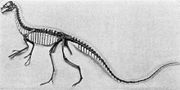 Ornitholestes was the first theropod to be discovered in the 20th century. The holotype
skeleton (AMNH 619) was excavated in 1900 at Bone Cabin Quarry
in Wyoming
by an American Museum of Natural History
expedition. Henry Fairfield Osborn named and scientifically described the specimen in 1903. The genus
name Ornitholestes, initially suggested by Theodore Gill
, means "bird robber" and is derived from the Greek
ὄρνις/ornithos ("bird") and λῃστήσ/lestes ("robber"). The species
name (O. hermanni) honors Adam Hermann, the head preparator at the Museum, who directed the restoration and mounting of the skeleton.
An incomplete hand (AMNH 587) was assigned to Ornitholestes by Osborn in his 1903 description of the genus. However, as Gregory S. Paul (1988) noted, the poor preservation of the corresponding elements in the type specimen made this association "tentative." In 2005, Kenneth Carpenter et al. described a new small theropod, Tanycolagreus
, whose skeleton was found in Bone Cabin Quarry only a few hundred yards from AMNH 587. Since AMNH 587 was virtually identical to the preserved hand of the Tanycolagreus type specimen, it is now considered to belong to that dinosaur and not to Ornitholestes. Following this reassignment, Phil Senter (2006) noted that "our knowledge of Ornitholestes can be drawn now only from the holotype." John Foster (2007) reported that some fragments from Dry Mesa Quarry
may belong to Ornitholestes, though these have not yet been described.
Coelurosauria
, coined in 1914 by Friedrich von Huene
, was traditionally a taxonomic wastebasket into which all small theropods were placed. Ornitholestes, due to its small size, was therefore generally classified as a coelurosaur. In 1986, Jacques Gauthier
redefined this and several other paleontological terms in a more rigorous fashion, based on cladistic
methods. Tetanurae
was defined as modern birds
and all theropods more closely related to modern birds than to ceratosaurs
, while Coelurosauria now comprised all members of Tetanurae more closely related to modern birds than to carnosaurs
. In 1988, Gregory S. Paul
suggested that Ornitholestes was very similar in skull structure to Proceratosaurus
, a Middle Jurassic theropod from England. He placed these two genera together in Ornitholestinae—a new subfamily under Allosauridae—and speculated that they were more closely related to the much larger Allosaurus
than to other small theropods. However, the classification of Ornitholestes and Proceratosaurus as allosaur relatives proved untenable (the latter has since proved to be a tyrannosauroid
), and Paul eventually abandoned it. All published cladistic analyses have shown Ornitholestes to be a coelurosaur as defined by Gauthier, and likely a primitive member of the advanced group Maniraptora
, though there is still disagreement regarding its exact position within this group.
, but none were found.
range. When flexed
(bent inward) at the elbow joint to the maximum possible extent, the humerus (upper arm bone) and radius (lower arm bone) formed a 53° angle. The ability of Ornitholestes to bend the forearm to an angle significantly more acute than 90° is characteristic of Maniraptoriformes, but absent in more primitive theropods such as Coelophysis
and Allosaurus.
Even when fully extended
(straightened) at the elbow, the forearm did not form a straight angle, falling short of this by 22°. Pronation
or supination
(twisting) of the forearm and hand was impossible, because the radius and ulna lacked rolling surfaces.
When Ornitholestes bent its elbows, this would cause the forearms to move inward, towards its midline. It may have used that ability to grasp prey with both hands simultaneously.
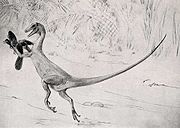 Henry Fairfield Osborn, in his 1903 description of Ornitholestes, noted its large and conical front teeth, the "rapid grasping power" of its hand, and the "balancing power" of its tail; these he interpreted as adaptations to prey on contemporary birds. Osborn later repudiated this hypothesis, but not before Charles R. Knight
had drawn an influential and widely-published illustration of Ornitholestes chasing Archaeopteryx. Knight's illustration, and others derived from it, continued to appear in dinosaur books aimed at a popular audience throughout the 20th century.
David Norman (1985) conceded it was "just possible, though not very likely" that Ornitholestes might have caught and eaten primitive birds. Most recent authors, however, have instead suggested a diet of small terrestrial vertebrates. Mammals, lizards, frogs, salamanders, rhynchocephalians
, and hatchling dinosaurs would all have been potential prey items. Gregory S. Paul (1988) thought that Ornitholestes might have used its conical front teeth to catch fish. Norman (1985) suggested that the robust skull and jaws might have allowed Ornitholestes to tackle "larger and more active prey" than other small theropods. In this vein, David Lambert (1993) speculated that Ornitholestes, if it was a pack hunter, might have been able to "take on ornithopod
s as big as a half-grown Camptosaurus
."
In 2007, John Foster, a specialist on the Morrison Formation, suggested the possibility of niche partitioning
between Ornitholestes and its contemporary Coelurus, which was within the same size range. He theorized that big-eyed Ornitholestes might have been specialized for nocturnal hunting, while Coelurus may have focused on those prey species that were active during the day. Foster noted, however, that this hypothesis was largely speculative; a lack of preserved skull material from Coelurus makes it impossible to verify whether its eyes were proportionally smaller than those of Ornitholestes.
Paul (1988) estimated that a 12 kg (26.5 lb) endotherm
ic Ornitholestes would have a daily dietary requirement of about 700 g (1.5 lb) of flesh.
hypothesized in 1944 that Ornitholestes might have borne feathers. However, this interpretation was largely disregarded for over half a century; most reconstructions of theropod dinosaurs, including Ornitholestes, portrayed them with reptile-like scaly skin. One of the few exceptions to this was Gregory S. Paul's Predatory Dinosaurs of the World (1988). Robert T. Bakker
's The Dinosaur Heresies
(1986) accurately predicted the presence of feathers on dromaeosaurids and contended that all dinosaurs were endothermic, yet did not incorporate feathers in its illustration of Ornitholestes.
In 1996, the primitive coelurosaur Sinosauropteryx
was discovered in China. The well-preserved fossil showed that this dinosaur bore a coat of rudimentary furlike feathers. As a result of this and other similar discoveries, most paleontologists now consider it likely that all coelurosaurs had insulating feathers of some kind, or were descended from ancestors that did. Based on its phylogenetic position, John Foster (2007) inferred that the feathers of Ornitholestes would probably have been more primitive than those of birds; they likely "would have covered the body except the legs in a short coat, perhaps with longer feathers lining the top of the skull or neck and the back edge of the forearms." Assuming they were present, these feathers would have been used for insulation, and possibly also for brooding eggs
.
Dinosaur
Dinosaurs are a diverse group of animals of the clade and superorder Dinosauria. They were the dominant terrestrial vertebrates for over 160 million years, from the late Triassic period until the end of the Cretaceous , when the Cretaceous–Paleogene extinction event led to the extinction of...
of the late Jurassic
Jurassic
The Jurassic is a geologic period and system that extends from about Mya to Mya, that is, from the end of the Triassic to the beginning of the Cretaceous. The Jurassic constitutes the middle period of the Mesozoic era, also known as the age of reptiles. The start of the period is marked by...
(middle Kimmeridgian
Kimmeridgian
In the geologic timescale, the Kimmeridgian is an age or stage in the Late or Upper Jurassic epoch or series. It spans the time between 155.7 ± 4 Ma and 150.8 ± 4 Ma . The Kimmeridgian follows the Oxfordian and precedes the Tithonian....
age, about 154 million years ago) of Western Laurasia
Laurasia
In paleogeography, Laurasia was the northernmost of two supercontinents that formed part of the Pangaea supercontinent from approximately...
(the area that was to become North America). To date, it is known only from a single partial skeleton, and badly crushed skull found at the Bone Cabin Quarry near Medicine Bow
Medicine Bow
Medicine Bow can refer to the following things:* Medicine Bow, Wyoming, a town in southeastern Wyoming* Medicine Bow Mountains, a mountain range in Colorado and Wyoming* Medicine Bow Peak, the highest peak of the Medicine Bow Mountains...
, Wyoming
Wyoming
Wyoming is a state in the mountain region of the Western United States. The western two thirds of the state is covered mostly with the mountain ranges and rangelands in the foothills of the Eastern Rocky Mountains, while the eastern third of the state is high elevation prairie known as the High...
, in 1900. It was described by Henry Fairfield Osborn
Henry Fairfield Osborn
Henry Fairfield Osborn, Sr. ForMemRS was an American geologist, paleontologist, and eugenicist.-Early life and career:...
in 1903. An incomplete hand was later attributed to Ornitholestes, although it now appears to belong to Tanycolagreus
Tanycolagreus
Tanycolagreus is a genus of coelurid theropod from the Late Jurassic of North America. The holotype is a partial skeleton recovered from the Bone Cabin Quarry West locality, Albany County, Wyoming, from the Morrison Formation...
. The type
Type species
In biological nomenclature, a type species is both a concept and a practical system which is used in the classification and nomenclature of animals and plants. The value of a "type species" lies in the fact that it makes clear what is meant by a particular genus name. A type species is the species...
(and only known) species is O. hermanni. The species name honors the American Museum of Natural History
American Museum of Natural History
The American Museum of Natural History , located on the Upper West Side of Manhattan in New York City, United States, is one of the largest and most celebrated museums in the world...
preparator Adam Hermann.
Description
Ornitholestes was a bipedal carnivore. Its head was proportionally smaller than that of most other predatory dinosaurs, but the skull was heavily built, with a short snout and robust lower jaw. The orbitsOrbit (anatomy)
In anatomy, the orbit is the cavity or socket of the skull in which the eye and its appendages are situated. "Orbit" can refer to the bony socket, or it can also be used to imply the contents...
(eye sockets) were quite large, measuring over 25 percent of the skull's length. There is no indication of a bony eye ring
Sclerotic ring
Sclerotic rings are rings of bone found in the eyes of several groups of vertebrate animals, except for mammals and crocodilians. They can be made up of single bones or small bones together. They are believed to have a role in supporting the eye, especially in animals whose eyes are not spherical,...
.
The front teeth of Ornitholestes were somewhat conical, with reduced serrations; back teeth were recurved and more sharply serrated, similar to those of other theropod dinosaurs. Henry Fairfield Osborn (1903) counted four teeth in the premaxilla
Premaxilla
The incisive bone is the portion of the maxilla adjacent to the incisors. It is a pair of small cranial bones at the very tip of the jaws of many animals, usually bearing teeth, but not always. They are connected to the maxilla and the nasals....
, of which the front tooth was the largest in the upper jaw. In contrast, Gregory S. Paul
Gregory S. Paul
Gregory Scott Paul is a freelance researcher, author and illustrator who works in paleontology, and more recently has examined sociology and theology. He is best known for his work and research on theropod dinosaurs and his detailed illustrations, both live and skeletal...
(1988) reconstructed the skull with only three premaxillary teeth, much smaller than those illustrated by Osborn. Each maxilla
Maxilla
The maxilla is a fusion of two bones along the palatal fissure that form the upper jaw. This is similar to the mandible , which is also a fusion of two halves at the mental symphysis. Sometimes The maxilla (plural: maxillae) is a fusion of two bones along the palatal fissure that form the upper...
(main tooth-bearing bone in the upper jaw) contained 10 teeth, and each dentary (tooth-bearing bone in the lower jaw) contained 12 teeth. The tooth rows of Ornitholestes were short, with the dentary (lower) row being even shorter than the maxillary (upper) row. Teeth did not extend as far back as the orbits, and neither tooth row spanned much more than one-third of the skull.
An area of broken bone near the external naris (nostril) appears to bulge upward, which led Gregory S. Paul to suggest in Predatory Dinosaurs of the World (1988) that Ornitholestes had a nasal horn "rather like a chicken's comb in looks." Both Oliver W.M. Rauhut (2003) and Kenneth Carpenter et al. (2005a) rejected that interpretation, and indicated that the upward flare of bone was due to post-mortem crushing of the skull. Paul's updated illustration of Ornitholestes in his 2010 Princeton Field Guide to Dinosaurs no longer contains the nasal horn.
Ornitholestes had a relatively short neck with a slight sigmoidal (S-shaped) curve. The tail was long and whiplike, comprising over half of the body's length. Not all of the vertebrae were preserved, but Osborn (1917) estimated that Ornitholestes had nine or ten cervical (neck) vertebrae, 13 dorsal (back) vertebrae, four sacral (hip) vertebrae, and 39 to 44 caudal (tail) vertebrae. Carpenter et al. (2005a) recorded that the specimen contained five sacral vertebrae. Ornitholestes was a short-bodied theropod, and this was reflected in the short front-to-back dimensions of the cervical and dorsal vertebrae.
The forelimbs of Ornitholestes were relatively long, slightly under two-thirds the length of the hind legs. The humerus
Humerus
The humerus is a long bone in the arm or forelimb that runs from the shoulder to the elbow....
(upper arm bone) was heavily built, and somewhat longer than the radius
Radius (bone)
The radius is one of the two large bones of the forearm, the other being the ulna. It extends from the lateral side of the elbow to the thumb side of the wrist and runs parallel to the ulna, which exceeds it in length and size. It is a long bone, prism-shaped and slightly curved longitudinally...
and ulna
Ulna
The ulna is one of the two long bones in the forearm, the other being the radius. It is prismatic in form and runs parallel to the radius, which is shorter and smaller. In anatomical position The ulna is one of the two long bones in the forearm, the other being the radius. It is prismatic in form...
(forearm bones). Both the humerus and radius were straight-shafted. The claws on digits I and II of the hand were about the same size. Although the hand's third ungual (claw bone) was not preserved, extrapolation from the closest relatives of Ornitholestes indicates that it was probably shorter than the first two.
Ornitholestes is often portrayed as a fast, long-legged theropod, but its lower limb bones were fairly short. Osborn (1917) calculated that the tibia
Tibia
The tibia , shinbone, or shankbone is the larger and stronger of the two bones in the leg below the knee in vertebrates , and connects the knee with the ankle bones....
(shin bone) was only about 70.6% as long as the femur
Femur
The femur , or thigh bone, is the most proximal bone of the leg in tetrapod vertebrates capable of walking or jumping, such as most land mammals, birds, many reptiles such as lizards, and amphibians such as frogs. In vertebrates with four legs such as dogs and horses, the femur is found only in...
(thigh bone). The metatarsals
Metatarsus
The metatarsus or metatarsal bones are a group of five long bones in the foot located between the tarsal bones of the hind- and mid-foot and the phalanges of the toes. Lacking individual names, the metatarsal bones are numbered from the medial side : the first, second, third, fourth, and fifth...
(foot bones) were spaced closely, but not fused together. As is typical of theropods, the feet were tridactyl (three-clawed). John H. Ostrom (1969) noted that the claw of digit II (the innermost toe) was larger than those of digits III and IV, and suggested that this digit may have borne a modified sickle claw similar to that of Deinonychus
Deinonychus
Deinonychus was a genus of carnivorous dromaeosaurid dinosaur. There is one described species, Deinonychus antirrhopus. This 3.4 meter long dinosaur lived during the early Cretaceous Period, about 115–108 million years ago . Fossils have been recovered from the U.S...
. However, as both Ostrom (1969) and Paul (1988) noted, the poor preservation of digit II makes this hypothesis difficult to confirm.
In his 1903 description, Osborn wrote that the length of Ornitholestes along "the skull and vertebral column as restored" was 2.22 m (7.3 ft). However, this reconstruction was inaccurate, being based in part on Othniel Charles Marsh
Othniel Charles Marsh
Othniel Charles Marsh was an American paleontologist. Marsh was one of the preeminent scientists in the field; the discovery or description of dozens of news species and theories on the origins of birds are among his legacies.Born into a modest family, Marsh was able to afford higher education...
's restoration of the basal
Basal (phylogenetics)
In phylogenetics, a basal clade is the earliest clade to branch in a larger clade; it appears at the base of a cladogram.A basal group forms an outgroup to the rest of the clade, such as in the following example:...
sauropodomorph
Sauropodomorpha
Sauropodomorpha is an extinct clade of long-necked, herbivorous, saurischian dinosaurs which includes the sauropods and their ancestral relatives. Sauropods generally grew to very large sizes, had long necks and tails, were quadrupedal, and became the largest animals to ever walk the Earth. The...
Anchisaurus
Anchisaurus
Anchisaurus is a genus of basal sauropodomorph, and was an early herbivorous dinosaur. Until recently it was classed as a member of Prosauropoda. The name comes from the Greek αγχι/agkhi...
, and the neck and trunk were both too elongated. David Norman (1985) and John Foster (2007) both estimated that Ornitholestes was about 2 m (6.6 ft) long. Gregory S. Paul's 1988 Predatory Dinosaurs of the World listed the length of Ornitholestes as approximately 2.08 m (6.8 ft).
Paul (1988) and Foster (2007) both estimated that Ornitholestes weighed 12.6 kg (27.8 lb). John A. Long and Peter Schouten (2008) suggested a slightly higher figure, 15 kg (33.1 lb).
Discovery and naming
Holotype
A holotype is a single physical example of an organism, known to have been used when the species was formally described. It is either the single such physical example or one of several such, but explicitly designated as the holotype...
skeleton (AMNH 619) was excavated in 1900 at Bone Cabin Quarry
Bone Cabin Quarry
Bone Cabin Quarry lies approximately fifteen miles north of Laramie, Wyoming near historic Como Bluff. During the summer of 1897 Walter W. Granger, a paleontologist from the American Museum of Natural History, came upon a hillside littered with Jurassic period dinosaur bone fragments...
in Wyoming
Wyoming
Wyoming is a state in the mountain region of the Western United States. The western two thirds of the state is covered mostly with the mountain ranges and rangelands in the foothills of the Eastern Rocky Mountains, while the eastern third of the state is high elevation prairie known as the High...
by an American Museum of Natural History
American Museum of Natural History
The American Museum of Natural History , located on the Upper West Side of Manhattan in New York City, United States, is one of the largest and most celebrated museums in the world...
expedition. Henry Fairfield Osborn named and scientifically described the specimen in 1903. The genus
Genus
In biology, a genus is a low-level taxonomic rank used in the biological classification of living and fossil organisms, which is an example of definition by genus and differentia...
name Ornitholestes, initially suggested by Theodore Gill
Theodore Gill
Theodore Nicholas Gill was an American ichthyologist, mammalogist, malacologist and librarian.Born and educated in New York City under private tutors, Gill early showed interest in natural history. He was associated with J...
, means "bird robber" and is derived from the Greek
Greek language
Greek is an independent branch of the Indo-European family of languages. Native to the southern Balkans, it has the longest documented history of any Indo-European language, spanning 34 centuries of written records. Its writing system has been the Greek alphabet for the majority of its history;...
ὄρνις/ornithos ("bird") and λῃστήσ/lestes ("robber"). The species
Species
In biology, a species is one of the basic units of biological classification and a taxonomic rank. A species is often defined as a group of organisms capable of interbreeding and producing fertile offspring. While in many cases this definition is adequate, more precise or differing measures are...
name (O. hermanni) honors Adam Hermann, the head preparator at the Museum, who directed the restoration and mounting of the skeleton.
An incomplete hand (AMNH 587) was assigned to Ornitholestes by Osborn in his 1903 description of the genus. However, as Gregory S. Paul (1988) noted, the poor preservation of the corresponding elements in the type specimen made this association "tentative." In 2005, Kenneth Carpenter et al. described a new small theropod, Tanycolagreus
Tanycolagreus
Tanycolagreus is a genus of coelurid theropod from the Late Jurassic of North America. The holotype is a partial skeleton recovered from the Bone Cabin Quarry West locality, Albany County, Wyoming, from the Morrison Formation...
, whose skeleton was found in Bone Cabin Quarry only a few hundred yards from AMNH 587. Since AMNH 587 was virtually identical to the preserved hand of the Tanycolagreus type specimen, it is now considered to belong to that dinosaur and not to Ornitholestes. Following this reassignment, Phil Senter (2006) noted that "our knowledge of Ornitholestes can be drawn now only from the holotype." John Foster (2007) reported that some fragments from Dry Mesa Quarry
Dry Mesa Quarry
The Dry Mesa Dinosaur Quarry is situated in southwestern Colorado, USA, near the town of Delta. Its geology forms a part of the Morrison Formation and has famously yielded a great diversity of animal remains from the Jurassic Period, among them Ceratosaurus, Supersaurus, and Torvosaurus...
may belong to Ornitholestes, though these have not yet been described.
Classification and systematics
The infraorderOrder (biology)
In scientific classification used in biology, the order is# a taxonomic rank used in the classification of organisms. Other well-known ranks are life, domain, kingdom, phylum, class, family, genus, and species, with order fitting in between class and family...
Coelurosauria
Coelurosauria
Coelurosauria is the clade containing all theropod dinosaurs more closely related to birds than to carnosaurs. In the past, it was used to refer to all small theropods, although this classification has been abolished...
, coined in 1914 by Friedrich von Huene
Friedrich von Huene
Friedrich von Huene was a German paleontologist who named more dinosaurs in the early 20th century than anyone else in Europe.-Biography:...
, was traditionally a taxonomic wastebasket into which all small theropods were placed. Ornitholestes, due to its small size, was therefore generally classified as a coelurosaur. In 1986, Jacques Gauthier
Jacques Gauthier
Jacques Armand Gauthier is a vertebrate paleontologist, comparative morphologist, and systematist, and one of the founders of the use of cladistics in biology....
redefined this and several other paleontological terms in a more rigorous fashion, based on cladistic
Cladistics
Cladistics is a method of classifying species of organisms into groups called clades, which consist of an ancestor organism and all its descendants . For example, birds, dinosaurs, crocodiles, and all descendants of their most recent common ancestor form a clade...
methods. Tetanurae
Tetanurae
Tetanurae, or "stiff tails", is a clade that includes most theropod dinosaurs, as well as birds. Tetanurans first appear during the early or middle Jurassic Period.-Definition:...
was defined as modern birds
Modern birds
Modern birds are the most recent common ancestor of all living birds and all its descendants.Modern birds are characterised by feathers, a beak with no teeth , the laying of hard-shelled eggs, a high metabolic rate, a four-chambered heart, and a lightweight but strong skeleton...
and all theropods more closely related to modern birds than to ceratosaurs
Ceratosaurus
Ceratosaurus meaning "horned lizard", in reference to the horn on its nose , was a large predatory theropod dinosaur from the Late Jurassic Period , found in the Morrison Formation of North America, in Tanzania and Portugal...
, while Coelurosauria now comprised all members of Tetanurae more closely related to modern birds than to carnosaurs
Carnosauria
Carnosauria is a group of large predatory dinosaurs that lived during the Jurassic and Cretaceous periods. While it originally contained a wide assortment of giant theropods that were not closely related, the group has since been defined to encompass only the allosaurs and their closest kin...
. In 1988, Gregory S. Paul
Gregory S. Paul
Gregory Scott Paul is a freelance researcher, author and illustrator who works in paleontology, and more recently has examined sociology and theology. He is best known for his work and research on theropod dinosaurs and his detailed illustrations, both live and skeletal...
suggested that Ornitholestes was very similar in skull structure to Proceratosaurus
Proceratosaurus
Proceratosaurus is a genus of small-sized carnivorous theropod dinosaur from the Middle Jurassic of England. It was originally thought to be an ancestor of Ceratosaurus, due to the similar small crest on its snout...
, a Middle Jurassic theropod from England. He placed these two genera together in Ornitholestinae—a new subfamily under Allosauridae—and speculated that they were more closely related to the much larger Allosaurus
Allosaurus
Allosaurus is a genus of large theropod dinosaur that lived 155 to 150 million years ago during the late Jurassic period . The name Allosaurus means "different lizard". It is derived from the Greek /allos and /sauros...
than to other small theropods. However, the classification of Ornitholestes and Proceratosaurus as allosaur relatives proved untenable (the latter has since proved to be a tyrannosauroid
Tyrannosauroidea
Tyrannosauroidea is a superfamily of coelurosaurian theropod dinosaurs that includes the family Tyrannosauridae as well as more basal relatives. Tyrannosauroids lived on the Laurasian supercontinent beginning in the Jurassic Period...
), and Paul eventually abandoned it. All published cladistic analyses have shown Ornitholestes to be a coelurosaur as defined by Gauthier, and likely a primitive member of the advanced group Maniraptora
Maniraptora
Maniraptora is a clade of coelurosaurian dinosaurs which includes the birds and the dinosaurs that were more closely related to them than to Ornithomimus velox. It contains the major subgroups Avialae, Deinonychosauria, Oviraptorosauria and Therizinosauria. Ornitholestes and the Alvarezsauroidea...
, though there is still disagreement regarding its exact position within this group.
Paleobiology
In a 2001 study conducted by Bruce Rothschild and other paleontologists, 20 foot bones referred to Ornitholestes were examined for signs of stress fractureStress fracture
A stress fracture is one type of incomplete fracture in bones. It is caused by "unusual or repeated stress" and also heavy continuous weight on the ankle or leg...
, but none were found.
Forelimb function
A biomechanical study conducted by Phil Senter (2006) used articulated casts of the Ornitholestes type specimen's right forelimb to determine its range of motion. Senter found that the antebrachium (forearm) could swing freely within a 95°Degree (angle)
A degree , usually denoted by ° , is a measurement of plane angle, representing 1⁄360 of a full rotation; one degree is equivalent to π/180 radians...
range. When flexed
Flexion
In anatomy, flexion is a position that is made possible by the joint angle decreasing. The skeletal and muscular systems work together to move the joint into a "flexed" position. For example the elbow is flexed when the hand is brought closer to the shoulder...
(bent inward) at the elbow joint to the maximum possible extent, the humerus (upper arm bone) and radius (lower arm bone) formed a 53° angle. The ability of Ornitholestes to bend the forearm to an angle significantly more acute than 90° is characteristic of Maniraptoriformes, but absent in more primitive theropods such as Coelophysis
Coelophysis
Coelophysis , meaning "hollow form" in reference to its hollow bones , is one of the earliest known genera of dinosaur...
and Allosaurus.
Even when fully extended
Extension (kinesiology)
In kinesiology, extension is a movement of a joint that results in increased angle between two bones or body surfaces at a joint. Extension usually results in straightening of the bones or body surfaces involved. For example, extension is produced by extending the flexed elbow. Straightening of...
(straightened) at the elbow, the forearm did not form a straight angle, falling short of this by 22°. Pronation
Pronation
In anatomy, pronation is a rotational movement of the forearm at the radioulnar joint, or of the foot at the subtalar and talocalcaneonavicular joints. For the forearm, when standing in the anatomical position, pronation will move the palm of the hand from an anterior-facing position to a...
or supination
Supination
Supination is a position of either the forearm or foot; in the forearm when the palm faces anteriorly, or faces up . Supination in the foot occurs when a person appears "bow-legged" with their weight supported primarily on the anterior of their feet.The hand is supine in the anatomical position...
(twisting) of the forearm and hand was impossible, because the radius and ulna lacked rolling surfaces.
When Ornitholestes bent its elbows, this would cause the forearms to move inward, towards its midline. It may have used that ability to grasp prey with both hands simultaneously.
Diet
Charles R. Knight
Charles Robert Knight was an American artist best known for his influential paintings of dinosaurs and other prehistoric animals...
had drawn an influential and widely-published illustration of Ornitholestes chasing Archaeopteryx. Knight's illustration, and others derived from it, continued to appear in dinosaur books aimed at a popular audience throughout the 20th century.
David Norman (1985) conceded it was "just possible, though not very likely" that Ornitholestes might have caught and eaten primitive birds. Most recent authors, however, have instead suggested a diet of small terrestrial vertebrates. Mammals, lizards, frogs, salamanders, rhynchocephalians
Sphenodontia
Sphenodontia is an order of lizard-like reptiles that includes only one living genus, the tuatara , and only two living species...
, and hatchling dinosaurs would all have been potential prey items. Gregory S. Paul (1988) thought that Ornitholestes might have used its conical front teeth to catch fish. Norman (1985) suggested that the robust skull and jaws might have allowed Ornitholestes to tackle "larger and more active prey" than other small theropods. In this vein, David Lambert (1993) speculated that Ornitholestes, if it was a pack hunter, might have been able to "take on ornithopod
Ornithopod
Ornithopods or members of the clade Ornithopoda are a group of ornithischian dinosaurs that started out as small, bipedal running grazers, and grew in size and numbers until they became one of the most successful groups of herbivores in the Cretaceous world, and dominated the North American...
s as big as a half-grown Camptosaurus
Camptosaurus
Camptosaurus is a genus of plant-eating, beaked ornithischian dinosaurs of the Late Jurassic period of western North America. The name means 'flexible lizard', ....
."
In 2007, John Foster, a specialist on the Morrison Formation, suggested the possibility of niche partitioning
Niche differentiation
The term niche differentiation , as it applies to the field of ecology, refers to the process by which natural selection drives competing species into different patterns of resource use or different niches...
between Ornitholestes and its contemporary Coelurus, which was within the same size range. He theorized that big-eyed Ornitholestes might have been specialized for nocturnal hunting, while Coelurus may have focused on those prey species that were active during the day. Foster noted, however, that this hypothesis was largely speculative; a lack of preserved skull material from Coelurus makes it impossible to verify whether its eyes were proportionally smaller than those of Ornitholestes.
Paul (1988) estimated that a 12 kg (26.5 lb) endotherm
Endotherm
An endotherm is an organism that produces heat through internal means, such as muscle shivering or increasing its metabolism...
ic Ornitholestes would have a daily dietary requirement of about 700 g (1.5 lb) of flesh.
Feathers
Ornithologist Percy LowePercy Lowe
Percy Roycroft Lowe was an English surgeon and ornithologist.Lowe was born at Stamford, Lincolnshire and studied medicine at Jesus College, Cambridge. He served as a civil surgeon in the Second Boer War, and it was whilst in South Africa that he became interested in ornithology...
hypothesized in 1944 that Ornitholestes might have borne feathers. However, this interpretation was largely disregarded for over half a century; most reconstructions of theropod dinosaurs, including Ornitholestes, portrayed them with reptile-like scaly skin. One of the few exceptions to this was Gregory S. Paul's Predatory Dinosaurs of the World (1988). Robert T. Bakker
Robert T. Bakker
Robert T. Bakker is an American paleontologist who helped reshape modern theories about dinosaurs, particularly by adding support to the theory that some dinosaurs were endothermic...
's The Dinosaur Heresies
The Dinosaur Heresies
The Dinosaur Heresies: New Theories Unlocking the Mystery of the Dinosaurs and Their Extinction was a 1986 book published by Robert T. Bakker, a prominent paleontologist....
(1986) accurately predicted the presence of feathers on dromaeosaurids and contended that all dinosaurs were endothermic, yet did not incorporate feathers in its illustration of Ornitholestes.
In 1996, the primitive coelurosaur Sinosauropteryx
Sinosauropteryx
Sinosauropteryx was the first genus of dinosaur outside of Avialae to be found with evidence of feathers. They were covered with "furry" coats of very simple filament-like feathers...
was discovered in China. The well-preserved fossil showed that this dinosaur bore a coat of rudimentary furlike feathers. As a result of this and other similar discoveries, most paleontologists now consider it likely that all coelurosaurs had insulating feathers of some kind, or were descended from ancestors that did. Based on its phylogenetic position, John Foster (2007) inferred that the feathers of Ornitholestes would probably have been more primitive than those of birds; they likely "would have covered the body except the legs in a short coat, perhaps with longer feathers lining the top of the skull or neck and the back edge of the forearms." Assuming they were present, these feathers would have been used for insulation, and possibly also for brooding eggs
Avian incubation
Incubation refers to the process by which certain oviparous animals hatch their eggs, and to the development of the embryo within the egg. The most vital factor of incubation is the constant temperature required for its development over a specific period. Especially in domestic fowl, the act of...
.