
- Not to be confused with Camposaurus
Camposaurus is a coelophysoid dinosaur genus from the Late Triassic of North America. With fossils dating back to the early to middle Norian stage, it is the oldest known neotheropod. It is known from partial lower leg bones, holotype UCMP 34498, and other fragmentary material...
.
Camptosaurus (icon ) is a
genusIn biology, a genus is a low-level taxonomic rank used in the biological classification of living and fossil organisms, which is an example of definition by genus and differentia...
of plant-eating, beaked ornithischian
dinosaurDinosaurs are a diverse group of animals of the clade and superorder Dinosauria. They were the dominant terrestrial vertebrates for over 160 million years, from the late Triassic period until the end of the Cretaceous , when the Cretaceous–Paleogene extinction event led to the extinction of...
s of the
Late JurassicThe Late Jurassic is the third epoch of the Jurassic Period, and it spans the geologic time from 161.2 ± 4.0 to 145.5 ± 4.0 million years ago , which is preserved in Upper Jurassic strata. In European lithostratigraphy, the name "Malm" indicates rocks of Late Jurassic age...
period of western
North AmericaNorth America is a continent wholly within the Northern Hemisphere and almost wholly within the Western Hemisphere. It is also considered a northern subcontinent of the Americas...
. The name means 'flexible lizard', (
GreekAncient Greek is the stage of the Greek language in the periods spanning the times c. 9th–6th centuries BC, , c. 5th–4th centuries BC , and the c. 3rd century BC – 6th century AD of ancient Greece and the ancient world; being predated in the 2nd millennium BC by Mycenaean Greek...
καμπτος/kamptos meaning 'bent' and σαυρος/sauros meaning 'lizard').
Discovery and species
On September 4, 1879 William Harlow Reed in
Albany County, Wyoming found the remains of a small euornithopod. That same year Professor
Othniel Charles MarshOthniel Charles Marsh was an American paleontologist. Marsh was one of the preeminent scientists in the field; the discovery or description of dozens of news species and theories on the origins of birds are among his legacies.Born into a modest family, Marsh was able to afford higher education...
described and named the find as
CamptonotusCamptonotus is a genus of leaf-rolling crickets. It includes the following species:*Camptonotus affinis Rehn, 1903*Camptonotus americanus *Camptonotus australis Rehn, 1907*Camptonotus carolinensis...
, or "flexible back", from Greek κάμπτω, "to bend" and νῶτον, "back", in reference to the presumed flexibility of the sacral vertebrae. The
holotypeA holotype is a single physical example of an organism, known to have been used when the species was formally described. It is either the single such physical example or one of several such, but explicitly designated as the holotype...
was
YPM 1877, a partial skeleton. The genus was renamed Camptosaurus by him in 1885 because the original name was already in use for a
cricketCrickets, family Gryllidae , are insects somewhat related to grasshoppers, and more closely related to katydids or bush crickets . They have somewhat flattened bodies and long antennae. There are about 900 species of crickets...
. In 1879, Marsh named C. dispar (
type speciesIn biological nomenclature, a type species is both a concept and a practical system which is used in the classification and nomenclature of animals and plants. The value of a "type species" lies in the fact that it makes clear what is meant by a particular genus name. A type species is the species...
of the genus) for material he received from his collectors at Quarry 13 near
Como BluffComo Bluff is a long ridge extending east-west, located between the towns of Rock River and Medicine Bow, Wyoming. The ridge is an anticline, formed as a result of compressional geological folding. Three geological formations, the Sundance, the Morrison, and the Cloverly Formations, containing...
,
WyomingWyoming is a state in the mountain region of the Western United States. The western two thirds of the state is covered mostly with the mountain ranges and rangelands in the foothills of the Eastern Rocky Mountains, while the eastern third of the state is high elevation prairie known as the High...
in the
Morrison FormationThe Morrison Formation is a distinctive sequence of Late Jurassic sedimentary rock that is found in the western United States, which has been the most fertile source of dinosaur fossils in North America. It is composed of mudstone, sandstone, siltstone and limestone and is light grey, greenish...
and C. amplus based on the holotype
YPM 1879, a foot found by
Arthur LakesArthur Lakes was a notable geologist, artist, writer, teacher and minister. He captured much of his geological and palaeontological field work in sketches and watercolours...
at Quarry 1A. The foot was later shown to have belonged to
AllosaurusAllosaurus is a genus of large theropod dinosaur that lived 155 to 150 million years ago during the late Jurassic period . The name Allosaurus means "different lizard". It is derived from the Greek /allos and /sauros...
. Throughout the 1880 and 1890s, he continued to receive specimens from Quarry 13 and in 1894 named two additional species: C. medius and C. nanus, based in part on size.
Charles W. GilmoreCharles Whitney Gilmore was an American paleontologist, who named dinosaurs in North America and Mongolia, including the Cretaceous sauropod Alamosaurus, Alectrosaurus, Archaeornithomimus, Bactrosaurus, Brachyceratops, Chirostenotes, Mongolosaurus, Parrosaurus, Pinacosaurus, Styracosaurus and...
named two additional species, C. browni and C. depressus in his 1909 redescription of the Marsh specimens. In the Morrison Formation, Camptosaurus fossils are present in stratigraphic zones 2-6.
Then in 1980,
Peter GaltonPeter M. Galton is a British vertebrate paleontologist working in America, who has to date written or co-written about a hundred papers in scientific journals or chapters in paleontology textbooks, especially on ornithischian and prosauropod dinosaurs.With Robert Bakker in a joint article...
and H.P. Powell in their redescription of C. prestwichi (see following), considered C. nanus, C. medius and C. browni to be different growth stages or different gender of the larger C. dispar, and therefore only C. dispar was a valid species. They also considered a skull,
YPM 1887, in 1886 referred to C. amplus by Marsh, later confirmed by Gilmore, to belong to C. dispar as well. Gilmore had used this skull to describe the skull of Camptosaurus, but the specimen was recently shown by Brill and Carpenter not to belong to Camptosaurus. In 2007, they put it into its own genus and species, Theiophytalia kerri.
Camptosaurus depressus was recovered from the
Lakota FormationThe Lakota Formation is a sequence of rocks from the Barremian epoch from Western North America. Located in South Dakota, the name is derived from the Lakota Native American tribe....
near the town of
Hot Springs, South DakotaHot Springs is a city in Fall River County, South Dakota, United States. As of the 2010 census, the city population was 3,711. It is the county seat of Fall River County...
. It was described by Charles Gilmore in 1909 based on the holotype and only known specimen
USNM 4753, a fragmentary postcranium, by the "narrowness or depressed nature of the ilia". Carpenter and Wilson (2008) referred this species to
PlanicoxaPlanicoxa is a genus of advanced iguanodontian dinosaur from the Early Cretaceous of North America. It is known from the partial skeletons of several individual specimens. Its fossils were discovered in Utah and South Dakota, United States....
, as P. depressa, on the basis of similarities between its ilium and the holotype ilium of Planicoxa venenica. However, McDonald and colleagues (2010), and McDonald (2011) found that the horizontal postacetabular process of C. depressus is more likely a product of distortion. Therefore, McDonald put it into its own genus,
OsmakasaurusOsmakasaurus is a genus of herbivorous iguanodontian dinosaur. It is a basal iguanodontian which lived during the lower Cretaceous period in what is now Buffalo Gap of South Dakota, USA. It is known from the Chilson Member of the Lakota Formation. This genus was named by Andrew T. McDonald in 2011...
. An additional species, Camptosaurus aphanoecetes, was named by Carpenter and Wilson in 2008 for specimens from
Dinosaur National MonumentDinosaur National Monument is a National Monument located on the southeast flank of the Uinta Mountains on the border between Colorado and Utah at the confluence of the Green and Yampa Rivers. Although most of the monument area is in Moffat County, Colorado, the Dinosaur Quarry is located in Utah...
. It differs from C. dispar in the lower jaw, shorter neck vertebrae, and straighter ischium ending in a small "foot" among other features. An analysis by Andrew McDonald and colleagues in 2010 suggested that like Cumnoria, C. aphanoecetes is actually more closely related to more advanced iguanodonts (Styracosterna). It has been moved to the new genus
UteodonUteodon is a genus of herbivorous iguanodontian dinosaur. It is a basal iguanodontian which lived during the upper Jurassic period in what is now Uintah County, Utah. It is known from the middle of the Brushy Basin Member, Morrison Formation. This genus was named by Andrew T. McDonald in 2011 and...
.
While Marsh was describing Camptosaurus species in North America, numerous species from Europe were also referred to the genus in the late 19th and early 20th centuries: C. inkeyi, C. hoggii, C. leedsi, C. prestwichi, and C. valdensis. C. inkeyi (Nopcsa, 1900) consists of fragmentary material, a dentary and articular from Upper Cretaceous rocks of the Haţeg Basin in
RomaniaRomania is a country located at the crossroads of Central and Southeastern Europe, on the Lower Danube, within and outside the Carpathian arch, bordering on the Black Sea...
. It is almost certainly a rhabdodontid and is no longer considered valid (
nomen dubiumIn zoological nomenclature, a nomen dubium is a scientific name that is of unknown or doubtful application...
). C. valdensis is a
dubiousIn zoological nomenclature, a nomen dubium is a scientific name that is of unknown or doubtful application...
dryosaurid, based on the holotype and only known specimen NHMUK R167, a poorly preserved left femur lacking the distal end. It is thus difficult to compare it to other dryosaurids, including the contemporary
Valdosaurus canaliculatusValdosaurus is a genus of bipedal herbivorous iguanodont ornithopod dinosaur found on the Isle of Wight and elsewhere in England. It lived during the Early Cretaceous.-Discovery and naming:...
. C. leedsi is probably a valid dryosaurid that has been moved to the new genus
CallovosaurusCallovosaurus is a genus of iguanodontian dinosaur known from most of a left thigh bone discovered in Middle Jurassic-age rocks of England. At times, it has been considered dubious or a valid genus of basal iguanodontian, perhaps a dryosaurid.-History and description:Callovosaurus is based on...
. C. hoggii was originally named
IguanodonIguanodon is a genus of ornithopod dinosaur that lived roughly halfway between the first of the swift bipedal hypsilophodontids and the ornithopods' culmination in the duck-billed dinosaurs...
hoggii by
Richard OwenSir Richard Owen, FRS KCB was an English biologist, comparative anatomist and palaeontologist.Owen is probably best remembered today for coining the word Dinosauria and for his outspoken opposition to Charles Darwin's theory of evolution by natural selection...
in 1874 and was moved to Camptosaurus by Norman and Barrett in 2002. It has since been transferred to the genus
OwenodonOwenodon is a genus of iguanodontian dinosaur known from a partial lower jaw discovered in Early Cretaceous-age rocks of Durlston Bay, Dorset, United Kingdom. The specimen, NHM R2998, comes from the Purbeck Limestone, dating to the middle Berriasian stage...
.
The remaining European species Camptosaurus prestwichii was recovered from Chawley Brick Pits,
Cumnor HurstCumnor Hurst, also known as Hurst Hill, is a wooded hill in the neighbourhood of the village of Cumnor, Oxfordshire, England. It lies to the north of Boars Hill. In 1974 it was transferred from Berkshire....
in
OxfordshireOxfordshire is a county in the South East region of England, bordering on Warwickshire and Northamptonshire , Buckinghamshire , Berkshire , Wiltshire and Gloucestershire ....
in England. The fossil was found when a tramway was driven into the side of a hill. It was described by Hulke in 1880 as Iguanodon prestwichii, and then placed in its own genus
CumnoriaCumnoria is a genus of herbivorous iguanodontian dinosaur. It is a basal iguanodontian which lived during the upper Jurassic period in what is now Oxfordshire, United Kingdom....
by Seeley in 1888, but was soon sunk into Camptosaurus by Lydekker in 1889. However, Naish & Martill (2008), McDonald and colleagues (2010), and McDonald (2011) found that Seeley's original generic distinction was valid. Cumnoria has been recovered as a styracosternan, more closely related to advanced iguanodonts than to Camptosaurus dispar.
Paleobiology
Due to the separate status of Uteodon it has become problematic which material from the Morrison belongs to Camptosaurus. The specimens with certainty belonging to Camptosaurus dispar, from Quarry 13, have been recovered from very deep layers, probably dating to the
CallovianIn the geologic timescale, the Callovian is an age or stage in the Middle Jurassic, lasting between 164.7 ± 4.0 Ma and 161.2 ± 4.0 Ma. It is the last stage of the Middle Jurassic, following the Bathonian and preceding the Oxfordian....
-Oxfordian. The largest fragments from later strata indicate adult individuals more than 7.9 metres (25.9 ft) long, and 2 metres (6.6 ft) at the hips. Based on studies of other iguanodonts, scientists believe they may have been able to achieve running speeds of 25 km per hour (15 mph).The Quarry 13 individuals are smaller though. They have been described as reaching 6 metres (19.7 feet) in length and 785 – 874 kg in weight. In 2010
Gregory S. PaulGregory Scott Paul is a freelance researcher, author and illustrator who works in paleontology, and more recently has examined sociology and theology. He is best known for his work and research on theropod dinosaurs and his detailed illustrations, both live and skeletal...
gave an even lower estimate: a length of five metres and a weight of half a tonne.
Camptosaurus is a relatively heavily built form, with robust hindlimbs and broad feet, still having four toes. The wrists are strongly ossified allowing the animal to rest on its arms while feeding from low vegetation. The fingers can be spread, not being bound together in a pad, and the thumb carries a small spike.
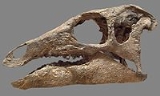
Because Marsh and Gilmore based themselves on the skull of Theiophytalia, many earlier reconstructions of the head of Camptosaurus have been incorrect, showing a much too rectangular profile. The skull was in fact triangular with a pointed snout, equipped with a beak. Its teeth were more tightly packed in the jaw compared to other Morrison euornithopods. Museum curator John Foster describes them as having "thick median ridges on their lateral sides and denticles along their edges," these features were similar to, but "more fully developed" than those in
DryosaurusDryosaurus is a genus of an ornithopod dinosaur that lived in the Late Jurassic period. It was an iguanodont . Fossils have been found in the western United States, and were first discovered in the late 19th century...
. Camptosaurus teeth frequently exhibit extensive wear, which indicates that individuals in the genus had a diet of relatively tough vegetation.
A tiny 9 inch fossilized embryo, referred to Camptosaurus, was retrieved from Morrison Formation strata at Dinosaur National Monument in Utah.
Phylogeny
Marsh in 1885 assigned Camptosaurus to a family of its own: the Camptosauridae. Alternatively some authors considered it an early member of the Iguanodontidae.
Modern
phylogeneticsIn biology, phylogenetics is the study of evolutionary relatedness among groups of organisms , which is discovered through molecular sequencing data and morphological data matrices...
has made Camptosaurus by definition part of the
cladeA clade is a group consisting of a species and all its descendants. In the terms of biological systematics, a clade is a single "branch" on the "tree of life". The idea that such a "natural group" of organisms should be grouped together and given a taxonomic name is central to biological...
Ankylopollexia, of which group it would then be a basal member.
This would mean that the genus is closely related to the ancestor of later iguanodontid and
hadrosauridHadrosaurids or duck-billed dinosaurs are members of the family Hadrosauridae, and include ornithopods such as Edmontosaurus and Parasaurolophus. They were common herbivores in the Upper Cretaceous Period of what are now Asia, Europe and North America. They are descendants of the Upper...
dinosaurs and was more
derivedIn phylogenetics, a derived trait is a trait that is present in an organism, but was absent in the last common ancestor of the group being considered. This may also refer to structures that are not present in an organism, but were present in its ancestors, i.e. traits that have undergone secondary...
than contemporaries such as
DryosaurusDryosaurus is a genus of an ornithopod dinosaur that lived in the Late Jurassic period. It was an iguanodont . Fossils have been found in the western United States, and were first discovered in the late 19th century...
,
DrinkerDrinker was a genus of hypsilophodont dinosaur from the late Jurassic period of North America. Although based on good remains, it remains obscure due to a lack of post-naming publications.-Description:...
, and
OthnielosaurusOthnielosaurus is a genus of ornithischian dinosaur that lived about 155 to 148 million years ago, during the Late Jurassic-age Morrison Formation of the western United States. It is named in honor of famed paleontologist Othniel Charles Marsh, and was formerly assigned to the genus...
.
External links