

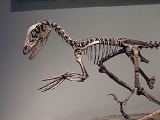
Deinonychus

Encyclopedia
Deinonychus was a genus
of carnivorous
dromaeosaurid
dinosaur
. There is one described species, Deinonychus antirrhopus. This 3.4 meter (11 ft) long dinosaur lived during the early Cretaceous
Period, about 115–108 million years ago (from the mid-Aptian
to early Albian
stages
). Fossils have been recovered from the U.S. state
s of Montana
, Wyoming
, and Oklahoma
, in rocks of the Cloverly Formation
and Antlers Formation
, though teeth that may belong to Deinonychus have been found much farther east in Maryland
.
Paleontologist
John Ostrom
's study of Deinonychus in the late 1960s revolutionized the way scientists thought about dinosaurs, leading to the "dinosaur renaissance
" and igniting the debate on whether dinosaurs were warm-blooded or cold blooded. Before this, the popular conception of dinosaurs had been one of plodding, reptilian giants. Ostrom noted the small body, sleek, horizontal, posture, ratite
-like spine, and especially the enlarged raptorial claws on the feet, which suggested an active, agile predator.
"Terrible claw" refers to the unusually large, sickle-shaped talon on the second toe of each hind foot. The fossil YPM 5205 preserves a large, strongly curved ungual
. In life, archosaurs have a horny sheath over this bone which extends the length. Ostrom looked at crocodile and bird claws and reconstructed the claw for YPM 5205 as over 120 millimetres (4.7 in) long. The species name antirrhopus means “counter balance”, which refers to Ostrom's idea about the function of the tail. As in other dromaeosaurids, the tail vertebrae have a series of ossified tendons and super-elongated bone processes
. These features seemed to make the tail into a stiff counterbalance, but a fossil of the very closely related Velociraptor mongoliensis
(IGM 100/986) has an articulated tail skeleton that is curved laterally in a long S–shape. This suggests that, in life, the tail could bend to the sides with a high degree of flexibility.
In both the Cloverly and Antlers formations, Deinonychus remains have been found closely associated with those of the ornithopod Tenontosaurus
. Teeth discovered associated with Tenontosaurus specimens imply it was hunted or at least scavenged upon by Deinonychus.
. Additional Deinonychus skull material and closely related species found with good three-dimensional preservation show that the palate was more vaulted than Ostrom thought, making the snout far narrower, while the jugal
s flared broadly, giving greater stereoscopic vision. The skull of Deinonychus was different from that of Velociraptor, however, in that it had a more robust skull roof like that of Dromaeosaurus
, and did not have the depressed nasals of Velociraptor. Both the skull and the lower jaw had fenestrae (skull openings) which reduced the weight of the skull. In Deinonychus, the antorbital fenestra
, a skull opening between the eye and nostril, was particularly large.
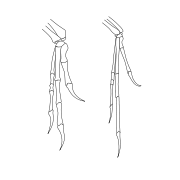
Deinonychus possessed large hands (manus
) with three claws on each forelimb. The first digit was shortest and the second was longest. Each hind foot bore a sickle-shaped claw on the second digit, which was probably used during predation.
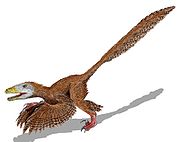
No feathers have ever been found in association with fossils of Deinonychus. Nonetheless, the evidence suggests that the Dromaeosauridae
, including Deinonychus, had feathers. The genus Microraptor
is both older geologically and more primitive phylogenetically than Deinonychus, and within the same family. Multiple fossils of Microraptor
preserve pennaceous, vaned feathers like those of modern birds on the arms, legs, and tail, along with covert and contour feathers. Velociraptor
is geologically younger than Deinonychus, but even more closely related (within the subfamily velociraptorinae, see Classification, below). A specimen of Velociraptor
has been found with quill knobs on the ulna. Quill knobs are where the follicular ligaments attached, and are a direct indicator of feathers of modern aspect.
 Deinonychus is one of the best-known dromaeosaurids
, and is a close relative of the smaller Velociraptor
, found in younger, Late Cretaceous–age rock formations in Central Asia. The clade
they form is called Velociraptorinae. The subfamily name Velociraptorinae was first coined by Rinchen Barsbold in 1983 and originally contained the single genus Velociraptor. Later Phil Currie
included most of the dromaeosaurids. Two Late Cretaceous genera, Tsaagan
from Mongolia and the North American Saurornitholestes
, may also be close relatives, but the latter is poorly known and hard to classify. Velociraptor and its allies are regarded as using their claws more than their skulls as killing tools, as opposed to dromaeosaurids like Dromaeosaurus
with stockier skulls. Together with the troodontids
, the dromaeosaurids form the Deinonychosauria
clade which is a sister taxon of aves. Phylogenetically
, the Deinonychosauria represent the group of non-avian dinosaurs most closely related to birds.
of Montana
and Wyoming
and in the roughly contemporary Antlers Formation
of Oklahoma
, in North America
. The Cloverly formation has been dated to the late Aptian
through early Albian
stages of the early Cretaceous
, about 115 to 108 Ma. Additionally, teeth found in the Arundel Clay Facies
(mid-Aptian), of the Potomac Formation
on the Atlantic Coastal Plain
of Maryland
may be assigned to the genus.
The first remains were uncovered in 1931 in southern Montana
near the town of Billings
. The team leader, paleontologist Barnum Brown
, was primarily concerned with excavating and preparing the remains of the ornithopod
dinosaur Tenontosaurus
, but in his field report from the dig site to the American Museum of Natural History
, he reported the discovery of a small carnivorous dinosaur close to a Tenontosaurus skeleton, "but encased in lime difficult to prepare." He informally called the animal "Daptosaurus agilis" and made preparations for describing it and having the skeleton, specimen AMNH 3015, put on display, but never finished this work. Brown brought back from the Cloverly Formation the skeleton of a smaller theropod with seemingly oversized teeth that he informally named "Megadontosaurus". John Ostrom
, reviewing this material decades later, realized that the teeth came from Deinonychus, but the skeleton came from a completely different animal. He named this skeleton Microvenator
.
A little more than thirty years later, in August 1964, paleontologist John Ostrom led an expedition from Yale University’s Peabody Museum which discovered more skeletal material near Bridger
. Expeditions during the following two summers uncovered more than 1000 bones, among which were at least three individuals. Since the association between the various recovered bones was weak, making the exact number of individual animals represented impossible to determine properly, the type specimen (YPM 5205) of Deinonychus was restricted to the complete left foot and partial right foot that definitely belonged to the same individual. The remaining specimens were catalogued in fifty separate entries at Yale
's Peabody Museum of Natural History.
Later study by Ostrom and Grant E. Meyer analyzed their own material as well as Brown's "Daptosaurus" in detail and found them to be the same species. Ostrom first published his findings in February 1969, giving all the referred remains the new name of Deinonychus antirrhopus. The specific name "antirrhopus", from Greek ἀντίρροπος, means "counterbalancing" and refers to the likely purpose of a stiffened tail. In July 1969 Ostrom published a very extensive monograph
on Deinonychus.
Though a myriad of bones was available by 1969, many important ones were missing or hard to interpret. There were few postorbital skull elements, no femurs, no sacrum, no furcula or sternum, missing vertebrae, and (Ostrom thought) only a tiny fragment of a coracoid. Ostrom’s skeletal reconstruction of Deinonychus included a very unusual pelvic bone – a pubis which was trapezoidal and flat, unlike that of other theropods, but which was the same length as the ischium and which was found right next to it.
A skeleton of Deinonychus including bones from the original (and most complete) AMNH 3015 specimen can be seen on display at the American Museum of Natural History, with another specimen on display at the Museum of Comparative Zoology
at Harvard University
. The American Museum and Harvard specimens are from a different locality than the Yale specimens. Even these two skeletal mounts are lacking elements including the sterna, sternal ribs, furcula, and gastralia.
Even after all of Ostrom’s work, several small blocks of lime-encased material remained unprepared in storage at the American Museum. These consisted mostly of isolated bones and bone fragments, including the original matrix, or surrounding rock in which the specimens were initially buried. An examination of these unprepared blocks by Gerald Grellet-Tinner and Peter Makovicky in 2000 revealed an interesting, overlooked feature. Several long, thin bones identified on the blocks as ossified tendons (structures which helped stiffen the tail of Deinonychus) turned out to actually represent gastralia
(abdominal ribs). More significantly, a large number of previously unnoticed fossilized eggshells were discovered in the rock matrix which had surrounded the original Deinonychus specimen.
In a subsequent, more detailed report on the eggshells, Grellet-Tinner and Makovicky concluded that the egg
almost certainly belonged to Deinonychus, representing the first dromaeosaurid egg to be identified. Moreover, the external surface of one eggshell was found in close contact with the gastralia suggesting that Deinonychus might have brooded
its eggs. This implies that Deinonychus used body heat transfer as a mechanism for egg incubation, and indicates an endothermy similar to modern birds. Further study by Gregory Erickson and colleagues finds that this individual was 13 or 14 years old at death and its growth had plateaued. Unlike other theropods in their study of specimens found associated with eggs or nests, it had finished growing at the time of its death.
 The description in 1969 by Ostrom of Deinonychus has been described as the most important single discovery of dinosaur paleontology in the mid-20th century. The discovery of this clearly active, agile predator did much to change the scientific (and popular) conception of dinosaurs and opened the door to speculation that dinosaurs may have been warm-blooded
. This development has been termed the dinosaur renaissance
. Several years later, Ostrom noted similarities between the forefeet of Deinonychus and that of birds, an observation which led him to revive the hypothesis that birds are descended from dinosaurs. Forty years later, this idea is almost universally accepted.
Because of its extremely bird-like anatomy and close relationship to other dromaeosaurids, paleontologists hypothesize that Deinonychus was probably covered in feathers. Clear fossil evidence of modern avian-style feathers exists for several related dromaeosaurids, including Velociraptor and Microraptor, though no direct evidence is yet known for Deinonychus itself. When conducting studies of such areas as range of motion in the forelimbs, paleontologists like Phil Senter have taken the likely presence of wing feathers (as present in all known dromaeosaurs with skin impressions) into consideration.
or swamp
like habitat. The paleoenvironment of both the upper Cloverly Formation and the Antlers Formation
, in which remains of Deinonychus have been found, consisted of tropical or sub-tropical forests, deltas
and lagoons, not unlike today's Louisiana
.
Other animals Deinonychus shared its world with include herbivorous dinosaurs such as the armored Sauropelta
and the ornithopods Zephyrosaurus
and Tenontosaurus
. In Oklahoma, the ecosystem of Deinonychus also included the large theropod Acrocanthosaurus
, the huge sauropod Sauroposeidon
, the crocodilian Goniopholis
, and the gar
Lepisosteus
. If the teeth found in Maryland are those of Deinonychus, then its neighbors would include Astrodon
and a nodosaur (called Priconodon
) only known from teeth. The middle portion of the Cloverly Formation ranges in age from 115 ± 10 Ma near the base to 108.5 ± 0.2 Ma near the top. In a 2001 study conducted by Bruce Rothschild and other paleontologists, 43 hand bones and 52 foot bones referred to Deinonychus were examined for signs of stress fracture
, but none were found.
dinosaur Tenontosaurus are quite common in the Cloverly Formation. Two quarries have been discovered that preserve fairly complete Deinonychus fossils near Tenontosaurus fossils. The first, the Yale quarry in the Cloverly of Montana, includes numerous teeth, four adult Deinonychus and one juvenile Deinonychus. The association of this number of Deinonychus skeleton
s in a single quarry suggests that Deinonychus may have fed on that animal, and perhaps hunted it. Ostrom and Maxwell have even used this information to speculate that Deinonychus might have lived and hunted in packs. The second such quarry is from the Antlers Formation of Oklahoma. The site contains six partial skeletons of Tenontosaurus of various sizes, along with one partial skeleton and many teeth of Deinonychus. One tenontosaur humerus even bears what might be Deinonychus tooth marks. Brinkman et al. (1998) point out that Deinonychus had an adult mass of 70–100 kilograms, whereas adult tenontosaurs were 1–4 metric tons. A solitary Deinonychus could not kill an adult tenontosaur, suggesting that pack hunting is possible.
A recent study by Roach and Brinkman has called into question the cooperative pack hunting behavior of Deinonychus, based on what is known of modern carnivore hunting and the taphonomy
of tenontosaur sites. Modern archosaur
s (bird
s and crocodile
s) and komodo dragon
s display little cooperative hunting; instead, they are usually either solitary hunters, or are drawn to previously killed carcasses, where much conflict occurs between individuals of the same species. For example, in situations where groups of komodo dragons are eating together, the largest individuals eat first and will attack smaller komodos that attempt to feed; if the smaller animal is killed, it is cannibalized
. When this information is applied to the tenontosaur sites, it appears that what is found is consistent with Deinonychus having a komodo- or crocodile-like feeding strategy. Deinonychus skeletal remains found at these sites are from subadults, with missing parts consistent with having been eaten by other Deinonychus. On the other hand, a paper by Li et al.. describes track sites with similar foot spacing and parallel trackways, implying gregarious packing behavior instead of uncoordinated feeding behavior.
. A 2010 study by Paul Gignac and colleagues attempted to estimate the bite force based directly on newly discovered Deinonychus tooth puncture marks in the bones of a Tenontosaurus. These puncture marks came from a large individual, and provided the first evidence that large Deinonychus could bite through bone. Using the tooth marks, Gignac's team were able to determine that the bite force of Deinonychus was significantly higher than earlier studies had estimated by biomechanical studies alone. They found the bite force of Deinonychus to be between 4,100 and 8,200 newtons, greater than living carnivorous mammals including the hyena
, and equivalent to a similarly sized alligator.
Gignac and colleagues also noted, however, that bone puncture marks from Deinonychus are relatively rare, and unlike larger theropods with many known puncture marks like Tyrannosaurus
, Deinonychus probably did not frequently bite through or eat bone. Instead, they probably used their high bite force in defense or prey capture, rather than feeding.
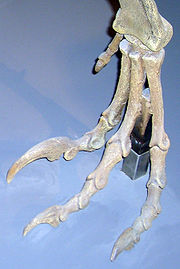 Despite being the most distinctive feature of Deinonychus, the shape and curvature of the sickle
claw varies between specimens. The type specimen described by Ostrom in 1969 has a strongly curved sickle claw, while a newer specimen described in 1976 had a claw with much weaker curvature, more similar in profile with the 'normal' claws on the remaining toes. Ostrom suggested that this difference in the size and shape of the sickle claws could be due to individual, sexual, or age-related variation, but admitted he could not be sure.
There is anatomical and trackway evidence that this talon was held up off the ground while the dinosaur walked on the third and fourth toes.
Ostrom suggested that Deinonychus could kick with the sickle claw to cut and slash at its prey. Some researchers even suggested that the talon was used to disembowel large ceratopsian dinosaurs. Other studies have suggested that the sickle claws were not used to slash but rather to deliver small stabs to the victim. Manning et al. (2005) ran tests on a robotic replica that precisely matched the anatomy of Deinonychus and Velociraptor
, and used hydraulic rams to make the robot strike a pig carcass. In these tests the talons made only shallow punctures and could not cut or slash. The authors suggested that the talons would have been more effective in climbing than in dealing killing blows.
Ostrom compared Deinonychus to the ostrich
and cassowary
. He noted that the bird species can inflict serious injury with the large claw on the second toe. The cassowary
has claws up to 125 millimetres (4.9 in) long. Ostrom cited Gilliard (1958) in saying that they can sever an arm or disembowel a man. Kofron (1999 and 2003) studied 241 documented cassowary attacks and found that one human and two dogs had been killed, but no evidence that cassowaries
can disembowel or dismember other animals. Cassowaries
use their claws to defend themselves, to attack threatening animals, and in agonistic displays such as the Bowed Threat Display. The seriema
also has an enlarged second toe claw, and uses it to tear apart small prey items for swallowing.
Biomechanical studies by Ken Carpenter
in 2002 confirmed that the most likely function of the forelimbs in predation was grasping, as their great lengths would have permitted longer reach than for most other theropods. The rather large and elongated coracoid, hinting for powerful muscles in the forelimbs, further strengthened this interpretation. Carpenter's biomechanical studies using bones casts also showed that Deinonychus could not fold its arms against its body like a bird ("avian folding"), contrary to what was inferred from the earlier 1985 descriptions by Jacques Gauthier
and Gregory S. Paul
in 1988.
Studies by Phil Senter in 2006 indicated that Deinonychus forelimbs could be used not only for grasping but also for clutching objects towards the chest. If Deinonychus had feathered fingers and wings, the feathers would have limited the range of motion of the forelimbs to some degree. For example, when Deinonychus extended its arm forward, the 'palm' of the hand automatically rotated to an upward-facing position. This would have caused one wing to block the other if both forelimbs were extended at the same time, leading Senter to conclude that clutching objects to the chest would have only been accomplished with one arm at a time. The function of the fingers would also have been limited by feathers; for example, only the third digit of the hand could have been employed in activities such as probing crevices for small prey items, and only in a position perpendicular to the main wing. Alan Gishlick, in a 2001 study of Deinonychus forelimb mechanics, found that even if large wing feathers were present, the grasping ability of the hand would not have been significantly hindered; rather, grasping would have been accomplished perpendicular to the wing, and objects likely would have been held by both hands simultaneously in a "bear hug" fashion, finding which have been supported by the later forelimb studies by Carpenter and Senter.
Parsons and Parsons have shown that juvenile and sub-adult specimens of Deinonychus display some morphological differences with the adults. For instance, the arms of the younger specimens were proportionally longer than those of the adults, a possible indication of difference in behavior between young and adults. Another example of this could be the function of the pedal claws. Parsons and Parsons have suggested that the claw curvature (which Ostrom [1976] had already shown was different between specimens) maybe was greater for juvenile Deinonychus, as this could help it climb in trees, and that the claws became straighter as the animal became older and started to live solely on the ground. This was based on the hypothesis that some small dromaeosaurids used their pedal claws for climbing.
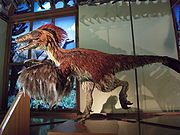 Dromaeosaurids, especially Deinonychus, are often depicted as unusually fast-running animals in the popular media, and Ostrom himself speculated that Deinonychus was fleet-footed in his original description. However, when first described, a complete leg of Deinonychus had not been found, and Ostrom's speculation about the length of the femur
(upper leg bone) later proved to have been an overestimate. In a later study, Ostrom noted that the ratio
of the femur to the tibia
(lower leg bone) is not as important in determining speed as the relative length of the foot and lower leg. In modern, fleet-footed birds like the ostrich
, the foot-tibia ratio is .95. In unusually fast-running dinosaurs like Struthiomimus
, the ratio is .68, but in Deinonychus, the ratio is .48. Ostrom stated that the "only reasonable conclusion" is that Deinonychus was not particularly fast compared to other dinosaurs, and certainly not as fast as modern flightless birds.
The low foot to lower leg ratio in Deinonychus is due partly to an unusually short metatarsus
(upper foot bones). The ratio is actually larger in smaller individuals than in larger ones. Ostrom suggested that the short metatarsus may be related to the function of the sickle claw, and used the fact that it appears to get shorter as individuals aged as support for this. He interpreted all these features – the short second toe with enlarged claw, short metatarsus, etc. – as support for the use of the hind leg as an offensive weapon, where the sickle claw would strike downwards and backwards, and the leg pulled back and down at the same time, slashing and tearing at the prey. Ostrom suggested that the short metatarsus reduced overall stress on the leg bones during such an attack, and interpreted the unusual arrangement of muscle attachments in the Deinonychus leg as support for his idea that a different set of muscles were used in the predatory stroke than in walking or running. Therefore, Ostrom concluded that the legs of Deinonychus represented a balance between running adaptations needed for an agile predator, and stress-reducing features to compensate for its unique foot weapon.
In his 1981 study of Canadian dinosaur footprints, Richard Kool produced rough walking speed estimates based on several trackways made by different species in the Gething Formation
of British Columbia
. Kool estimated one of these trackways, representing the ichnospecies
Irenichnites gracilis (which may have been made by Deinonychus), to have a walking speed of 10.1 kilometers per hour (6 miles per hour).
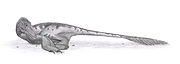 The identification in 2000 of a probable Deinonychus egg associated with one of the original specimens allowed comparison with other theropod dinosaurs in terms of egg structure, nesting, and reproduction. In their 2006 examination of the specimen, Grellet-Tinner and Makovicky examined the possibility that the dromaeosaurid had been feeding on the egg, or that the egg fragments had been associated with the Deinonychus skeleton by coincidence. They dismissed the idea that the egg had been a meal for the theropod, noting that the fragments were sandwiched between the belly ribs and forelimb bones, making it impossible that they represented contents of the animal's stomach. In addition, the manner in which the egg had been crushed and fragmented indicated that it had been intact at the time of burial, and was broken by the fossilization process. The idea that the egg was randomly associated with the dinosaur was also found to be unlikely; the bones surrounding the egg had not been scattered or disarticulated, but remained fairly intact relative to their positions in life, indicating that the area around and including the egg was not disturbed during preservation. The fact that these bones were belly ribs (gastralia
), which are very rarely found articulated, supported this interpretation. All the evidence, according to Grellet-Tinner and Makovicky, indicates that the egg was intact beneath the body of the Deinonychus when it was buried. It is possible that this represents brooding or nesting behavior in Deinonychus similar to that seen in the related troodontids and oviraptorids, or that the egg was in fact inside the oviduct
when the animal died.
Examination of the Deinonychus egg's microstructure confirms that it belonged to a theropod, since it shares characteristics with other known theropod eggs and shows dissimilarities with ornithischia
n and sauropod eggs. Compared to other maniraptora
n theropods, the egg of Deinonychus is more similar to those of oviraptorids than to those of troodontids, despite studies which show the latter are more closely related to dromaeosaurids like Deinonychus. While the egg was too badly crushed to accurately determine its size, Grellet-Tinner and Makovicky estimated a diameter of about 7 cm (2.7 in) based on the width of the pelvic canal through which the egg had to have passed. This size is similar to the 7.2 cm diameter of the largest Citipati
(an oviraptorid) eggs; Citipati and Deinonychus also shared the same overall body size, supporting this estimate. Additionally, the thicknesses of Citipati and Deinonychus eggshells are almost identical, and since shell thickness correlates with egg volume, this further supports the idea that the eggs of these two animals were about the same size.
Genus
In biology, a genus is a low-level taxonomic rank used in the biological classification of living and fossil organisms, which is an example of definition by genus and differentia...
of carnivorous
Carnivore
A carnivore meaning 'meat eater' is an organism that derives its energy and nutrient requirements from a diet consisting mainly or exclusively of animal tissue, whether through predation or scavenging...
dromaeosaurid
Dromaeosauridae
Dromaeosauridae is a family of bird-like theropod dinosaurs. They were small- to medium-sized feathered carnivores that flourished in the Cretaceous Period. The name Dromaeosauridae means 'running lizards', from Greek dromeus meaning 'runner' and sauros meaning 'lizard'...
dinosaur
Dinosaur
Dinosaurs are a diverse group of animals of the clade and superorder Dinosauria. They were the dominant terrestrial vertebrates for over 160 million years, from the late Triassic period until the end of the Cretaceous , when the Cretaceous–Paleogene extinction event led to the extinction of...
. There is one described species, Deinonychus antirrhopus. This 3.4 meter (11 ft) long dinosaur lived during the early Cretaceous
Cretaceous
The Cretaceous , derived from the Latin "creta" , usually abbreviated K for its German translation Kreide , is a geologic period and system from circa to million years ago. In the geologic timescale, the Cretaceous follows the Jurassic period and is followed by the Paleogene period of the...
Period, about 115–108 million years ago (from the mid-Aptian
Aptian
The Aptian is an age in the geologic timescale or a stage in the stratigraphic column. It is a subdivision of the Early or Lower Cretaceous epoch or series and encompasses the time from 125.0 ± 1.0 Ma to 112.0 ± 1.0 Ma , approximately...
to early Albian
Albian
The Albian is both an age of the geologic timescale and a stage in the stratigraphic column. It is the youngest or uppermost subdivision of the Early/Lower Cretaceous epoch/series. Its approximate time range is 112.0 ± 1.0 Ma to 99.6 ± 0.9 Ma...
stages
Faunal stage
In chronostratigraphy, a stage is a succession of rock strata laid down in a single age on the geologic timescale, which usually represents millions of years of deposition. A given stage of rock and the corresponding age of time will by convention have the same name, and the same boundaries.Rock...
). Fossils have been recovered from the U.S. state
U.S. state
A U.S. state is any one of the 50 federated states of the United States of America that share sovereignty with the federal government. Because of this shared sovereignty, an American is a citizen both of the federal entity and of his or her state of domicile. Four states use the official title of...
s of Montana
Montana
Montana is a state in the Western United States. The western third of Montana contains numerous mountain ranges. Smaller, "island ranges" are found in the central third of the state, for a total of 77 named ranges of the Rocky Mountains. This geographical fact is reflected in the state's name,...
, Wyoming
Wyoming
Wyoming is a state in the mountain region of the Western United States. The western two thirds of the state is covered mostly with the mountain ranges and rangelands in the foothills of the Eastern Rocky Mountains, while the eastern third of the state is high elevation prairie known as the High...
, and Oklahoma
Oklahoma
Oklahoma is a state located in the South Central region of the United States of America. With an estimated 3,751,351 residents as of the 2010 census and a land area of 68,667 square miles , Oklahoma is the 28th most populous and 20th-largest state...
, in rocks of the Cloverly Formation
Cloverly Formation
The Cloverly Formation are Lower Cretaceous strata located in Montana and Wyoming, in the western United States. The term now includes strata that had formerly been called the Dakota Formation in central and southern Wyoming.-Members:...
and Antlers Formation
Antlers Formation
The Antlers Formation occurs as a band of strata from Arkansas through southern Oklahoma into northeastern Texas. It consists of 150 m of silty to sandy mudstones, fine- to coarse grained sandstones that are poorly to moderately sorted and cemented with clay or calcium carbonate...
, though teeth that may belong to Deinonychus have been found much farther east in Maryland
Maryland
Maryland is a U.S. state located in the Mid Atlantic region of the United States, bordering Virginia, West Virginia, and the District of Columbia to its south and west; Pennsylvania to its north; and Delaware to its east...
.
Paleontologist
Paleontology
Paleontology "old, ancient", ὄν, ὀντ- "being, creature", and λόγος "speech, thought") is the study of prehistoric life. It includes the study of fossils to determine organisms' evolution and interactions with each other and their environments...
John Ostrom
John Ostrom
John H. Ostrom was an American paleontologist who revolutionized modern understanding of dinosaurs in the 1960s, when he demonstrated that dinosaurs are more like big non-flying birds than they are like lizards , an idea first proposed by Thomas Henry Huxley in the 1860s, but which had garnered...
's study of Deinonychus in the late 1960s revolutionized the way scientists thought about dinosaurs, leading to the "dinosaur renaissance
Dinosaur renaissance
The dinosaur renaissance was a small-scale scientific revolution that started in the late 1960s, and led to renewed academic and popular interest in dinosaurs...
" and igniting the debate on whether dinosaurs were warm-blooded or cold blooded. Before this, the popular conception of dinosaurs had been one of plodding, reptilian giants. Ostrom noted the small body, sleek, horizontal, posture, ratite
Ratite
A ratite is any of a diverse group of large, flightless birds of Gondwanan origin, most of them now extinct. Unlike other flightless birds, the ratites have no keel on their sternum—hence the name from the Latin ratis...
-like spine, and especially the enlarged raptorial claws on the feet, which suggested an active, agile predator.
"Terrible claw" refers to the unusually large, sickle-shaped talon on the second toe of each hind foot. The fossil YPM 5205 preserves a large, strongly curved ungual
Ungual
An ungual is a highly modified distal toe bone which ends in a hoof, claw, or nail. Elephants and other ungulates have ungual phalanges, as did the sauropods and horned dinosaurs. A claw is a highly modified ungual phalange.As an adjective, ungual means related to nail, as in periungual .-External...
. In life, archosaurs have a horny sheath over this bone which extends the length. Ostrom looked at crocodile and bird claws and reconstructed the claw for YPM 5205 as over 120 millimetres (4.7 in) long. The species name antirrhopus means “counter balance”, which refers to Ostrom's idea about the function of the tail. As in other dromaeosaurids, the tail vertebrae have a series of ossified tendons and super-elongated bone processes
Process (anatomy)
In anatomy, a process is a projection or outgrowth of tissue from a larger body. The vertebra has several kinds of processes,such as: transverse process, prezygapophysis, postzygapophysis.-Examples:Examples of processes include:...
. These features seemed to make the tail into a stiff counterbalance, but a fossil of the very closely related Velociraptor mongoliensis
Velociraptor
Velociraptor is a genus of dromaeosaurid theropod dinosaur that existed approximately 75 to 71 million years ago during the later part of the Cretaceous Period. Two species are currently recognized, although others have been assigned in the past. The type species is V. mongoliensis; fossils...
(IGM 100/986) has an articulated tail skeleton that is curved laterally in a long S–shape. This suggests that, in life, the tail could bend to the sides with a high degree of flexibility.
In both the Cloverly and Antlers formations, Deinonychus remains have been found closely associated with those of the ornithopod Tenontosaurus
Tenontosaurus
Tenontosaurus is a genus of medium- to large-sized ornithopod dinosaur. The genus is known from the late Aptian to Albian ages of the middle Cretaceous period sediments of western North America, dating between 115 to 108 million years ago...
. Teeth discovered associated with Tenontosaurus specimens imply it was hunted or at least scavenged upon by Deinonychus.
Description
Based on the largest known specimens, Deinonychus could reach at least 3.4 metre in length, with a skull length of 410 mm (16.1 in), a hip height of 0.87 metre, and an estimated weight of 73 kilograms (160.9 lb). Its skull was equipped with powerful jaws lined with around seventy curved, blade-like teeth. Studies of the skull have progressed a great deal over the decades. Ostrom reconstructed the partial, imperfectly preserved, skulls that he had as triangular, broad, and fairly similar to AllosaurusAllosaurus
Allosaurus is a genus of large theropod dinosaur that lived 155 to 150 million years ago during the late Jurassic period . The name Allosaurus means "different lizard". It is derived from the Greek /allos and /sauros...
. Additional Deinonychus skull material and closely related species found with good three-dimensional preservation show that the palate was more vaulted than Ostrom thought, making the snout far narrower, while the jugal
Jugal
The jugal is a skull bone found in most reptiles, amphibians, and birds. In mammals, the jugal is often called the malar or Zygomatic. It is connected to the quadratojugal and maxilla, as well as other bones, which may vary by species....
s flared broadly, giving greater stereoscopic vision. The skull of Deinonychus was different from that of Velociraptor, however, in that it had a more robust skull roof like that of Dromaeosaurus
Dromaeosaurus
Dromaeosaurus was a genus of theropod dinosaur which lived during the Late Cretaceous period , sometime between 76.5 and 74.8 million years ago, in the western United States and Alberta, Canada. The name means 'running lizard'....
, and did not have the depressed nasals of Velociraptor. Both the skull and the lower jaw had fenestrae (skull openings) which reduced the weight of the skull. In Deinonychus, the antorbital fenestra
Antorbital fenestra
An antorbital fenestra is an opening in the skull, in front of the eye sockets. This skull formation first appeared in archosaurs during the Triassic Period. Living birds today possess antorbital fenestrae, but the feature has been lost in modern crocodilians...
, a skull opening between the eye and nostril, was particularly large.
Deinonychus possessed large hands (manus
Manus (zoology)
The manus is the zoological term for the distal portion of the fore limb of an animal. In tetrapods, it is the part of the pentadactyl limb that includes the metacarpals and digits . During evolution, it has taken many forms and served a variety of functions...
) with three claws on each forelimb. The first digit was shortest and the second was longest. Each hind foot bore a sickle-shaped claw on the second digit, which was probably used during predation.
No feathers have ever been found in association with fossils of Deinonychus. Nonetheless, the evidence suggests that the Dromaeosauridae
Dromaeosauridae
Dromaeosauridae is a family of bird-like theropod dinosaurs. They were small- to medium-sized feathered carnivores that flourished in the Cretaceous Period. The name Dromaeosauridae means 'running lizards', from Greek dromeus meaning 'runner' and sauros meaning 'lizard'...
, including Deinonychus, had feathers. The genus Microraptor
Microraptor
Microraptor is a genus of small, four-winged dromaeosaurid dinosaurs. Numerous well-preserved fossil specimens have been recovered from Liaoning, China...
is both older geologically and more primitive phylogenetically than Deinonychus, and within the same family. Multiple fossils of Microraptor
Microraptor
Microraptor is a genus of small, four-winged dromaeosaurid dinosaurs. Numerous well-preserved fossil specimens have been recovered from Liaoning, China...
preserve pennaceous, vaned feathers like those of modern birds on the arms, legs, and tail, along with covert and contour feathers. Velociraptor
Velociraptor
Velociraptor is a genus of dromaeosaurid theropod dinosaur that existed approximately 75 to 71 million years ago during the later part of the Cretaceous Period. Two species are currently recognized, although others have been assigned in the past. The type species is V. mongoliensis; fossils...
is geologically younger than Deinonychus, but even more closely related (within the subfamily velociraptorinae, see Classification, below). A specimen of Velociraptor
Velociraptor
Velociraptor is a genus of dromaeosaurid theropod dinosaur that existed approximately 75 to 71 million years ago during the later part of the Cretaceous Period. Two species are currently recognized, although others have been assigned in the past. The type species is V. mongoliensis; fossils...
has been found with quill knobs on the ulna. Quill knobs are where the follicular ligaments attached, and are a direct indicator of feathers of modern aspect.
Classification
Dromaeosauridae
Dromaeosauridae is a family of bird-like theropod dinosaurs. They were small- to medium-sized feathered carnivores that flourished in the Cretaceous Period. The name Dromaeosauridae means 'running lizards', from Greek dromeus meaning 'runner' and sauros meaning 'lizard'...
, and is a close relative of the smaller Velociraptor
Velociraptor
Velociraptor is a genus of dromaeosaurid theropod dinosaur that existed approximately 75 to 71 million years ago during the later part of the Cretaceous Period. Two species are currently recognized, although others have been assigned in the past. The type species is V. mongoliensis; fossils...
, found in younger, Late Cretaceous–age rock formations in Central Asia. The clade
Clade
A clade is a group consisting of a species and all its descendants. In the terms of biological systematics, a clade is a single "branch" on the "tree of life". The idea that such a "natural group" of organisms should be grouped together and given a taxonomic name is central to biological...
they form is called Velociraptorinae. The subfamily name Velociraptorinae was first coined by Rinchen Barsbold in 1983 and originally contained the single genus Velociraptor. Later Phil Currie
Phil Currie
Philip John Currie, AOE is a Canadian palaeontologist and museum curator who helped found the Royal Tyrrell Museum of Palaeontology in Drumheller, Alberta and is now a professor at the University of Alberta in Edmonton...
included most of the dromaeosaurids. Two Late Cretaceous genera, Tsaagan
Tsaagan
Tsaagan is a genus of carnivorous dromaeosaurid theropod dinosaur from the Djadokhta Formation of the late Cretaceous of Mongolia....
from Mongolia and the North American Saurornitholestes
Saurornitholestes
Saurornitholestes is a genus of carnivorous dromaeosaurid theropod dinosaur from the late Cretaceous of Alberta, Montana and New Mexico....
, may also be close relatives, but the latter is poorly known and hard to classify. Velociraptor and its allies are regarded as using their claws more than their skulls as killing tools, as opposed to dromaeosaurids like Dromaeosaurus
Dromaeosaurus
Dromaeosaurus was a genus of theropod dinosaur which lived during the Late Cretaceous period , sometime between 76.5 and 74.8 million years ago, in the western United States and Alberta, Canada. The name means 'running lizard'....
with stockier skulls. Together with the troodontids
Troodontidae
Troodontidae is a family of bird-like theropod dinosaurs. During most of the 20th century, troodontid fossils were few and scrappy and they have therefore been allied, at various times, with many dinosaurian lineages...
, the dromaeosaurids form the Deinonychosauria
Deinonychosauria
The Deinonychosauria were a clade of coelurosaurian theropod dinosaurs from the Late Jurassic and Cretaceous periods. These omnivores and carnivores are known for their switchblade-like second toe claws and for displaying numerous bird-like characteristics. The clade has been divided into two...
clade which is a sister taxon of aves. Phylogenetically
Phylogenetics
In biology, phylogenetics is the study of evolutionary relatedness among groups of organisms , which is discovered through molecular sequencing data and morphological data matrices...
, the Deinonychosauria represent the group of non-avian dinosaurs most closely related to birds.
Discovery and naming
Fossilized remains of Deinonychus have been recovered from the Cloverly FormationCloverly Formation
The Cloverly Formation are Lower Cretaceous strata located in Montana and Wyoming, in the western United States. The term now includes strata that had formerly been called the Dakota Formation in central and southern Wyoming.-Members:...
of Montana
Montana
Montana is a state in the Western United States. The western third of Montana contains numerous mountain ranges. Smaller, "island ranges" are found in the central third of the state, for a total of 77 named ranges of the Rocky Mountains. This geographical fact is reflected in the state's name,...
and Wyoming
Wyoming
Wyoming is a state in the mountain region of the Western United States. The western two thirds of the state is covered mostly with the mountain ranges and rangelands in the foothills of the Eastern Rocky Mountains, while the eastern third of the state is high elevation prairie known as the High...
and in the roughly contemporary Antlers Formation
Antlers Formation
The Antlers Formation occurs as a band of strata from Arkansas through southern Oklahoma into northeastern Texas. It consists of 150 m of silty to sandy mudstones, fine- to coarse grained sandstones that are poorly to moderately sorted and cemented with clay or calcium carbonate...
of Oklahoma
Oklahoma
Oklahoma is a state located in the South Central region of the United States of America. With an estimated 3,751,351 residents as of the 2010 census and a land area of 68,667 square miles , Oklahoma is the 28th most populous and 20th-largest state...
, in North America
North America
North America is a continent wholly within the Northern Hemisphere and almost wholly within the Western Hemisphere. It is also considered a northern subcontinent of the Americas...
. The Cloverly formation has been dated to the late Aptian
Aptian
The Aptian is an age in the geologic timescale or a stage in the stratigraphic column. It is a subdivision of the Early or Lower Cretaceous epoch or series and encompasses the time from 125.0 ± 1.0 Ma to 112.0 ± 1.0 Ma , approximately...
through early Albian
Albian
The Albian is both an age of the geologic timescale and a stage in the stratigraphic column. It is the youngest or uppermost subdivision of the Early/Lower Cretaceous epoch/series. Its approximate time range is 112.0 ± 1.0 Ma to 99.6 ± 0.9 Ma...
stages of the early Cretaceous
Cretaceous
The Cretaceous , derived from the Latin "creta" , usually abbreviated K for its German translation Kreide , is a geologic period and system from circa to million years ago. In the geologic timescale, the Cretaceous follows the Jurassic period and is followed by the Paleogene period of the...
, about 115 to 108 Ma. Additionally, teeth found in the Arundel Clay Facies
Arundel Formation
The Arundel Formation, also known as the Arundel Clay, is a clay-rich sedimentary rock formation, within the Potomac Group, found in Maryland of the United States of America. It is of Aptian age . This rock unit had been economically important as a source of iron ore, but is now more notable for...
(mid-Aptian), of the Potomac Formation
Potomac Formation
The Potomac Formation consists of Lower Cretaceous to Upper Cretaceous strata located in Delaware, Maryland, and New Jersey, in the eastern United States.Flora found include large cycads....
on the Atlantic Coastal Plain
Atlantic Coastal Plain
The Atlantic coastal plain has both low elevation and low relief, but it is also a relatively flat landform extending from the New York Bight southward to a Georgia/Florida section of the Eastern Continental Divide, which demarcates the plain from the ACF River Basin in the Gulf Coastal Plain to...
of Maryland
Maryland
Maryland is a U.S. state located in the Mid Atlantic region of the United States, bordering Virginia, West Virginia, and the District of Columbia to its south and west; Pennsylvania to its north; and Delaware to its east...
may be assigned to the genus.
The first remains were uncovered in 1931 in southern Montana
Montana
Montana is a state in the Western United States. The western third of Montana contains numerous mountain ranges. Smaller, "island ranges" are found in the central third of the state, for a total of 77 named ranges of the Rocky Mountains. This geographical fact is reflected in the state's name,...
near the town of Billings
Billings, Montana
Billings is the largest city in the U.S. state of Montana, and is the principal city of the Billings Metropolitan Area, the largest metropolitan area in over...
. The team leader, paleontologist Barnum Brown
Barnum Brown
Barnum Brown , a paleontologist born in Carbondale, Kansas, and named after the circus showman P.T. Barnum, discovered the second fossil of Tyrannosaurus rex during a career that made him one of the most famous fossil hunters working from the late Victorian era into the early 20th century.Sponsored...
, was primarily concerned with excavating and preparing the remains of the ornithopod
Ornithopod
Ornithopods or members of the clade Ornithopoda are a group of ornithischian dinosaurs that started out as small, bipedal running grazers, and grew in size and numbers until they became one of the most successful groups of herbivores in the Cretaceous world, and dominated the North American...
dinosaur Tenontosaurus
Tenontosaurus
Tenontosaurus is a genus of medium- to large-sized ornithopod dinosaur. The genus is known from the late Aptian to Albian ages of the middle Cretaceous period sediments of western North America, dating between 115 to 108 million years ago...
, but in his field report from the dig site to the American Museum of Natural History
American Museum of Natural History
The American Museum of Natural History , located on the Upper West Side of Manhattan in New York City, United States, is one of the largest and most celebrated museums in the world...
, he reported the discovery of a small carnivorous dinosaur close to a Tenontosaurus skeleton, "but encased in lime difficult to prepare." He informally called the animal "Daptosaurus agilis" and made preparations for describing it and having the skeleton, specimen AMNH 3015, put on display, but never finished this work. Brown brought back from the Cloverly Formation the skeleton of a smaller theropod with seemingly oversized teeth that he informally named "Megadontosaurus". John Ostrom
John Ostrom
John H. Ostrom was an American paleontologist who revolutionized modern understanding of dinosaurs in the 1960s, when he demonstrated that dinosaurs are more like big non-flying birds than they are like lizards , an idea first proposed by Thomas Henry Huxley in the 1860s, but which had garnered...
, reviewing this material decades later, realized that the teeth came from Deinonychus, but the skeleton came from a completely different animal. He named this skeleton Microvenator
Microvenator
Microvenator is a genus of dinosaur from the Early Cretaceous Cloverly Formation in what is now south central Montana. Microvenator was an oviraptorosaurian theropod. The holotype fossil is an incomplete skeleton, most likely a juvenile, with a living length of about four feet. The adult size of...
.
A little more than thirty years later, in August 1964, paleontologist John Ostrom led an expedition from Yale University’s Peabody Museum which discovered more skeletal material near Bridger
Bridger, Montana
Bridger is a town in Carbon County, Montana, United States. It is part of the Billings, Montana Metropolitan Statistical Area. The population was 745 at the 2000 census.The town of Bridger was named for the scout Jim Bridger...
. Expeditions during the following two summers uncovered more than 1000 bones, among which were at least three individuals. Since the association between the various recovered bones was weak, making the exact number of individual animals represented impossible to determine properly, the type specimen (YPM 5205) of Deinonychus was restricted to the complete left foot and partial right foot that definitely belonged to the same individual. The remaining specimens were catalogued in fifty separate entries at Yale
Yale University
Yale University is a private, Ivy League university located in New Haven, Connecticut, United States. Founded in 1701 in the Colony of Connecticut, the university is the third-oldest institution of higher education in the United States...
's Peabody Museum of Natural History.
Later study by Ostrom and Grant E. Meyer analyzed their own material as well as Brown's "Daptosaurus" in detail and found them to be the same species. Ostrom first published his findings in February 1969, giving all the referred remains the new name of Deinonychus antirrhopus. The specific name "antirrhopus", from Greek ἀντίρροπος, means "counterbalancing" and refers to the likely purpose of a stiffened tail. In July 1969 Ostrom published a very extensive monograph
Monograph
A monograph is a work of writing upon a single subject, usually by a single author.It is often a scholarly essay or learned treatise, and may be released in the manner of a book or journal article. It is by definition a single document that forms a complete text in itself...
on Deinonychus.
Though a myriad of bones was available by 1969, many important ones were missing or hard to interpret. There were few postorbital skull elements, no femurs, no sacrum, no furcula or sternum, missing vertebrae, and (Ostrom thought) only a tiny fragment of a coracoid. Ostrom’s skeletal reconstruction of Deinonychus included a very unusual pelvic bone – a pubis which was trapezoidal and flat, unlike that of other theropods, but which was the same length as the ischium and which was found right next to it.
Further findings
In 1974 Ostrom published another monograph on the shoulder of Deinonychus in which he realized that the pubis that he had described was actually a coracoid – a shoulder element. In that same year, another specimen of Deinonychus, MCZ 4371, was excavated in Montana by a Harvard University expedition headed by Farish Jenkins. This discovery added several new elements; well preserved femurs, pubes, a sacrum, and better ilia, as well as elements of the pes and metatarsus. Ostrom described this specimen and revised his skeletal restoration of Deinonychus. This time it showed the very long pubis, and Ostrom began to suspect that they may have even been a little retroverted like those of birds.A skeleton of Deinonychus including bones from the original (and most complete) AMNH 3015 specimen can be seen on display at the American Museum of Natural History, with another specimen on display at the Museum of Comparative Zoology
Museum of Comparative Zoology
The Museum of Comparative Zoology, full name "The Louis Agassiz Museum of Comparative Zoology", often abbreviated simply to "MCZ", is a zoology museum located on the grounds of Harvard University in Cambridge, Massachusetts. It is one of three museums which collectively comprise the Harvard Museum...
at Harvard University
Harvard University
Harvard University is a private Ivy League university located in Cambridge, Massachusetts, United States, established in 1636 by the Massachusetts legislature. Harvard is the oldest institution of higher learning in the United States and the first corporation chartered in the country...
. The American Museum and Harvard specimens are from a different locality than the Yale specimens. Even these two skeletal mounts are lacking elements including the sterna, sternal ribs, furcula, and gastralia.
Even after all of Ostrom’s work, several small blocks of lime-encased material remained unprepared in storage at the American Museum. These consisted mostly of isolated bones and bone fragments, including the original matrix, or surrounding rock in which the specimens were initially buried. An examination of these unprepared blocks by Gerald Grellet-Tinner and Peter Makovicky in 2000 revealed an interesting, overlooked feature. Several long, thin bones identified on the blocks as ossified tendons (structures which helped stiffen the tail of Deinonychus) turned out to actually represent gastralia
Gastralium
Gastralia are dermal bones found in the ventral body wall of crocodilian and Sphenodon species. They are found between the sternum and pelvis, and do not articulate with the vertebrae...
(abdominal ribs). More significantly, a large number of previously unnoticed fossilized eggshells were discovered in the rock matrix which had surrounded the original Deinonychus specimen.
In a subsequent, more detailed report on the eggshells, Grellet-Tinner and Makovicky concluded that the egg
Egg (biology)
An egg is an organic vessel in which an embryo first begins to develop. In most birds, reptiles, insects, molluscs, fish, and monotremes, an egg is the zygote, resulting from fertilization of the ovum, which is expelled from the body and permitted to develop outside the body until the developing...
almost certainly belonged to Deinonychus, representing the first dromaeosaurid egg to be identified. Moreover, the external surface of one eggshell was found in close contact with the gastralia suggesting that Deinonychus might have brooded
Avian incubation
Incubation refers to the process by which certain oviparous animals hatch their eggs, and to the development of the embryo within the egg. The most vital factor of incubation is the constant temperature required for its development over a specific period. Especially in domestic fowl, the act of...
its eggs. This implies that Deinonychus used body heat transfer as a mechanism for egg incubation, and indicates an endothermy similar to modern birds. Further study by Gregory Erickson and colleagues finds that this individual was 13 or 14 years old at death and its growth had plateaued. Unlike other theropods in their study of specimens found associated with eggs or nests, it had finished growing at the time of its death.
Implications
Warm-blooded
The term warm-blooded is a colloquial term to describe animal species which have a relatively higher blood temperature, and maintain thermal homeostasis primarily through internal metabolic processes...
. This development has been termed the dinosaur renaissance
Dinosaur renaissance
The dinosaur renaissance was a small-scale scientific revolution that started in the late 1960s, and led to renewed academic and popular interest in dinosaurs...
. Several years later, Ostrom noted similarities between the forefeet of Deinonychus and that of birds, an observation which led him to revive the hypothesis that birds are descended from dinosaurs. Forty years later, this idea is almost universally accepted.
Because of its extremely bird-like anatomy and close relationship to other dromaeosaurids, paleontologists hypothesize that Deinonychus was probably covered in feathers. Clear fossil evidence of modern avian-style feathers exists for several related dromaeosaurids, including Velociraptor and Microraptor, though no direct evidence is yet known for Deinonychus itself. When conducting studies of such areas as range of motion in the forelimbs, paleontologists like Phil Senter have taken the likely presence of wing feathers (as present in all known dromaeosaurs with skin impressions) into consideration.
Paleobiology and paleoecology
Geological evidence suggests that Deinonychus inhabited a floodplainFloodplain
A floodplain, or flood plain, is a flat or nearly flat land adjacent a stream or river that stretches from the banks of its channel to the base of the enclosing valley walls and experiences flooding during periods of high discharge...
or swamp
Swamp
A swamp is a wetland with some flooding of large areas of land by shallow bodies of water. A swamp generally has a large number of hammocks, or dry-land protrusions, covered by aquatic vegetation, or vegetation that tolerates periodical inundation. The two main types of swamp are "true" or swamp...
like habitat. The paleoenvironment of both the upper Cloverly Formation and the Antlers Formation
Antlers Formation
The Antlers Formation occurs as a band of strata from Arkansas through southern Oklahoma into northeastern Texas. It consists of 150 m of silty to sandy mudstones, fine- to coarse grained sandstones that are poorly to moderately sorted and cemented with clay or calcium carbonate...
, in which remains of Deinonychus have been found, consisted of tropical or sub-tropical forests, deltas
River delta
A delta is a landform that is formed at the mouth of a river where that river flows into an ocean, sea, estuary, lake, reservoir, flat arid area, or another river. Deltas are formed from the deposition of the sediment carried by the river as the flow leaves the mouth of the river...
and lagoons, not unlike today's Louisiana
Louisiana
Louisiana is a state located in the southern region of the United States of America. Its capital is Baton Rouge and largest city is New Orleans. Louisiana is the only state in the U.S. with political subdivisions termed parishes, which are local governments equivalent to counties...
.
Other animals Deinonychus shared its world with include herbivorous dinosaurs such as the armored Sauropelta
Sauropelta
Sauropelta is a genus of nodosaurid dinosaur that existed in the Early Cretaceous Period of North America. One species has been named although others may have existed. Anatomically, Sauropelta is one of the most well-understood nodosaurids, with fossilized remains recovered in the U.S. states of...
and the ornithopods Zephyrosaurus
Zephyrosaurus
Zephyrosaurus is a genus of hypsilophodont ornithopod dinosaur. It is based on a partial skull and postcranial fragments discovered in the Aptian-Albian-age Lower Cretaceous Cloverly Formation of Carbon County, Montana...
and Tenontosaurus
Tenontosaurus
Tenontosaurus is a genus of medium- to large-sized ornithopod dinosaur. The genus is known from the late Aptian to Albian ages of the middle Cretaceous period sediments of western North America, dating between 115 to 108 million years ago...
. In Oklahoma, the ecosystem of Deinonychus also included the large theropod Acrocanthosaurus
Acrocanthosaurus
Acrocanthosaurus is a genus of theropod dinosaur that existed in what is now North America during the Aptian and early Albian stages of the Early Cretaceous. Like most dinosaur genera, Acrocanthosaurus contains only a single species, A. atokensis. Its fossil remains are found mainly in the U.S...
, the huge sauropod Sauroposeidon
Sauroposeidon
Sauroposeidon is a genus of sauropod dinosaur known from four neck vertebrae that were found in the southeastern portion of the US state of Oklahoma. The fossils were found in rocks dating to the Early Cretaceous, a period when the sauropods of North America had diminished in both size and...
, the crocodilian Goniopholis
Goniopholis
Goniopholis is an extinct genus of crocodyliform that lived in North America, Europe and Asia during the Late Jurassic and Early Cretaceous. Being semi-aquatic it is very similar to modern crocodiles...
, and the gar
Gar
In American English the name gar is strictly applied to members of the Lepisosteidae, a family including seven living species of fish in two genera that inhabit fresh, brackish, and occasionally marine, waters of eastern North America, Central America, and the Caribbean islands.-Etymology:In...
Lepisosteus
Lepisosteus
Lepisosteus is a genus of gars in the family Lepisosteidae.There are four species:* Lepisosteus oculatus Winchell, 1864 * Lepisosteus osseus...
. If the teeth found in Maryland are those of Deinonychus, then its neighbors would include Astrodon
Astrodon
Astrodon was a genus of large herbivorous sauropod dinosaur, related to Brachiosaurus, that lived in what is now the eastern United States during the Early Cretaceous period. Its fossils have been found in the Arundel Formation, which has been dated through palynomorphs to the Aptian-Albian...
and a nodosaur (called Priconodon
Priconodon
Priconodon is an extinct genus of dinosaur , known from its large teeth. Its remains have been found in the Aptian-Albian age Lower Cretaceous Arundel Formation of Muirkirk, Prince George's County, Maryland.-History:...
) only known from teeth. The middle portion of the Cloverly Formation ranges in age from 115 ± 10 Ma near the base to 108.5 ± 0.2 Ma near the top. In a 2001 study conducted by Bruce Rothschild and other paleontologists, 43 hand bones and 52 foot bones referred to Deinonychus were examined for signs of stress fracture
Stress fracture
A stress fracture is one type of incomplete fracture in bones. It is caused by "unusual or repeated stress" and also heavy continuous weight on the ankle or leg...
, but none were found.
Predatory behavior
Deinonychus teeth found in association with fossils of the ornithopodOrnithopod
Ornithopods or members of the clade Ornithopoda are a group of ornithischian dinosaurs that started out as small, bipedal running grazers, and grew in size and numbers until they became one of the most successful groups of herbivores in the Cretaceous world, and dominated the North American...
dinosaur Tenontosaurus are quite common in the Cloverly Formation. Two quarries have been discovered that preserve fairly complete Deinonychus fossils near Tenontosaurus fossils. The first, the Yale quarry in the Cloverly of Montana, includes numerous teeth, four adult Deinonychus and one juvenile Deinonychus. The association of this number of Deinonychus skeleton
Skeleton
The skeleton is the body part that forms the supporting structure of an organism. There are two different skeletal types: the exoskeleton, which is the stable outer shell of an organism, and the endoskeleton, which forms the support structure inside the body.In a figurative sense, skeleton can...
s in a single quarry suggests that Deinonychus may have fed on that animal, and perhaps hunted it. Ostrom and Maxwell have even used this information to speculate that Deinonychus might have lived and hunted in packs. The second such quarry is from the Antlers Formation of Oklahoma. The site contains six partial skeletons of Tenontosaurus of various sizes, along with one partial skeleton and many teeth of Deinonychus. One tenontosaur humerus even bears what might be Deinonychus tooth marks. Brinkman et al. (1998) point out that Deinonychus had an adult mass of 70–100 kilograms, whereas adult tenontosaurs were 1–4 metric tons. A solitary Deinonychus could not kill an adult tenontosaur, suggesting that pack hunting is possible.
A recent study by Roach and Brinkman has called into question the cooperative pack hunting behavior of Deinonychus, based on what is known of modern carnivore hunting and the taphonomy
Taphonomy
Taphonomy is the study of decaying organisms over time and how they become fossilized . The term taphonomy was introduced to paleontology in 1940 by Russian scientist Ivan Efremov to describe the study of the transition of remains, parts, or products of organisms, from the biosphere, to the...
of tenontosaur sites. Modern archosaur
Archosaur
Archosaurs are a group of diapsid amniotes whose living representatives consist of modern birds and crocodilians. This group also includes all extinct non-avian dinosaurs, many extinct crocodilian relatives, and pterosaurs. Archosauria, the archosaur clade, is a crown group that includes the most...
s (bird
Bird
Birds are feathered, winged, bipedal, endothermic , egg-laying, vertebrate animals. Around 10,000 living species and 188 families makes them the most speciose class of tetrapod vertebrates. They inhabit ecosystems across the globe, from the Arctic to the Antarctic. Extant birds range in size from...
s and crocodile
Crocodile
A crocodile is any species belonging to the family Crocodylidae . The term can also be used more loosely to include all extant members of the order Crocodilia: i.e...
s) and komodo dragon
Komodo dragon
The Komodo dragon , also known as the Komodo monitor, is a large species of lizard found in the Indonesian islands of Komodo, Rinca, Flores, Gili Motang and Gili Dasami. A member of the monitor lizard family , it is the largest living species of lizard, growing to a maximum length of in rare cases...
s display little cooperative hunting; instead, they are usually either solitary hunters, or are drawn to previously killed carcasses, where much conflict occurs between individuals of the same species. For example, in situations where groups of komodo dragons are eating together, the largest individuals eat first and will attack smaller komodos that attempt to feed; if the smaller animal is killed, it is cannibalized
Cannibalism (zoology)
In zoology, cannibalism is the act of one individual of a species consuming all or part of another individual of the same species as food. Cannibalism is a common ecological interaction in the animal kingdom and has been recorded for more than 1500 species...
. When this information is applied to the tenontosaur sites, it appears that what is found is consistent with Deinonychus having a komodo- or crocodile-like feeding strategy. Deinonychus skeletal remains found at these sites are from subadults, with missing parts consistent with having been eaten by other Deinonychus. On the other hand, a paper by Li et al.. describes track sites with similar foot spacing and parallel trackways, implying gregarious packing behavior instead of uncoordinated feeding behavior.
Bite force
Bite force estimates for Deinonychus were first produced in 2005, based on reconstructed jaw musculature. This study concluded that Deinonychus likely had a maximum bite force only 15% that of the modern American AlligatorAmerican Alligator
The American alligator , sometimes referred to colloquially as a gator, is a reptile endemic only to the Southeastern United States. It is one of the two living species of alligator, in the genus Alligator, within the family Alligatoridae...
. A 2010 study by Paul Gignac and colleagues attempted to estimate the bite force based directly on newly discovered Deinonychus tooth puncture marks in the bones of a Tenontosaurus. These puncture marks came from a large individual, and provided the first evidence that large Deinonychus could bite through bone. Using the tooth marks, Gignac's team were able to determine that the bite force of Deinonychus was significantly higher than earlier studies had estimated by biomechanical studies alone. They found the bite force of Deinonychus to be between 4,100 and 8,200 newtons, greater than living carnivorous mammals including the hyena
Hyena
Hyenas or Hyaenas are the animals of the family Hyaenidae of suborder feliforms of the Carnivora. It is the fourth smallest biological family in the Carnivora , and one of the smallest in the mammalia...
, and equivalent to a similarly sized alligator.
Gignac and colleagues also noted, however, that bone puncture marks from Deinonychus are relatively rare, and unlike larger theropods with many known puncture marks like Tyrannosaurus
Tyrannosaurus
Tyrannosaurus meaning "tyrant," and sauros meaning "lizard") is a genus of coelurosaurian theropod dinosaur. The species Tyrannosaurus rex , commonly abbreviated to T. rex, is a fixture in popular culture. It lived throughout what is now western North America, with a much wider range than other...
, Deinonychus probably did not frequently bite through or eat bone. Instead, they probably used their high bite force in defense or prey capture, rather than feeding.
Limb function
Sickle
A sickle is a hand-held agricultural tool with a variously curved blade typically used for harvesting grain crops or cutting succulent forage chiefly for feeding livestock . Sickles have also been used as weapons, either in their original form or in various derivations.The diversity of sickles that...
claw varies between specimens. The type specimen described by Ostrom in 1969 has a strongly curved sickle claw, while a newer specimen described in 1976 had a claw with much weaker curvature, more similar in profile with the 'normal' claws on the remaining toes. Ostrom suggested that this difference in the size and shape of the sickle claws could be due to individual, sexual, or age-related variation, but admitted he could not be sure.
There is anatomical and trackway evidence that this talon was held up off the ground while the dinosaur walked on the third and fourth toes.
Ostrom suggested that Deinonychus could kick with the sickle claw to cut and slash at its prey. Some researchers even suggested that the talon was used to disembowel large ceratopsian dinosaurs. Other studies have suggested that the sickle claws were not used to slash but rather to deliver small stabs to the victim. Manning et al. (2005) ran tests on a robotic replica that precisely matched the anatomy of Deinonychus and Velociraptor
Velociraptor
Velociraptor is a genus of dromaeosaurid theropod dinosaur that existed approximately 75 to 71 million years ago during the later part of the Cretaceous Period. Two species are currently recognized, although others have been assigned in the past. The type species is V. mongoliensis; fossils...
, and used hydraulic rams to make the robot strike a pig carcass. In these tests the talons made only shallow punctures and could not cut or slash. The authors suggested that the talons would have been more effective in climbing than in dealing killing blows.
Ostrom compared Deinonychus to the ostrich
Ostrich
The Ostrich is one or two species of large flightless birds native to Africa, the only living member of the genus Struthio. Some analyses indicate that the Somali Ostrich may be better considered a full species apart from the Common Ostrich, but most taxonomists consider it to be a...
and cassowary
Cassowary
The cassowaries are ratites, very large flightless birds in the genus Casuarius native to the tropical forests of New Guinea, nearby islands and northeastern Australia. There are three extant species recognized today...
. He noted that the bird species can inflict serious injury with the large claw on the second toe. The cassowary
Cassowary
The cassowaries are ratites, very large flightless birds in the genus Casuarius native to the tropical forests of New Guinea, nearby islands and northeastern Australia. There are three extant species recognized today...
has claws up to 125 millimetres (4.9 in) long. Ostrom cited Gilliard (1958) in saying that they can sever an arm or disembowel a man. Kofron (1999 and 2003) studied 241 documented cassowary attacks and found that one human and two dogs had been killed, but no evidence that cassowaries
Cassowary
The cassowaries are ratites, very large flightless birds in the genus Casuarius native to the tropical forests of New Guinea, nearby islands and northeastern Australia. There are three extant species recognized today...
can disembowel or dismember other animals. Cassowaries
Cassowary
The cassowaries are ratites, very large flightless birds in the genus Casuarius native to the tropical forests of New Guinea, nearby islands and northeastern Australia. There are three extant species recognized today...
use their claws to defend themselves, to attack threatening animals, and in agonistic displays such as the Bowed Threat Display. The seriema
Seriema
The seriemas are the sole extant members of the small and ancient family Cariamidae, which is also the sole surviving family of the Cariamae. Once believed to be related to cranes, they have been placed by one recent study near the falcons, parrots and passerines, as well as the extinct terror birds...
also has an enlarged second toe claw, and uses it to tear apart small prey items for swallowing.
Biomechanical studies by Ken Carpenter
Kenneth Carpenter
Kenneth Carpenter is a paleontologist. He is the museum director of the USU Eastern Prehistoric Museum and author or co-author of a number of books on dinosaurs and Mesozoic life...
in 2002 confirmed that the most likely function of the forelimbs in predation was grasping, as their great lengths would have permitted longer reach than for most other theropods. The rather large and elongated coracoid, hinting for powerful muscles in the forelimbs, further strengthened this interpretation. Carpenter's biomechanical studies using bones casts also showed that Deinonychus could not fold its arms against its body like a bird ("avian folding"), contrary to what was inferred from the earlier 1985 descriptions by Jacques Gauthier
Jacques Gauthier
Jacques Armand Gauthier is a vertebrate paleontologist, comparative morphologist, and systematist, and one of the founders of the use of cladistics in biology....
and Gregory S. Paul
Gregory S. Paul
Gregory Scott Paul is a freelance researcher, author and illustrator who works in paleontology, and more recently has examined sociology and theology. He is best known for his work and research on theropod dinosaurs and his detailed illustrations, both live and skeletal...
in 1988.
Studies by Phil Senter in 2006 indicated that Deinonychus forelimbs could be used not only for grasping but also for clutching objects towards the chest. If Deinonychus had feathered fingers and wings, the feathers would have limited the range of motion of the forelimbs to some degree. For example, when Deinonychus extended its arm forward, the 'palm' of the hand automatically rotated to an upward-facing position. This would have caused one wing to block the other if both forelimbs were extended at the same time, leading Senter to conclude that clutching objects to the chest would have only been accomplished with one arm at a time. The function of the fingers would also have been limited by feathers; for example, only the third digit of the hand could have been employed in activities such as probing crevices for small prey items, and only in a position perpendicular to the main wing. Alan Gishlick, in a 2001 study of Deinonychus forelimb mechanics, found that even if large wing feathers were present, the grasping ability of the hand would not have been significantly hindered; rather, grasping would have been accomplished perpendicular to the wing, and objects likely would have been held by both hands simultaneously in a "bear hug" fashion, finding which have been supported by the later forelimb studies by Carpenter and Senter.
Parsons and Parsons have shown that juvenile and sub-adult specimens of Deinonychus display some morphological differences with the adults. For instance, the arms of the younger specimens were proportionally longer than those of the adults, a possible indication of difference in behavior between young and adults. Another example of this could be the function of the pedal claws. Parsons and Parsons have suggested that the claw curvature (which Ostrom [1976] had already shown was different between specimens) maybe was greater for juvenile Deinonychus, as this could help it climb in trees, and that the claws became straighter as the animal became older and started to live solely on the ground. This was based on the hypothesis that some small dromaeosaurids used their pedal claws for climbing.
Speed
Femur
The femur , or thigh bone, is the most proximal bone of the leg in tetrapod vertebrates capable of walking or jumping, such as most land mammals, birds, many reptiles such as lizards, and amphibians such as frogs. In vertebrates with four legs such as dogs and horses, the femur is found only in...
(upper leg bone) later proved to have been an overestimate. In a later study, Ostrom noted that the ratio
Ratio
In mathematics, a ratio is a relationship between two numbers of the same kind , usually expressed as "a to b" or a:b, sometimes expressed arithmetically as a dimensionless quotient of the two which explicitly indicates how many times the first number contains the second In mathematics, a ratio is...
of the femur to the tibia
Tibia
The tibia , shinbone, or shankbone is the larger and stronger of the two bones in the leg below the knee in vertebrates , and connects the knee with the ankle bones....
(lower leg bone) is not as important in determining speed as the relative length of the foot and lower leg. In modern, fleet-footed birds like the ostrich
Ostrich
The Ostrich is one or two species of large flightless birds native to Africa, the only living member of the genus Struthio. Some analyses indicate that the Somali Ostrich may be better considered a full species apart from the Common Ostrich, but most taxonomists consider it to be a...
, the foot-tibia ratio is .95. In unusually fast-running dinosaurs like Struthiomimus
Struthiomimus
Struthiomimus is a genus of ornithomimid dinosaur from the late Cretaceous of Alberta, Canada. It was a long-legged, ostrich-like dinosaur.The bipedal Struthiomimus stood about long and tall at the hips and weighed around...
, the ratio is .68, but in Deinonychus, the ratio is .48. Ostrom stated that the "only reasonable conclusion" is that Deinonychus was not particularly fast compared to other dinosaurs, and certainly not as fast as modern flightless birds.
The low foot to lower leg ratio in Deinonychus is due partly to an unusually short metatarsus
Metatarsus
The metatarsus or metatarsal bones are a group of five long bones in the foot located between the tarsal bones of the hind- and mid-foot and the phalanges of the toes. Lacking individual names, the metatarsal bones are numbered from the medial side : the first, second, third, fourth, and fifth...
(upper foot bones). The ratio is actually larger in smaller individuals than in larger ones. Ostrom suggested that the short metatarsus may be related to the function of the sickle claw, and used the fact that it appears to get shorter as individuals aged as support for this. He interpreted all these features – the short second toe with enlarged claw, short metatarsus, etc. – as support for the use of the hind leg as an offensive weapon, where the sickle claw would strike downwards and backwards, and the leg pulled back and down at the same time, slashing and tearing at the prey. Ostrom suggested that the short metatarsus reduced overall stress on the leg bones during such an attack, and interpreted the unusual arrangement of muscle attachments in the Deinonychus leg as support for his idea that a different set of muscles were used in the predatory stroke than in walking or running. Therefore, Ostrom concluded that the legs of Deinonychus represented a balance between running adaptations needed for an agile predator, and stress-reducing features to compensate for its unique foot weapon.
In his 1981 study of Canadian dinosaur footprints, Richard Kool produced rough walking speed estimates based on several trackways made by different species in the Gething Formation
Gething Formation
Gething Formation is a stratigraphical unit of Lower Cretaceous age in the Western Canadian Sedimentary Basin.It was first described in the Peace River Canyon by F.H. McLearn in 1923. The canyon was partly inundated in 1968 by the Williston Lake after the construction of the W. A. C. Bennett Dam...
of British Columbia
British Columbia
British Columbia is the westernmost of Canada's provinces and is known for its natural beauty, as reflected in its Latin motto, Splendor sine occasu . Its name was chosen by Queen Victoria in 1858...
. Kool estimated one of these trackways, representing the ichnospecies
Ichnotaxon
An ichnotaxon is defined by the International Code of Zoological Nomenclature as "a taxon based on the fossilized work of an organism", that is, the non-human equivalent of an artifact. Ichnotaxa are names used to identify and distinguish morphologically distinctive ichnofossils, more commonly...
Irenichnites gracilis (which may have been made by Deinonychus), to have a walking speed of 10.1 kilometers per hour (6 miles per hour).
Eggs
Gastralium
Gastralia are dermal bones found in the ventral body wall of crocodilian and Sphenodon species. They are found between the sternum and pelvis, and do not articulate with the vertebrae...
), which are very rarely found articulated, supported this interpretation. All the evidence, according to Grellet-Tinner and Makovicky, indicates that the egg was intact beneath the body of the Deinonychus when it was buried. It is possible that this represents brooding or nesting behavior in Deinonychus similar to that seen in the related troodontids and oviraptorids, or that the egg was in fact inside the oviduct
Oviduct
In non-mammalian vertebrates, the passageway from the ovaries to the outside of the body is known as the oviduct. The eggs travel along the oviduct. These eggs will either be fertilized by sperm to become a zygote, or will degenerate in the body...
when the animal died.
Examination of the Deinonychus egg's microstructure confirms that it belonged to a theropod, since it shares characteristics with other known theropod eggs and shows dissimilarities with ornithischia
Ornithischia
Ornithischia or Predentata is an extinct order of beaked, herbivorous dinosaurs. The name ornithischia is derived from the Greek ornitheos meaning 'of a bird' and ischion meaning 'hip joint'...
n and sauropod eggs. Compared to other maniraptora
Maniraptora
Maniraptora is a clade of coelurosaurian dinosaurs which includes the birds and the dinosaurs that were more closely related to them than to Ornithomimus velox. It contains the major subgroups Avialae, Deinonychosauria, Oviraptorosauria and Therizinosauria. Ornitholestes and the Alvarezsauroidea...
n theropods, the egg of Deinonychus is more similar to those of oviraptorids than to those of troodontids, despite studies which show the latter are more closely related to dromaeosaurids like Deinonychus. While the egg was too badly crushed to accurately determine its size, Grellet-Tinner and Makovicky estimated a diameter of about 7 cm (2.7 in) based on the width of the pelvic canal through which the egg had to have passed. This size is similar to the 7.2 cm diameter of the largest Citipati
Citipati
Citipati is a genus of oviraptorid theropod dinosaur from the Late Cretaceous Period of what is now Mongolia . It is one of the best-known oviraptorids, thanks to a number of well-preserved skeletons, including several specimens found in brooding positions atop nests of eggs...
(an oviraptorid) eggs; Citipati and Deinonychus also shared the same overall body size, supporting this estimate. Additionally, the thicknesses of Citipati and Deinonychus eggshells are almost identical, and since shell thickness correlates with egg volume, this further supports the idea that the eggs of these two animals were about the same size.