

Ornithopod

Encyclopedia
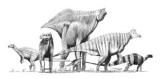
Ornithopods or members of the clade
Ornithopoda (ɔr) are a group of ornithischia
n dinosaur
s that started out as small, bipedal running
grazers, and grew in size and numbers until they became one of the most successful groups of herbivore
s in the Cretaceous
world, and dominated the North America
n landscape. Their major evolutionary advantage was the progressive development of a chewing apparatus that became the most sophisticated ever developed by a reptile
, rivalling that of modern mammal
s like the domestic cow. They reached their apex in the duck-bills, before they were wiped out by the Cretaceous-Tertiary extinction event
along with all other non-avian dinosaur
s. Members are known from all seven continent
s, although the Antarctic
remains are unnamed, and they are generally rare in the Southern Hemisphere
.
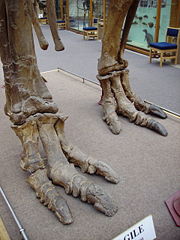 Ornithopoda means "bird feet", from the Greek
ornithos ("bird") and pous ("feet"); this refers to their characteristic three-toe
d feet, although many early forms retained four toes. They were also characterized by having no armour, the development of a horny beak
, an elongated pubis
that eventually extended past the ilium
, and a missing hole in the lower jaw
. A variety of ornithopods and related cerapods
had thin cartilaginous
plates along the outside of the ribs; in some cases, these plates mineralized and were fossilized. The function of these intercostal plates is unknown. They have been found with Hypsilophodon
, Othnielosaurus
, Parksosaurus
, Talenkauen
, Thescelosaurus
, and Macrogryphosaurus
to date.
The early ornithopods were only about 1 metre (3 feet) long, but probably very fast. They had a stiff tail, like the theropods
, to help them balance as they ran on their hind legs. Later ornithopods became more adapted to grazing on all fours; their spine
s curved, and came to resemble the spines of modern ground-feeders like the bison
. As they became more adapted to eating while bent over, they became semi-quadruped
al; still running on two legs, and comfortable reaching up into trees; but spending most of their time walking or grazing while on all fours. The taxonomy of dinosaurs previously ascribed to the hypsilophodontidae is problematic. The group previously consisted of all non-Iguanodontid bipedal ornithischians, but a phylogenetic reappraisal has shown such species to be paraphyletic. As such, the hypsilophodont family is represented only by Hypsilophodon
.
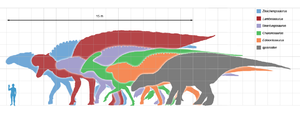 Later ornithopods became larger, but never rivalled the incredible size of the long-necked, long-tailed sauropods that they partially supplanted. The very largest, like Shantungosaurus
were as heavy as medium sized sauropods at up to 23 metric tons (25 short ton
s) but never grew far beyond 15 metres (50 feet).
 Historically, most indeterminate ornithischian biped
s were lumped in as ornithopods. Most have since been reclassified as basal
members of typically quadrupedal taxa like Marginocephalia
; and some, like the "bone-headed" pachycephalosaurids, have been given their own taxa.
(originally named as an unranked clade
), while others, such as Ibiricu et al. 2010, have retained it at its traditional rank of suborder.
Suborder Ornithopoda
below follows a 2009 analysis by Zheng and colleagues.
Cladogram after Butler et al, 2011.
Clade
A clade is a group consisting of a species and all its descendants. In the terms of biological systematics, a clade is a single "branch" on the "tree of life". The idea that such a "natural group" of organisms should be grouped together and given a taxonomic name is central to biological...
Ornithopoda (ɔr) are a group of ornithischia
Ornithischia
Ornithischia or Predentata is an extinct order of beaked, herbivorous dinosaurs. The name ornithischia is derived from the Greek ornitheos meaning 'of a bird' and ischion meaning 'hip joint'...
n dinosaur
Dinosaur
Dinosaurs are a diverse group of animals of the clade and superorder Dinosauria. They were the dominant terrestrial vertebrates for over 160 million years, from the late Triassic period until the end of the Cretaceous , when the Cretaceous–Paleogene extinction event led to the extinction of...
s that started out as small, bipedal running
Cursorial
Cursorial is a biological term that describes an organism as being adapted specifically to run. It is typically used in conjunction with an animal's feeding habits or another important adaptation. For example, a horse can be considered a "cursorial grazer", while a wolf may be considered a...
grazers, and grew in size and numbers until they became one of the most successful groups of herbivore
Herbivore
Herbivores are organisms that are anatomically and physiologically adapted to eat plant-based foods. Herbivory is a form of consumption in which an organism principally eats autotrophs such as plants, algae and photosynthesizing bacteria. More generally, organisms that feed on autotrophs in...
s in the Cretaceous
Cretaceous
The Cretaceous , derived from the Latin "creta" , usually abbreviated K for its German translation Kreide , is a geologic period and system from circa to million years ago. In the geologic timescale, the Cretaceous follows the Jurassic period and is followed by the Paleogene period of the...
world, and dominated the North America
North America
North America is a continent wholly within the Northern Hemisphere and almost wholly within the Western Hemisphere. It is also considered a northern subcontinent of the Americas...
n landscape. Their major evolutionary advantage was the progressive development of a chewing apparatus that became the most sophisticated ever developed by a reptile
Reptile
Reptiles are members of a class of air-breathing, ectothermic vertebrates which are characterized by laying shelled eggs , and having skin covered in scales and/or scutes. They are tetrapods, either having four limbs or being descended from four-limbed ancestors...
, rivalling that of modern mammal
Mammal
Mammals are members of a class of air-breathing vertebrate animals characterised by the possession of endothermy, hair, three middle ear bones, and mammary glands functional in mothers with young...
s like the domestic cow. They reached their apex in the duck-bills, before they were wiped out by the Cretaceous-Tertiary extinction event
Cretaceous-Tertiary extinction event
The Cretaceous–Paleogene extinction event, formerly named and still commonly referred to as the Cretaceous-Tertiary extinction event, occurred approximately 65.5 million years ago at the end of the Maastrichtian age of the Cretaceous period. It was a large-scale mass extinction of animal and plant...
along with all other non-avian dinosaur
Dinosaur
Dinosaurs are a diverse group of animals of the clade and superorder Dinosauria. They were the dominant terrestrial vertebrates for over 160 million years, from the late Triassic period until the end of the Cretaceous , when the Cretaceous–Paleogene extinction event led to the extinction of...
s. Members are known from all seven continent
Continent
A continent is one of several very large landmasses on Earth. They are generally identified by convention rather than any strict criteria, with seven regions commonly regarded as continents—they are : Asia, Africa, North America, South America, Antarctica, Europe, and Australia.Plate tectonics is...
s, although the Antarctic
Antarctic
The Antarctic is the region around the Earth's South Pole, opposite the Arctic region around the North Pole. The Antarctic comprises the continent of Antarctica and the ice shelves, waters and island territories in the Southern Ocean situated south of the Antarctic Convergence...
remains are unnamed, and they are generally rare in the Southern Hemisphere
Southern Hemisphere
The Southern Hemisphere is the part of Earth that lies south of the equator. The word hemisphere literally means 'half ball' or "half sphere"...
.
Description
Greek language
Greek is an independent branch of the Indo-European family of languages. Native to the southern Balkans, it has the longest documented history of any Indo-European language, spanning 34 centuries of written records. Its writing system has been the Greek alphabet for the majority of its history;...
ornithos ("bird") and pous ("feet"); this refers to their characteristic three-toe
Toe
Toes are the digits of the foot of a tetrapod. Animal species such as cats that walk on their toes are described as being digitigrade. Humans, and other animals that walk on the soles of their feet, are described as being plantigrade; unguligrade animals are those that walk on hooves at the tips of...
d feet, although many early forms retained four toes. They were also characterized by having no armour, the development of a horny beak
Beak
The beak, bill or rostrum is an external anatomical structure of birds which is used for eating and for grooming, manipulating objects, killing prey, fighting, probing for food, courtship and feeding young...
, an elongated pubis
Pubis (bone)
In vertebrates, the pubic bone is the ventral and anterior of the three principal bones composing either half of the pelvis.It is covered by a layer of fat, which is covered by the mons pubis....
that eventually extended past the ilium
Ilium (bone)
The ilium is the uppermost and largest bone of the pelvis, and appears in most vertebrates including mammals and birds, but not bony fish. All reptiles have an ilium except snakes, although some snake species have a tiny bone which is considered to be an ilium.The name comes from the Latin ,...
, and a missing hole in the lower jaw
Jaw
The jaw is any opposable articulated structure at the entrance of the mouth, typically used for grasping and manipulating food. The term jaws is also broadly applied to the whole of the structures constituting the vault of the mouth and serving to open and close it and is part of the body plan of...
. A variety of ornithopods and related cerapods
Cerapoda
Neornithischia is a clade of the dinosaur order Ornithischia. They are the sister group of the Thyreophora within the clade Genasauria. Neornithischians are united by having a thicker layer of asymmetrical enamel on the inside of their lower teeth...
had thin cartilaginous
Cartilage
Cartilage is a flexible connective tissue found in many areas in the bodies of humans and other animals, including the joints between bones, the rib cage, the ear, the nose, the elbow, the knee, the ankle, the bronchial tubes and the intervertebral discs...
plates along the outside of the ribs; in some cases, these plates mineralized and were fossilized. The function of these intercostal plates is unknown. They have been found with Hypsilophodon
Hypsilophodon
Hypsilophodon is an ornithopod dinosaur genus from the Early Cretaceous period of Europe. It was a small bipedal animal with an herbivorous or possibly omnivorous diet...
, Othnielosaurus
Othnielosaurus
Othnielosaurus is a genus of ornithischian dinosaur that lived about 155 to 148 million years ago, during the Late Jurassic-age Morrison Formation of the western United States. It is named in honor of famed paleontologist Othniel Charles Marsh, and was formerly assigned to the genus...
, Parksosaurus
Parksosaurus
Parksosaurus was a genus of hypsilophodont ornithopod dinosaur from the early Maastrichtian-age Upper Cretaceous Horseshoe Canyon Formation of Alberta, Canada. It is based on most of a partially articulated skeleton and partial skull, showing it to have been a small, bipedal, herbivorous dinosaur...
, Talenkauen
Talenkauen
Talenkauen is a genus of basal iguanodont dinosaur from the Maastrichtian-age Upper Cretaceous Pari Aike Formation of Lake Viedma, Santa Cruz, Argentina. It is based on MPM-10001, a partial articulated skeleton missing the rear part of the skull, the tail, and the hands...
, Thescelosaurus
Thescelosaurus
Thescelosaurus was a genus of small ornithopod dinosaur that appeared at the very end of the Late Cretaceous period in North America. It was a member of the last dinosaurian fauna before the Cretaceous-Tertiary extinction event around 65.5 million years ago...
, and Macrogryphosaurus
Macrogryphosaurus
Macrogryphosaurus is a genus of basal iguanodont dinosaur from the Turonian-early Coniacian age Upper Cretaceous Portezuelo Formation of Patagonia, Argentina. It was described by Jorge Calvo and colleagues, with M...
to date.
The early ornithopods were only about 1 metre (3 feet) long, but probably very fast. They had a stiff tail, like the theropods
Theropoda
Theropoda is both a suborder of bipedal saurischian dinosaurs, and a clade consisting of that suborder and its descendants . Dinosaurs belonging to the suborder theropoda were primarily carnivorous, although a number of theropod groups evolved herbivory, omnivory, and insectivory...
, to help them balance as they ran on their hind legs. Later ornithopods became more adapted to grazing on all fours; their spine
Vertebral column
In human anatomy, the vertebral column is a column usually consisting of 24 articulating vertebrae, and 9 fused vertebrae in the sacrum and the coccyx. It is situated in the dorsal aspect of the torso, separated by intervertebral discs...
s curved, and came to resemble the spines of modern ground-feeders like the bison
Bison
Members of the genus Bison are large, even-toed ungulates within the subfamily Bovinae. Two extant and four extinct species are recognized...
. As they became more adapted to eating while bent over, they became semi-quadruped
Quadruped
Quadrupedalism is a form of land animal locomotion using four limbs or legs. An animal or machine that usually moves in a quadrupedal manner is known as a quadruped, meaning "four feet"...
al; still running on two legs, and comfortable reaching up into trees; but spending most of their time walking or grazing while on all fours. The taxonomy of dinosaurs previously ascribed to the hypsilophodontidae is problematic. The group previously consisted of all non-Iguanodontid bipedal ornithischians, but a phylogenetic reappraisal has shown such species to be paraphyletic. As such, the hypsilophodont family is represented only by Hypsilophodon
Hypsilophodon
Hypsilophodon is an ornithopod dinosaur genus from the Early Cretaceous period of Europe. It was a small bipedal animal with an herbivorous or possibly omnivorous diet...
.
Shantungosaurus
Shantungosaurus, meaning "Shandong Lizard", is a genus of saurolophine hadrosaurid dinosaurs found in the Late Cretaceous Wangshi Formation of the Shandong Peninsula in China.-Description:...
were as heavy as medium sized sauropods at up to 23 metric tons (25 short ton
Short ton
The short ton is a unit of mass equal to . In the United States it is often called simply ton without distinguishing it from the metric ton or the long ton ; rather, the other two are specifically noted. There are, however, some U.S...
s) but never grew far beyond 15 metres (50 feet).
Classification
Biped
Bipedalism is a form of terrestrial locomotion where an organism moves by means of its two rear limbs, or legs. An animal or machine that usually moves in a bipedal manner is known as a biped , meaning "two feet"...
s were lumped in as ornithopods. Most have since been reclassified as basal
Basal (phylogenetics)
In phylogenetics, a basal clade is the earliest clade to branch in a larger clade; it appears at the base of a cladogram.A basal group forms an outgroup to the rest of the clade, such as in the following example:...
members of typically quadrupedal taxa like Marginocephalia
Marginocephalia
Marginocephalia is a clade of ornithischian dinosaurs that includes the thick-skulled pachycephalosaurids, and horned ceratopsians. They were all herbivores, walking on two or four legs, and are characterized by a bony ridge or frill the back of the skull...
; and some, like the "bone-headed" pachycephalosaurids, have been given their own taxa.
Taxonomy
Ornithopoda is usually given the rank of Suborder, within the order Ornithischia. While ranked taxonomy has largely fallen out of favour among dinosaur paleontologists, some researchers have continued to employ such a classification, though sources have differed on what its rank should be. Benton (2004) placed it as an infraorder within the suborder CerapodaCerapoda
Neornithischia is a clade of the dinosaur order Ornithischia. They are the sister group of the Thyreophora within the clade Genasauria. Neornithischians are united by having a thicker layer of asymmetrical enamel on the inside of their lower teeth...
(originally named as an unranked clade
Clade
A clade is a group consisting of a species and all its descendants. In the terms of biological systematics, a clade is a single "branch" on the "tree of life". The idea that such a "natural group" of organisms should be grouped together and given a taxonomic name is central to biological...
), while others, such as Ibiricu et al. 2010, have retained it at its traditional rank of suborder.
Suborder Ornithopoda
- ChangchunsaurusChangchunsaurusChangchunsaurus is an extinct genus of small herbivorous ornithopod dinosaur from Early Cretaceous deposits of Gongzhuling, Jilin, China. It is the first named dinosaur genus from Jilin.-Description:...
- Family HypsilophodontHypsilophodontHypsilophodonts were small ornithopod dinosaurs, regarded as fast, herbivorous bipeds on the order of 1–2 meters long . They are known from Asia, Australia, Europe, New Zealand, North America, and South America, from rocks of Middle Jurassic to late Cretaceous age...
idae*ParaphylyA group of taxa is said to be paraphyletic if the group consists of all the descendants of a hypothetical closest common ancestor minus one or more monophyletic groups of descendants... - Unranked cladeCladeA clade is a group consisting of a species and all its descendants. In the terms of biological systematics, a clade is a single "branch" on the "tree of life". The idea that such a "natural group" of organisms should be grouped together and given a taxonomic name is central to biological...
Iguanodontia- AnabisetiaAnabisetiaAnabisetia is a genus of ornithopod dinosaur from the Late Cretaceous Period of Patagonia, South America. It was a small bipedal herbivore, almost seven feet long....
- ?BihariosaurusBihariosaurusBihariosaurus was a genus of camptosaurid dinosaur from Late Cretaceous Romania. The type species, Bihariosaurus bauxiticus, was described by Marinescu in 1989. It was similar to Camptosaurus, and was an iguanodont....
- Elasmaria
- MacrogryphosaurusMacrogryphosaurusMacrogryphosaurus is a genus of basal iguanodont dinosaur from the Turonian-early Coniacian age Upper Cretaceous Portezuelo Formation of Patagonia, Argentina. It was described by Jorge Calvo and colleagues, with M...
- TalenkauenTalenkauenTalenkauen is a genus of basal iguanodont dinosaur from the Maastrichtian-age Upper Cretaceous Pari Aike Formation of Lake Viedma, Santa Cruz, Argentina. It is based on MPM-10001, a partial articulated skeleton missing the rear part of the skull, the tail, and the hands...
- Macrogryphosaurus
- TenontosaurusTenontosaurusTenontosaurus is a genus of medium- to large-sized ornithopod dinosaur. The genus is known from the late Aptian to Albian ages of the middle Cretaceous period sediments of western North America, dating between 115 to 108 million years ago...
- Family Camptosauridae
- Family DryosauridaeDryosauridaeDryosaurids were primitive iguanodonts. They are known from Middle Jurassic to Early Cretaceous rocks of Africa, Europe, and North America.-Phylogeny:...
- Family RhabdodontidaeRhabdodontidaeRhabdodontids were herbivorous ornithopod dinosaurs from the Cretaceous Period. Rhabdodontids were similar to large, robust hypsilophodonts, with deep skulls and jaws. The family was first proposed by David B. Weishampel et al. in 2002...
- Hadrosauriformes
- Family IguanodonIguanodonIguanodon is a genus of ornithopod dinosaur that lived roughly halfway between the first of the swift bipedal hypsilophodontids and the ornithopods' culmination in the duck-billed dinosaurs...
tidae - Superfamily HadrosauroideaHadrosauroideaHadrosauroidea is a clade or superfamily of ornithischian dinosaurs that includes the "duck-billed" dinosaurs, or hadrosaurids, and their close relatives. Many primitive hadrosauroids, such as the sail-backed Ouranosaurus, have traditionally been included in a paraphyletic "Iguanodontidae"...
- Family Hadrosauridae
- Family Iguanodon
- Anabisetia
Phylogeny
The cladogramCladogram
A cladogram is a diagram used in cladistics which shows ancestral relations between organisms, to represent the evolutionary tree of life. Although traditionally such cladograms were generated largely on the basis of morphological characters, DNA and RNA sequencing data and computational...
below follows a 2009 analysis by Zheng and colleagues.
Cladogram after Butler et al, 2011.
External links
- Ornithopoda, by Justin Tweet, from Thescelosaurus!
- GEOL 104 dinosaurs: a Natural history, ornithopoda: beaks, bills & crests, by Thomas R. Holtz, Jr.