


Open sandwich

Encyclopedia
Bread
Bread is a staple food prepared by cooking a dough of flour and water and often additional ingredients. Doughs are usually baked, but in some cuisines breads are steamed , fried , or baked on an unoiled frying pan . It may be leavened or unleavened...
with one or more food
Food
Food is any substance consumed to provide nutritional support for the body. It is usually of plant or animal origin, and contains essential nutrients, such as carbohydrates, fats, proteins, vitamins, or minerals...
items on top.
In various countries
An open sandwich is a slice of fresh bread or toast, with different spreads, butter, liver pâtéPâté
Pâté is a mixture of ground meat and fat minced into a spreadable paste. Common additions include vegetables, herbs, spices, and either wine or cognac, armagnac or brandy...
, cheese spreads, cold cuts such as roast beef
Roast beef
Roast beef is a dish of beef which is roasted in an oven. Essentially prepared as a main meal, the leftovers can be and are often served within sandwiches and sometimes is used to make hash...
, turkey, ham, bacon, salami
Salami
Salami is cured sausage, fermented and air-dried meat, originating from one of a variety of animals. Historically, salami has been popular among Southern European peasants because it can be stored at room temperature for periods of up to 10 years, supplementing a possibly meager or inconsistent...
, beef tongue
Beef tongue
Beef tongue is the tongue of a cow. The human consumption of beef tongue dates back to the days of Paleolithic hunters, who preferred the fatty portions of the carcass including tongues, as well as organs, brains, feet, and marrow. Beef tongue is very high in fat, at almost 75% of its calories...
, mortadella
Mortadella
Mortadella is a large Italian sausage or cold cut made of finely hashed or ground, heat-cured pork sausage, which incorporates at least 15% small cubes of pork fat . Mortadella is a staple product of Bologna, Italy...
, head cheese
Head cheese
Head cheese , or brawn , is a cold cut that originated in Europe. A version pickled with vinegar is known as souse. Head cheese is not a cheese but a terrine or meat jelly made with flesh from the head of a calf or pig , and often set in aspic. Which parts of the head are used can vary, but the...
or sausages like beerwurst
Beerwurst
Bierwurst is a German cooked, smoked Brühwurst sausage originally from Bavaria, with a garlicky flavor and dark red color. It is seasoned with black peppercorns, paprika, and mustard seeds for flavor....
or kabanos
Kabanos
Kabanos is a long thin stick of Polish dry sausage made of pork. They are smoky in flavor, and can be soft or very dry in texture depending on freshness. Typically they are quite long, but very thin, with a diameter of around , and folded in two, giving them a very characteristic appearance...
, and vegetables like bell peppers, tomatoes, radish, scallion and cucumber. Open sandwiches like this are consumed in Austria
Austria
Austria , officially the Republic of Austria , is a landlocked country of roughly 8.4 million people in Central Europe. It is bordered by the Czech Republic and Germany to the north, Slovakia and Hungary to the east, Slovenia and Italy to the south, and Switzerland and Liechtenstein to the...
, Germany
Germany
Germany , officially the Federal Republic of Germany , is a federal parliamentary republic in Europe. The country consists of 16 states while the capital and largest city is Berlin. Germany covers an area of 357,021 km2 and has a largely temperate seasonal climate...
, Hungary
Hungary
Hungary , officially the Republic of Hungary , is a landlocked country in Central Europe. It is situated in the Carpathian Basin and is bordered by Slovakia to the north, Ukraine and Romania to the east, Serbia and Croatia to the south, Slovenia to the southwest and Austria to the west. The...
, the Netherlands, Poland
Poland
Poland , officially the Republic of Poland , is a country in Central Europe bordered by Germany to the west; the Czech Republic and Slovakia to the south; Ukraine, Belarus and Lithuania to the east; and the Baltic Sea and Kaliningrad Oblast, a Russian exclave, to the north...
as well as other parts of Europe
Europe
Europe is, by convention, one of the world's seven continents. Comprising the westernmost peninsula of Eurasia, Europe is generally 'divided' from Asia to its east by the watershed divides of the Ural and Caucasus Mountains, the Ural River, the Caspian and Black Seas, and the waterways connecting...
, and North America
North America
North America is a continent wholly within the Northern Hemisphere and almost wholly within the Western Hemisphere. It is also considered a northern subcontinent of the Americas...
as a regular breakfast
Breakfast
Breakfast is the first meal taken after rising from a night's sleep, most often eaten in the early morning before undertaking the day's work...
and supper
Supper
Supper is the name for the evening meal in some dialects of English - ordinarily the last meal of the day. Originally, in the Middle Ages, it referred to the lighter meal following dinner, where until the 18th century dinner was invariably eaten as the midday meal.The term is derived from the...
food item. The American tongue toast
Tongue toast
Tongue toast is an open faced sandwich prepared with sauteed beef tongue, and scrambled eggs. It is seasoned to taste with black pepper and onions. Sometimes the tongue is served on buttered toast instead, with a poached egg instead of a scrambled one...
is offered as an entrée for breakfast, lunch, and supper and as an hors d'œuvre for formal parties.
In Great Britain, the open toasted sandwich doesn't exist, instead there is "on toast" e.g. cheese on toast. However, this is not considered a sandwich.
The Dutch and Flemish Uitsmijter arrives on a large plate with large slices of usually white bread, topped with a selection of meats, cheeses, vegetables and possibly an egg. The dish is often served as a hearty breakfast.
Open sandwich is the common, traditional sandwich type in the Nordic countries
Nordic countries
The Nordic countries make up a region in Northern Europe and the North Atlantic which consists of Denmark, Finland, Iceland, Norway and Sweden and their associated territories, the Faroe Islands, Greenland and Åland...
, Estonia
Estonia
Estonia , officially the Republic of Estonia , is a state in the Baltic region of Northern Europe. It is bordered to the north by the Gulf of Finland, to the west by the Baltic Sea, to the south by Latvia , and to the east by Lake Peipsi and the Russian Federation . Across the Baltic Sea lies...
, the Netherlands
Netherlands
The Netherlands is a constituent country of the Kingdom of the Netherlands, located mainly in North-West Europe and with several islands in the Caribbean. Mainland Netherlands borders the North Sea to the north and west, Belgium to the south, and Germany to the east, and shares maritime borders...
, Lithuania
Lithuania
Lithuania , officially the Republic of Lithuania is a country in Northern Europe, the biggest of the three Baltic states. It is situated along the southeastern shore of the Baltic Sea, whereby to the west lie Sweden and Denmark...
and Latvia
Latvia
Latvia , officially the Republic of Latvia , is a country in the Baltic region of Northern Europe. It is bordered to the north by Estonia , to the south by Lithuania , to the east by the Russian Federation , to the southeast by Belarus and shares maritime borders to the west with Sweden...
, where it is typically eaten at breakfast, as lunch or other meal.
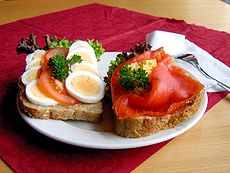
The Scandinavian open sandwich consists of one piece of buttered bread, often whole-grain rye
Rye
Rye is a grass grown extensively as a grain and as a forage crop. It is a member of the wheat tribe and is closely related to barley and wheat. Rye grain is used for flour, rye bread, rye beer, some whiskeys, some vodkas, and animal fodder...
bread , topped with, for instance, cold steak
Steak
A steak is a cut of meat . Most are cut perpendicular to the muscle fibers, improving the perceived tenderness of the meat. In North America, steaks are typically served grilled, pan-fried, or broiled. The more tender cuts from the loin and rib are cooked quickly, using dry heat, and served whole...
, shrimp
Shrimp
Shrimp are swimming, decapod crustaceans classified in the infraorder Caridea, found widely around the world in both fresh and salt water. Adult shrimp are filter feeding benthic animals living close to the bottom. They can live in schools and can swim rapidly backwards. Shrimp are an important...
s, smoked salmon
Salmon
Salmon is the common name for several species of fish in the family Salmonidae. Several other fish in the same family are called trout; the difference is often said to be that salmon migrate and trout are resident, but this distinction does not strictly hold true...
, caviar
Caviar
Caviar, sometimes called black caviar, is a luxury delicacy, consisting of processed, salted, non-fertilized sturgeon roe. The roe can be "fresh" or pasteurized, the latter having much less culinary and economic value....
, hard boiled eggs, bacon, herring
Herring
Herring is an oily fish of the genus Clupea, found in the shallow, temperate waters of the North Pacific and the North Atlantic oceans, including the Baltic Sea. Three species of Clupea are recognized. The main taxa, the Atlantic herring and the Pacific herring may each be divided into subspecies...
, fish fillets, liver pâté , and/or small meatballs. This is typically complemented by some herb
Herb
Except in botanical usage, an herb is "any plant with leaves, seeds, or flowers used for flavoring, food, medicine, or perfume" or "a part of such a plant as used in cooking"...
s and vegetables such as parsley
Parsley
Parsley is a species of Petroselinum in the family Apiaceae, native to the central Mediterranean region , naturalized elsewhere in Europe, and widely cultivated as an herb, a spice and a vegetable.- Description :Garden parsley is a bright green hairless biennial herbaceous plant in temperate...
, cold salad, thinly sliced cucumber, tomato wedges and/or pickled beets etc. on the same slice of bread. A condiment, such as mayonnaise, or mayonnaise-based dressing is also often included in some form. An old traditional replacement for butter on a piece of bread with herring is pig fat. There are many variations associated with the smørrebrød/smørbrød/smörgås and there are even special stores, cafés and restaurants (especially in Denmark) that specialize in them. In Finland
Finland
Finland , officially the Republic of Finland, is a Nordic country situated in the Fennoscandian region of Northern Europe. It is bordered by Sweden in the west, Norway in the north and Russia in the east, while Estonia lies to its south across the Gulf of Finland.Around 5.4 million people reside...
the sandwich is called voileipä which also means "butter bread" and the Finnish rye bread
Breads of Finland
In Finland, bread is a very important food, served with almost every meal with many different types produced domestically.In the Swedish-speaking region of Åland , there are other varieties of bread, the majority of which owe much to Swedish cuisine.-Rye bread:...
is ruisleipä.
Sweet toppings are commonly used for breakfast in the Netherlands and Belgium
Belgium
Belgium , officially the Kingdom of Belgium, is a federal state in Western Europe. It is a founding member of the European Union and hosts the EU's headquarters, and those of several other major international organisations such as NATO.Belgium is also a member of, or affiliated to, many...
: e.g. sprinkles
Sprinkles
Sprinkles are very small pieces of confectionery used as a decoration or to add texture to desserts—typically cupcakes, cookies, doughnuts, ice cream, frozen yogurt, and some puddings...
, vlokken
Vlokken
Vlokken is a commonly used sandwich topping in the Netherlands. One vlok is made of chocolate and is curved, its size is about 0.5 cm x 2 cm x 0.1 cm....
, or muisjes
Muisjes
Muisjes are a traditional Dutch open-faced sandwich topping, very similar to nonpareils. While customary on bread, their most typical use is on beschuit, or rusk. Muisjes are made of aniseed sprinkles with a sugared and colored outer layer...
, next to the more widespread peanut butter
Peanut butter
Peanut butter is a food paste made primarily from ground dry roasted peanuts, popular in North America, Netherlands, United Kingdom, and parts of Asia, particularly the Philippines and Indonesia. It is mainly used as a sandwich spread, sometimes in combination as in the peanut butter and jelly...
, honey
Honey
Honey is a sweet food made by bees using nectar from flowers. The variety produced by honey bees is the one most commonly referred to and is the type of honey collected by beekeepers and consumed by humans...
, jam
Fruit preserves
Fruit preserves are preparations of fruits and sugar, often canned or sealed for long-term storage. The preparation of fruit preserves today often involves adding commercial or natural pectin as a gelling agent, although sugar or honey may be used, as well. Prior to World War II, fruit preserve...
, and chocolate spread
Chocolate spread
Chocolate spread is a chocolate-flavoured paste which is eaten mostly spread on breads and toasts or similar pastries such as muffins and pitas.Chocolate spread is a product favored mainly by children and serves as a prevalent spread on their sandwiches....
.
In the United States
United States
The United States of America is a federal constitutional republic comprising fifty states and a federal district...
an open faced sandwich may also refer to a slice of bread topped with warm slices of roasted
Roasting
Roasting is a cooking method that uses dry heat, whether an open flame, oven, or other heat source. Roasting usually causes caramelization or Maillard browning of the surface of the food, which is considered by some as a flavor enhancement. Roasting uses more indirect, diffused heat , and is...
meat and gravy
Gravy
Gravy is a sauce made often from the juices that run naturally from meat or vegetables during cooking. In North America the term can refer to a wider variety of sauces and gravy is often thicker than in Britain...
(called a "Manhattan
Beef Manhattan
Beef Manhattan is a dish consisting of roast beef and gravy. It is often served with mashed potatoes either on top or on the side. A variation on this dish is Turkey Manhattan, which substitutes turkey for the roast beef...
" in some areas), or bread topped with Welsh rarebit. This is also done in Scandinavian countries, where they eat open faced sandwiches with fried meat and fried fish quite often.
History
During the Middle AgesMiddle Ages
The Middle Ages is a periodization of European history from the 5th century to the 15th century. The Middle Ages follows the fall of the Western Roman Empire in 476 and precedes the Early Modern Era. It is the middle period of a three-period division of Western history: Classic, Medieval and Modern...
, thick slabs of coarse bread called "tranches" (late 15th century French) or, in its English derivative, "trenchers", were used as plates. At the end of the meal, the food-soaked trencher was eaten by the diner (from which we get the expression "trencherman"), or perhaps fed to a dog or saved for beggars. Trenchers were as much the harbingers of open-face sandwiches as they were of disposable dishware.
As such, open-face sandwiches have a unique origin and history, differing from that of the true (multi-slice) sandwich.
Usage
The term "sandwich" is occasionally used (informally) in reference to open-faced sandwiches, but the term "sandwich" more formally refers to a dish with two slices of bread with a filling between them, not on top. The open-faced "sandwich" also has a unique history (described above), originating between the 6th and 16th centuries, whereas the modern sandwich traces its roots to the Earl of Sandwich.In the court case in the United States of Panera Bread Co.
Panera Bread
Panera Bread is a chain of bakery–café quick casual restaurants in the United States and Canada that sells breads, sandwiches, soups, salads, and other bakery items. Its headquarters are in Sunset Hills, Missouri, a suburb of St. Louis.-Corporate history:In 1993, Au Bon Pain Co...
v. Qdoba Mexican Grill
Qdoba Mexican Grill
Qdoba Mexican Grill , is a chain of fast casual "Fresh Mex" restaurants in the United States serving Mexican-style cuisine. The company is owned by Jack in the Box, having been owned and expanded by ACI Capital until 2003....
, the judge ruled that a true sandwich (from a legal perspective) must include at least two slices of bread. Many open-faced sandwiches do not satisfy this condition, although some served in diners and restaurants in the northeastern U. S. actually do pile the meat and gravy atop two overlapping slices of bread.
See also
- SandwichSandwichA sandwich is a food item, typically consisting of two or more slices of :bread with one or more fillings between them, or one slice of bread with a topping or toppings, commonly called an open sandwich. Sandwiches are a widely popular type of lunch food, typically taken to work or school, or...
- SmørrebrødSmørrebrødSmørrebrød usually consists of a piece of buttered rye bread , a dense, dark brown bread. Pålæg , the topping, then among others can refer to commercial or homemade cold cuts, pieces of meat or fish, cheese or spreads...
- ButterbrotButterbrotThe German word "Butterbrot" describes a slice of bread topped with butter. The words in formal and colloquial German and the different dialects for butterbrot , simply "Brot" , "Butterstulle", "Stulle", "Schnitte" ,...
- French toastFrench toastFrench toast or Eggy Bread, is a food made with bread and eggs. It is a Christmas time dessert in Portugal and Brazil.Where French toast is served as a sweet dish, milk, sugar, or cinnamon are also commonly added before frying, and it may be then topped with sugar, butter, fruit, syrup, or other...
- Welsh rarebit
- Ham and cheese sandwichHam and cheese sandwichThe ham and cheese sandwich is a common type of sandwich. It is made by putting cheese and sliced ham between two slices of bread. The bread is sometimes buttered and toasted. Vegetables like lettuce, tomato, onion or pickle slices can also be included...
- Croque-monsieurCroque-monsieurA croque-monsieur is a hot ham and cheese grilled sandwich. It originated in France as a fast-food snack served in cafés and bars...
- Grilled cheese sandwich
- FrancesinhaFrancesinhaFrancesinha is a Portuguese sandwich originally from Porto, made with bread, wet-cured ham, linguiça, fresh sausage like chipolata, steak or roast meat and covered with molten cheese and a hot thick tomato and beer sauce served with french fries.- History :It is said that the Francesinha was an...
- Monte Cristo sandwichMonte Cristo sandwichA Monte Cristo is a fried ham and cheese sandwich. The cheese used is Emmental or Gruyère.-Description:The sandwich can differ regionally. Regional variations may include sliced turkey along with the ham and cheese. Traditionally, the sandwich is dipped in its entirety in egg batter and fried...
- SmörgåsbordSmörgåsbordSmörgåsbord is a type of Scandinavian meal served buffet-style with multiple dishes of various foods on a table, originating in Sweden. In Norway it is called koldtbord, in Denmark it is called det kolde bord, in Finland seisova pöytä and in Estonia rootsi laud...
- Tongue toastTongue toastTongue toast is an open faced sandwich prepared with sauteed beef tongue, and scrambled eggs. It is seasoned to taste with black pepper and onions. Sometimes the tongue is served on buttered toast instead, with a poached egg instead of a scrambled one...
- List of sandwiches