

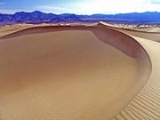
Sediment transport

Encyclopedia
Sediment
Sediment is naturally occurring material that is broken down by processes of weathering and erosion, and is subsequently transported by the action of fluids such as wind, water, or ice, and/or by the force of gravity acting on the particle itself....
), typically due to a combination of the force of gravity acting on the sediment, and/or the movement of the fluid
Fluid
In physics, a fluid is a substance that continually deforms under an applied shear stress. Fluids are a subset of the phases of matter and include liquids, gases, plasmas and, to some extent, plastic solids....
in which the sediment is entrained. An understanding of sediment transport is typically used in natural systems, where the particles are clastic rocks (sand
Sand
Sand is a naturally occurring granular material composed of finely divided rock and mineral particles.The composition of sand is highly variable, depending on the local rock sources and conditions, but the most common constituent of sand in inland continental settings and non-tropical coastal...
, gravel
Gravel
Gravel is composed of unconsolidated rock fragments that have a general particle size range and include size classes from granule- to boulder-sized fragments. Gravel can be sub-categorized into granule and cobble...
, boulders, etc.), mud
Mud
Mud is a mixture of water and some combination of soil, silt, and clay. Ancient mud deposits harden over geological time to form sedimentary rock such as shale or mudstone . When geological deposits of mud are formed in estuaries the resultant layers are termed bay muds...
, or clay
Clay
Clay is a general term including many combinations of one or more clay minerals with traces of metal oxides and organic matter. Geologic clay deposits are mostly composed of phyllosilicate minerals containing variable amounts of water trapped in the mineral structure.- Formation :Clay minerals...
; the fluid is air, water, or ice; and the force of gravity acts to move the particles due to the sloping surface on which they are resting. Sediment transport due to fluid motion occurs in river
River
A river is a natural watercourse, usually freshwater, flowing towards an ocean, a lake, a sea, or another river. In a few cases, a river simply flows into the ground or dries up completely before reaching another body of water. Small rivers may also be called by several other names, including...
s, the ocean
Ocean
An ocean is a major body of saline water, and a principal component of the hydrosphere. Approximately 71% of the Earth's surface is covered by ocean, a continuous body of water that is customarily divided into several principal oceans and smaller seas.More than half of this area is over 3,000...
s, lakes, sea
Sea
A sea generally refers to a large body of salt water, but the term is used in other contexts as well. Most commonly, it means a large expanse of saline water connected with an ocean, and is commonly used as a synonym for ocean...
s, and other bodies of water, due to currents
Current (fluid)
A current in a fluid is the magnitude and direction of flow within that fluid. An air current presents the same properties for a gaseous medium.Kinds of fluid currents include.* Boundary current* Current , a current in a river or stream...
and tide
Tide
Tides are the rise and fall of sea levels caused by the combined effects of the gravitational forces exerted by the moon and the sun and the rotation of the Earth....
s; in glacier
Glacier
A glacier is a large persistent body of ice that forms where the accumulation of snow exceeds its ablation over many years, often centuries. At least 0.1 km² in area and 50 m thick, but often much larger, a glacier slowly deforms and flows due to stresses induced by its weight...
s as they flow, and on terrestrial surfaces under the influence of wind
Wind
Wind is the flow of gases on a large scale. On Earth, wind consists of the bulk movement of air. In outer space, solar wind is the movement of gases or charged particles from the sun through space, while planetary wind is the outgassing of light chemical elements from a planet's atmosphere into space...
. Sediment transport due only to gravity can occur on sloping surfaces in general, including hill
Hill
A hill is a landform that extends above the surrounding terrain. Hills often have a distinct summit, although in areas with scarp/dip topography a hill may refer to a particular section of flat terrain without a massive summit A hill is a landform that extends above the surrounding terrain. Hills...
slopes, scarp
Escarpment
An escarpment is a steep slope or long cliff that occurs from erosion or faulting and separates two relatively level areas of differing elevations.-Description and variants:...
s, cliff
Cliff
In geography and geology, a cliff is a significant vertical, or near vertical, rock exposure. Cliffs are formed as erosion landforms due to the processes of erosion and weathering that produce them. Cliffs are common on coasts, in mountainous areas, escarpments and along rivers. Cliffs are usually...
s, and the continental shelf
Continental shelf
The continental shelf is the extended perimeter of each continent and associated coastal plain. Much of the shelf was exposed during glacial periods, but is now submerged under relatively shallow seas and gulfs, and was similarly submerged during other interglacial periods. The continental margin,...
—continental slope boundary.
Sediment transport is important in the fields of sedimentary geology, geomorphology
Geomorphology
Geomorphology is the scientific study of landforms and the processes that shape them...
, civil engineering
Civil engineering
Civil engineering is a professional engineering discipline that deals with the design, construction, and maintenance of the physical and naturally built environment, including works like roads, bridges, canals, dams, and buildings...
and environmental engineering
Environmental engineering
Environmental engineering is the application of science and engineering principles to improve the natural environment , to provide healthy water, air, and land for human habitation and for other organisms, and to remediate polluted sites...
(see applications, below). Knowledge of sediment transport is most often used to know whether erosion
Erosion
Erosion is when materials are removed from the surface and changed into something else. It only works by hydraulic actions and transport of solids in the natural environment, and leads to the deposition of these materials elsewhere...
or deposition will occur, the magnitude of this erosion or deposition, and the time and distance over which it will occur.
Mechanisms
Aeolian
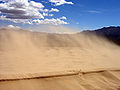
Aeolian or eolian (depending on the parsing of æÆ
Æ is a grapheme formed from the letters a and e. Originally a ligature representing a Latin diphthong, it has been promoted to the full status of a letter in the alphabets of some languages, including Danish, Faroese, Norwegian and Icelandic...
) is the term for sediment transport by wind
Wind
Wind is the flow of gases on a large scale. On Earth, wind consists of the bulk movement of air. In outer space, solar wind is the movement of gases or charged particles from the sun through space, while planetary wind is the outgassing of light chemical elements from a planet's atmosphere into space...
. This process results in the formation of ripples and sand dunes. Typically, the size of the transported sediment is fine sand
Sand
Sand is a naturally occurring granular material composed of finely divided rock and mineral particles.The composition of sand is highly variable, depending on the local rock sources and conditions, but the most common constituent of sand in inland continental settings and non-tropical coastal...
(<1 mm) and smaller, because air is a fluid with low density
Density
The mass density or density of a material is defined as its mass per unit volume. The symbol most often used for density is ρ . In some cases , density is also defined as its weight per unit volume; although, this quantity is more properly called specific weight...
and viscosity
Viscosity
Viscosity is a measure of the resistance of a fluid which is being deformed by either shear or tensile stress. In everyday terms , viscosity is "thickness" or "internal friction". Thus, water is "thin", having a lower viscosity, while honey is "thick", having a higher viscosity...
, and can therefore not exert very much shear
Shear strength
Shear strength in engineering is a term used to describe the strength of a material or component against the type of yield or structural failure where the material or component fails in shear. A shear load is a force that tends to produce a sliding failure on a material along a plane that is...
on its bed.
Bedform
Bedform
A bedform is a depositional feature on the bed of a river or other body of flowing water that is formed by the movement of the bed material due to the flow. Bedforms are characteristic to the flow parameters, and are particularly to flow depth and velocity, and therefore the Froude...
s are generated by aeolian sediment transport in the terrestrial near-surface environment. Ripples
Ripple marks
In geology, ripple marks are sedimentary structures and indicate agitation by water or wind.- Defining ripple cross-laminae and asymmetric ripples :...
and dune
Dune
In physical geography, a dune is a hill of sand built by wind. Dunes occur in different forms and sizes, formed by interaction with the wind. Most kinds of dunes are longer on the windward side where the sand is pushed up the dune and have a shorter "slip face" in the lee of the wind...
s form as a natural self-organizing response to sediment transport.
Aeolian sediment transport is common on beaches and in the arid regions of the world, because it is in these environments that vegetation does not prevent the presence and motion of fields of sand.
Wind-blown very fine-grained dust
Dust
Dust consists of particles in the atmosphere that arise from various sources such as soil dust lifted up by wind , volcanic eruptions, and pollution...
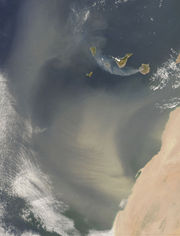
is capable of entering the upper atmosphere and moving across the globe. Dust from the Sahara
Sahara
The Sahara is the world's second largest desert, after Antarctica. At over , it covers most of Northern Africa, making it almost as large as Europe or the United States. The Sahara stretches from the Red Sea, including parts of the Mediterranean coasts, to the outskirts of the Atlantic Ocean...
deposits on the Canary Islands
Canary Islands
The Canary Islands , also known as the Canaries , is a Spanish archipelago located just off the northwest coast of mainland Africa, 100 km west of the border between Morocco and the Western Sahara. The Canaries are a Spanish autonomous community and an outermost region of the European Union...
and islands in the Caribbean
Caribbean
The Caribbean is a crescent-shaped group of islands more than 2,000 miles long separating the Gulf of Mexico and the Caribbean Sea, to the west and south, from the Atlantic Ocean, to the east and north...
, and dust from the Gobi desert
Gobi Desert
The Gobi is a large desert region in Asia. It covers parts of northern and northwestern China, and of southern Mongolia. The desert basins of the Gobi are bounded by the Altai Mountains and the grasslands and steppes of Mongolia on the north, by the Hexi Corridor and Tibetan Plateau to the...
has deposited on the western United States
Western United States
.The Western United States, commonly referred to as the American West or simply "the West," traditionally refers to the region comprising the westernmost states of the United States. Because the U.S. expanded westward after its founding, the meaning of the West has evolved over time...
. This sediment is important to the soil budget and ecology of several islands.
Deposits of fine-grained wind-blown glacial
Glacier
A glacier is a large persistent body of ice that forms where the accumulation of snow exceeds its ablation over many years, often centuries. At least 0.1 km² in area and 50 m thick, but often much larger, a glacier slowly deforms and flows due to stresses induced by its weight...
sediment are called loess
Loess
Loess is an aeolian sediment formed by the accumulation of wind-blown silt, typically in the 20–50 micrometre size range, twenty percent or less clay and the balance equal parts sand and silt that are loosely cemented by calcium carbonate...
.
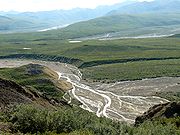
Fluvial
In geologyGeology
Geology is the science comprising the study of solid Earth, the rocks of which it is composed, and the processes by which it evolves. Geology gives insight into the history of the Earth, as it provides the primary evidence for plate tectonics, the evolutionary history of life, and past climates...
, physical geography
Physical geography
Physical geography is one of the two major subfields of geography. Physical geography is that branch of natural science which deals with the study of processes and patterns in the natural environment like the atmosphere, biosphere and geosphere, as opposed to the cultural or built environment, the...
, and sediment transport, fluvial
Fluvial
Fluvial is used in geography and Earth science to refer to the processes associated with rivers and streams and the deposits and landforms created by them...
processes relate to flowing water
Water
Water is a chemical substance with the chemical formula H2O. A water molecule contains one oxygen and two hydrogen atoms connected by covalent bonds. Water is a liquid at ambient conditions, but it often co-exists on Earth with its solid state, ice, and gaseous state . Water also exists in a...
in natural systems. This encompasses rivers, streams, periglacial
Periglacial
Periglacial is an adjective originally referring to places in the edges of glacial areas, but it has later been widely used in geomorphology to describe any place where geomorphic processes related to freezing of water occur...
flows, flash floods and glacial lake outburst flood
Glacial lake outburst flood
A glacial lake outburst flood is a type of outburst flood that occurs when the dam containing a glacial lake fails. The dam can consist of glacier ice or a terminal moraine...
s. Sediment moved by water can be larger than sediment moved by air because water has both a higher density
Density
The mass density or density of a material is defined as its mass per unit volume. The symbol most often used for density is ρ . In some cases , density is also defined as its weight per unit volume; although, this quantity is more properly called specific weight...
and viscosity
Viscosity
Viscosity is a measure of the resistance of a fluid which is being deformed by either shear or tensile stress. In everyday terms , viscosity is "thickness" or "internal friction". Thus, water is "thin", having a lower viscosity, while honey is "thick", having a higher viscosity...
. In typical rivers the largest carried sediment is of sand
Sand
Sand is a naturally occurring granular material composed of finely divided rock and mineral particles.The composition of sand is highly variable, depending on the local rock sources and conditions, but the most common constituent of sand in inland continental settings and non-tropical coastal...
and gravel
Gravel
Gravel is composed of unconsolidated rock fragments that have a general particle size range and include size classes from granule- to boulder-sized fragments. Gravel can be sub-categorized into granule and cobble...
size, but larger floods can carry cobbles and even boulders.
Fluvial sediment transport can result in the formation of ripple
Ripple marks
In geology, ripple marks are sedimentary structures and indicate agitation by water or wind.- Defining ripple cross-laminae and asymmetric ripples :...
s and dune
Dune
In physical geography, a dune is a hill of sand built by wind. Dunes occur in different forms and sizes, formed by interaction with the wind. Most kinds of dunes are longer on the windward side where the sand is pushed up the dune and have a shorter "slip face" in the lee of the wind...
s, in fractal
Fractal
A fractal has been defined as "a rough or fragmented geometric shape that can be split into parts, each of which is a reduced-size copy of the whole," a property called self-similarity...
-shaped patterns of erosion, in complex patterns of natural river systems, and in the development of floodplain
Floodplain
A floodplain, or flood plain, is a flat or nearly flat land adjacent a stream or river that stretches from the banks of its channel to the base of the enclosing valley walls and experiences flooding during periods of high discharge...
s.

Coastal
Coastal sediment transport takes place in near-shore environments due to the motions of waves and currents. At the mouths of rivers, coastal sediment and fluvial sediment transport processes mesh to create river deltaRiver delta
A delta is a landform that is formed at the mouth of a river where that river flows into an ocean, sea, estuary, lake, reservoir, flat arid area, or another river. Deltas are formed from the deposition of the sediment carried by the river as the flow leaves the mouth of the river...
s.
Coastal sediment transport results in the formation of characteristic coastal landforms such as beach
Beach
A beach is a geological landform along the shoreline of an ocean, sea, lake or river. It usually consists of loose particles which are often composed of rock, such as sand, gravel, shingle, pebbles or cobblestones...
es, barrier islands, and capes.
Glacial
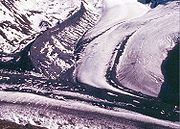
As glaciers move over their beds, they entrain and move material of all sizes. Glaciers can carry the largest sediment, and areas of glacial deposition often contain a large number of glacial erratics, many of which are several metres in diameter. Glaciers also pulverize rock into "glacial flour", which is so fine that it is often carried away by winds to create loessLoess
Loess is an aeolian sediment formed by the accumulation of wind-blown silt, typically in the 20–50 micrometre size range, twenty percent or less clay and the balance equal parts sand and silt that are loosely cemented by calcium carbonate...
deposits thousands of kilometres afield. Sediment entrained in glaciers often moves approximately along the glacial flowlines, causing it to appear at the surface in the ablation zone
Ablation zone
Ablation zone refers to the low altitude area of a glacier or ice sheet where there is a net loss in ice mass due to melting, sublimation, evaporation, or calving. The ablation zone is delineated by the equilibrium line altitude , or snow line, which separates the ablation zone and the high...
.
Hillslope
In hillslope sediment transport, a variety of processes move regolithRegolith
Regolith is a layer of loose, heterogeneous material covering solid rock. It includes dust, soil, broken rock, and other related materials and is present on Earth, the Moon, some asteroids, and other terrestrial planets and moons.-Etymology:...
downslope. These include:
- Soil creep
- Tree throwTree throwA tree throw or tree hole is a bowl-shaped cavity or depression created in the subsoil by a tree.They are formed either by the long term presence and growth of tree roots or when a large tree is blown over or has its stump pulled out which tears out a quantity of soil along with the roots...
- Movement of soil by burrowing animals
- Slumping and landsliding of the hillslope
These processes generally combine to give the hillslope a profile that looks like a solution to the diffusion equation, where the diffusivity is a parameter that relates to the ease of sediment transport on the particular hillslope. For this reason, the tops of hills generally have a parabolic concave-up profile, which grades into a convex-up profile around valleys.
As hillslopes steepen, however, they become more prone to episodic landslide
Landslide
A landslide or landslip is a geological phenomenon which includes a wide range of ground movement, such as rockfalls, deep failure of slopes and shallow debris flows, which can occur in offshore, coastal and onshore environments...
s and other mass wasting
Mass wasting
Mass wasting, also known as slope movement or mass movement, is the geomorphic process by which soil, regolith, and rock move downslope under the force of gravity. Types of mass wasting include creep, slides, flows, topples, and falls, each with its own characteristic features, and taking place...
events. Therefore, hillslope processes are better described by a nonlinear diffusion equation in which classic diffusion dominates for shallow slopes and erosion rates go to infinity as the hillslope reaches a critical angle of repose
Angle of repose
The angle of repose or, more precisely, the critical angle of repose, of a granular material is the steepest angle of descent or dip of the slope relative to the horizontal plane when material on the slope face is on the verge of sliding. This angle is in the range 0°–90°.When bulk granular...
.
Debris flow
Large masses of material are moved in debris flowDebris flow
A debris flow is a fast moving, liquefied landslide of unconsolidated, saturated debris that looks like flowing concrete. It is differentiated from a mudflow in terms of the viscosity and textural properties of the flow. Flows can carry material ranging in size from clay to boulders, and may...
s, hyperconcentrated mixtures of mud, clasts that range up to boulder-size, and water. Debris flows move as granular flows down steep mountain valleys and washes. Because they transport sediment as a granular mixture, their transport mechanisms and capacities scale differently than those of fluvial systems.
Applications
Sediment transport is applied to solve many environmental, geotechnical, and geological problems.Movement of sediment is important in providing habitat for fish and other organisms in rivers. Therefore, managers of highly regulated rivers, which are often sediment-starved due to dams, are often advised to stage short floods to refresh the bed material and rebuild bars. This is also important, for example, in the Grand Canyon
Grand Canyon
The Grand Canyon is a steep-sided canyon carved by the Colorado River in the United States in the state of Arizona. It is largely contained within the Grand Canyon National Park, the 15th national park in the United States...
of the Colorado River
Colorado River
The Colorado River , is a river in the Southwestern United States and northwestern Mexico, approximately long, draining a part of the arid regions on the western slope of the Rocky Mountains. The watershed of the Colorado River covers in parts of seven U.S. states and two Mexican states...
, to rebuild shoreline habitats also used as campsites.
Sediment discharge into a reservoir formed by a dam forms a reservoir delta
River delta
A delta is a landform that is formed at the mouth of a river where that river flows into an ocean, sea, estuary, lake, reservoir, flat arid area, or another river. Deltas are formed from the deposition of the sediment carried by the river as the flow leaves the mouth of the river...
. This delta will fill the basin, and eventually, either the reservoir will need to be dredged or the dam will need to be removed. Knowledge of sediment transport can be used to properly plan to extend the life of a dam.
Geologists can use inverse solutions of transport relationships to understand flow depth, velocity, and direction, from sedimentary rocks and young deposits of alluvial materials.
Flow in culverts, over dams, and around bridge piers can cause erosion of the bed. This erosion can damage the environment and expose or unsettle the foundations of the structure. Therefore, good knowledge of the mechanics of sediment transport in a built environment are important for civil and hydraulic engineers.
When suspended sediment transport is increased due to human activities, causing environmental problems including the filling of channels, it is called siltation
Siltation
Siltation is the pollution of water by fine particulate terrestrial clastic material, with a particle size dominated by silt or clay. It refers both to the increased concentration of suspended sediments, and to the increased accumulation of fine sediments on bottoms where they are undesirable...
after the grain-size fraction dominating the process.
Stress balance
For a fluid to begin transporting sediment that is currently at rest on a surface, the boundary (or bed) shear stressShear stress
A shear stress, denoted \tau\, , is defined as the component of stress coplanar with a material cross section. Shear stress arises from the force vector component parallel to the cross section...
 exerted by the fluid must exceed the critical shear stress
  for the initiation motion of grains at the bed. This basic criterion can be for the initiation of motion can be written as:
 .
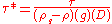
.This is typically represented by a comparison between a dimensionless shear stress (
 )and a dimensionless critical shear stress (
 ). The nondimensionalization is in order to compare the driving forces of particle motion (shear stress) to the resisting forces that would make it stationary (particle density and size). This dimensionless shear stress,
  , is called the Shields parameter
Shields parameter
The Shields parameter, also called the Shields criterion or Shields number, is a nondimensional number used to calculate the initiation of motion of sediment in a fluid flow. It is a nondimensionalization of a shear stress, and is typically denoted \tau_\ast or \theta...
and defined as:
 .
.And the new equation to solve becomes:
 .
.The equations included here describe sediment transport for clastic, or granular sediment. They do not work for clays and muds because these types of floccular
Flocculation
Flocculation, in the field of chemistry, is a process wherein colloids come out of suspension in the form of floc or flakes by the addition of a clarifying agent. The action differs from precipitation in that, prior to flocculation, colloids are merely suspended in a liquid and not actually...
sediments do not fit the geometric simplifications in these equations, and also interact thorough electrostatic forces. The equations were also designed for fluvial
Fluvial
Fluvial is used in geography and Earth science to refer to the processes associated with rivers and streams and the deposits and landforms created by them...
sediment transport of particles carried along in a liquid flow, such as that in a river, canal, or other open channel.
Only one size of particle is considered in this equation. However, river beds are often formed by a mixture of sediment of various sizes. In case of partial motion where only a part of the sediment mixture moves, the river bed becomes enriched in large gravel as the smaller sediments are washed away. The smaller sediments present under this layer of large gravel have a lower possibility of movement and total sediment transport decreases. This is called armouring effect.
Critical shear stress
The Shields diagram empirically shows how the dimensionless critical shear stress required for the initiation of motion is a function of a particular form of the particle Reynolds number, or Reynolds number related to the particle. This allows us to rewrite the criterion for the initiation of motion in terms of only needing to solve for a specific version of the particle Reynolds number, which we call
  .
.
This equation can then be solved by using the empirically derived Shields curve to find
 as a function of a specific form of the particle Reynolds number called the boundary Reynolds number.
Particle Reynolds Number
In general, a particle Reynolds Number has the form:
Where
 is a characteristic particle velocity,
  is the grain diameter (a characteristic particle size), and
  is the kinematic viscosity, which is given by the dynamic viscosity,
  , divided by the fluid density,
  .
.
The specific particle Reynolds number of interest is called the boundary Reynolds number, and it is formed by replacing the velocity term in the Particle Reynolds number by the shear velocity
Shear velocity
Shear velocity, also called friction velocity, is a form by which a shear stress may be re-written in units of velocity. It is useful as a method in fluid mechanics to compare true velocities, such as the velocity of a flow in a stream, to a velocity that relates shear between layers of flow.Shear...
,
 , which is a way of rewriting shear stress in terms of velocity.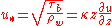
where
 is the bed shear stress (described below), and
  is the von Kármán constant
Von Kármán constant
In fluid dynamics, the Von Kármán constant , named for Theodore von Kármán, is a dimensionless constant describing the logarithmic velocity profile of a turbulent fluid flow near a boundary with a no-slip condition...
, where
 .
.The particle Reynolds number is therefore given by:

Bed shear stress
The boundary Reynolds number can be used with the Shields diagram to empirically solve the equation ,
,which solves the right-hand side of the equation
 .
.In order to solve the left-hand side, expanded as
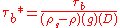 ,
,we must find the bed shear stress,
 . There are several ways to solve for the bed shear stress. First, we develop the simplest approach, in which the flow is assumed to be steady and uniform and reach-averaged depth and slope are used. Due to the difficulty of measuring shear stress in situ, this method is also one of the most-commonly used. This method is known as the depth-slope product
Depth-slope product
The depth–slope product is used to calculate the shear stress at the bed of an open channel containing fluid that is undergoing steady, uniform flow. It is widely used in river engineering, stream restoration, sedimentology, and fluvial geomorphology...
.
Depth-slope product
For a river undergoing approximately steady, uniform equilibrium flow, of approximately constant depth h and slope θ over the reach of interest, and whose width is much greater than its depth, the bed shear stress is given by some momentum considerations stating that the gravity force component in the flow direction equals exactly the friction force. For a wide channel, it yields:
For shallow slopes, which are found in almost all natural lowland streams, the small-angle formula shows that
 is approximately equal to
  , which is given by
  , the slope. Rewritten with this:
Shear velocity, velocity, and friction factor
For the steady case, by extrapolating the depth-slope product and the equation for shear velocity:
 ,
,We can see that the depth-slope product can be rewritten as:
 .
. is related to the mean flow velocity,
  , through the generalized Darcy-Weisbach friction factor,
  , which is equal to the Darcy-Weisbach friction factor divided by 8 (for mathematical convenience). Inserting this friction factor,
 .
.Unsteady flow
For all flows that cannot be simplified as a single-slope infinite channel (as in the depth-slope productDepth-slope product
The depth–slope product is used to calculate the shear stress at the bed of an open channel containing fluid that is undergoing steady, uniform flow. It is widely used in river engineering, stream restoration, sedimentology, and fluvial geomorphology...
, above), the bed shear stress can be locally found by applying the Saint-Vennant equations
Shallow water equations
The shallow water equations are a set of hyperbolic partial differential equations that describe the flow below a pressure surface in a fluid .The equations are derived from depth-integrating the Navier–Stokes...
for continuity
Continuity
Continuity may refer to:In mathematics:* The opposing concept to discreteness; common examples include:** Continuous probability distribution or random variable in probability and statistics...
, which consider accelerations within the flow.
Set-up
The criterion for the initiation of motion, established earlier, states that .
.In this equation,
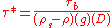 , and therefore
 .
. is a function of boundary Reynolds number, a specific type of particle Reynolds number.
 .
.For a particular particle Reynolds number,
 will be an emprical constant given by the Shields Curve or by another set of empirical data (depending on whether or not the grain size is uniform).
Therefore, the final equation that we seek to solve is:
 .
.Solution
We make several assumptions to provide an example that will allow us to bring the above form of the equation into a solved form.First, we assume that the a good approximation of reach-averaged shear stress is given by the depth-slope product. We can then rewrite the equation as
 .
.Moving and re-combining the terms, we obtain:

where R is the submerged specific gravity of the sediment.
We then make our second assumption, which is that the particle Reynolds number is high. This is typically applicable to particles of gravel-size or larger in a stream, and means that the critical shear stress is a constant. The Shields curve shows that for a bed with a uniform grain size,
 .
.Later researchers have shown that this value is closer to

for more uniformly sorted beds. Therefore, we will simply insert

and insert both values at the end.
The equation now reads:

This final expression shows that the product of the channel depth and slope is equal to the Shield's criterion times the submerged specific gravity of the particles times the particle diameter.
For a typical situation, such as quartz-rich sediment
 in water
  , the submerged specific gravity is equal to 1.65.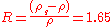
Plugging this into the equation above,
 .
.For the Shield's criterion of
 . 0.06 * 1.65 = 0.099, which is well within standard margins of error of 0.1. Therefore, for a uniform bed,
 .
.For these situations, the product of the depth and slope of the flow should be 10% of the diameter of the median grain diameter.
The mixed-grain-size bed value is
 , which is supported by more recent research as being more broadly applicable because most natural streams have mixed grain sizes. Using this value, and changing D to D_50 ("50" for the 50th percentile, or the median grain size, as we are now looking at a mixed-grain-size bed), the equation becomes:
Which means that the depth times the slope should be about 5% of the median grain diameter in the case of a mixed-grain-size bed.
Modes of entrainment
The sediments entrained in a flow can be transported along the bed as bed loadBed load
The term bed load or bedload describes particles in a flowing fluid that are transported along the bed. Bed load is complementary to suspended load and wash load.Bed load moves by rolling, sliding, and/or saltating ....
in the form of sliding and rolling grains, or in suspension as suspended load
Suspended load
Suspended load is the portion of the sediment that is carried by a fluid flow which settle slowly enough such that it almost never touches the bed...
advected by the main flow. Some sediment materials may also come from the upstream reaches and be carried downstream in the form of wash load
Wash load
Wash load is the portion of sediment that is carried by a fluid flow, usually in a river, such that it always remains close the free surface . It is in near-permanent suspension and is transported without deposition, essentially passing straight through the stream...
.
Rouse number
The location in the flow in which a particle is entrained is determined by the Rouse numberRouse number
The Rouse number is a non-dimensional number in fluid dynamics which is used to define a concentration profile of suspended sediment and which also determines how sediment will be transported in a flowing fluid...
, which is determined by the density ρs and diameter d of the sediment particle, and the density ρ and kinematic viscosity ν of the fluid, determine in which part of the flow the sediment particle will be carried.

Here, the Rouse number is given by P. The term in the numerator is the (downwards) sediment the sediment settling velocity
Terminal velocity
In fluid dynamics an object is moving at its terminal velocity if its speed is constant due to the restraining force exerted by the fluid through which it is moving....
ws, which is discussed below. The upwards velocity on the grain is given as a product of the von Kármán constant
Von Kármán constant
In fluid dynamics, the Von Kármán constant , named for Theodore von Kármán, is a dimensionless constant describing the logarithmic velocity profile of a turbulent fluid flow near a boundary with a no-slip condition...
, κ = 0.4, and the shear velocity
Shear velocity
Shear velocity, also called friction velocity, is a form by which a shear stress may be re-written in units of velocity. It is useful as a method in fluid mechanics to compare true velocities, such as the velocity of a flow in a stream, to a velocity that relates shear between layers of flow.Shear...
, u∗.
The following table gives the approximate required Rouse numbers for transport as bed load
Bed load
The term bed load or bedload describes particles in a flowing fluid that are transported along the bed. Bed load is complementary to suspended load and wash load.Bed load moves by rolling, sliding, and/or saltating ....
, suspended load
Suspended load
Suspended load is the portion of the sediment that is carried by a fluid flow which settle slowly enough such that it almost never touches the bed...
, and wash load
Wash load
Wash load is the portion of sediment that is carried by a fluid flow, usually in a river, such that it always remains close the free surface . It is in near-permanent suspension and is transported without deposition, essentially passing straight through the stream...
.
| Mode of Transport | Rouse Number |
|---|---|
| Initiation of motion | >7.5 |
| Bed load Bed load The term bed load or bedload describes particles in a flowing fluid that are transported along the bed. Bed load is complementary to suspended load and wash load.Bed load moves by rolling, sliding, and/or saltating .... |
>2.5, <7.5 |
| Suspended load Suspended load Suspended load is the portion of the sediment that is carried by a fluid flow which settle slowly enough such that it almost never touches the bed... : 50% Suspended |
>1.2, <2.5 |
| Suspended load Suspended load Suspended load is the portion of the sediment that is carried by a fluid flow which settle slowly enough such that it almost never touches the bed... : 100% Suspended |
>0.8, <1.2 |
| Wash load Wash load Wash load is the portion of sediment that is carried by a fluid flow, usually in a river, such that it always remains close the free surface . It is in near-permanent suspension and is transported without deposition, essentially passing straight through the stream... |
<0.8 |
Settling velocity
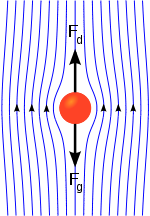
Terminal velocity
In fluid dynamics an object is moving at its terminal velocity if its speed is constant due to the restraining force exerted by the fluid through which it is moving....
") is a function of the particle Reynolds number. Generally, for small particles (laminar approximation), it can be calculated with Stokes' Law
Stokes' law
In 1851, George Gabriel Stokes derived an expression, now known as Stokes' law, for the frictional force – also called drag force – exerted on spherical objects with very small Reynolds numbers in a continuous viscous fluid...
. For larger particles (turbulent particle Reynolds numbers), fall velocity is calculated with the turbulent drag
Drag (physics)
In fluid dynamics, drag refers to forces which act on a solid object in the direction of the relative fluid flow velocity...
law. Dietrich
William E. Dietrich
William Eric Dietrich is a professor of geology in the Department of Earth and Planetary Science at the University of California, Berkeley. His specialty is geomorphology, with a particular interest in the biological forces shaping landscapes. He obtained his Ph.D. in geology from the University...
(1982) compiled a large amount of published data to which he empirically fit settling velocity curves. Ferguson and Church (2006) analytically combined the expressions for Stokes flow and a turbulent drag law into a single equation that works for all sizes of sediment, and successfully tested it against the data of Dietrich. Their equation is
 .
.In this equation ws is the sediment settling velocity, g is acceleration due to gravity, and D is mean sediment diameter.
 is the kinematic viscosity of water
Water
Water is a chemical substance with the chemical formula H2O. A water molecule contains one oxygen and two hydrogen atoms connected by covalent bonds. Water is a liquid at ambient conditions, but it often co-exists on Earth with its solid state, ice, and gaseous state . Water also exists in a...
, which is approximately 1.0 x 10⁻⁶ m2/s for water at 20°C.
 and
and  are constants related to the shape and smoothness of the grains.
| Constant | Smooth Spheres | Natural Grains: Sieve Diameters | Natural Grains: Nominal Diameters | Limit for Ultra-Angular Grains |
|---|---|---|---|---|
 |
18 | 18 | 20 | 24 |
 |
0.4 | 1.0 | 1.1 | 1.2 |
The expression for fall velocity can be simplified so that it can be solved only in terms of D. We use the sieve diameters for natural grains,
 , and values given above for
  and
and  . From these parameters, the fall velocity is given by the expression:
Transport rate
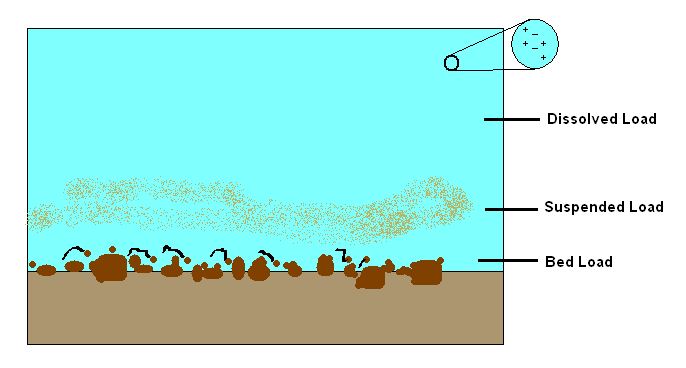
Bed load
The term bed load or bedload describes particles in a flowing fluid that are transported along the bed. Bed load is complementary to suspended load and wash load.Bed load moves by rolling, sliding, and/or saltating ....
, suspended load
Suspended load
Suspended load is the portion of the sediment that is carried by a fluid flow which settle slowly enough such that it almost never touches the bed...
, and wash load
Wash load
Wash load is the portion of sediment that is carried by a fluid flow, usually in a river, such that it always remains close the free surface . It is in near-permanent suspension and is transported without deposition, essentially passing straight through the stream...
. They may sometimes also be segregated into bed material load
Bed material load
The bed material load is the portion of the sediment that is transported by a stream that contains material derived from the bed. Bed material load typically consists of all of the bed load, and the proportion of the suspended load that is represented in the bed sediments...
and wash load.
Bed Load
Bed load moves by rolling, sliding, and hopping (or saltating) over the bed, and moves at a small fraction of the fluid flow velocity. Bed load is generally thought to constitute 5-10% of the total sediment load in a stream, making it less important in terms of mass balance. However, the bed material loadBed material load
The bed material load is the portion of the sediment that is transported by a stream that contains material derived from the bed. Bed material load typically consists of all of the bed load, and the proportion of the suspended load that is represented in the bed sediments...
(the bed load plus the portion of the suspended load which comprises material derived from the bed) is often dominated by bed load, especially in gravel-bed rivers. This bed material load is the only part of the sediment load that actively interacts with the bed. As the bed load is an important component of that, it plays a major role in controlling the morphology of the channel.
Bed load transport rates are usually expressed as being related to excess dimensionless shear stress raised to some power. Excess dimensionless shear stress is a nondimensional measure of bed shear stress about the threshold for motion.
 ,
,Bed load transport rates may also be given by a ratio of bed shear stress to critical shear stress, which is equivalent in both the dimensional and nondimensional cases. This ratio is called the "transport stage"
 and is an important in that it shows bed shear stress as a multiple of the value of the criterion for the initiation of motion.
When used for sediment transport formulae, this ratio is typically raised to a power.
The majority of the published relations for bedload transport are given in dry sediment weight per unit channel width,
 ("breadth"):
 .
.Due to the difficulty of estimating bed load transport rates, these equations are typically only suitable for the situations for which they were designed.
Meyer-Peter Müller and derivatives
The transport formula of Meyer-Peter and Müller, originally developed in 1948, was designed for well-sorted
Sorting (sediment)
Sorting indicates the distribution of grain size of sediments, either in unconsolidated deposits or in sedimentary rocks. Poorly sorted indicates that the sediment sizes are mixed ; whereas well sorted indicates that the sediment sizes are similar .The degree of sorting may also indicate the energy...
fine
Particle size (grain size)
Particle size, also called grain size, refers to the diameter of individual grains of sediment, or the lithified particles in clastic rocks. The term may also be applied to other granular materials. This is different from the crystallite size, which is the size of a single crystal inside the...
gravel
Gravel
Gravel is composed of unconsolidated rock fragments that have a general particle size range and include size classes from granule- to boulder-sized fragments. Gravel can be sub-categorized into granule and cobble...
at a transport stage of about 8. The formula uses the above nondimensionalization for shear stress,
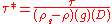 ,
,and Hans Einstein's nondimensionalization for sediment volumetric discharge per unit width
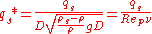 .
.Their formula reads:
 .
.Their experimentally determined value for
 is 0.047, and is the third commonly used value for this (in addition to Parker's 0.03 and Shields' 0.06).
Because of its broad use, some revisions to the formula have taken place over the years that show that the coefficient on the left ("8" above) is a function of the transport stage:


The variations in the coefficient were later generalized as a function of dimensionless shear stress:
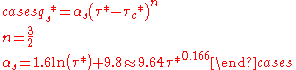
Wilcock and Crowe
In 2003, Peter Wilcock and Joanna Crowe (now Joanna Curran) published a sediment transport formula that works with multiple grain sizes across the sand and gravel range. Their formula works with surface grain size distributions, as opposed to older models which use subsurface grain size distributions (and thereby implicitly infer a surface grain sorting
Sorting (sediment)
Sorting indicates the distribution of grain size of sediments, either in unconsolidated deposits or in sedimentary rocks. Poorly sorted indicates that the sediment sizes are mixed ; whereas well sorted indicates that the sediment sizes are similar .The degree of sorting may also indicate the energy...
).
Their expression is more complicated than the basic sediment transport rules (such as that of Meyer-Peter and Müller) because it takes into account multiple grain sizes: this requires consideration of reference shear stresses for each grain size, the fraction of the total sediment supply that falls into each grain size class, and a "hiding function".
The "hiding function" takes into account the fact that, while small grains are inherently more mobile than large grains, on a mixed-grain-size bed, they may be trapped in deep pockets between large grains. Likewise, a large grain on a bed of small particles will be stuck in a much smaller pocket than if it were on a bed of grains of the same size. In gravel-bed rivers, this can cause "equal mobility", in which small grains can move just as easily as large ones. As sand is added to the system, it moves away from the "equal mobility" portion of the hiding function to one in which grain size again matters.
Their model is based on the transport stage, or ratio of bed shear stress to critical shear stress for the initiation of grain motion. Because their formula works with several grain sizes simultaneously, they define the critical shear stress for each grain size class,
 , to be equal to a "reference shear stress",
  .
.They express their equations in terms of a dimensionless transport parameter,
 (with the "
 " indicating nondimensionality and the "
 " indicating that it is a function of grain size):
 is the volumetric bed load transport rate of size class
  per unit channel width
  .
.  is the proportion of size class
  that is present on the bed.
They came up with two equations, depending on the transport stage,
 . For
. For  :
:
and for
 :
: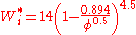 .
.This equation asymptotically reaches a constant value of
 as
as  becomes large.
Suspended load
Suspended load is carried in the lower to middle parts of the flow, and moves at a large fraction of the mean flow velocity in the stream.A common characterization of suspended sediment concentration in a flow is given by the Rouse Profile. This characterization works for the situation in which sediment concentration
 at one particular elevation above the bed
  can be quantified. It is given by the expression: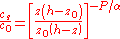
Here,
 is the elevation above the bed,
  is the concentration of suspended sediment at that elevation,
  is the flow depth,
  is the Rouse number, and
  relates the eddy viscosity for momentum
  to the eddy diffusivity for sediment, which is approximately equal to one.
Experimental work has shown that
 ranges from 0.93 to 1.10 for sands and silts.
The Rouse profile characterizes sediment concentrations because the Rouse number includes both turbulent mixing and settling under the weight of the particles. Turbulent mixing results in the net motion of particles from regions of high concentrations to low concentrations. Because particles settle downward, for all cases where the particles are not neutrally buoyant or sufficiently light that this settling velocity is negligible, there is a net negative concentration gradient as one goes upward in the flow. The Rouse Profile therefore gives the concentration profile that provides a balance between turbulent mixing (net upwards) of sediment and the downwards settling velocity of each particle.
Bed material load
Bed material load comprises the bed load and the portion of the suspended load that is sourced from the bed.Three common bed material transport relations are the "Ackers-White", "Engelund-Hansen", "Yang" formulae. The first is for sand
Sand
Sand is a naturally occurring granular material composed of finely divided rock and mineral particles.The composition of sand is highly variable, depending on the local rock sources and conditions, but the most common constituent of sand in inland continental settings and non-tropical coastal...
to granule
Granule (geology)
A granule is a clast of rock with a particle size of 2 to 4 millimetres based on the Krumbein phi scale of sedimentology. Granules are generally considered to be larger than sand and smaller than pebbles . A rock made predominantly of granules is termed a conglomerate....
-size gravel, and the second and third are for sand though Yang later expanded his formula to include fine gravel. That all of these formulae cover the sand-size range and two of them are exclusively for sand is that the sediment in sand-bed rivers is commonly moved simultaneously as bed and suspended load.
Engelund-Hansen
The bed material load formula of Engelund and Hansen is the only one to not include some kind of critical value for the initiation of sediment transport. It reads:
where
 is the Einstein nondimensionalization for bed shear stress,
  is a friction factor, and
  is the Shields stress. The Engelund-Hansen formula is one of the few sediment transport formulae in which a threshold "critical shear stress" is absent.
Wash load
Wash load is carried within the water column as part of the flow, and therefore moves with the mean velocity of main stream. Wash load concentrations are approximately uniform in the water column. This is described by the endmember case in which the Rouse number is equal to 0 (i.e. the settling velocity is far less than the turbulent mixing velocity), which leads to a prediction of a perfectly uniform vertical concentration profile of material.Total load
Some authors have attempted formulations for the total sediment load carried in water. These formulas are designed largely for sand, as (depending on flow conditions) sand often can be carried as both bed load and suspended load in the same stream or shoreface.External links
- Liu, Z. (2001), Sediment Transport.
- Moore, A. Fluvial sediment transport lecture notes, Kent State.
- Southard, J. B. (2007), John Southard, Sediment Transport and Sedimentary Structures, MIT Open Courseware.