
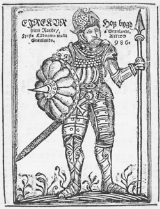
Erik Thorvaldsson known as
Erik the Red , is remembered in medieval and Icelandic saga sources as having founded the first
NordicThe Nordic countries make up a region in Northern Europe and the North Atlantic which consists of Denmark, Finland, Iceland, Norway and Sweden and their associated territories, the Faroe Islands, Greenland and Åland...
settlement in
GreenlandGreenland is an autonomous country within the Kingdom of Denmark, located between the Arctic and Atlantic Oceans, east of the Canadian Arctic Archipelago. Though physiographically a part of the continent of North America, Greenland has been politically and culturally associated with Europe for...
. The Icelandic tradition indicates that he was born in the
JærenJæren is a traditional district in the county of Rogaland. The others are Dalane, Ryfylke and Haugalandet.Jæren is the largest flat lowland area in Norway, stretching from the municipality of Randaberg in the north to Hå in the south. The coast is flat compared to the rest of the Norwegian coast,...
district of
Rogalandis a county in Western Norway, bordering Hordaland, Telemark, Aust-Agder and Vest-Agder. It is the center of the Norwegian petroleum industry, and as a result of this, Rogaland has the lowest unemployment rate of any county in Norway, 1.1%...
,
NorwayNorway , officially the Kingdom of Norway, is a Nordic unitary constitutional monarchy whose territory comprises the western portion of the Scandinavian Peninsula, Jan Mayen, and the Arctic archipelago of Svalbard and Bouvet Island. Norway has a total area of and a population of about 4.9 million...
, as the son of Thorvald Asvaldsson, he therefore also appears,
patronymicA patronym, or patronymic, is a component of a personal name based on the name of one's father, grandfather or an even earlier male ancestor. A component of a name based on the name of one's mother or a female ancestor is a matronymic. Each is a means of conveying lineage.In many areas patronyms...
ally, as Erik Thorvaldsson (
Eiríkr Þorvaldsson). The appellation "the Red" most likely refers to his hair color.
Leif EricsonLeif Ericson was a Norse explorer who is regarded as the first European to land in North America , nearly 500 years before Christopher Columbus...
, the famous
IcelandIceland , described as the Republic of Iceland, is a Nordic and European island country in the North Atlantic Ocean, on the Mid-Atlantic Ridge. Iceland also refers to the main island of the country, which contains almost all the population and almost all the land area. The country has a population...
ic explorer, was Erik's son.
Exiles
Erik the Red's parents left
NorwayNorway , officially the Kingdom of Norway, is a Nordic unitary constitutional monarchy whose territory comprises the western portion of the Scandinavian Peninsula, Jan Mayen, and the Arctic archipelago of Svalbard and Bouvet Island. Norway has a total area of and a population of about 4.9 million...
on account of manslaughter. Along with him, the family settled in
HornstrandirHornstrandir is Iceland's northernmost peninsula, situated in the Westfjords, to the north of the Jökulfirðir and to the northwest of Drangajökull....
in West
IcelandIceland , described as the Republic of Iceland, is a Nordic and European island country in the North Atlantic Ocean, on the Mid-Atlantic Ridge. Iceland also refers to the main island of the country, which contains almost all the population and almost all the land area. The country has a population...
. The Icelanders later sentenced Erik to a three-year exile for several murders around the year 982.
After marrying Thorild, he moved to Haukadal (Hawksdale) where he built a farm. The initial confrontation happened when his
slavesSlavery is a system under which people are treated as property to be bought and sold, and are forced to work. Slaves can be held against their will from the time of their capture, purchase or birth, and deprived of the right to leave, to refuse to work, or to demand compensation...
started a
landslideA landslide or landslip is a geological phenomenon which includes a wide range of ground movement, such as rockfalls, deep failure of slopes and shallow debris flows, which can occur in offshore, coastal and onshore environments...
on the neighboring farm belonging to Valthjof. Valthjof's friend, Eyiolf the Foul, killed the slaves. In return, Erik killed Eyiolf and Holmgang-Hrafn (Dueling-Raven). Eyiolf's kinsmen demanded his banishment from Haukadal.
Erik then moved to the island of Öxney. He asked Thorgest to keep his
setstokkr, inherited ornamented beams of significant mystical value, which his father had brought from Norway. When he had finished his new house, he went back to get them, but they "could not be obtained". Erik then went to Breidabolstad and took them. These are likely to have been Thorgest's
setstokkr, although the sagas are unclear at this point.
Thorgest gave chase, and in the ensuing fight Erik slew both Thorgest's sons and "a few other men".
After this each of them retained a considerable body of men with him at his home. Styr gave Eric his support, as did also Eyiolf of Sviney, Thorbjiorn, Vifil's son, and the sons of Thorbrand of Alptafirth; while Thorgest was backed by the sons of Thord the Yeller, and Thorgeir of HitardalHítardalur is a big farm and ancient church and rectory estate in Mýrasýslu, Borgarbyggð. The farm estate is situated in Hítardalur valley of the same name, both of which are supposedly named after the ogre Hít who, as the rumour has it, was traveling there along with half-human turned ogre Bárður...
, Aslak of Langadal and his son Illugi.
The dispute was resolved at an assembly, the
ThingA thing was the governing assembly in Germanic and introduced into some Celtic societies, made up of the free people of the community and presided by lawspeakers, meeting in a place called a thingstead...
, with the result that Erik was outlawed for three years.
Discoveries
Even though popular history credits Erik as the first person to discover Greenland, the Icelandic sagas suggest that earlier Norsemen discovered and tried to settle it before him. Tradition credits
Gunnbjörn UlfssonGunnbjørn Ulfsson , name also given as Gunnbjørn Ulf-Krakuson, was the first European to sight North America....
(also known as Gunnbjörn Ulf-Krakuson) with the first sighting of the land-mass. Nearly a century before Eric, strong winds had driven Gunnbjörn towards a land he called "Gunnbjarnarsker" ("
Gunnbjörn's skerriesGunnbjörn's skerries were a group of small skerries lying close between Iceland and Greenland, discovered by Gunnbjörn Ulfsson in the 9th century. They became a popular stopover for ships traveling to Greenland and a brief attempt to set up a colony was made about 970. Snaebjörn Galti visited...
"). But the accidental nature of Gunnbjörn's discovery has led to his neglect in the history of Greenland. After Gunnbjörn,
Snaebjörn GaltiSnøbjørn Galte Holmsteinsson was the first Norseman to intentionally navigate to Greenland, doing so in 978 CE....
had also visited Greenland. According to records from the time, Galti headed the first Norse attempt to colonize Greenland, which ended in disaster. Erik the Red was the first
permanent European settler.
In this context, about 982, Erik sailed to a somewhat mysterious and little-known land. He rounded the southern tip of the island (later known as Cape Farewell) and sailed up the western coast. He eventually reached a part of the coast that, for the most part, seemed ice-free and consequently had conditions—similar to those of Iceland—that promised growth and future prosperity. According to the
Saga of Erik the Red, he spent his three years of exile exploring this land. The first winter he spent on the island of Eiriksey, the second winter he passed in Eiriksholmar (close to Hvarfsgnipa). In the final summer he explored as far north as Snaefell and in to Hrafnsfjord.
When Erik returned to Iceland after his exile had expired, he is said to have brought with him stories of "Greenland". Erik deliberately gave the land a more appealing name than "Iceland" in order to lure potential settlers. He explained, "people would be attracted to go there if it had a favorable name". He knew that the success of any settlement in Greenland would need the support of as many people as possible. His salesmanship proved successful, as many people (especially "those Vikings living on poor land in Iceland" and those that had suffered a "recent famine") became convinced that Greenland held great opportunity.
After spending the winter in Iceland, Erik returned to Greenland in 985 with a large number of colonists and established two colonies on its southwest coast: the
Eastern SettlementThe Eastern Settlement was the largest and first of the three areas of Greenland, settled in approximately 985 AD by Norse farmers from Iceland . At its peak it contained approximately 4,000 inhabitants...
or Eystribyggð, in modern-day
QaqortoqQaqortoq is a town in the Kujalleq municipality in southern Greenland. With a population of 3,230 as of 2011, it is the most populous town in southern Greenland, and the fourth-largest town in the country. The name is western Greenlandic and means "[the] white [one]".- History :The area around...
, and the
Western SettlementThe Western Settlement was the smaller of the two main areas of Greenland settled in around 985 AD by Norse farmers from Iceland ....
or Vestribyggð, close to present-day
NuukNuuk, is the capital of Greenland, the northernmost capital in North America and the largest city in Greenland. Located in the Nuup Kangerlua fjord, the city lies on the eastern shore of the Labrador Sea and on the west coast of Sermersooq. Nuuk is the largest cultural and economic center in...
. (Eventually, a Middle Settlement grew, but many people suggest it formed part of the Western Settlement.) The Eastern and Western Settlements, both established on the southwest coast, proved the only two areas suitable for farming. During the summers, when the weather favored travel more, each settlement would send an army of men to hunt in
Disko BayDisko Bay is a bay on the western coast of Greenland. The bay constitutes a wide southeastern inlet of Baffin Bay.- Geography :To the south the coastline is complicated with multiple waterways of skerries and small islands in the Aasiaat archipelago...
above the
Arctic CircleThe Arctic Circle is one of the five major circles of latitude that mark maps of the Earth. For Epoch 2011, it is the parallel of latitude that runs north of the Equator....
for food and other valuable commodities such as seals (used for rope), ivory from Walrus tusks, and
beached whaleA beached whale is a whale that has stranded itself on land, usually on a beach. Beached whales often die due to dehydration, the body collapsing under its own weight, or drowning when high tide covers the blowhole.-Species:...
s.
Eystribyggð
In Eystribyggð, Erik built the
estateAn estate comprises the houses and outbuildings and supporting farmland and woods that surround the gardens and grounds of a very large property, such as a country house or mansion. It is the modern term for a manor, but lacks the latter's now abolished jurisdictional authority...
BrattahlíðBrattahlíð was Erik the Red's estate in the Eastern Settlement Viking colony he established in south-western Greenland toward the end of the 10th century. The present settlement of Qassiarsuk, approximately southwest from the Narsarsuaq settlement, is now located in its place...
, near present-day
NarsarsuaqNarsarsuaq is a settlement in the Kujalleq municipality in southern Greenland. It had 158 inhabitants in 2010. There is a thriving tourism industry in and around Narsarsuaq, whose attractions include a great diversity of wildlife, gemstones, tours to glaciers, and an airfield museum...
. He held the title of
paramount chieftainThe ancient Norse rulers of Greenland were called paramount chieftains.Among the island nation's chieftains were:*Erik the Red, or Eirikr Thorvaldsson, the nation's first chieftain and its first settler, began rule in 985....
of Greenland and became both greatly respected and wealthy. The settlement venture involved 25
shipSince the end of the age of sail a ship has been any large buoyant marine vessel. Ships are generally distinguished from boats based on size and cargo or passenger capacity. Ships are used on lakes, seas, and rivers for a variety of activities, such as the transport of people or goods, fishing,...
s, 14 of which made the journey successfully; of the other 11, some turned back, while others disappeared at sea.
The settlement flourished, growing to 5000 inhabitants spread over a considerable area along Eriksfjord and neighboring
fjordGeologically, a fjord is a long, narrow inlet with steep sides or cliffs, created in a valley carved by glacial activity.-Formation:A fjord is formed when a glacier cuts a U-shaped valley by abrasion of the surrounding bedrock. Glacial melting is accompanied by rebound of Earth's crust as the ice...
s. Groups of immigrants escaping overcrowding in Iceland joined the original party. However, one group of immigrants which arrived in 1002 brought with it an
epidemicIn epidemiology, an epidemic , occurs when new cases of a certain disease, in a given human population, and during a given period, substantially exceed what is expected based on recent experience...
that ravaged the colony, killing many of its leading citizens, including Erik himself. Nevertheless, the colony rebounded and survived until the
Little Ice AgeThe Little Ice Age was a period of cooling that occurred after the Medieval Warm Period . While not a true ice age, the term was introduced into the scientific literature by François E. Matthes in 1939...
made the land marginal for European life-styles in the 15th century (shortly before
Christopher ColumbusChristopher Columbus was an explorer, colonizer, and navigator, born in the Republic of Genoa, in northwestern Italy. Under the auspices of the Catholic Monarchs of Spain, he completed four voyages across the Atlantic Ocean that led to general European awareness of the American continents in the...
's voyage to the
Canary IslandsThe Canary Islands , also known as the Canaries , is a Spanish archipelago located just off the northwest coast of mainland Africa, 100 km west of the border between Morocco and the Western Sahara. The Canaries are a Spanish autonomous community and an outermost region of the European Union...
in 1492). Pirate raids, conflict with
InuitThe Inuit are a group of culturally similar indigenous peoples inhabiting the Arctic regions of Canada , Denmark , Russia and the United States . Inuit means “the people” in the Inuktitut language...
moving into the Norse territories, and the colony's abandonment by Norway became other factors in its decline.
Descendants
The medieval Icelandic tradition relates that Erik the Red and his wife Þjóðhildr (Thjodhildr) had four children: a daughter,
FreydísFreydís Eiríksdóttir was a daughter of Erik the Red who was associated with the Norse exploration of North America. The only medieval sources which mention Freydís are the two Vinland sagas, believed to be composed in the 13th century but purporting to describe events around 1000...
, and three sons, the
explorer Leif EiríkssonLeif Ericson was a Norse explorer who is regarded as the first European to land in North America , nearly 500 years before Christopher Columbus...
, Þorvaldr (Thorvald) and Þorsteinn (Thorstein). Erik himself remained a follower of
Norse paganismNorse paganism is the religious traditions of the Norsemen, a Germanic people living in the Nordic countries. Norse paganism is therefore a subset of Germanic paganism, which was practiced in the lands inhabited by the Germanic tribes across most of Northern and Central Europe in the Viking Age...
, unlike his son Leif and Leif's wife, who became
ChristianA Christian is a person who adheres to Christianity, an Abrahamic, monotheistic religion based on the life and teachings of Jesus of Nazareth as recorded in the Canonical gospels and the letters of the New Testament...
s. Thjothhild was the daughter of Jørundur Ulfsson and Thorbjørg Gilsdottir (from whom Gilsfjørd is named). Jørund's mother Bjørg was granddaughter to Irish king
Cerball mac DúnlaingeCerball mac Dúnlainge was king of Osraige in south-east Ireland. The kingdom of Osraige occupied roughly the area of modern County Kilkenny and lay between the larger provincial kingdoms of Munster and Leinster....
(Kjarval) through his daughter Rafarta.
While not the first to sight the North American continent, Leif Erikson became the first Viking to explore the land of
VinlandVinland was the name given to an area of North America by the Norsemen, about the year 1000 CE.There is a consensus among scholars that the Vikings reached North America approximately five centuries prior to the voyages of Christopher Columbus...
(part of
North AmericaNorth America is a continent wholly within the Northern Hemisphere and almost wholly within the Western Hemisphere. It is also considered a northern subcontinent of the Americas...
, probably near modern-day
NewfoundlandNewfoundland and Labrador is the easternmost province of Canada. Situated in the country's Atlantic region, it incorporates the island of Newfoundland and mainland Labrador with a combined area of . As of April 2011, the province's estimated population is 508,400...
). Leif invited his father on the voyage, but according to legend, Erik fell off his
horseThe horse is one of two extant subspecies of Equus ferus, or the wild horse. It is a single-hooved mammal belonging to the taxonomic family Equidae. The horse has evolved over the past 45 to 55 million years from a small multi-toed creature into the large, single-toed animal of today...
on his way to the ship and took this as a bad sign, leaving his son to continue without his company. Erik died the winter after his son's departure. There is no evidence that Leif was aware of his father's death until he got back to Greenland.
Norse settlement in Greenland
For much of the time that the Norse survived in Greenland, they had a very tough life that demanded finding a balance between maintaining population levels and finding enough food and supplies to survive. Most of the time they had just enough supplies to continue their societies. Despite the Norse settlers' constant struggle, at Norse Greenland's peak at c. 1126 the inhabitants numbered between 2000 and 4000. The Eastern Settlement had around "190 small farms, 12 parish churches, a cathedral, an Augustinian monastery and a
BenedictineBenedictine refers to the spirituality and consecrated life in accordance with the Rule of St Benedict, written by Benedict of Nursia in the sixth century for the cenobitic communities he founded in central Italy. The most notable of these is Monte Cassino, the first monastery founded by Benedict...
nunnery". Even though smaller than the Eastern Settlement, the Western Settlement still had "90 farms and four churches", while the smallest Middle Settlement had only around "20 farms". Despite enjoying what some might consider a reasonable amount of time on Greenland in conjunction with varying times of successes and failures, the Norse settlement in Greenland did not last more than 500 years.
Jared DiamondJared Mason Diamond is an American scientist and author whose work draws from a variety of fields. He is currently Professor of Geography and Physiology at UCLA...
gives a rationale for this, as have others. He presents a five-step process that explains the collapse of civilizations and offers Greenland as an example of this process.
The Norse had become separated from their kin in Europe for so long that most of their friendships and alliances had fallen away, hurting some of their trading and eventual protection; political changes in Europe hastened this process. Perhaps more significantly, a change in climate in the North Atlantic led to an increase in sea-ice, making communication with Europe difficult, and favoring migrations of the
InuitThe Inuit are a group of culturally similar indigenous peoples inhabiting the Arctic regions of Canada , Denmark , Russia and the United States . Inuit means “the people” in the Inuktitut language...
from northern Greenland to the south and to regular contact with the Norse, leading to violence between the groups. Finally, and most importantly, the Norse failed to adapt fully to their surroundings. They clung too much to familiar ways of living that proved ultimately unsuitable in Greenland.
Despite the apparent failure of the Norse Greenland colonies, they mark one of the great achievements in Norse expansion and exploration.
External links