

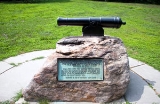
Battle of White Plains

Encyclopedia
The Battle of White Plains was a battle in the New York and New Jersey campaign
of the American Revolutionary War
fought on October 28, 1776, near White Plains
, New York
. Following the retreat of George Washington
's Continental Army
northward from New York City
, British
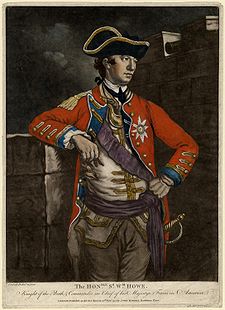
General William Howe
landed troops in Westchester County, intending to cut off Washington's escape route. Alerted to this move, Washington retreated further, establishing a position in the village of White Plains but failed to establish firm control over local high ground. Howe's troops drove Washington's troops from a hill near the village; following this loss, Washington ordered the Americans to retreat further north.
Later British movements chased Washington across New Jersey
and into Pennsylvania
. Washington then crossed the Delaware
and surprised a brigade of Hessian troops in the December 26 Battle of Trenton
.
, after evacuating Boston
in March 1776, regrouped in Halifax, Nova Scotia
, and embarked in June on a campaign to gain control of New York City
. The campaign began with an unopposed landing on Staten Island
in early July. British troops made another unopposed landing on Long Island
on August 22, south of the areas where General George Washington
's Continental Army
had organized significant defenses.
After losing the Battle of Long Island
on August 27, General Washington and his army of 9,000 troops escaped on the night of August 29–30 to York Island (as Manhattan
was then called). General Howe followed up with a landing on Manhattan
on September 15, but his advance was checked the next day at Harlem Heights
. After an abortive landing at Throg's Neck, he landed troops with some resistance at Pell's Point
on October 18 to begin an encircling maneuver that was intended to trap Washington's army between that force, his troops in Manhattan, and the Hudson River
, which was dominated by warships of the Royal Navy
. Howe established a camp at New Rochelle
, but advance elements of his army were near Mamaroneck
, only 7 miles (11.3 km) from White Plains
, where there was a lightly defended Continental Army supply depot.
out on a reconnaissance mission from his camp at Harlem Heights. Putnam discovered the general placement of the British troop locations and recognized the danger to the army and its supplies. When he reported this to Washington that evening, Washington immediately dispatched Putnam with orders to Lord Stirling, whose troops were furthest north, to immediately march to White Plains. They arrived at White Plains at 9 am on October 21, and were followed by other units of the army as the day progressed. Washington decided to withdraw most of the army to White Plains, leaving a garrison of 1,200 men under Nathanael Greene
to defend Fort Washington
on Manhattan. General Howe's army advanced slowly, with troops from his center and right moving along the road from New Rochelle to White Plains, while a unit of Loyalists
occupied Mamaroneck. The latter was attacked that night by a detachment of Lord Stirling's troops under John Haslet
, who took more than thirty prisoners as well as supplies, but suffered several killed and 15 wounded. As a result, Howe moved elements of his right wing to occupy Mamaroneck. On October 22, Howe was reinforced by the landing at New Rochelle of an additional 8,000 troops under the command of Wilhelm von Knyphausen
.
Washington established his headquarters at the Elijah Miller House
in North White Plains on October 23, and chose a defensive position that he fortified with two lines of entrenchment
s. The trenches were situated on raised terrain, protected on the right by the swamp
y ground near the Bronx River
, with steeper hills further back as a place of retreat. The American defenses were 3 miles (4.8 km) long. Beyond that, on the right, was Chatterton's Hill, which commanded the plain over which the British would have to advance. The hill was initially occupied by militia companies numbering several hundred, probably including John Brooks' Massachusetts militia company.
On October 24 and 25, Howe's army moved from New Rochelle to Scarsdale
, where they established a camp covering the eastern bank of the Bronx River
. This move was apparently made in the hopes of catching Charles Lee
's column, which had to alter its route toward White Plains and execute a forced march at night to avoid them. Howe remained at Scarsdale until the morning of October 28, when his forces marched toward White Plains, with British troops on the right under General Henry Clinton
, and primarily Hessian troops on the left under General von Heister
.
out to slow the British advance, and sent Haslet and the 1st Delaware Regiment
, along with Alexander McDougall
's brigade (Ritzema's
3rd New York, Charles Webb's Connecticut
, William Smallwood
's Maryland
, and McDougall's own
regiments) to reinforce Chatterton Hill.
Spencer's force crossed the Bronx River, set up behind a stone wall, and exchanged fire with the Hessians led by Colonel Johann Rall that were at the head of the British left column. Eventually forced to retreat when Clinton's column threatened their flank, these companies retreated across the Bronx River, while fire from the troops on Chatterton Hill covered their move. Rall's troops attempted to gain the hill, but were repelled by fire from Haslet's troops and the militia, and retreated to a nearby hilltop on the same side of the river. This concerted defense brought the entire British army, which was maneuvering as if to attack the entire American line, to a stop.
While Howe and his command conferred, the Hessian artillery on the left opened fire on the hilltop position, where they succeeded in driving the militia into a panicked retreat. The arrival of McDougall and his brigade helped to rally them, and a defensive line was established, with the militia on the right and the Continentals arrayed along the top of the hill. Howe finally issued orders, and while most of his army waited, a detachment of British and Hessian troops was sent to take the hill.
The British attack was organized with Hessian regiments leading the assault. Rall was to charge the American right, while a Hessian battalion under Colonel Carl von Donop
(consisting of the Linsing, Mingerode
, Lengereck, and Kochler grenadiers, and Donop's own chasseur regiment) was to attack the center. A British column under General Alexander Leslie (consisting of the 5th, 28th, 35th, and 49th Foot) was to attack the right. Donop's force either had difficulty crossing the river, or was reluctant to do so, and elements of the British force were the first to cross the river. Rall's charge scattered the militia on the American right, leaving the flank of the Maryland and New York regiments exposed as they poured musket fire onto the British attackers, which temporarily halted the British advance. The exposure of their flank caused them to begin a fighting retreat, which progressively forced the remainder of the American line, which had engaged with the other segments of the British force, to give way and retreat. Haslet's Delaware regiment, which anchored the American left, provided covering fire while the remaining troops retreated to the north, and were the last to leave the hill. The fighting was intense, and both sides suffered significant casualties before the Continentals made a disciplined retreat.
_at_san_diego,_8_march_1944.jpg) John Fortescue's History of the British Army says that Howe's casualties numbered 214 British and 99 Hessians. However, Rodney Atwood points out that Fortescue's figure for the Hessians includes the entire Hessian casualties from 19–28 October and that in fact only 53 of these casualties were incurred at the Battle of White Plains. This revised figure would give a total of 267 British and Hessians killed, wounded or missing at White Plains. Henry Dawson, on the other hand, gives Howe's loss as 47 killed, 182 wounded and 4 missing.
John Fortescue's History of the British Army says that Howe's casualties numbered 214 British and 99 Hessians. However, Rodney Atwood points out that Fortescue's figure for the Hessians includes the entire Hessian casualties from 19–28 October and that in fact only 53 of these casualties were incurred at the Battle of White Plains. This revised figure would give a total of 267 British and Hessians killed, wounded or missing at White Plains. Henry Dawson, on the other hand, gives Howe's loss as 47 killed, 182 wounded and 4 missing.
The American loss is uncertain. Theodore Savas and J. David Dameron give a range of 150-500 killed, wounded and captured. Samuel Roads numbers the casualties of 47 killed and 70 wounded. Henry Dawson estimates 50 killed, 150 wounded and 17 missing for McDougall's and Spencer's commands but has no information on the losses in Haslet's regiment or the Massachusetts militia units.
on October 30, Howe planned to act against the Americans the following day. However, a heavy rain fell the whole next day, and when Howe was finally prepared to act, he awoke to find that Washington had again eluded his grasp.
Washington withdrew his army into the hills to the north on the night of October 31, establishing a camp near North Castle
. Howe chose not to follow, instead attempting without success to draw Washington out. On November 5, he turned his army south to finish evicting Continental Army troops from Manhattan, a task he accomplished with the November 16 Battle of Fort Washington
.
Washington eventually crossed the Hudson River at Peekskill
with most of his army, leaving New England
regiments behind to guard supply stores and important river crossings. Later, British movements chased him across New Jersey and into Pennsylvania
, and the British established a chain of outposts across New Jersey. Washington, seeing an opportunity for a victory to boost the nation's morale, crossed the Delaware
and surprised Rall's troops in the December 26 Battle of Trenton
.
. Two ships in the United States Navy
were named for the Battle of White Plains. CVE-66
was an escort carrier in World War II
. AFS-4
was a combat stores ship
that was decommissioned in 1995 after suffering extensive damage in 1992's Typhoon Omar
.
New York and New Jersey campaign
The New York and New Jersey campaign was a series of battles for control of New York City and the state of New Jersey in the American Revolutionary War between British forces under General Sir William Howe and the Continental Army under General George Washington in 1776 and the winter months of 1777...
of the American Revolutionary War
American Revolutionary War
The American Revolutionary War , the American War of Independence, or simply the Revolutionary War, began as a war between the Kingdom of Great Britain and thirteen British colonies in North America, and ended in a global war between several European great powers.The war was the result of the...
fought on October 28, 1776, near White Plains
White Plains, New York
White Plains is a city and the county seat of Westchester County, New York, United States. It is located in south-central Westchester, about east of the Hudson River and northwest of Long Island Sound...
, New York
New York
New York is a state in the Northeastern region of the United States. It is the nation's third most populous state. New York is bordered by New Jersey and Pennsylvania to the south, and by Connecticut, Massachusetts and Vermont to the east...
. Following the retreat of George Washington
George Washington
George Washington was the dominant military and political leader of the new United States of America from 1775 to 1799. He led the American victory over Great Britain in the American Revolutionary War as commander-in-chief of the Continental Army from 1775 to 1783, and presided over the writing of...
's Continental Army
Continental Army
The Continental Army was formed after the outbreak of the American Revolutionary War by the colonies that became the United States of America. Established by a resolution of the Continental Congress on June 14, 1775, it was created to coordinate the military efforts of the Thirteen Colonies in...
northward from New York City
New York City
New York is the most populous city in the United States and the center of the New York Metropolitan Area, one of the most populous metropolitan areas in the world. New York exerts a significant impact upon global commerce, finance, media, art, fashion, research, technology, education, and...
, British
Kingdom of Great Britain
The former Kingdom of Great Britain, sometimes described as the 'United Kingdom of Great Britain', That the Two Kingdoms of Scotland and England, shall upon the 1st May next ensuing the date hereof, and forever after, be United into One Kingdom by the Name of GREAT BRITAIN. was a sovereign...
General William Howe
William Howe, 5th Viscount Howe
William Howe, 5th Viscount Howe, KB, PC was a British army officer who rose to become Commander-in-Chief of British forces during the American War of Independence...
landed troops in Westchester County, intending to cut off Washington's escape route. Alerted to this move, Washington retreated further, establishing a position in the village of White Plains but failed to establish firm control over local high ground. Howe's troops drove Washington's troops from a hill near the village; following this loss, Washington ordered the Americans to retreat further north.
Later British movements chased Washington across New Jersey
New Jersey
New Jersey is a state in the Northeastern and Middle Atlantic regions of the United States. , its population was 8,791,894. It is bordered on the north and east by the state of New York, on the southeast and south by the Atlantic Ocean, on the west by Pennsylvania and on the southwest by Delaware...
and into Pennsylvania
Pennsylvania
The Commonwealth of Pennsylvania is a U.S. state that is located in the Northeastern and Mid-Atlantic regions of the United States. The state borders Delaware and Maryland to the south, West Virginia to the southwest, Ohio to the west, New York and Ontario, Canada, to the north, and New Jersey to...
. Washington then crossed the Delaware
Washington's crossing of the Delaware
Washington's crossing of the Delaware River, which occurred on December 25, 1776, during the American Revolutionary War, was the first move in a surprise attack organized by George Washington against the Hessian forces in Trenton, New Jersey...
and surprised a brigade of Hessian troops in the December 26 Battle of Trenton
Battle of Trenton
The Battle of Trenton took place on December 26, 1776, during the American Revolutionary War, after General George Washington's crossing of the Delaware River north of Trenton, New Jersey. The hazardous crossing in adverse weather made it possible for Washington to lead the main body of the...
.
Background
British General William HoweWilliam Howe, 5th Viscount Howe
William Howe, 5th Viscount Howe, KB, PC was a British army officer who rose to become Commander-in-Chief of British forces during the American War of Independence...
, after evacuating Boston
Boston campaign
The Boston campaign was the opening campaign of the American Revolutionary War. The campaign was primarily concerned with the formation of American colonial irregular militia units, and their transformation into a unified Continental Army...
in March 1776, regrouped in Halifax, Nova Scotia
City of Halifax
Halifax is a city in Canada, which was the capital of the province of Nova Scotia and shire town of Halifax County. It was the largest city in Atlantic Canada until it was amalgamated into Halifax Regional Municipality in 1996...
, and embarked in June on a campaign to gain control of New York City
New York City
New York is the most populous city in the United States and the center of the New York Metropolitan Area, one of the most populous metropolitan areas in the world. New York exerts a significant impact upon global commerce, finance, media, art, fashion, research, technology, education, and...
. The campaign began with an unopposed landing on Staten Island
Staten Island
Staten Island is a borough of New York City, New York, United States, located in the southwest part of the city. Staten Island is separated from New Jersey by the Arthur Kill and the Kill Van Kull, and from the rest of New York by New York Bay...
in early July. British troops made another unopposed landing on Long Island
Long Island
Long Island is an island located in the southeast part of the U.S. state of New York, just east of Manhattan. Stretching northeast into the Atlantic Ocean, Long Island contains four counties, two of which are boroughs of New York City , and two of which are mainly suburban...
on August 22, south of the areas where General George Washington
George Washington
George Washington was the dominant military and political leader of the new United States of America from 1775 to 1799. He led the American victory over Great Britain in the American Revolutionary War as commander-in-chief of the Continental Army from 1775 to 1783, and presided over the writing of...
's Continental Army
Continental Army
The Continental Army was formed after the outbreak of the American Revolutionary War by the colonies that became the United States of America. Established by a resolution of the Continental Congress on June 14, 1775, it was created to coordinate the military efforts of the Thirteen Colonies in...
had organized significant defenses.
After losing the Battle of Long Island
Battle of Long Island
The Battle of Long Island, also known as the Battle of Brooklyn or the Battle of Brooklyn Heights, fought on August 27, 1776, was the first major battle in the American Revolutionary War following the United States Declaration of Independence, the largest battle of the entire conflict, and the...
on August 27, General Washington and his army of 9,000 troops escaped on the night of August 29–30 to York Island (as Manhattan
Manhattan
Manhattan is the oldest and the most densely populated of the five boroughs of New York City. Located primarily on the island of Manhattan at the mouth of the Hudson River, the boundaries of the borough are identical to those of New York County, an original county of the state of New York...
was then called). General Howe followed up with a landing on Manhattan
Landing at Kip's Bay
The Landing at Kip's Bay was a British amphibious landing during the New York Campaign in the American Revolutionary War on September 15, 1776, occurring on the eastern shore of present-day Manhattan....
on September 15, but his advance was checked the next day at Harlem Heights
Battle of Harlem Heights
The Battle of Harlem Heights was fought during the New York and New Jersey campaign of the American Revolutionary War. The action took place in what is now the Morningside Heights and west Harlem neighborhoods of Manhattan in New York City on September 16, 1776....
. After an abortive landing at Throg's Neck, he landed troops with some resistance at Pell's Point
Battle of Pell's Point
The Battle of Pell's Point , also known as the Battle of Pelham, was a skirmish fought between British and American troops during the New York and New Jersey campaign of the American Revolutionary War...
on October 18 to begin an encircling maneuver that was intended to trap Washington's army between that force, his troops in Manhattan, and the Hudson River
Hudson River
The Hudson is a river that flows from north to south through eastern New York. The highest official source is at Lake Tear of the Clouds, on the slopes of Mount Marcy in the Adirondack Mountains. The river itself officially begins in Henderson Lake in Newcomb, New York...
, which was dominated by warships of the Royal Navy
Royal Navy
The Royal Navy is the naval warfare service branch of the British Armed Forces. Founded in the 16th century, it is the oldest service branch and is known as the Senior Service...
. Howe established a camp at New Rochelle
New Rochelle, New York
New Rochelle is a city in Westchester County, New York, United States, in the southeastern portion of the state.The town was settled by refugee Huguenots in 1688 who were fleeing persecution in France...
, but advance elements of his army were near Mamaroneck
Mamaroneck (town), New York
Mamaroneck is a town in Westchester County, New York, United States. The population was 29,156 at the 2010 census. There are two villages contained within the town: Larchmont and the Village of Mamaroneck...
, only 7 miles (11.3 km) from White Plains
White Plains, New York
White Plains is a city and the county seat of Westchester County, New York, United States. It is located in south-central Westchester, about east of the Hudson River and northwest of Long Island Sound...
, where there was a lightly defended Continental Army supply depot.
Prelude
On October 20, General Washington sent Colonel Rufus PutnamRufus Putnam
Rufus Putnam was a colonial military officer during the French and Indian War, and a general in the Continental Army during the American Revolutionary War...
out on a reconnaissance mission from his camp at Harlem Heights. Putnam discovered the general placement of the British troop locations and recognized the danger to the army and its supplies. When he reported this to Washington that evening, Washington immediately dispatched Putnam with orders to Lord Stirling, whose troops were furthest north, to immediately march to White Plains. They arrived at White Plains at 9 am on October 21, and were followed by other units of the army as the day progressed. Washington decided to withdraw most of the army to White Plains, leaving a garrison of 1,200 men under Nathanael Greene
Nathanael Greene
Nathanael Greene was a major general of the Continental Army in the American Revolutionary War. When the war began, Greene was a militia private, the lowest rank possible; he emerged from the war with a reputation as George Washington's most gifted and dependable officer. Many places in the United...
to defend Fort Washington
Fort Washington (New York)
Fort Washington was a fortified position near the north end of Manhattan Island and was located at the highest point on the island. The Fort Washington Site is listed on the U.S...
on Manhattan. General Howe's army advanced slowly, with troops from his center and right moving along the road from New Rochelle to White Plains, while a unit of Loyalists
Loyalist (American Revolution)
Loyalists were American colonists who remained loyal to the Kingdom of Great Britain during the American Revolutionary War. At the time they were often called Tories, Royalists, or King's Men. They were opposed by the Patriots, those who supported the revolution...
occupied Mamaroneck. The latter was attacked that night by a detachment of Lord Stirling's troops under John Haslet
John Haslet
John Haslet was an American clergyman and soldier from Milford, in Kent County, Delaware. He was a veteran of the French and Indian War and an officer of the Continental Army in the American Revolution, serving as the first Colonel of the 1st Delaware Regiment...
, who took more than thirty prisoners as well as supplies, but suffered several killed and 15 wounded. As a result, Howe moved elements of his right wing to occupy Mamaroneck. On October 22, Howe was reinforced by the landing at New Rochelle of an additional 8,000 troops under the command of Wilhelm von Knyphausen
Wilhelm von Knyphausen
Wilhelm Reichsfreiherr zu Innhausen und Knyphausen was a general from Hesse-Cassel. He fought in the American Revolutionary War, during which he led Hessian mercenaries on behalf of the British Empire.-Biography:His father was colonel in a German regiment under the Duke of Marlborough...
.
Washington established his headquarters at the Elijah Miller House
Elijah Miller House
The Elijah Miller House is a historic home at North White Plains, Westchester County, New York. The house is an 18th century Rhode Island-style farmhouse that was used during the Revolutionary War by General George Washington as a headquarters command post during the Battle of White Plains...
in North White Plains on October 23, and chose a defensive position that he fortified with two lines of entrenchment
Entrenchment
Entrenchment or Entrenched may refer to:* Military trenches with relation to Trench warfare, especially that of World War I *Entrenchment as a feature of a Constitution, making it more difficult to amend* Entrenched clause within a constitution...
s. The trenches were situated on raised terrain, protected on the right by the swamp
Swamp
A swamp is a wetland with some flooding of large areas of land by shallow bodies of water. A swamp generally has a large number of hammocks, or dry-land protrusions, covered by aquatic vegetation, or vegetation that tolerates periodical inundation. The two main types of swamp are "true" or swamp...
y ground near the Bronx River
Bronx River
The Bronx River, approximately long, flows through southeast New York in the United States. It is named after colonial settler Jonas Bronck. The Bronx River is the only fresh water river in New York City....
, with steeper hills further back as a place of retreat. The American defenses were 3 miles (4.8 km) long. Beyond that, on the right, was Chatterton's Hill, which commanded the plain over which the British would have to advance. The hill was initially occupied by militia companies numbering several hundred, probably including John Brooks' Massachusetts militia company.
On October 24 and 25, Howe's army moved from New Rochelle to Scarsdale
Scarsdale, New York
Scarsdale is a coterminous town and village in Westchester County, New York, United States, in the northern suburbs of New York City. The Town of Scarsdale is coextensive with the Village of Scarsdale, but the community has opted to operate solely with a village government, one of several villages...
, where they established a camp covering the eastern bank of the Bronx River
Bronx River
The Bronx River, approximately long, flows through southeast New York in the United States. It is named after colonial settler Jonas Bronck. The Bronx River is the only fresh water river in New York City....
. This move was apparently made in the hopes of catching Charles Lee
Charles Lee (general)
Charles Lee was a British soldier who later served as a General of the Continental Army during the American War of Independence. Lee served in the British army during the Seven Years War. After the war he sold his commission and served for a time in the Polish army of King Stanislaus II...
's column, which had to alter its route toward White Plains and execute a forced march at night to avoid them. Howe remained at Scarsdale until the morning of October 28, when his forces marched toward White Plains, with British troops on the right under General Henry Clinton
Henry Clinton (American War of Independence)
General Sir Henry Clinton KB was a British army officer and politician, best known for his service as a general during the American War of Independence. First arriving in Boston in May 1775, from 1778 to 1782 he was the British Commander-in-Chief in North America...
, and primarily Hessian troops on the left under General von Heister
Leopold Philip de Heister
Leopold Philip de Heister was a Hessian general who fought for the British during the American Revolution. He was a crippled veteran of many campaigns when he was selected to command the Hessian troops that were hired by the British government for service against the American colonies...
.
Battle
While Washington was inspecting the terrain to determine where it was best to station his troops, messengers alerted him that the British were advancing. Returning to his headquarters, he ordered 1,500 men under Joseph SpencerJoseph Spencer
Joseph Spencer was an American lawyer, soldier, and statesman from Connecticut. During the Revolutionary War, he served both as a delegate to the Continental Congress and as a major general in the Continental Army....
out to slow the British advance, and sent Haslet and the 1st Delaware Regiment
1st Delaware Regiment
The 1st Delaware Regiment was raised on December 9, 1775 for service with the continental army under the command of Colonel John Haslet. The regiment would see action during the New York Campaign, Battle of Trenton, Battle of Princeton, Battle of Brandywine, Battle of Germantown and the Battle of...
, along with Alexander McDougall
Alexander McDougall
Alexander McDougall was an American seaman, merchant, a Sons of Liberty leader from New York City before and during the American Revolution, and a military leader during the Revolutionary War. He served as a major general in the Continental Army, and as a delegate to the Continental Congress...
's brigade (Ritzema's
Rudolphus Ritzema
Colonel Rudolphus Ritzema was an American officer in the New York Line during the American Revolutionary War, and later changed sides, serving as a lieutenant colonel in a British regiment....
3rd New York, Charles Webb's Connecticut
19th Continental Regiment
The 19th Continental Regiment was a unit of the Connecticut Line in the 1776 establishment of the Continental Army. It is a successor to Webb's Connecticut Regiment , which was part of the 1775 establishment, and it continued to be commanded by Col. Charles Webb...
, William Smallwood
William Smallwood
William Smallwood was an American planter, soldier and politician from Charles County, Maryland. He served in the American Revolutionary War, rising to the rank of major general...
's Maryland
1st Maryland Regiment
The 1st Maryland Regiment originated with the authorization of a Maryland Battalion of the Maryland State Troops on 14 January 1776...
, and McDougall's own
1st New York Regiment
The 1st New York Regiment was authorized on 25 May 1775 and organized at New York City from 28 June to 4 August, for service with the Continental Army under the command of Colonel Alexander McDougall...
regiments) to reinforce Chatterton Hill.
Spencer's force crossed the Bronx River, set up behind a stone wall, and exchanged fire with the Hessians led by Colonel Johann Rall that were at the head of the British left column. Eventually forced to retreat when Clinton's column threatened their flank, these companies retreated across the Bronx River, while fire from the troops on Chatterton Hill covered their move. Rall's troops attempted to gain the hill, but were repelled by fire from Haslet's troops and the militia, and retreated to a nearby hilltop on the same side of the river. This concerted defense brought the entire British army, which was maneuvering as if to attack the entire American line, to a stop.
While Howe and his command conferred, the Hessian artillery on the left opened fire on the hilltop position, where they succeeded in driving the militia into a panicked retreat. The arrival of McDougall and his brigade helped to rally them, and a defensive line was established, with the militia on the right and the Continentals arrayed along the top of the hill. Howe finally issued orders, and while most of his army waited, a detachment of British and Hessian troops was sent to take the hill.
The British attack was organized with Hessian regiments leading the assault. Rall was to charge the American right, while a Hessian battalion under Colonel Carl von Donop
Carl von Donop
Count Carl Emilius von Donop was a Hessian colonel who fought in the American Revolutionary War.-Origins and ambitions:...
(consisting of the Linsing, Mingerode
Duderstadt
Duderstadt is a city in southern Lower Saxony, Germany, located in the district of Göttingen. It is the center and capital of the northern part of the Eichsfeld...
, Lengereck, and Kochler grenadiers, and Donop's own chasseur regiment) was to attack the center. A British column under General Alexander Leslie (consisting of the 5th, 28th, 35th, and 49th Foot) was to attack the right. Donop's force either had difficulty crossing the river, or was reluctant to do so, and elements of the British force were the first to cross the river. Rall's charge scattered the militia on the American right, leaving the flank of the Maryland and New York regiments exposed as they poured musket fire onto the British attackers, which temporarily halted the British advance. The exposure of their flank caused them to begin a fighting retreat, which progressively forced the remainder of the American line, which had engaged with the other segments of the British force, to give way and retreat. Haslet's Delaware regiment, which anchored the American left, provided covering fire while the remaining troops retreated to the north, and were the last to leave the hill. The fighting was intense, and both sides suffered significant casualties before the Continentals made a disciplined retreat.
Casualties
The American loss is uncertain. Theodore Savas and J. David Dameron give a range of 150-500 killed, wounded and captured. Samuel Roads numbers the casualties of 47 killed and 70 wounded. Henry Dawson estimates 50 killed, 150 wounded and 17 missing for McDougall's and Spencer's commands but has no information on the losses in Haslet's regiment or the Massachusetts militia units.
Aftermath
The two generals remained where they were for two days, while Howe reinforced the position on Chatterton Hill, and Washington organized his army for retreat into the hills. With the arrival of additional Hessian and Waldeck troops under Lord PercyHugh Percy, 1st Duke of Northumberland
Hugh Percy, 1st Duke of Northumberland, KG, PC was an Engish peer, landowner and art patron.He was born Hugh Smithson, the son of Langdale Smithson and grandson of Sir Hugh Smithson, 3rd Baronet from whom he inherited the baronetcy in 1733...
on October 30, Howe planned to act against the Americans the following day. However, a heavy rain fell the whole next day, and when Howe was finally prepared to act, he awoke to find that Washington had again eluded his grasp.
Washington withdrew his army into the hills to the north on the night of October 31, establishing a camp near North Castle
North Castle, New York
North Castle is a town in Westchester County, New York, United States. The population was 11,841 at the 2010 census. It has no villages.-Geography:...
. Howe chose not to follow, instead attempting without success to draw Washington out. On November 5, he turned his army south to finish evicting Continental Army troops from Manhattan, a task he accomplished with the November 16 Battle of Fort Washington
Battle of Fort Washington
The Battle of Fort Washington was fought in the American Revolutionary War between the United States and Great Britain on November 16, 1776. It was a decisive British victory, forcing the entire garrison of Fort Washington to surrender....
.
Washington eventually crossed the Hudson River at Peekskill
Peekskill, New York
Peekskill is a city in Westchester County, New York. It is situated on a bay along the east side of the Hudson River, across from Jones Point.This community was known to be an early American industrial center, primarily for its iron plow and stove products...
with most of his army, leaving New England
New England
New England is a region in the northeastern corner of the United States consisting of the six states of Maine, New Hampshire, Vermont, Massachusetts, Rhode Island, and Connecticut...
regiments behind to guard supply stores and important river crossings. Later, British movements chased him across New Jersey and into Pennsylvania
Pennsylvania
The Commonwealth of Pennsylvania is a U.S. state that is located in the Northeastern and Mid-Atlantic regions of the United States. The state borders Delaware and Maryland to the south, West Virginia to the southwest, Ohio to the west, New York and Ontario, Canada, to the north, and New Jersey to...
, and the British established a chain of outposts across New Jersey. Washington, seeing an opportunity for a victory to boost the nation's morale, crossed the Delaware
Washington's crossing of the Delaware
Washington's crossing of the Delaware River, which occurred on December 25, 1776, during the American Revolutionary War, was the first move in a surprise attack organized by George Washington against the Hessian forces in Trenton, New Jersey...
and surprised Rall's troops in the December 26 Battle of Trenton
Battle of Trenton
The Battle of Trenton took place on December 26, 1776, during the American Revolutionary War, after General George Washington's crossing of the Delaware River north of Trenton, New Jersey. The hazardous crossing in adverse weather made it possible for Washington to lead the main body of the...
.
Legacy
Each year on or near the anniversary date, the White Plains Historical Society hosts a commemoration of the event at the Jacob Purdy House in White Plains, New YorkWhite Plains, New York
White Plains is a city and the county seat of Westchester County, New York, United States. It is located in south-central Westchester, about east of the Hudson River and northwest of Long Island Sound...
. Two ships in the United States Navy
United States Navy
The United States Navy is the naval warfare service branch of the United States Armed Forces and one of the seven uniformed services of the United States. The U.S. Navy is the largest in the world; its battle fleet tonnage is greater than that of the next 13 largest navies combined. The U.S...
were named for the Battle of White Plains. CVE-66
USS White Plains (CVE-66)
USS White Plains was an Casablanca class escort carrier of the United States Navy.She was laid down on 11 February 1943 at Vancouver, Washington, by the Kaiser Shipbuilding Company, Inc., under a Maritime Commission contract as Elbour Bay ; renamed White Plains on 3 April 1943; redesignated...
was an escort carrier in World War II
World War II
World War II, or the Second World War , was a global conflict lasting from 1939 to 1945, involving most of the world's nations—including all of the great powers—eventually forming two opposing military alliances: the Allies and the Axis...
. AFS-4
USS White Plains (AFS-4)
USS White Plains was the fourth of the United States Navy. The ship was named after the city of White Plains, New York, scene of the Battle of White Plains during the American Revolutionary War.-Construction and commissioning:...
was a combat stores ship
Combat stores ship
Combat stores ships, or Storeships were originally a designation given to captured ships in the Age of Sail and immediately afterward, used to stow supplies and other goods for naval purposes. Modern combat store ships are operated by the United States Navy...
that was decommissioned in 1995 after suffering extensive damage in 1992's Typhoon Omar
Typhoon Omar
Super Typhoon Omar was the 15th tropical depression, the 15th named storm, and the 9th typhoon of the 1992 Pacific typhoon season...
.