
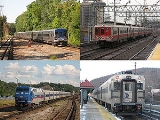
The
Metro-North Commuter Railroad , trading as
MTA Metro-North Railroad, or, more commonly,
Metro-North, is a suburban commuter rail service that is run and managed by the
Metropolitan Transportation AuthorityThe Metropolitan Transportation Authority of the State of New York is a public benefit corporation responsible for public transportation in the U.S...
(MTA), an
authorityNew York State public benefit corporations and authorities operate like quasi-private corporations, with boards of directors appointed by elected officials. Public authorities share characteristics with government agencies, but they are exempt from many state and local regulations...
of
New YorkNew York is a state in the Northeastern region of the United States. It is the nation's third most populous state. New York is bordered by New Jersey and Pennsylvania to the south, and by Connecticut, Massachusetts and Vermont to the east...
State. It is the busiest commuter railroad in the United States as measured in terms of overall monthly ridership. Metro–North runs service between
New York CityNew York is the most populous city in the United States and the center of the New York Metropolitan Area, one of the most populous metropolitan areas in the world. New York exerts a significant impact upon global commerce, finance, media, art, fashion, research, technology, education, and...
to its northern suburbs in New York and
ConnecticutConnecticut is a state in the New England region of the northeastern United States. It is bordered by Rhode Island to the east, Massachusetts to the north, and the state of New York to the west and the south .Connecticut is named for the Connecticut River, the major U.S. river that approximately...
. Trains terminate in places respective to their branch line; these locals include, in New York State, in
Port JervisPort Jervis is a city on the Delaware River in western Orange County, New York, with a population of 8,860 at the 2000 census. The communities of Deerpark, Huguenot, Sparrowbush, and Greenville are adjacent to Port Jervis, and the towns of Montague, New Jersey and Matamoras, Pennsylvania face the...
,
Spring ValleySpring Valley, incorporated on July 9, 1902 is a village spanning the Town of Ramapo and Town of Clarkstown in Rockland County, New York, United States located north of Nanuet; east of Airmont and Monsey; south of Hillcrest and west of West Nyack...
,
PoughkeepsieThe Poughkeepsie Metro-North Railroad station serves Poughkeepsie, New York and surrounding areas as the north end of the Hudson Line. It is also served by many Amtrak trains, which continue north to Albany and points beyond, and south to New York City's Pennsylvania Station. Trains leave for New...
, and
WassaicWassaic is a hamlet in the Town of Amenia, Dutchess County, New York in the United States.Wassaic is located in southeast New York State and surrounded by the East and West Mountains and along the Tenmile River....
; in Connecticut, in
New CanaanNew Canaan is a town in Fairfield County, Connecticut, United States, northeast of Stamford, on the Fivemile River. The population was 19,738 according to the 2010 census.The town is one of the most affluent communities in the United States...
,
DanburyDanbury is a city in northern Fairfield County, Connecticut, United States. It had population at the 2010 census of 80,893. Danbury is the fourth largest city in Fairfield County and is the seventh largest city in Connecticut....
,
WaterburyWaterbury is a city in New Haven County, Connecticut, on the Naugatuck River, 33 miles southwest of Hartford and 77 miles northeast of New York City...
, and
New HavenNew Haven is the second-largest city in Connecticut and the sixth-largest in New England. According to the 2010 Census, New Haven's population increased by 5.0% between 2000 and 2010, a rate higher than that of the State of Connecticut, and higher than that of the state's five largest cities, and...
. Metro-North also provides local rail service within New York City with a reduced fare.
The MTA, which also operates the
New York City Transit AuthorityThe New York City Transit Authority is a public authority in the U.S. state of New York that operates public transportation in New York City...
buses and
subwaysThe New York City Subway is a rapid transit system owned by the City of New York and leased to the New York City Transit Authority, a subsidiary agency of the Metropolitan Transportation Authority and also known as MTA New York City Transit...
, as well as the
Long Island Rail RoadThe Long Island Rail Road or LIRR is a commuter rail system serving the length of Long Island, New York. It is the busiest commuter railroad in North America, serving about 81.5 million passengers each year. Established in 1834 and having operated continuously since then, it is the oldest US...
, has jurisdiction, through Metro-North, for use of the railroad lines on the western and eastern portions of the
Hudson RiverThe Hudson is a river that flows from north to south through eastern New York. The highest official source is at Lake Tear of the Clouds, on the slopes of Mount Marcy in the Adirondack Mountains. The river itself officially begins in Henderson Lake in Newcomb, New York...
in New York State. Service on the western side of the Hudson is operated by
New Jersey TransitNew Jersey Transit Rail Operations is the rail division of New Jersey Transit. It provides regional rail service in New Jersey, with most service centered around transportation to and from New York City, Hoboken, and Newark...
under contract with the MTA. There are 120 stations operated by Metro-North.
Lines
East of Hudson
Three Metro-North lines provide passenger service on the east side of the
Hudson RiverThe Hudson is a river that flows from north to south through eastern New York. The highest official source is at Lake Tear of the Clouds, on the slopes of Mount Marcy in the Adirondack Mountains. The river itself officially begins in Henderson Lake in Newcomb, New York...
, all of which terminate at
Grand Central TerminalGrand Central Terminal —often incorrectly called Grand Central Station, or shortened to simply Grand Central—is a terminal station at 42nd Street and Park Avenue in Midtown Manhattan in New York City, United States...
in
ManhattanManhattan is the oldest and the most densely populated of the five boroughs of New York City. Located primarily on the island of Manhattan at the mouth of the Hudson River, the boundaries of the borough are identical to those of New York County, an original county of the state of New York...
: the
Hudson LineMetro-North Railroad's Hudson Line is a commuter rail line running north from New York City along the east shore of the Hudson River. Metro-North service ends at Poughkeepsie, with Amtrak's Empire Corridor trains continuing north to and beyond Albany...
, Harlem Line and New Haven Line. An additional line, the
Beacon LineMetro-North Railroad's Beacon Line is a non-revenue line connecting the railroad's three revenue lines east of the Hudson River. West to east, they are the Hudson Line, Harlem Line, and the Danbury Branch of the New Haven Line...
, is owned by Metro-North but is not in service.
The Hudson and Harlem Lines terminate in Poughkeepsie and Wassaic, New York, respectively. No other branches extend from these lines.
The New Haven Line is operated through a partnership between Metro-North and the State of Connecticut. Under the arrangement, the
Connecticut Department of TransportationThe Connecticut Department of Transportation is responsible for the development and operation of highways, railroads, mass transit systems, ports, waterways and aviation facilities in the U.S. state of Connecticut. The current Commissioner of ConnDOT is Jeffrey Parker...
(ConnDOT) owns the tracks and stations within Connecticut. ConnDOT also finances and performs capital improvements to such within Connecticut. MTA owns the tracks and stations, and handles capital improvements for such within New York State. MTA also performs routine maintenance and provides police services for the entire New Haven Line, its branches and stations. New cars and locomotives are typically purchased in a joint agreement between MTA and ConnDOT, with the agencies paying for 33.3% and 66.7% of costs, respectively. ConnDOT pays more because most of the line is in Connecticut.
The New Haven Line has three branches providing connecting service in Connecticut- the New Canaan Branch, Danbury Branch and
Waterbury BranchMetro-North Railroad's Waterbury Branch is a branch of the New Haven Line, running north from a junction east of Stratford to Waterbury. Originally built as the Naugatuck Railroad, it once continued north to Winsted...
. At New Haven, the
Shore Line EastShore Line East is a commuter rail service operating in southern Connecticut, USA. A fully owned subsidiary of the Connecticut Department of Transportation , SLE provides service seven days a week along the Northeast Corridor from New London west to New Haven, with continuing service to Bridgeport...
connecting service, which is run by Connecticut, continues east to
New LondonNew London is a seaport city and a port of entry on the northeast coast of the United States.It is located at the mouth of the Thames River in New London County, southeastern Connecticut....
.
AmtrakThe National Railroad Passenger Corporation, doing business as Amtrak , is a government-owned corporation that was organized on May 1, 1971, to provide intercity passenger train service in the United States. "Amtrak" is a portmanteau of the words "America" and "track". It is headquartered at Union...
also operates intercity train service along the New Haven and Hudson Lines. Because the New Haven Line is also part of Amtrak's
Northeast CorridorThe Northeast Corridor is a fully electrified railway line owned primarily by Amtrak serving the Northeast megalopolis of the United States from Boston in the north, via New York to Washington, D.C. in the south, with branches serving other cities...
, high-speed
Acela ExpressThe Acela Express is Amtrak's high-speed rail service along the Northeast Corridor in the Northeast United States between Washington, D.C., and Boston via Baltimore, Philadelphia, and New York...
trains run on the line from
New RochelleNew Rochelle is a city in Westchester County, New York, United States, in the southeastern portion of the state.The town was settled by refugee Huguenots in 1688 who were fleeing persecution in France...
to
New Haven Union StationUnion Station, also known as New Haven Railroad Station, is the main railroad passenger station in New Haven, Connecticut. Designed by noted American architect Cass Gilbert, the beaux-arts Union Station was completed and opened in 1920 after the previous Union Station was...
. Also at New Haven, the New Haven Line connects to the New Haven – Springfield Line with service provided by Amtrak.
Freight trainA freight train or goods train is a group of freight cars or goods wagons hauled by one or more locomotives on a railway, ultimately transporting cargo between two points as part of the logistics chain...
s occasionally run on Metro-North, as CSX,
P & WThe Providence and Worcester Railroad is a Class II railroad in the United States. The railroad connects from Gardner in central Massachusetts, south through its namesake cities of Worcester and Providence, Rhode Island, and west from Rhode Island through Connecticut and into New York City...
, and
Housatonic RailroadThe Housatonic Railroad is a Class III railroad operating in southwestern New England. It was chartered in 1983 to operate a short section of ex-New York, New Haven and Hartford Railroad in northwestern Connecticut, and has since expanded north and south, as well as west into New York State.The...
each have
trackage rightsTrackage rights , running rights or running powers is an agreement whereby a railway company has the right to run its trains on tracks owned by another railway company....
on certain sections of the system.
West of Hudson
Metro-North also provides service on trains west of the Hudson River that originate from
Hoboken TerminalHoboken Terminal is one of the New York Metropolitan area's major transportation hubs. The commuter-oriented intermodal facility, is located on the Hudson River in Hoboken, New Jersey...
, New Jersey. This service is jointly run by Metro-North and New Jersey Transit, under contract. There are two branches of the west-of-Hudson service, the Port Jervis Line, and the
Pascack Valley LineThe Pascack Valley Line is a commuter rail line operated by the Hoboken Division of New Jersey Transit. The line runs north from Hoboken, New Jersey through Bergen County and into Rockland County, New York, terminating at Spring Valley. Service within New York is operated under contract with...
. The Port Jervis Line is accessed from two New Jersey Transit lines, the
Main LineThe Main Line is a rail line owned and operated by New Jersey Transit running from Suffern, New York to Hoboken, New Jersey. It runs daily commuter service and was once the north-south main line of the Erie Lackawanna Railroad...
and the
Bergen County LineThe Bergen County Line is a commuter rail line and service owned and operated by New Jersey Transit in the U.S. state of New Jersey. The line loops off the Main Line between the Meadowlands and Glen Rock, with trains continuing in either direction along the Main Line...
.
The Port Jervis Line terminates in
Port Jervis, New YorkPort Jervis is a city on the Delaware River in western Orange County, New York, with a population of 8,860 at the 2000 census. The communities of Deerpark, Huguenot, Sparrowbush, and Greenville are adjacent to Port Jervis, and the towns of Montague, New Jersey and Matamoras, Pennsylvania face the...
, and the Pascack Valley line in
Spring Valley, New YorkSpring Valley, incorporated on July 9, 1902 is a village spanning the Town of Ramapo and Town of Clarkstown in Rockland County, New York, United States located north of Nanuet; east of Airmont and Monsey; south of Hillcrest and west of West Nyack...
; these lines are in Orange and Rockland Counties, respectively. Trackage on the Port Jervis Line north of the Suffern Yard is leased from the
Norfolk Southern RailwayThe Norfolk Southern Railway is a Class I railroad in the United States, owned by the Norfolk Southern Corporation. With headquarters in Norfolk, Virginia, the company operates 21,500 route miles in 22 eastern states, the District of Columbia and the province of Ontario, Canada...
by the MTA, but New Jersey Transit owns all Pascack Valley Line track, including the track in
Rockland County, New YorkRockland County is a suburban county 15 miles to the northwest of Manhattan and part of the New York City Metropolitan Area, in the U.S. state of New York. It is the southernmost county in New York west of the Hudson River, and the smallest county in New York outside of New York City. The...
.
Most stops for the Main Line and Pascack Valley Lines are in New Jersey, so New Jersey Transit provides most of the
rolling stockRolling stock comprises all the vehicles that move on a railway. It usually includes both powered and unpowered vehicles, for example locomotives, railroad cars, coaches and wagons...
and all the staff for service west of the Hudson River; Metro-North supplies some equipment. Metro-North equipment has been used on other New Jersey Transit lines on the Hoboken division.
All stations west of the Hudson River in New York, except for Suffern, are owned and operated by Metro-North.
The New York Central, New Haven, and Erie Lackawanna operations
Before the Metro-North service was running as it is today, most of the trackage east of the
Hudson RiverThe Hudson is a river that flows from north to south through eastern New York. The highest official source is at Lake Tear of the Clouds, on the slopes of Mount Marcy in the Adirondack Mountains. The river itself officially begins in Henderson Lake in Newcomb, New York...
and in New York State was under the control of the large
New York Central RailroadThe New York Central Railroad , known simply as the New York Central in its publicity, was a railroad operating in the Northeastern United States...
(NYC). The New York Central initially operated three commuter lines, two of which ran directly into Grand Central Terminal. Metro-North's Harlem Line had been initially a combination of trackage from the
New York and Harlem RailroadThe New York and Harlem Railroad was one of the first railroads in the United States, and possibly also the world's first street railway. Designed by John Stephenson, it was opened in stages between 1832 and 1852 between Lower Manhattan to and beyond Harlem...
and the old
Boston and Albany RailroadThe Boston and Albany Railroad was a railroad connecting Boston, Massachusetts to Albany, New York, later becoming part of the New York Central Railroad system, Conrail and CSX. The line is used by CSX for freight...
, running from Manhattan to Chatham, New York in
Columbia CountyColumbia County is a county located in the U.S. state of New York. As of the 2010 census, the population was 63,096. The county seat is Hudson. The name comes from the Latin feminine form of the name of Christopher Columbus, which was at the time of the formation of the county a popular proposal...
. At Chatham passengers could transfer to long distance trains on the Boston and Albany that would take them to destinations in
AlbanyAlbany is the capital city of the U.S. state of New York, the seat of Albany County, and the central city of New York's Capital District. Roughly north of New York City, Albany sits on the west bank of the Hudson River, about south of its confluence with the Mohawk River...
, Boston,
VermontVermont is a state in the New England region of the northeastern United States of America. The state ranks 43rd in land area, , and 45th in total area. Its population according to the 2010 census, 630,337, is the second smallest in the country, larger only than Wyoming. It is the only New England...
, and
CanadaCanada is a North American country consisting of ten provinces and three territories. Located in the northern part of the continent, it extends from the Atlantic Ocean in the east to the Pacific Ocean in the west, and northward into the Arctic Ocean...
. In the 1870s, the New York & Harlem Railroad was bought by
Commodore VanderbiltCornelius Vanderbilt , also known by the sobriquet Commodore, was an American entrepreneur who built his wealth in shipping and railroads. He was also the patriarch of the Vanderbilt family and one of the richest Americans in history...
, which added the railroad to his complex empire of railroads, which were run by the New York Central. The Boston and Albany would come under ownership of the NYC in 1914.
The NYC also operated its famous four tracked Water Level Route which paralleled the Hudson River, Erie Canal, and Great Lakes on a route from New York to Chicago via Albany. The route was fast and popular due to the lack of any significant grades along the line. The section of the Water Level route between Grand Central and
Peekskill, New YorkPeekskill is a city in Westchester County, New York. It is situated on a bay along the east side of the Hudson River, across from Jones Point.This community was known to be an early American industrial center, primarily for its iron plow and stove products...
, the northern most station in Westchester County became known as the NYC's Hudson Division, which operated frequent commuter service in and out of Manhattan. Stations to the north of Peekskill, such as Poughkeepsie, were considered to be long distance services. The other major commuter line was the Putnam Division running from a terminal station at 155th Street in
The BronxThe Bronx is the northernmost of the five boroughs of New York City. It is also known as Bronx County, the last of the 62 counties of New York State to be incorporated...
to
Brewster, New YorkBrewster is a village within the town of Southeast in Putnam County, New York, United States. Its population was 2,162 at the 2000 census. The village is the most densely populated portion of the town...
. Passengers would transfer to the IRT 9th Avenue Line to reach destinations in Manhattan.
From the mid-19th century until 1969, the New Haven Line, including the New Canaan, Danbury, and Waterbury branches, was owned by
New York, New Haven and Hartford RailroadThe New York, New Haven and Hartford Railroad , was a railroad that operated in the northeast United States from 1872 to 1968 which served the states of Connecticut, New York, Rhode Island, and Massachusetts...
(NYNH&H). These branches were started in the 1830s by the as a system of horse-pulled cars, later replaced by steam engines, on a route that that connected the then-early
Lower ManhattanLower Manhattan is the southernmost part of the island of Manhattan, the main island and center of business and government of the City of New York...
to
HarlemHarlem is a neighborhood in the New York City borough of Manhattan, which since the 1920s has been a major African-American residential, cultural and business center. Originally a Dutch village, formally organized in 1658, it is named after the city of Haarlem in the Netherlands...
. Additional lines started in the mid-19th century included the
New York and New Haven RailroadThe New York and New Haven Railroad was a railroad connecting New York City to New Haven, Connecticut along the shore of the Long Island Sound. It opened in 1849, and in 1872 it merged with the Hartford and New Haven Railroad to form the New York, New Haven and Hartford Railroad...
and the
Hartford and New Haven RailroadThe Hartford and New Haven Railroad was an important direct predecessor of the New York, New Haven and Hartford Railroad. Its railroad commenced service in 1844 and ended independent operations in 1872...
, which provided routes to Hartford,
Springfield, MassachusettsSpringfield is the most populous city in Western New England, and the seat of Hampden County, Massachusetts, United States. Springfield sits on the eastern bank of the Connecticut River near its confluence with three rivers; the western Westfield River, the eastern Chicopee River, and the eastern...
, and eventually
BostonBoston is the capital of and largest city in Massachusetts, and is one of the oldest cities in the United States. The largest city in New England, Boston is regarded as the unofficial "Capital of New England" for its economic and cultural impact on the entire New England region. The city proper had...
. The two roads would merge to become the New York, New Haven, and Hartford in 1872 growing into the largest passenger and commuter carrier in New England. In the early 20th century the New Haven came under the control of the wealthy J.P. Morgan. Morgan's bankroll allowed the NYNH&H to modernize by upgrading stream power with both electric (along the New Haven Line) and diesel power (branches and lines to eastern and northern New England). The company saw much profitability throughout the 1910s and 1920s until the
Great DepressionThe Great Depression was a severe worldwide economic depression in the decade preceding World War II. The timing of the Great Depression varied across nations, but in most countries it started in about 1929 and lasted until the late 1930s or early 1940s...
of the 1930s would force the company into bankruptcy.
Commuter services west of the Hudson River, which make up today's Port Jervis and Pascack Valley lines, were initially part of the
Erie RailroadThe Erie Railroad was a railroad that operated in New York State, New Jersey, Pennsylvania, Ohio, Indiana, and Illinois, originally connecting New York City with Lake Erie...
. The Port Jervis Line, built in the 1850s and 1860s, was originally part of the Erie's mainline from Jersey City to
Buffalo, New YorkBuffalo is the second most populous city in the state of New York, after New York City. Located in Western New York on the eastern shores of Lake Erie and at the head of the Niagara River across from Fort Erie, Ontario, Buffalo is the seat of Erie County and the principal city of the...
. The Pascack Valley Line was built by the
New Jersey and New York Railroad, which became a subsidiary of the Erie. Trains that service Port Jervis formerly continued all the way to Binghamton and
Buffalo, New YorkBuffalo is the second most populous city in the state of New York, after New York City. Located in Western New York on the eastern shores of Lake Erie and at the head of the Niagara River across from Fort Erie, Ontario, Buffalo is the seat of Erie County and the principal city of the...
(but today is only used by freight trains), while Pascack Valley service continued to
Haverstraw, New YorkHaverstraw is the name of two locations in Rockland County, New York:*Haverstraw, New York, a town*Haverstraw , New York, a village located entirely within the townIt may also refer to:*West Haverstraw, New York*Haverstraw Bay*Haverstraw Indians...
. In 1956, the Erie Railroad began a somewhat successful merger with its rival the Delaware, Lackawanna, and Western Railroad, and in 1960 they formed the Erie Lackawanna which became responsible for the services. Trains were re-routed to the Lackawanna's
Hoboken TerminalHoboken Terminal is one of the New York Metropolitan area's major transportation hubs. The commuter-oriented intermodal facility, is located on the Hudson River in Hoboken, New Jersey...
in 1956-58.
Penn Central
Passenger rail, both long distance and commuter, began to falter after World War II. By the 1950s the railroad industry as a whole would begin to experience a significant downturn due to overregulation, market saturation, and competition from the car and the airplane.. Commuter lines would take a significant hit from this downfall.
Commuter services, historically had always been money losers, and were usually subsidized by the money generated by long distance passenger and freight services. However, as these profits disappeared, commuter services usually were the first to be affected. Many railroads began to gradually discontinue their commuter lines after the war. By 1958, the New York Central had already suspended service on its Putnam Division, while the newly formed Erie Lackawanna, in an effort to make a successful merger, began to prune some of its commuter services. However, as a whole, most New Yorkers still chose the train as their primary means of commuting making many of the other lines heavily patronized. Thus the New York Central, the New Haven, and the Erie Lackawanna had to maintain some level of service on these lines. Corporate mergers between railroads was seen as a way to curtail these issues by combining capital, services, and creating efficiencies. In 1968, following the Erie Lackawanna's example, the New York Central and its rival the
Pennsylvania RailroadThe Pennsylvania Railroad was an American Class I railroad, founded in 1846. Commonly referred to as the "Pennsy", the PRR was headquartered in Philadelphia, Pennsylvania....
formed
Penn Central TransportationThe Penn Central Transportation Company, commonly abbreviated to Penn Central, was an American railroad company that operated from 1968 until 1976. It was created by the merger on February 1, 1968, of the Pennsylvania Railroad and the New York Central Railroad...
with the hope of revitalizing their fortunes. In 1969 the now bankrupt New Haven was also combined into Penn Central by the
Interstate Commerce CommissionThe Interstate Commerce Commission was a regulatory body in the United States created by the Interstate Commerce Act of 1887. The agency's original purpose was to regulate railroads to ensure fair rates, to eliminate rate discrimination, and to regulate other aspects of common carriers, including...
. However, this merger eventually failed, due to large financial costs, government regulations, corporate rivalries, and lack of a formal merger plan. In 1970 Penn Central declared bankruptcy, at the time being the largest corporate bankruptcy ever declared.
In 1972, the now bankrupt Penn Central petitioned the ICC to allow for the discontinuance of its commuter services. Penn Central's long distance passenger services had been taken over by the newly formed, government owned,
AmtrakThe National Railroad Passenger Corporation, doing business as Amtrak , is a government-owned corporation that was organized on May 1, 1971, to provide intercity passenger train service in the United States. "Amtrak" is a portmanteau of the words "America" and "track". It is headquartered at Union...
a year earlier and thus subsidies for the continuance of the New York area lines would have to come from the states of New York and Connecticut. The
Metropolitan Transportation AuthorityThe Metropolitan Transportation Authority of the State of New York is a public benefit corporation responsible for public transportation in the U.S...
, an agency formed by New York State in 1965 with the purpose of subsidizing the
New York City SubwayThe New York City Subway is a rapid transit system owned by the City of New York and leased to the New York City Transit Authority, a subsidiary agency of the Metropolitan Transportation Authority and also known as MTA New York City Transit...
and the
Long Island Rail RoadThe Long Island Rail Road or LIRR is a commuter rail system serving the length of Long Island, New York. It is the busiest commuter railroad in North America, serving about 81.5 million passengers each year. Established in 1834 and having operated continuously since then, it is the oldest US...
, decided to provide the funds for these lines with Penn Central operating them. The state of Connecticut also provided subsidies in an operating agreement they made with the MTA.
Conrail
Many of the other Northeastern railroads at the time, including the Erie Lackawanna, were following Penn Central into bankruptcy and so the federal government decided to fold these lines into the newly created
Consolidated Rail CorporationThe Consolidated Rail Corporation, commonly known as Conrail , was the primary Class I railroad in the Northeast U.S. between 1976 and 1999. The federal government created it to take over the potentially profitable lines of bankrupt carriers, including the Penn Central Transportation Company and...
(Conrail) in 1976. Conrail was initially given the responsibility of operating the former commuter services of these fallen railroads, including the Erie Lackawanna's and Penn Central's.
MTA operation and the formation of Metro-North
However, Conrail was being floated by the federal government as a private for profit freight only carrier. Even with state subsidies, Conrail did not want the responsibility of taking on the operating costs of the money losing commuter lines, an act they officially were relieved from by the passage of the Northeast Rail Act of 1981. Thus, it became essential that state owned agencies both operate and subsidize their commuter services. Over the next few years commuter lines under the control of Conrail were gradually taken over by state agencies such as the newly formed New Jersey Transit in New Jersey, and the established SEPTA in southeastern Pennsylvania, and
Massachusetts Bay Transportation AuthorityThe Massachusetts Bay Transportation Authority, often referred to as the MBTA or simply The T, is the public operator of most bus, subway, commuter rail and ferry systems in the greater Boston, Massachusetts, area. Officially a "body politic and corporate, and a political subdivision" of the...
in Boston. The MTA in conjunction with the Connecticut Department of Transportation formed the Metro-North Commuter Railroad in 1983.
Metro-North also took the responsibility of operating the former Erie Lackawanna services west of the Hudson and north of the New Jersey state line. However, since those lines are physically connected to New Jersey Transit lines, their operations were contracted to NJ Transit, with Metro-North subsidizing the service and supplying equipment.
Much work was needed in reorganization, as significant business success would not appear for at least two decades, following the altogether faltering railroad industry in the 1970s. Conrail and later Metro-North had decided to trim whatever services they felt were unnecessary. A significant portion of the old NYC Harlem Line between Millerton and Chatham, New York was completely abandoned by Conrail leaving residents in Dutchess and Columbia Counties with no other means of public transportation. Nonetheless, most of the old commuter lines were kept in service although they were in much need of a repair.
The first major project undertaken by the new agency was the extension of the third rail electrification on the Harlem line from
North White PlainsThe North White Plains Metro-North Railroad station serves the residents of northern White Plains, New York via the Harlem Line. It is the north terminal for most trains that run local to the south and, until 1984, was the northern limit of electrification. Adjacent to the station is a yard/support...
to a new station at Brewster North (since renamed
SoutheastSoutheast is a Metro-North Railroad station serving the residents of Southeast, New York via the Harlem Line. Trains leave for New York City every hour, and about every 30 minutes during rush hour. It is the terminus of the Harlem Line electrified service. For travel farther north to Wassaic,...
). This was completed in 1984. In the early 1990s all wayside signals that did not protect switches and interlockings north of Grand Central Terminal were removed and replaced by modern cab signaling.
Metro-North spent the better part of its early days updating and repairing its infrastructure. Stations, track, and rolling stock all needed to be repaired, renovated, or replaced. Nonetheless, the railroad succeeded and by the mid nineties gained both respect and monetary success, according to the MTA's own website. 2006 was the best year for the line, as there was a 97.8% rate of on-time trains, a record amount of ridership (76.9 million people), and a passenger satisfaction rating of 92%.
The Harlem and Hudson lines, and the Park Avenue mainline to Grand Central, are now owned by Midtown TDR Ventures LLC, who bought them from the corporate successors to Penn Central, but the MTA has a lease on the entire system extending to 2274, and an option to buy starting in 2017.
Technical details
East of Hudson
Most services running directly into Grand Central Terminal are electric powered.
In the case when the diesel powered train runs into Grand Central,
General ElectricGeneral Electric Company , or GE, is an American multinational conglomerate corporation incorporated in Schenectady, New York and headquartered in Fairfield, Connecticut, United States...
P32AC-DMGE Genesis is a series of passenger locomotives produced by GE Transportation Systems, a subsidiary of General Electric...
electro-diesel locomotiveAn Electro-diesel locomotive is powered either from an electricity supply or by using the onboard diesel engine...
s capable of switching to a pure electric mode using contact shoes to contact the railroad's under-running
third railA third rail is a method of providing electric power to a railway train, through a semi-continuous rigid conductor placed alongside or between the rails of a railway track. It is used typically in a mass transit or rapid transit system, which has alignments in its own corridors, fully or almost...
power distribution system. Shoreliner series coaches are used in
push-pullPush–pull is a mode of operation for locomotive-hauled trains allowing them to be driven from either end.A push–pull train has a locomotive at one end of the train, connected via some form of remote control, such as multiple-unit train control, to a vehicle equipped with a control cab at the other...
operation.
On the Hudson Line, local trains between Grand Central and
Croton-HarmonThe Croton–Harmon Metro-North Railroad station serves the residents of Croton-on-Hudson, New York via the Hudson Line. It is the main transfer point between the Hudson Line's local and express service, and it is also served by almost all Amtrak trains on the line. Metro-North trains leave for New...
are powered by electrified
third railA third rail is a method of providing electric power to a railway train, through a semi-continuous rigid conductor placed alongside or between the rails of a railway track. It is used typically in a mass transit or rapid transit system, which has alignments in its own corridors, fully or almost...
. Through trains to Poughkeepsie are diesel powered and do not require a change of trains at Croton-Harmon. The Harlem Line has third rail from Grand Central Terminal to Southeast and are powered by diesel north of that station to Wassaic. At most times, passengers traveling between Southeast and Wassaic must change trains at Southeast to a diesel-powered train. These trains are powered by Brookville BL20-GH locomotives. Electric service on the Hudson and Harlem lines uses
M3The M1 and M3 are two similar series of electric multiple unit rail cars made by the Budd Company for the Long Island Rail Road, the Metro North Railroad and Metro North's predecessors, Penn Central and Conrail...
and
M7The M7 is an electric multiple unit railroad car built by Bombardier, with delivery beginning in 2002.The cars were ordered by the Metropolitan Transportation Authority for the Long Island Rail Road and Metro-North Railroad . The M7 replaced the M1 railcars, which had previously provided electric...
MU cars.
The New Haven Line is unique in that trains can use either 700 V
DCDirect current is the unidirectional flow of electric charge. Direct current is produced by such sources as batteries, thermocouples, solar cells, and commutator-type electric machines of the dynamo type. Direct current may flow in a conductor such as a wire, but can also flow through...
from a third rail or 13.8 kV
ACIn alternating current the movement of electric charge periodically reverses direction. In direct current , the flow of electric charge is only in one direction....
from an overhead catenary wire. The line from
WoodlawnThe Woodlawn Metro-North Railroad station serves the residents of the Woodlawn section of The Bronx via the Harlem Line. It is 11.8 miles from Grand Central Terminal and is located on East 233rd Street, three blocks from the 233rd Street station on the IRT White Plains Road Line of the New York...
to
PelhamThe Pelham Metro-North Railroad station serves passengers who wish to travel to or from Pelham, New York, via the New Haven Line. The station is one mile west of the point where the New Haven Line joins the Northeast Corridor and just east of the end of third rail power and start of overhead...
(3 miles, or 4.8 km), is powered by third rail, while from
PelhamThe Pelham Metro-North Railroad station serves passengers who wish to travel to or from Pelham, New York, via the New Haven Line. The station is one mile west of the point where the New Haven Line joins the Northeast Corridor and just east of the end of third rail power and start of overhead...
, New York east to New Haven Union Station (58 miles, or 93 km) is powered by catenary.
Multi-systemA Multi-system locomotive is one that is able to operate using more than one railway electrification system, such as the British Rail Class 92 which can operate from both 750 V DC third rail and 25 kV, 50 Hz AC from overhead lines.As well as multi-system electric...
M2The M2 is a series of 244 electric multiple unit cars produced for the Metropolitan Transportation Authority and the Connecticut Department of Transportation for use on the New Haven Line...
,
M4The M2 is a series of 244 electric multiple unit cars produced for the Metropolitan Transportation Authority and the Connecticut Department of Transportation for use on the New Haven Line...
and
M6The M2 is a series of 244 electric multiple unit cars produced for the Metropolitan Transportation Authority and the Connecticut Department of Transportation for use on the New Haven Line...
railcars are used, as well as the new
M8The M8 is an electric multiple unit railroad car built by Kawasaki for use on the New Haven Line of the Metro-North Railroad. It will replace the current fleet of 240 M2's which are nearing 40 years old and the 54 M4's which entered service in 1987.-Design:...
railcars, of which 380 have been ordered; the first sets entered service in March 2011.
The New Canaan Branch also uses catenary. The Danbury Branch was formerly electrified but in 1961 became a diesel-only line. The Waterbury Branch, the only east-of-Hudson Metro-North service which has no direct service of any sort into Grand Central, is diesel-only.
The third rails on the three Metro-North lines which go into Grand Central Terminal are unusual in that power is collected from below the third rail as opposed to above, unlike most other third rail systems (including the Long Island Rail Road and New York City Subway). This system is known as the Wilgus-Sprague third rail and the SEPTA
Market-Frankford LineThe Market–Frankford Line is a rapid transit line in Philadelphia, Pennsylvania, United States, operated by the Southeastern Pennsylvania Transportation Authority .-Route:The Market–Frankford Line begins at 69th Street Transportation Center, in Upper Darby...
in Philadelphia and Metro-North are the only two electric rail systems in North America that use it. This allows the third rail to be completely insulated from above, thus decreasing the chances of a person being electrocuted by coming in contact with the rail. It also reduces the impact of icing conditions on operations during winter weather.
West of Hudson
Most of the rolling stock on west-of-Hudson Metro-North lines consists of Metro-North owned and marked
Comet VThe Comet V railcar is the fifth generation of the Comet railcar series. Produced by the manufacturer Alstom, the Comet V is a much different type of car compared to previous versions of the series...
cars, although occasionally other NJT cars are used, as the two railroads pool equipment. The trains are also usually handled by EMD GP40FH-2, GP40PH-2,
F40PH-2CAT-Amtrak NPCU Conversions:In later years, as Amtrak's F40PH fleet was being replaced by the newer GE Genesis-series locomotives, Amtrak converted a number of the retired units—generally ones with major mechanical problems limiting their value in the resale or lease marketplace—into "Non-Power...
or
AlstomAlstom is a large multinational conglomerate which holds interests in the power generation and transport markets. According to the company website, in the years 2010-2011 Alstom had annual sales of over €20.9 billion, and employed more than 85,000 people in 70 countries. Alstom's headquarters are...
PL42ACThe PL42AC is a diesel-electric 4-axle locomotive built by Alstom, EMD and Vossloh España for New Jersey Transit. The first 33 locomotives were manufactured at the Vossloh España plant in Valencia, Spain in 2003. Later units were assembled at the Alstom Transport plant in Hornell, New York in 2004...
diesel locomotives, although any Metro-North or New Jersey Transit diesel can show up.
Reporting marks
Although Metro-North uses many abbreviations (MNCR, MNR, MN, etc.) there are two official
reporting markA reporting mark is a two-, three-, or four-letter alphabetic code used to identify owners or lessees of rolling stock and other equipment used on the North American railroad network. The marks are stenciled on each piece of equipment, along with a one-to-six-digit number, which together uniquely...
s used on equipment. For non-revenue equipment, the mark registered and recognized on AEI scanner tags is 'MNCW', while revenue equipment is identified using 'MNCR'.
Active rolling stock
Includes passenger revenue equipment only.
| Builder and model |
Photo |
Built |
Power |
Notes |
| Locomotives |
| GE GE Transportation, formerly known as GE Rail, is a division of General Electric. The organization manufactures equipment for the railroad, marine, mining, drilling and energy generation industries. It is based in Erie, Pennsylvania. Locomotives are assembled at the Erie plant, while engine...
P32AC-DM |
 |
1995- 1998 |
3200 hp |
Dual mode for operation into Grand Central Terminal |
Brookville BL20-GH |
 |
2008–2009 |
2250 hp |
Used on branch line shuttles and as work trains, cannot enter Grand Central Terminal |
| Electric Multiple Units |
| Budd The Budd Company is a metal fabricator and major supplier of body components to the automobile industry, and was formerly a manufacturer of stainless steel passenger rail cars during the 20th century....
M2The M2 is a series of 244 electric multiple unit cars produced for the Metropolitan Transportation Authority and the Connecticut Department of Transportation for use on the New Haven Line...
|
 |
1972–1977 |
650V DC Third Rail under running 12.5kV 60 Hz AC catenary |
220 out of 244 remain in service, being replaced by M8s |
| M3A |
 |
1984–1985 |
650V DC Third Rail under running |
Will undergo CSR after the M8s have arrived |
Tokyu Car M4 |
|
1987–1988 |
650V DC Third Rail under running 12.5kV 60 Hz AC catenary |
3 car sets |
Morrison Knudsen M6 |
|
1993 |
650V DC Third Rail under running 12.5kV 60 Hz catenary |
3 car sets |
BombardierBombardier Transportation is the rail equipment division of the Canadian firm, Bombardier Inc. Bombardier Transportation is one of the world's largest companies in the rail-equipment manufacturing and servicing industry. Its headquarters are in Berlin, Germany....
M7AThe M7 is an electric multiple unit railroad car built by Bombardier, with delivery beginning in 2002.The cars were ordered by the Metropolitan Transportation Authority for the Long Island Rail Road and Metro-North Railroad . The M7 replaced the M1 railcars, which had previously provided electric...
|
 |
2002 |
650V DC Third Rail under running |
Replaced M1s and ACMUs |
Kawasakiis an international corporation based in Japan. It has headquarters in both Chūō-ku, Kobe and Minato, Tokyo.The company is named after its founder Shōzō Kawasaki and has no connection with the city of Kawasaki, Kanagawa....
M8The M8 is an electric multiple unit railroad car built by Kawasaki for use on the New Haven Line of the Metro-North Railroad. It will replace the current fleet of 240 M2's which are nearing 40 years old and the 54 M4's which entered service in 1987.-Design:...
|
|
2009– |
650V DC Third Rail under running 650V DC Third Rail over running 12.5kV 60 Hz AC catenary 25kV 60 Hz AC catenary |
Delivery ongoing. Will be able to operate on Shore Line EastShore Line East is a commuter rail service operating in southern Connecticut, USA. A fully owned subsidiary of the Connecticut Department of Transportation , SLE provides service seven days a week along the Northeast Corridor from New London west to New Haven, with continuing service to Bridgeport... and may eventually operate into Penn Station. Total of 405 on order. Deliveries began in late 2009; as of summer 2011, 38 had been delivered. One 8 car set in service as of March 1, 2011. |
| Push Pull Coaches |
BombardierBombardier Transportation is the rail equipment division of the Canadian firm, Bombardier Inc. Bombardier Transportation is one of the world's largest companies in the rail-equipment manufacturing and servicing industry. Its headquarters are in Berlin, Germany....
Shoreliner I |
|
1983 |
Non-powered |
One door on each end, odd # trailers have toilets |
BombardierBombardier Transportation is the rail equipment division of the Canadian firm, Bombardier Inc. Bombardier Transportation is one of the world's largest companies in the rail-equipment manufacturing and servicing industry. Its headquarters are in Berlin, Germany....
Shoreliner II |
|
1987 |
Non-powered |
Near identical to Shoreliner Is |
BombardierBombardier Transportation is the rail equipment division of the Canadian firm, Bombardier Inc. Bombardier Transportation is one of the world's largest companies in the rail-equipment manufacturing and servicing industry. Its headquarters are in Berlin, Germany....
Shoreliner III |
|
1991 |
Non-powered |
Have center doors in addition to end doors, odd # trailers have toilets |
BombardierBombardier Transportation is the rail equipment division of the Canadian firm, Bombardier Inc. Bombardier Transportation is one of the world's largest companies in the rail-equipment manufacturing and servicing industry. Its headquarters are in Berlin, Germany....
Shoreliner IV |
|
1996–1998 |
Non-powered |
Engineers side door removed in cab cars, odd # trailers have toilets |
AlstomAlstom is a large multinational conglomerate which holds interests in the power generation and transport markets. According to the company website, in the years 2010-2011 Alstom had annual sales of over €20.9 billion, and employed more than 85,000 people in 70 countries. Alstom's headquarters are...
Comet VThe Comet V railcar is the fifth generation of the Comet railcar series. Produced by the manufacturer Alstom, the Comet V is a much different type of car compared to previous versions of the series...
|
 |
2006 |
Non-powered |
Operated by NJ Transit for west-of-Hudson service |
Fare policies
Metro-North offers many different ticket types and prices depending on the frequency of travel and distance of the ride. While the fare policies of the "East of Hudson" and "West of Hudson" divisions are essentially the same, they operate differently because the West of Hudson trains are operated by New Jersey Transit therefore using their ticketing system.
East of Hudson
Tickets may be bought from a ticket office at stations, ticket vending machines (TVMs), online through the "WebTicket" program, or on the train itself. Monthly tickets may also be bought through the MTA's "Mail&Ride" program where monthly passes that are paid in advance, usually by credit card, are delivered by mail to the rider. There is a discount for buying tickets online and through Mail&Ride. A surcharge is added on top of the standard price if a ticket is purchased on a train.
Ticket types available include One-Way, Round-trip (two one-way tickets), 10-trip, Weekly (unlimited travel for one calendar week), Monthly (unlimited travel for one calendar month), and special student and disabled fare tickets.
MetroCardThe MetroCard is the payment method for the New York City Subway rapid transit system; New York City Transit buses, including routes operated by Atlantic Express under contract to the Metropolitan Transportation Authority ; MTA Bus, and MTA Long Island Bus systems; the PATH subway system; the...
s are also available on the reverse side of the weekly, monthly, and round-trip tickets.
All tickets to/from Manhattan (Grand Central Terminal and Harlem-125th Street) are distinguished as being peak or off-peak. Peak fares, which are substantially higher than off-peak trains, apply to trains that arrive in Grand Central between 5 AM and 10 AM and trains that leave Grand Central between 5:30 AM and 9 AM and from 4 PM to 8 PM all coinciding with the standard New York City rush hours. Trains arriving at Grand Central during the PM peak hours are not subject to peak fare. Off-peak fares are charged all other times including weekends and holidays. Tickets for travel outside of Manhattan are called "intermediate" tickets and the peak/off-peak rules do not apply.
The fares themselves are distinguished by the 14 zones that the lines are divided into within New York State. In Connecticut, the fare structure is more complex due to the many branches on the New Haven line. Generally, these zones correspond to express stops on the lines and from "blocks" of service within the schedules.
West of Hudson
The fare structure resembles the New Jersey Transit fare structure, and less like that of east-of-Hudson trains.
Plans
Metro-North is continually upgrading trackage, equipment, and station facilities.
Metro-North is also in the process of upgrading its Operations Control Center in Grand Central Terminal. In 2008, construction began on a new Operations Control Center to replace all control hardware. Software upgrades are providing for state of the art rail traffic technology. Construction is underway on the OCC at GCT and construction on a backup OCC is also underway.
Hudson Line
No further plans are in the works on the Hudson Line at this time. On May 23, 2009 a new station opened, Yankees-E. 153rd Street, which is accessible from all three Metro-North Railroad, East of Hudson lines with direct game day trains. The trains to the new station that originate from the New Haven and Harlem lines gain access to the Hudson line station via the
wyeA wye or triangular junction, in rail terminology, is a triangular shaped arrangement of rail tracks with a switch or set of points at each corner. In mainline railroads, this can be used at a rail junction, where three rail lines join, in order to allow trains to pass from any line to any other...
at Mott Haven Junction. This marks the first time in the long history of these lines that revenue service operates across this section of the wye.
Northward expansion of the Hudson Line has often met opposition from residents of communities including
Hyde ParkHyde Park is a town located in the northwest part of Dutchess County, New York, United States, just north of the city of Poughkeepsie. The town is most famous for being the hometown of U.S. President Franklin D. Roosevelt....
and Rhinecliff, even though the latter is home to
AmtrakThe National Railroad Passenger Corporation, doing business as Amtrak , is a government-owned corporation that was organized on May 1, 1971, to provide intercity passenger train service in the United States. "Amtrak" is a portmanteau of the words "America" and "track". It is headquartered at Union...
's
Rhinecliff-Kingston stationThe Rhinecliff–Kingston Amtrak station, commonly and formerly known as simply Rhinecliff, is located in Rhinebeck, New York and serves northern Dutchess County and the nearby Kingston area across the Hudson River. The station has one low-level island platform that serves two tracks...
, frequented by commuters who live in northern Dutchess and northern
UlsterUlster County is a county located in the state of New York, USA. It sits in the state's Mid-Hudson Region of the Hudson Valley. As of the 2010 census, the population was 182,493. Recent population estimates completed by the United States Census Bureau for the 12-month period ending July 1 are at...
Counties. As recently as January 2007, supervisors of some towns north of Poughkeepsie have expressed new interest in extending rail service.
Harlem Line
There are plans to redevelop the former
Wingdale Psychiatric CenterHarlem Valley State Hospital, south of the hamlet of Wingdale in the Town of Dover, was a New York State psychiatric hospital that operated from 1924-1994....
into a mixed-use commercial and residential neighborhood known as Dover Knolls, centered around the Harlem Valley – Wingdale Station.
The northward expansion of the Harlem Line took place most recently when it was expanded from Dover Plains to Wassaic in 2001, requiring a costly rebuilding of tracks that were abandoned years before. Going even further north would require further substantial investment to rebuild tracks; grade crossings, stations and other facilities which existed in the past but were removed long ago, as well as obtaining eminent domain for the current train property used by the Harlem Valley Rail Trail. However, expansion of either line would be limited to Dutchess County. Extending Metro-North service into
Columbia CountyColumbia County is a county located in the U.S. state of New York. As of the 2010 census, the population was 63,096. The county seat is Hudson. The name comes from the Latin feminine form of the name of Christopher Columbus, which was at the time of the formation of the county a popular proposal...
would require changes to the MTA charter, and residents of that county would become subject to the MTA tax, therefore extending the Harlem Line back up to
ChathamUnion Station served the residents of Chatham, New York from 1887 to 1972 as a passenger station and until 1976 as a freight station. It was the final stop for Harlem Line trains. It had originally served trains of the Boston and Albany Railroad, then the New York Central Railroad and the Rutland...
would be unlikely.
New Haven Line
Discussions are underway to re-electrify the Danbury Branch with a concurrent expansion to
New MilfordNew Milford is a town in southern Litchfield County, Connecticut, United States north of Danbury, on the Housatonic River. It is the largest town in the state in terms of land area at nearly . The population was 28,671 according to the Census Bureau's 2006 estimates...
. Work began in late 2007 on a third Metro-North station for the Town of
Fairfield, ConnecticutFairfield is a town located in Fairfield County, Connecticut, United States. It is bordered by the towns of Bridgeport, Trumbull, Easton, Redding and Westport along the Gold Coast of Connecticut. As of the 2010 census, the town had a population of 59,404...
. This station, in eastern Fairfield near the
BridgeportBridgeport is the most populous city in the U.S. state of Connecticut.Bridgeport may also refer to:-Places:In Canada:* Bridgeport, Nova ScotiaIn the United States:* Bridgeport, Alabama* Bridgeport, California, in Mono County...
line, was to be part of a large mixed-use development known as
Fairfield Metro CenterFairfield Metro is a planned commercial development and regional commuter rail station situated on in the town of Fairfield, Connecticut. At present, the station is scheduled to open on December 5, 2011.-Name:...
. Many of the developers have backed out of the project due to the recent economic crisis, but the station is still being built. Connecticut officials and Metro-North also began construction of
a new stationWest Haven is a future railroad station on Metro-North Railroad's New Haven Line in West Haven, Connecticut. The station is being built on Sawmill Road between Hood Terrace and Railroad Avenue. Plans include 1,229 parking spaces, including 629 in a parking garage in a refurbished industrial...
in
West HavenWest Haven is a city in New Haven County, Connecticut, United States. According to 2006 Census Bureau estimates, the population of the city is 52,721.-History:...
in November 2010. ConnDOT is also moving forward on a study to increase freight service on the New Haven Line in an effort to reduce the number of trucks on the congested
Connecticut TurnpikeThe Connecticut Turnpike, known now as the Governor John Davis Lodge Turnpike, is a freeway in Connecticut that runs from Greenwich to Killingly. It is signed as Interstate 95 from the New York state line at Greenwich to East Lyme, and then as Interstate 395 from East Lyme to Plainfield...
. A number of projects are either planned or underway that will upgrade the catenary system, replace outdated bridges, and straighten certain sections of the New Haven Line to accommodate the Acela's 240 km/h (150 mph) maximum operating speeds. Much of the catenary system has not been upgraded since the New Haven Railroad installed the catenary wires in 1907. The Danbury Branch is going to receive $30 million for upgrades of stations along the line and also implementation of a new signal system.
Plans to extend the Waterbury Branch northeast from its current terminus in Waterbury are currently under discussion. The extension would bring passenger rail service to central Connecticut, including the two largest cities in Connecticut without passenger rail service,
BristolBristol is a suburban city located in Hartford County, Connecticut, United States southwest of Hartford. According to 2006 Census Bureau estimates, the population of the city is 61,353. Bristol is primarily known as the home of ESPN, whose central studios are in the city. Bristol is also home to...
and
New BritainNew Britain is a city in Hartford County, Connecticut, United States. It is located approximately 9 miles southwest of Hartford. According to 2006 Census Bureau estimates, the population of the city is 71,254....
, and on to Hartford, where transfers to Amtrak would be possible.
West of Hudson
The MTA is working with the Tappan Zee Bridge Environmental Review on several options where a future replacement for the
Tappan Zee BridgeThe Governor Malcolm Wilson Tappan Zee Bridge, usually referred to as Tappan Zee Bridge, is a cantilever bridge in New York over the Hudson River at one of its widest points; the Tappan Zee is named for an American Indian tribe from the area called "Tappan"; and zee being the Dutch word for "sea"....
would include a rail line to connect the Port Jervis Line in Rockland County to the Hudson Line in Westchester County. "Alternatives 4A, 4B and 4C" all include plans for such a rail line to connect with the Hudson Line at
TarrytownThe Tarrytown Metro-North Railroad station serves residents of Tarrytown, New York and other commuters via the Hudson Line and is one of four express stations on that line south of Croton–Harmon seeing most trains minus peak hour trains to/from Poughkeepsie. Trains leave for New York City every 25...
, providing a one-seat ride from Rockland County to Grand Central Terminal in New York City. All three also include mass-transit service across Westchester County, connecting to the Harlem Line in White Plains, and the New Haven Line at Port Chester. The only difference between the three is whether the cross-Westchester trip will be accomplished by heavy rail,
light railLight rail or light rail transit is a form of urban rail public transportation that generally has a lower capacity and lower speed than heavy rail and metro systems, but higher capacity and higher speed than traditional street-running tram systems...
or rapid
busA bus is a road vehicle designed to carry passengers. Buses can have a capacity as high as 300 passengers. The most common type of bus is the single-decker bus, with larger loads carried by double-decker buses and articulated buses, and smaller loads carried by midibuses and minibuses; coaches are...
service.
Metro-North is also considering extending Port Jervis Line service to
Stewart International AirportStewart International Airport is located in the southern Hudson Valley, west of Newburgh, New York and over north of Midtown Manhattan, New York City. The airport is located in the Town of Newburgh and the Town of New Windsor."." U.S. Census Bureau...
in Newburgh, a move that could make a Tappan Zee Bridge rail line even more useful, as it would serve both commuters and travelers who choose to fly to and from Stewart, instead of the three major New York City-area airports.
Access to Penn Station
In September 2009 Metro North announced plans for a $1.7 million
Environmental Impact StatementAn environmental impact statement , under United States environmental law, is a document required by the National Environmental Policy Act for certain actions "significantly affecting the quality of the human environment". An EIS is a tool for decision making...
on accessing
Penn StationPennsylvania Station—commonly known as Penn Station—is the major intercity train station and a major commuter rail hub in New York City. It is one of the busiest rail stations in the world, and a hub for inbound and outbound railroad traffic in New York City. The New York City Subway system also...
. Metro North has been considering the possibility for several decades but never pursued it because no space was available at Penn Station.
The project depends upon the success of the
East Side AccessEast Side Access is a public works project being undertaken by the Metropolitan Transportation Authority in New York City, designed to bring the Long Island Rail Road into a new East Side station to be built below and incorporated into Grand Central Terminal in Manhattan...
which would reroute some
Long Island Rail RoadThe Long Island Rail Road or LIRR is a commuter rail system serving the length of Long Island, New York. It is the busiest commuter railroad in North America, serving about 81.5 million passengers each year. Established in 1834 and having operated continuously since then, it is the oldest US...
trains from Penn Station to Grand Central. That project is scheduled for completion in 2014 at the earliest.
New Haven Line trains would enter the
Hell Gate LineThe Hell Gate Bridge or Hell's Gate Bridge is a steel through arch railroad bridge between Astoria in the borough of Queens and Randall's and Wards Islands in New York City, over a portion of the East River known...
through New Rochelle. At the Sunnyside Yards they would enter Manhattan via the
East River TunnelsThe East River Tunnels are 4 single-track railroad tunnels that extend from the eastern end of Pennsylvania Station under 32nd and 33rd Streets in Manhattan and cross the East River to Long Island City in Queens. The tracks carry Long Island Rail Road and Amtrak trains travelling to and from Penn...
. Stations would be built at Co-Op City, Parkchester and
Hunts PointHunts Point is a low-income neighborhood located on a peninsula in the South Bronx in New York City. It is the location of one of the largest food distribution facilities in the world. The neighborhood is part of Bronx Community Board 2. Its boundaries are the Bruckner Expressway to the west and...
.
Hudson Line trains would access Penn Station via a change at Spuyten Duyvil and would travel under
Riverside ParkRiverside Park is a scenic waterfront public park on the Upper West Side of the borough of Manhattan in New York City, operated and maintained by the New York City Department of Parks and Recreation. The park consists of a narrow four-mile strip of land between the Hudson River and the gently...
via
AmtrakThe National Railroad Passenger Corporation, doing business as Amtrak , is a government-owned corporation that was organized on May 1, 1971, to provide intercity passenger train service in the United States. "Amtrak" is a portmanteau of the words "America" and "track". It is headquartered at Union...
's Empire Connection. Plans call for new stations on West
125th Street125th Street is a two-way street that runs east-west in the New York City borough of Manhattan, considered the "Main Street" of Harlem; It is also called Martin Luther King, Jr...
and West 62nd Street in Manhattan (the site of the historic New York Central West 60th Yards which is now part of the
Trump PlaceRiverside South is an apartment complex originated by Donald Trump and six civic partners on the Upper West Side of Manhattan, in New York City.The $3 billion project on a site between 59th Street and 72nd...
development) .
Community relations
Mascot
Metro-North sponsors a mascot named Metro-Man, a small remote-operated robot that "speaks" about rail safety during appearances at schools and other events.
Croton-Harmon Shop Open House
Each October, one Saturday is set aside for the railroad to hold an open house at the Croton-Harmon heavy repair facility located next to the station. An extensive tour of the facility is given showing all facets of repair and maintenance along with detailed exhibits that display the different parts of the system such as power and signaling. Also a large display of the many diesel locomotives is set up and a free "Fall Foliage" ride is offered from the shop north to the interlocking south of Garrison station and back. In addition, the MTA Police have a display of their equipment and the K-9 dog corps put on a show so the visitors can see how highly skilled dogs can sniff out contraband and explosives. No open house was held in 2009 or 2010 due to construction at the shop.
In films
- The railroad has been featured in several films, including: The Ice Storm
The Ice Storm is a 1997 drama film directed by Ang Lee, based on the 1994 novel of the same name by Rick Moody.The film features an ensemble cast of Kevin Kline, Joan Allen, Tobey Maguire, Christina Ricci, Elijah Wood, and Sigourney Weaver...
, U.S. MarshalsU.S. Marshals is a 1998 action thriller film starring Tommy Lee Jones and Wesley Snipes, and a sequel to The Fugitive. The storyline of U.S. Marshals does not feature the character Dr. Richard Kimble; the role of the protagonist has been passed onto Samuel Gerard and his team of U.S...
, and Steven Spielberg's War of the WorldsWar of the Worlds is a 2005 American science fiction film adaptation of H. G. Wells' novel of the same name, directed by Steven Spielberg and written by Josh Friedman and David Koepp. It is one of three film adaptations of War of the Worlds released that year, alongside The Asylum's version and...
.
- The film Eternal Sunshine of the Spotless Mind
Eternal Sunshine of the Spotless Mind is a 2004 American romantic science fiction film about an estranged couple who have each other erased from their memories, scripted by Charlie Kaufman and directed by the French director, Michel Gondry. The film uses elements of science fiction, psychological...
was filmed on a Metro-North train representing the Long Island Rail Road.
- Hudson Line trains were also the setting for the 1984 film Falling in Love, starring Robert De Niro
Robert De Niro, Jr. is an American actor, director and producer. His first major film roles were in Bang the Drum Slowly and Mean Streets, both in 1973...
and Meryl StreepMary Louise "Meryl" Streep is an American actress who has worked in theatre, television and film.Streep made her professional stage debut in 1971's The Playboy of Seville, before her screen debut in the television movie The Deadliest Season in 1977. In that same year, she made her film debut with...
.
- The trains are also mentioned in the movie, Madagascar
Madagascar is a 2005 computer-animated film produced by DreamWorks Animation, and released in movie theaters on May 27, 2005. The film tells the story of four Central Park Zoo animals who have spent their lives in blissful captivity and are unexpectedly shipped back to Africa, getting shipwrecked...
, as the rail service that Marty the Zebra wanted to use to get to Connecticut.
In advertisements
Recent
Tuscan Dairy FarmsTuscan Dairy Farms is a dairy based in the New York metropolitan area, owned by Dean Foods.Founded in 1918 by Louis Borinsky, Tuscan Dairy Farms was begun as a family-run distribution operation, delivering dairy products door to door on routes throughout Union and Essex counties in New...
and
Verizon FiosVerizon FiOS is a bundled Internet access, telephone, and television service which operates over a fiber-optic communications network. It is offered in some areas of the United States by Verizon Communications. Verizon was one of the first major U.S...
commercials featured
CrestwoodThe Crestwood Metro-North Railroad station serves the residents of Crestwood, NY, which is in the city of Yonkers and the residents of the northern part of Tuckahoe, Westchester County, New York via the Harlem Line. It is from Grand Central Terminal...
, on the Harlem Line.
See also
- Long Island Rail Road
The Long Island Rail Road or LIRR is a commuter rail system serving the length of Long Island, New York. It is the busiest commuter railroad in North America, serving about 81.5 million passengers each year. Established in 1834 and having operated continuously since then, it is the oldest US...
- List of Metro-North Railroad stations
- Transportation in New York City
The transportation system of New York City is a cooperation of complex systems of infrastructure. New York City, being the largest city in the United States, has a transportation system which includes the largest subway system in the world, measured by track mileage; the world's first mechanically...
- Transportation in New York State
- CityTicket
CityTicket is a program that was instituted on January 10, 2004 by the Metropolitan Transportation Authority of New York. It allows weekend travel on the Metro-North Railroad or the Long Island Rail Road between any two points within the borders of New York City, for a reduced $3.75 fare. Tickets...
External links