
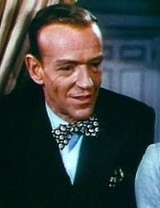
Fred Astaire was an
AmericanThe United States of America is a federal constitutional republic comprising fifty states and a federal district...
film and
BroadwayBroadway theatre, commonly called simply Broadway, refers to theatrical performances presented in one of the 40 professional theatres with 500 or more seats located in the Theatre District centered along Broadway, and in Lincoln Center, in Manhattan in New York City...
stage dancer, choreographer, singer and actor. His stage and subsequent film career spanned a total of 76 years, during which he made 31
musical filmThe musical film is a film genre in which songs sung by the characters are interwoven into the narrative, sometimes accompanied by dancing. The songs usually advance the plot or develop the film's characters, though in some cases they serve merely as breaks in the storyline, often as elaborate...
s. He was named the fifth
Greatest Male Star of All TimePart of the AFI 100 Years... series, AFI's 100 Years...100 Stars is a list of the top 50 greatest screen legends of American cinema, 25 male and 25 female...
by the
American Film InstituteThe American Film Institute is an independent non-profit organization created by the National Endowment for the Arts, which was established in 1967 when President Lyndon B. Johnson signed the National Foundation on the Arts and the Humanities Act...
. He is particularly associated with
Ginger RogersGinger Rogers was an American actress, dancer, and singer who appeared in film, and on stage, radio, and television throughout much of the 20th century....
, with whom he made ten films.
Gene KellyEugene Curran "Gene" Kelly was an American dancer, actor, singer, film director and producer, and choreographer...
, another major innovator in filmed dance, said that "the history of dance on film begins with Astaire". Beyond film and television, many classical dancers and choreographers,
Rudolf NureyevRudolf Khametovich Nureyev was a Russian dancer, considered one of the most celebrated ballet dancers of the 20th century. Nureyev's artistic skills explored expressive areas of the dance, providing a new role to the male ballet dancer who once served only as support to the women.In 1961 he...
;
Sammy Davis, Jr.Samuel George "Sammy" Davis Jr. was an American entertainer and was also known for his impersonations of actors and other celebrities....
;
Michael JacksonMichael Joseph Jackson was an American recording artist, entertainer, and businessman. Referred to as the King of Pop, or by his initials MJ, Jackson is recognized as the most successful entertainer of all time by Guinness World Records...
;
Gregory HinesGregory Oliver Hines was an American actor, singer, dancer and choreographer.-Early years:Born in New York City, Hines and his older brother Maurice started dancing at an early age, studying with choreographer Henry LeTang...
;
Mikhail BaryshnikovMikhail Nikolaevich Baryshnikov is a Soviet and American dancer, choreographer, and actor, often cited alongside Vaslav Nijinsky and Rudolf Nureyev as one of the greatest ballet dancers of the 20th century. After a promising start in the Kirov Ballet in Leningrad, he defected to Canada in 1974...
;
George BalanchineGeorge Balanchine , born Giorgi Balanchivadze in Saint Petersburg, Russia, to a Georgian father and a Russian mother, was one of the 20th century's most famous choreographers, a developer of ballet in the United States, co-founder and balletmaster of New York City Ballet...
and
Jerome RobbinsJerome Robbins was an American theater producer, director, and choreographer known primarily for Broadway Theater and Ballet/Dance, but who also occasionally directed films and directed/produced for television. His work has included everything from classical ballet to contemporary musical theater...
among them, also acknowledged his importance and influence.
1899–1917: Early life and career
Astaire was born in
Omaha, NebraskaOmaha is the largest city in the state of Nebraska, United States, and is the county seat of Douglas County. It is located in the Midwestern United States on the Missouri River, about 20 miles north of the mouth of the Platte River...
, the son of Johanna "Ann" (née Geilus) and Frederic "Fritz"
AusterlitzAusterlitz is the name of a Jewish family. As is the case with all names derived from places, the surname "Austerlitz" does not necessarily signify that all the persons so named belong to one family. It denotes that an ancestor of the person came from that place or was for some time a resident...
(born September 8, 1868, as Friedrich Emanuel Austerlitz). Astaire's mother was born in the United States to Lutheran German immigrants from
East PrussiaEast Prussia is the main part of the region of Prussia along the southeastern Baltic Coast from the 13th century to the end of World War II in May 1945. From 1772–1829 and 1878–1945, the Province of East Prussia was part of the German state of Prussia. The capital city was Königsberg.East Prussia...
and
AlsaceAlsace is the fifth-smallest of the 27 regions of France in land area , and the smallest in metropolitan France. It is also the seventh-most densely populated region in France and third most densely populated region in metropolitan France, with ca. 220 inhabitants per km²...
, while Astaire's father was born in
LinzLinz is the third-largest city of Austria and capital of the state of Upper Austria . It is located in the north centre of Austria, approximately south of the Czech border, on both sides of the river Danube. The population of the city is , and that of the Greater Linz conurbation is about...
, Austria, to Jewish parents who had converted to
CatholicismCatholicism is a broad term for the body of the Catholic faith, its theologies and doctrines, its liturgical, ethical, spiritual, and behavioral characteristics, as well as a religious people as a whole....
.
After arriving in New York City at age 24 on October 26, 1892, and being inspected at
Ellis IslandEllis Island in New York Harbor was the gateway for millions of immigrants to the United States. It was the nation's busiest immigrant inspection station from 1892 until 1954. The island was greatly expanded with landfill between 1892 and 1934. Before that, the much smaller original island was the...
, Astaire's father, hoping to find work in his brewing trade, moved to Omaha, Nebraska, and landed a job with the
Storz Brewing CompanyThe Storz Brewing Company was located at 1807 North 16th Street in North Omaha, Nebraska. Established from a company started in 1863, Storz Brewing began in 1876 by Gottlieb Storz and was owned by the Storz family until 1966; the brewery ceased operations in 1972...
. Astaire's mother dreamed of escaping Omaha by virtue of her children's talents, after Astaire's sister,
Adele AstaireLady Charles Cavendish , better known as Adele Astaire, was an American dancer and entertainer. She was Fred Astaire's elder sister. Her birthdate was often given as 1897 or 1898, but the 1900 U.S...
, early on revealed herself to be an instinctive dancer and singer. She planned a "brother-and-sister act," which was common in
vaudevilleVaudeville was a theatrical genre of variety entertainment in the United States and Canada from the early 1880s until the early 1930s. Each performance was made up of a series of separate, unrelated acts grouped together on a common bill...
at the time. Although Astaire refused dance lessons at first, he easily mimicked his older sister's step and took up piano,
accordionThe accordion is a box-shaped musical instrument of the bellows-driven free-reed aerophone family, sometimes referred to as a squeezebox. A person who plays the accordion is called an accordionist....
and
clarinetThe clarinet is a musical instrument of woodwind type. The name derives from adding the suffix -et to the Italian word clarino , as the first clarinets had a strident tone similar to that of a trumpet. The instrument has an approximately cylindrical bore, and uses a single reed...
.
When their father suddenly lost his job, the family moved to New York City to launch the show business career of the children. Despite Adele and Fred's teasing rivalry, they quickly acknowledged their individual strengths, his durability and her greater talent. Sister and brother took the name "Astaire" in 1905, as they were taught dance, speaking, and singing in preparation for developing an act. Family legend attributes the name to an uncle surnamed "L'Astaire".
Their first act was called
Juvenile Artists Presenting an Electric Musical Toe-Dancing Novelty. Fred wore a top hat and tails in the first half and a lobster outfit in the second. The goofy act debuted in
Keyport, New JerseyKeyport is a borough in Monmouth County, New Jersey, United States. As of the 2010 United States Census, the borough population was 7,240. Keyport's nickname is the "Pearl of the Bayshore" or the "Gateway to the Bayshore"....
, in a "tryout theater." The local paper wrote, "the Astaires are the greatest child act in vaudeville."
As a result of their father's salesmanship, Fred and Adele rapidly landed a major contract and played the famed Orpheum Circuit not only in Omaha, but throughout the United States. Soon Adele grew to at least three inches taller than Fred and the pair began to look incongruous. The family decided to take a two-year break from show business to let time take its course and to avoid trouble from the Gerry Society and the child labor laws of the time. In 1912, Fred became an Episcopalian.
The career of the Astaire siblings resumed with mixed fortunes, though with increasing skill and polish, as they began to incorporate tap dancing into their routines. Astaire's dancing was inspired by
Bill "Bojangles" RobinsonBill “Bojangles” Robinson was an American tap dancer and actor of stage and film. Audiences enjoyed his understated style, which eschewed the frenetic manner of the jitterbug in favor of cool and reserve; rarely did he use his upper body, relying instead on busy, inventive feet, and an expressive...
and
John "Bubbles" SublettJohn William Sublett , known by his stage name John W. Bubbles, was an American vaudeville performer, dancer, singer and entertainer.-Life and career:...
. From vaudeville dancer Aurelio Coccia, they learned the tango, waltz and other ballroom dances popularized by Vernon and Irene Castle.
Some sources state that the Astaire siblings appeared in a 1915 film entitled
Fanchon, the Cricket, starring
Mary PickfordMary Pickford was a Canadian-born motion picture actress, co-founder of the film studio United Artists and one of the original 36 founders of the Academy of Motion Picture Arts and Sciences...
, but the Astaires have consistently denied this.
Fred Astaire first met
George GershwinGeorge Gershwin was an American composer and pianist. Gershwin's compositions spanned both popular and classical genres, and his most popular melodies are widely known...
, who was working as a song plugger in
Jerome H. Remick__notoc__Jerome Hosmer Remick , was a Detroit music publisher, philanthropist and businessman from the late 19th century to the early 20th century.-Life and career:...
's, in 1916. Fred had already been hunting for new music and dance ideas. Their chance meeting was to deeply affect the careers of both artists.
Astaire was always on the lookout for new steps on the circuit and was starting to demonstrate his ceaseless quest for novelty and perfection. The Astaires broke into Broadway in 1917 with
Over the Top, a patriotic revue.
1917–1933: Stage career in Broadway and London
They followed up with several more shows, and of their work in
The Passing Show of 1918 Heywood BrounHeywood Campbell Broun, Jr. was an American journalist. He worked as a sportswriter, newspaper columnist, and editor in New York City. He founded the American Newspaper Guild, now known as The Newspaper Guild. Born in Brooklyn, New York, he is best remembered for his writing on social issues and...
wrote: "In an evening in which there was an abundance of good dancing, Fred Astaire stood out ... He and his partner, Adele Astaire, made the show pause early in the evening with a beautiful loose-limbed dance."
By this time, Astaire's dancing skill was beginning to outshine his sister's, though she still set the tone of their act and her sparkle and humor drew much of the attention, due in part to Fred's careful preparation and strong supporting choreography.
During the 1920s, Fred and Adele appeared on Broadway and on the
LondonLondon is the capital city of :England and the :United Kingdom, the largest metropolitan area in the United Kingdom, and the largest urban zone in the European Union by most measures. Located on the River Thames, London has been a major settlement for two millennia, its history going back to its...
stage in shows such as
GeorgeGeorge Gershwin was an American composer and pianist. Gershwin's compositions spanned both popular and classical genres, and his most popular melodies are widely known...
and
Ira GershwinIra Gershwin was an American lyricist who collaborated with his younger brother, composer George Gershwin, to create some of the most memorable songs of the 20th century....
's
Lady Be GoodLady, Be Good is a musical written by Guy Bolton and Fred Thompson with music by George and lyrics by Ira Gershwin. It was first presented on Broadway in 1924; the West End production followed in 1926...
(1924) and
Funny FaceFunny Face is a 1927 musical composed by George Gershwin, with lyrics by Ira Gershwin, and book by Fred Thompson and Paul Gerard Smith.Originally called Smarty, it starred Fred Astaire and his sister Adele Astaire. It opened in Philadelphia to poor reviews, and amidst major re-writes,...
(1927), and later in
The Band WagonFor the film, see The Band WagonThe Band Wagon is a musical revue with book by George S. Kaufman and Howard Dietz, lyrics by Howard Dietz and music by Arthur Schwartz. It first played on Broadway in 1931, running for 260 performances...
(1931), winning popular acclaim with the theater crowd on both sides of the Atlantic. By then, Astaire's tap dancing was recognized as among the best, as
Robert BenchleyRobert Charles Benchley was an American humorist best known for his work as a newspaper columnist and film actor...
wrote in 1930, "I don't think that I will plunge the nation into war by stating that Fred is the greatest tap-dancer in the world."
After the close of
Funny Face, the Astaires went to Hollywood for a screen test (now lost) at
Paramount PicturesParamount Pictures Corporation is an American film production and distribution company, located at 5555 Melrose Avenue in Hollywood. Founded in 1912 and currently owned by media conglomerate Viacom, it is America's oldest existing film studio; it is also the last major film studio still...
, but were not considered suitable for films.
They split in 1932 when Adele married her first husband,
Lord Charles Arthur Francis CavendishLord Charles Arthur Francis Cavendish was the second son of Victor Cavendish, 9th Duke of Devonshire and his wife Lady Evelyn Emily Mary Petty-FitzMaurice....
, a son of the
Duke of DevonshireDuke of Devonshire is a title in the peerage of England held by members of the Cavendish family. This branch of the Cavendish family has been one of the richest and most influential aristocratic families in England since the 16th century, and have been rivalled in political influence perhaps only...
. Fred Astaire went on to achieve success on his own on Broadway and in London with
Gay DivorceGay Divorce is a musical with music and lyrics by Cole Porter and book by Dwight Taylor, adapted by Kenneth Webb and Samuel Hoffenstein. It was Fred Astaire's last Broadway show and featured the hit song "Night and Day" in which Astaire danced with co-star Claire Luce.It was made into a musical...
, while considering offers from Hollywood. The end of the partnership was traumatic for Astaire, but stimulated him to expand his range. Free of the brother-sister constraints of the former pairing and with a new partner (
Claire Luce), he created a romantic partnered dance to
Cole PorterCole Albert Porter was an American composer and songwriter. Born to a wealthy family in Indiana, he defied the wishes of his domineering grandfather and took up music as a profession. Classically trained, he was drawn towards musical theatre...
's "
Night and Day"Night and Day" is a popular song by Cole Porter. It was written for the 1932 musical play Gay Divorce. It is perhaps Porter's most popular contribution to the Great American Songbook and has been recorded by dozens of artists....
", which had been written for
Gay Divorce. Luce stated that she had to encourage him to take a more romantic approach: "Come on, Fred, I'm not your sister, you know." The success of the stage play was credited to this number, and when recreated in the film version of the play
The Gay DivorceeThe Gay Divorcee is a 1934 American film based on the musical play Gay Divorce written by Dwight Taylor, Kenneth S. Webb, Samuel Hoffenstein, with screenplay by George Marion Jr., Dorothy Yost and Edward Kaufman, from an unproduced play by J. Hartley Manners...
(1934), it ushered in a new era in filmed dance.
Recently, film footage taken by
Fred StoneFred Andrew Stone was an American actor. Stone began his career as a performer in circuses and minstrel shows, went on to act on vaudeville, and became a star on Broadway and in feature films, which earned him a star on the Hollywood Walk of Fame.-Biography:He was particularly famous for appearing...
of Astaire performing in
Gay Divorce with Luce's successor, Dorothy Stone, in New York in 1933 was uncovered by dancer and historian Betsy Baytos and now represents the earliest known performance footage of Astaire.
1933–1939: Astaire and Rogers at RKO
According to Hollywood folklore, a screen test report on Astaire for
RKO PicturesRKO Pictures is an American film production and distribution company. As RKO Radio Pictures Inc., it was one of the Big Five studios of Hollywood's Golden Age. The business was formed after the Keith-Albee-Orpheum theater chains and Joseph P...
, now lost along with the test, is reported to have read: "Can't sing. Can't act. Balding. Can dance a little." The producer of the Astaire-Rogers pictures,
Pandro S. BermanPandro Samuel Berman , was an American film producer.-Biography:His father, Henry Berman, was general manager of Universal Pictures during Hollywood's formative years. The younger Berman, Pandro Samuel, was an assistant director during the 1920s under Mal St. Clair and Ralph Ince...
, claimed he had never heard the story in the 1930s and that it only emerged years later. Astaire later insisted that the report had actually read: "Can't act. Slightly bald.
Also dances". In any case, the test was clearly disappointing, and
David O. SelznickDavid O. Selznick was an American film producer. He is best known for having produced Gone with the Wind and Rebecca , both of which earned him an Oscar for Best Picture.-Early years:...
, who had signed Astaire to RKO and commissioned the test, stated in a memo, "I am uncertain about the man, but I feel, in spite of his enormous ears and bad chin line, that his charm is so tremendous that it comes through even on this wretched test." However, this did not affect RKO's plans for Astaire, first lending him for a few days to MGM in 1933 for his Hollywood debut, where he appeared as himself dancing with
Joan CrawfordJoan Crawford , born Lucille Fay LeSueur, was an American actress in film, television and theatre....
in the successful musical film
Dancing LadyDancing Lady is a 1933 musical film starring Joan Crawford and Clark Gable, and featuring Franchot Tone, the fourth of eight collaborations between Crawford and Gable. It was directed by Robert Z. Leonard, produced by John W. Considine Jr. and David O. Selznick, and was based on the novel of the...
.
On his return to
RKO PicturesRKO Pictures is an American film production and distribution company. As RKO Radio Pictures Inc., it was one of the Big Five studios of Hollywood's Golden Age. The business was formed after the Keith-Albee-Orpheum theater chains and Joseph P...
, he got fifth billing after fourth billed
Ginger RogersGinger Rogers was an American actress, dancer, and singer who appeared in film, and on stage, radio, and television throughout much of the 20th century....
in the 1933
Dolores del RíoDolores del Río was a Mexican film actress. She was a star of Hollywood films during the silent era and in the Golden Age of Hollywood...
vehicle
Flying Down to RioFlying Down to Rio is a 1933 RKO musical film noted for being the first screen pairing of Fred Astaire and Ginger Rogers. Astaire and Rogers were not the stars of the film, however, Dolores del Río and Gene Raymond were top-billed. Among the featured players Franklin Pangborn and Eric Blore are...
. In a review,
VarietyVariety is an American weekly entertainment-trade magazine founded in New York City, New York, in 1905 by Sime Silverman. With the rise of the importance of the motion-picture industry, Daily Variety, a daily edition based in Los Angeles, California, was founded by Silverman in 1933. In 1998, the...
magazine attributed its massive success to Astaire's presence: "The main point of
Flying Down to Rio is the screen promise of Fred Astaire ... He's assuredly a bet after this one, for he's distinctly likable on the screen, the mike is kind to his voice and as a dancer he remains in a class by himself. The latter observation will be no news to the profession, which has long admitted that Astaire starts dancing where the others stop hoofing."
Having already been linked to his sister Adele on stage, Astaire was initially very reluctant to become part of another dance team. He wrote his agent, "I don't mind making another picture with her, but as for this
team idea it's
out! I've just managed to live down one partnership and I don't want to be bothered with any more." He was persuaded by the obvious public appeal of the Astaire-Rogers pairing. The partnership, and the choreography of Astaire and
Hermes PanHermes Pan was an American dancer and choreographer, principally celebrated as Fred Astaire's choreographic collaborator on the famous 1930s movie musicals starring Astaire and Ginger Rogers.-Early life:...
, helped make dancing an important element of the Hollywood
film musicalThe musical film is a film genre in which songs sung by the characters are interwoven into the narrative, sometimes accompanied by dancing. The songs usually advance the plot or develop the film's characters, though in some cases they serve merely as breaks in the storyline, often as elaborate...
. Astaire and Rogers made ten films together, including
The Gay DivorceeThe Gay Divorcee is a 1934 American film based on the musical play Gay Divorce written by Dwight Taylor, Kenneth S. Webb, Samuel Hoffenstein, with screenplay by George Marion Jr., Dorothy Yost and Edward Kaufman, from an unproduced play by J. Hartley Manners...
,
RobertaRoberta is a 1935 musical film by RKO starring Irene Dunne, Fred Astaire, Ginger Rogers, and Randolph Scott. It was an adaptation of a 1933 Broadway theatre musical of the same name, which in turn was based on the novel Gowns by Roberta by Alice Duer Miller...
(1935),
Top HatTop Hat is a 1935 screwball comedy musical film in which Fred Astaire plays an American dancer named Jerry Travers, who comes to London to star in a show produced by Horace Hardwick . He meets and attempts to impress Dale Tremont to win her affection...
(1935),
Follow the FleetFollow the Fleet is a 1936 Hollywood musical comedy film with a nautical theme and stars Fred Astaire, Ginger Rogers, Randolph Scott, Harriet Hilliard, and Astrid Allwyn, with music and lyrics by Irving Berlin. Lucille Ball and Betty Grable also appear, in small supporting roles...
(1936),
Swing Time (1936),
Shall We Dance (1937), and
CarefreeCarefree is a 1938 musical film starring Fred Astaire and Ginger Rogers. With a plot similar to screwball comedies of the period, Carefree is the shortest of the Astaire-Rogers films, featuring only four musical numbers...
(1938). Six out of the nine Astaire-Rogers musicals became the biggest moneymakers for RKO; all of the films brought a certain prestige and artistry that all studios coveted at the time. Their partnership elevated them both to stardom; as
Katharine HepburnKatharine Houghton Hepburn was an American actress of film, stage, and television. In a career that spanned 62 years as a leading lady, she was best known for playing strong-willed, sophisticated women in both dramas and comedies...
reportedly said, "He gives her class and she gives him sex."
Astaire received a percentage of the films' profits, something extremely rare in actors' contracts at that time; and complete autonomy over how the dances would be presented, allowing him to revolutionize dance on film.
Astaire is credited with two important innovations in early film musicals. First, he insisted that the (almost stationary) camera film a dance routine in a single shot, if possible, while holding the dancers in full view at all times. Astaire famously quipped: "Either the camera will dance, or I will." Astaire maintained this policy from
The Gay Divorcee (1934) onwards (until overruled by
Francis Ford CoppolaFrancis Ford Coppola is an American film director, producer and screenwriter. He is widely acclaimed as one of Hollywood's most innovative and influential film directors...
, who directed
Finian's RainbowFinian's Rainbow is a 1968 American musical film directed by Francis Ford Coppola that stars Fred Astaire and Petula Clark. The screenplay by E. Y. Harburg and Fred Saidy is based on their 1947 stage musical of the same name.-Plot:...
(1968), Astaire's last film musical). Astaire's style of dance sequences thus contrasted with the
Busby BerkeleyBusby Berkeley was a highly influential Hollywood movie director and musical choreographer. Berkeley was famous for his elaborate musical production numbers that often involved complex geometric patterns...
musicals, which were known for dance sequences filled with extravagant aerial shots, quick takes, and zooms on certain areas of the body, such as the arms or legs. Second, Astaire was adamant that all song and dance routines be seamlessly integrated into the plotlines of the film. Instead of using dance as spectacle as Busby Berkeley did, Astaire used it to move the plot along. Typically, an Astaire picture would include a solo performance by Astaire — which he termed his "sock solo" — a partnered comedy dance routine, and a partnered romantic dance routine.
Dance commentators
Arlene CroceArlene Croce founded Ballet Review magazine in 1965. She was a dance critic for The New Yorker magazine from 1973 to 1998. Prior to her long career as a dance writer, she also wrote film criticism for Film Culture and other magazines. The keynote of her criticism can be grasped from her ability to...
, Hannah Hyam and
John MuellerJohn E. Mueller is a political scientist in the field of international relations as well as a scholar of the history of dance. He is recognized for his ideas concerning "the banality of ethnic war" and the theory that major world conflicts are quickly becoming obsolete.-Career:He received his A.B...
consider Rogers to have been Astaire's greatest dance partner, while recognizing that some of his later partners displayed superior technical dance skills, a view shared by Hermes Pan and
Stanley DonenStanley Donen ; is an American film director and choreographer whose most celebrated works are Singin' in the Rain and On the Town, both of which he co-directed with Gene Kelly. His other noteworthy films include Royal Wedding, Seven Brides for Seven Brothers, Funny Face, Indiscreet, Damn...
. Film critic
Pauline KaelPauline Kael was an American film critic who wrote for The New Yorker magazine from 1968 to 1991. Earlier in her career, her work appeared in City Lights, McCall's and The New Republic....
adopts a more neutral stance, while
TimeTime is an American news magazine. A European edition is published from London. Time Europe covers the Middle East, Africa and, since 2003, Latin America. An Asian edition is based in Hong Kong...
magazine film critic
Richard SchickelRichard Warren Schickel is an American author, journalist, and documentary filmmaker. He is a film critic for Time magazine, having also written for Life magazine and the Los Angeles Times Book Review....
writes "The nostalgia surrounding Rogers-Astaire tends to bleach out other partners."
Mueller sums up Rogers's abilities as follows: "Rogers was outstanding among Astaire's partners not because she was superior to others as a dancer, but because, as a skilled, intuitive actress, she was cagey enough to realize that acting did not stop when dancing began ... the reason so many women have fantasized about dancing with Fred Astaire is that Ginger Rogers conveyed the impression that dancing with him is the most thrilling experience imaginable." According to Astaire, "Ginger had never danced with a partner before ["Flying Down to Rio"]. She faked it an awful lot. She couldn't tap and she couldn't do this and that ... but Ginger had style and talent and improved as she went along. She got so that after a while everyone else who danced with me looked wrong."
For her part, Rogers described Astaire's uncompromising standards extending to the whole production, "Sometimes he'll think of a new line of dialogue or a new angle for the story ... they never know what time of night he'll call up and start ranting enthusiastically about a fresh idea ... No loafing on the job on an Astaire picture, and no cutting corners."
Astaire was still unwilling to have his career tied exclusively to any partnership, however. He negotiated with RKO to strike out on his own with
A Damsel in Distress in 1937 with an inexperienced, non-dancing Joan Fontaine, unsuccessfully as it turned out. He returned to make two more films with Rogers,
CarefreeCarefree is a 1938 musical film starring Fred Astaire and Ginger Rogers. With a plot similar to screwball comedies of the period, Carefree is the shortest of the Astaire-Rogers films, featuring only four musical numbers...
(1938) and
The Story of Vernon and Irene CastleThe Story of Vernon and Irene Castle is an American biographical musical comedy, released in 1939 and directed by H.C. Potter. The film stars Fred Astaire, Ginger Rogers, Edna May Oliver, and Walter Brennan....
(1939). While both films earned respectable gross incomes, they both lost money due to increased production costs and Astaire left RKO. Rogers remained and went on to become the studio's hottest property in the early forties. They were reunited in 1949 at MGM for their final outing,
The Barkleys of BroadwayThe Barkleys of Broadway is a 1949 musical film from the Arthur Freed unit at MGM that reunited Fred Astaire and Ginger Rogers after ten years apart...
.
1940–1947: Drifting to an early retirement
In 1939, Astaire left RKO to freelance and pursue new film opportunities, with mixed though generally successful outcomes. Throughout this period, Astaire continued to value the input of choreographic collaborators and, unlike the 1930s when he worked almost exclusively with Hermes Pan, he tapped the talents of other choreographers in an effort to continually innovate. His first post-Ginger dance partner was the redoubtable
Eleanor PowellEleanor Torrey Powell was an American film actress and dancer of the 1930s and 1940s, known for her exuberant solo tap dancing.-Early life:...
— considered the finest female tap-dancer of her generation — in
Broadway Melody of 1940Broadway Melody of 1940 is a 1940 MGM movie musical starring Fred Astaire, Eleanor Powell and George Murphy. It was directed by Norman Taurog and features music by Cole Porter, including "Begin the Beguine"....
where they performed a celebrated extended dance routine to
Cole PorterCole Albert Porter was an American composer and songwriter. Born to a wealthy family in Indiana, he defied the wishes of his domineering grandfather and took up music as a profession. Classically trained, he was drawn towards musical theatre...
's "
Begin the Beguine"Begin the Beguine" is a song written by Cole Porter . Porter composed the song at the piano in the bar of the Ritz Hotel in Paris. In October 1935, it was introduced by June Knight in the Broadway musical Jubilee produced at the Imperial Theatre in New York City.-Music:The beguine music and dance...
". In his autobiography
Steps in Time, Astaire remarked, "She 'put 'em down like a man', no ricky-ticky-sissy stuff with Ellie. She really knocked out a tap dance in a class by herself."
He played alongside
Bing CrosbyHarry Lillis "Bing" Crosby was an American singer and actor. Crosby's trademark bass-baritone voice made him one of the best-selling recording artists of the 20th century, with over half a billion records in circulation....
in
Holiday InnHoliday Inn is a 1942 American musical film starring Bing Crosby and Fred Astaire, with music by Irving Berlin. The film has twelve songs written expressly for the film, the most notable being "White Christmas"...
(1942) and later
Blue SkiesBlue Skies is a 1946 Hollywood musical Technicolor comedy film, released by Paramount Pictures and starring Bing Crosby, Fred Astaire, Joan Caulfield, Olga San Juan and Billy De Wolfe, with music, lyrics and story by Irving Berlin; most of the songs were recycled from earlier works. The film was...
(1946), but in spite of the enormous financial success of both, was reportedly dissatisfied with roles where he lost the girl to Crosby. The former film is particularly remembered for his virtuoso solo dance to "Let's Say it with Firecrackers" while the latter film featured an innovative song and dance routine to a song indelibly associated with him: "
Puttin' on the Ritz"Puttin' on the Ritz" is a popular song written and published in 1929 by Irving Berlin and introduced by Harry Richman in the musical film Puttin' on the Ritz . The title derives from the slang expression "putting on the Ritz," meaning to dress very fashionably. The expression was inspired by the...
". Other partners during this period included
Paulette GoddardPaulette Goddard was an American film and theatre actress. A former child fashion model and in several Broadway productions as Ziegfeld Girl, she was a major star of the Paramount Studio in the 1940s. She was married to several notable men, including Charlie Chaplin, Burgess Meredith, and Erich...
in
Second ChorusSecond Chorus is a Hollywood musical comedy film starring Fred Astaire, Burgess Meredith, Paulette Goddard, Artie Shaw, and Charles Butterworth, with music by Artie Shaw, Bernie Hanighen, Hal Borne and lyrics by Johnny Mercer. The film was directed by H. C...
(1940), in which he dance-conducted the
Artie ShawArthur Jacob Arshawsky , better known as Artie Shaw, was an American jazz clarinetist, composer, and bandleader. He was also the author of both fiction and non-fiction writings....
orchestra.
He made two pictures with
Rita HayworthRita Hayworth was an American film actress and dancer who attained fame during the 1940s as one of the era's top stars...
, the daughter of his former vaudeville dance idols, the Cansinos: the first
You'll Never Get RichYou'll Never Get Rich is a 1941 Hollywood musical comedy film with a wartime theme starring Fred Astaire, Rita Hayworth, Robert Benchley, Cliff Nazarro, with music and lyrics by Cole Porter. The film was directed by Sidney Lanfield...
(1941) catapulted Hayworth to stardom and provided Astaire with his first opportunity to integrate Latin-American dance idioms into his style, taking advantage of Hayworth's professional Latin dance pedigree. His second film with Hayworth,
You Were Never LovelierYou Were Never Lovelier is a 1942 Hollywood musical comedy film, set in Buenos Aires. It starred Fred Astaire, Rita Hayworth, Adolphe Menjou and Xavier Cugat, with music by Jerome Kern and lyrics by Johnny Mercer. The film was directed by William A...
(1942) was equally successful, and featured a duet to Kern's "
I'm Old Fashioned"I'm Old Fashioned" is a 1942 song composed by Jerome Kern, with lyrics written by Johnny Mercer.It was written for the film You Were Never Lovelier , where it was introduced by Nan Wynn who dubbed for Rita Hayworth as part of a song and dance routine with Fred Astaire.According to Mueller:...
" which became the centerpiece of
Jerome RobbinsJerome Robbins was an American theater producer, director, and choreographer known primarily for Broadway Theater and Ballet/Dance, but who also occasionally directed films and directed/produced for television. His work has included everything from classical ballet to contemporary musical theater...
's 1983
New York City BalletNew York City Ballet is a ballet company founded in 1948 by choreographer George Balanchine and Lincoln Kirstein. Leon Barzin was the company's first music director. Balanchine and Jerome Robbins are considered the founding choreographers of the company...
tribute to Astaire. He next appeared opposite the seventeen-year-old
Joan LeslieJoan Leslie is a retired American film and television actress.-Early life:Leslie was born Joan Agnes Theresa Sadie Brodel in Detroit, Michigan, and raised Roman Catholic. She began performing as a singer at the age of nine as part of a vaudeville act with her two sisters; Betty and Mae Brodel...
in the wartime drama
The Sky's the Limit (1943) where he introduced
ArlenHarold Arlen was an American composer of popular music, having written over 500 songs, a number of which have become known the world over. In addition to composing the songs for The Wizard of Oz, including the classic 1938 song, "Over the Rainbow,” Arlen is a highly regarded contributor to the...
and
MercerJohn Herndon "Johnny" Mercer was an American lyricist, songwriter and singer. He is best known as a lyricist, but he also composed music. He was also a popular singer who recorded his own songs as well as those written by others...
's "
One for My Baby"One for My Baby " is a popular song written by Harold Arlen and Johnny Mercer for the musical The Sky's the Limit and first performed in the film by Fred Astaire. It was popularized by the American singer Frank Sinatra...
" while dancing on a bar counter in a dark and troubled routine. This film which was choreographed by Astaire alone and achieved modest box office success, represented an important departure for Astaire from his usual charming happy-go-lucky screen persona and confused contemporary critics.
His next partner,
Lucille BremerLucille Bremer was an American film actress and dancer.Bremer was born in Amsterdam, New York and began her career as a Rockette at Radio City Music Hall in New York City, aged 16. Bremer, along with fellow stars Vera-Ellen and June Allyson, appeared as a 'Pony Girl' in the Broadway musical Panama...
, was featured in two lavish vehicles, both directed by
Vincente MinnelliVincente Minnelli was an American stage director and film director, famous for directing such classic movie musicals as Meet Me in St. Louis, The Band Wagon, and An American in Paris. In addition to having directed some of the most famous and well-remembered musicals of his time, Minnelli made...
: the fantasy
Yolanda and the ThiefYolanda and the Thief is a 1945 MGM musical-comedy film set in a fictional Latin American country, and stars Fred Astaire, Lucille Bremer, Frank Morgan, Ludwig Stossel and Mildred Natwick, with music by Harry Warren and lyrics by Arthur Freed...
which featured an avant-garde surrealistic ballet, and the musical revue
Ziegfeld FolliesZiegfeld Follies is a 1945 Hollywood musical comedy film directed by Lemuel Ayers, Roy Del Ruth, Robert Lewis, Vincente Minnelli, Merrill Pye, George Sidney and Charles Waters...
(1946) which featured a memorable teaming of Astaire with
Gene KellyEugene Curran "Gene" Kelly was an American dancer, actor, singer, film director and producer, and choreographer...
to "The Babbit and the Bromide", a Gershwin song Astaire had introduced with his sister Adele back in 1927. While
Follies was a hit,
Yolanda bombed at the box office and Astaire, ever insecure and believing his career was beginning to falter surprised his audiences by announcing his retirement during the production of
Blue Skies (1946), nominating "Puttin' on the Ritz" as his farewell dance.
After announcing his retirement in 1946, Astaire concentrated on his horse-racing interests and went on to found the
Fred Astaire Dance StudiosFred Astaire Dance Studios, Inc. is a ballroom dance franchise chain of studios in the United States and Canada, named after a famous dancer Fred Astaire. It is headquartered in Longmeadow, Massachusetts, USA....
in 1947 — which he subsequently sold in 1966.
1948–1957: Productive years with MGM and second retirement
However, he soon returned to the big screen to replace the injured Kelly in
Easter Parade opposite
Judy GarlandJudy Garland was an American actress and singer. Through a career that spanned 45 of her 47 years and for her renowned contralto voice, she attained international stardom as an actress in musical and dramatic roles, as a recording artist and on the concert stage...
,
Ann MillerJohnnie Lucille Collier, better known as Ann Miller was an American singer, dancer and actress.-Early life:...
and
Peter LawfordPeter Sydney Ernest Aylen , better known as Peter Lawford, was an English-American actor.He was a member of the "Rat Pack", and brother-in-law to US President John F. Kennedy, perhaps more noted in later years for his off-screen activities as a celebrity than for his acting...
, and for a final reunion with Rogers in
The Barkleys of Broadway (1949). He then went on to make more musicals throughout the 1950s:
Let's Dance (1950) with
Betty HuttonBetty Hutton was an American stage, film, and television actress, comedienne and singer.-Early life:Hutton was born Elizabeth June Thornburg, daughter of a railroad foreman, Percy E. Thornburg and his wife, the former Mabel Lum . While she was very young, her father abandoned the family for...
,
Royal WeddingRoyal Wedding is a 1951 Hollywood musical comedy film known for Fred Astaire's dance performance on a ceiling and another with a coat rack. The story is set in London in 1947 at the time of the wedding of Princess Elizabeth and Prince Philip, and stars Astaire, Jane Powell, Peter Lawford, Sarah...
(1951) with
Jane PowellJane Powell is an American singer, dancer and actress.After rising to fame as a singer in her home state of Oregon, Powell was signed to Metro-Goldwyn-Mayer while still in her teens...
,
Three Little WordsThree Little Words is a 1950 American musical film biography of the Tin Pan Alley songwriting partnership of Kalmar and Ruby and stars Fred Astaire as lyricist Bert Kalmar, Red Skelton as composer Harry Ruby, along with Vera-Ellen and Arlene Dahl as their wives, with Debbie Reynolds in a small but...
(1950) and
The Belle of New YorkThe Belle of New York is a 1952 Hollywood musical comedy film set in New York circa 1900 and stars Fred Astaire, Vera-Ellen, Alice Pearce, Marjorie Main and Keenan Wynn, with music by Harry Warren and lyrics by Johnny Mercer...
(1952) with
Vera-EllenVera-Ellen was an American actress and dancer, principally celebrated for her filmed dance partnerships with Fred Astaire, Gene Kelly, Danny Kaye and Donald O'Connor.-Early life:...
,
The Band WagonThe Band Wagon is a 1953 musical comedy film that many critics rank, along with Singin' in the Rain, as the finest of the MGM musicals, although it was only a modest box-office success. It tells the story of an aging musical star who hopes a Broadway play will restart his career...
(1953) and
Silk StockingsSilk Stockings is a 1957 MGM musical film remake of Ninotchka. It was directed by Rouben Mamoulian and starred Fred Astaire and Cyd Charisse...
(1957) with
Cyd CharisseCyd Charisse was an American actress and dancer.After recovering from polio as a child, and studying ballet, Charisse entered films in the 1940s...
,
Daddy Long Legs (1955) with
Leslie CaronLeslie Claire Margaret Caron is a French film actress and dancer, who appeared in 45 films between 1951 and 2003. In 2006, her performance in Law and Order: Special Victims Unit won her an Emmy for guest actress in a drama series...
, and
Funny FaceFunny Face is an American musical film released in 1957 in VistaVision Technicolor, with assorted songs by George and Ira Gershwin. The film was written by Leonard Gershe and directed by Stanley Donen. It stars Audrey Hepburn, Fred Astaire, and Kay Thompson...
(1957) with
Audrey HepburnAudrey Hepburn was a British actress and humanitarian. Although modest about her acting ability, Hepburn remains one of the world's most famous actresses of all time, remembered as a film and fashion icon of the twentieth century...
.
During 1952 Astaire recorded
The Astaire StoryThe Astaire Story is a 1952 album by Fred Astaire. The album was conceived of and produced by Norman Granz, the founder of Clef Records , who was also responsible for the Jazz at the Philharmonic concerts, at which all of the musicians on the album had performed.- Content and reception :The...
, a four-volume album with a quintet led by
Oscar PetersonOscar Emmanuel Peterson was a Canadian jazz pianist and composer. He was called the "Maharaja of the keyboard" by Duke Ellington, "O.P." by his friends. He released over 200 recordings, won seven Grammy Awards, and received other numerous awards and honours over the course of his career...
. The album provided a musical overview of Astaire's career, and was produced by
Norman GranzNorman Granz was an American jazz music impresario and producer.Granz was a fundamental figure in American jazz, especially from about 1947 to 1960...
.
The Astaire Story later won the
Grammy Hall of Fame AwardThe Grammy Hall of Fame Award is a special Grammy award established in 1973 to honor recordings that are at least twenty-five years old and that have "qualitative or historical significance"...
in 1999, a special Grammy award to honor recordings that are at least twenty-five years old, and that have "qualitative or historical significance."
His legacy at this point was 30 musical films in 25 years. Afterwards, Astaire announced that he was retiring from dancing in film to concentrate on dramatic acting, scoring rave reviews for the nuclear war drama
On the BeachOn the Beach is a post-apocalyptic drama film based on Nevil Shute's 1957 novel of the same name. The film features Gregory Peck , Ava Gardner , Fred Astaire and Anthony Perkins...
(1959).
1958–1981: Branching out into televised dance and straight acting
Astaire did not retire from dancing completely. He made a series of four highly rated
Emmy AwardAn Emmy Award, often referred to simply as the Emmy, is a television production award, similar in nature to the Peabody Awards but more focused on entertainment, and is considered the television equivalent to the Academy Awards and the Grammy Awards .A majority of Emmys are presented in various...
-winning musical specials for television in 1958, 1959, 1960, and 1968, each featuring
Barrie Chase, with whom Astaire enjoyed an Indian summer of dance creativity. The first of these programs, 1958's
An Evening with Fred AstaireAn Evening with Fred Astaire is a one-hour live television special starring Fred Astaire, broadcast on NBC on October 17, 1958. It was highly successful, winning nine Emmy awards and spawning three further specials, and technically innovative, as it was one of the first major television shows to be...
, won nine Emmy Awards, including "Best Single Performance by an Actor" and "Most Outstanding Single Program of the Year." It was also noteworthy for being the first major broadcast to be prerecorded on color videotape, and has recently been restored. The restoration won technical Emmy in 1988 for Ed Reitan, Don Kent, and Dan Einstein, who restored the original videotape, transferring its contents to a modern format, and filling in gaps where the tape had deteriorated with kinescope footage. Astaire personally won the Emmy for Best Single Performance by an Actor but the choice had a controversial backlash because many felt that his dancing in the special was not the type of "acting" the award was designed for. At one point Astaire even offered to return the award, but the Television Academy refused to consider it.
Fred played the role of Julian Osborne in the 1959 movie
On the Beach and was nominated a Golden Globe Best Supporting Actor award for his performance, losing to
Stephen BoydStephen Boyd was an Irish actor, from Glengormley, Northern Ireland, who appeared in around 60 films, most notably in the role of Messala in Ben-Hur.-Biography:...
in
Ben Hur . Astaire's last major musical film was
Finian's RainbowFinian's Rainbow is a 1968 American musical film directed by Francis Ford Coppola that stars Fred Astaire and Petula Clark. The screenplay by E. Y. Harburg and Fred Saidy is based on their 1947 stage musical of the same name.-Plot:...
(1968), directed by
Francis Ford CoppolaFrancis Ford Coppola is an American film director, producer and screenwriter. He is widely acclaimed as one of Hollywood's most innovative and influential film directors...
. He shed his white tie and tails to play an Irish rogue who believes if he buries a crock of gold in the shadows of
Fort KnoxFort Knox is a United States Army post in Kentucky south of Louisville and north of Elizabethtown. The base covers parts of Bullitt, Hardin, and Meade counties. It currently holds the Army Human Resources Center of Excellence to include the Army Human Resources Command, United States Army Cadet...
it will multiply. His dance partner was
Petula ClarkPetula Clark, CBE is an English singer, actress, and composer whose career has spanned seven decades.Clark's professional career began as an entertainer on BBC Radio during World War II...
, who portrayed his skeptical daughter. He admitted to being as nervous about singing with her as she confessed to being apprehensive about dancing with him. Unfortunately, the film was a box-office failure, though it has gained a strong reputation over the years since its release.
Astaire continued to act into the 1970s, appearing on television as the father of
Robert WagnerRobert John Wagner is an American actor of stage, screen, and television.A veteran of many films in the 1950s and 1960s, Wagner gained prominence in three American television series that spanned three decades: It Takes a Thief , Switch , and Hart to Hart...
's character of Alexander Mundy in
It Takes a Thief and in films such as
The Towering InfernoThe Towering Inferno is a 1974 American action disaster film produced by Irwin Allen featuring an all-star cast led by Steve McQueen and Paul Newman.A co-production between Twentieth Century-Fox and Warner Bros...
(1974), in which he danced with
Jennifer JonesPhylis Lee Isley , better known by her stage name Jennifer Jones, was an American actress. A five-time Academy Award nominee, Jones won the Academy Award for Best Actress for her performance in The Song of Bernadette .-Early life:Jones was born in Tulsa, Oklahoma, the daughter of Flora Mae and...
and for which he received his only
Academy AwardAn Academy Award, also known as an Oscar, is an accolade bestowed by the American Academy of Motion Picture Arts and Sciences to recognize excellence of professionals in the film industry, including directors, actors, and writers...
nomination, in the category of
Best Supporting ActorPerformance by an Actor in a Supporting Role is one of the Academy Awards of Merit presented annually by the Academy of Motion Picture Arts and Sciences to recognize an actor who has delivered an outstanding performance while working within the film industry. Since its inception, however, the...
. He voiced the mailman narrator in 1970's classic animated film
Santa Claus is Comin' to Town. He appeared in the first two
That's Entertainment!That's Entertainment! is a 1974 compilation film released by Metro-Goldwyn-Mayer to celebrate its 50th anniversary. It was followed by two sequels and a related film called That's Dancing!....
documentaries in the mid 1970s. In the second, aged seventy-six, he performed a number of song-and-dance routines with Kelly, his last dance performances in a musical film. In the summer of 1975, he made three albums in London,
Attitude Dancing,
They Can't Take These Away From MeThey Can't Take These Away From Me is a 1976 studio album by Fred Astaire.This was Astaire's last solo studio album, and the second of the three albums he recorded for Ken Barnes and United Artists Records.-Track listing:...
, and
A Couple of Song and Dance MenA Couple of Song and Dance Men is a 1975 album by Fred Astaire and Bing Crosby. - Track listing :# "Roxie" – 2:50# "Top Billing" – 3:16# "Sing" – 3:22...
, the last an album of duets with
Bing CrosbyHarry Lillis "Bing" Crosby was an American singer and actor. Crosby's trademark bass-baritone voice made him one of the best-selling recording artists of the 20th century, with over half a billion records in circulation....
. In 1976, he played a supporting role as a dog owner in the cult movie
The Amazing Dobermans, co-starring
Barbara EdenBarbara Eden is an American film and television actress and singer who is best known for her starring role in the sitcom I Dream of Jeannie.-Early years:...
and
James FranciscusJames Grover Franciscus was an American actor, known for his roles in the series The Naked City and The Investigators, and in feature films.-Life and career:...
. Fred Astaire played Dr. Seamus Scully in the
FrenchThe French Republic , The French Republic , The French Republic , (commonly known as France , is a unitary semi-presidential republic in Western Europe with several overseas territories and islands located on other continents and in the Indian, Pacific, and Atlantic oceans. Metropolitan France...
filmA film, also called a movie or motion picture, is a series of still or moving images. It is produced by recording photographic images with cameras, or by creating images using animation techniques or visual effects...
The Purple Taxi (1977). In 1978, he co-starred with
Helen HayesHelen Hayes Brown was an American actress whose career spanned almost 70 years. She eventually garnered the nickname "First Lady of the American Theatre" and was one of twelve people who have won an Emmy, a Grammy, an Oscar and a Tony Award...
in a well-received television film,
A Family Upside Down, in which they play an elderly couple coping with failing health. Astaire won an Emmy Award for his performance. He made a well-publicized guest appearance on the
science fictionScience fiction is a genre of fiction dealing with imaginary but more or less plausible content such as future settings, futuristic science and technology, space travel, aliens, and paranormal abilities...
television series
Battlestar GalacticaBattlestar Galactica is an American science fiction television series, created by Glen A. Larson. It starred Lorne Greene, Richard Hatch and Dirk Benedict and ran for one season in 1978–79. After cancellation, its story was continued in 1980 as Galactica 1980 with Adama, Lieutenant Boomer and...
in 1979, as Chameleon, the possible father of
StarbuckLieutenant Starbuck of the Colonial Service, played by Dirk Benedict, is a fictional character in the 1978 science fiction television series Battlestar Galactica. Starbuck is a Viper starfighter pilot, gambler, womanizer and smoker of "fumerellos," or cigars. He is involved with Lieutenant Athena...
, in "The Man with Nine Lives", a role written for him by Donald P. Bellisario. Astaire asked his agent to obtain a role for him on
Galactica because of his grandchildren's interest in the series. His final film role was the 1981 adaptation of
Peter StraubPeter Francis Straub is an American author and poet, most famous for his work in the horror genre. His horror fiction has received numerous literary honors such as the Bram Stoker Award, World Fantasy Award, and International Horror Guild Award, placing him among the most-honored horror authors in...
's novel
Ghost StoryGhost Story is a 1981 American horror film directed by John Irvin and based on the book of the same name by Peter Straub. It stars Fred Astaire, Melvyn Douglas, Douglas Fairbanks Jr., John Houseman and Craig Wasson . It was the last film to feature Astaire, Fairbanks, and Douglas, and the first...
. This horror film was also the last for two of his most prominent castmates,
Melvyn DouglasMelvyn Edouard Hesselberg , better known as Melvyn Douglas, was an American actor.Coming to prominence in the 1930s as a suave leading man , Douglas later transitioned into more mature and fatherly roles as in his Academy Award-winning performances in Hud...
and
Douglas Fairbanks, Jr.Douglas Elton Fairbanks, Jr. KBE was an American actor and a highly decorated naval officer of World War II.-Early life:...
Working methods and influence on filmed dance
Astaire was a virtuoso dancer, able to convey light-hearted venturesomeness or deep emotion when called for. His technical control and sense of rhythm were astonishing. Long after the photography for the solo dance number "I Want to Be a Dancin' Man" was completed for the 1952 feature "The Belle of New York", it was decided that Astaire's humble costume and the threadbare stage set were inadequate and the entire sequence was re-shot. The 1994 documentary
That's Entertainment! III shows the two performances side-by-side in split screen. Frame for frame, the two performances are absolutely identical, down to the subtlest gesture.
Astaire's execution of a dance routine was prized for its elegance, grace, originality and precision. He drew from a variety of influences, including tap and other black rhythms, classical dance and the elevated style of
Vernon and Irene CastleVernon and Irene Castle were a husband-and-wife team of ballroom dancers of the early 20th century. They are credited with invigorating the popularity of modern dancing. Vernon Castle was born William Vernon Blyth in Norwich, Norfolk, England...
, to create a uniquely recognizable dance style which greatly influenced the American Smooth style of
ballroom danceBallroom dance refers to a set of partner dances, which are enjoyed both socially and competitively around the world. Because of its performance and entertainment aspects, ballroom dance is also widely enjoyed on stage, film, and television....
, and set standards against which subsequent film dance musicals would be judged. He termed his eclectic approach his "outlaw style", an unpredictable and instinctive blending of personal artistry. His dances are economical yet endlessly nuanced, as
Jerome RobbinsJerome Robbins was an American theater producer, director, and choreographer known primarily for Broadway Theater and Ballet/Dance, but who also occasionally directed films and directed/produced for television. His work has included everything from classical ballet to contemporary musical theater...
stated, "Astaire's dancing looks so simple, so disarming, so easy, yet the understructure, the way he sets the steps on, over or against the music, is so surprising and inventive." Astaire further observes:
"Working out the steps is a very complicated process — something like writing music. You have to think of some step that flows into the next one, and the whole dance must have an integrated pattern. If the dance is right, there shouldn't be a single superfluous movement. It should build to a climax and stop!"
With very few exceptions, Astaire created his routines in collaboration with other choreographers, primarily
Hermes PanHermes Pan was an American dancer and choreographer, principally celebrated as Fred Astaire's choreographic collaborator on the famous 1930s movie musicals starring Astaire and Ginger Rogers.-Early life:...
. They would often start with a blank slate:
"For maybe a couple of days we wouldn't get anywhere — just stand in front of the mirror and fool around ... Then suddenly I'd get an idea or one of them would get an idea ... So then we'd get started ... You might get practically the whole idea of the routine done that day, but then you'd work on it, edit it, scramble it, and so forth. It might take sometimes as long as two, three weeks to get something going."
Frequently, a dance sequence was built around two or three principal ideas, sometimes inspired by his own steps or by the music itself, suggesting a particular mood or action. Many of his dances were built around a "gimmick", such as dancing on the walls in "Royal Wedding," or dancing with his shadows in
Swing TimeSwing Time is a 1936 RKO musical comedy film set mainly in New York City and stars Fred Astaire, Ginger Rogers, Helen Broderick, Victor Moore, Eric Blore and Georges Metaxa, with music by Jerome Kern and lyrics by Dorothy Fields...
, that he or his collaborator had thought up earlier and saved for the right situation. They would spend weeks creating all the dance sequences in a secluded rehearsal space before filming would begin, working with a rehearsal pianist (often the composer
Hal BorneHal Borne was an American popular song composer, orchestra leader, music arranger and musical director, who studied music at the University of Illinois...
) who in turn would communicate modifications to the musical orchestrators.
His perfectionism was legendary; however, his relentless insistence on rehearsals and retakes was a burden to some. When time approached for the shooting of a number, Astaire would rehearse for another two weeks, and record the singing and music. With all the preparation completed, the actual shooting would go quickly, conserving costs. Astaire agonized during the entire process, frequently asking colleagues for acceptance for his work, as
Vincente MinnelliVincente Minnelli was an American stage director and film director, famous for directing such classic movie musicals as Meet Me in St. Louis, The Band Wagon, and An American in Paris. In addition to having directed some of the most famous and well-remembered musicals of his time, Minnelli made...
stated, "He lacks confidence to the most enormous degree of all the people in the world. He will not even go to see his rushes ... He always thinks he is no good." As Astaire himself observed, "I've never yet got anything 100% right. Still it's never as bad as I think it is."
Although he viewed himself as an entertainer first and foremost, his consummate artistry won him the admiration of such twentieth century dance legends as
Gene KellyEugene Curran "Gene" Kelly was an American dancer, actor, singer, film director and producer, and choreographer...
,
George BalanchineGeorge Balanchine , born Giorgi Balanchivadze in Saint Petersburg, Russia, to a Georgian father and a Russian mother, was one of the 20th century's most famous choreographers, a developer of ballet in the United States, co-founder and balletmaster of New York City Ballet...
, the
Nicholas BrothersThe Nicholas Brothers were a famous African American team of dancing brothers, Fayard and Harold . With their highly acrobatic technique , high level of artistry and daring innovations, they were considered by many the greatest tap dancers of their day...
,
Mikhail BaryshnikovMikhail Nikolaevich Baryshnikov is a Soviet and American dancer, choreographer, and actor, often cited alongside Vaslav Nijinsky and Rudolf Nureyev as one of the greatest ballet dancers of the 20th century. After a promising start in the Kirov Ballet in Leningrad, he defected to Canada in 1974...
,
Margot FonteynDame Margot Fonteyn de Arias, DBE , was an English ballerina of the 20th century. She is widely regarded as one of the greatest classical ballet dancers of all time...
,
Bob FosseRobert Louis “Bob” Fosse was an American actor, dancer, musical theater choreographer, director, screenwriter, film editor and film director. He won an unprecedented eight Tony Awards for choreography, as well as one for direction...
,
Gregory HinesGregory Oliver Hines was an American actor, singer, dancer and choreographer.-Early years:Born in New York City, Hines and his older brother Maurice started dancing at an early age, studying with choreographer Henry LeTang...
,
Rudolf NureyevRudolf Khametovich Nureyev was a Russian dancer, considered one of the most celebrated ballet dancers of the 20th century. Nureyev's artistic skills explored expressive areas of the dance, providing a new role to the male ballet dancer who once served only as support to the women.In 1961 he...
,
Michael JacksonMichael Joseph Jackson was an American recording artist, entertainer, and businessman. Referred to as the King of Pop, or by his initials MJ, Jackson is recognized as the most successful entertainer of all time by Guinness World Records...
and
Bill RobinsonBill “Bojangles” Robinson was an American tap dancer and actor of stage and film. Audiences enjoyed his understated style, which eschewed the frenetic manner of the jitterbug in favor of cool and reserve; rarely did he use his upper body, relying instead on busy, inventive feet, and an expressive...
.
BalanchineGeorge Balanchine , born Giorgi Balanchivadze in Saint Petersburg, Russia, to a Georgian father and a Russian mother, was one of the 20th century's most famous choreographers, a developer of ballet in the United States, co-founder and balletmaster of New York City Ballet...
compared him to
BachJohann Sebastian Bach was a German composer, organist, harpsichordist, violist, and violinist whose sacred and secular works for choir, orchestra, and solo instruments drew together the strands of the Baroque period and brought it to its ultimate maturity...
, describing him as "the most interesting, the most inventive, the most elegant dancer of our times", while for Baryshnikov he was "a genius ... a classical dancer like I never saw in my life".
Influence on popular song
Extremely modest about his singing abilities (he frequently claimed that he couldn't sing), but the critics rated him as among the finest, Astaire introduced some of the most celebrated songs from the
Great American SongbookThe Great American Songbook is a hypothetical construct that seeks to represent the best American songs of the 20th century principally from Broadway theatre, musical theatre, and Hollywood musicals, from the 1920s to 1960, including dozens of songs of enduring popularity...
, in particular,
Cole PorterCole Albert Porter was an American composer and songwriter. Born to a wealthy family in Indiana, he defied the wishes of his domineering grandfather and took up music as a profession. Classically trained, he was drawn towards musical theatre...
's: "
Night and Day"Night and Day" is a popular song by Cole Porter. It was written for the 1932 musical play Gay Divorce. It is perhaps Porter's most popular contribution to the Great American Songbook and has been recorded by dozens of artists....
" in
Gay DivorceGay Divorce is a musical with music and lyrics by Cole Porter and book by Dwight Taylor, adapted by Kenneth Webb and Samuel Hoffenstein. It was Fred Astaire's last Broadway show and featured the hit song "Night and Day" in which Astaire danced with co-star Claire Luce.It was made into a musical...
(1932);
Irving BerlinIrving Berlin was an American composer and lyricist of Jewish heritage, widely considered one of the greatest songwriters in American history.His first hit song, "Alexander's Ragtime Band", became world famous...
's "
Isn't This a Lovely Day?"Isn't This a Lovely Day?" is a popular song written by Irving Berlin for the 1935 film Top Hat, where it was introduced by Fred Astaire in the scene where his and Ginger Rogers' characters are caught in a gazebo during a rainstorm....
", "
Cheek to Cheek"Cheek to Cheek" is a song written by Irving Berlin, and first performed by Fred Astaire in the movie Top Hat . Astaire's 1935 recording with the Leo Reisman Orchestra was inducted into the Grammy Hall of Fame in 2000....
" and "
Top Hat, White Tie and Tails"Top Hat, White Tie and Tails" is a popular song written by Irving Berlin for the 1935 film Top Hat, where it was introduced by Fred Astaire.The song title refers to the formal wear required on a party invitation, top hat, white tie, and a tailcoat....
" in
Top HatTop Hat is a 1935 screwball comedy musical film in which Fred Astaire plays an American dancer named Jerry Travers, who comes to London to star in a show produced by Horace Hardwick . He meets and attempts to impress Dale Tremont to win her affection...
(1935), "
Let's Face the Music and Dance"Let's Face the Music and Dance" is a song written in 1936 by Irving Berlin for the film Follow the Fleet, where it was introduced by Fred Astaire and featured in a celebrated dance duet with Astaire and Ginger Rogers...
" in
Follow the FleetFollow the Fleet is a 1936 Hollywood musical comedy film with a nautical theme and stars Fred Astaire, Ginger Rogers, Randolph Scott, Harriet Hilliard, and Astrid Allwyn, with music and lyrics by Irving Berlin. Lucille Ball and Betty Grable also appear, in small supporting roles...
(1936) and "
Change Partners"Change Partners" is a popular song written by Irving Berlin for the 1938 film Carefree, where it was introduced by Fred Astaire. Hit records included Astaire, Ozzie Nelson and Jimmy Dorsey...
" in
CarefreeCarefree is a 1938 musical film starring Fred Astaire and Ginger Rogers. With a plot similar to screwball comedies of the period, Carefree is the shortest of the Astaire-Rogers films, featuring only four musical numbers...
(1938). He first presented
Jerome KernJerome David Kern was an American composer of musical theatre and popular music. One of the most important American theatre composers of the early 20th century, he wrote more than 700 songs, used in over 100 stage works, including such classics as "Ol' Man River", "Can't Help Lovin' Dat Man", "A...
's "
The Way You Look Tonight"The Way You Look Tonight" is a song featured in the film Swing Time, originally performed by Fred Astaire. It won the Academy Award for Best Original Song in 1936. The song was sung to Ginger Rogers as Penelope "Penny" Carroll by Astaire's character of John "Lucky" Garnett while Penny was busy...
" in
Swing Time (1936);
the Gershwins'George Gershwin was an American composer and pianist. Gershwin's compositions spanned both popular and classical genres, and his most popular melodies are widely known...
"
They Can't Take That Away From Me"They Can't Take That Away from Me" is a 1937 song written by George Gershwin and Ira Gershwin and introduced by Fred Astaire in the 1937 film Shall We Dance....
" in
Shall We Dance (1937), "
A Foggy Day"A Foggy Day" is a song composed by George Gershwin, with lyrics by Ira Gershwin, introduced by Fred Astaire in the 1937 film A Damsel in Distress...
" and "
Nice Work if You Can Get it"Nice Work If You Can Get It" is a popular song.The music was written by George Gershwin, the lyrics by Ira Gershwin. It was one of nine songs George Gershwin wrote for the movie A Damsel in Distress, in which it was performed by Fred Astaire with backing vocals provided by The Stafford Sisters...
" in
A Damsel in DistressA Damsel in Distress is a 1937 English-themed Hollywood musical comedy film starring Fred Astaire, Joan Fontaine, George Burns, and Gracie Allen. With a screenplay by P. G...
(1937);
Johnny MercerJohn Herndon "Johnny" Mercer was an American lyricist, songwriter and singer. He is best known as a lyricist, but he also composed music. He was also a popular singer who recorded his own songs as well as those written by others...
's "
One for My Baby"One for My Baby " is a popular song written by Harold Arlen and Johnny Mercer for the musical The Sky's the Limit and first performed in the film by Fred Astaire. It was popularized by the American singer Frank Sinatra...
" from
The Sky's the Limit (1943) and "
Something's Gotta Give"Something's Gotta Give" is a popular song with words and music by Johnny Mercer in 1954. It was published in 1955. It was written for and first performed by Fred Astaire in the 1955 musical film Daddy Long Legs....
" from
Daddy Long Legs (1955); and
Harry WarrenHarry Warren was an American composer and lyricist. Warren was the first major American songwriter to write primarily for film. He was nominated for the Academy Award for Best Song eleven times and won three Oscars for composing "Lullaby of Broadway", "You'll Never Know" and "On the Atchison,...
and
Arthur FreedArthur Freed was born Arthur Grossman in Charleston, South Carolina. He was a Jewish American lyricist and a Hollywood film producer.- Biography :Freed began his career as a song-plugger and pianist in Chicago...
's "This Heart of Mine" from
Ziegfeld FolliesZiegfeld Follies is a 1945 Hollywood musical comedy film directed by Lemuel Ayers, Roy Del Ruth, Robert Lewis, Vincente Minnelli, Merrill Pye, George Sidney and Charles Waters...
(1946).
Astaire also co-introduced a number of song classics via song duets with his partners. For example, with his sister Adele, he co-introduced the Gershwins' "I'll Build a Stairway to Paradise" from
Stop Flirting (1923), "
Fascinating Rhythm"Fascinating Rhythm" is a popular song written by George Gershwin in 1924 with lyrics by Ira Gershwin.It was first introduced by Cliff Edwards, Fred Astaire and Adele Astaire in the Broadway musical Lady Be Good. The Astaires also recorded the song on April 19, 1926 in London with George Gershwin...
" in
Lady, Be Good (1924), "
Funny Face"Funny Face" is a 1927 song composed by George Gershwin, with lyrics by Ira Gershwin.It was the title song of Funny Face, where it was introduced by Fred Astaire, and his sister, Adele...
" in
Funny Face (1927); and, in duets with Ginger Rogers, he presented Irving Berlin's "
I'm Putting all My Eggs in One Basket"I'm Putting All My Eggs in One Basket" is a popular song written by Irving Berlin for the 1936 film Follow the Fleet, where it was introduced by Fred Astaire and Ginger Rogers.-Notable recordings:...
" in
Follow the Fleet (1936), Jerome Kern's "
Pick Yourself Up"Pick Yourself Up" is a popular song composed in 1936 by Jerome Kern, with lyrics by Dorothy Fields. It has a verse and chorus, as well as a third section, though the third section is often omitted in recordings...
" and "
A Fine Romance"A Fine Romance" is a popular song composed by Jerome Kern with lyrics by Dorothy Fields, published in 1936.The song was written for the musical film, Swing Time, where it was co-introduced by Fred Astaire and Ginger Rogers...
" in
Swing Time (1936), along with The Gershwins' "
Let's Call The Whole Thing Off"Let's Call the Whole Thing Off" is a song written by George Gershwin and Ira Gershwin for the 1937 film Shall We Dance where it was introduced by Fred Astaire and Ginger Rogers as part of a celebrated dance duet on roller skates...
" from
Shall We Dance (1937). With
Judy GarlandJudy Garland was an American actress and singer. Through a career that spanned 45 of her 47 years and for her renowned contralto voice, she attained international stardom as an actress in musical and dramatic roles, as a recording artist and on the concert stage...
, he sang Irving Berlin's "A Couple of Swells" from
Easter Parade (1948); and, with
Jack BuchananWalter John "Jack" Buchanan was a British theatre and film actor, singer, producer and director. He was known for three decades as the embodiment of the debonair man-about-town in the tradition of George Grossmith Jr., and was described by The Times as "the last of the knuts." He is best known in...
,
Oscar LevantOscar Levant was an American pianist, composer, author, comedian, and actor. He was more famous for his mordant character and witticisms, on the radio and in movies and television, than for his music.-Life and career:...
, and
Nanette FabrayNanette Fabray is an American actress, comedienne, singer, dancer, and activist. She began her career performing in vaudeville as a child and then became a musical theatre actress during the 1940s and 1950s, winning a Tony Award in 1949 for her performance in Love Life...
he delivered
Betty ComdenBetty Comden was one-half of the musical-comedy duo Comden and Green, who provided lyrics, libretti, and screenplays to some of the most beloved and successful Hollywood musicals and Broadway shows of the mid-20th century...
and
Adolph GreenAdolph Green was an American lyricist and playwright who, with long-time collaborator Betty Comden, penned the screenplays and songs for some of the most beloved movie musicals, particularly as part of Arthur Freed's production unit at MGM, during the genre's heyday...
's "That's Entertainment" from
The Band WagonThe Band Wagon is a 1953 musical comedy film that many critics rank, along with Singin' in the Rain, as the finest of the MGM musicals, although it was only a modest box-office success. It tells the story of an aging musical star who hopes a Broadway play will restart his career...
(1953).
Although he possessed a light voice, he was admired for his lyricism, diction and phrasing — the grace and elegance so prized in his dancing seemed to be reflected in his singing, a capacity for synthesis which led
Burton LaneBurton Lane was an American composer and lyricist. His most popular and successful work is the musical Finian's Rainbow, "the score for which Lane will always be most remembered."-Biography:...
to describe him as "The world's greatest musical performer." Irving Berlin considered Astaire the equal of any male interpreter of his songs — "as good as
JolsonAl Jolson was an American singer, comedian and actor. In his heyday, he was dubbed "The World's Greatest Entertainer"....
,
CrosbyHarry Lillis "Bing" Crosby was an American singer and actor. Crosby's trademark bass-baritone voice made him one of the best-selling recording artists of the 20th century, with over half a billion records in circulation....
or
SinatraFrancis Albert "Frank" Sinatra was an American singer and actor.Beginning his musical career in the swing era with Harry James and Tommy Dorsey, Sinatra became an unprecedentedly successful solo artist in the early to mid-1940s, after being signed to Columbia Records in 1943. Being the idol of the...
, not necessarily because of his voice, but for his conception of projecting a song." Jerome Kern considered him the supreme male interpreter of his songs and Cole Porter and Johnny Mercer also admired his unique treatment of their work. And while George Gershwin was somewhat critical of Astaire's singing abilities, he wrote many of his most memorable songs for him. In his heyday, Astaire was referenced in lyrics of songwriters Cole Porter,
Lorenz HartLorenz "Larry" Milton Hart was the lyricist half of the famed Broadway songwriting team Rodgers and Hart...
and
Eric MaschwitzAlbert Eric Maschwitz OBE , known as Eric Maschwitz and sometimes credited as Holt Marvell, was an English entertainer, writer, broadcaster and broadcasting executive.-Life and work:...
and continues to inspire modern songwriters.
Astaire was a songwriter of note himself, with "I'm Building Up to an Awful Letdown" (written with lyricist
Johnny MercerJohn Herndon "Johnny" Mercer was an American lyricist, songwriter and singer. He is best known as a lyricist, but he also composed music. He was also a popular singer who recorded his own songs as well as those written by others...
) reaching number four in the Hit Parade of 1936. He recorded his own "It's Just Like Taking Candy from a Baby" with
Benny GoodmanBenjamin David “Benny” Goodman was an American jazz and swing musician, clarinetist and bandleader; widely known as the "King of Swing".In the mid-1930s, Benny Goodman led one of the most popular musical groups in America...
in 1940, and nurtured a lifelong ambition to be a successful popular song composer.
Awards, honors and tributes
- 1938 — Invited to place his hand and foot prints in cement at Grauman's Chinese Theatre
Grauman's Chinese Theatre is a movie theater at 6925 Hollywood Boulevard in Hollywood. It is on the historic Hollywood Walk of Fame.The Chinese Theatre was commissioned following the success of the nearby Grauman's Egyptian Theatre which opened in 1922...
, Hollywood.
- 1950 — Ginger Rogers
Ginger Rogers was an American actress, dancer, and singer who appeared in film, and on stage, radio, and television throughout much of the 20th century....
presented an honorary Academy Award to Astaire "for his unique artistry and his contributions to the technique of musical pictures".

- 1950 — Golden Globe for "Best Motion Picture Actor -Music/Comedy" for Three Little Words
Three Little Words is a 1950 American musical film biography of the Tin Pan Alley songwriting partnership of Kalmar and Ruby and stars Fred Astaire as lyricist Bert Kalmar, Red Skelton as composer Harry Ruby, along with Vera-Ellen and Arlene Dahl as their wives, with Debbie Reynolds in a small but...
- 1958 — Emmy Award
An Emmy Award, often referred to simply as the Emmy, is a television production award, similar in nature to the Peabody Awards but more focused on entertainment, and is considered the television equivalent to the Academy Awards and the Grammy Awards .A majority of Emmys are presented in various...
for "Best Single Performance by an Actor" for An Evening with Fred AstaireAn Evening with Fred Astaire is a one-hour live television special starring Fred Astaire, broadcast on NBC on October 17, 1958. It was highly successful, winning nine Emmy awards and spawning three further specials, and technically innovative, as it was one of the first major television shows to be...
- 1959 — Dance Magazine
Dance Magazine is an "influential" American trade publication for dance, currently published by the Macfadden Communications Group. It was first published in June 1927 as The American Dancer. William Como was its editor-in-chief from 1970 to his death in 1989. Wendy Perron became its editor-in...
award
- 1960 — Nominated for Emmy Award
An Emmy Award, often referred to simply as the Emmy, is a television production award, similar in nature to the Peabody Awards but more focused on entertainment, and is considered the television equivalent to the Academy Awards and the Grammy Awards .A majority of Emmys are presented in various...
for "Program Achievement" for Another Evening with Fred Astaire
- 1960 — Golden Globe Cecil B. DeMille Award
The Cecil B. DeMille Award is an honorary Golden Globe Award bestowed by the Hollywood Foreign Press Association for "outstanding contributions to the world of entertainment". It was first presented on February 21, 1952 at the 9th Annual Golden Globe Awards ceremony and is named in honor of its...
for "Lifetime Achievement in Motion Pictures"
- 1961 — Emmy Award
An Emmy Award, often referred to simply as the Emmy, is a television production award, similar in nature to the Peabody Awards but more focused on entertainment, and is considered the television equivalent to the Academy Awards and the Grammy Awards .A majority of Emmys are presented in various...
for "Program Achievement" in 1961 for Astaire Time
- 1961 — Voted Champion of Champions — Best Television performer in annual television critics and columnists poll conducted by Television Today and Motion Picture Daily
- 1965 — The George Award from the George Eastman House
The George Eastman House is the world's oldest museum dedicated to photography and one of the world's oldest film archives, opened to the public in 1949 in Rochester, New York, USA. World-renowned for its photograph and motion picture archives, the museum is also a leader in film preservation and...
for "outstanding contributions to motion pictures"
- 1968 — Nominated for an Emmy Award
An Emmy Award, often referred to simply as the Emmy, is a television production award, similar in nature to the Peabody Awards but more focused on entertainment, and is considered the television equivalent to the Academy Awards and the Grammy Awards .A majority of Emmys are presented in various...
for Musical Variety Program for The Fred Astaire Show
- 1972 — Named Musical Comedy Star of the Century by Liberty, "The Nostalgia Magazine".
- 1973 — Subject of a Gala by the Film Society of Lincoln Center
- 1975 — Academy Award nomination for The Towering Inferno
The Towering Inferno is a 1974 American action disaster film produced by Irwin Allen featuring an all-star cast led by Steve McQueen and Paul Newman.A co-production between Twentieth Century-Fox and Warner Bros...
- 1975 — Golden Globe for "Best Supporting Actor", BAFTA and David di Donatello
David di Donatello, named after Donatello's David, is a movie award assigned each year for cinematic performances and production by Ente David di Donatello, part of Accademia del Cinema Italiano. It is the Italian equivalent to the Academy Award. There are 24 categories as of 2006.- History :The...
awards for The Towering InfernoThe Towering Inferno is a 1974 American action disaster film produced by Irwin Allen featuring an all-star cast led by Steve McQueen and Paul Newman.A co-production between Twentieth Century-Fox and Warner Bros...

- 1978 — Emmy Award
An Emmy Award, often referred to simply as the Emmy, is a television production award, similar in nature to the Peabody Awards but more focused on entertainment, and is considered the television equivalent to the Academy Awards and the Grammy Awards .A majority of Emmys are presented in various...
for "Best Actor — Drama or Comedy Special" for A Family Upside Down
- 1978 — Honored by the Academy of Television Arts & Sciences.
- 1978 — First recipient of the Kennedy Center Honors
The Kennedy Center Honors is an annual honor given to those in the performing arts for their lifetime of contributions to American culture. The Honors have been presented annually since 1978 in Washington, D.C., during gala weekend-long events which culminate in a performance for—and...
- 1978 — National Artist Award from the American National Theatre Association for "contributing immeasurably to the American Theatre"
- 1981 — The Lifetime Achievement Award from the American Film Institute
The American Film Institute is an independent non-profit organization created by the National Endowment for the Arts, which was established in 1967 when President Lyndon B. Johnson signed the National Foundation on the Arts and the Humanities Act...
- 1982 — The Anglo-American Contemporary Dance Foundation announces the Astaire Awards "to honor Fred Astaire and his sister Adele and to reward the achievement of an outstanding dancer or dancers". The awards have since been renamed The Fred and Adele Astaire Awards
- 1987 — The Capezio Dance Shoe Award (co-awarded with Rudolph Nureyev)
- 1987 — Inducted into the National Museum of Dance C.V. Whitney Hall of Fame
The National Museum of Dance and Hall of Fame, in the Saratoga Spa State Park, Saratoga, New York, was established in 1986 and is the only museum in the nation dedicated entirely to dance. It contains photographs, videos, artifacts, costumes and biographies. The museum is located in the former and...
in Saratoga Springs, New York
- 1989 — Posthumous award of Grammy Lifetime Achievement Award
The Grammy Lifetime Achievement Award is awarded by the Recording Academy to "performers who, during their lifetimes, have made creative contributions of outstanding artistic significance to the field of recording."...
- 1991 — Posthumous induction into the Ballroom Dancer's Hall of Fame
- 2000 — Ava Astaire McKenzie unveils a plaque in honor of her father, erected by the citizens of Lismore, County Waterford
Lismore is a town in County Waterford, Ireland. It is located where the N72 road crosses the River Blackwater.-History:It was founded by Saint Mochuda, also known as Saint Carthage. In the 7th century, Lismore was the site of the well-known Lismore Abbey. It is also home to Lismore Castle, the...
, IrelandIreland is an island to the northwest of continental Europe. It is the third-largest island in Europe and the twentieth-largest island on Earth...
- 2008 — Conference to honor the life and work of Fred Astaire at Oriel College
Oriel College is a constituent college of the University of Oxford in Oxford, England. Located in Oriel Square, the college has the distinction of being the oldest royal foundation in Oxford...
, University of OxfordThe University of Oxford is a university located in Oxford, United Kingdom. It is the second-oldest surviving university in the world and the oldest in the English-speaking world. Although its exact date of foundation is unclear, there is evidence of teaching as far back as 1096...
, June 21–24.
Built in 1905, the Gottlieb Storz Mansion in Astaire's hometown of Omaha includes the "Adele and Fred Astaire Ballroom" on the top floor, which is the only memorial to their Omaha roots.
Astaire is referenced in the 2003 animated feature,
The Triplets of Belleville, in which he is eaten by his shoes after a fast-paced dance act.
Personal life
Politically, Astaire was a conservative and a lifelong
Republican PartyThe Republican Party is one of the two major contemporary political parties in the United States, along with the Democratic Party. Founded by anti-slavery expansion activists in 1854, it is often called the GOP . The party's platform generally reflects American conservatism in the U.S...
supporter, though he never made his political views publicly known. Along with
Bing CrosbyHarry Lillis "Bing" Crosby was an American singer and actor. Crosby's trademark bass-baritone voice made him one of the best-selling recording artists of the 20th century, with over half a billion records in circulation....
,
George MurphyGeorge Lloyd Murphy was an American dancer, actor, and politician.-Life and career:He was born in New Haven, Connecticut of Irish Catholic extraction, the son of Michael Charles "Mike" Murphy, athletic trainer and coach, and Nora Long. He was educated at Peddie School, Trinity-Pawling School, and...
,
Ginger RogersGinger Rogers was an American actress, dancer, and singer who appeared in film, and on stage, radio, and television throughout much of the 20th century....
and others he was a charter (founding) member of the Hollywood Republican Committee. He was churchgoing, supportive of American military action and was dismissive of the more open sexiness of movies in the 1970s.
Always immaculately turned out, he and
Cary GrantArchibald Alexander Leach , better known by his stage name Cary Grant, was an English actor who later took U.S. citizenship...
were called "the best-dressed actor[s] in American movies". Astaire remained a male fashion icon even into his later years, eschewing his trademark top hat, white tie and tails (which he never really cared for) in favor of a breezy casual style of tailored sports jackets, colored shirts, cravats and slacks — the latter usually held up by the idiosyncratic use of an old tie in place of a belt.
Astaire was married for the first time in 1933, to the 25-year-old Phyllis Potter (née Phyllis Livingston Baker; born 1908, died September 13, 1954), a
BostonBoston is the capital of and largest city in Massachusetts, and is one of the oldest cities in the United States. The largest city in New England, Boston is regarded as the unofficial "Capital of New England" for its economic and cultural impact on the entire New England region. The city proper had...
-born New York socialite and former wife of Eliphalet Nott Potter III (1906–1981), after pursuing her ardently for roughly two years. Phyllis's death from lung cancer, at the age of 46, ended 21 years of a blissful marriage and left Astaire devastated. Astaire attempted to drop out of the film
Daddy Long Legs (1955), offering to pay the production costs to date, but was persuaded to stay.
In addition to Phyllis Potter's son, Eliphalet IV (known as Peter), the Astaires had two children. Fred, Jr. (born January 1, 1936) appeared with his father in the movie
Midas RunMidas Run is a 1969 comedy film directed by Alf Kjellin and starring Richard Crenna.-Cast:* Richard Crenna - Mike Warden* Anne Heywood - Sylvia Giroux* Ralph Richardson - Lord Henshaw* Cesar Romero - Carlo Dodero...
, but became a charter pilot and rancher instead of an actor. He married Gale (born 1938) in 1956. Ava Astaire McKenzie (born March 19, 1942; married Richard MacKenzie) remains actively involved in promoting her late father's heritage.
His friend,
David NivenJames David Graham Niven , known as David Niven, was a British actor and novelist, best known for his roles as Phileas Fogg in Around the World in 80 Days and Sir Charles Lytton, a.k.a. "the Phantom", in The Pink Panther...
, described him as "a pixie — timid, always warm-hearted, with a penchant for schoolboy jokes." Astaire was a lifelong golf and
ThoroughbredThe Thoroughbred is a horse breed best known for its use in horse racing. Although the word thoroughbred is sometimes used to refer to any breed of purebred horse, it technically refers only to the Thoroughbred breed...
horse racing enthusiast. In 1946 his horse
TriplicateTriplicate was an American Thoroughbred racehorse. He was sired by the 1928 American Horse of the Year and U.S. Racing Hall of Fame inductee, Reigh Count. His dam was Fairday, a daughter of another Hall of Fame inductee, Fair Play...
won the prestigious
Hollywood Gold CupThe Hollywood Gold Cup is an American Grade I stakes race for thoroughbred horses inaugurated in 1938 at Hollywood Park Racetrack in Inglewood, California. It was run as a handicap race until 1997 when it was switched to weight-for-age conditions...
and San Juan Capistrano Handicap. He remained physically active well into his eighties. At age seventy-eight, he broke his left wrist while riding his grandson's skateboard.
On June 24, 1980, he was married again, to Robyn Smith (born August 14, 1944), a jockey almost 45 years his junior who rode for
Alfred G. Vanderbilt IIAlfred Gwynne Vanderbilt II was a member of the prominent Vanderbilt family, a son of the first Alfred Gwynne Vanderbilt who died a hero in the sinking of the RMS Lusitania. His mother, Margaret Emerson, was one of America's wealthiest women and most sought-after hostesses, operating at least...
.
Astaire died from pneumonia on June 22, 1987. He was 88 years old. He was interred in the
Oakwood Memorial Park CemeteryThe Oakwood Memorial Park Cemetery is located at 22601 Lassen Street, Chatsworth, Los Angeles, California. It has been used as a cemetery since 1924, and there was a Native American graveyard next to the cemetery before a fire destroyed the old wooden crosses that marked the site. The Old...
in Chatsworth, California. One last request of his was to thank his fans for their years of support.
Astaire never has been portrayed on film. He always refused permission for such portrayals, saying, "However much they offer me — and offers come in all the time — I shall not sell." Astaire's will included a clause requesting that no such portrayal ever take place; he commented, "It is there because I have no particular desire to have my life misinterpreted, which it would be."
Stage, film and television work
Musical films
- Dancing Lady
Dancing Lady is a 1933 musical film starring Joan Crawford and Clark Gable, and featuring Franchot Tone, the fourth of eight collaborations between Crawford and Gable. It was directed by Robert Z. Leonard, produced by John W. Considine Jr. and David O. Selznick, and was based on the novel of the...
(1933)
- Flying Down to Rio
Flying Down to Rio is a 1933 RKO musical film noted for being the first screen pairing of Fred Astaire and Ginger Rogers. Astaire and Rogers were not the stars of the film, however, Dolores del Río and Gene Raymond were top-billed. Among the featured players Franklin Pangborn and Eric Blore are...
(1933)*
- The Gay Divorcee
The Gay Divorcee is a 1934 American film based on the musical play Gay Divorce written by Dwight Taylor, Kenneth S. Webb, Samuel Hoffenstein, with screenplay by George Marion Jr., Dorothy Yost and Edward Kaufman, from an unproduced play by J. Hartley Manners...
(1934)*
- Roberta
Roberta is a 1935 musical film by RKO starring Irene Dunne, Fred Astaire, Ginger Rogers, and Randolph Scott. It was an adaptation of a 1933 Broadway theatre musical of the same name, which in turn was based on the novel Gowns by Roberta by Alice Duer Miller...
(1935)*
- Top Hat
Top Hat is a 1935 screwball comedy musical film in which Fred Astaire plays an American dancer named Jerry Travers, who comes to London to star in a show produced by Horace Hardwick . He meets and attempts to impress Dale Tremont to win her affection...
(1935)*
- Follow the Fleet
Follow the Fleet is a 1936 Hollywood musical comedy film with a nautical theme and stars Fred Astaire, Ginger Rogers, Randolph Scott, Harriet Hilliard, and Astrid Allwyn, with music and lyrics by Irving Berlin. Lucille Ball and Betty Grable also appear, in small supporting roles...
(1936)*
- Swing Time (1936)*
- Shall We Dance (1937)*
- A Damsel in Distress (1937)
- Carefree
Carefree is a 1938 musical film starring Fred Astaire and Ginger Rogers. With a plot similar to screwball comedies of the period, Carefree is the shortest of the Astaire-Rogers films, featuring only four musical numbers...
(1938)*
- The Story of Vernon and Irene Castle
The Story of Vernon and Irene Castle is an American biographical musical comedy, released in 1939 and directed by H.C. Potter. The film stars Fred Astaire, Ginger Rogers, Edna May Oliver, and Walter Brennan....
(1939)*
- Broadway Melody of 1940
Broadway Melody of 1940 is a 1940 MGM movie musical starring Fred Astaire, Eleanor Powell and George Murphy. It was directed by Norman Taurog and features music by Cole Porter, including "Begin the Beguine"....
(1940)
- Second Chorus
Second Chorus is a Hollywood musical comedy film starring Fred Astaire, Burgess Meredith, Paulette Goddard, Artie Shaw, and Charles Butterworth, with music by Artie Shaw, Bernie Hanighen, Hal Borne and lyrics by Johnny Mercer. The film was directed by H. C...
(1940)
- You'll Never Get Rich
You'll Never Get Rich is a 1941 Hollywood musical comedy film with a wartime theme starring Fred Astaire, Rita Hayworth, Robert Benchley, Cliff Nazarro, with music and lyrics by Cole Porter. The film was directed by Sidney Lanfield...
(1941)
- Holiday Inn
Holiday Inn is a 1942 American musical film starring Bing Crosby and Fred Astaire, with music by Irving Berlin. The film has twelve songs written expressly for the film, the most notable being "White Christmas"...
(1942)
- You Were Never Lovelier
You Were Never Lovelier is a 1942 Hollywood musical comedy film, set in Buenos Aires. It starred Fred Astaire, Rita Hayworth, Adolphe Menjou and Xavier Cugat, with music by Jerome Kern and lyrics by Johnny Mercer. The film was directed by William A...
(1942)
- The Sky's the Limit (1943)
- Yolanda and the Thief
Yolanda and the Thief is a 1945 MGM musical-comedy film set in a fictional Latin American country, and stars Fred Astaire, Lucille Bremer, Frank Morgan, Ludwig Stossel and Mildred Natwick, with music by Harry Warren and lyrics by Arthur Freed...
(1945)
- Ziegfeld Follies (1946)
- Blue Skies
Blue Skies is a 1946 Hollywood musical Technicolor comedy film, released by Paramount Pictures and starring Bing Crosby, Fred Astaire, Joan Caulfield, Olga San Juan and Billy De Wolfe, with music, lyrics and story by Irving Berlin; most of the songs were recycled from earlier works. The film was...
(1946)
- Easter Parade (1948)
- The Barkleys of Broadway
The Barkleys of Broadway is a 1949 musical film from the Arthur Freed unit at MGM that reunited Fred Astaire and Ginger Rogers after ten years apart...
(1949)*
- Three Little Words
Three Little Words is a 1950 American musical film biography of the Tin Pan Alley songwriting partnership of Kalmar and Ruby and stars Fred Astaire as lyricist Bert Kalmar, Red Skelton as composer Harry Ruby, along with Vera-Ellen and Arlene Dahl as their wives, with Debbie Reynolds in a small but...
(1950)
- Let's Dance (1950)
- Royal Wedding
Royal Wedding is a 1951 Hollywood musical comedy film known for Fred Astaire's dance performance on a ceiling and another with a coat rack. The story is set in London in 1947 at the time of the wedding of Princess Elizabeth and Prince Philip, and stars Astaire, Jane Powell, Peter Lawford, Sarah...
(1951)
- The Belle of New York
The Belle of New York is a 1952 Hollywood musical comedy film set in New York circa 1900 and stars Fred Astaire, Vera-Ellen, Alice Pearce, Marjorie Main and Keenan Wynn, with music by Harry Warren and lyrics by Johnny Mercer...
(1952)
- The Band Wagon
The Band Wagon is a 1953 musical comedy film that many critics rank, along with Singin' in the Rain, as the finest of the MGM musicals, although it was only a modest box-office success. It tells the story of an aging musical star who hopes a Broadway play will restart his career...
(1953)
- Daddy Long Legs
Daddy Long Legs is a Hollywood musical comedy film set in France, New York City, and the fictional college town of "Walston" in Massachusetts. The film was directed by Jean Negulesco, and stars Fred Astaire, Leslie Caron, Terry Moore, Fred Clark, and Thelma Ritter, with music and lyrics by Johnny...
(1955)
- Funny Face
Funny Face is an American musical film released in 1957 in VistaVision Technicolor, with assorted songs by George and Ira Gershwin. The film was written by Leonard Gershe and directed by Stanley Donen. It stars Audrey Hepburn, Fred Astaire, and Kay Thompson...
(1957)
- Silk Stockings
Silk Stockings is a 1957 MGM musical film remake of Ninotchka. It was directed by Rouben Mamoulian and starred Fred Astaire and Cyd Charisse...
(1957)
- The Notorious Landlady
The Notorious Landlady is a 1962 comedy/mystery American film starring Kim Novak, Jack Lemmon, and Fred Astaire. The film was directed by Richard Quine, with a script by Blake Edwards.-Plot:...
(1962)
- Finian's Rainbow
Finian's Rainbow is a 1968 American musical film directed by Francis Ford Coppola that stars Fred Astaire and Petula Clark. The screenplay by E. Y. Harburg and Fred Saidy is based on their 1947 stage musical of the same name.-Plot:...
(1968)
- That's Entertainment, Part II
That's Entertainment, Part II is a 1976 motion picture by Metro-Goldwyn-Mayer, and a sequel to the 1974 documentary That's Entertainment!. Like the previous film, That's Entertainment, Part II was a retrospective of famous films released by MGM from the 1930s to the 1950s...
(1976) (narrator and performer)
*Performances with Ginger Rogers
External links