


Luxembourg Crisis

Encyclopedia
France
The French Republic , The French Republic , The French Republic , (commonly known as France , is a unitary semi-presidential republic in Western Europe with several overseas territories and islands located on other continents and in the Indian, Pacific, and Atlantic oceans. Metropolitan France...
and Prussia
Kingdom of Prussia
The Kingdom of Prussia was a German kingdom from 1701 to 1918. Until the defeat of Germany in World War I, it comprised almost two-thirds of the area of the German Empire...
over the political status of Luxembourg
Luxembourg
Luxembourg , officially the Grand Duchy of Luxembourg , is a landlocked country in western Europe, bordered by Belgium, France, and Germany. It has two principal regions: the Oesling in the North as part of the Ardennes massif, and the Gutland in the south...
. The confrontation almost led to war between the two parties, but was peacefully resolved by the Treaty of London
Treaty of London, 1867
The Treaty of London , often called the Second Treaty of London after the 1839 Treaty, was an international treaty signed on 11 May 1867. Agreed in the aftermath of the Austro-Prussian War and the Luxembourg Crisis, it had wide-reaching consequences for Luxembourg and for relations between...
.
Background
Luxembourg City boasted some of the most impressive fortifications in the world; designed by Marshal VaubanVauban
Sébastien Le Prestre, Seigneur de Vauban and later Marquis de Vauban , commonly referred to as Vauban, was a Marshal of France and the foremost military engineer of his age, famed for his skill in both designing fortifications and breaking through them...
, it was referred to as the Gibraltar of the North
Gibraltar of the North
The 'Gibraltar of the North' is an historical nickname for Luxembourg City, the capital of Luxembourg. It refers to the city's coveted former fortifications, and the fortress' importance to the control of the Left Bank of the Rhine and the approaches between France and Germany...
. Since the 1815 Congress of Vienna
Congress of Vienna
The Congress of Vienna was a conference of ambassadors of European states chaired by Klemens Wenzel von Metternich, and held in Vienna from September, 1814 to June, 1815. The objective of the Congress was to settle the many issues arising from the French Revolutionary Wars, the Napoleonic Wars,...
, the Grand Duchy of Luxembourg had been in personal union
Personal union
A personal union is the combination by which two or more different states have the same monarch while their boundaries, their laws and their interests remain distinct. It should not be confused with a federation which is internationally considered a single state...
with the Kingdom of the Netherlands
Kingdom of the Netherlands
The Kingdom of the Netherlands is a sovereign state and constitutional monarchy with territory in Western Europe and in the Caribbean. The four parts of the Kingdom—Aruba, Curaçao, the Netherlands, and Sint Maarten—are referred to as "countries", and participate on a basis of equality...
. In a concession to Prussia, Luxembourg was to be a member of the German Confederation
German Confederation
The German Confederation was the loose association of Central European states created by the Congress of Vienna in 1815 to coordinate the economies of separate German-speaking countries. It acted as a buffer between the powerful states of Austria and Prussia...
, with several thousand Prussian soldiers stationed there. The Belgian Revolution
Belgian Revolution
The Belgian Revolution was the conflict which led to the secession of the Southern provinces from the United Kingdom of the Netherlands and established an independent Kingdom of Belgium....
had divided Luxembourg into two, and threatened Dutch control of the remaining territory. As a result, William I
William I of the Netherlands
William I Frederick, born Willem Frederik Prins van Oranje-Nassau , was a Prince of Orange and the first King of the Netherlands and Grand Duke of Luxembourg....
entered Luxembourg into the German
Germany
Germany , officially the Federal Republic of Germany , is a federal parliamentary republic in Europe. The country consists of 16 states while the capital and largest city is Berlin. Germany covers an area of 357,021 km2 and has a largely temperate seasonal climate...
customs union
Customs union
A customs union is a type of trade bloc which is composed of a free trade area with a common external tariff. The participant countries set up common external trade policy, but in some cases they use different import quotas...
, the Zollverein
Zollverein
thumb|upright=1.2|The German Zollverein 1834–1919blue = Prussia in 1834 grey= Included region until 1866yellow= Excluded after 1866red = Borders of the German Union of 1828 pink= Relevant others until 1834...
, to dilute the French and Belgian cultural and economic influence in Luxembourg.
Seven Weeks' War
Second War of Schleswig
The Second Schleswig War was the second military conflict as a result of the Schleswig-Holstein Question. It began on 1 February 1864, when Prussian forces crossed the border into Schleswig.Denmark fought Prussia and Austria...
had further advanced nationalist tensions in Germany, and, throughout 1865, it was clear that Prussia intended to challenge the position of Austria within the German Confederation. Despite potentially holding the balance of power between the two, Napoleon III
Napoleon III of France
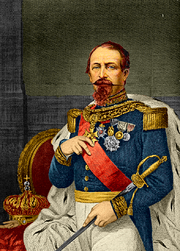
Louis-Napoléon Bonaparte was the President of the French Second Republic and as Napoleon III, the ruler of the Second French Empire. He was the nephew and heir of Napoleon I, christened as Charles Louis Napoléon Bonaparte...
kept France neutral
Neutral country
A neutral power in a particular war is a sovereign state which declares itself to be neutral towards the belligerents. A non-belligerent state does not need to be neutral. The rights and duties of a neutral power are defined in Sections 5 and 13 of the Hague Convention of 1907...
; the French Emperor (like most of Europe) expected an Austrian victory, but could not intervene on Austria's side, as that would jeopardise France's relationship with Italy
Italy
Italy , officially the Italian Republic languages]] under the European Charter for Regional or Minority Languages. In each of these, Italy's official name is as follows:;;;;;;;;), is a unitary parliamentary republic in South-Central Europe. To the north it borders France, Switzerland, Austria and...
post-Risorgimento
Italian unification
Italian unification was the political and social movement that agglomerated different states of the Italian peninsula into the single state of Italy in the 19th century...
.
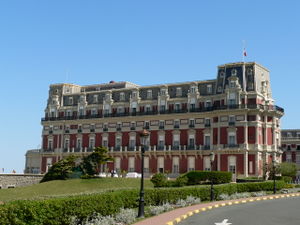
As a result, at Biarritz
Biarritz
Biarritz is a city which lies on the Bay of Biscay, on the Atlantic coast, in south-western France. It is a luxurious seaside town and is popular with tourists and surfers....
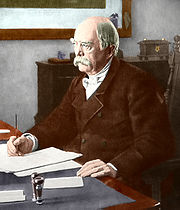
on 4 October 1865, Napoleon III promised Bismarck
Otto von Bismarck
Otto Eduard Leopold, Prince of Bismarck, Duke of Lauenburg , simply known as Otto von Bismarck, was a Prussian-German statesman whose actions unified Germany, made it a major player in world affairs, and created a balance of power that kept Europe at peace after 1871.As Minister President of...
France's neutrality, hoping that such an open statement of intent would strengthen France's negotiating position on the western bank of the Rhine. The Prussian Prime Minister
Prime Minister of Prussia
The office of Minister President or Prime Minister of Prussia existed in one form or another from 1702 until the dissolution of Prussia in 1947. When Prussia was an independent kingdom the Minister President or Prime Minister functioned as the King's Chief Minister and presided over the Prussian...
refused to offer any land from the Rhineland
Rhineland
Historically, the Rhinelands refers to a loosely-defined region embracing the land on either bank of the River Rhine in central Europe....
, which was Napoleon's preferred region. However, he did make offers of French hegemony in Belgium
Belgium
Belgium , officially the Kingdom of Belgium, is a federal state in Western Europe. It is a founding member of the European Union and hosts the EU's headquarters, and those of several other major international organisations such as NATO.Belgium is also a member of, or affiliated to, many...
and Luxembourg
Luxembourg
Luxembourg , officially the Grand Duchy of Luxembourg , is a landlocked country in western Europe, bordered by Belgium, France, and Germany. It has two principal regions: the Oesling in the North as part of the Ardennes massif, and the Gutland in the south...
, although not committing anything to writing.
When Austria and Prussia did go to war
Austro-Prussian War
The Austro-Prussian War was a war fought in 1866 between the German Confederation under the leadership of the Austrian Empire and its German allies on one side and the Kingdom of Prussia with its German allies and Italy on the...
in 1866, the result was a shock to Europe. Prussia defeated Austria's allies in Bavaria
Bavaria
Bavaria, formally the Free State of Bavaria is a state of Germany, located in the southeast of Germany. With an area of , it is the largest state by area, forming almost 20% of the total land area of Germany...
and crushed the Austrian army under Benedek
Ludwig August, Ritter von Benedek
Ludwig August Ritter von Benedek , also known as Lajos Benedek, was an Austrian general of Hungarian descent, best known for commanding the imperial army in 1866 in the Battle of Königgrätz against the Prussian Army.-Early years:Benedek was born in Sopron as the son of a physician...
at Königgrätz
Battle of Königgrätz
The Battle of Königgrätz , also known as the Battle of Sadowa, Sadová, or Hradec Králové, was the decisive battle of the Austro-Prussian War, in which the Kingdom of Prussia defeated the Austrian Empire...
, forcing Austria to the negotiating table. Napoleon III offered to mediate, and the result, the Treaty of Prague, dissolved the German Confederation in favour of a Prussian-dominated organisation, the North German Confederation
North German Confederation
The North German Confederation 1866–71, was a federation of 22 independent states of northern Germany. It was formed by a constitution accepted by the member states in 1867 and controlled military and foreign policy. It included the new Reichstag, a parliament elected by universal manhood...
.
French offer
William III of the Netherlands
William III was from 1849 King of the Netherlands and Grand Duke of Luxembourg until his death and the Duke of Limburg until the abolition of the Duchy in 1866.-Early life:William was born in Brussels as son of William II of the Netherlands and...
5,000,000 guilders for his personal possession of Luxembourg. Being in deep financial trouble, William accepted the offer on 23 March 1867, but the French were shocked to learn that Bismarck would not. Not only had Bismarck united much of northern Germany under the Prussian crown, but he had secretly concluded agreements with the southern states on 10 October. His hand forced by nationalistic newspapers in North Germany, Bismarck sought to renege on the pledge that he had made to Napoleon at Biarritz, and threatened war.
To avert a war that might drag their own countries into conflict, ministers
Minister (government)
A minister is a politician who holds significant public office in a national or regional government. Senior ministers are members of the cabinet....
of other countries rushed to offer compromise proposals. Austria
Austrian Empire
The Austrian Empire was a modern era successor empire, which was centered on what is today's Austria and which officially lasted from 1804 to 1867. It was followed by the Empire of Austria-Hungary, whose proclamation was a diplomatic move that elevated Hungary's status within the Austrian Empire...
's Foreign minister
Foreign minister
A Minister of Foreign Affairs, or foreign minister, is a cabinet minister who helps form the foreign policy of a sovereign state. The foreign minister is often regarded as the most senior ministerial position below that of the head of government . It is often granted to the deputy prime minister in...
, Count Beust
Friedrich Ferdinand Graf Beust
Count Friedrich Ferdinand von Beust was a German and Austrian statesman.- Birth and education :He was born in Dresden, where his father held office in the Saxon court. He was descended from a noble family which had originally sprung from the Mark of Brandenburg, and of which one branch had been...
, proposed transferring Luxembourg to neutral
Neutral country
A neutral power in a particular war is a sovereign state which declares itself to be neutral towards the belligerents. A non-belligerent state does not need to be neutral. The rights and duties of a neutral power are defined in Sections 5 and 13 of the Hague Convention of 1907...
Belgium
Belgium
Belgium , officially the Kingdom of Belgium, is a federal state in Western Europe. It is a founding member of the European Union and hosts the EU's headquarters, and those of several other major international organisations such as NATO.Belgium is also a member of, or affiliated to, many...
, in return for which France would be compensated with Belgian land. However, Belgian King Leopold II
Leopold II of Belgium
Leopold II was the second king of the Belgians. Born in Brussels the second son of Leopold I and Louise-Marie of Orléans, he succeeded his father to the throne on 17 December 1865 and remained king until his death.Leopold is chiefly remembered as the founder and sole owner of the Congo Free...
refused to part with any of his lands, putting paid to Beust's proposal.
With the German public angered and an impasse developing, Napoleon III sought to backtrack; he certainly did not want to appear to be unduly expansionist
Expansionism
In general, expansionism consists of expansionist policies of governments and states. While some have linked the term to promoting economic growth , more commonly expansionism refers to the doctrine of a state expanding its territorial base usually, though not necessarily, by means of military...
to the other Great Powers. Thus, he demanded only that Prussia withdraw its soldiers from Luxembourg City, threatening war in the event that Prussia did not comply. To avoid this fate, the Russian
Russian Empire
The Russian Empire was a state that existed from 1721 until the Russian Revolution of 1917. It was the successor to the Tsardom of Russia and the predecessor of the Soviet Union...
Emperor Alexander II
Alexander II of Russia
Alexander II , also known as Alexander the Liberator was the Emperor of the Russian Empire from 3 March 1855 until his assassination in 1881...
called for an international conference, to be held in London
London
London is the capital city of :England and the :United Kingdom, the largest metropolitan area in the United Kingdom, and the largest urban zone in the European Union by most measures. Located on the River Thames, London has been a major settlement for two millennia, its history going back to its...
. The United Kingdom
United Kingdom of Great Britain and Ireland
The United Kingdom of Great Britain and Ireland was the formal name of the United Kingdom during the period when what is now the Republic of Ireland formed a part of it....
was more than happy to host the talks as the British government feared that the absorption of Luxembourg, by either power, would weaken Belgium, its strategic ally on the continent.