


Ludwig von Mises Institute

Encyclopedia
The Ludwig von Mises Institute (LvMI), based in Auburn, Alabama
, is a libertarian
academic organization engaged in research and scholarship in the fields of economics, philosophy and political economy
. Its scholarship is inspired by the work of Austrian School
economist Ludwig von Mises
. Other Austrian School academics such as Murray Rothbard
and Friedrich Hayek
have also had a strong influence on the Institute's work. The Institute is funded entirely through private donations.
The Institute does not consider itself a traditional think tank
. While it has working relationships with individuals such as U.S. Representative
Ron Paul
and organizations like the Foundation for Economic Education
, it does not seek to implement public policy
. It has no formal affiliation with any political party (including the Libertarian Party
), nor does it receive funding from any. The Institute also has a formal policy of not accepting contract work from corporations or other organizations.
There are also several other Institutes with the same name throughout the world, including those in Belgium, Poland, Argentina, Brazil, Romania, Ecuador, Czech Republic & Slovakia, and Portugal. However, the Institute has no formal ties with any of them.
The Institute's official motto is Tu ne cede malis sed contra audentior ito, which comes from Virgil
's Aeneid
, Book VI; the motto means "do not give in to evil but proceed ever more boldly against it." Early in his life, Mises chose this sentence to be his guiding principle in life. It is prominently displayed throughout the Institute's campus, on their website and on memorabilia.
is the founder, a former president and currently the chairman (since 2009); Douglas French is the current president. The late economist Murray Rothbard was a major influence on the Institute's activities and served as its academic vice president until his death in 1995. Among others, Friedrich von Hayek, Lawrence Fertig
, and Henry Hazlitt
also assisted in both its construction and continued scholarly development.
According to Chairman and Founder Lew Rockwell and others, the institute was met with strong opposition from interests of the Koch Family Foundations
during its development throughout the 1980s. The ensuing ideology-driven drama created a rift between the Mises Institute and organizations like the Cato Institute
, whose members had been staunch allies throughout the 1970s and early 1980s.
in all its forms". Its methodology is based on praxeology
, a description of individual human action which seeks to avoid errors in scientific behavioral observation that could be induced by human self-consciousness and complexity. The Institute's economic theories depict any government intervention as destructive, whether through welfare, inflation, taxation, regulation, or war. The Institute disparages both communism and the American System
school of economics (more broadly known as the American School
).
The Institute is generally critical of statism and democracy, with the latter being described in Institute publications as "coercive", "incompatible with wealth creation" "replete with inner contradictions" and a system " of legalized graft."
With 250 academic faculty members and thousands of donors (throughout all 50 States in the United States of America and in more than 60 countries), the Institute has sponsored hundreds of teaching and scholars' conferences and seminars treating subjects ranging from monetary policy
to the history of war. The Institute has published dozens of books, hundreds of scholarly papers and thousands of mainstream articles covering economic and historical issues.
The Institute's website went online in 1995. The Institute has also produced several documentary films, including Liberty and Economics: The Ludwig von Mises Legacy, The Future of Austrian Economics and Money, Banking, and the Federal Reserve.
Institute scholars typically take a critical view of most U.S. government activities, foreign and domestic, throughout American history. The Institute characterizes itself as libertarian and expresses antiwar
and non-interventionist
positions on American foreign policy, asserting that war is a violation of rights to life, liberty, and property, with destructive effects on the market economy, and tends to increase the power of government. The Institute's website offers content which expresses support of individualism
and is explicitly critical of democracy, collectivism, fascism, socialism, and communism.
The website offers an array of articles and books by Ludwig von Mises, Murray N. Rothbard, and many other scholars who write in the tradition established by Carl Menger
in 1871 with the publication of his Principles of Economics. The Institute's current campus was built in 1998; its main building is a Victorian-style villa. Before that, the Institute's offices were located in the business department at Auburn University
. A 2006 article in The Wall Street Journal
discusses the rationale behind its strategic placement in rural Alabama. The author suggests that "a charming downtown, low prices for room and board, easy access to Atlanta's international airport, and good ol' Southern hospitality" were among the reasons for locating in Alabama. In addition, he suggests that "Southerners have always been distrustful of government," making the South a natural home for the organization's paleolibertarian
outlook. Despite its location, the institute is not affiliated with Auburn University.
In 2007, the Institute's annual revenues were $3,583,575 and its expenses were $2,852,751. These expenses went to programs (75.5%), administration (13.6%) and fundraising (10.7%).
viewpoint and is published monthly. The Austrian Economics Newsletter links their academic network with in-depth interviews. The Mises Review surveys new books in the social sciences. The Mises Memo covers issues and legislation, plus conferences and publications of the Institute.
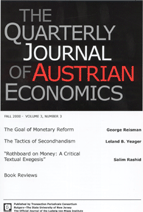 The Quarterly Journal of Austrian Economics (the successor journal to the Review of Austrian Economics), publishes articles dealing with a wide range of issues in economics. The Journal of Libertarian Studies
is the scholarly venue for political theory and applications. Policy implications are frequently discussed in both.
In addition, they also host Reason Papers, which is a peer-reviewed
journal on inderdisciplinary normative studies appearing annually. It was founded in 1974, and was edited by Tibor R. Machan
from issues 1 through 25. Beginning with Issue 26 (Summer 2003), it is now edited by Aeon J. Skoble. http://www.reasonpapers.com/
The Libertarian Forum was a journal edited (and largely written by) Murray N. Rothbard from 1969 to 1984. It contains substantive theoretical contributions, commentaries on politics, details of disputes and arguments within the libertarian movement, and forecasts on the future of liberty.
Left and Right: A Journal of Libertarian Thought was a journal on libertarian philosophy that was the precursor to the Journal of Libertarian Studies. It was published from 1965–1968 and was edited by Murray Rothbard.
They also host a collection of continuously growing academic working papers. These papers are not in final form and are not available for publication. As of August 2006, there are more than 100 papers in draft form, with approximately 2–3 added each month.
In addition, they feature original commentary through a stream of Daily Articles and a supplemental weblog. These original essays are written by professors and lay people alike and edited by Jeffrey Tucker
. As of August 2006, there are more than 24,000 subscribers to the Daily Articles.
.
Notable entries include:
 In addition to maintaining an active website since October 1995, the Institute also maintains a virtual store of its entire in-print catalogue, a group weblog, numerous RSS
feeds for weekly podcasts, and BitTorrent files for much of its video library. It also offers lectures, conferences and audiobooks via iTunes U.
In the month of October 2008 alone, the site transferred over six terabytes of data. This is in addition to having content hosted at sites such as YouTube and Google Video
.
Throughout the year, the Institute hosts numerous symposia. These range on topic from the history of taxation to free speech and dissent during wartime. They are typically hosted by a senior faculty member or noted scholar (such as historian Charles Adams and literary critic Paul Cantor
).
The Institute also awards scholarships and fellowships throughout the year. These include the Peg Rowley Summer Fellowship for graduate
and post-doctoral students. The O.P. Alford, III Fellowship is awarded to undergraduates studying during the summer. The Kurzweg Fellowship sponsors a visiting scholar for an entire year of research and study at the Institute. Economist Walter Block
was a recent Kurzweg Fellow, due to the events of Hurricane Katrina
.
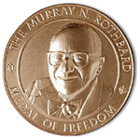 In maintaining a tradition of recognizing scholarly achievement, each year the Institute awards several individuals for their accomplishments. The annual Schlarbaum Prize for lifetime defense of liberty, awards $10,000 to a public intellectual or distinguished scholar. The Kurzweg Family Prize awards $5,000 for the defense of liberty, property, and personal responsibility. The Elgin Groseclose
Award, a $20 Liberty Head Double Eagle
, goes to the best piece of money writing in the previous year. The Lawrence W. Fertig
Prize in Austrian Economics awards $1,000 to the author of a paper that best advances economic science in the Austrian tradition. The O.P. Alford III Prize in Libertarian Scholarship awards $1,000 to the author of the paper best advances libertarian scholarship.
Individuals such as Congressman Ron Paul and philosopher Antony Flew
are among past laureates.
, and Just War
.
Institute scholars have been highly critical of Abraham Lincoln
's conduct of the American Civil War
(e.g. suspending habeas corpus
), asserting that his policies contributed to the growth of statism in the United States. Senior faculty member Thomas DiLorenzo, in his critical biographies The Real Lincoln
and Lincoln: Unmasked, argues that the sixteenth president substantially expanded the size and powers of the federal government at the expense of individual liberty. Adjunct faculty member Donald Livingston
shares a similar view, blaming Lincoln for the creation of "a French Revolution
ary style unitary state" and "centralizing totalitarianism." Institute scholars have also taken a more general anti-war stance. Many works espousing a general anti-war view such as John Denson's A Century of War and H.C. Engelbrecht's The Merchants of Death can be found on the institute’s website and purchased through its bookstore.
The Institute's publications argue that fascism and National Socialism (Nazism) are branches of socialist political philosophy. They assert that these ideologies are based on collectivist rejections of the individual in favor of some "greater good", and that they incorporate central control over the economy and often also society. This line of argument is discussed in more detail at Fascism and ideology
.
Institute scholars are often opposed to democracy, described by Institute Fellow Hans-Hermann Hoppe
as "Democracy: The God That Failed
". James Ostrowski describes the system as follows:
Institute scholars disagree on the subject of immigration. Walter Block argues in favor of open borders. Hans-Hermann Hoppe argues that in a stateless society individuals would only be able to travel with permission of individual land owners.
".
has debated on Lincoln with LvMI's Thomas DiLorenzo and writers from both organizations have sparred in editorial publications. DiLorenzo's references to the American Civil War
as the "War to prevent Southern Independence" and Mises faculty member Thomas Woods's presence at the founding of the League of the South
were cited by James Kirchick, writing for the New Republic, as suggesting a "disturbing attachment to the Confederacy." Woods has stated that he was present at the meeting at which the organization was founded, and later contributed to its newsletter, but that his involvement was limited.
Reason magazine has also alleged that from 1989 to 1994, a period during which Rockwell headed the Mises Institute, "Rockwell and the prominent libertarian theorist Murray Rothbard championed an open strategy of exploiting racial and class resentment to build a coalition with populist 'paleoconservatives
.'" In a 1992 op-ed in the Los Angeles Times
, Institute president Lew Rockwell discussed the Rodney King
beatings, writing "Did they hit him too many times? Sure, but that’s not the issue. It’s safe streets versus urban terror, and why we have moved from one to the other." Rockwell is also alleged by Reason magazine writers Julian Sanchez
and David Weigel
to have been in charge of Ron Paul's newsletter during a period when what they describe as "bigoted rhetoric about African Americans and gays" appeared in that publication. Rockwell denied responsibility for the disputed material and has called the accusations "hysterical smears aimed at political enemies." In an interview on February 1999, Rockwell explained, "The civil-rights movement of the 1960s complicates the picture. My ideological sympathies were and are with those who resisted the federal government's attacks on the freedom of association (not to mention the federalist structure of the Constitution) in the name of racial integration." He later states, "I never liked Martin Luther King, Jr.
I thought he was a fraud and a tool. But when he turned his attention to the evils of the U.S. war on Vietnam
, I began to like him. That's also when the establishment turned against him, and soon he was murdered."
(SPLC) has criticized the Institute for its "interest in neo-Confederate
themes". The SPLC also criticized alleged connections with the League of the South.
Lew Rockwell responded to these criticisms by writing "We have published revisionist accounts of the origins of the Civil War that demonstrate that the tariff bred more conflict between the South and the feds than slavery. For that, we were decried as a dangerous institutional proponent of “neoconfederate” ideology. Why not just plain old Confederate ideology."
Another SPLC complaint involves a Murray Rothbard
essay called "Origins of the Welfare State in America" on the Mises Institute website. According to a 2003 SPLC Intelligence Report article written by Chip Berlet
:
Auburn, Alabama
Auburn is a city in Lee County, Alabama, United States. It is the largest city in eastern Alabama with a 2010 population of 53,380. It is a principal city of the Auburn-Opelika Metropolitan Area...
, is a libertarian
Libertarianism
Libertarianism, in the strictest sense, is the political philosophy that holds individual liberty as the basic moral principle of society. In the broadest sense, it is any political philosophy which approximates this view...
academic organization engaged in research and scholarship in the fields of economics, philosophy and political economy
Political economy
Political economy originally was the term for studying production, buying, and selling, and their relations with law, custom, and government, as well as with the distribution of national income and wealth, including through the budget process. Political economy originated in moral philosophy...
. Its scholarship is inspired by the work of Austrian School
Austrian School
The Austrian School of economics is a heterodox school of economic thought. It advocates methodological individualism in interpreting economic developments , the theory that money is non-neutral, the theory that the capital structure of economies consists of heterogeneous goods that have...
economist Ludwig von Mises
Ludwig von Mises
Ludwig Heinrich Edler von Mises was an Austrian economist, philosopher, and classical liberal who had a significant influence on the modern Libertarian movement and the "Austrian School" of economic thought.-Biography:-Early life:...
. Other Austrian School academics such as Murray Rothbard
Murray Rothbard
Murray Newton Rothbard was an American author and economist of the Austrian School who helped define capitalist libertarianism and popularized a form of free-market anarchism he termed "anarcho-capitalism." Rothbard wrote over twenty books and is considered a centrally important figure in the...
and Friedrich Hayek
Friedrich Hayek
Friedrich August Hayek CH , born in Austria-Hungary as Friedrich August von Hayek, was an economist and philosopher best known for his defense of classical liberalism and free-market capitalism against socialist and collectivist thought...
have also had a strong influence on the Institute's work. The Institute is funded entirely through private donations.
The Institute does not consider itself a traditional think tank
Think tank
A think tank is an organization that conducts research and engages in advocacy in areas such as social policy, political strategy, economics, military, and technology issues. Most think tanks are non-profit organizations, which some countries such as the United States and Canada provide with tax...
. While it has working relationships with individuals such as U.S. Representative
United States House of Representatives
The United States House of Representatives is one of the two Houses of the United States Congress, the bicameral legislature which also includes the Senate.The composition and powers of the House are established in Article One of the Constitution...
Ron Paul
Ron Paul
Ronald Ernest "Ron" Paul is an American physician, author and United States Congressman who is seeking to be the Republican Party candidate in the 2012 presidential election. Paul represents Texas's 14th congressional district, which covers an area south and southwest of Houston that includes...
and organizations like the Foundation for Economic Education
Foundation for Economic Education
The Foundation for Economic Education is one of the oldest free-market organizations established in the United States to study and advance the freedom philosophy. Murray Rothbard recognizes FEE for creating a "crucial open center" that he credits with launching the movement...
, it does not seek to implement public policy
Public policy (law)
In private international law, the public policy doctrine or ordre public concerns the body of principles that underpin the operation of legal systems in each state. This addresses the social, moral and economic values that tie a society together: values that vary in different cultures and change...
. It has no formal affiliation with any political party (including the Libertarian Party
Libertarian Party (United States)
The Libertarian Party is the third largest and fastest growing political party in the United States. The political platform of the Libertarian Party reflects its brand of libertarianism, favoring minimally regulated, laissez-faire markets, strong civil liberties, minimally regulated migration...
), nor does it receive funding from any. The Institute also has a formal policy of not accepting contract work from corporations or other organizations.
There are also several other Institutes with the same name throughout the world, including those in Belgium, Poland, Argentina, Brazil, Romania, Ecuador, Czech Republic & Slovakia, and Portugal. However, the Institute has no formal ties with any of them.
The Institute's official motto is Tu ne cede malis sed contra audentior ito, which comes from Virgil
Virgil
Publius Vergilius Maro, usually called Virgil or Vergil in English , was an ancient Roman poet of the Augustan period. He is known for three major works of Latin literature, the Eclogues , the Georgics, and the epic Aeneid...
's Aeneid
Aeneid
The Aeneid is a Latin epic poem, written by Virgil between 29 and 19 BC, that tells the legendary story of Aeneas, a Trojan who travelled to Italy, where he became the ancestor of the Romans. It is composed of roughly 10,000 lines in dactylic hexameter...
, Book VI; the motto means "do not give in to evil but proceed ever more boldly against it." Early in his life, Mises chose this sentence to be his guiding principle in life. It is prominently displayed throughout the Institute's campus, on their website and on memorabilia.
Background
The Ludwig von Mises Institute was established in 1982 under the direction of Margit von Mises, widow of Ludwig von Mises. She chaired the Institute's board until her death in 1993. Llewellyn H. Rockwell, JrLew Rockwell
Llewellyn Harrison "Lew" Rockwell, Jr. is an American libertarian political commentator, activist, proponent of the Austrian School of economics, and chairman of the Ludwig von Mises Institute.-Life and work:...
is the founder, a former president and currently the chairman (since 2009); Douglas French is the current president. The late economist Murray Rothbard was a major influence on the Institute's activities and served as its academic vice president until his death in 1995. Among others, Friedrich von Hayek, Lawrence Fertig
Lawrence Fertig
Lawrence W. Fertig was an American advertising executive and a libertarian journalist and economic commentator.Fertig wrote columns for the New York World-Telegram and the New York Sun. Fertig also wrote the 1961 Regnery Press offering, Prosperity Through Freedom.He was the founder of Lawrence...
, and Henry Hazlitt
Henry Hazlitt
Henry Stuart Hazlitt was an American economist, philosopher, literary critic and journalist for such publications as The Wall Street Journal, The Nation, The American Mercury, Newsweek, and The New York Times...
also assisted in both its construction and continued scholarly development.
According to Chairman and Founder Lew Rockwell and others, the institute was met with strong opposition from interests of the Koch Family Foundations
Koch Family Foundations
Koch Family Foundations is the informal name for a group of charities in the United States of America associated with the family of Fred C. Koch. The most prominent of these are the Charles G. Koch Charitable Foundation and the David H. Koch Charitable Foundation, created by two of Fred C...
during its development throughout the 1980s. The ensuing ideology-driven drama created a rift between the Mises Institute and organizations like the Cato Institute
Cato Institute
The Cato Institute is a libertarian think tank headquartered in Washington, D.C. It was founded in 1977 by Edward H. Crane, who remains president and CEO, and Charles Koch, chairman of the board and chief executive officer of the conglomerate Koch Industries, Inc., the largest privately held...
, whose members had been staunch allies throughout the 1970s and early 1980s.
Mission and activities
The Institute's stated goal is to "undermine statismStatism
Statism is a term usually describing a political philosophy, whether of the right or the left, that emphasises the role of the state in politics or supports the use of the state to achieve economic, military or social goals...
in all its forms". Its methodology is based on praxeology
Praxeology
Praxeology is the study of human action. Praxeology rejects the empirical methods of the natural sciences for the study of human action, because the observation of how humans act in simple situations cannot predict how they will act in complex situations...
, a description of individual human action which seeks to avoid errors in scientific behavioral observation that could be induced by human self-consciousness and complexity. The Institute's economic theories depict any government intervention as destructive, whether through welfare, inflation, taxation, regulation, or war. The Institute disparages both communism and the American System
American System (economic plan)
The American System, originally called "The American Way", was a mercantilist economic plan that played a prominent role in American policy during the first half of the 19th century...
school of economics (more broadly known as the American School
American School (economics)
The American School, also known as "National System", represents three different yet related constructs in politics, policy and philosophy. It was the American policy for the 1860s to the 1940s, waxing and waning in actual degrees and details of implementation...
).
The Institute is generally critical of statism and democracy, with the latter being described in Institute publications as "coercive", "incompatible with wealth creation" "replete with inner contradictions" and a system " of legalized graft."
With 250 academic faculty members and thousands of donors (throughout all 50 States in the United States of America and in more than 60 countries), the Institute has sponsored hundreds of teaching and scholars' conferences and seminars treating subjects ranging from monetary policy
Monetary policy
Monetary policy is the process by which the monetary authority of a country controls the supply of money, often targeting a rate of interest for the purpose of promoting economic growth and stability. The official goals usually include relatively stable prices and low unemployment...
to the history of war. The Institute has published dozens of books, hundreds of scholarly papers and thousands of mainstream articles covering economic and historical issues.
The Institute's website went online in 1995. The Institute has also produced several documentary films, including Liberty and Economics: The Ludwig von Mises Legacy, The Future of Austrian Economics and Money, Banking, and the Federal Reserve.
Institute scholars typically take a critical view of most U.S. government activities, foreign and domestic, throughout American history. The Institute characterizes itself as libertarian and expresses antiwar
Anti-war
An anti-war movement is a social movement, usually in opposition to a particular nation's decision to start or carry on an armed conflict, unconditional of a maybe-existing just cause. The term can also refer to pacifism, which is the opposition to all use of military force during conflicts. Many...
and non-interventionist
Non-interventionism
Nonintervention or non-interventionism is a foreign policy which holds that political rulers should avoid alliances with other nations, but still retain diplomacy, and avoid all wars not related to direct self-defense...
positions on American foreign policy, asserting that war is a violation of rights to life, liberty, and property, with destructive effects on the market economy, and tends to increase the power of government. The Institute's website offers content which expresses support of individualism
Individualism
Individualism is the moral stance, political philosophy, ideology, or social outlook that stresses "the moral worth of the individual". Individualists promote the exercise of one's goals and desires and so value independence and self-reliance while opposing most external interference upon one's own...
and is explicitly critical of democracy, collectivism, fascism, socialism, and communism.
The website offers an array of articles and books by Ludwig von Mises, Murray N. Rothbard, and many other scholars who write in the tradition established by Carl Menger
Carl Menger
Carl Menger was the founder of the Austrian School of economics, famous for contributing to the development of the theory of marginal utility, which contested the cost-of-production theories of value, developed by the classical economists such as Adam Smith and David Ricardo.- Biography :Menger...
in 1871 with the publication of his Principles of Economics. The Institute's current campus was built in 1998; its main building is a Victorian-style villa. Before that, the Institute's offices were located in the business department at Auburn University
Auburn University
Auburn University is a public university located in Auburn, Alabama, United States. With more than 25,000 students and 1,200 faculty members, it is one of the largest universities in the state. Auburn was chartered on February 7, 1856, as the East Alabama Male College, a private liberal arts...
. A 2006 article in The Wall Street Journal
The Wall Street Journal
The Wall Street Journal is an American English-language international daily newspaper. It is published in New York City by Dow Jones & Company, a division of News Corporation, along with the Asian and European editions of the Journal....
discusses the rationale behind its strategic placement in rural Alabama. The author suggests that "a charming downtown, low prices for room and board, easy access to Atlanta's international airport, and good ol' Southern hospitality" were among the reasons for locating in Alabama. In addition, he suggests that "Southerners have always been distrustful of government," making the South a natural home for the organization's paleolibertarian
Paleolibertarianism
Paleolibertarianism is a school of thought within American libertarianism associated with the late economist Murray Rothbard, and the Ludwig von Mises Institute. It is based on a combination of right-libertarianism in politics and cultural conservatism in social thought...
outlook. Despite its location, the institute is not affiliated with Auburn University.
In 2007, the Institute's annual revenues were $3,583,575 and its expenses were $2,852,751. These expenses went to programs (75.5%), administration (13.6%) and fundraising (10.7%).
Periodicals
As of 2006, the Institute publishes seven periodicals. The Free Market examines the economic and political scene from a classical liberalClassical liberalism
Classical liberalism is the philosophy committed to the ideal of limited government, constitutionalism, rule of law, due process, and liberty of individuals including freedom of religion, speech, press, assembly, and free markets....
viewpoint and is published monthly. The Austrian Economics Newsletter links their academic network with in-depth interviews. The Mises Review surveys new books in the social sciences. The Mises Memo covers issues and legislation, plus conferences and publications of the Institute.
Journal of Libertarian Studies
The Journal of Libertarian Studies is a scholarly journal published annually by the Ludwig von Mises Institute and Lew Rockwell. It was established in the spring of 1977 by Murray Rothbard who also served as its editor until his death in 1995...
is the scholarly venue for political theory and applications. Policy implications are frequently discussed in both.
In addition, they also host Reason Papers, which is a peer-reviewed
Peer review
Peer review is a process of self-regulation by a profession or a process of evaluation involving qualified individuals within the relevant field. Peer review methods are employed to maintain standards, improve performance and provide credibility...
journal on inderdisciplinary normative studies appearing annually. It was founded in 1974, and was edited by Tibor R. Machan
Tibor R. Machan
Tibor Richard Machan, Ph.D. is a Hungarian-American philosopher. A professor emeritus in the department of philosophy at Auburn University, Machan holds the R. C...
from issues 1 through 25. Beginning with Issue 26 (Summer 2003), it is now edited by Aeon J. Skoble. http://www.reasonpapers.com/
The Libertarian Forum was a journal edited (and largely written by) Murray N. Rothbard from 1969 to 1984. It contains substantive theoretical contributions, commentaries on politics, details of disputes and arguments within the libertarian movement, and forecasts on the future of liberty.
Left and Right: A Journal of Libertarian Thought was a journal on libertarian philosophy that was the precursor to the Journal of Libertarian Studies. It was published from 1965–1968 and was edited by Murray Rothbard.
They also host a collection of continuously growing academic working papers. These papers are not in final form and are not available for publication. As of August 2006, there are more than 100 papers in draft form, with approximately 2–3 added each month.
In addition, they feature original commentary through a stream of Daily Articles and a supplemental weblog. These original essays are written by professors and lay people alike and edited by Jeffrey Tucker
Jeffrey Tucker
Jeffrey Albert Tucker is the publisher and executive editor of Laissez Faire Books. He is past editorial vice president of the Ludwig von Mises Institute and past editor for the institute's website, Mises.org...
. As of August 2006, there are more than 24,000 subscribers to the Daily Articles.
Books
The Institute has published nearly 50 books and pamphlets, most of which deal with topics covering political and economic theories and their interconnectedness. Others deal with history, from early American settlements to chronicling the Great DepressionGreat Depression
The Great Depression was a severe worldwide economic depression in the decade preceding World War II. The timing of the Great Depression varied across nations, but in most countries it started in about 1929 and lasted until the late 1930s or early 1940s...
.
Notable entries include:
- Human ActionHuman ActionHuman Action: A Treatise on Economics is the magnum opus of the Austrian economist Ludwig von Mises. It presents a case for laissez-faire capitalism based on Mises' praxeology, or rational investigation of human decision-making. It rejects positivism within economics...
, The Scholars Edition, the original, unaltered treatise (originally published in 1949) written by Ludwig von Mises. It is largely viewed as his magnum opusMasterpieceMasterpiece in modern usage refers to a creation that has been given much critical praise, especially one that is considered the greatest work of a person's career or to a work of outstanding creativity, skill or workmanship....
and is a rejection of positivismPositivismPositivism is a a view of scientific methods and a philosophical approach, theory, or system based on the view that, in the social as well as natural sciences, sensory experiences and their logical and mathematical treatment are together the exclusive source of all worthwhile information....
within economics. It defends an a prioriA priori and a posteriori (philosophy)The terms a priori and a posteriori are used in philosophy to distinguish two types of knowledge, justifications or arguments...
epistemology and defines the science of praxeologyPraxeologyPraxeology is the study of human action. Praxeology rejects the empirical methods of the natural sciences for the study of human action, because the observation of how humans act in simple situations cannot predict how they will act in complex situations...
. - Man, Economy, and StateMan, Economy, and StateMan, Economy, and State: A Treatise on Economic Principles, first published in 1962, is a book on economics by Murray Rothbard, and is one of the most important books in the Austrian School of economics...
, an economic treatise covering both micro and macro thought and written by Murray Rothbard. It was originally published in 1962, but the final eight chapters were removed due to political conflicts with the original publisher. These were finally published as Power and Market in 1970. The 2004 edition published by the Institute combines both books in a single volume. - For a New LibertyFor a New LibertyFor a New Liberty: The Libertarian Manifesto is a book by American economist and historian Murray N. Rothbard, first published in 1973, that helped launch the modern libertarian movement in the United States, and was the first modern free market anarchist manifesto For a New Liberty: The...
, written by Murray Rothbard and published in 1973. It attempts to reconcile his libertarian system of thought, including natural lawNatural lawNatural law, or the law of nature , is any system of law which is purportedly determined by nature, and thus universal. Classically, natural law refers to the use of reason to analyze human nature and deduce binding rules of moral behavior. Natural law is contrasted with the positive law Natural...
, natural rightsNatural rightsNatural and legal rights are two types of rights theoretically distinct according to philosophers and political scientists. Natural rights are rights not contingent upon the laws, customs, or beliefs of any particular culture or government, and therefore universal and inalienable...
, Austrian economics, American history, and State intervention. - The Case for Gold, by Ron Paul and Lewis Lehrman (originally published in 1982 by the Cato Institute). Republished by the Mises Institute in 2007, it presents the libertarian case for forms of the gold standard from the viewpoint of minority members of the U.S. Gold Commission.
- Mises and Austrian Economics, by Ron Paul, published in 1984. It recalls Paul's personal recollections of Austrian school economists, such as Rothbard and Hans SennholzHans SennholzHans F. Sennholz was an economist of the Austrian school of economics who studied under Ludwig von Mises. After serving in the Luftwaffe in World War II, he took degrees at the universities of Marburg and Köln. He then moved to the United States to study for a Ph.D. at New York University...
, both of whom Paul knew well. - Reassessing the Presidency, edited by John V. Denson and published in 2001. It is a critique of each American President through the lens of libertarianism.
- The Myth of National DefenseThe Myth of National DefenseThe Myth of National Defense is a book edited by Hans-Hermann Hoppe, published in 2003 by the Ludwig von Mises Institute, and contributed to by many prominent anarcho-capitalists, about the merits of replacing government defense agencies with private defense agencies...
, edited by Hans-Hermann HoppeHans-Hermann HoppeHans-Hermann Hoppe is an Austrian School economist of the anarcho-capitalist tradition, and a Professor Emeritus of economics at the University of Nevada, Las Vegas.-Academic career:...
and published in 2003. It is a collection of essays on the theory and history of security production.
Student outreach programs
The Institute provides various resources for students regardless of academic background.Web resources
- The "Are You An Austrian?" quiz is designed to test an individual's economic reasoning. Its questions include topics covering many fundamental tenets in economic thought (e.g., property rights, the role of state interventionEconomic interventionismEconomic interventionism is an action taken by a government in a market economy or market-oriented mixed economy, beyond the basic regulation of fraud and enforcement of contracts, in an effort to affect its own economy...
, value of money). - The Austrian Literature Guide is a freely-accessible comprehensive selection of Austrian-oriented literature comprising videos, audio lectures, books, papers and more. As of May 2008, it comprises approximately 3,000 unique items and the entire contents of 239 books and seven academic journals.
- The Mises Community is a web-based interactive forum and blog community in which students from across the globe can discuss theories, papers, research agendas, conferences and a cornucopia of other topics. As of May 2008 it has over 2800 members, 22,000 posts, and dozens of active blogs.
RSS (file format)
RSS is a family of web feed formats used to publish frequently updated works—such as blog entries, news headlines, audio, and video—in a standardized format...
feeds for weekly podcasts, and BitTorrent files for much of its video library. It also offers lectures, conferences and audiobooks via iTunes U.
In the month of October 2008 alone, the site transferred over six terabytes of data. This is in addition to having content hosted at sites such as YouTube and Google Video
Google Video
Google Videos is a video search engine, and formerly a free video sharing website, from Google Inc. Before removing user-uploaded content, the service allowed selected videos to be remotely embedded on other websites and provided the necessary HTML code alongside the media, similar to YouTube...
.
E-learning initiatives
- The Mises Academy, started in March 2010, is a MoodleMoodleMoodle is a free source e-learning software platform, also known as a Course Management System, Learning Management System, or Virtual Learning Environment...
-based e-learningE-learningE-learning comprises all forms of electronically supported learning and teaching. The information and communication systems, whether networked learning or not, serve as specific media to implement the learning process...
education initiative of the Institute which aggregates multimedia from both past Mises Academy conferences and Academy-exclusive material from fellows of the Institute (many of whom are professors from other universities). It is pay-based and expands the scholastic scope of the Institute. Notable Mises Academy instructors include Thomas DiLorenzoThomas DiLorenzoThomas James DiLorenzo is an American economics professor at Loyola University Maryland. He is an adherent of the Austrian School of Economics. He is a senior faculty member of the Ludwig von Mises Institute and an associated scholar of the Abbeville Institute...
, David GordonDavid Gordon (philosopher)David Gordon is a libertarian philosopher and intellectual historian influenced by Rothbardian views of economics. He is a senior fellow at the Ludwig von Mises Institute and editor of "The Mises Review."...
, Stephan KinsellaStephan Kinsellaframe|right|Stephan KinsellaNorman Stephan Kinsella is an American intellectual property lawyer and libertarian legal theorist. His electronically published works are primarily published on his blog and websites associated with the Ludwig von Mises Institute and anarcho-capitalist...
, Robert P. MurphyRobert P. MurphyRobert P. "Bob" Murphy is an Austrian School economist and anarcho-capitalist.-Education and personal life:Murphy completed his Bachelor of Arts in economics at Hillsdale College in 1998. He then moved back to his home state of New York to continue his studies at New York University. Murphy earned...
, Thomas WoodsThomas WoodsThomas E. "Tom" Woods, Jr. is an American historian, economist, political analyst, and New York Times-bestselling author. He has written extensively on the subjects of American history, contemporary politics, and economic theory...
, and Peter G. KleinPeter G. KleinPeter G. Klein is an American Austrian economist who studies managerial and organizational issues. Klein is Associate Professor in the Division of Applied Social Sciences at the University of Missouri and Associate Director of the...
.
Conferences
- The Austrian Scholars Conference is an interdisciplinary meeting of the Austrian School held annually each spring at the Institute's campus. It typically lasts three days and involves paper presentations and moderated panels.
- Mises University, started in 1986, is a week-long summer instructional program. The schedule of events includes lectures from senior and adjunct faculty members, reading groups, discussion panels and various social functions. It takes place twice each summer, and typically hosts 100–125 students from around the world (reportedly nearly 30% are from Europe).
Throughout the year, the Institute hosts numerous symposia. These range on topic from the history of taxation to free speech and dissent during wartime. They are typically hosted by a senior faculty member or noted scholar (such as historian Charles Adams and literary critic Paul Cantor
Paul Cantor
Paul A. Cantor is a wide-ranging American literary critic inspired by the Austrian School of economic thought.As a young man Cantor attended Ludwig von Mises' seminars. He went on to study English literature at Harvard...
).
Support of scholarship
The Ward and Massey libraries are an on-site archive of nearly 35,000 volumes.The Institute also awards scholarships and fellowships throughout the year. These include the Peg Rowley Summer Fellowship for graduate
Graduate school
A graduate school is a school that awards advanced academic degrees with the general requirement that students must have earned a previous undergraduate degree...
and post-doctoral students. The O.P. Alford, III Fellowship is awarded to undergraduates studying during the summer. The Kurzweg Fellowship sponsors a visiting scholar for an entire year of research and study at the Institute. Economist Walter Block
Walter Block
Walter Edward Block is a free market economist and anarcho-capitalist associated with the Austrian School of economics.-Personal history and education:...
was a recent Kurzweg Fellow, due to the events of Hurricane Katrina
Hurricane Katrina
Hurricane Katrina of the 2005 Atlantic hurricane season was a powerful Atlantic hurricane. It is the costliest natural disaster, as well as one of the five deadliest hurricanes, in the history of the United States. Among recorded Atlantic hurricanes, it was the sixth strongest overall...
.
Academic awards
Elgin Groseclose
Elgin Earl Groseclose was an American economist, statesman, and author.Special assistant to Arthur Millspaugh's economic mission in Persia, he was appointed Treasurer-General of Persia by the order of the parliament of Iran in 1943....
Award, a $20 Liberty Head Double Eagle
Double Eagle
A Double Eagle is a gold coin of the United States with a denomination of $20. . The coins are made from a 90% gold and 10% copper alloy....
, goes to the best piece of money writing in the previous year. The Lawrence W. Fertig
Lawrence Fertig
Lawrence W. Fertig was an American advertising executive and a libertarian journalist and economic commentator.Fertig wrote columns for the New York World-Telegram and the New York Sun. Fertig also wrote the 1961 Regnery Press offering, Prosperity Through Freedom.He was the founder of Lawrence...
Prize in Austrian Economics awards $1,000 to the author of a paper that best advances economic science in the Austrian tradition. The O.P. Alford III Prize in Libertarian Scholarship awards $1,000 to the author of the paper best advances libertarian scholarship.
Individuals such as Congressman Ron Paul and philosopher Antony Flew
Antony Flew
Antony Garrard Newton Flew was a British philosopher. Belonging to the analytic and evidentialist schools of thought, he was notable for his works on the philosophy of religion....
are among past laureates.
Views espoused by founder and organization scholars
Mises Institute scholars are generally consistent with several philosophies, including: Austrian Economics, Libertarianism, Anarcho-CapitalismAnarcho-capitalism
Anarcho-capitalism is a libertarian and individualist anarchist political philosophy that advocates the elimination of the state in favour of individual sovereignty in a free market...
, and Just War
Just War
Just war theory is a doctrine of military ethics of Roman philosophical and Catholic origin, studied by moral theologians, ethicists and international policy makers, which holds that a conflict ought to meet philosophical, religious or political criteria.-Origins:The concept of justification for...
.
Institute scholars have been highly critical of Abraham Lincoln
Abraham Lincoln
Abraham Lincoln was the 16th President of the United States, serving from March 1861 until his assassination in April 1865. He successfully led his country through a great constitutional, military and moral crisis – the American Civil War – preserving the Union, while ending slavery, and...
's conduct of the American Civil War
American Civil War
The American Civil War was a civil war fought in the United States of America. In response to the election of Abraham Lincoln as President of the United States, 11 southern slave states declared their secession from the United States and formed the Confederate States of America ; the other 25...
(e.g. suspending habeas corpus
Habeas corpus
is a writ, or legal action, through which a prisoner can be released from unlawful detention. The remedy can be sought by the prisoner or by another person coming to his aid. Habeas corpus originated in the English legal system, but it is now available in many nations...
), asserting that his policies contributed to the growth of statism in the United States. Senior faculty member Thomas DiLorenzo, in his critical biographies The Real Lincoln
The Real Lincoln
The Real Lincoln: A New Look at Abraham Lincoln, His Agenda, and an Unnecessary War is a biography of Abraham Lincoln written by Thomas DiLorenzo in 2002...
and Lincoln: Unmasked, argues that the sixteenth president substantially expanded the size and powers of the federal government at the expense of individual liberty. Adjunct faculty member Donald Livingston
Donald Livingston
Donald Livingston is an American philosophy professor based at Emory University with an expertise in the writings of David Hume. Livingston received his doctorate at Washington University in 1965. He has been a National Endowment for the Humanities fellow and is on the editorial board of Hume...
shares a similar view, blaming Lincoln for the creation of "a French Revolution
French Revolution
The French Revolution , sometimes distinguished as the 'Great French Revolution' , was a period of radical social and political upheaval in France and Europe. The absolute monarchy that had ruled France for centuries collapsed in three years...
ary style unitary state" and "centralizing totalitarianism." Institute scholars have also taken a more general anti-war stance. Many works espousing a general anti-war view such as John Denson's A Century of War and H.C. Engelbrecht's The Merchants of Death can be found on the institute’s website and purchased through its bookstore.
The Institute's publications argue that fascism and National Socialism (Nazism) are branches of socialist political philosophy. They assert that these ideologies are based on collectivist rejections of the individual in favor of some "greater good", and that they incorporate central control over the economy and often also society. This line of argument is discussed in more detail at Fascism and ideology
Fascism and ideology
Fascism and ideology is the subject of numerous debates. The position of fascism on the political spectrum is a point of contention.-Ideological origins:...
.
Institute scholars are often opposed to democracy, described by Institute Fellow Hans-Hermann Hoppe
Hans-Hermann Hoppe
Hans-Hermann Hoppe is an Austrian School economist of the anarcho-capitalist tradition, and a Professor Emeritus of economics at the University of Nevada, Las Vegas.-Academic career:...
as "Democracy: The God That Failed
Democracy: The God That Failed
Democracy: The God That Failed is a 2001 book by Hans-Hermann Hoppe, containing a series of thirteen essays on the subject of democracy and concluding with the belief that democracy is the primary cause of the decivilization sweeping the world since World War I, and that it must be delegitimized.He...
". James Ostrowski describes the system as follows:
Institute scholars disagree on the subject of immigration. Walter Block argues in favor of open borders. Hans-Hermann Hoppe argues that in a stateless society individuals would only be able to travel with permission of individual land owners.
Faculty and administration
The institute has a staff of 16 senior scholars and about 200 adjunct scholars from a variety of universities in the United States and around the world.Administration
- Douglas French, President
- Patricia Barnett, Vice-President
- Jeffrey TuckerJeffrey TuckerJeffrey Albert Tucker is the publisher and executive editor of Laissez Faire Books. He is past editorial vice president of the Ludwig von Mises Institute and past editor for the institute's website, Mises.org...
, Editorial Vice-President - Lew RockwellLew RockwellLlewellyn Harrison "Lew" Rockwell, Jr. is an American libertarian political commentator, activist, proponent of the Austrian School of economics, and chairman of the Ludwig von Mises Institute.-Life and work:...
, Chairman
Senior faculty
- Walter BlockWalter BlockWalter Edward Block is a free market economist and anarcho-capitalist associated with the Austrian School of economics.-Personal history and education:...
- Thomas DiLorenzoThomas DiLorenzoThomas James DiLorenzo is an American economics professor at Loyola University Maryland. He is an adherent of the Austrian School of Economics. He is a senior faculty member of the Ludwig von Mises Institute and an associated scholar of the Abbeville Institute...
- Jeffrey Herbener
- Hans-Hermann HoppeHans-Hermann HoppeHans-Hermann Hoppe is an Austrian School economist of the anarcho-capitalist tradition, and a Professor Emeritus of economics at the University of Nevada, Las Vegas.-Academic career:...
, Distinguished Fellow, former editor, Journal of Libertarian Studies - Peter G. KleinPeter G. KleinPeter G. Klein is an American Austrian economist who studies managerial and organizational issues. Klein is Associate Professor in the Division of Applied Social Sciences at the University of Missouri and Associate Director of the...
- Roderick LongRoderick LongRoderick Tracy Long is a professor of philosophy at Auburn University and libertarian anarchist blogger. He also serves as a senior scholar for the Ludwig von Mises Institute, an editor of the Journal of Ayn Rand Studies, director and president of the Molinari Institute, and an advisory panel...
, former editor, Journal of Libertarian Studies - Ralph RaicoRalph RaicoRalph Raico is an American historian, libertarian, and specialist in European classical liberalism and Austrian Economics. He is currently a professor of history at Buffalo State College and a senior faculty member at the Ludwig von Mises Institute. Raico was a student of Ludwig von Mises and...
- Joseph SalernoJoseph SalernoJoseph T. Salerno is an Austrian School economist in the United States. A professor at Pace University, Salerno is an active scholar in the areas of banking and monetary theory, comparative economics, and the history of economic thought.-Early life:...
- Mark ThorntonMark ThorntonMark Thornton is an American economist of the Austrian School. Thornton has been described by the Advocates for Self-Government as "one of America's experts on the economics of illegal drugs." Thornton has written extensively on that topic, as well as on the economics of the American Civil War,...
- Thomas WoodsThomas WoodsThomas E. "Tom" Woods, Jr. is an American historian, economist, political analyst, and New York Times-bestselling author. He has written extensively on the subjects of American history, contemporary politics, and economic theory...
- Yuri MaltsevYuri MaltsevYuri Nicholas Maltsev born in Kazan, Tatarstan, Russia, is an Austrian school economist and economic historian. He is a Professor of Economics at the Carthage College in Wisconsin and is a Senior Fellow of the Ludwig von Mises Institute in Auburn, Alabama....
Adjunct faculty
|
Jesús Huerta de Soto Jesús Huerta de Soto Ballester is a leading Austrian School economist and Professor of Political Economy at Rey Juan Carlos University of Madrid, Spain. He received doctoral degrees in Law and Economic and Business Sciences , both from Complutense University of Madrid, and an MBA from Stanford... Stephan Kinsella frame|right|Stephan KinsellaNorman Stephan Kinsella is an American intellectual property lawyer and libertarian legal theorist. His electronically published works are primarily published on his blog and websites associated with the Ludwig von Mises Institute and anarcho-capitalist... Israel Kirzner Israel Meir Kirzner is a leading economist in the Austrian School.-Early life:The son of a well-known rabbi and Talmudist, Kirzner was born in London, England and came to the United States via South Africa.-Education:After studying with the University of Cape Town, South Africa in 1947-48 and... Donald Livingston Donald Livingston is an American philosophy professor based at Emory University with an expertise in the writings of David Hume. Livingston received his doctorate at Washington University in 1965. He has been a National Endowment for the Humanities fellow and is on the editorial board of Hume... Carlo Lottieri Carlo Lottieri is an Italian free-market anarchist philosopher.- Life :He studied philosophy in Genoa and sociology at the Institut Universitaire d’Etudes Européennes at the University of Geneva and in Paris, where he obtained a D.E.A. and a Ph.D. at the Paris-Sorbonne University... Wendy McElroy Wendy McElroy is a Canadian individualist anarchist and individualist feminist. She was a co-founder along with Carl Watner and George H. Smith of The Voluntaryist in 1982.-Sex-positive:... Robert P. Murphy Robert P. "Bob" Murphy is an Austrian School economist and anarcho-capitalist.-Education and personal life:Murphy completed his Bachelor of Arts in economics at Hillsdale College in 1998. He then moved back to his home state of New York to continue his studies at New York University. Murphy earned... |
Lawrence Reed Lawrence W. Reed is president of the Foundation for Economic Education , headquartered in Irvington-on-Hudson, New York, a position he has held since September 1, 2008. Before joining FEE, Reed served as president of the Mackinac Center for Public Policy, a Midland, Michigan based free-market... George Reisman George Gerald Reisman is Professor Emeritus of Economics at Pepperdine University and author of Capitalism: A Treatise on Economics . He is also the author of an earlier book, The Government Against the Economy , which was praised by F.A... Morgan Reynolds Morgan O. Reynolds is a former professor emeritus at Texas A&M University and former director of the Criminal Justice Center at the National Center for Policy Analysis headquartered in Dallas, TX.... Paul Craig Roberts Paul Craig Roberts is an American economist and a columnist for Creators Syndicate. He served as an Assistant Secretary of the Treasury in the Reagan Administration earning fame as a co-founder of Reaganomics. He is a former editor and columnist for the Wall Street Journal, Business Week, and... Pascal Salin Pascal Salin is a libertarian French economist, professor at the Université Paris-Dauphine and a specialist in public finance. He is a former president of the Mont Pelerin Society .... Chris Matthew Sciabarra Chris Matthew Sciabarra is a Brooklyn, New York-based political theorist. He is the author of three scholarly books—Ayn Rand: The Russian Radical; Marx, Hayek, and Utopia; and Total Freedom: Toward a Dialectical Libertarianism—as well several shorter works... Arthur Seldon Dr Arthur Seldon CBE was joint founder president, with Ralph Harris, of the Institute of Economic Affairs, where he directed academic affairs for 30 years.... Barry Smith (ontologist) Barry Smith is a Julian Park Distinguished Professor of Philosophy in the University at Buffalo and Research Scientist in the New York State . From 2002 to 2006 he was Director of the Institute for Formal Ontology and Medical Information Science in Leipzig and Saarbrücken, GermaUny... |
Criticisms
The Institute has been characterized by some writers as "right-wing", a label which individuals associated with the Institute, including Lew Rockwell, say is inaccurate. This claim is also disputed by sources published in the Mises Institute working papers, which cite Institute faculty member Roderick Long and others whom they describe as "left libertariansLeft-libertarianism
Left-libertarianism names several related but distinct approaches to politics, society, culture, and political and social theory, which stress equally both individual freedom and social justice.-Schools of thought:...
".
Views on the Confederacy and race relations
The Claremont Institute's Harry V. JaffaHarry V. Jaffa
Harry V. Jaffa is Professor Emeritus at Claremont McKenna College and Claremont Graduate University and a distinguished fellow of the Claremont Institute. He has written on Aristotle, Thomas Aquinas, Abraham Lincoln, Thomas Jefferson, Winston Churchill, Leo Strauss, American constitutionalism...
has debated on Lincoln with LvMI's Thomas DiLorenzo and writers from both organizations have sparred in editorial publications. DiLorenzo's references to the American Civil War
American Civil War
The American Civil War was a civil war fought in the United States of America. In response to the election of Abraham Lincoln as President of the United States, 11 southern slave states declared their secession from the United States and formed the Confederate States of America ; the other 25...
as the "War to prevent Southern Independence" and Mises faculty member Thomas Woods's presence at the founding of the League of the South
League of the South
The League of the South is a Southern nationalist organization, headquartered in Killen, Alabama, which states that its ultimate goal is "a free and independent Southern republic." The group defines the Southern United States as the states that made up the former Confederacy...
were cited by James Kirchick, writing for the New Republic, as suggesting a "disturbing attachment to the Confederacy." Woods has stated that he was present at the meeting at which the organization was founded, and later contributed to its newsletter, but that his involvement was limited.
Reason magazine has also alleged that from 1989 to 1994, a period during which Rockwell headed the Mises Institute, "Rockwell and the prominent libertarian theorist Murray Rothbard championed an open strategy of exploiting racial and class resentment to build a coalition with populist 'paleoconservatives
Paleoconservatism
Paleoconservatism is a term for a conservative political philosophy found primarily in the United States stressing tradition, limited government, civil society, anti-colonialism, anti-corporatism and anti-federalism, along with religious, regional, national and Western identity. Chilton...
.'" In a 1992 op-ed in the Los Angeles Times
Los Angeles Times
The Los Angeles Times is a daily newspaper published in Los Angeles, California, since 1881. It was the second-largest metropolitan newspaper in circulation in the United States in 2008 and the fourth most widely distributed newspaper in the country....
, Institute president Lew Rockwell discussed the Rodney King
Rodney King
Rodney Glen King is an American best known for his involvement in a police brutality case involving the Los Angeles Police Department on March 3, 1991...
beatings, writing "Did they hit him too many times? Sure, but that’s not the issue. It’s safe streets versus urban terror, and why we have moved from one to the other." Rockwell is also alleged by Reason magazine writers Julian Sanchez
Julian Sanchez
Julian Sanchez is an American libertarian writer living in Washington, D.C.. Currently a research fellow at the Cato Institute, he previously covered technology and privacy issues as the Washington Editor for Ars Technica...
and David Weigel
David Weigel
David "Dave" Weigel , is an American journalist, currently working for Slate magazine and MSNBC. Weigel began appearing on MSNBC in 2009, accepting a position as a paid contributor in June 2010...
to have been in charge of Ron Paul's newsletter during a period when what they describe as "bigoted rhetoric about African Americans and gays" appeared in that publication. Rockwell denied responsibility for the disputed material and has called the accusations "hysterical smears aimed at political enemies." In an interview on February 1999, Rockwell explained, "The civil-rights movement of the 1960s complicates the picture. My ideological sympathies were and are with those who resisted the federal government's attacks on the freedom of association (not to mention the federalist structure of the Constitution) in the name of racial integration." He later states, "I never liked Martin Luther King, Jr.
Martin Luther King, Jr.
Martin Luther King, Jr. was an American clergyman, activist, and prominent leader in the African-American Civil Rights Movement. He is best known for being an iconic figure in the advancement of civil rights in the United States and around the world, using nonviolent methods following the...
I thought he was a fraud and a tool. But when he turned his attention to the evils of the U.S. war on Vietnam
Vietnam War
The Vietnam War was a Cold War-era military conflict that occurred in Vietnam, Laos, and Cambodia from 1 November 1955 to the fall of Saigon on 30 April 1975. This war followed the First Indochina War and was fought between North Vietnam, supported by its communist allies, and the government of...
, I began to like him. That's also when the establishment turned against him, and soon he was murdered."
Criticism from the Southern Poverty Law Center
The Southern Poverty Law CenterSouthern Poverty Law Center
The Southern Poverty Law Center is an American nonprofit civil rights organization noted for its legal victories against white supremacist groups; legal representation for victims of hate groups; monitoring of alleged hate groups, militias and extremist organizations; and educational programs that...
(SPLC) has criticized the Institute for its "interest in neo-Confederate
Neo-confederate
Neo-Confederate is a term used by some academics and political activists to describe the views of various groups and individuals who have a positive belief system concerning the historical experience of the Confederate States of America, the Southern secession, and the Southern United...
themes". The SPLC also criticized alleged connections with the League of the South.
Lew Rockwell responded to these criticisms by writing "We have published revisionist accounts of the origins of the Civil War that demonstrate that the tariff bred more conflict between the South and the feds than slavery. For that, we were decried as a dangerous institutional proponent of “neoconfederate” ideology. Why not just plain old Confederate ideology."
Another SPLC complaint involves a Murray Rothbard
Murray Rothbard
Murray Newton Rothbard was an American author and economist of the Austrian School who helped define capitalist libertarianism and popularized a form of free-market anarchism he termed "anarcho-capitalism." Rothbard wrote over twenty books and is considered a centrally important figure in the...
essay called "Origins of the Welfare State in America" on the Mises Institute website. According to a 2003 SPLC Intelligence Report article written by Chip Berlet
Chip Berlet
John Foster "Chip" Berlet is an American investigative journalist, and photojournalist activist specializing in the study of right-wing movements in the United States, particularly the religious right, white supremacists, homophobic groups, and paramilitary organizations...
: