

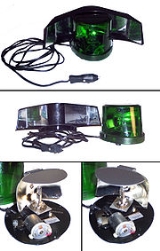
Light bar

Encyclopedia
Emergency vehicle lighting refers to any of several visual warning devices, which may be known as light bars or beacons, fitted to a vehicle and used when the driver wishes to convey to other road users the urgency of their journey, to provide additional warning of a hazard when stationary, or in the case of law enforcement as a means of signalling the driver to stop for interaction with an officer. These are additional to any standard lighting on the car such as hazard lights and are often used along with a siren
(or occasionally sirens) in order to maximize their effectiveness. In many jurisdictions, the use of these lights may afford the user specific legal powers, and may place requirements on other road users to behave differently, such as compelling them to pull to the side of the road and yield right of way so the emergency vehicle may proceed through unimpeded.
The use of emergency beacons is restricted by law in many jurisdictions only for responding to an emergency, initiating a traffic stop, bona fide training exercises, or when a specific hazard exists in the road.
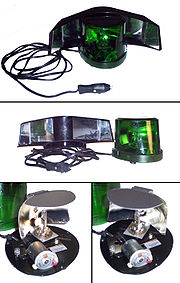 These revolving lights may contain a single, stationary bulb around which a curved mirror is spun (or which is attached to a spinning mirror), or a lamp with a Fresnel lens
. This creates rotating beam(s) of light, appearing to flash when viewed. Larger rotating lights may contain modular or sealed-beam
lamps which rotate as an assembly (commonly 2 or 4 bulbs, but possibly 1 or 3).
To protect the workings of the beacon, a plastic dome often covers the assembly. These domes usually come in solid colors, but in some cases the front and back halves of the dome are different colors. Other beacons use a clear dome with colored lenses on each lamp. Especially in the last case, these rotating beacons are sometimes referred to colloquially as "gumball machine
s" or sometimes "cherry tops" in the case of red lights.
Rotating lights often use a quartz-halogen
or conventional incandescent
bulb, though some rotating beacons are now made with LEDs rather than bulbs.
Rotating lights may be used in lightbars as well as in single beacons. In a modern enclosed lightbar, generally 'V'- or diamond-shaped mirrors are provided between the lamps to give the effect of multiple flashing lights.
s similar to those used in flash photography. These xenon flash lamps put out a very brief but very bright flash by ionizing and then discharging a large current through the gas. The light produced has a somewhat bluish emission spectrum
, which makes red lightbars glow a fuchsia-pink color when lit.
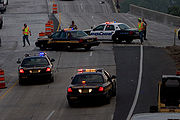 LED-based lighting is becoming very popular in the emergency services for several reasons. Light-emitting diode
s are small, completely solid state, very power-efficient, long-lasting (as they have no filaments to burn out) and can be seen very easily even at great distances and in sunlight.
Whether as lightbars or single beacons, LED-based lights typically use a clear, colorless dome because the light color is an intrinsic property of the LEDs themselves. LED-based lightbars can be made very thin, reducing wind resistance
by around 8-10 percent, or made very flat and used in novel applications, for example to flip up under a sun visor.
LED lights are often used in a mode similar to conventional strobe lights, however they can be programmed with a wider variety of flash patterns because of their ability to be switched directly by electronics, as opposed to discharging a capacitor through a gas-filled tube.
LED lights produce relatively little heat when in use. In colder inclement climates, this has resulted in LED emergency vehicle warning lights (as well as traffic light
s) being obscured by the buildup of frost or snow, raising safety concerns. Solutions are being researched to provide a heat source, as necessary in certain weather conditions, to keep LED lights clear of snow and frost.
), or by drilling holes in the reflectors of stock lighting and inserting flashing lights in those holes.
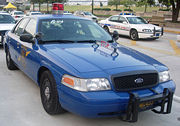 Emergency lighting may be fitted to several places on a vehicle, depending on the degree of conspicuity required. Beacons and lightbars are often mounted on the roof for high visibility, while other lights may be mounted on the body, in the grill, or in the interior of the vehicle.
Since their introduction in the year 1948, rotating beacons have become widely accepted as a means of attracting attention to one's vehicle. Although the use of the single beacon in law enforcement has dropped since the introduction of light bars, they are still used by some police departments, because of their lower cost and in some cases, it may be simply due to tradition. One agency that famously continues to employ traditional red rotating beacons on its patrol cars is the Michigan State Police
. Beacons are also commonly used on construction equipment when a full-sized lightbar would be unnecessary or impractical to attach to the vehicle.
While many single beacons use rotating lamps or mirrors, others use strobe lights under a translucent dome to provide an omnidirectional flash. Some smaller and low-cost beacons of the latter type, however, are simply a blinking incandescent bulb. LEDs are also used to light some omnidirectional beacons.
The single beacon is also available with a magnetic mount for situations where permanent mounting is impractical. Examples of such situations would be detective
s in unmarked vehicles, volunteer firefighters, or managers at freight yards who use an amber light for safety. These "mag-mount" beacons are often round or teardrop-shaped, and are often referred to as "Kojak
" lights after the popular 1970s TV detective who used one.
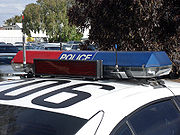
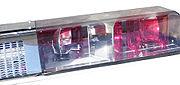 Originally, this referred to a simple metal bar on the roof of the vehicle upon which agencies would mount two rotating beacons, as well as other components such as sirens and stationary "lollipop" lights. Soon the beacon manufacturers began producing off-the-shelf complete "light bars".
Later, the individual components of the lightbar were integrated into a single contiguous unit, with two elongated domes on either side of a siren enclosure. The extended domes allowed for more rotating beacons, additional mirrors, and fixed-beam lights toward the center to replace the "lollipops".
Lightbars may now contain fixed, rotating, strobe, or LED-based lights in various configurations and offering programmable flash patterns. They may include a second, lower, tier of lamps, such as clear halogen "takedown" lights towards the front to illuminate the vehicle being stopped, clear side-facing "alley" spotlights, additional amber or red towards the rear for scene protection, or directional traffic advisory arrows. The modern trend of locating sirens on or near the front bumper of emergency vehicles has resulted in many lightbar models eliminating the siren housing in lieu of more lighting.
Some lightbar variations are specialized to meet certain desires of the agencies utilizing them, such as those using multiple rotating beacons in a "V" pattern to provide additional illumination to the sides of the vehicle, and those designed to hug the roof of a vehicle to minimize air resistance or present a lower profile for "stealth" purposes.
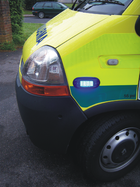 Some types of light can be mounted on to the outside of the vehicle (usually a permanent install) and these can be used to provide directional lighting in key areas, such as in front for clearing traffic, or to the rear for scene protection. They can also form part of the main lighting arrangement for subtly marked or unmarked vehicles. In this application, the operating service may choose to use lights with clear lenses so as to minimize the possibility of the lights being noticed when not on.
Common places to mount such beacons include on or in the grill of the vehicle and on the front of the rear view mirrors, where they can gain maximum visibility. In the UK many emergency vehicles have lights on the side of the bonnet, which helps to warn oncoming traffic when pulling out of junctions. These lights are often strobe or LED types, as they have the lowest profile for purposes of attachment.
lighting, this involves adding a device to alternately flash the high-beam headlights, or, in some countries, the rear fog lights. It can also involve drilling out other lights on the vehicle to add "hideaway" or "corner strobes".
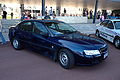
Interior lighting is available in a variety of form factors, ranging from flat LED panels under the sun visors, to halogen or strobe lights mounted on the rear deck, to "cherry" or oscillating "teardrop" lights mounted on the dash. These may be permanently mounted and wired into the vehicle's electrical system, or they may be temporarily mounted and plug into the vehicle's cigarette lighter. They are often fitted with shields which direct the light through the window, but prevent reflections in to the cab.
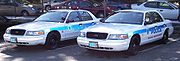 The aerodynamic properties of light bars can be important for police applications, as fuel efficiency and drag are concerns in patrol and pursuit. Because of this, some police cars do not have roof mounted lightbars. These "slick-top" cars mount their emergency lights within the cruiser, generally around the periphery of the windshield or into the leading or trailing edge of the roof. Slick-top police cars also lack the silhouette of a lightbar or beacon, making the car harder to identify as a police vehicle. Because of these visual advantages, these vehicles are sometimes referred to as "stealth" vehicles.
A key disadvantage of relying solely on internal lighting is the number of lights required to achieve true 360 degree visibility, with most lights usually concentrated front and rear. This can limit the application of vehicles for instances such as scene protection.
This same study compared different light colors for glare and detection time under both daylight and night conditions. While red and blue both compared favorably with amber for glare under various conditions, some contradictory findings were observed for detection time. When all colors were held at equal intensity, amber had the poorest detection time both daytime and night. But when the light source was held at constant intensity, the amber filters, which generally let the most light through, had the best detection time.
By far the most common colors for the core emergency services to use are blue and red, and there are some arguments for using both. One study found that for flashing lights, red was more easily perceived in daylight, and blue at night. Furthermore, red has advantages in haze and fog, while blue stands out against traffic at night. On the other hand, a different study found that red had the quickest detection times at night.
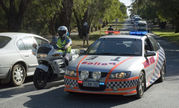
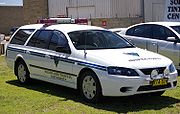 In Australia, colors are generally regulated at the state level, but there are some commonalities:
Many police vehicles, and less often other emergency services, also fit LED matrix variable message displays to vehicle lightbars. Such message bars used in New South Wales by the police and fire brigade are capable of displaying numerous messages warning motorists of various hazards or dangers.
Police now use both red and blue Canada-wide(except where local laws prohibit), including Ontario (thanks to successful testing in Toronto
and Ottawa
, and changes in the provincial traffic act), where the color blue was only used for non-emergency work.
Blue flashing lights are still permitted on snow removal vehicles in Ontario, as long as they are not used in conjunction with flashing red lights.
Some provinces restrict municipal peace officers (the exact title varies by province) to a different color; for instance, red-only in Québec, and amber in Ontario. However, Ontario does permit certain types of provincial enforcement officers, such as Ministry of Transportation, red lights. Officers appointed to enforce the Highway Traffic Act and other statutes use red or red and blue lights as well, such as Ministry of the Environment, Ministry of Natural Resources, University Constables and others. White flashing lights are common as a supplemental light on emergency vehicles, particularly for fire and ambulance vehicles.
In some provinces, green may indicate a volunteer firefighter's medical responder's private vehicle, or other volunteer emergency first responders such as Search and Rescue personnel, In New Brunswick Green is reserved for EMO Command post. In addition to the use of optional green lights, volunteer firefighters often receive special licence plate size markings (red letters on a yellow background) to be displayed in place of a front licence plate, or in the window of said vehicle.
Utility vehicles generally use amber. Ontario and Newfoundland use blue lights for snowplows, while Alberta uses amber and red for snowplows, and has a public awareness campaign advising motorists that "flashing amber and red means snowplow ahead". Alberta also allows red lights on certain classes of utility vehicles, such as natural gas utilities which may need to disconnect a gas line in an emergency.
While funeral vehicles may also use amber, more recently, some funeral homes in Ontario, and more recently Alberta; have begun using purple lights for identification. Often, as a courtesy, motorists yield to funeral processions. However, they are not required to by law.
(Other "non-police" law enforcement means entities such as Conservation Officer, Environmental Officer, Provincial Officer, Ministry/Department of Transportation Enforcement Officers, University Constables, Community Peace Officers, and in some cases, Municipal By-law Enforcement Officers and Fuel Tax Enforcement Officers)
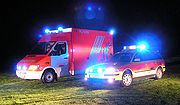 In most of Europe emergency vehicles use blue lights. However, it is a darker specification blue than used in other parts of the world. Swedish ambulances and fire engines often use white along with the dark "euro" blue to improve visibility during daylight hours.
In Spain
, the law allows only the Cuerpo Nacional de Policía, Guardia Civil, Policía Local and autonomous law-enforcement agencies to use blue lights, so in contrast with convention in Europe, civil defence, ambulances (Ambulancia) and fire engines (Bomberos) have to use yellow/amber lights (the only other color authorized, in contrast to convention in which these color lights are used to denote slow vehicles). However some Autonomous Communities have allowed other colors, such as blue, red or white (the latter two of which is used by SAMUR in Madrid), which however, would be technically illegal to use throughout Spain. However, also yellow/an¡mber lights are used in wide-load trucks and its accompanying vehicles.
In Germany
, only emergency and police vehicle may use blue lights. This includes firefighters, rescue services, emergency response vehicles for public utilities and civil defense units. All other kinds of blue lights (e.g. car floor lighting or cab interior lights) are illegal on public roads. This shall ensure that emergency vehicles are easily recognisable. Flashing blue lights and sirens may only be used by authorised vehicles in case of emergency and order all other vehicles to make way, since these vehicles have the absolute right of way. Blue lights alone may be used to secure the site of an accident (or a standing emergency vehicle). Sometimes, columns of emergency or police vehicles use blue lights (without sirens) to make the column more visible to other vehicles.
German police lightbars often have "POLIZEI" written in white over the dome, and usually incorporate an LED
text display that can read, in mirrored writing if towards the front, "STOP POLIZEI" or "BITTE FOLGEN" ("please follow"), to signal drivers to pull over. In the newest generation, the text display changes between german and english (STOP POLIZEI -> STOP POLICE and BITTE FOLGEN -> FOLLOW ME) British police lightbars use the word "STOP".
 Dutch
Dutch
Police Vans and motorcycles often have a separate display, which in some cases can show up to 16 different texts in red lighting. Most often used are "Stop police" or "Volgen" (follow). Standard Dutch police cars often have a text bar incorporated between the blue lights.
Red lights are not as common in Europe, though they are used in some countries where red has a specific meaning. Police in Finland, Estonia, Germany and Sweden use a forward-facing red light to indicate that a driver must pull over and stop. Germany
and Sweden
also use red on fire vehicles to designate the command post; in other countries a single green beacon sometimes designates the command post. In Sweden, a green strobe will indicate a medical command vehicle. Greece uses red on fire engines, and red along with blue on police vehicles. In Poland, red is used on some police and military vehicles to show that it leads a convoy. Until recently the National Police in Slovakia used only blue lights, they have recently started using red and blue lights; Municipal and Military Police used blue lights in Slovakia.
Highway Taxation Enforcement Officers of the Dutch Ministry of Finance use red lightbars on their marked patrol vehicles in order to stop vehicles for enforcement purposes.
Sweden
also allows blue lights to be used on vehicles of "vital importance to the community". This means response vehicles from gas companies and electrical companies may use blue lights and sirens, as well as command vehicles for the Stockholm metro. Vehicles that transport blood or donor organs may also use blue lights and sirens. Cars carrying armed security officers (tasked with protecting embassies, airports and government buildings) may use blue lights and sirens if responding to an alarm.
In The Netherlands, on newer ambulance models red light will alternate the words "Ambulance" and "Spoed". The latter one being Dutch for "urgent". Also, Dutch police cars have a red light on their police cars with the words "POLITIE" (Police), "STOP" (Stop) and "Volgen" (Follow). In a mass-casualty event, the first ambulance will have a flashing or rotating green light.
In Latvia
, mostly all the emergency vehicles are equipped with roof lightbars that are:
The gas emergency service (Avārijas dienests/Gāzes avārijas dienests) and the firefighter cars are equipped with the dark blue beacons on top. The gas emergency service vehicles don't have lightbars.
The Police cars are the only ones that have dark blue dash flashers.
Amber lights generally designate nonemergency or slow movement vehicles such as tow trucks, tractor
s, combine harvester
s or construction equipment.
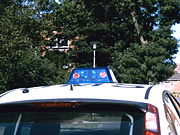 Usage of emergency vehicle lighting is restricted in the United Kingdom through the Road Vehicle Lighting Regulations 1989. It is illegal for any vehicle to show a flashing coloured light (with the exception of the normal direction indicators or a green anti-lock brake warning indicator), unless it is an emergency or other authorised vehicle. However recently pedal cycles can exhibit a flashing rear red lamp.
The main colour for emergency service
vehicles is overwhelmingly blue, although there is also widespread use of flashing (white) headlights. The legal definition of an emergency vehicle limits the use of both methods to vehicles used for:
Blue flashing lights must only be lit at the scene of an emergency, or when the driver considers it desirable to indicate that the journey being undertaken is urgent, and (in terms of the law) convey to other drivers that they should take special care.
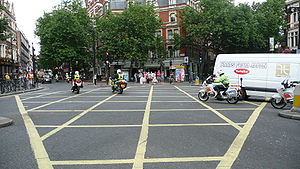 Although not specifically linked to the use of warning beacons, the police, fire brigade and ambulance services (and in certain cases, the blood services and bomb disposal units, but not the other emergency services listed above) may also choose to allow their drivers to claim legal exemptions from certain motoring regulations, such as being able to treat a red traffic light
as a give way sign, exceeding the speed limit, passing the wrong side of a keep left/right sign, driving in a bus lane, or parking in restricted areas. They may not, however, ignore "no entry" signs, drive the wrong way down a one-way street or cross a solid white line in the middle of the road (other than the same exceptions granted everyone else, for example to pass a stationary vehicle). In reality some drivers will disobey other laws at their professional judgement but they do so without any automatic protection from the law. Some services, such as HM coastguard do not allow all their staff to claim all the exemptions available to them.
No qualification other than a driver's license
is legally required to use blue lights; whilst provision has been made to require the drivers of emergency vehicles to have suitable training if they will be driving above the speed limit, this has not yet been brought into force. However most organisations will insist that their drivers are trained in emergency driving techniques.
The common combination of blue flashing lights with two-tone sirens has led to 'blues and twos
' becoming a nickname for the core emergency services as a whole, as well as the title of a British documentary series depicting them.
Amber lights grant no priority in traffic and exist purely to advertise the vehicle's presence. The Regulations specifies several classes of vehicles which may use amber lights, such as towing, highway maintenance, pilot vehicles escorting an oversize load, and vehicles unable to travel over 25 mph and fitting these lights to other vehicles(such as privately owned or pedestrian) is legal (these beacons are widely fitted to vehicles as wide ranging as security and ambulances).
Amber LEDs are widely used on operational appliances owned by Hampshire Fire and Rescue Service
. The combination of blue and amber LEDs in a light bar are proven to be more visible at a distance.
Amber lights are also utilised by the Vehicle and Operator Services Agency (VOSA)
Doctors on emergency calls are allowed a green flashing light, but it grants no privileges or exemptions from traffic laws.
Flashing red lights are not generally allowed on vehicles, though many emergency vehicles have rear-facing flashing red lights, which are used to signify that the vehicle is stationary. These are, however, specifically prohibited by the Regulations. Hazard lights may be wired to function at the same time, to make civilians further conscious of their presence. Fog lights may also be used in an alternating left/right pattern.
Steady chequered lights denote command and control vehicles - these are red and white for fire (one of the few situations where a forward-facing red light may be shown), blue and white for police and green and white for ambulance, and are often fitted in the middle of the light bar.
It should also be noted that UK legislation considers all lights, reflectors and reflective material to be lights, and all items resembling special warning beacons (of any colour) must be covered and not just disconnected (as this is a separate offence) while on the public highway. Similarly, no distinction is made between lights mounted on light bars and those mounted anywhere else on the vehicle (e.g. headlights, indicators, brake lights) - all are covered by the same regulations.
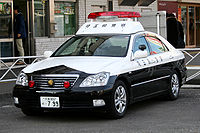
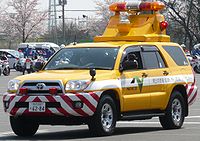 Red is the most used color on Japanese emergency vehicles, with the exception of the wig-wag headlights. The Japanese police uses light bars mounted on a raised platform or a mechanical raised platform to make them more visible over congested streets. Rotating light are the most commonly used. But some of the newer fire vehicles do have LED light bars installed. Vehicles with any other color light are security or engineers.
Volunteers in general are afforded no special privileges and cannot use flashing lights or sirens in order to navigate traffic. However, volunteer Fire Police
members who respond to calls in their own private vehicles may be authorized by their unit or brigade to display a red beacon, for reasons of safety and identification. However, these lights may only be fitted and operational while stationary at an emergency scene, not while mobile in traffic.
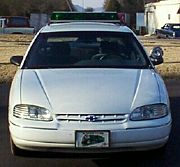 In the United States, colors are generally regulated at the state and local levels, but there are some commonalities.
Some privately operated special police
are allowed to display the same colors as regular police, generally, if they receive their special police authority at the state level. This can include railroad, university, hospital, and humane society police departments.
generally use red and white lights. Vehicles operated by fire departments, such as fire engines and heavy rescue vehicle
s, prominently use red, a color with strong cultural associations with the fire service, along with some white. Amber, and blue in some states, are also shown towards the rear, and some communities even have lighting on fire trucks not dissimilar to police (Red and Blue). Many fire chiefs' cars have, in addition to the red lights, a single green beacon to indicate command post status. On the other hand, in Chicago and some nearby communities, fire vehicles show a green light on the right, or starboard, side of the vehicle, reflecting nautical tradition.
Emergency medical vehicles, such as ambulance
s and paramedic fly-car
s, generally use white and red, with an amber light facing the rear. Some states have a specific rule authorizing light colors for EMS vehicles, while on the other hand some EMS vehicles "inherit" their light colors from the fire or police department they are operated by or contracted to, and may show blue lights.
The National Fire Protection Association
publishes the NFPA-1901
standards for fire vehicles, which specifies the degree of lighting on various parts of the vehicles, with some flexibility as to color. There is also a GSA
procurement specification for ambulances known as KKK-A-1822-F, which many local authorities follow.
personnel to place emergency warning lights in their personal vehicles for use when responding to emergencies. The laws vary greatly by state. For instance, Virginia state law allows emergency personnel to equip one private vehicle "with no more than two flashing or steady-burning red or red and white combination warning lights".
The degree of lighting is mandated by law and also by local custom in most areas, and can vary from a single rotating light on the dashboard or roof, to a setup much like modern police cruisers. Some states also allow volunteer use of sirens and air horns to request the right of way.
 In some states, volunteers are allowed to use the normal red lights, while in other states volunteers must use some other color, usually blue or green. In the latter case, the lights are used as a courtesy to "request" the right of way and generally do not mandate pulling over. Some states, such as Pennsylvania, limit volunteer use of red lights to chiefs and captains of squads.
Separate colors may be used for fire versus EMS volunteers. In Connecticut, Indiana, and New York, volunteer firefighters use blue while volunteer EMTs use green. In New Jersey, volunteer fire and ambulance personnel use blue lights in their personal vehicles while respoding to their stations. In NJ red lights are only allowed for emergency vehicles, fire chiefs or other law enforcement vehicles. New York also certifies some volunteer EMTs to use red lights and sirens provided their vehicles carry certain equipment; this is often used by Hatzolah
volunteers in the NYC area. Typically in New York state, volunteer firemen use blue lights in their personal vehicles and volunteer EMS use green lights. Although, it is confusing to also have green lights to signify an incident command vehicle.
The conflicting color assignments can create issues for volunteers who drive their vehicles out of state. While some authorities may be satisfied with covering the lights with an "Out Of Service" tarp, compliance may be more difficult in other jurisdictions. For example, Arkansas bars civilian possession of blue lights on or in a vehicle unless sealed in the manufacturer's original package.
The confusion generated by the different colors in each state can also cause problems for drivers who travel into others states. One color in their state may mean firefighter or EMT when in another state it may mean police, obviously causing problems.
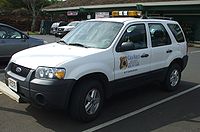 Yellow lights are often used on vehicle involved in non-emergency work. Most phone and cable companies, towing services, and certain types of construction equipment mount some type of lightbar or lighting system; additionally, several local and state vehicles involved in maintenance work for roads, gas and water pipes, electric services, and so forth utilize yellow lights for a higher degree of visibility. In Detroit, Michigan
, Angels' Night volunteers will patrol neighborhoods with yellow lights to help deter vandalism during Devil's Night
and Halloween
. Typically these lights are the single beacon kind, although lightbars have been used for vehicles of this type, especially on wreckers/tow trucks. Also in Michigan, emergency road service vehicles (tow trucks, wreckers, etc.) are allowed to use red warning lights only when stationary.
In states that do not enforce specific rules about green, yellow or white lights, they are often used by entities like private security companies which may be ineligible to use blue or red lights but wish to distinguish themselves from utility vehicles. Security vehicles generally use their lights on private property and are generally not allowed a "courtesy" or "emergency" light on public roads. Some security companies have gone so far as equipping their vehicles with sirens.
Siren (noisemaker)
A siren is a loud noise making device. Most modern ones are civil defense or air raid sirens, tornado sirens, or the sirens on emergency service vehicles such as ambulances, police cars and fire trucks. There are two general types: pneumatic and electronic....
(or occasionally sirens) in order to maximize their effectiveness. In many jurisdictions, the use of these lights may afford the user specific legal powers, and may place requirements on other road users to behave differently, such as compelling them to pull to the side of the road and yield right of way so the emergency vehicle may proceed through unimpeded.
Purpose
Emergency vehicle lighting is generally used to clear the right of way for emergency vehicles, or to warn on-coming motorists of potential hazards, such as: a vehicle that is stopped or moving slower than the rate of traffic, or a car that has been pulled over. It may also be used to provide specific directions to motorists, such as a command to pull over. Some vehicles incorporate a small arrow board to direct traffic on the rear of the light bar.The use of emergency beacons is restricted by law in many jurisdictions only for responding to an emergency, initiating a traffic stop, bona fide training exercises, or when a specific hazard exists in the road.
Optical types
The optical and mechanical characteristics of the lights used can have a significant effect on the look of the vehicle and how readily it gains attention in emergencies.Steady burning
The simplest form of lighting is a steadily burning lamp. These may be white lights used on scene to enable emergency workers to see what they are doing, or they may be colored lights that advertise the emergency vehicle's presence. In the latter case, steadily burning lights are often used alongside rotating or flashing lights rather than on their own, though historically some emergency vehicles only displayed steadily burning lights. For example, California Vehicle Code Section 25252 states that: "Every authorized emergency vehicle shall be equipped with at least one steady burning red warning lamp visible from at least 1,000 feet to the front of the vehicle"Rotating light
Fresnel lens
A Fresnel lens is a type of lens originally developed by French physicist Augustin-Jean Fresnel for lighthouses.The design allows the construction of lenses of large aperture and short focal length without the mass and volume of material that would be required by a lens of conventional design...
. This creates rotating beam(s) of light, appearing to flash when viewed. Larger rotating lights may contain modular or sealed-beam
Sealed beam
A sealed beam is a type of lamp that includes a reflector and filament as a single assembly, over which a front cover of clear glass, is permanently attached. Previously, automotive headlamps used a separate small bulb and reflector covered with a ribbed lens to avoid glare from the filament. This...
lamps which rotate as an assembly (commonly 2 or 4 bulbs, but possibly 1 or 3).
To protect the workings of the beacon, a plastic dome often covers the assembly. These domes usually come in solid colors, but in some cases the front and back halves of the dome are different colors. Other beacons use a clear dome with colored lenses on each lamp. Especially in the last case, these rotating beacons are sometimes referred to colloquially as "gumball machine
Gumball machine
A gumball machine is a toy or commercial device, a type of bulk vending machine, which dispenses gumballs, usually for a small fee.Originally one penny, the standard cost of one gumball in the United States is now one quarter.-History:...
s" or sometimes "cherry tops" in the case of red lights.
Rotating lights often use a quartz-halogen
Halogen lamp
A halogen lamp, also known as a tungsten halogen lamp, is an incandescent lamp with a tungsten filament contained within an inert gas and a small amount of a halogen such as iodine or bromine. The chemical halogen cycle redeposits evaporated tungsten back on to the filament, extending the life of...
or conventional incandescent
Incandescent light bulb
The incandescent light bulb, incandescent lamp or incandescent light globe makes light by heating a metal filament wire to a high temperature until it glows. The hot filament is protected from air by a glass bulb that is filled with inert gas or evacuated. In a halogen lamp, a chemical process...
bulb, though some rotating beacons are now made with LEDs rather than bulbs.
Rotating lights may be used in lightbars as well as in single beacons. In a modern enclosed lightbar, generally 'V'- or diamond-shaped mirrors are provided between the lamps to give the effect of multiple flashing lights.
Strobe lights
Some emergency lighting is based on strobe lightStrobe light
A strobe light or stroboscopic lamp, commonly called a strobe, is a device used to produce regular flashes of light. It is one of a number of devices that can be used as a stroboscope...
s similar to those used in flash photography. These xenon flash lamps put out a very brief but very bright flash by ionizing and then discharging a large current through the gas. The light produced has a somewhat bluish emission spectrum
Emission spectrum
The emission spectrum of a chemical element or chemical compound is the spectrum of frequencies of electromagnetic radiation emitted by the element's atoms or the compound's molecules when they are returned to a lower energy state....
, which makes red lightbars glow a fuchsia-pink color when lit.
LED lighting
Light-emitting diode
A light-emitting diode is a semiconductor light source. LEDs are used as indicator lamps in many devices and are increasingly used for other lighting...
s are small, completely solid state, very power-efficient, long-lasting (as they have no filaments to burn out) and can be seen very easily even at great distances and in sunlight.
Whether as lightbars or single beacons, LED-based lights typically use a clear, colorless dome because the light color is an intrinsic property of the LEDs themselves. LED-based lightbars can be made very thin, reducing wind resistance
Drag (physics)
In fluid dynamics, drag refers to forces which act on a solid object in the direction of the relative fluid flow velocity...
by around 8-10 percent, or made very flat and used in novel applications, for example to flip up under a sun visor.
LED lights are often used in a mode similar to conventional strobe lights, however they can be programmed with a wider variety of flash patterns because of their ability to be switched directly by electronics, as opposed to discharging a capacitor through a gas-filled tube.
LED lights produce relatively little heat when in use. In colder inclement climates, this has resulted in LED emergency vehicle warning lights (as well as traffic light
Traffic light
Traffic lights, which may also be known as stoplights, traffic lamps, traffic signals, signal lights, robots or semaphore, are signalling devices positioned at road intersections, pedestrian crossings and other locations to control competing flows of traffic...
s) being obscured by the buildup of frost or snow, raising safety concerns. Solutions are being researched to provide a heat source, as necessary in certain weather conditions, to keep LED lights clear of snow and frost.
Modification of stock lighting
The vehicle's stock lighting may also be modified to add flashing and strobe effects. This can be done by adding electronics to the existing lighting system (for instance, to create a wig-wagWig-wag (automobile)
A wig-wag is a device for flashing an automobile's headlights at a preset rate. Traditionally, the wig-wag will flash the right and left headlights alternately, but some designs will flash both headlights on and off together...
), or by drilling holes in the reflectors of stock lighting and inserting flashing lights in those holes.
Information matrix signs
Some emergency vehicles use signs made up of a large number of light sources (usually LEDs), which can be programmed to display messages to other road users. This can be used to request other vehicles to pull over, indicate a special instruction, or just to display the name of the operating service (e.g. 'Police')Mounting types
Since their introduction in the year 1948, rotating beacons have become widely accepted as a means of attracting attention to one's vehicle. Although the use of the single beacon in law enforcement has dropped since the introduction of light bars, they are still used by some police departments, because of their lower cost and in some cases, it may be simply due to tradition. One agency that famously continues to employ traditional red rotating beacons on its patrol cars is the Michigan State Police
Michigan State Police
The Michigan State Police is the state police agency for the state of Michigan. The MSP is a full service law enforcement agency with its sworn members having full police powers statewide....
. Beacons are also commonly used on construction equipment when a full-sized lightbar would be unnecessary or impractical to attach to the vehicle.
While many single beacons use rotating lamps or mirrors, others use strobe lights under a translucent dome to provide an omnidirectional flash. Some smaller and low-cost beacons of the latter type, however, are simply a blinking incandescent bulb. LEDs are also used to light some omnidirectional beacons.
The single beacon is also available with a magnetic mount for situations where permanent mounting is impractical. Examples of such situations would be detective
Detective
A detective is an investigator, either a member of a police agency or a private person. The latter may be known as private investigators or "private eyes"...
s in unmarked vehicles, volunteer firefighters, or managers at freight yards who use an amber light for safety. These "mag-mount" beacons are often round or teardrop-shaped, and are often referred to as "Kojak
Kojak
Kojak is an American television series starring Telly Savalas as the title character, bald New York City Police Department Detective Lieutenant Theo Kojak. It aired from October 24, 1973, to March 18, 1978, on CBS. It took the time slot of the popular Cannon series, which was moved one hour earlier...
" lights after the popular 1970s TV detective who used one.
Lightbar
Later, the individual components of the lightbar were integrated into a single contiguous unit, with two elongated domes on either side of a siren enclosure. The extended domes allowed for more rotating beacons, additional mirrors, and fixed-beam lights toward the center to replace the "lollipops".
Lightbars may now contain fixed, rotating, strobe, or LED-based lights in various configurations and offering programmable flash patterns. They may include a second, lower, tier of lamps, such as clear halogen "takedown" lights towards the front to illuminate the vehicle being stopped, clear side-facing "alley" spotlights, additional amber or red towards the rear for scene protection, or directional traffic advisory arrows. The modern trend of locating sirens on or near the front bumper of emergency vehicles has resulted in many lightbar models eliminating the siren housing in lieu of more lighting.
Some lightbar variations are specialized to meet certain desires of the agencies utilizing them, such as those using multiple rotating beacons in a "V" pattern to provide additional illumination to the sides of the vehicle, and those designed to hug the roof of a vehicle to minimize air resistance or present a lower profile for "stealth" purposes.
Body mounted
Common places to mount such beacons include on or in the grill of the vehicle and on the front of the rear view mirrors, where they can gain maximum visibility. In the UK many emergency vehicles have lights on the side of the bonnet, which helps to warn oncoming traffic when pulling out of junctions. These lights are often strobe or LED types, as they have the lowest profile for purposes of attachment.
Vehicle integral
Sometimes, the existing lighting on a vehicle is modified to create warning beacons. In the case of wig-wagWig-wag (automobile)
A wig-wag is a device for flashing an automobile's headlights at a preset rate. Traditionally, the wig-wag will flash the right and left headlights alternately, but some designs will flash both headlights on and off together...
lighting, this involves adding a device to alternately flash the high-beam headlights, or, in some countries, the rear fog lights. It can also involve drilling out other lights on the vehicle to add "hideaway" or "corner strobes".
Interior mounted
A variety of emergency lights may be used in the interior of a vehicle, generally on the dashboard, visor area, or rear deck. Uses range from discreet or temporary lighting for unmarked vehicles and volunteer responders, to additional rear lighting on fully marked vehicles, to a "slick-top" configuration not unlike a full lightbar set.Interior lighting is available in a variety of form factors, ranging from flat LED panels under the sun visors, to halogen or strobe lights mounted on the rear deck, to "cherry" or oscillating "teardrop" lights mounted on the dash. These may be permanently mounted and wired into the vehicle's electrical system, or they may be temporarily mounted and plug into the vehicle's cigarette lighter. They are often fitted with shields which direct the light through the window, but prevent reflections in to the cab.
A key disadvantage of relying solely on internal lighting is the number of lights required to achieve true 360 degree visibility, with most lights usually concentrated front and rear. This can limit the application of vehicles for instances such as scene protection.
Perception
A study at Loughborough University in the United Kingdom showed that strobe lighting conveyed a greater sense of urgency to other road users, with the faster the flash the greater urgency, potentially helping to speed the emergency vehicle through traffic. It also concluded that factors such as flash pattern were important, with simultaneously flashing beacons attracting attention far quicker than alternately flashing versions, although this did increase discomfort glare. Unsurprisingly, attention was gained far quicker the higher the intensity of the light was, and the more beacons were present.This same study compared different light colors for glare and detection time under both daylight and night conditions. While red and blue both compared favorably with amber for glare under various conditions, some contradictory findings were observed for detection time. When all colors were held at equal intensity, amber had the poorest detection time both daytime and night. But when the light source was held at constant intensity, the amber filters, which generally let the most light through, had the best detection time.
Potential hazards
There may be a number of hazards to other road users related to the use of emergency beacons, and these effects should be mitigated as far as possible during vehicle design. These potential hazards include:- Photosensitive epilepsyPhotosensitive epilepsyPhotosensitive epilepsy is a form of epilepsy in which seizures are triggered by visual stimuli that form patterns in time or space, such as flashing lights, bold, regular patterns, or regular moving patterns.-Symptoms:...
- This is an epileptic reaction to flashing lights in susceptible persons, which can range in severity from an unusual feeling or involuntary twitch to a generalized seizure. This epileptogenic response can be triggered by lights flashing in the frequency range of 10–20 Hz, regardless of color. While individual light sources used on emergency vehicles generally have much lower flash rates than this, the Loughborough study suggests that such possibilities be minimized. It also notes that emergency workers may report distraction and eyestrain unrelated to epilepsy from working under the lights. - GlareGlare (vision)Glare is difficulty seeing in the presence of bright light such as direct or reflected sunlight or artificial light such as car headlamps at night. Because of this, some cars include mirrors with automatic anti-glare functions....
- A bright light source in a person's field of view can reduce their ability to see other objects. The effect may be exacerbated by rain, windshields, or eyeglasses. The study distinguished between "disability glare", where a driver may be temporarily blinded and unable to see hazards in the road, versus "discomfort glare", which is a more general effect from lights which may cause motorists to avert their eyes. The worst effects for disability glare occurred with amber beacons, strobe beacons, and especially bright lights. - PhototaxisPhototaxisPhototaxis is a kind of taxis, or locomotory movement, that occurs when a whole organism moves in response to the stimulus of light. This is advantageous for phototrophic organisms as they can orient themselves most efficiently to receive light for photosynthesis...
- This is the so called 'moth-to-flame' effect, where the hypothesis runs that some drivers may be so distracted by the beacons that they are 'drawn' to them. The Loughborough study, referencing the February 1998 issue of the U.S. trade journal Tow Times, asserts that there was a lawsuit in the U.S. where a tow operator was found liable for an accident for this reason, though the study authors were unable to locate any supporting scientific research.
Usage by country
The color of a vehicle's emergency lights is useful to denote the type of vehicle or situation, but the relationship between color and service varies widely by jurisdiction. In North America the usual emergency colors are red and blue, with blue generally reserved for police in many jurisdictions and red reserved for fire departments and emergency medical services. In western Europe the emergency color tends to be only blue, with amber as a warning color for construction equipment, etc. In eastern Europe emergency vehicles use blue, or a combination of blue and red. In Asia the usual emergency color is red.By far the most common colors for the core emergency services to use are blue and red, and there are some arguments for using both. One study found that for flashing lights, red was more easily perceived in daylight, and blue at night. Furthermore, red has advantages in haze and fog, while blue stands out against traffic at night. On the other hand, a different study found that red had the quickest detection times at night.
Argentina
Argentina uses blue for police, red with some blue for fire, green for ambulances, and amber for utility vehicles.Australia
- Red and Blue is used by all State and Federal Police forces, Military Police, Australian Customs as 'law enforcement' vehicles. Red and blue is also used by all State and Australian Defence Force fire and ambulance services. Civilian Ambulance and most fire units across the country use red and blue lights with State Emergency ServiceState Emergency ServiceA State Emergency Service is an Australian volunteer organisation that provides emergency help during and after declared disasters. The SES is also the primary or secondary agency for emergencies, such as storm damage,flood damage, building damage, traffic hazards and road crash rescue...
vehicles in most states being authorised to use the red and blue light combination (except for Queensland SES). New South Wales also allows red and blue to be used by Roads and Traffic AuthorityRoads and Traffic AuthorityThe Roads and Traffic Authority is a former New South Wales government agency that was responsible for major road infrastructure, licensing of drivers, and registration of motor vehicles. The RTA directly managed State roads and provided funding to local councils for regional and local roads...
traffic commanders and traffic response crews designated as emergency vehicles. - Red signifies a risk-to-life situation, and is used alone by Mines Rescue, Red Cross blood/organ transport and St John Ambulance Service. Until recently some states used only red on fire engines, ambulances and State Emergency Service vehicles.
- Amber lights are used by tow trucks, road construction/repair vehicles and most other utility vehicles. Amber is also used by vehicles operating in and around airports and docks, this includes Australian Federal Police and Australian Customs vehicles which are fitted with additional amber lighting to supplement their red and blue lightbars. Queensland State Emergency Service vehicles are only authorised to display amber lights under certain circumstances.
- Green lights are used to denote a stationary ambulance, fire or police command vehicle. In Queensland it is also used on some State Forest bush fire units along with the amber. Further, in Queensland, some municipal animal control units use a green and amber light combination.
- Blue lights are reserved for emergency vehicles in general, such as police, fire, ambulance, State Emergency Service (except Queensland) and traffic commanders. Blue by itself is also used by airport emergency vehicles to designate a command vehicle.
- Magenta (purple) lights are primarily used by heavy vehicle enforcement/escort officers of the New South WalesNew South WalesNew South Wales is a state of :Australia, located in the east of the country. It is bordered by Queensland, Victoria and South Australia to the north, south and west respectively. To the east, the state is bordered by the Tasman Sea, which forms part of the Pacific Ocean. New South Wales...
Roads and Traffic AuthorityRoads and Traffic AuthorityThe Roads and Traffic Authority is a former New South Wales government agency that was responsible for major road infrastructure, licensing of drivers, and registration of motor vehicles. The RTA directly managed State roads and provided funding to local councils for regional and local roads...
, VictorianVictoria (Australia)Victoria is the second most populous state in Australia. Geographically the smallest mainland state, Victoria is bordered by New South Wales, South Australia, and Tasmania on Boundary Islet to the north, west and south respectively....
VicRoadsVicRoadsVicRoads or the Roads Corporation of Victoria is a statutory corporation which is the state road and traffic authority in the state of Victoria, Australia. It is responsible for maintenance and construction of the state arterial road network, as well as driver licensing and vehicle registration. ...
and South Australian Transport Safety Inspectors. They are also used in combination with amber lights by some council rangerCouncil rangerCouncil rangers are officers employed by Local Government Areas in Australia to enforce the by-laws of those local governments and a limited range of state laws relating to such matters as litter control, animal control, dog laws, fire control, off-road vehicles, emergency management, and...
s and the New South WalesNew South WalesNew South Wales is a state of :Australia, located in the east of the country. It is bordered by Queensland, Victoria and South Australia to the north, south and west respectively. To the east, the state is bordered by the Tasman Sea, which forms part of the Pacific Ocean. New South Wales...
Ministry of Transport. In Western Australia magenta is used by the Department Of Environment and Conservation "HAZMAT Response Unit". - White is used on most newer emergency vehicles, both as an extra color on lightbars and in the form of 'wig-wag' headlights.
Many police vehicles, and less often other emergency services, also fit LED matrix variable message displays to vehicle lightbars. Such message bars used in New South Wales by the police and fire brigade are capable of displaying numerous messages warning motorists of various hazards or dangers.
Canada
Generally, red is used for emergency vehicles, amber for construction and utility vehicles, and green for volunteer firefighters. Blue is used, along with red, for police, as well as for snow removal vehicles in Ontario (with Amber for Municipal snow removal) and purple is used for a funeral.Police now use both red and blue Canada-wide(except where local laws prohibit), including Ontario (thanks to successful testing in Toronto
Toronto
Toronto is the provincial capital of Ontario and the largest city in Canada. It is located in Southern Ontario on the northwestern shore of Lake Ontario. A relatively modern city, Toronto's history dates back to the late-18th century, when its land was first purchased by the British monarchy from...
and Ottawa
Ottawa
Ottawa is the capital of Canada, the second largest city in the Province of Ontario, and the fourth largest city in the country. The city is located on the south bank of the Ottawa River in the eastern portion of Southern Ontario...
, and changes in the provincial traffic act), where the color blue was only used for non-emergency work.
Blue flashing lights are still permitted on snow removal vehicles in Ontario, as long as they are not used in conjunction with flashing red lights.
Some provinces restrict municipal peace officers (the exact title varies by province) to a different color; for instance, red-only in Québec, and amber in Ontario. However, Ontario does permit certain types of provincial enforcement officers, such as Ministry of Transportation, red lights. Officers appointed to enforce the Highway Traffic Act and other statutes use red or red and blue lights as well, such as Ministry of the Environment, Ministry of Natural Resources, University Constables and others. White flashing lights are common as a supplemental light on emergency vehicles, particularly for fire and ambulance vehicles.
In some provinces, green may indicate a volunteer firefighter's medical responder's private vehicle, or other volunteer emergency first responders such as Search and Rescue personnel, In New Brunswick Green is reserved for EMO Command post. In addition to the use of optional green lights, volunteer firefighters often receive special licence plate size markings (red letters on a yellow background) to be displayed in place of a front licence plate, or in the window of said vehicle.
Utility vehicles generally use amber. Ontario and Newfoundland use blue lights for snowplows, while Alberta uses amber and red for snowplows, and has a public awareness campaign advising motorists that "flashing amber and red means snowplow ahead". Alberta also allows red lights on certain classes of utility vehicles, such as natural gas utilities which may need to disconnect a gas line in an emergency.
While funeral vehicles may also use amber, more recently, some funeral homes in Ontario, and more recently Alberta; have begun using purple lights for identification. Often, as a courtesy, motorists yield to funeral processions. However, they are not required to by law.
- Red and Blue: police; and other "non-police" law enforcement in all provinces and territories.
- Red: fire department; and other "non-police" law enforcement in the provinces of BC, ON, and QC.
- Red and White: Emergency Medical Services, St. John Ambulance and private ambulatory services; police services that have not changed over to Red and Blue
- Blue: snow plows (see below for Ontario), municipal and private contractors except BC.
- Amber and Blue: snow plows - Manitoba and Ontario (only on Municipal vehicles).
- Amber: construction and utility; funeral homes; airport service vehicles (excludes emergency vehicles); private snow removal vehicles (Ontario); Canadian Automobile AssociationCanadian Automobile AssociationThe Canadian Automobile Association , commonly known as CAA, is a non-profit federation, founded in 1913, of nine clubs across Canada, providing roadside assistance service, a complete range of auto touring and leisure travel services, insurance services, and member discounts with preferred...
Emergency Assistance vehicles. - Purple: funeral homes - Ontario, Alberta, Manitoba, and Prince Edward Island.
- Green: emergency service volunteers in certain provinces. Green may also be used by stopped Emergency Vehicles to denote a command vehicle or the site commander, New Brunswick EMO Command post.
- White/Clear: mall security (Ontario); university campus security (Ontario)
(Other "non-police" law enforcement means entities such as Conservation Officer, Environmental Officer, Provincial Officer, Ministry/Department of Transportation Enforcement Officers, University Constables, Community Peace Officers, and in some cases, Municipal By-law Enforcement Officers and Fuel Tax Enforcement Officers)
Europe
In Spain
Spain
Spain , officially the Kingdom of Spain languages]] under the European Charter for Regional or Minority Languages. In each of these, Spain's official name is as follows:;;;;;;), is a country and member state of the European Union located in southwestern Europe on the Iberian Peninsula...
, the law allows only the Cuerpo Nacional de Policía, Guardia Civil, Policía Local and autonomous law-enforcement agencies to use blue lights, so in contrast with convention in Europe, civil defence, ambulances (Ambulancia) and fire engines (Bomberos) have to use yellow/amber lights (the only other color authorized, in contrast to convention in which these color lights are used to denote slow vehicles). However some Autonomous Communities have allowed other colors, such as blue, red or white (the latter two of which is used by SAMUR in Madrid), which however, would be technically illegal to use throughout Spain. However, also yellow/an¡mber lights are used in wide-load trucks and its accompanying vehicles.
In Germany
Germany
Germany , officially the Federal Republic of Germany , is a federal parliamentary republic in Europe. The country consists of 16 states while the capital and largest city is Berlin. Germany covers an area of 357,021 km2 and has a largely temperate seasonal climate...
, only emergency and police vehicle may use blue lights. This includes firefighters, rescue services, emergency response vehicles for public utilities and civil defense units. All other kinds of blue lights (e.g. car floor lighting or cab interior lights) are illegal on public roads. This shall ensure that emergency vehicles are easily recognisable. Flashing blue lights and sirens may only be used by authorised vehicles in case of emergency and order all other vehicles to make way, since these vehicles have the absolute right of way. Blue lights alone may be used to secure the site of an accident (or a standing emergency vehicle). Sometimes, columns of emergency or police vehicles use blue lights (without sirens) to make the column more visible to other vehicles.
German police lightbars often have "POLIZEI" written in white over the dome, and usually incorporate an LED
LEd
LEd is a TeX/LaTeX editing software working under Microsoft Windows. It is a freeware product....
text display that can read, in mirrored writing if towards the front, "STOP POLIZEI" or "BITTE FOLGEN" ("please follow"), to signal drivers to pull over. In the newest generation, the text display changes between german and english (STOP POLIZEI -> STOP POLICE and BITTE FOLGEN -> FOLLOW ME) British police lightbars use the word "STOP".
Netherlands
The Netherlands is a constituent country of the Kingdom of the Netherlands, located mainly in North-West Europe and with several islands in the Caribbean. Mainland Netherlands borders the North Sea to the north and west, Belgium to the south, and Germany to the east, and shares maritime borders...
Police Vans and motorcycles often have a separate display, which in some cases can show up to 16 different texts in red lighting. Most often used are "Stop police" or "Volgen" (follow). Standard Dutch police cars often have a text bar incorporated between the blue lights.
Red lights are not as common in Europe, though they are used in some countries where red has a specific meaning. Police in Finland, Estonia, Germany and Sweden use a forward-facing red light to indicate that a driver must pull over and stop. Germany
Germany
Germany , officially the Federal Republic of Germany , is a federal parliamentary republic in Europe. The country consists of 16 states while the capital and largest city is Berlin. Germany covers an area of 357,021 km2 and has a largely temperate seasonal climate...
and Sweden
Sweden
Sweden , officially the Kingdom of Sweden , is a Nordic country on the Scandinavian Peninsula in Northern Europe. Sweden borders with Norway and Finland and is connected to Denmark by a bridge-tunnel across the Öresund....
also use red on fire vehicles to designate the command post; in other countries a single green beacon sometimes designates the command post. In Sweden, a green strobe will indicate a medical command vehicle. Greece uses red on fire engines, and red along with blue on police vehicles. In Poland, red is used on some police and military vehicles to show that it leads a convoy. Until recently the National Police in Slovakia used only blue lights, they have recently started using red and blue lights; Municipal and Military Police used blue lights in Slovakia.
Highway Taxation Enforcement Officers of the Dutch Ministry of Finance use red lightbars on their marked patrol vehicles in order to stop vehicles for enforcement purposes.
Sweden
Sweden
Sweden , officially the Kingdom of Sweden , is a Nordic country on the Scandinavian Peninsula in Northern Europe. Sweden borders with Norway and Finland and is connected to Denmark by a bridge-tunnel across the Öresund....
also allows blue lights to be used on vehicles of "vital importance to the community". This means response vehicles from gas companies and electrical companies may use blue lights and sirens, as well as command vehicles for the Stockholm metro. Vehicles that transport blood or donor organs may also use blue lights and sirens. Cars carrying armed security officers (tasked with protecting embassies, airports and government buildings) may use blue lights and sirens if responding to an alarm.
In The Netherlands, on newer ambulance models red light will alternate the words "Ambulance" and "Spoed". The latter one being Dutch for "urgent". Also, Dutch police cars have a red light on their police cars with the words "POLITIE" (Police), "STOP" (Stop) and "Volgen" (Follow). In a mass-casualty event, the first ambulance will have a flashing or rotating green light.
In Latvia
Latvia
Latvia , officially the Republic of Latvia , is a country in the Baltic region of Northern Europe. It is bordered to the north by Estonia , to the south by Lithuania , to the east by the Russian Federation , to the southeast by Belarus and shares maritime borders to the west with Sweden...
, mostly all the emergency vehicles are equipped with roof lightbars that are:
- white with white/dark blue colour with smaller EU dark blue lights - PoliceLaw enforcement in LatviaLaw enforcement in Latvia is under the jurisdiction of the Ministry of the Interior, which is composed of the State Police, Security Police and State Border Guard branches.In 2003, the State Police consisted of 8,222 officers..-External links:***...
(Policija), Road police(Ceļu policija) - dark blue with smaller white lights + dark blue beacons - Paramedics (Neatliekamā ātrā palīdzība)
The gas emergency service (Avārijas dienests/Gāzes avārijas dienests) and the firefighter cars are equipped with the dark blue beacons on top. The gas emergency service vehicles don't have lightbars.
The Police cars are the only ones that have dark blue dash flashers.
Amber lights generally designate nonemergency or slow movement vehicles such as tow trucks, tractor
Tractor
A tractor is a vehicle specifically designed to deliver a high tractive effort at slow speeds, for the purposes of hauling a trailer or machinery used in agriculture or construction...
s, combine harvester
Combine harvester
The combine harvester, or simply combine, is a machine that harvests grain crops. The name derives from the fact that it combines three separate operations, reaping, threshing, and winnowing, into a single process. Among the crops harvested with a combine are wheat, oats, rye, barley, corn ,...
s or construction equipment.
Blue lights
The main colour for emergency service
Emergency service
Emergency services are organizations which ensure public safety and health by addressing different emergencies. Some agencies exist solely for addressing certain types of emergencies whilst others deal with ad hoc emergencies as part of their normal responsibilities...
vehicles is overwhelmingly blue, although there is also widespread use of flashing (white) headlights. The legal definition of an emergency vehicle limits the use of both methods to vehicles used for:
- Fire brigade, ambulance or police purposes (this includes private fire or ambulance services)
- Fire salvage
- Forestry CommissionForestry CommissionThe Forestry Commission is a non-ministerial government department responsible for forestry in Great Britain. Its mission is to protect and expand Britain's forests and woodlands and increase their value to society and the environment....
or local authority when fighting fires - Ministry of DefenceMinistry of Defence (United Kingdom)The Ministry of Defence is the United Kingdom government department responsible for implementation of government defence policy and is the headquarters of the British Armed Forces....
bomb disposal, mountain rescue, nuclear emergency or armament support, or special forcesSpecial forcesSpecial forces, or special operations forces are terms used to describe elite military tactical teams trained to perform high-risk dangerous missions that conventional units cannot perform...
responding to a national securityNational securityNational security is the requirement to maintain the survival of the state through the use of economic, diplomacy, power projection and political power. The concept developed mostly in the United States of America after World War II...
emergency - National Blood ServiceNational Blood ServiceThe National Blood Service is the organisation for England and North Wales which collects blood and other tissues, tests, processes, and supplies all the hospitals in England and North Wales...
or Scottish National Blood Transfusion ServiceScottish National Blood Transfusion ServiceThe Scottish National Blood Transfusion Service is the national blood, blood product and tissue provider of Scotland. It is a special health board of the Scottish National Health Service.-History:...
vehicles - HM Coastguard
- British Coal Corporation (now the Coal AuthorityCoal AuthorityThe Coal Authority is a non-departmental public body of the United Kingdom government.-History:It was established under the Coal Industry Act 1994 to manage certain functions previously undertaken by the British Coal Corporation , including ownership of unworked coal.It is situated in the south of...
) for mine rescue - RNLI lifeboatLifeboat (rescue)A rescue lifeboat is a boat rescue craft which is used to attend a vessel in distress, or its survivors, to rescue crewmen and passengers. It can be hand pulled, sail powered or powered by an engine...
launching vehicles (usually restricted to launching slipway) - mountain rescueMountain rescueMountain rescue refers to search and rescue activities that occur in a mountainous environment, although the term is sometimes also used to apply to search and rescue in other wilderness environments. The difficult and remote nature of the terrain in which mountain rescue often occurs has resulted...
- carrying human tissue for transplant
- HM Revenue and Customs when investigating serious crime.
Blue flashing lights must only be lit at the scene of an emergency, or when the driver considers it desirable to indicate that the journey being undertaken is urgent, and (in terms of the law) convey to other drivers that they should take special care.
Traffic light
Traffic lights, which may also be known as stoplights, traffic lamps, traffic signals, signal lights, robots or semaphore, are signalling devices positioned at road intersections, pedestrian crossings and other locations to control competing flows of traffic...
as a give way sign, exceeding the speed limit, passing the wrong side of a keep left/right sign, driving in a bus lane, or parking in restricted areas. They may not, however, ignore "no entry" signs, drive the wrong way down a one-way street or cross a solid white line in the middle of the road (other than the same exceptions granted everyone else, for example to pass a stationary vehicle). In reality some drivers will disobey other laws at their professional judgement but they do so without any automatic protection from the law. Some services, such as HM coastguard do not allow all their staff to claim all the exemptions available to them.
No qualification other than a driver's license
Driver's license
A driver's license/licence , or driving licence is an official document which states that a person may operate a motorized vehicle, such as a motorcycle, car, truck or a bus, on a public roadway. Most U.S...
is legally required to use blue lights; whilst provision has been made to require the drivers of emergency vehicles to have suitable training if they will be driving above the speed limit, this has not yet been brought into force. However most organisations will insist that their drivers are trained in emergency driving techniques.
The common combination of blue flashing lights with two-tone sirens has led to 'blues and twos
Blues and twos
Blues and twos is a colloquial British term that refers to the emergency vehicle equipment of combined flashing lights as well as sirens that the emergency services in the UK and Ireland use when responding to an incident...
' becoming a nickname for the core emergency services as a whole, as well as the title of a British documentary series depicting them.
Amber/yellow lights
Amber lights grant no priority in traffic and exist purely to advertise the vehicle's presence. The Regulations specifies several classes of vehicles which may use amber lights, such as towing, highway maintenance, pilot vehicles escorting an oversize load, and vehicles unable to travel over 25 mph and fitting these lights to other vehicles(such as privately owned or pedestrian) is legal (these beacons are widely fitted to vehicles as wide ranging as security and ambulances).
Amber LEDs are widely used on operational appliances owned by Hampshire Fire and Rescue Service
Hampshire Fire and Rescue Service
Hampshire Fire and Rescue Service is the statutory fire and rescue service for the county of Hampshire, on the south coast of England. The service's chief fire officer is John Bonney.-History:...
. The combination of blue and amber LEDs in a light bar are proven to be more visible at a distance.
Amber lights are also utilised by the Vehicle and Operator Services Agency (VOSA)
Other lights
Doctors on emergency calls are allowed a green flashing light, but it grants no privileges or exemptions from traffic laws.
Flashing red lights are not generally allowed on vehicles, though many emergency vehicles have rear-facing flashing red lights, which are used to signify that the vehicle is stationary. These are, however, specifically prohibited by the Regulations. Hazard lights may be wired to function at the same time, to make civilians further conscious of their presence. Fog lights may also be used in an alternating left/right pattern.
Steady chequered lights denote command and control vehicles - these are red and white for fire (one of the few situations where a forward-facing red light may be shown), blue and white for police and green and white for ambulance, and are often fitted in the middle of the light bar.
It should also be noted that UK legislation considers all lights, reflectors and reflective material to be lights, and all items resembling special warning beacons (of any colour) must be covered and not just disconnected (as this is a separate offence) while on the public highway. Similarly, no distinction is made between lights mounted on light bars and those mounted anywhere else on the vehicle (e.g. headlights, indicators, brake lights) - all are covered by the same regulations.
Hong Kong
Under Hong Kong Law, Chapter 374G of the Road Traffic (Traffic Control) Regulations: Section 46 Giving way to animals, police vehicles, ambulances, etc., drivers must yield to vehicles who are sounding siren or flashing light bars.- Red and Blue: Hong Kong Police ForceHong Kong Police ForceThe Hong Kong Police Force is the largest disciplined service under the Security Bureau of Hong Kong. It is the world's second, and Asia's first, police agency to operate with a modern policing system. It was formed on 1 May 1844, with a strength of 32 officers...
- Red only: Fire Services Department fire engines
- Blue only: Ambulances, whether operated by Fire Services Department, Auxiliary Medical ServicesAuxiliary Medical ServicesAuxiliary Medical Service is a well-trained, committed voluntary medical and health services provider in Hong Kong. Its mission is to supply effectively and efficiently regular services to maintain the health and well-being of people in Hong Kong....
, or Hong Kong St. John AmbulanceHong Kong St. John AmbulanceHong Kong St. John Ambulance is a charitable organization with a long history stretching back over a century and has been serving the community since 1884...
, also Customs and Excise Department, Hong Kong Correctional ServicesHong Kong Correctional ServicesHong Kong Correctional Services is responsible for prisoners and prisons in Hong Kong. The Commissioner of Correctional Services reports to the Secretary for Security.... - Amber only: Utility vehicles, also Civil Aid ServiceCivil Aid ServiceThe Civil Aid Service or CAS in short is a civil organisation that assist in a variety of auxiliary emergency roles, including search and rescue operations in Hong Kong:...
, and all vehicles in the air-side of the airportHong Kong International AirportHong Kong International Airport is the main airport in Hong Kong. It is colloquially known as Chek Lap Kok Airport , being built on the island of Chek Lap Kok by land reclamation, and also to distinguish it from its predecessor, the closed Kai Tak Airport.The airport opened for commercial...
(for pilots' visibility), Hong Kong Immigration Department vehicles
Japan
- Red: Police DepartmentPolice system of JapanLaw enforcement in Japan is provided by the Prefectural Police under the oversight of the National Police Agency or NPA. The NPA is headed by the National Public Safety Commission thus ensuring that Japan's police are an apolitical body and free of direct central government executive control...
, Fire Department, and any other emergency vehicles. - Amber: Engineer vehicles and Japan Highway Public CorporationJapan Highway Public Corporation, or JH, was a public company established after World War II to construct and manage highway networks in Japan, founded in 1956.On October 1, 2005, JH was divided into three private enterprises, East Nippon Expressway Co., Ltd. , Central Nippon Expressway Co., Ltd. , and West Nippon Expressway...
vehicles. - Blue: Security and City vehicles.
New Zealand
In New Zealand, the colors used on lightbars and beacons are defined by the New Zealand Land Transport Safety Authority regulations.- Red: Used by any vehicle defined as an emergency vehicle to signify vehicles to give way to the emergency vehicle. This includes the New Zealand Fire ServiceNew Zealand Fire ServiceThe New Zealand Fire Service is New Zealand's national fire fighting body. While its founding legislation, the Fire Service Act 1975, only provides for this role, the organisation has assumed responsibility for several other areas.-Strategic Direction:The New Zealand Fire Service has defined for...
, recognized ambulance services, and the New Zealand PoliceNew Zealand PoliceThe New Zealand Police is the national police force of New Zealand, responsible for enforcing criminal law, enhancing public safety, maintaining order and keeping the peace throughout New Zealand...
.
- Blue: Used by any vehicle that has statutory authority to signify a vehicle to pull over and stop. Currently only used by the police, but after 1 November 2009, can be used by customs officers, fisheries officers, and marine reserve officers.
- Amber: Amber lights may be operated by towing companies, traffic management agencies, or by other utility vehicles when necessary to warn other motorists of a hazard. Amber must also be fitted to oversize vehicles and their pilot vehicles.
- Purple: Purple and amber lights must be fitted to pilot vehicles escorting an oversize vehicle.
- Green: A vehicle operated by a registered medical practitioner, such as a doctor, nurse or midwife, may be fitted with a single green beacon.
Volunteers in general are afforded no special privileges and cannot use flashing lights or sirens in order to navigate traffic. However, volunteer Fire Police
Fire Police
Fire Police are Volunteer Fire Brigade/Company members who have sworn police powers. They receive special police training and are responsible for traffic control, crowd control, fire and incident scene security, apparatus security, and station security during calls for service.They also assist...
members who respond to calls in their own private vehicles may be authorized by their unit or brigade to display a red beacon, for reasons of safety and identification. However, these lights may only be fitted and operational while stationary at an emergency scene, not while mobile in traffic.
South Korea
- Red: Fire department, ambulances of the Gyeongi province, some police vehicles
- Blue: Police motorcycles, some police vehicles
- Red and blue: Police patrol cars
- Green: Ambulances (some privately operated ambulances use the mix of green and red)
- Yellow/amber:Utility vehicles
United States
- Red almost always denotes an emergency vehicle if the lights are facing forward. In the state of Iowa, red lights can also be used on a funeral hearseHearseA hearse is a funerary vehicle used to carry a coffin from a church or funeral home to a cemetery. In the funeral trade, hearses are often called funeral coaches.-History:...
, but only during funerals. In Washington State, red lights are also used on tow trucks, but only if the vehicle is not in motion. In Wisconsin, red lights are allowed on tow trucks in motion or not, but only in combination with amber lights. - AmberAmber (color)Amber is an orange-yellow color that got its name from the material known as amber. Due to this, amber can refer not to one but to a series of shades of orange, since the natural material varies from nearly yellow when newer to orange or reddish-orange when older.-Amber:Amber is a pure chroma color...
or Yellow lights are often used by vehicles such as construction vehicles, tow trucks, snow plows, funeral escorts and hearses, security patrol vehicles or other vehicles which may be stopped or moving slower than the flow of traffic. Amber is usually the most permissively regulated color. - White is often used as an optional color on lightbars, though it may be restricted to emergency vehicles in some states. It is rarely used as the only color on a lightbar, though Arkansas, Rhode Island, Florida, Illinois, Michigan, Wisconsin, Maryland, West Virginia, South Dakota, Texas, Louisiana, and Kentucky require flashing white beacons on school buses. Certain railroad-related machines, like fueling tankers or switching engines, may also use a flashing white light. Certain government vehicles, such as rural mail delivery vehicles, use a flashing white beacon in some states.
- Green on a fire chief's car or a mobile command post denotes the command vehicle on scene; this usage derives from the use of green flags in the Incident Command SystemIncident Command SystemThe Incident Command System is "a systematic tool used for the command, control, and coordination of emergency response" according to the United States Federal Highway Administration...
. Green can also denote a firefighter or EMT's vehicle in some states. In some states, green is used by private security guards. In the Commonwealth of Puerto Rico, Green is used along with Blue by Municipal Police Forces. In some states, green denotes a funeral vehicle or police escorting a funeral procession. - Blue is reserved for law enforcement, firefighters and EMTs. In New Mexico and Texas, tow trucks have blue lights. In Texas light construction and utility vehicles commonly use Blue along with Amber, though technically illegal. Alaska, Arizona, Colorado, Minnesota, and Nebraska also use blue lights on snowplows.
- Purple is permitted in some states to denote a funeral vehicle.
Police
Police agencies may use red, blue, or both, depending on the state, along with white and amber as optional colors; although amber is usually restricted to face behind the vehicle. Some police cars have an amber traffic-control stick, or "arrow stick", behind the lightbar to direct traffic left or right around the vehicle; these usually have 6 or 8 rear-facing lights that flash in sequence.Some privately operated special police
Special police
Special Police does not have a consistent international meaning. In many cases it will describe a police force or a unit within a police force whose duties and responsibilities are significantly different from other forces in the same country or significantly different from other police in the same...
are allowed to display the same colors as regular police, generally, if they receive their special police authority at the state level. This can include railroad, university, hospital, and humane society police departments.
Fire and EMS
Fire and emergency medical servicesEmergency medical services
Emergency medical services are a type of emergency service dedicated to providing out-of-hospital acute medical care and/or transport to definitive care, to patients with illnesses and injuries which the patient, or the medical practitioner, believes constitutes a medical emergency...
generally use red and white lights. Vehicles operated by fire departments, such as fire engines and heavy rescue vehicle
Heavy rescue vehicle
A heavy rescue vehicle is a type of specialty firefighting or EMS apparatus. They are primarily designed to provide the specialized equipment necessary for technical rescue situations such as auto accidents requiring vehicle extrication, building collapses, confined space rescue, rope rescues and...
s, prominently use red, a color with strong cultural associations with the fire service, along with some white. Amber, and blue in some states, are also shown towards the rear, and some communities even have lighting on fire trucks not dissimilar to police (Red and Blue). Many fire chiefs' cars have, in addition to the red lights, a single green beacon to indicate command post status. On the other hand, in Chicago and some nearby communities, fire vehicles show a green light on the right, or starboard, side of the vehicle, reflecting nautical tradition.
Emergency medical vehicles, such as ambulance
Ambulance
An ambulance is a vehicle for transportation of sick or injured people to, from or between places of treatment for an illness or injury, and in some instances will also provide out of hospital medical care to the patient...
s and paramedic fly-car
Fly-car
An ambulance emergency response vehicle is a vehicle operated by an emergency medical service to respond to medical emergencies either in addition to, or in place of, an ambulance capable of transporting patients....
s, generally use white and red, with an amber light facing the rear. Some states have a specific rule authorizing light colors for EMS vehicles, while on the other hand some EMS vehicles "inherit" their light colors from the fire or police department they are operated by or contracted to, and may show blue lights.
The National Fire Protection Association
National Fire Protection Association
The National Fire Protection Association is a United States trade association that creates and maintains private, copywrited, standards and codes for usage and adoption by local governments...
publishes the NFPA-1901
NFPA 1901
NFPA 1901, the Standard for Automotive Fire Apparatus, is published by the National Fire Protection Association to outline the standard for firefighting apparatus...
standards for fire vehicles, which specifies the degree of lighting on various parts of the vehicles, with some flexibility as to color. There is also a GSA
General Services Administration
The General Services Administration is an independent agency of the United States government, established in 1949 to help manage and support the basic functioning of federal agencies. The GSA supplies products and communications for U.S...
procurement specification for ambulances known as KKK-A-1822-F, which many local authorities follow.
Volunteer Personnel
Many U.S. states allow volunteer fire and EMSEmergency medical services
Emergency medical services are a type of emergency service dedicated to providing out-of-hospital acute medical care and/or transport to definitive care, to patients with illnesses and injuries which the patient, or the medical practitioner, believes constitutes a medical emergency...
personnel to place emergency warning lights in their personal vehicles for use when responding to emergencies. The laws vary greatly by state. For instance, Virginia state law allows emergency personnel to equip one private vehicle "with no more than two flashing or steady-burning red or red and white combination warning lights".
The degree of lighting is mandated by law and also by local custom in most areas, and can vary from a single rotating light on the dashboard or roof, to a setup much like modern police cruisers. Some states also allow volunteer use of sirens and air horns to request the right of way.
Separate colors may be used for fire versus EMS volunteers. In Connecticut, Indiana, and New York, volunteer firefighters use blue while volunteer EMTs use green. In New Jersey, volunteer fire and ambulance personnel use blue lights in their personal vehicles while respoding to their stations. In NJ red lights are only allowed for emergency vehicles, fire chiefs or other law enforcement vehicles. New York also certifies some volunteer EMTs to use red lights and sirens provided their vehicles carry certain equipment; this is often used by Hatzolah
Hatzolah
Hatzolah/Hatzalah is a volunteer Emergency Medical Service organization serving mostly Jewish communities around the world. Most local branches operate independently of each other, but use the common name...
volunteers in the NYC area. Typically in New York state, volunteer firemen use blue lights in their personal vehicles and volunteer EMS use green lights. Although, it is confusing to also have green lights to signify an incident command vehicle.
The conflicting color assignments can create issues for volunteers who drive their vehicles out of state. While some authorities may be satisfied with covering the lights with an "Out Of Service" tarp, compliance may be more difficult in other jurisdictions. For example, Arkansas bars civilian possession of blue lights on or in a vehicle unless sealed in the manufacturer's original package.
The confusion generated by the different colors in each state can also cause problems for drivers who travel into others states. One color in their state may mean firefighter or EMT when in another state it may mean police, obviously causing problems.
Utility Vehicles
Detroit, Michigan
Detroit is the major city among the primary cultural, financial, and transportation centers in the Metro Detroit area, a region of 5.2 million people. As the seat of Wayne County, the city of Detroit is the largest city in the U.S. state of Michigan and serves as a major port on the Detroit River...
, Angels' Night volunteers will patrol neighborhoods with yellow lights to help deter vandalism during Devil's Night
Devil's Night
Devil's Night or Hell Night ' is a name associated with October 30th, the night before Halloween. It is related to the "Mischief night" practiced in other parts of the United States and the world, but is chiefly associated with the serious vandalism and arson seen in Detroit, Michigan from the...
and Halloween
Halloween
Hallowe'en , also known as Halloween or All Hallows' Eve, is a yearly holiday observed around the world on October 31, the night before All Saints' Day...
. Typically these lights are the single beacon kind, although lightbars have been used for vehicles of this type, especially on wreckers/tow trucks. Also in Michigan, emergency road service vehicles (tow trucks, wreckers, etc.) are allowed to use red warning lights only when stationary.
In states that do not enforce specific rules about green, yellow or white lights, they are often used by entities like private security companies which may be ineligible to use blue or red lights but wish to distinguish themselves from utility vehicles. Security vehicles generally use their lights on private property and are generally not allowed a "courtesy" or "emergency" light on public roads. Some security companies have gone so far as equipping their vehicles with sirens.
Optional colors
Often, while certain colors are customarily used by different services, there are other colors that are optionally used, such as amber and white. Sometimes, this is done to satisfy particular regulations; for example, California requires a steady red light facing forward and a flashing amber light to the rear on every vehicle.See also
- Automotive lightingAutomotive lightingThe lighting system of a motor vehicle consists of lighting and signalling devices mounted or integrated to the front, sides, rear, and in some cases the top of the motor vehicle...
- Emergency vehicle equipmentEmergency vehicle equipmentEmergency vehicle equipment is the equipment fitted to, or carried by, an emergency vehicle, which is additional to any equipment such as headlights, steering wheels or windshield/windscreens that a standard non-emergency vehicle is fitted with....