

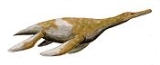
Polycotylidae

Encyclopedia
Polycotylidae is a family of plesiosaur
s from the Cretaceous
, a sister group to the Leptocleididae
.
With their short necks and large elongated heads, they resemble the pliosaur
s, but closer phylogenetical studies indicate that they share many common features with the plesiosauridae
and elasmosauridae
. They have been found worldwide, with specimens reported from New Zealand
, Australia
, Japan
, Morocco
, the USA, Canada
, the former states of the USSR and South America
.
after Albright, Gillette and Titus (2007).
Cladogram after Ketchum and Benson (2010).
Below is a cladogram of polycotylid relationships from Ketchum & Benson, 2011.
Plesiosaur
Plesiosauroidea is an extinct clade of carnivorous plesiosaur marine reptiles. Plesiosauroids, are known from the Jurassic and Cretaceous Periods...
s from the Cretaceous
Cretaceous
The Cretaceous , derived from the Latin "creta" , usually abbreviated K for its German translation Kreide , is a geologic period and system from circa to million years ago. In the geologic timescale, the Cretaceous follows the Jurassic period and is followed by the Paleogene period of the...
, a sister group to the Leptocleididae
Leptocleididae
Leptocleididae is a family of small-sized plesiosaurs that lived during the Early Cretaceous period . Leptocleidus and Umoonasaurus had round bodies and triangle shaped heads. Hilary F. Ketchum and Roger B. J. Benson , transferred Brancasaurus, Kaiwhekea, Nichollssaura and Thililua to this family...
.
With their short necks and large elongated heads, they resemble the pliosaur
Pliosaur
Pliosauroidea is an extinct clade of marine reptiles. Pliosauroids, also commonly known as pliosaurs, are known from the Jurassic and Cretaceous Periods. The pliosauroids were short-necked plesiosaurs with large heads and massive toothed jaws. These swimming reptiles were not dinosaurs but distant...
s, but closer phylogenetical studies indicate that they share many common features with the plesiosauridae
Plesiosauridae
Plesiosauridae was a monophyletic family of plesiosaurs.-References:...
and elasmosauridae
Elasmosauridae
Elasmosauridae was the family of plesiosaurs. They had the longest necks of the plesiosaurs and survived from the Late Triassic to the end of the Cretaceous. They had a diet of fish and shelless cephalopods.-Size:...
. They have been found worldwide, with specimens reported from New Zealand
New Zealand
New Zealand is an island country in the south-western Pacific Ocean comprising two main landmasses and numerous smaller islands. The country is situated some east of Australia across the Tasman Sea, and roughly south of the Pacific island nations of New Caledonia, Fiji, and Tonga...
, Australia
Australia
Australia , officially the Commonwealth of Australia, is a country in the Southern Hemisphere comprising the mainland of the Australian continent, the island of Tasmania, and numerous smaller islands in the Indian and Pacific Oceans. It is the world's sixth-largest country by total area...
, Japan
Japan
Japan is an island nation in East Asia. Located in the Pacific Ocean, it lies to the east of the Sea of Japan, China, North Korea, South Korea and Russia, stretching from the Sea of Okhotsk in the north to the East China Sea and Taiwan in the south...
, Morocco
Morocco
Morocco , officially the Kingdom of Morocco , is a country located in North Africa. It has a population of more than 32 million and an area of 710,850 km², and also primarily administers the disputed region of the Western Sahara...
, the USA, Canada
Canada
Canada is a North American country consisting of ten provinces and three territories. Located in the northern part of the continent, it extends from the Atlantic Ocean in the east to the Pacific Ocean in the west, and northward into the Arctic Ocean...
, the former states of the USSR and South America
South America
South America is a continent situated in the Western Hemisphere, mostly in the Southern Hemisphere, with a relatively small portion in the Northern Hemisphere. The continent is also considered a subcontinent of the Americas. It is bordered on the west by the Pacific Ocean and on the north and east...
.
Phylogeny
CladogramCladogram
A cladogram is a diagram used in cladistics which shows ancestral relations between organisms, to represent the evolutionary tree of life. Although traditionally such cladograms were generated largely on the basis of morphological characters, DNA and RNA sequencing data and computational...
after Albright, Gillette and Titus (2007).
Cladogram after Ketchum and Benson (2010).
Below is a cladogram of polycotylid relationships from Ketchum & Benson, 2011.
Websites
- Palæos: The Vertebrates, Lepidosauromorpha: Cryptocleidoidea: Tricleidia