


Deccan Traps

Encyclopedia
Large igneous province
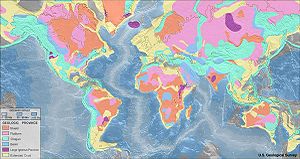
A Large Igneous Province is an extremely large accumulation of igneous rocks—intrusive, extrusive, or both—in the earth's crust...
located on the Deccan Plateau
Deccan Plateau
The Deccan Plateau is a large plateau in India, making up the majority of the southern part of the country. It rises a hundred meters high in the north, rising further to more than a kilometers high in the south, forming a raised triangle nested within the familiar downward-pointing triangle of...
of west-central India
India
India , officially the Republic of India , is a country in South Asia. It is the seventh-largest country by geographical area, the second-most populous country with over 1.2 billion people, and the most populous democracy in the world...
(between 17–24N, 73–74E) and one of the largest volcanic features on Earth. They consist of multiple layers of solidified flood basalt
Flood basalt
A flood basalt or trap basalt is the result of a giant volcanic eruption or series of eruptions that coats large stretches of land or the ocean floor with basalt lava. Flood basalts have occurred on continental scales in prehistory, creating great plateaus and mountain ranges...
that together are more than 2000 m (6,562 ft) thick and cover an area of 500000 km² (193,051 sq mi) and a volume of 512000 km³ (122,835.3 cu mi). The term 'trap', used in geology
Geology
Geology is the science comprising the study of solid Earth, the rocks of which it is composed, and the processes by which it evolves. Geology gives insight into the history of the Earth, as it provides the primary evidence for plate tectonics, the evolutionary history of life, and past climates...
for such rock formation
Rock formation
This is a list of rock formations that include isolated, scenic, or spectacular surface rock outcrops. These formations are usually the result of weathering and erosion sculpting the existing rock...
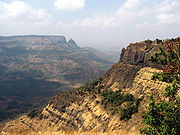
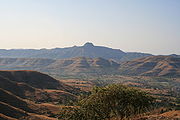
s, is derived from the Swedish word for stairs and refers to the step-like hills forming the landscape of the region.
History
The Deccan Traps formed between 60 and 68 million years ago, at the end of the CretaceousCretaceous
The Cretaceous , derived from the Latin "creta" , usually abbreviated K for its German translation Kreide , is a geologic period and system from circa to million years ago. In the geologic timescale, the Cretaceous follows the Jurassic period and is followed by the Paleogene period of the...
period. The bulk of the volcanic eruption occurred at the Western Ghats
Western Ghats
The Western Ghats, Western Ghauts or the Sahyādri is a mountain range along the western side of India. It runs north to south along the western edge of the Deccan Plateau, and separates the plateau from a narrow coastal plain along the Arabian Sea. The Western Ghats block rainfall to the Deccan...
(near Mumbai
Mumbai
Mumbai , formerly known as Bombay in English, is the capital of the Indian state of Maharashtra. It is the most populous city in India, and the fourth most populous city in the world, with a total metropolitan area population of approximately 20.5 million...
) some 65 million years ago. This series of eruptions may have lasted less than 30,000 years in total.
The original area covered by the lava flows is estimated to have been as large as 1.5 million km², approximately half the size of modern India
India
India , officially the Republic of India , is a country in South Asia. It is the seventh-largest country by geographical area, the second-most populous country with over 1.2 billion people, and the most populous democracy in the world...
. The Deccan Traps region was reduced to its current size by erosion
Erosion
Erosion is when materials are removed from the surface and changed into something else. It only works by hydraulic actions and transport of solids in the natural environment, and leads to the deposition of these materials elsewhere...
and plate tectonics; the present area of directly observable lava flows is around 512000 km² (197,684 sq mi).
Influence
The release of volcanic gasVolcanic gas
|250px|thumb|right|Image of the [[rhyolitic]] [[lava dome]] of [[Chaitén Volcano]] during its 2008-2010 eruption.Volcanic gases include a variety of substances given off by active volcanoes...
es, particularly sulfur dioxide
Sulfur dioxide
Sulfur dioxide is the chemical compound with the formula . It is released by volcanoes and in various industrial processes. Since coal and petroleum often contain sulfur compounds, their combustion generates sulfur dioxide unless the sulfur compounds are removed before burning the fuel...
, during the formation of the traps contributed to contemporary climate change
Climate change
Climate change is a significant and lasting change in the statistical distribution of weather patterns over periods ranging from decades to millions of years. It may be a change in average weather conditions or the distribution of events around that average...
. Data point to an average fall in temperature of 2 °C in this period.
Due to the volcanic gases and subsequent temperature drop, the formation of the traps is seen as a major stressor on biodiversity at the time. This is confirmed by a mass extinction topping 17 families per million years (about 15 families per million years above the average). Sudden cooling due to sulfurous volcanic gases released by the formation of the traps and localised gas concentrations may have been enough to drive a less significant mass extinction, but the impact of the meteoroid
Meteoroid
A meteoroid is a sand- to boulder-sized particle of debris in the Solar System. The visible path of a meteoroid that enters Earth's atmosphere is called a meteor, or colloquially a shooting star or falling star. If a meteoroid reaches the ground and survives impact, then it is called a meteorite...
that formed the Chicxulub Crater
Chicxulub Crater
The Chicxulub crater is an ancient impact crater buried underneath the Yucatán Peninsula in Mexico. Its center is located near the town of Chicxulub, after which the crater is named...
(which would have made a sunlight blocking dust cloud that killed much of the plants and reduced global temperature, called an impact winter
Impact winter
An impact winter is a period of prolonged cold weather caused by the impact on the Earth of a large asteroid or comet. If such an impact occurred on land or the floor of a shallow sea, it could cause large amounts of dust or ash to be thrown into the Earth's atmosphere, blocking the Sun's light...
) made this one of the most pronounced mass extinctions in the Phanerozoic
Phanerozoic
The Phanerozoic Eon is the current eon in the geologic timescale, and the one during which abundant animal life has existed. It covers roughly 542 million years and goes back to the time when diverse hard-shelled animals first appeared...
.
Because of its magnitude, scientists formerly speculated that the gases released during the formation of the Deccan Traps played a role in the Cretaceous–Tertiary extinction event, which included the extinction
Extinction
In biology and ecology, extinction is the end of an organism or of a group of organisms , normally a species. The moment of extinction is generally considered to be the death of the last individual of the species, although the capacity to breed and recover may have been lost before this point...
of the non-avian dinosaur
Dinosaur
Dinosaurs are a diverse group of animals of the clade and superorder Dinosauria. They were the dominant terrestrial vertebrates for over 160 million years, from the late Triassic period until the end of the Cretaceous , when the Cretaceous–Paleogene extinction event led to the extinction of...
s. The current consensus among the scientific community is that the extinction was triggered by the Chicxulub impact event
Chicxulub Crater
The Chicxulub crater is an ancient impact crater buried underneath the Yucatán Peninsula in Mexico. Its center is located near the town of Chicxulub, after which the crater is named...
in Central America.
Chemical composition
Within the Deccan Traps at least 95% of the lavas are tholeiitic basalts, however other rock types do occur:- Alkali basaltBasaltBasalt is a common extrusive volcanic rock. It is usually grey to black and fine-grained due to rapid cooling of lava at the surface of a planet. It may be porphyritic containing larger crystals in a fine matrix, or vesicular, or frothy scoria. Unweathered basalt is black or grey...
s - NepheliniteNepheliniteNephelinite is a fine-grained or aphanitic igneous rock made up almost entirely of nepheline and clinopyroxene . If olivine is present, the rock may be classified as an olivine nephelinite. Nephelinite is dark in color and may resemble basalt in hand specimen...
s - LamprophyreLamprophyreLamprophyres are uncommon, small volume ultrapotassic igneous rocks primarily occurring as dikes, lopoliths, laccoliths, stocks and small intrusions...
- CarbonatiteCarbonatiteCarbonatites are intrusive or extrusive igneous rocks defined by mineralogic composition consisting of greater than 50 percent carbonate minerals. Carbonatites may be confused with marble, and may require geochemical verification....
s
Mantle xenolith
Xenolith
A xenolith is a rock fragment which becomes enveloped in a larger rock during the latter's development and hardening. In geology, the term xenolith is almost exclusively used to describe inclusions in igneous rock during magma emplacement and eruption...
s have been described from Kachchh (northwestern India) and elsewhere in the western Deccan.
Fossils
The Deccan Traps are famous for the beds of fossils that have been found between layers of traps lava. Particularly well known species include the frog Oxyglossus pusillus (Owen) of the EoceneEocene
The Eocene Epoch, lasting from about 56 to 34 million years ago , is a major division of the geologic timescale and the second epoch of the Paleogene Period in the Cenozoic Era. The Eocene spans the time from the end of the Palaeocene Epoch to the beginning of the Oligocene Epoch. The start of the...
of India
India
India , officially the Republic of India , is a country in South Asia. It is the seventh-largest country by geographical area, the second-most populous country with over 1.2 billion people, and the most populous democracy in the world...
and the toothed frog Indobatrachus, an early lineage of modern frogs, which is now placed in the Australian family Myobatrachidae.
Theories of formation
It is postulated that the Deccan Traps eruption was associated with a deep mantle plumeMantle plume
A mantle plume is a hypothetical thermal diapir of abnormally hot rock that nucleates at the core-mantle boundary and rises through the Earth's mantle. Such plumes were invoked in 1971 to explain volcanic regions that were not thought to be explicable by the then-new theory of plate tectonics. Some...
. The area of long-term eruption (the hotspot
Hotspot (geology)
The places known as hotspots or hot spots in geology are volcanic regions thought to be fed by underlying mantle that is anomalously hot compared with the mantle elsewhere. They may be on, near to, or far from tectonic plate boundaries. There are two hypotheses to explain them...
), known as the Réunion hotspot
Réunion hotspot
The Réunion hotspot is a volcanic hotspot which currently lies under the Island of Réunion in the Indian Ocean. The Chagos-Laccadive Ridge and the southern part of the Mascarene Plateau are volcanic traces of the Réunion hotspot....
, is suspected of both causing the Deccan Traps eruption and opening the rift that once separated the Seychelles plateau
Mascarene Plateau
The Mascarene Plateau is an submarine plateau in the Indian Ocean, north and east of Madagascar. The plateau extends approximately 2000 km, from the Seychelles in the north to Réunion in the south. The plateau covers an area of over 115,000 km² of shallow water, with depths ranging from...
from India. Seafloor spreading
Seafloor spreading
Seafloor spreading is a process that occurs at mid-ocean ridges, where new oceanic crust is formed through volcanic activity and then gradually moves away from the ridge. Seafloor spreading helps explain continental drift in the theory of plate tectonics....
at the boundary between the Indian and African Plate
African Plate
The African Plate is a tectonic plate which includes the continent of Africa, as well as oceanic crust which lies between the continent and various surrounding ocean ridges.-Boundaries:...
s subsequently pushed India north over the plume, which now lies under Réunion
Réunion
Réunion is a French island with a population of about 800,000 located in the Indian Ocean, east of Madagascar, about south west of Mauritius, the nearest island.Administratively, Réunion is one of the overseas departments of France...
island in the Indian Ocean
Indian Ocean
The Indian Ocean is the third largest of the world's oceanic divisions, covering approximately 20% of the water on the Earth's surface. It is bounded on the north by the Indian Subcontinent and Arabian Peninsula ; on the west by eastern Africa; on the east by Indochina, the Sunda Islands, and...
, southwest of India. The mantle plume model has, however, been challenged.
Data continues to emerge which supports the plume model. The motion of the Indian tectonic plate and the eruptive history of the Deccan traps show strong correlations. Based on data from marine magnetic profiles, a pulse of unusually rapid plate motion begins at the same time as the first pulse of Deccan flood basalts, which is dated at 67 Myr ago. The spreading rate rapidly increased and reached a maximum at the same time as the peak basaltic eruptions. The spreading rate then dropped off, with the decrease occurring around 63 Myr ago, by which time the main phase of Deccan volcanism ended. This correlation is seen as driven by plume dynamics.
The Indian and African plates motions have also been shown to be coupled, with the common element being the position of these plates relative to the location of the Réunion plume head. The onset of accelerated motion of India coincides with a large slowing of the rate of counterclockwise rotation of Africa. The close correlations between the plate motions suggest that they were both driven by the force of the Réunion plume.
Link to Shiva Crater
A large impact crater has been claimed to exist in the sea floor off the west coast of India. Called the Shiva craterShiva crater
The Shiva crater is a sea floor structure located beneath the Indian Ocean, west of Mumbai, India. It was named by the paleontologist Sankar Chatterjee after Shiva, the Hindu god of destruction and renewal....
, it has also been dated at sixty-five million years, right at the K–T boundary
K–T boundary
The K–T boundary is a geological signature, usually a thin band, dated to 65.5 ± 0.3 Ma ago. K is the traditional abbreviation for the Cretaceous period, and T is the abbreviation for the Tertiary period...
. The researchers suggest that the impact may have been the triggering event for the Deccan Traps as well as contributing to the acceleration of the Indian plate in the early Tertiary
Tertiary
The Tertiary is a deprecated term for a geologic period 65 million to 2.6 million years ago. The Tertiary covered the time span between the superseded Secondary period and the Quaternary...
. However, opinion in the geologic community is not unanimous that this feature is actually an impact crater.
See also
- List of volcanoes in India
- Geology of IndiaGeology of IndiaThe geology of India started with the geological evolution of rest of the Earth i.e. 4.57 Ga . India has a diverse geology. Different regions in India contain rocks of all types belonging to different geologic periods. Some of the rocks are badly deformed and transmuted while others are recently...
- Siberian TrapsSiberian TrapsThe Siberian Traps form a large region of volcanic rock, known as a large igneous province, in the Russian region of Siberia. The massive eruptive event which formed the traps, one of the largest known volcanic events of the last 500 million years of Earth's geological history, continued for...
- Emeishan TrapsEmeishan TrapsThe Emeishan Traps constitute a flood basalt volcanic province, or large igneous province, in southwestern China, centered in Sichuan province. It is sometimes referred to as the Permian Emeishan Large Igneous Province or variations of that term....
- Lameta FormationLameta FormationThe Lameta Formation is a sedimentary rock formation found in Madhya Pradesh, Gujarat, and Maharashtra, India. It is of Maastrichtian age , and is notable for its dinosaur fossils...