


Zajecar

Encyclopedia
Zaječar is a city
and municipality in the eastern part of Serbia
. According to the 2011 census the town has a population of 36,830, and its coordinates are 43.91° North, 22.30° East. Zaječar has a number of primary and secondary schools as well as the first private college established in Serbia, the Faculty of Management Megatrend University
. Zaječar is widely known for its rock music festival Gitarijada
which has existed for more than 40 years and for the festival dedicated to contemporary art, ZALET
. It is the administrative center of the Zaječar District
and a main town
in the Timočka Krajina
region
.
, the town is known as Zaječar (Зајечар), and in Vlach
/Romanian
as Zăiicer (archaic name) / Zăiceri / Zăicear.
The origin of the name is from the Torlak dialect name for "hare" = zajec / зајец (in all other Serbian
dialect
s it is zec / зец, while in Bulgarian
it is "zaek"). It means "the man who breeds and keeps hares".
Folk etymology in Vlach
, a language of a local minority, gives "Zāiicer" as meaning the "God
s are asking (for sacrifice)", but this is clearly not the origin of the city name.
(r. 293–311), Maximinus
(r. 305–312) and Licinius
(r. 308–324).
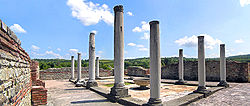 The Late Roman fortified palace compound and memorial complex of Gamzigrad
-Romuliana at the outskirts of Zaječar was commissioned by Emperor Caius Valerius Galerius Maximianus, in the late 3rd and early 4th century. It was known as Felix Romuliana, named after the Emperor's mother Romula. The site consists of fortifications, the palace in the north-western part of the complex, basilicas, temples, hot baths, memorial complex, and a tetrapylon
. The site offers a unique testimony of the Roman building tradition marked by the ideology of the period of the Second Tetrachy. The group of buildings is also unique in its intertwining of ceremonial and memorial functions. The relation between two spatial ensembles in this site is stressed by the tetrapylon which is placed on the crossroads between the worldly fortification and palace on the one side and the other-worldly mausoleums and consecration monuments on the other.
, Hajduk
Veljko Petrović liberated the area from Ottoman rule.
The city has two sport-recreation centers, "Popova plaža" and "Kraljevica", while a third, "Kotlujevac", is under reconstruction.
(stylised as ZA*73T) organizes manifestations, such as exhibitions, concerts, literary evenings and experimental theater, with innovative and progressive aspects of artistic expressions: performance, art comics, low-fi video, video-art, conceptual art, the synthesis of fine and conceptual arts.
(Serbian Cyrillic: Гитаријада, trans. Guitar fest) is a musical festival held during summer in order to promote demo bands. Held since 1969, Gitarijada is one of the longest-lasting festivals in Serbia and in South Eastern Europe. Festival started its life in Zaječar during 1970. Some of notable bands from Serbia such as Bjesovi
& Galija
were winners on Gitarijada
during '80s and '90s. The program of Gitarijada
fest has a few parts. Demo battles as a main, performances of famous artists and art exhibitions surrounding themes like rock, blues, metal and similar. So far, Gitarijada
has reached its 44th birthday and it is considered to be the biggest rock festival in South Eastern Europe.
High schools
University education
The city is the seat place of "Megatrend" university
Faculty of Management;
Business School of Management.
In 2011, the municipality of Zaječar has a population of 58,547 people, and the town has 36,830. The city has grown quickly in the last five years, and has an urban area of over 50 km².
1953. 14489
1961. 18690
1971. 27599
1981. 36958
1991. 39958
2002. 49491
2011. 58547
with: Vidin
, Bulgaria
Calafat
, Romania
External links=
City
A city is a relatively large and permanent settlement. Although there is no agreement on how a city is distinguished from a town within general English language meanings, many cities have a particular administrative, legal, or historical status based on local law.For example, in the U.S...
and municipality in the eastern part of Serbia
Serbia
Serbia , officially the Republic of Serbia , is a landlocked country located at the crossroads of Central and Southeast Europe, covering the southern part of the Carpathian basin and the central part of the Balkans...
. According to the 2011 census the town has a population of 36,830, and its coordinates are 43.91° North, 22.30° East. Zaječar has a number of primary and secondary schools as well as the first private college established in Serbia, the Faculty of Management Megatrend University
Megatrend University
The Megatrend University is a private university located in Belgrade, Serbia. It was founded in 1989 and is organized into 19 institutions....
. Zaječar is widely known for its rock music festival Gitarijada
Gitarijada
Gitarijada is a musical festival held in Zaječar, Serbia in order to promote demo bands. Held since 1969, Gitarijada is one of the longest lasting festivals in Serbia and in South Eastern Europe and the largest festival of young and unsinged bands in South Eastern Europe...
which has existed for more than 40 years and for the festival dedicated to contemporary art, ZALET
ZALET
Zalet is a bunch of happenings in Zaječar emerged as a need to initiate, organize and support cultural events, to affirm artists and to intermediate in transmission of diverse artistic expressions and tendencies...
. It is the administrative center of the Zaječar District
Zajecar District
Zaječar District is a district of Serbia. It expands in the eastern part of Serbia. It has a population of 118,295 . The Seat of the District is in the city of Zaječar.-Municipalities:It encompasses the municipalities of:*Boljevac...
and a main town
Town
A town is a human settlement larger than a village but smaller than a city. The size a settlement must be in order to be called a "town" varies considerably in different parts of the world, so that, for example, many American "small towns" seem to British people to be no more than villages, while...
in the Timočka Krajina
Timočka Krajina
Timočka Krajina is a geographical region located in Serbia. It is situated in eastern Serbia around the Timok River. The population of Timočka Krajina is 284,112 .-Name:...
region
Region
Region is most commonly found as a term used in terrestrial and astrophysics sciences also an area, notably among the different sub-disciplines of geography, studied by regional geographers. Regions consist of subregions that contain clusters of like areas that are distinctive by their uniformity...
.
Name
In SerbianSerbian language
Serbian is a form of Serbo-Croatian, a South Slavic language, spoken by Serbs in Serbia, Bosnia and Herzegovina, Montenegro, Croatia and neighbouring countries....
, the town is known as Zaječar (Зајечар), and in Vlach
Vlach language (Serbia)
Vlach / Romanian are the terms used to designate the Romanian varieties spoken by the Vlachs of eastern Serbia.-Status:...
/Romanian
Romanian language
Romanian Romanian Romanian (or Daco-Romanian; obsolete spellings Rumanian, Roumanian; self-designation: română, limba română ("the Romanian language") or românește (lit. "in Romanian") is a Romance language spoken by around 24 to 28 million people, primarily in Romania and Moldova...
as Zăiicer (archaic name) / Zăiceri / Zăicear.
The origin of the name is from the Torlak dialect name for "hare" = zajec / зајец (in all other Serbian
Serbian language
Serbian is a form of Serbo-Croatian, a South Slavic language, spoken by Serbs in Serbia, Bosnia and Herzegovina, Montenegro, Croatia and neighbouring countries....
dialect
Dialect
The term dialect is used in two distinct ways, even by linguists. One usage refers to a variety of a language that is a characteristic of a particular group of the language's speakers. The term is applied most often to regional speech patterns, but a dialect may also be defined by other factors,...
s it is zec / зец, while in Bulgarian
Bulgarian language
Bulgarian is an Indo-European language, a member of the Slavic linguistic group.Bulgarian, along with the closely related Macedonian language, demonstrates several linguistic characteristics that set it apart from all other Slavic languages such as the elimination of case declension, the...
it is "zaek"). It means "the man who breeds and keeps hares".
Folk etymology in Vlach
Vlach language (Serbia)
Vlach / Romanian are the terms used to designate the Romanian varieties spoken by the Vlachs of eastern Serbia.-Status:...
, a language of a local minority, gives "Zāiicer" as meaning the "God
God
God is the English name given to a singular being in theistic and deistic religions who is either the sole deity in monotheism, or a single deity in polytheism....
s are asking (for sacrifice)", but this is clearly not the origin of the city name.
Municipal settlements
The city of Zaječar includes following settlements:
|
|
|
Ancient
Three Roman Emperors were born in the municipality of Zaječar; GaleriusGalerius
Galerius , was Roman Emperor from 305 to 311. During his reign he campaigned, aided by Diocletian, against the Sassanid Empire, sacking their capital Ctesiphon in 299. He also campaigned across the Danube against the Carpi, defeating them in 297 and 300...
(r. 293–311), Maximinus
Maximinus
Maximinus II , also known as Maximinus Daia or Maximinus Daza, was Roman Emperor from 308 to 313. He was born of Dacian peasant stock to the half sister of the emperor Galerius near their family lands around Felix Romuliana; a rural area then in the Danubian region of Moesia, now Eastern Serbia.He...
(r. 305–312) and Licinius
Licinius
Licinius I , was Roman Emperor from 308 to 324. Co-author of the Edict of Milan that granted official toleration to Christians in the Roman Empire, for the majority of his reign he was the rival of Constantine I...
(r. 308–324).
Gamzigrad
Gamzigrad is an archaeological site, spa resort and UNESCO World Heritage Site of Serbia, located south of the Danube river, near the city of Zaječar. It is the location of the ancient Roman complex of palaces and temples Felix Romuliana, built by Emperor Galerius...
-Romuliana at the outskirts of Zaječar was commissioned by Emperor Caius Valerius Galerius Maximianus, in the late 3rd and early 4th century. It was known as Felix Romuliana, named after the Emperor's mother Romula. The site consists of fortifications, the palace in the north-western part of the complex, basilicas, temples, hot baths, memorial complex, and a tetrapylon
Tetrapylon
The South Tetrapylon -- which is greek for "four gates"-- is the intersection of Jerash's Cardo with the first cross street in the ancient ruins of Jerash in Jordan dated to the Roman period at the end of the 2nd century AD. Four niched pilasters formed the base of a former central monument....
. The site offers a unique testimony of the Roman building tradition marked by the ideology of the period of the Second Tetrachy. The group of buildings is also unique in its intertwining of ceremonial and memorial functions. The relation between two spatial ensembles in this site is stressed by the tetrapylon which is placed on the crossroads between the worldly fortification and palace on the one side and the other-worldly mausoleums and consecration monuments on the other.
Middle Ages
Zaječar was first mentioned in Turkish defter in 1466. At the time, there were only eight families living there. A Roman imperial palace Felix Romuliana dating from the third century AD is located nearby.Modern
In the First Serbian UprisingFirst Serbian Uprising
The First Serbian Uprising was the first stage of the Serbian Revolution , the successful wars of independence that lasted for 9 years and approximately 9 months , during which Serbia perceived itself as an independent state for the first time after more than three centuries of Ottoman rule and...
, Hajduk
Hajduk
Hajduk is a term most commonly referring to outlaws, highwaymen or freedom fighters in the Balkans, Central- and Eastern Europe....
Veljko Petrović liberated the area from Ottoman rule.
Sport
- Host of 2006 Serbian triathlonTriathlonA triathlon is a multi-sport event involving the completion of three continuous and sequential endurance events. While many variations of the sport exist, triathlon, in its most popular form, involves swimming, cycling, and running in immediate succession over various distances...
championship
The city has two sport-recreation centers, "Popova plaža" and "Kraljevica", while a third, "Kotlujevac", is under reconstruction.
Theater
Zaječar is a home of theater "Zoran Radmilović" built 2 February 1947 by the name "Oblasno narodno pozorište". The first play ever performed in the new theater was "Žita cvetaju". Theater is being renamed during its 45th (1992) bithday into "Zoran Radmilović" to celebrate a famous and beloved actor who was born there. Every year, this theater is a home of art festival "Dani Zorana Radmilovića".ZA*73T
The Festival of Contemporary Art ZALETZALET
Zalet is a bunch of happenings in Zaječar emerged as a need to initiate, organize and support cultural events, to affirm artists and to intermediate in transmission of diverse artistic expressions and tendencies...
(stylised as ZA*73T) organizes manifestations, such as exhibitions, concerts, literary evenings and experimental theater, with innovative and progressive aspects of artistic expressions: performance, art comics, low-fi video, video-art, conceptual art, the synthesis of fine and conceptual arts.
Gitarijada
GitarijadaGitarijada
Gitarijada is a musical festival held in Zaječar, Serbia in order to promote demo bands. Held since 1969, Gitarijada is one of the longest lasting festivals in Serbia and in South Eastern Europe and the largest festival of young and unsinged bands in South Eastern Europe...
(Serbian Cyrillic: Гитаријада, trans. Guitar fest) is a musical festival held during summer in order to promote demo bands. Held since 1969, Gitarijada is one of the longest-lasting festivals in Serbia and in South Eastern Europe. Festival started its life in Zaječar during 1970. Some of notable bands from Serbia such as Bjesovi
Bjesovi
Bjesovi are a Serbian grunge/alternative rock band from Gornji Milanovac.- Formation and breakup :...
& Galija
Galija
Galija is a Serbian and former Yugoslav rock band from Niš. The central figures of the band are brothers Nenad Milosavljević and Predrag Milosavljević...
were winners on Gitarijada
Gitarijada
Gitarijada is a musical festival held in Zaječar, Serbia in order to promote demo bands. Held since 1969, Gitarijada is one of the longest lasting festivals in Serbia and in South Eastern Europe and the largest festival of young and unsinged bands in South Eastern Europe...
during '80s and '90s. The program of Gitarijada
Gitarijada
Gitarijada is a musical festival held in Zaječar, Serbia in order to promote demo bands. Held since 1969, Gitarijada is one of the longest lasting festivals in Serbia and in South Eastern Europe and the largest festival of young and unsinged bands in South Eastern Europe...
fest has a few parts. Demo battles as a main, performances of famous artists and art exhibitions surrounding themes like rock, blues, metal and similar. So far, Gitarijada
Gitarijada
Gitarijada is a musical festival held in Zaječar, Serbia in order to promote demo bands. Held since 1969, Gitarijada is one of the longest lasting festivals in Serbia and in South Eastern Europe and the largest festival of young and unsinged bands in South Eastern Europe...
has reached its 44th birthday and it is considered to be the biggest rock festival in South Eastern Europe.
Education
Elementary schools- OŠ "Desanka Maksimovic"
- OŠ "Ljuba Nesic"
- OŠ "Djura Jaksic"
- OŠ "Ljubica Radosavljevic Nada"
- OŠ "Hajduk Veljko"
- OŠ "Vladislav Petkovic Dis"
- OŠ "Vuk Karadzic"
- OŠ "Jeremija Ilić Jegor"
- OŠ "Dositej Obradovic"
- OŠ "15.maj"
- OŠ "Jovan Jovanovic Zmaj"
High schools
- Gymnasium (since 1836)
- Medical Assistant/Nurse high school
- Technical high school
- Business Assistant and Accountancy high school
- Machine technician high school
University education
The city is the seat place of "Megatrend" university
Faculty of Management;
Business School of Management.
Ethnic groups in the town
In 2002 census, the population of the Zaječar town numbered 49,491 people, and was composed of:- Serbs = 48,631 (94,95%)
- Others
Ethnic groups in the municipality
In 2011 census, the population of city of Zaječar numbered 58,547 people, and was composed of:- 59,867 (90.75%) SerbiansSerbsThe Serbs are a South Slavic ethnic group of the Balkans and southern Central Europe. Serbs are located mainly in Serbia, Montenegro and Bosnia and Herzegovina, and form a sizable minority in Croatia, the Republic of Macedonia and Slovenia. Likewise, Serbs are an officially recognized minority in...
- 2,981 (4.52%) Vlachs
- others
In 2011, the municipality of Zaječar has a population of 58,547 people, and the town has 36,830. The city has grown quickly in the last five years, and has an urban area of over 50 km².
Population through history
1948. 118611953. 14489
1961. 18690
1971. 27599
1981. 36958
1991. 39958
2002. 49491
2011. 58547
Twin cities
Zaječar is twinnedTown twinning
Twin towns and sister cities are two of many terms used to describe the cooperative agreements between towns, cities, and even counties in geographically and politically distinct areas to promote cultural and commercial ties.- Terminology :...
with: Vidin
Vidin
Vidin is a port town on the southern bank of the Danube in northwestern Bulgaria. It is close to the borders with Serbia and Romania, and is also the administrative centre of Vidin Province, as well as of the Metropolitan of Vidin...
, Bulgaria
Bulgaria
Bulgaria , officially the Republic of Bulgaria , is a parliamentary democracy within a unitary constitutional republic in Southeast Europe. The country borders Romania to the north, Serbia and Macedonia to the west, Greece and Turkey to the south, as well as the Black Sea to the east...
Calafat
Calafat
Calafat is a city in Dolj County, Romania, on the river Danube, opposite the Bulgarian city of Vidin, to which it is linked by ferryboat. The construction of the Calafat-Vidin Bridge is planned between the two cities....
, Romania
Romania
Romania is a country located at the crossroads of Central and Southeastern Europe, on the Lower Danube, within and outside the Carpathian arch, bordering on the Black Sea...
Notable citizens
The people listed below were born in, residents of, or otherwise closely associated with the city of Zaječar area.- GaleriusGaleriusGalerius , was Roman Emperor from 305 to 311. During his reign he campaigned, aided by Diocletian, against the Sassanid Empire, sacking their capital Ctesiphon in 299. He also campaigned across the Danube against the Carpi, defeating them in 297 and 300...
, a Roman EmperorRoman EmperorThe Roman emperor was the ruler of the Roman State during the imperial period . The Romans had no single term for the office although at any given time, a given title was associated with the emperor...
born in GamzigradGamzigradGamzigrad is an archaeological site, spa resort and UNESCO World Heritage Site of Serbia, located south of the Danube river, near the city of Zaječar. It is the location of the ancient Roman complex of palaces and temples Felix Romuliana, built by Emperor Galerius...
around 305. near Zaječar - Veljko Petrović, one of the leaders Voivoda of the First Serbian Uprising rebellion against the Ottoman EmpireOttoman EmpireThe Ottoman EmpireIt was usually referred to as the "Ottoman Empire", the "Turkish Empire", the "Ottoman Caliphate" or more commonly "Turkey" by its contemporaries...
. His birthplace is in LenovacLenovacLenovac is a village in the municipality of Zaječar, Serbia. According to the 2002 census, the village has a population of 204 people....
near Zaječar circa 1780-1813. - Nikola PašićNikola PašicNikola P. Pašić was a Serbian and Yugoslav politician and diplomat, the most important Serbian political figure for almost 40 years, leader of the People's Radical Party who, among other posts, was twice a mayor of Belgrade...
was SerbianSerbiansSerbians may refer to people who are identified with the country of Serbia, or people of the Serb ethnic group.However it could also be used as the translation of Serbian word "Србијанци" , especially when distinction is made between the two...
and YugoslavYugoslaviaYugoslavia refers to three political entities that existed successively on the western part of the Balkans during most of the 20th century....
politician and diplomat born in 1845 in the eastern Serbian village Veliki IzvorVeliki IzvorVeliki Izvor is a village in the municipality of Zaječar, Serbia. According to the 2002 census, the village has a population of 2684 people.-References:...
, near Zaječar. - Svetozar MarkovićSvetozar MarkovicSvetozar Marković was an influential Serbian political activist and literary critic. He developed an activistic anthropological philosophy with a definite program of social change.-Early life:...
, an influential Serbian political activist born in Zaječar circa 1846. - Zoran RadmilovićZoran RadmilovicZoran Radmilović was a Serbian actor, beloved for some of the most memorable roles in the history of former Yugoslav cinema....
, a beloved SerbianSerbiansSerbians may refer to people who are identified with the country of Serbia, or people of the Serb ethnic group.However it could also be used as the translation of Serbian word "Србијанци" , especially when distinction is made between the two...
actor born in Zaječar in 1933. - Sava Datsov, Bulgarian scholar and public figure
External links=