

Korean royal court cuisine

Encyclopedia
Korean royal court cuisine (Joseon Wangjo Gungjung yori) was the style of cookery within Korean cuisine traditionally consumed at the court of the Joseon Dynasty
, which ruled Korea
from 1392 to 1910. There has been a revival of this cookery style in the 21st century. It is said that twelve dishes should be served along with rice and soup, with most dishes served in bangjja
(bronzeware).
 Collectively known as kungjiung ǔmsik during the pre-modern era, the foods of the royal palace were reflective of the opulent nature of the past rulers of the Korean peninsula. The opulent nature of the royalty is evidenced in examples as far back as the Silla
kingdom, where a man-made lake (Anapji Lake, located in Gyeongju
), was created with multiple pavilions and halls for the sole purpose of opulent banquet
s and a spring fed channel, Poseokjeong
, was created for the singular purpose of setting wine cups afloat during the writing of poems.
Reflecting the regionalism of the kingdoms and bordering countries of the peninsula, the cuisine borrowed from each of these areas to function as a showcase. The royalty had the finest regional delicacies sent to the palace. Although there are records of banquets pre-dating the Joseon period, the majority of these records note a vast variety of foods without mentioning the specific foods present. The meals cooked for the royal family were not seasonal, like a commoner's meal. Instead, they varied significantly day to day. The eight provinces were represented each month in turn in the royal palace by ingredients presented by their governors. This gave the cooks a wide assortment of ingredients to utilize for royal meals.
Food held a very important place in Joseon period. Official positions were created within the Six Ministries
(Yukjo, 육조) that were charged with all matters related to procurement and consumption of food and drink for the royal court. The Board of Personnel (Ijo, 이조) contained positions specific for attaining rice for the royal family. The Board of Rites (Yejo) were responsible for foods prepared for ancestor rites, attaining wines and other beverages, and medicinal foods. There were also hundreds of slaves and women who worked in the palace that had tasks such as making tofu
, liquor, tea, and tteok
(rice cakes). The women were the cooks to the royal palace and were of commoner or low-status families. These women would be split into specific skill sets or "bureaus" such as the Bureau of special foods (Saenggwa-bang, 생과방) or the Bureau of cooking foods (Soju-bang, 소주방). These female cooks may have been assisted by male cooks from outside the palace during larger banquets when necessary.
Five meals were generally served in the royal palace each day during the Joseon period, and records suggest this pattern had existed from antiquity. Three of these meals would be full-course meals, while the afternoon and after dinner meals would consist of lighter fare. The first meal, mieumsang (미음상), was served at sunrise on days when the king and queen were not taking herbal medicines. The meal consisted of rice porridge
(juk, 죽) made with ingredients such as abalone (jeonbokjuk
), white rice (huinjuk), mushrooms (beoseotjuk), pine nuts (jatjuk
), and sesame (kkaejuk). The side dishes could consist of kimchi, nabak kimchi
, oysters, soy sauce, and other items. The porridge was thought to give vitality to the king and queen throughout the day.
The sura (수라) were the main meals of the day. Breakfast was served at ten in the morning and the evening meals were served between six and seven at night. The set of three tables (surasang, 수라상), were usually set with two types of rice, two types of soup, two types of stew (jjigae
), one dish of jjim
(meat stew), one dish of jeongol
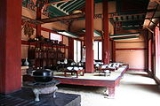
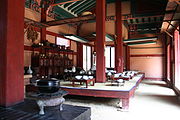
(a casserole of meat and vegetables), three types of kimchi, three types of jang (장) and twelve side dishes, or called 12 cheop (12첩). The meals were set in the suragan (수라간), a room specifically used for taking meals, with the king seated to the east and the queen to the west. Each had their own set of tables and were attended by three palace servant women known as sura sanggung (수라상궁). These women would remove bowl covers and offer the foods to the king and queen after ensuring that the dishes were not poisoned.
such as sinseollo
.
 Sura (수라) is a bowl of boiled rice and grains. Two kinds of sura must always be served. This includes white sura.
usually served in the morning. Juk is thicker than mieum in texture, latter of which is similar to the Western gruel
.
are noodles that are prepared with buckwheat or wheat flour, with the former being preferred.
(만두) are boiled or steamed dumplings. Mandu dough is made from either wheat flour or buckwheat
. The dough is then stuffed with various fillings. Tteokguk (떡국) is a soup made of tteok
(glutinous rice cakes)
is a type of soup made with beef shank
, intestines, a knuckle (bone) and beef brisket.
in nowadays. If seasoned with gochujang
, they are called gamjeong. Jochi is seasoned with salt or salted shrimp. Other varieties include:
 Jjim
Jjim
: steamed or boiled beef, pork, and fish seasoned with vegetables. Seon
is steamed vegetables, tofu, and fish stuffed with fillings made with beef or chicken and onions.
and sinseollo
are similar to Western stew
or Chinese hotpot
. Sinseollo (which is a variety of jeongol) is boiled in meat stock with various vegetables and mushrooms in a specific cooking pot with holes. Jeongol and sinseollo are served with a burner
.
(생채) is like a salad
seasoned with salt, vinegar, soy sauce, or mustard sauce.
 Namul
Namul
(나물) are any variety of steamed vegetables seasoned with hot pepper, garlic, green onion, salt, and sesame or perilla oil. Typical vegetables include spinach
, daikon
, royal fern, bracken
, zucchini
, green bean sprouts, Korean bellflower
, bamboo shoot
s, etc. In some cases, dangmyeon (potato starch
noodles) and roasted beef can be used as well.
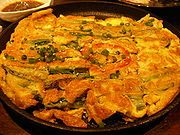 Jeonyuhwa (전유화) or sometimes jeon
: a dish resembling a pancake. The main ingredients can be lightly battered with egg and wheat flour. Eggs, flour, and other ingredients can be mixed to make pancakes.
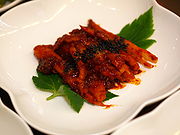 Gui is a generic Korean cuisine term for roasted and seasoned dishes. The main ingredients include laver
, beef, the root of deodeok (Codonopsis
lanceolata; 더덕), fish, mushrooms, vegetables, Aralia elata
sprouts (두릅), etc.
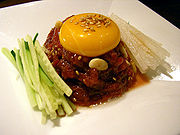 Hoe
Hoe
(회) is raw fish or raw seasoned beef
Mostly made of rice, it is eaten as a dessert or on Korean Thanksgiving Day, which falls on August 15 of the lunar year. These rice cakes vary from containing sweet red bean rice to sesame seeds. Most of these rice cakes are mildy sweet and are enjoyed by everyone from young to old.
A sweet rice punch. Being an iconic Korean traditional drink, several varieties of canned sikhye are now widely available.
A sweet drink flavored with ginger and cinnamon. Softened dried persimmon
s and pine nuts are added at serving time.
Joseon Dynasty
Joseon , was a Korean state founded by Taejo Yi Seong-gye that lasted for approximately five centuries. It was founded in the aftermath of the overthrow of the Goryeo at what is today the city of Kaesong. Early on, Korea was retitled and the capital was relocated to modern-day Seoul...
, which ruled Korea
Korea
Korea ) is an East Asian geographic region that is currently divided into two separate sovereign states — North Korea and South Korea. Located on the Korean Peninsula, Korea is bordered by the People's Republic of China to the northwest, Russia to the northeast, and is separated from Japan to the...
from 1392 to 1910. There has been a revival of this cookery style in the 21st century. It is said that twelve dishes should be served along with rice and soup, with most dishes served in bangjja
Bangjja
Bangjja, also known as yugi, is a Korean type of hand-forged bronzeware. A complete set of bangjja includes dishes, bowls, spoons and chopsticks. The main difference between Korean bronzeware or Banjja from other bronzeware is the alloy ratio of copper to tin...
(bronzeware).
History
Silla
Silla was one of the Three Kingdoms of Korea, and one of the longest sustained dynasties in...
kingdom, where a man-made lake (Anapji Lake, located in Gyeongju
Gyeongju
Gyeongju is a coastal city in the far southeastern corner of North Gyeongsang province in South Korea. It is the second largest city by area in the province after Andong, covering with a population of 269,343 people according to the 2008 census. Gyeongju is southeast of Seoul, and east of the...
), was created with multiple pavilions and halls for the sole purpose of opulent banquet
Banquet
A banquet is a large meal or feast, complete with main courses and desserts. It usually serves a purpose such as a charitable gathering, a ceremony, or a celebration, and is often preceded or followed by speeches in honour of someone....
s and a spring fed channel, Poseokjeong
Poseokjeong
The Poseokjeong site near Namsan in Gyeongju, Gyeongsangbuk-do South Korea, was built in the Silla period. The site once featured a royal pavilion–said to have been the most beautiful royal villa of the time—, but the only remains today is a granite water feature. This abalone-shaped watercourse...
, was created for the singular purpose of setting wine cups afloat during the writing of poems.
Reflecting the regionalism of the kingdoms and bordering countries of the peninsula, the cuisine borrowed from each of these areas to function as a showcase. The royalty had the finest regional delicacies sent to the palace. Although there are records of banquets pre-dating the Joseon period, the majority of these records note a vast variety of foods without mentioning the specific foods present. The meals cooked for the royal family were not seasonal, like a commoner's meal. Instead, they varied significantly day to day. The eight provinces were represented each month in turn in the royal palace by ingredients presented by their governors. This gave the cooks a wide assortment of ingredients to utilize for royal meals.
Food held a very important place in Joseon period. Official positions were created within the Six Ministries
Six Ministries of Joseon
The Six Ministries of Joseon were the major executive bodies of the Korean Joseon Dynasty. They included ministries of Personnel , Taxation , Rites , Military Affairs , Punishments , and Public works .It was established in 1298...
(Yukjo, 육조) that were charged with all matters related to procurement and consumption of food and drink for the royal court. The Board of Personnel (Ijo, 이조) contained positions specific for attaining rice for the royal family. The Board of Rites (Yejo) were responsible for foods prepared for ancestor rites, attaining wines and other beverages, and medicinal foods. There were also hundreds of slaves and women who worked in the palace that had tasks such as making tofu
Tofu
is a food made by coagulating soy milk and then pressing the resulting curds into soft white blocks. It is part of East Asian and Southeast Asian cuisine such as Chinese, Japanese, Korean, Indonesian, Vietnamese, and others. There are many different varieties of tofu, including fresh tofu and tofu...
, liquor, tea, and tteok
Tteok
Tteok is a class of Korean rice cakes made with glutinous rice flour , by steaming. Normal rice flour can be used for some kinds of tteok. There are hundreds of different kinds of tteok eaten year round...
(rice cakes). The women were the cooks to the royal palace and were of commoner or low-status families. These women would be split into specific skill sets or "bureaus" such as the Bureau of special foods (Saenggwa-bang, 생과방) or the Bureau of cooking foods (Soju-bang, 소주방). These female cooks may have been assisted by male cooks from outside the palace during larger banquets when necessary.
Five meals were generally served in the royal palace each day during the Joseon period, and records suggest this pattern had existed from antiquity. Three of these meals would be full-course meals, while the afternoon and after dinner meals would consist of lighter fare. The first meal, mieumsang (미음상), was served at sunrise on days when the king and queen were not taking herbal medicines. The meal consisted of rice porridge
Rice congee
Congee is a type of rice porridge popular in many Asian countries. It can be eaten alone or served with a side dish. Names for congee are as varied as the style of its preparation...
(juk, 죽) made with ingredients such as abalone (jeonbokjuk
Jeonbokjuk
Jeonbokjuk is a variety of juk , or Korean porridge, made with abalone and white rice. Abalone is regarded as a high quality ingredient in Korean cuisine and was often presented as a gift to the king of Korea.The dish is a local specialty of Jeju Island where abalones are commonly harvested...
), white rice (huinjuk), mushrooms (beoseotjuk), pine nuts (jatjuk
Jatjuk
Jatjuk or jaht jook is a variety of juk , or Korean porridge, made by boiling finely ground pine nuts and rice flour or soaked rice in water. It is seasoned with salt and garnished with pine nuts and sliced jujubes. The dish has been regarded as a quality food in Korea because of its rich and...
), and sesame (kkaejuk). The side dishes could consist of kimchi, nabak kimchi
Nabak kimchi
Nabak kimchi is a watery kimchi, similar to dongchimi, in Korean cuisine. It is made of thinly sliced Korean white radish and Napa cabbage into a rectangular shape as main ingredients and salted them with mixed vegetables and spices such as cucumber, spring onions, water dropwort , garlic, ginger,...
, oysters, soy sauce, and other items. The porridge was thought to give vitality to the king and queen throughout the day.
The sura (수라) were the main meals of the day. Breakfast was served at ten in the morning and the evening meals were served between six and seven at night. The set of three tables (surasang, 수라상), were usually set with two types of rice, two types of soup, two types of stew (jjigae
Jjigae
Jjigae is a Korean dish similar to a Western stew. There are many different varieties but it is typically made with meat, seafood or vegetables in a broth seasoned with gochujang, doenjang, ganjang or saeujeot. Jjigae is typically served in a communal dish and boiling hot.A Korean meal almost...
), one dish of jjim
Jjim
Jjim is a Korean cuisine term referring to dishes made by steaming or boiling meat, chicken, fish, or shellfish which have been marinated in a sauce or soup. The cooking technique originally referred to dishes cooked in a siru by steaming...
(meat stew), one dish of jeongol
Jeongol
Jeongol is a category of elaborate stews or casseroles in Korean cuisine. It is similar to the category of Korean stews called jjigae, with the main difference being that jjigae are generally made with only a single main ingredient, and named after that ingredient , while jeongol usually contain a...
(a casserole of meat and vegetables), three types of kimchi, three types of jang (장) and twelve side dishes, or called 12 cheop (12첩). The meals were set in the suragan (수라간), a room specifically used for taking meals, with the king seated to the east and the queen to the west. Each had their own set of tables and were attended by three palace servant women known as sura sanggung (수라상궁). These women would remove bowl covers and offer the foods to the king and queen after ensuring that the dishes were not poisoned.
Surang setting
The surang should be served with three tables and a hotpot. The largest round table at the right upper corner is the main table which contains main bowl, soups and stews, dishes, side dishes and fermented stored dishes. The small round table at the left upper corner contains red sura, gomtang or thick meat broth, dessert, tea, empty dishes and bowls. This table is also used to store the covers of bowls and dishes used in the main table. The rectangular table in the right lower corner contains eggs, sesame oil, various raw vegetables and several sauces. The hotpot at the left lower corner is heated with charcoal, and usually contains jeongolJeongol
Jeongol is a category of elaborate stews or casseroles in Korean cuisine. It is similar to the category of Korean stews called jjigae, with the main difference being that jjigae are generally made with only a single main ingredient, and named after that ingredient , while jeongol usually contain a...
such as sinseollo
Sinseollo
Sinseollo or yeolguja tang is an elaborate dish consisting of meatballs, small and round jeonyueo , mushrooms, and vegetables cooked in a rich broth in Korean royal court cuisine. The dish is a form of jeongol...
.
Sura
- White Sura : boiled rice without any additional ingredients.
- Red Sura : boiled rice made with the boiled water of azuki beanAzuki beanThe is an annual vine, Vigna angularis, widely grown throughout East Asia and the Himalayas for its small bean. The cultivars most familiar in north-east Asia have a uniform red color, but white, black, gray and variously mottled varieties are also known. Scientists presume Vigna angularis var...
s. - Five Grain Sura : made by boiling rice, sweet rice, glutinous millet, and azuki beans
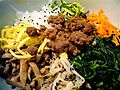
- GoldongbanBibimbapBibimbap is a signature Korean dish. The word literally means "mixed meal." Bibimbap is served as a bowl of warm white rice topped with namul and gochujang . A raw or fried egg and sliced meat are common additions. The ingredients are stirred together thoroughly just before eating...
: boiled rice mixed with steamed vegetables, roasted beef, and a fried egg. In the royal palace, bibimbapBibimbapBibimbap is a signature Korean dish. The word literally means "mixed meal." Bibimbap is served as a bowl of warm white rice topped with namul and gochujang . A raw or fried egg and sliced meat are common additions. The ingredients are stirred together thoroughly just before eating...
was known as goldongban.
Juk, mieum, and eungi
Juk and mieum (미음) or eung-i (응이) are types of rice porridgePorridge
Porridge is a dish made by boiling oats or other cereal meals in water, milk, or both. It is usually served hot in a bowl or dish...
usually served in the morning. Juk is thicker than mieum in texture, latter of which is similar to the Western gruel
Gruel
Gruel is a food preparation consisting of some type of cereal—oat, wheat or rye flour, or rice—boiled in water or milk. It is a thinner version of porridge that may be more often drunk than eaten and need not even be cooked...
.
- Omija eungi : Firstly, omijaSchisandra chinensisSchisandra chinensis is a deciduous woody vine native to forests of Northern China and the Russian Far East. It is hardy in USDA Zone 4. The plant likes some shade with moist, well-drained soil...
berries are boiled and honey is then added to the boiled omija. The boiled omija berries are taken out. Mung beanMung beanThe mung bean is the seed of Vigna radiata. It is native to the Indian subcontinent.-Description:They are small, ovoid in shape, and green in color...
starch is then added, the liquid is boiled again. - Sok mieum : Sweet rice, red jujubeJujubeZiziphus zizyphus , commonly called jujube , red date, Chinese date, Korean date, or Indian date is a species of Ziziphus in the buckthorn family Rhamnaceae, used primarily as a fruiting shade tree.-Distribution:Its precise natural distribution is uncertain due to extensive cultivation,...
s, ginsengGinsengGinseng is any one of eleven species of slow-growing perennial plants with fleshy roots, belonging to the genus Panax of the family Araliaceae....
root, and chestnutChestnutChestnut , some species called chinkapin or chinquapin, is a genus of eight or nine species of deciduous trees and shrubs in the beech family Fagaceae, native to temperate regions of the Northern Hemisphere. The name also refers to the edible nuts they produce.-Species:The chestnut belongs to the...
s are simmered. - JatjukJatjukJatjuk or jaht jook is a variety of juk , or Korean porridge, made by boiling finely ground pine nuts and rice flour or soaked rice in water. It is seasoned with salt and garnished with pine nuts and sliced jujubes. The dish has been regarded as a quality food in Korea because of its rich and...
: rice is soaked and pine nuts are ground before being boiled in water. - Hangin Juk : Apricot kernels (also the flavoring agent of the popular Italian liqueur Amaretti di SaronnoAmaretti di SaronnoAmaretti di Saronno refer to an amaretto macaroon that is traditional to Saronno, a comune of Lombardy, Italy. It is one of many types of traditional amaretto biscuits....
) are peeled and ground with rice. The rice and apricot seed mixture is boiled. - Heuikimjajuk : Black sesame seeds are ground and boiled with rice.
- TarakjukTarakjukTarakjuk is a variety of juk , or Korean porridge, made by boiling a mixture of milk and finely ground rice soaked in water. It is also called uyujuk , both terms meaning "milk porridge".-History:...
: soaked rice is boiled with water, and then cow milk is added. It is then boiled some more. - JanggukjukJanggukjukJanggukjuk or Jangguk jook is a variety of juk , or Korean porridge, made with pounded non-glutinous rice , beef and brown oak mushrooms. Janggukjuk is seasoned with soy sauce, and it literally means soy sauce porridge. It is high in protein and therefore believed to be good for recovering patients...
: ground beef and chopped shiitakeShiitakeThe Shiitake is an edible mushroom native to East Asia, which is cultivated and consumed in many Asian countries, as well as being dried and exported to many countries around the world. It is a feature of many Asian cuisines including Vietnamese, Chinese, Japanese, Korean and Thai...
mushrooms are boiled together. - Other dishes include dalgyal samhap mieum, jo mieum, sok mieum, chajo mieum, yulmu eungi, nokmal eungi, omija eungi, etc.
Guksu
GuksuKorean noodles
Korean noodles are noodles or noodle dishes in Korean cuisine and are collectively referred to as "guksu" in native Korean or "myeon" in hanja. Preparations and cooking with noodles are relatively simple, so the history is longer than that of bread, dating back around BCE 6000 to BCE 5000 in China...
are noodles that are prepared with buckwheat or wheat flour, with the former being preferred.
- Myeon sinseollo : Boiled sliced beef shankBeef shankThe beef shank is the shank portion of a steer or heifer. In Britain the corresponding cuts of beef are the shin , and the leg ....
, paeju , Korean parsleyCryptotaeniaCryptotaenia is a genus of two species of herbaceous perennial plants, native to North America and eastern Asia, growing wild in moist, shady places.-Species:*Cryptotaenia canadensis...
, and sliced bamboo sprouts are boiled with beef stock. Boiled guksu is added to the ready beef stock mixture. - Onmyeon : stock made from beef brisketBrisketBrisket is a cut of meat from the breast or lower chest of beef or veal. The beef brisket is one of the eight beef primal cuts. The brisket muscles include the superficial and deep pectorals. As cattle do not have collar bones, these muscles support about 60% of the body weight of standing/moving...
is added to roast beef, sliced egg pancake, and guksu. - Nanmyeon : Wheat flour is mixed with eggs to make noodles. They are then served with beef stock.
- Domimyeon : noodle soup made with panfishPanfishA panfish, also spelled pan-fish or pan fish, is an edible game fish that usually doesn't outgrow the size of a frying pan. The term is also commonly used by anglers to refer to any small catch that will fit in a pan, but is large enough to be legal. However its definition and usage varies with...
, sliced egg pancakes, ginkgo seeds, walnuts, fried meatballs, and pine nuts. - Other guksu dishes include jangguk naengmyeon, kimchiguk naengmyung, bibim naengmyeon, etc. Simple naengmyeonNaengmyeonNaengmyeon is a Korean dish of long and thin hand-made noodles made from the flour and starch of various ingredients: buckwheat , potatoes, sweet potatoes, 칡냉면, naengmyun made with the starch from arrowroot , and kudzu...
is also popular.
Mandu and ddeokguk
ManduMandu (dumpling)
Mandu are dumplings in Korean cuisine. They are similar to pelmeni and pierogi in some Slavic cultures. The name is a cognate to the names of similar types of meat-filled dumplings in Central Asia, such as Turkish manti, Kazakh manty, and Uzbek manti.In Korean cuisine, mandu generally denotes a...
(만두) are boiled or steamed dumplings. Mandu dough is made from either wheat flour or buckwheat
Buckwheat
Buckwheat refers to a variety of plants in the dicot family Polygonaceae: the Eurasian genus Fagopyrum, the North American genus Eriogonum, and the Northern Hemisphere genus Fallopia. Either of the latter two may be referred to as "wild buckwheat"...
. The dough is then stuffed with various fillings. Tteokguk (떡국) is a soup made of tteok
Tteok
Tteok is a class of Korean rice cakes made with glutinous rice flour , by steaming. Normal rice flour can be used for some kinds of tteok. There are hundreds of different kinds of tteok eaten year round...
(glutinous rice cakes)
- Jangguk mandu : kimchiKimchiKimchi , also spelled gimchi, kimchee, or kim chee, is a traditional fermented Korean dish made of vegetables with varied seasonings. There are hundreds of varieties of kimchi made with a main vegetable ingredient such as napa cabbage, radish, green onions or cucumber. It is the most common...
, pork, and tofu are used as filling. - Saengchi mandu : ring neck pheasant, dropwortDropwortDropwort , also known as Fern-leaf Dropwort, is a perennial herb of the family Rosaceae closely related to Meadowsweet...
, cabbage, and shiitake mushrooms are used as filling. Buckwheat dough is used. The prepared saengchi mandu is then boiled in meat stock. - Donga mandu : Mandu made with winter melonWinter melonThe winter melon, also called white gourd, ash gourd, or "fuzzy melon", is a vine grown for its very large fruit, eaten as a vegetable when mature. It is the only member of the genus Benincasa. The fruit is fuzzy when young. The immature melon has thick white flesh that is sweet when eaten...
, chicken and starch. It is steamed and then boiled in meat stock. - Pyeonsu : Mandu made with beef, cucumber, green bean sprouts, shiitakeShiitakeThe Shiitake is an edible mushroom native to East Asia, which is cultivated and consumed in many Asian countries, as well as being dried and exported to many countries around the world. It is a feature of many Asian cuisines including Vietnamese, Chinese, Japanese, Korean and Thai...
mushrooms, and rock tripeRock tripeRock tripe is a lichen of the genus Umbilicaria that grows on rocks. It can be found throughout northern parts of North America such as New England and the Rocky Mountains...
. - Tteokguk : TteokTteokTteok is a class of Korean rice cakes made with glutinous rice flour , by steaming. Normal rice flour can be used for some kinds of tteok. There are hundreds of different kinds of tteok eaten year round...
sliced round to resemble coins, and is boiled with meat stock. It is served with egg pancake slices and roasted ground meat. - Other varieties include gyuasang and junchi mandu .
- Eo mandu : Mandu made with a thinly sliced fish flesh as its wrap and stuffed with minced beef, vegetables, and several spices.
Tang
TangGuk
Guk , also sometimes known as Tang , is a class of soup-like dishes in Korean cuisine. Guk and tang are commonly grouped together and regarded as the same type of dish, although guk is more watery and a basic dish for the Korean table setting, and is usually eaten at home...
is a type of soup made with beef shank
Beef shank
The beef shank is the shank portion of a steer or heifer. In Britain the corresponding cuts of beef are the shin , and the leg ....
, intestines, a knuckle (bone) and beef brisket.
- Malgeun guk : a hot and clear soup, and includes daikon-guk , clear beef soup, wakameWakame, Undaria pinnatifida, or Miyeok in Korean, is a sea vegetable, or edible seaweed. It has a subtly sweet flavour and is most often served in soups and salads....
soup, matsutakeMatsutakeMatsutake is the common name for a highly sought after mycorrhizal mushroom that grows in Asia, Europe, and North America...
soup, dried pollockPollockPollock is the common name used for either of the two species of marine fish in the Pollachius genus. Both P. pollachius and P. virens are commonly referred to as pollock. Other names for P...
soup, etc. - GomgukGomgukGomguk, also called gomtang, refers to a soup in Korean cuisine made with various beef parts such as ribs, oxtail, brisket, ox's head or ox bones by slow simmering on a low flame. The broth of gomguk tends to have a milky color with a rich and hearty taste.-Regional:*Hyeonpung gomtang : from the...
: a thick soup made so by simmering for a long time. Varieties include gomtang , seolleongtangSeolleongtangSeolleongtang or Sul Lung Tang is a Korean broth soup made from ox bones , brisket and other cuts. Seasoning is generally done at the table according to personal taste by adding salt, ground black pepper, red pepper, minced garlic, or chopped spring onions...
, yukgaejangYukgaejangYukgaejang is a spicy, soup-like Korean dish made from shredded beef with scallions and other ingredients, which are simmered together for a long time. It is a variety of gomguk, or thick soup, which was formerly served in Korean royal court cuisine...
, etc. - Tojangguk : a soup flavored with doenjangDoenjangDoenjang is a traditional Korean fermented soybean paste. Its name literally means "thick paste" in Korean.-Production:...
(fermented soybean paste). This includes cabbage tonjangguk, spinach tojangguk, etc. - NaenggukNaenggukNaengguk refers to all kinds of cold guk in Korean cuisine, mainly eaten in summer. It is so called changuk, which literally means "cold soup" in pure Korean, while the term naengguk is a combination of a hanja word and a pure Korean word with the same meaning.The first historical record on...
: a soup served cold. This includes kkaeguktang, oinaengguk, and wakameWakame, Undaria pinnatifida, or Miyeok in Korean, is a sea vegetable, or edible seaweed. It has a subtly sweet flavour and is most often served in soups and salads....
cold soup.
Jochi and gamjeong
Jochi and gamjeong (감정) are stew-like dishes which is called jjigaeJjigae
Jjigae is a Korean dish similar to a Western stew. There are many different varieties but it is typically made with meat, seafood or vegetables in a broth seasoned with gochujang, doenjang, ganjang or saeujeot. Jjigae is typically served in a communal dish and boiling hot.A Korean meal almost...
in nowadays. If seasoned with gochujang
Gochujang
Gochujang is a savory and pungent fermented Korean condiment. Traditionally, it has been naturally fermented over years in large earthen pots outdoors, more often on an elevated stone platform, called jangdokdae in the backyard...
, they are called gamjeong. Jochi is seasoned with salt or salted shrimp. Other varieties include:
- Crab gamjeong
- Cucumber gamjeong
- Oyster jochi
- Zucchini jochi
- Fish jochi, etc.
Jjim and seon
Jjim
Jjim is a Korean cuisine term referring to dishes made by steaming or boiling meat, chicken, fish, or shellfish which have been marinated in a sauce or soup. The cooking technique originally referred to dishes cooked in a siru by steaming...
: steamed or boiled beef, pork, and fish seasoned with vegetables. Seon
Seon (food)
Seon refers to Korean traditional dishes made by steaming vegetables such as zucchinis, cucumbers, eggplants, or Napa cabbages that are stuffed with fillings. Although the term is a counterpart of jjim, dishes made by steaming meat or seafood, the concept is not clearly settled...
is steamed vegetables, tofu, and fish stuffed with fillings made with beef or chicken and onions.
- Swellfish jjim
- Bure jjim
- Red sea breamRed sea breamRed sea bream is a name given to at least two species of fish of the family Sparidae, Pagrus major and Pagellus bogaraveo. Pagellus bogaraveo is also known as blackspot sea bream....
jjim or Pagrus major jjim - TteokTteokTteok is a class of Korean rice cakes made with glutinous rice flour , by steaming. Normal rice flour can be used for some kinds of tteok. There are hundreds of different kinds of tteok eaten year round...
- Ox tail jjim
- Dubuseon (두부선), steamed tofuTofuis a food made by coagulating soy milk and then pressing the resulting curds into soft white blocks. It is part of East Asian and Southeast Asian cuisine such as Chinese, Japanese, Korean, Indonesian, Vietnamese, and others. There are many different varieties of tofu, including fresh tofu and tofu...
with fillings - Gajiseon (가지선), made with eggplant
- Oiseon (오이선), made with cucumber
- Hobakseon (호박선), made with zucchini
- Museon (무선), made with daikonDaikonDaikon , Raphanus sativus var. longipinnatus, also called White Radish, Japanese radish, Oriental radish, Chinese radish, lo bok and Mooli , is a mild flavoured, very large, white East Asian radish...
- Baechuseon (배추선), made with napa cabbageNapa cabbageNapa cabbage , also known as celery cabbage, is a type of Chinese cabbage originating near the Beijing region of China, and is widely used in East Asian cuisine. In much of the world, this is the vegetable referred to as "Chinese cabbage"...
Jeongol and sinseollo
JeongolJeongol
Jeongol is a category of elaborate stews or casseroles in Korean cuisine. It is similar to the category of Korean stews called jjigae, with the main difference being that jjigae are generally made with only a single main ingredient, and named after that ingredient , while jeongol usually contain a...
and sinseollo
Sinseollo
Sinseollo or yeolguja tang is an elaborate dish consisting of meatballs, small and round jeonyueo , mushrooms, and vegetables cooked in a rich broth in Korean royal court cuisine. The dish is a form of jeongol...
are similar to Western stew
Stew
A stew is a combination of solid food ingredients that have been cooked in liquid and served in the resultant gravy. Ingredients in a stew can include any combination of vegetables , meat, especially tougher meats suitable for slow-cooking, such as beef. Poultry, sausages, and seafood are also used...
or Chinese hotpot
Hotpot
Hot pot may refer to:* Lancashire hotpot, a traditional British stew of meat, potatoes and vegetables* Hot pot, a dish or style of cooking from China, Taiwan, and Southeast Asia**Shabu-shabu* Hodge-Podge soup* Karelian hot pot...
. Sinseollo (which is a variety of jeongol) is boiled in meat stock with various vegetables and mushrooms in a specific cooking pot with holes. Jeongol and sinseollo are served with a burner
Portable stove
A portable stove is a cooking stove specially designed to be portable and lightweight, as for camping or picnicking, or for use in remote locations where an easily transportable means of cooking or heating is needed...
.
- Domi guksu jeongol, made with noodles and Red seabream
- Nakji jeongol, made with small octopus
- Dubu jeongol, made with tofu
Saengchae
SaengchaeSaengchae
Saengchae is a kind of Korean salad generally consisting of uncooked mixed seasonal vegetables such as radishes and other ingredients such as chicken or jellyfish....
(생채) is like a salad
Salad
Salad is any of a wide variety of dishes, including vegetable salads; salads of pasta, legumes, eggs, or grains; mixed salads incorporating meat, poultry, or seafood; and fruit salads. They may include a mixture of cold and hot, often including raw vegetables or fruits.Green salads include leaf...
seasoned with salt, vinegar, soy sauce, or mustard sauce.
- Mu saengchae, made of shredded daikonDaikonDaikon , Raphanus sativus var. longipinnatus, also called White Radish, Japanese radish, Oriental radish, Chinese radish, lo bok and Mooli , is a mild flavoured, very large, white East Asian radish...
- Oi saengchae, made of cucumber
- Deodeok saengchae, made of deodeok root (Codonopsis lanceolataCodonopsis lanceolataCodonopsis lanceolata is a flowering plant. It originates from China and Japan. It is a variety of bonnet bellflower.The roots are used in Korean cuisine, where it is called deodeok ....
, a species of bonnet bellflowerCodonopsisCodonopsis is a genus of flowering plant within the family Campanulaceae. It is allied to Campanumoea and Leptocodon, and some authors suggest that Codonopsis should include these genera...
). - Seomchorongkkot saengchae, made of Korean bellflower, etc.
Namul
Namul
Namul is a general term for a Korean seasoned vegetable dish. The name of the dish may vary slightly depending on what vegetables are used and how they are prepared, but they will nonetheless still be a type of namul....
(나물) are any variety of steamed vegetables seasoned with hot pepper, garlic, green onion, salt, and sesame or perilla oil. Typical vegetables include spinach
Spinach
Spinach is an edible flowering plant in the family of Amaranthaceae. It is native to central and southwestern Asia. It is an annual plant , which grows to a height of up to 30 cm. Spinach may survive over winter in temperate regions...
, daikon
Daikon
Daikon , Raphanus sativus var. longipinnatus, also called White Radish, Japanese radish, Oriental radish, Chinese radish, lo bok and Mooli , is a mild flavoured, very large, white East Asian radish...
, royal fern, bracken
Bracken
Bracken are several species of large, coarse ferns of the genus Pteridium. Ferns are vascular plants that have alternating generations, large plants that produce spores and small plants that produce sex cells . Brackens are in the family Dennstaedtiaceae, which are noted for their large, highly...
, zucchini
Zucchini
The zucchini is a summer squash which often grows to nearly a meter in length, but which is usually harvested at half that size or less. It is a hybrid of the cucumber. Along with certain other squashes, it belongs to the species Cucurbita pepo. Zucchini can be dark or light green...
, green bean sprouts, Korean bellflower
Korean bellflower
The Korean bellflower is a species of bellflower. It bears pink to white flowers. There are several cultivars....
, bamboo shoot
Bamboo shoot
Bamboo shoots or bamboo sprouts are the edible shoots of many bamboo species including Bambusa vulgaris and Phyllostachys edulis. They are used in numerous Asian dishes and broths...
s, etc. In some cases, dangmyeon (potato starch
Potato starch
Potato starch is starch extracted from potatoes. The cells of the root tubers of the potato plant contain starch grains . To extract the starch, the potatoes are crushed; the starch grains are released from the destroyed cells...
noodles) and roasted beef can be used as well.
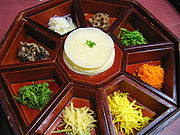
- GujeolpanGujeolpanGujeolpan refers to either an elaborate Korean dish consisting of nine different foods assorted on a wooden plate with nine divided sections in an octagon shape or the plate itself. The name is composed of three hanja words: gu , jeol , and pan in Korean...
- JapchaeJapchaeJapchae is a Korean dish made from sweet potato noodles , stir fried in sesame oil with various vegetables , sometimes served with beef, and flavoured with soy sauce, and sweetened with sugar...
- Tangpyeonchae
Jorigae
Jorigae (조리개) hard-boiled foods with heavy seasonings. Meats, fish and vegetable are mainly used.- Beef jorigae (우육조리개)
- Sliced steamed beef jorigae (우편육조리개)
- Sliced steamed pork jorigae (돈편육조리개)
- Small yellow croakerLarimichthys polyactisLarimichthys polyactis, called the redlip croaker, small yellow croaker, little yellow croaker or yellow corvina, is a species of croaker native to the western Pacific, generally in temperate waters such as the East China Sea and the Yellow Sea. They are benthopelagic feeders that remain in shallow...
jorigae (조기조리개)
Jeonyuhwa
Jeon (food)
Jeon , buchimgae, jijimgae, or jijim refer to many pancake-like dishes in Korean cuisine. It has been also called jeonyueo or jeonyuhwa, especially in Korean royal court cuisine. Sometimes, jeonya is used as an abbreviated term for the two...
: a dish resembling a pancake. The main ingredients can be lightly battered with egg and wheat flour. Eggs, flour, and other ingredients can be mixed to make pancakes.
- Jogaejeon, made with shellfishShellfishShellfish is a culinary and fisheries term for exoskeleton-bearing aquatic invertebrates used as food, including various species of molluscs, crustaceans, and echinoderms. Although most kinds of shellfish are harvested from saltwater environments, some kinds are found only in freshwater...
- Saeu jeon, made with shrimp
- Gochu jeon, made with hot pepper
- BindaetteokBindaetteokBindaetteok is a variety of jeon, a Korean style pancake...
(빈대떡) made from ground mung beans and other ingredients - Yeongeun jeon, made with sliced lotus root
- PajeonPajeonPajeon is a variety of jeon with green onions as its prominent ingredient. Pa literally means green onion in Korean. It is a pancake-like Korean dish made from a batter of eggs, flour, rice flour, green onions and other additional ingredients depending on the variety...
, made with green onionsScallionScallions , are the edible plants of various Allium species, all of which are "onion-like", having hollow green leaves and lacking a fully developed root bulb.-Etymology:The words...
Gui
Laver (seaweed)
Laver is an edible algae often considered to be a seaweed that has a high mineral salt content, particularly iodine and iron. It is used for making laverbread, a traditional Welsh dish. Laver is common around the west coast of Britain and east coast of Ireland along the Irish Sea.It is smooth and...
, beef, the root of deodeok (Codonopsis
Codonopsis
Codonopsis is a genus of flowering plant within the family Campanulaceae. It is allied to Campanumoea and Leptocodon, and some authors suggest that Codonopsis should include these genera...
lanceolata; 더덕), fish, mushrooms, vegetables, Aralia elata
Aralia elata
Aralia elata or Japanese Angelica-tree is a woody plant belonging to the Aralia family .-Description:It is an upright deciduous small tree or shrub growing up to 6 m in height, native to eastern Russia, China, Korea, and Japan....
sprouts (두릅), etc.
- Garibi guiGalbiGalbi or kalbi generally refers to a variety of gui or grilled dishes in Korean cuisine that is made with marinated beef short ribs in a ganjang-based sauce . In the Korean language, galbi literally means "rib" and can often indicate uncooked ribs...
(가리비구이) or gari gui (가리구리), old term for galbiGalbiGalbi or kalbi generally refers to a variety of gui or grilled dishes in Korean cuisine that is made with marinated beef short ribs in a ganjang-based sauce . In the Korean language, galbi literally means "rib" and can often indicate uncooked ribs...
, grilled short ribsShort ribsShort ribs are a popular cut of beef. Beef short ribs are larger and usually more tender and meatier than their pork counterpart, pork spare ribs...
seasoned with soy sauce - Garibi gui (가리비구이), grilled scallopScallopA scallop is a marine bivalve mollusk of the family Pectinidae. Scallops are a cosmopolitan family, found in all of the world's oceans. Many scallops are highly prized as a food source...
s - Neobiani (너비아니), ancient form of bulgogiBulgogiBulgogi is a Korean dish that usually consists of marinated barbecued beef, although chicken or pork may also be used. It is listed at number 23 on World's 50 most delicious foods readers' poll complied by CNN Go in 2011.-Etymology:...
- Pogui (포구이), grilled po (either dried meat jerky, or fish)
- Dak sanjeok (닭산적), grilled chicken and vegetables on skewers
- Hwayang seok (화양적), various marinated ingredients grilled on skewers
Hoe
Hoe (dish)
Hoe may refer to various raw food dishes in Korean cuisine. Saengseon hoe or "Hwal-eo hoe" is thinly sliced raw fish or other raw seafood ; yukhoe is hoe made with a raw beef and seasoned with soy sauce, sesame oil, and rice wine; and gan hoe is raw beef liver with a sauce of sesame oil and...
(회) is raw fish or raw seasoned beef
- YukhoeYukhoeYukhoe refers to a variety of hoe , which are usually made from raw ground beef seasoned with various spices or sauces. It is basically a Korean steak tartare. Usually the most tender part of beef will be used...
, raw seasoned beef - Gaksaek hoe (각색회)
- Gabhoe (갑회), etc.
Jang
- sauce
- Cheongjang : "bright" sauce (soy sauce with vinegar)
- GochujangGochujangGochujang is a savory and pungent fermented Korean condiment. Traditionally, it has been naturally fermented over years in large earthen pots outdoors, more often on an elevated stone platform, called jangdokdae in the backyard...
: hot pepper soybean paste sauce - Chogochujang : vinegar hot pepper soybean paste sauce
- Gyeojajeub : mustard sauce
Banchan
- dishes
- Changui : cold roast of laver and Codonopsis lanceolataCodonopsis lanceolataCodonopsis lanceolata is a flowering plant. It originates from China and Japan. It is a variety of bonnet bellflower.The roots are used in Korean cuisine, where it is called deodeok ....
root, a bonnet bellflowerCodonopsisCodonopsis is a genus of flowering plant within the family Campanulaceae. It is allied to Campanumoea and Leptocodon, and some authors suggest that Codonopsis should include these genera...
species called deodeok in Korean - Deoungui : hot roast of meat, fish, etc.
- Jeonyuhwa : pancake of meat, fish, and vegetables
- Pyeonyuk : steamed meat
- Sukchae : steamed vegetables
- Saengchae : raw seasoned vegetables
- JorimJorimJorim is a generic Korean cuisine term referring to dishes made of vegetables, meats, seafood, or tofu in a mixed sauce by simmering for a long time. Jorim is the noun of jorida which means "simmering in a thick soup or sauce". The term did not appear in cookbooks until 17th century because...
: lightly boiled meat, fish and vegetables with seasoning - Janggwa : fermented vegetables in soy sauce
- JeotgalJeotgalJeotgal or jeot is a salted fermented food in Korean cuisine. It is made with various seafood, such as shrimp, oysters, shellfish, fish, fish eggs, and fish intestines....
: fermented salty fish - Mareulchan : dried slices of meat seasoned with spices, fried kelp, and dried salty fish
- HoeHoe (dish)Hoe may refer to various raw food dishes in Korean cuisine. Saengseon hoe or "Hwal-eo hoe" is thinly sliced raw fish or other raw seafood ; yukhoe is hoe made with a raw beef and seasoned with soy sauce, sesame oil, and rice wine; and gan hoe is raw beef liver with a sauce of sesame oil and...
: raw fish or beef, or fermented raw fish - Chansuran : cold soup with vegetables or boiled meat
- Chasu : tea made from grains
- Changui : cold roast of laver and Codonopsis lanceolata
Dessert
- TteokTteokTteok is a class of Korean rice cakes made with glutinous rice flour , by steaming. Normal rice flour can be used for some kinds of tteok. There are hundreds of different kinds of tteok eaten year round...
(rice cake)
Mostly made of rice, it is eaten as a dessert or on Korean Thanksgiving Day, which falls on August 15 of the lunar year. These rice cakes vary from containing sweet red bean rice to sesame seeds. Most of these rice cakes are mildy sweet and are enjoyed by everyone from young to old.
Tea and fruit punch
- SikhyeSikhyeSikhye is a traditional sweet Korean rice beverage, usually served as a dessert...
:
A sweet rice punch. Being an iconic Korean traditional drink, several varieties of canned sikhye are now widely available.
- SujeonggwaSujeonggwaSujeonggwa is a Korean traditional fruit punch. Dark reddish brown in color, it is made from dried persimmons, cinnamon, ginger, peppercorn and is often garnished with pine nuts. The punch is made by brewing first the cinnamon, ginger and peppercorn at a slow boil...
:
A sweet drink flavored with ginger and cinnamon. Softened dried persimmon
Persimmon
A persimmon is the edible fruit of a number of species of trees in the genus Diospyros in the ebony wood family . The word Diospyros means "the fire of Zeus" in ancient Greek. As a tree, it is a perennial plant...
s and pine nuts are added at serving time.
- Fruit HwachaeHwachaeHwachae is a general term for Korean traditional punches made with various fruits or edible flower petals soaked in omija or honeyed juice.-Types:...
: fruit punch made by mixing several fruits together, or only one fruit used. The ingredients are cherries, strawberries, peaches, or watermelons. There are also hwachae with floating azalea petals, boiled barley, pine pollen, or slices of pear in omija-flavored water, sweetened with honey or sugar.