


Azuki bean

Encyclopedia
The is an annual
vine
, Vigna angularis, widely grown throughout East Asia
and the Himalayas
for its small (approximately 5 mm) bean
. The cultivar
s most familiar in north-east Asia have a uniform red color, but white, black, gray and variously mottled varieties are also known. Scientists presume Vigna angularis var. nipponensis is the progenitor.
Genetic evidence indicates that the azuki bean was first domesticated in the Himalayas. It was first cultivated in Korean peninsula
and northeast of China before 1000 BC. It was later taken to Japan
, where it is now the second most popular legume after the soybean
.
name. Japanese also has a Chinese loanword
, Shōzu (小豆), which means "small bean" (its counterpart "large bean" (大豆; Daizu) being the soybean
). It is common to write 小豆 in kanji
but pronounce it as azuki , an example of ateji
.
In China
, the corresponding name is still used in botanical or agricultural parlance. However in everyday Chinese
, the more common terms are hongdou (紅豆; hóngdòu) and chidou (赤豆; chìdòu), both meaning "red bean", because almost all Chinese cultivars are uniformly red. In English-language discussions of Chinese topics, the term "red bean" is often used (especially in reference to red bean paste
), but in other contexts this usage can cause confusion with other beans that are also red
. In normal contexts, "red cowpeas" have been used to refer to this bean.
The Korean name is pat (hangul
: ), and in Vietnamese it is called đậu đỏ (literally: red bean).
In some parts of India
, they are referred to as "Red Chori". In Indian Punjab it is called "ravaa'n" and is a common ingredient of chaat
. In Marathi
, it is known as 'Lal Chavali (लाल चवळी)'- literally means 'red cowpea
.
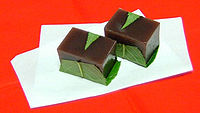 In East Asian cuisine the azuki bean is commonly eaten sweetened. In particular, it is often boiled with sugar, resulting in red bean paste (an), a very common ingredient in all of these cuisines; it is also common to add flavoring to the bean paste, such as chestnut.
Red bean paste is used in many Chinese foods
, such as
tangyuan, zongzi
, mooncake
s, baozi
, and red bean ice
.
It is also used as a filling for Japan
ese sweets such as anpan
, dorayaki
, imagawayaki
, manjū
, monaka
, anmitsu
, taiyaki
and daifuku
. A more liquid version, using azuki beans boiled with sugar and a pinch of salt, produces a sweet dish called red bean soup
. Azuki beans are also commonly eaten sprouted
, or boiled in a hot, tea
-like drink. Some Asian cultures enjoy red bean paste as a filling or topping for various kinds of waffles, pastries, baked buns or biscuits.
In Japan, rice with azuki beans (赤飯; sekihan
) is traditionally cooked for auspicious occasions. Azuki beans are also used to produce amanattō
, and as a popular flavour of ice cream
.
On October 20, 2009, Pepsi Japan released an Azuki-flavored Pepsi product.
Azuki beans, along with butter and sugar, form the basis of the popular Somali supper dish cambuulo.
In Gujarat, India, they are known as Chori.
of cooked beans providing 4.6 mg of Iron (~25% RDI
), 119.6 mg of magnesium (~30% RDI), 1.223 g of potassium (~25 % AI), 4.0 mg of zinc (~25% RDI) and 278 µg of folic acid (~70% RDI).
Annual plant
An annual plant is a plant that usually germinates, flowers, and dies in a year or season. True annuals will only live longer than a year if they are prevented from setting seed...
vine
Vine
A vine in the narrowest sense is the grapevine , but more generally it can refer to any plant with a growth habit of trailing or scandent, that is to say climbing, stems or runners...
, Vigna angularis, widely grown throughout East Asia
East Asia
East Asia or Eastern Asia is a subregion of Asia that can be defined in either geographical or cultural terms...
and the Himalayas
Himalayas
The Himalaya Range or Himalaya Mountains Sanskrit: Devanagari: हिमालय, literally "abode of snow"), usually called the Himalayas or Himalaya for short, is a mountain range in Asia, separating the Indian subcontinent from the Tibetan Plateau...
for its small (approximately 5 mm) bean
Bean
Bean is a common name for large plant seeds of several genera of the family Fabaceae used for human food or animal feed....
. The cultivar
Cultivar
A cultivar'Cultivar has two meanings as explained under Formal definition. When used in reference to a taxon, the word does not apply to an individual plant but to all those plants sharing the unique characteristics that define the cultivar. is a plant or group of plants selected for desirable...
s most familiar in north-east Asia have a uniform red color, but white, black, gray and variously mottled varieties are also known. Scientists presume Vigna angularis var. nipponensis is the progenitor.
Genetic evidence indicates that the azuki bean was first domesticated in the Himalayas. It was first cultivated in Korean peninsula
Korean Peninsula
The Korean Peninsula is a peninsula in East Asia. It extends southwards for about 684 miles from continental Asia into the Pacific Ocean and is surrounded by the Sea of Japan to the south, and the Yellow Sea to the west, the Korea Strait connecting the first two bodies of water.Until the end of...
and northeast of China before 1000 BC. It was later taken to Japan
Japan
Japan is an island nation in East Asia. Located in the Pacific Ocean, it lies to the east of the Sea of Japan, China, North Korea, South Korea and Russia, stretching from the Sea of Okhotsk in the north to the East China Sea and Taiwan in the south...
, where it is now the second most popular legume after the soybean
Soybean
The soybean or soya bean is a species of legume native to East Asia, widely grown for its edible bean which has numerous uses...
.
Names
The name azuki is a transliteration of the native JapaneseJapanese language
is a language spoken by over 130 million people in Japan and in Japanese emigrant communities. It is a member of the Japonic language family, which has a number of proposed relationships with other languages, none of which has gained wide acceptance among historical linguists .Japanese is an...
name. Japanese also has a Chinese loanword
Loanword
A loanword is a word borrowed from a donor language and incorporated into a recipient language. By contrast, a calque or loan translation is a related concept where the meaning or idiom is borrowed rather than the lexical item itself. The word loanword is itself a calque of the German Lehnwort,...
, Shōzu (小豆), which means "small bean" (its counterpart "large bean" (大豆; Daizu) being the soybean
Soybean
The soybean or soya bean is a species of legume native to East Asia, widely grown for its edible bean which has numerous uses...
). It is common to write 小豆 in kanji
Kanji
Kanji are the adopted logographic Chinese characters hanzi that are used in the modern Japanese writing system along with hiragana , katakana , Indo Arabic numerals, and the occasional use of the Latin alphabet...
but pronounce it as azuki , an example of ateji
Ateji
In modern Japanese, primarily refers to kanji used phonetically to represent native or borrowed words, without regard to the meaning of the underlying characters. This is analogous to man'yōgana in pre-modern Japanese...
.
In China
China
Chinese civilization may refer to:* China for more general discussion of the country.* Chinese culture* Greater China, the transnational community of ethnic Chinese.* History of China* Sinosphere, the area historically affected by Chinese culture...
, the corresponding name is still used in botanical or agricultural parlance. However in everyday Chinese
Chinese language
The Chinese language is a language or language family consisting of varieties which are mutually intelligible to varying degrees. Originally the indigenous languages spoken by the Han Chinese in China, it forms one of the branches of Sino-Tibetan family of languages...
, the more common terms are hongdou (紅豆; hóngdòu) and chidou (赤豆; chìdòu), both meaning "red bean", because almost all Chinese cultivars are uniformly red. In English-language discussions of Chinese topics, the term "red bean" is often used (especially in reference to red bean paste
Red bean paste
Red bean paste or Azuki bean paste is a sweet, dark red bean paste originating from China. It is used in Chinese cuisine, Japanese confectionery, and Korean cuisine. It is prepared by boiling and mashing azuki beans and then sweetening the paste with sugar or honey...
), but in other contexts this usage can cause confusion with other beans that are also red
Red bean
Red bean may refer to:* Azuki bean, commonly used in Japanese and Chinese cuisine, particularly as red bean paste* Kidney bean, commonly used in Indian and North American cuisine, such as chili con carne and red beans and rice...
. In normal contexts, "red cowpeas" have been used to refer to this bean.
The Korean name is pat (hangul
Hangul
Hangul,Pronounced or ; Korean: 한글 Hangeul/Han'gŭl or 조선글 Chosŏn'gŭl/Joseongeul the Korean alphabet, is the native alphabet of the Korean language. It is a separate script from Hanja, the logographic Chinese characters which are also sometimes used to write Korean...
: ), and in Vietnamese it is called đậu đỏ (literally: red bean).
In some parts of India
India
India , officially the Republic of India , is a country in South Asia. It is the seventh-largest country by geographical area, the second-most populous country with over 1.2 billion people, and the most populous democracy in the world...
, they are referred to as "Red Chori". In Indian Punjab it is called "ravaa'n" and is a common ingredient of chaat
Chaat
Chaat is a term describing savoury snacks, typically served at road-side tracks from stalls or carts in India. With its origins in east India, chaat has become immensely popular in the rest of India and the rest of South Asia...
. In Marathi
Marathi language
Marathi is an Indo-Aryan language spoken by the Marathi people of western and central India. It is the official language of the state of Maharashtra. There are over 68 million fluent speakers worldwide. Marathi has the fourth largest number of native speakers in India and is the fifteenth most...
, it is known as 'Lal Chavali (लाल चवळी)'- literally means 'red cowpea
Cowpea
The Cowpea is one of several species of the widely cultivated genus Vigna. Four cultivated subspecies are recognised:*Vigna unguiculata subsp. cylindrica Catjang...
.
Uses
Red bean paste is used in many Chinese foods
Chinese cuisine
Chinese cuisine is any of several styles originating in the regions of China, some of which have become highly popular in other parts of the world – from Asia to the Americas, Australia, Western Europe and Southern Africa...
, such as
tangyuan, zongzi
Zongzi
Zongzi is a traditional Chinese food, made of glutinous rice stuffed with different fillings and wrapped in bamboo or reed leaves. They are cooked by steaming or boiling. Laotians, Thais, and Cambodians also have similar traditional dishes. In the Western world, they are also known as rice...
, mooncake
Mooncake
Mooncake is a Chinese bakery product traditionally eaten during the Mid-Autumn Festival / Zhongqiu Festival. The festival is for lunar worship and moon watching; mooncakes are regarded as an indispensable delicacy on this occasion. Mooncakes are offered between friends or on family gatherings...
s, baozi
Baozi
A bāozi or simply known as bao, bau, humbow, nunu, bausak, pow or pau is a type of steamed, filled bun or bread-like item in various Chinese cuisines, as there is much variation as to the fillings and the preparations...
, and red bean ice
Red bean ice
Red bean ice is a drink commonly found in Hong Kong. It is usually served in restaurants like cha chaan teng . The standard ingredients include azuki beans, light rock sugar syrup, and milk. It is often topped with ice cream to become a dessert.-Origin:...
.
It is also used as a filling for Japan
Japan
Japan is an island nation in East Asia. Located in the Pacific Ocean, it lies to the east of the Sea of Japan, China, North Korea, South Korea and Russia, stretching from the Sea of Okhotsk in the north to the East China Sea and Taiwan in the south...
ese sweets such as anpan
Anpan
is a Japanese sweet bun most commonly filled with red bean paste. Anpan can also be prepared with other fillings, including white beans , sesame and chestnut .- History :...
, dorayaki
Dorayaki
is a type of Japanese confection, а red bean pancake which consists of two small pancake-like patties made from castella wrapped around a filling of sweet red bean paste....
, imagawayaki
Imagawayaki
is a Japanese dessert often found at festivals, also eaten in Taiwan . It is made of batter in a special pan , and filled with sweet azuki bean paste, although it is becoming increasingly popular to use a wider variety of fillings such as vanilla custard, different fruit...
, manjū
Manju
Manju is a Sanskrit word with following associated meanings - pleasant, sweet, snow, beautiful, Lord Shiva's name, clouds, morning dew and is predominantly an Indian male/female/given name.Manju, means a language of clouds.That is Rain...
, monaka
Monaka
is a Japanese sweet made of azuki bean jam filling sandwiched between two thin crisp wafers made from mochi. The jam can not only be made from azuki beans but also with sesame seed, chestnuts, or rice cake ....
, anmitsu
Anmitsu
is a Japanese dessert that has been popular for many decades.It is made of small cubes of agar jelly, a white translucent jelly made from red algae or seaweed. The agar is dissolved with water to make the jelly...
, taiyaki
Taiyaki
is a Japanese fish-shaped cake. The most common filling is red bean paste that is made from sweetened azuki beans. Other common fillings may be custard, chocolate, or cheese. Some shops even sell taiyaki with okonomiyaki, gyoza filling, or a sausage inside....
and daifuku
Daifuku
', or ' , is a Japanese confection consisting of a small round mochi stuffed with sweet filling, most commonly anko, sweetened red bean paste made from azuki beans....
. A more liquid version, using azuki beans boiled with sugar and a pinch of salt, produces a sweet dish called red bean soup
Oshiruko
Red bean soup refers to a number of traditional Asian soups, all made with azuki beans.-China:In China, red bean soup is a popular dish. The soup is commonly thinner than the Japanese oshiruko version. It is categorized as a tang shui糖水, , or sweet soup...
. Azuki beans are also commonly eaten sprouted
Sprouting
Sprouting is the practice of germinating seeds to be eaten either raw or cooked.They are a convenient way to have fresh vegetables for salads, or otherwise, in any season and can be germinated at home or produced industrially...
, or boiled in a hot, tea
Tea
Tea is an aromatic beverage prepared by adding cured leaves of the Camellia sinensis plant to hot water. The term also refers to the plant itself. After water, tea is the most widely consumed beverage in the world...
-like drink. Some Asian cultures enjoy red bean paste as a filling or topping for various kinds of waffles, pastries, baked buns or biscuits.
In Japan, rice with azuki beans (赤飯; sekihan
Sekihan
Sekihan , literally red rice, is a Japanese traditional dish. It is sticky rice steamed with azuki beans, which give a reddish color to the rice, hence its name....
) is traditionally cooked for auspicious occasions. Azuki beans are also used to produce amanattō
Amanatto
is a Japanese traditional confectionery that is made of azuki or other beans, covered with refined sugar after simmering with sugar syrup and drying....
, and as a popular flavour of ice cream
Ice cream
Ice cream is a frozen dessert usually made from dairy products, such as milk and cream, and often combined with fruits or other ingredients and flavours. Most varieties contain sugar, although some are made with other sweeteners...
.
On October 20, 2009, Pepsi Japan released an Azuki-flavored Pepsi product.
Azuki beans, along with butter and sugar, form the basis of the popular Somali supper dish cambuulo.
In Gujarat, India, they are known as Chori.
Nutritional Information
Azuki beans are a good source for a variety of minerals, with 1 cupCup (unit)
The cup is a customary unit of measurement for volume, used in cooking to measure liquids and bulk foods such as granulated sugar...
of cooked beans providing 4.6 mg of Iron (~25% RDI
Reference Daily Intake
The Reference Daily Intake or Recommended Daily Intake is the daily intake level of a nutrient that is considered to be sufficient to meet the requirements of 97–98% of healthy individuals in every demographic in the United States .The RDI is used to determine the Daily Value of foods,...
), 119.6 mg of magnesium (~30% RDI), 1.223 g of potassium (~25 % AI), 4.0 mg of zinc (~25% RDI) and 278 µg of folic acid (~70% RDI).