


Jug band

Encyclopedia
Jug (musical instrument)
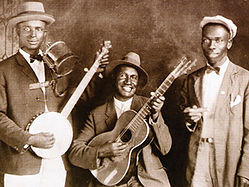
The jug as a musical instrument reached its height of popularity in the 1920s, when jug bands, such as Cannon's Jug Stompers were popular. The jug is just that: an empty jug played with the mouth...
player and a mix of traditional and home-made instruments. These home-made instruments are ordinary objects adapted to or modified for making of sound, like the washtub bass
Washtub bass
The washtub bass, or "gutbucket", is a stringed instrument used in American folk music that uses a metal washtub as a resonator. Although it is possible for a washtub bass to have four or more strings and tuning pegs, traditional washtub basses have a single string whose pitch is adjusted by...
, washboard
Washboard
A washboard is a tool designed for hand washing clothing. With mechanized cleaning of clothing becoming more common by the end of the 20th century, the washboard has become better known for its originally subsidiary use as a musical instrument....
, spoons, stovepipe and comb & tissue paper (kazoo
Kazoo
The kazoo is a wind instrument which adds a "buzzing" timbral quality to a player's voice when the player vocalizes into it. The kazoo is a type of mirliton, which is a membranophone, a device which modifies the sound of a person's voice by way of a vibrating membrane."Kazoo" was the name given by...
). The term jug band is loosely used in referring to ensembles that also incorporate home-made instruments but that are more accurately called skiffle
Skiffle
Skiffle is a type of popular music with jazz, blues, folk, roots and country influences, usually using homemade or improvised instruments. Originating as a term in the United States in the first half of the twentieth century, it became popular again in the UK in the 1950s, where it was mainly...
bands, spasm bands or juke (or jook) bands (see juke joint
Juke joint
Juke joint is the vernacular term for an informal establishment featuring music, dancing, gambling, and drinking, primarily operated by African American people in the southeastern United States. The term "juke" is believed to derive from the Gullah word joog, meaning rowdy or disorderly...
) because they are missing the required jug player.
In the early days of jug band music, guitar and mandolins were sometimes made from the necks of discarded guitars fastened to large gourds. The gourds were flattened on one side, with a sound-hole cut into the flat side, before drying. Banjos were sometimes made from a discarded guitar neck and a metal pie plate.
The eponym
Eponym
An eponym is the name of a person or thing, whether real or fictitious, after which a particular place, tribe, era, discovery, or other item is named or thought to be named...
ous jug sound is made by taking a jug
Jug (container)
A jug is a type of container used to hold liquid. It has an opening, often narrow, from which to pour or drink, and nearly always has a handle. One could imagine a jug being made from nearly any watertight material, but most jugs throughout history have been made from clay, glass, or plastic...
(usually made of glass or stoneware) and buzzing the lips into its mouth from about an inch away. As with brass instruments, changes in pitch are controlled by altering lip tension, and an accomplished jug player could have a two octave range. The stovepipe (usually a section of tin pipe, 3" or 4" in diameter) is played in much the same manner, with the pipe rather than the jug being the resonating chamber. There is some similarity to the didgeridoo
Didgeridoo
The didgeridoo is a wind instrument developed by Indigenous Australians of northern Australia around 1,500 years ago and still in widespread usage today both in Australia and around the world. It is sometimes described as a natural wooden trumpet or "drone pipe"...
, but there is no contact between the stovepipe and the player's lips. Some jug and stovepipe players utilize throat vocalization along with lip buzzing, as with the didgeridoo
Didgeridoo
The didgeridoo is a wind instrument developed by Indigenous Australians of northern Australia around 1,500 years ago and still in widespread usage today both in Australia and around the world. It is sometimes described as a natural wooden trumpet or "drone pipe"...
.
The swooping sounds of the jug fill a musical role halfway between the trombone
Trombone
The trombone is a musical instrument in the brass family. Like all brass instruments, sound is produced when the player’s vibrating lips cause the air column inside the instrument to vibrate...
and sousaphone
Sousaphone
The sousaphone is a type of tuba that is widely employed in marching bands. Designed so that it fits around the body of the musician and is supported by the left shoulder, the sousaphone may be readily played while being carried...
or tuba
Tuba
The tuba is the largest and lowest-pitched brass instrument. Sound is produced by vibrating or "buzzing" the lips into a large cupped mouthpiece. It is one of the most recent additions to the modern symphony orchestra, first appearing in the mid-19th century, when it largely replaced the...
in Dixieland
Dixieland
Dixieland music, sometimes referred to as Hot jazz, Early Jazz or New Orleans jazz, is a style of jazz music which developed in New Orleans at the start of the 20th century, and was spread to Chicago and New York City by New Orleans bands in the 1910s.Well-known jazz standard songs from the...
bands, playing mid- and lower-range harmonies in rhythm.
Early jug bands were typically made up of African American
African American
African Americans are citizens or residents of the United States who have at least partial ancestry from any of the native populations of Sub-Saharan Africa and are the direct descendants of enslaved Africans within the boundaries of the present United States...
vaudeville
Vaudeville
Vaudeville was a theatrical genre of variety entertainment in the United States and Canada from the early 1880s until the early 1930s. Each performance was made up of a series of separate, unrelated acts grouped together on a common bill...
and medicine show
Medicine show
Medicine shows were traveling horse and wagon teams which peddled "miracle cure" medications and other products between various entertainment acts. Their precise origins unknown, medicine shows were common in the 19th century United States...
musicians. Beginning in the urban south, they played a mixture of Memphis blues
Memphis blues
The Memphis blues is a style of blues music that was created in the 1920s and 1930s by Memphis-area musicians like Frank Stokes, Sleepy John Estes, Furry Lewis and Memphis Minnie...
(even before it was formally called the blues), ragtime
Ragtime
Ragtime is an original musical genre which enjoyed its peak popularity between 1897 and 1918. Its main characteristic trait is its syncopated, or "ragged," rhythm. It began as dance music in the red-light districts of American cities such as St. Louis and New Orleans years before being published...
, and jazz music. The history of jug bands is related to the development of the blues. The informal and energetic music of the jug bands also contributed to the development of rock and roll
Rock and roll
Rock and roll is a genre of popular music that originated and evolved in the United States during the late 1940s and early 1950s, primarily from a combination of African American blues, country, jazz, and gospel music...
.
The well known Memphis
Memphis, Tennessee
Memphis is a city in the southwestern corner of the U.S. state of Tennessee, and the county seat of Shelby County. The city is located on the 4th Chickasaw Bluff, south of the confluence of the Wolf and Mississippi rivers....
jug bands were small street groups, performing generally on Beale Street
Beale Street
Beale Street is a street in Downtown Memphis, Tennessee, which runs from the Mississippi River to East Street, a distance of approximately . It is a significant location in the city's history, as well as in the history of the blues. Today, the blues clubs and restaurants that line Beale Street are...
, and had their own blues style, using guitar
Guitar
The guitar is a plucked string instrument, usually played with fingers or a pick. The guitar consists of a body with a rigid neck to which the strings, generally six in number, are attached. Guitars are traditionally constructed of various woods and strung with animal gut or, more recently, with...
, harmonica
Harmonica
The harmonica, also called harp, French harp, blues harp, and mouth organ, is a free reed wind instrument used primarily in blues and American folk music, jazz, country, and rock and roll. It is played by blowing air into it or drawing air out by placing lips over individual holes or multiple holes...
, banjo
Banjo
In the 1830s Sweeney became the first white man to play the banjo on stage. His version of the instrument replaced the gourd with a drum-like sound box and included four full-length strings alongside a short fifth-string. There is no proof, however, that Sweeney invented either innovation. This new...
and a jug to accompany their blues and dance songs.
Original jug bands
The first jug bands to record were the Louisville and Birmingham jug bands. These bands played popular dance band jazz, using the jug as a novelty element. Vaudeville-blues singer Sara MartinSara Martin
Sara Martin was an American blues singer, in her time one of the most popular of the classic blues singers. She was billed as "The Famous Moanin' Mama" and "The Colored Sophie Tucker"...
and America's blue yodeler Jimmie Rodgers
Jimmie Rodgers (country singer)
James Charles Rodgers , known as Jimmie Rodgers, was an American country singer in the early 20th century known most widely for his rhythmic yodeling...
both employed these groups on their recordings.
The Memphis area jug bands were more firmly rooted in country blues and earlier African-American traditions. Will Shade
Will Shade
Will Shade was an African American Memphis blues musician, best known for his membership in the Memphis Jug Band. Shade was commonly called Son Brimmer, a nickname from his grandmother Annie Brimmer, because "son" is short for "grandson"...
's Memphis Jug Band
Memphis Jug Band
The Memphis Jug Band was an American musical group in the late 1920s and early to mid 1930s. The band featured harmonicas, violins, mandolins, banjos, and guitars, backed by washboards, kazoo, and jugs blown to supply the bass; they played in a variety of musical styles...
and Gus Cannon
Gus Cannon
Gus Cannon was an American blues musician, who helped to popularize jug bands in the 1920s and 1930s. There is doubt about his birth year; his tombstone gives the date as 1874....
's Jug Stompers recorded the great songs that became the basis for the later jug band revival: "Stealin'
Stealin'
Stealin' is an American folk song from the 1920s. The song is particularly identified with the jug band tradition, but gained wider popularity after several folk and blues artists recorded it in the 1960s....
," "Jug Band Music," "On the Road Again," "Whoa, Mule," "Minglewood Blues," "Walk Right In
Walk Right In
Walk Right In is the title of a country blues song written by musician Gus Cannon and originally recorded by Cannon's Jug Stompers in 1929, released on Victor Records, catalogue 38611. It was reissued on album in 1959 as a track on The Country Blues....
", and many others.
Other Memphis area bands were Jack Kelly and His South Memphis Jug Band, Jed Davenport's Beale Street Jug Band, and Noah Lewis's Jug Band. Ma Rainey
Ma Rainey
Ma Rainey was one of the earliest known American professional blues singers and one of the first generation of such singers to record. She was billed as The Mother of the Blues....
's tub-jug band featured the first recordings of slide guitar performer Tampa Red
Tampa Red
Tampa Red , born Hudson Woodbridge but known from childhood as Hudson Whittaker, was an American Chicago blues musician....
, who later formed his own Hokum Jug Band. Big Bill Broonzy
Big Bill Broonzy
Big Bill Broonzy was a prolific American blues singer, songwriter and guitarist. His career began in the 1920s when he played country blues to mostly black audiences. Through the ‘30s and ‘40s he successfully navigated a transition in style to a more urban blues sound popular with white audiences...
and Memphis Minnie
Memphis Minnie
Memphis Minnie was an American blues guitarist, vocalist, and songwriter. She was the only female blues artist considered a match to male contemporaries as both a singer and an instrumentalist.-Career:...
cut a few sides each backed up by their own jug bands; Memphis Minnie also sang and played with The Memphis Jug Band.
The 1930s depression and the devastating effect of radio on record sales reduced the output of jug band music to a trickle. The last sides by Cannon and The Memphis Jug Band were from 1930 and 1934 respectively. Cannon and Will Shade were recorded again in 1956 by Sam Charters on a field trip for Folkways Records
Folkways Records
Folkways Records was a record label founded by Moses Asch that documented folk, world, and children's music. It was acquired by the Smithsonian Institution in 1987, and is now part of Smithsonian Folkways.-History:...
. The sound of the washboard and tub bass, however, lasted well into the 1940s as an integral part of the "Bluebird beat
Bluebird Records
Bluebird Records is a sub-label of RCA Victor Records originally created in 1932 to counter the American Record Company in the "3 records for a dollar" market. Along with ARC's Perfect Records, Melotone Records and Romeo Records, and the independent US Decca label, Bluebird became one of the best...
" in Chicago. Bukka White
Bukka White
Booker T. Washington White , better known as Bukka White, was an American Delta blues guitarist and singer. "Bukka" was not a nickname, but a phonetic misspelling of White's given name Booker, by his second record label .-Biography:Born between Aberdeen and Houston, Mississippi, White was the...
's "Fixin' to Die," recorded in Chicago in 1940, is driven by a syncopated washboard backup.
Jug band revival
One of the first recordings of the folk era jug band revival was by The Orange Blossom Jug Five, made in 1958 for the poorly-distributed Lyrichord label, "Skiffle in Stereo." It was also the first recording by New York folksinger Dave Van RonkDave Van Ronk
Dave Van Ronk was an American folk singer, born in Brooklyn, New York, who settled in Greenwich Village, New York, and was eventually nicknamed the "Mayor of MacDougal Street" ....
, and featured Sam Charters, author of 'The Country Blues',and his wife Ann as well as Len Kunstadt
Len Kunstadt
Leonard Kunstadt was a scholar of jazz and blues music, and a record label manager.Len Kunstadt was born and raised in Brownsville, Brooklyn. He was the son of Morris Kunstadt, a violinist and chess master, and Sophie Sherry Kunstadt, a writer and assistant to band leader Edwin Franko Goldman. ...
, co-owner of the Spivey Records
Spivey Records
Spivey Records was a specialist blues record label founded by blues singer Victoria Spivey and jazz historian Len Kunstadt in 1961. Spivey Records released a series of blues and jazz albums between 1961 and 1985.- History of Spivey Records :...
label. Van Ronk would revisit the genre in 1964 with the album "Dave Van Ronk and the Ragtime Jug Stompers," a modern classic, though his ragtime guitar picking and repertoire influenced many subsequent jug bands. Another early recording group was Jolly Joe's Jug Band, led by record collector Joe Bussard, and released on his own Fonotone label-as 78 rpm records. Eventually these were collected on LP by the Piedmont label.
Gus Cannon's "Walk Right In" was a #1 hit for The Rooftop Singers in 1963, the only time a jug band song topped the charts. These one-hit wonders even made an appearance at that year's Newport Folk Festival before fading into obscurity. The song's success brought Cannon himself back into the Stax Records
Stax Records
Stax Records is an American record label, originally based in Memphis, Tennessee.Founded in 1957 as Satellite Records, the name Stax Records was adopted in 1961. The label was a major factor in the creation of the Southern soul and Memphis soul music styles, also releasing gospel, funk, jazz, and...
studios in Memphis for his last recording that same year at age 79. The album, called "Walk Right In," features Cannon on banjo and old friends Will Shade on jug and Milton Roby on washboard. The album consists of a run through of a baker's dozen of his old hits with Cannon interjecting comments and telling stories about the songs.
This brief flurry of interest in the genre sparked the formation of a few jug bands that reached national prominence. The Jim Kweskin
Jim Kweskin
Jim Kweskin is the founder of the Jim Kweskin Jug Band, with Fritz Richmond, Mel Lyman, and Geoff and Maria Muldaur...
Jug Band of Boston, who recorded for the Vanguard label
Vanguard Records
Vanguard Records is a record label set up in 1950 by brothers Maynard and Seymour Solomon in New York. It started as a classical label, but is perhaps best known for its catalogue of recordings by a number of pivotal folk and blues artists from the 1960s; the Bach Guild was a subsidiary...
, featured the washtub bass and jug player Fritz Richmond
Fritz Richmond
John B. "Fritz" Richmond was an American musician and recording engineer. Fritz Richmond was considered the foremost washtub bassist in the world, and was also the most successful professional jug player....
, who later played jug on Warren Zevon's "I'll Sleep When I'm Dead." The New York based Even Dozen Jug Band
Even Dozen Jug Band
The Even Dozen Jug Band was founded in 1963 by Stefan Grossman and Peter Siegel in New York City, New York...
was the Elektra
Elektra Records
Elektra Records is an American record label owned by Warner Music Group. In 2004, it was consolidated into WMG's Atlantic Records Group. After five years of dormancy, the label was revived by Atlantic in 2009....
label's answer to the Kweskin band and featured (among others) Maria D'Amato
Maria Muldaur
Maria Muldaur is a folk-blues singer who was part of the American folk music revival in the early 1960s...
, Joshua Rifkin
Joshua Rifkin
Joshua Rifkin is an American conductor, keyboard player, and musicologist. He is best known by the general public for having played a central role in the ragtime revival in the 1970s with the three albums he recorded of Scott Joplin's works for Nonesuch Records, and to classical musicians for his...
, David Grisman
David Grisman
David Grisman is an American bluegrass/newgrass mandolinist and composer of acoustic music. In the early 1990s, he started the Acoustic Disc record label in an effort to preserve and spread acoustic or instrumental music.-Biography:Grisman grew up in Hackensack, New Jersey...
, Stefan Grossman
Stefan Grossman
Stefan Grossman is an American acoustic fingerstyle guitarist and singer, music producer and educator, and co-founder of Kicking Mule records.-Early life and influences:Born in Brooklyn, New York, to Herbert and Ruth Grossman...
, John Sebastian
John Sebastian
John Benson Sebastian Jr. is an American singer, songwriter, guitarist and autoharpist. He is best known as a founder of The Lovin' Spoonful, a band inducted into the Rock and Roll Hall of Fame in 2000...
, and Steve Katz
Steve Katz (musician)
Steve Katz is a guitarist and record producer who is best known as a member of the rock group Blood, Sweat & Tears. Katz was an original member of the rock bands The Blues Project and American Flyer...
. Maria D'Amato then joined The Jim Kweskin Jug Band, later marrying guitarist Geoff Muldaur
Geoff Muldaur
Geoff Muldaur is an American founding member of the Jim Kweskin Jug Band of Cambridge, Massachusetts; a member of Paul Butterfield's Better Days; and an accomplished solo guitarist, singer, and songwriter....
. The Austin, Texas band The 13th Floor Elevators formed as an electric jug band, featuring Tommy Hall
Tommy Hall
Tommy Hall is the name of:* Tommy Hall , British cyclist* Tommy Hall , British football player* Tommy Hall , Australian musician...
as electric jug player. A similar revival began in the UK
United Kingdom
The United Kingdom of Great Britain and Northern IrelandIn the United Kingdom and Dependencies, other languages have been officially recognised as legitimate autochthonous languages under the European Charter for Regional or Minority Languages...
in the 1960s, possibly as an offshoot of the USA revival. A number of jug bands appeared there in the late 60s in addition to the skiffle
Skiffle
Skiffle is a type of popular music with jazz, blues, folk, roots and country influences, usually using homemade or improvised instruments. Originating as a term in the United States in the first half of the twentieth century, it became popular again in the UK in the 1950s, where it was mainly...
bands including the Anglo-American Ffilharmonious Jug Band
Ffilharmonious Jug Band
The Ffilharmonious Jug Band was an Anglo-American Jug band group in England in the late 1960s. Members were American Jeff Wilson , American Jim Johnson , Briton Doug Kyle The Ffilharmonious Jug Band was an Anglo-American Jug band group in England in the late 1960s. Members were American Jeff Wilson...
.
The musicians playing in jug music revival groups went on to form other bands. John Sebastian founded the pop music group The Lovin' Spoonful
The Lovin' Spoonful
The Lovin' Spoonful is an American pop rock band of the 1960s, named to the Rock and Roll Hall of Fame in 2000. When asked about his band, leader John Sebastian said it sounded like a combination of "Mississippi John Hurt and Chuck Berry," prompting his friend, Fritz Richmond, to suggest the name...
and later continued as a successful solo artist. Country Joe and the Fish
Country Joe and the Fish
Country Joe and the Fish was a rock band most widely known for musical protests against the Vietnam War, from 1966 to 1971, and also regarded as a seminal influence to psychedelic rock.-History:...
came from The Instant Action Jug Band. Mungo Jerry
Mungo Jerry
Mungo Jerry is an English rock group whose greatest success was in the early 1970s, though they have continued throughout the years with an ever-changing line-up, always fronted by Ray Dorset. They are remembered above all for their hit "In the Summertime". It remains their most successful and most...
, who had evolved from an earlier blues group Good Earth, were in effect a jug band on their first live performances and recordings, thanks to their use of jug (played by the group's banjo player Paul King
Paul King (musician)
Paul Malcolm King , was a member of Mungo Jerry between 1970 and 1972. He contributed occasional lead vocals, and played acoustic guitar , banjo, harmonica, kazoo and jug...
, who left in 1972), and washboard, contributed by regular 'extra member' Joe Rush
Joe Rush
Joe Rush influenced by the film 'Mad Max' and 'Judge Dredd' comics, was the co-originator of the travelling multi media art group Eat my face, an underground art collective who specialised in building large scale installations out of waste material...
. Jesse Colin Young moved to the west coast and formed The Youngbloods, whose first hit was "Grizzly Bear," a jug band standard. Another group with jug band roots was Grateful Dead
Grateful Dead
The Grateful Dead was an American rock band formed in 1965 in the San Francisco Bay Area. The band was known for its unique and eclectic style, which fused elements of rock, folk, bluegrass, blues, reggae, country, improvisational jazz, psychedelia, and space rock, and for live performances of long...
. Jerry Garcia, Bob Weir, and Ron "Pigpen" McKernan were in Mother McCree's Uptown Jug Champions before forming The Warlocks, which evolved into Grateful Dead. A self-titled CD
Mother McCree's Uptown Jug Champions (album)
Mother McCree's Uptown Jug Champions is an American folk music album. It was recorded live by the band of the same name at the Top of the Tangent coffee house in Palo Alto, California in July, 1964, and released in 1999....
of Mother McCree's jug band music recorded in 1964 was released in 1999. Maria Muldaur, Geoff Muldaur, David Grisman, and Stefan Grossman all continued with successful solo careers.
Pop-rock tributes to jug band music include "Willie and the Poor Boys" by Creedence Clearwater Revival
Creedence Clearwater Revival
Creedence Clearwater Revival was an American rock band that gained popularity in the late 1960s and early 1970s with a number of successful singles drawn from various albums....
and "Jug Band Music" by The Lovin' Spoonful
The Lovin' Spoonful
The Lovin' Spoonful is an American pop rock band of the 1960s, named to the Rock and Roll Hall of Fame in 2000. When asked about his band, leader John Sebastian said it sounded like a combination of "Mississippi John Hurt and Chuck Berry," prompting his friend, Fritz Richmond, to suggest the name...
. The Spoonful also mined the old songs. In addition to doing versions of songs from the classic jug band repertoire on their first album "Do You Believe In Magic" (1965) such as "Blues In The Bottle," "Sportin' Life," "My Gal," "Fishin' Blues," and "Wild About My Lovin'," Sebastian's "Younger Girl" used
the melody of Gus Cannon's "Prison Wall Blues." Indeed, the song "Do You Believe In Magic," a Top Ten hit, mentioned the genre in its lyrics: "If you believe in magic, don't bother to choose / If it's jug band music or rhythm and blues / Just go and listen, it'll start with a smile / That won't wipe off your face no matter how hard you try." That instantaneous joy many have felt upon first listening to jug band music contributes to its fans' longlasting affection and the genre's longevity.
The children's Christmas special, "Emmet Otter's Jug-Band Christmas
Emmet Otter's Jug-Band Christmas
Emmet Otter's Jug Band Christmas is a children's storybook by Russell Hoban which was first published in 1971. In 1977 it was adapted into a television special by Jim Henson with songs by Paul Williams...
", based on a book written by Lillian Hoban and Russell Hoban, features a jug band composed of woodland-creature Muppets and a soundtrack composed by Paul Williams
Paul Williams (songwriter)
Paul Hamilton Williams, Jr. is an Academy Award-winning American composer, musician, songwriter, and actor. He is perhaps best known for popular songs performed by a number of acts in the 1970s including Three Dog Night's "An Old Fashioned Love Song", Helen Reddy's "You and Me Against the World",...
. The show first aired in 1977.
Jug bands have continued to exist and evolve to the present day. John Sebastian still leads The J-Band, which included not only musicians from the modern folk revival such as the late Fritz Richmond
Fritz Richmond
John B. "Fritz" Richmond was an American musician and recording engineer. Fritz Richmond was considered the foremost washtub bassist in the world, and was also the most successful professional jug player....
from the Kweskin band, but also the late Yank Rachell
Yank Rachell
James "Yank" Rachell was an American country blues musician, dubbed an "elder statesman of the blues."-Career:...
, mandolin player and jug band leader from the original era. Some bands remain faithful to the original roots, while others continually expand the jug band repertoire to include other folk music, popular music, jazz and classical music forms, such as The Juggernaut Jug Band of Louisville, Kentucky (formed in the late 1960s and possibly the only full-time jug band in existence at this time), The Cincinnati Dancing Pigs (who also have been together for 40 years), The Carolina Chocolate Drops (an African American jug band that also plays old-time African American fiddle tunes), The Hobo Gobbelins, The Kitchen Syncopators and The Inkwell Rhythm Makers. The Connecticut-based Jugadelics continue the traditions of the genre as they employ both homemade and traditional instruments while infusing their own original material in the jug band style. In San Francisco, there's Devine's Jug Band, which is one of the few jug bands today that actually uses a jug blower full time. And also in the Bay Area, the "Mother of Jug Band Music", Maria Muldaur, has formed a new jug band called The "Garden of Joy Jug Band". The Canadian contribution, The Genuine Jug Band from Vancouver, British Columbia has most of the original members who have played together since 1968. In Connecticut, The Bluelights (formerly Washboard Slim And The Blue Lights) incorporate the blues with the usual ragtime repertoire, as well as original material. Tennessee-based Jake Leg Stompers continue the traditional Memphis style. The South Austin Jug Band is a young Austin, Texas group that plays newer variations on traditional music but does not include a jug player and is not related to the earlier Austin Jug Band which featured vocalists Danny Barton and Galen Barber. Finally, The Philadelphia Jug Band have been playing authentic classic jug band music virtually unchanged for over 45 years.
There has been an Annual Battle of the Jug Bands in Minneapolis, Minnesota held since 1980. Over 20 jugbands compete for the "Coveted Hollywood Waffle Iron" trophy, including The Jook Savages, a jugband that predates Kweskin's band and is still together. The competition is held the Sunday after the Super Bowl.
The annual San Francisco Jug Band Festival is held in San Francisco, California
San Francisco, California
San Francisco , officially the City and County of San Francisco, is the financial, cultural, and transportation center of the San Francisco Bay Area, a region of 7.15 million people which includes San Jose and Oakland...
each August and there is a JugFest gathering of jug bands each September in Sutter Creek, California
Sutter Creek, California
Sutter Creek is a city in Amador County, California, United States. The population was 2,501 at the 2010 census, up from 2,303 at the 2000 census...
. Both of these free, outdoor, festivals feature a wide variety of jug bands in an all-day format that gives each band plenty of time to stretch out and play a full set. The National Jug Band Jubilee was launched in Louisville, Kentucky, the probable birthplace of jug band music, in October 2006. The 1st Annual West Coast Jug Band Jubilee took place in August 2010 in Berkeley, California
Berkeley, California
Berkeley is a city on the east shore of the San Francisco Bay in Northern California, United States. Its neighbors to the south are the cities of Oakland and Emeryville. To the north is the city of Albany and the unincorporated community of Kensington...
.
A documentary by Todd Kwait about the history and influence of jug band music, Chasin' Gus' Ghost, first screened at the 2007 San Francisco Jug Band Festival. The film features numerous well-known musicians in interviews and performances, including John Sebastian, Jim Kweskin, Geoff Muldaur, David Grisman
David Grisman
David Grisman is an American bluegrass/newgrass mandolinist and composer of acoustic music. In the early 1990s, he started the Acoustic Disc record label in an effort to preserve and spread acoustic or instrumental music.-Biography:Grisman grew up in Hackensack, New Jersey...
, Fritz Richmond
Fritz Richmond
John B. "Fritz" Richmond was an American musician and recording engineer. Fritz Richmond was considered the foremost washtub bassist in the world, and was also the most successful professional jug player....
, Maria Muldaur
Maria Muldaur
Maria Muldaur is a folk-blues singer who was part of the American folk music revival in the early 1960s...
, and Bob Weir
Bob Weir
Bob Weir is an American singer, songwriter, and guitarist, most recognized as a founding member of the Grateful Dead. After the Grateful Dead disbanded in 1995, Weir performed with The Other Ones, later known as The Dead, together with other former members of the Grateful Dead...
of the Grateful Dead
Grateful Dead
The Grateful Dead was an American rock band formed in 1965 in the San Francisco Bay Area. The band was known for its unique and eclectic style, which fused elements of rock, folk, bluegrass, blues, reggae, country, improvisational jazz, psychedelia, and space rock, and for live performances of long...
, as well as Taj Mahal
Taj Mahal (musician)
Henry Saint Clair Fredericks , who uses the stage name Taj Mahal, is an American Grammy Award winning blues musician. He incorporates elements of world music into his music...
as the voice of Gus Cannon
Gus Cannon
Gus Cannon was an American blues musician, who helped to popularize jug bands in the 1920s and 1930s. There is doubt about his birth year; his tombstone gives the date as 1874....
. Many of these musicians performed at a sold-out concert at the San Francisco Jug Band Festival. Chasin' Gus' Ghost will have its film festival premiere in October 2007 at the Woodstock Film Festival.
Post-modern jug bands
The 1990s and first decade of the 2000s saw another generation of jug band revival, which might be termed post-modern jug band movement. These bands range from traditionalists (covering 1920s and 1930s jazz and blues) to modernists and post-modernists (creating new music from jug band instrumentation and aesthetics).Scenes of this nature have developed in New York City (centering on the Lower East Side and Red Hook, Brooklyn), in Southern California (primarily the Los Angeles area), in the San Francisco Bay area, and in the Pacific Northwest.
Organizations
- Jugband.org
- Jug Band Hall of Fame
- National Jug Band Jubilee
- California Jug Band Association
- Minneapolis Battle of the Jug Bands
Media
- Chasin' Gus' Ghost jug band documentary
- "But Only Use a 10-Cent Comb", Time, December 27, 1963
- "Jug Band Hootenanny: Local folkies gather to honor down-home, old-timey music", Minnesota DailyMinnesota DailyThe Minnesota Daily is the campus newspaper of the University of Minnesota Twin Cities, published Monday-Thursday while school is in session, and published weekly on Wednesdays during summer sessions. Published since 1900, the paper is one of the largest student-run and student-written newspapers...
, February 10, 2005