

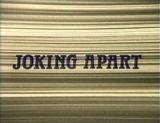
Joking Apart

Encyclopedia
Joking Apart is a BBC television
sitcom
written by Steven Moffat
about the rise and fall of a relationship. It juxtaposes a couple, Mark (Robert Bathurst
) and Becky (Fiona Gillies
), who fall in love and marry, before getting separated and finally divorced. The twelve episodes, broadcast between 1993 and 1995, were directed by Bob Spiers
and produced by Andre Ptaszynski
for independent production company Pola Jones.
The show is semi-autobiographical; it was inspired by the then-recent separation of Moffat and his first wife. Some of the episodes in the first series followed a non-linear parallel structure, contrasting the rise of the relationship with the fall. Other episodes were ensemble
farce
s, predominantly including the couple's friends Robert (Paul Raffield
) and Tracy (Tracie Bennett
). Paul-Mark Elliott
also appeared as Trevor, Becky's lover.
Scheduling problems meant that the show attracted low viewing figures. However, it scored highly on the Appreciation Index
and accrued a loyal fanbase. One fan acquired the home video rights from the BBC and released both series on his own DVD label.
, but the programme's high cost along with organisational changes at Central
cast its future in doubt. As Moffat wondered what to do next and worried about his future employment, Bob Spiers
, Press Gangs primary director, suggested that he meet with producer Andre Ptaszynski
to discuss writing a sitcom. Moffat's father had been a headteacher and Moffat himself had taught English before writing Press Gang, so his initial proposal was a programme similar to what would become Chalk
, a series that eventually aired in 1997.
As he was separating from his wife, Moffat was going through a difficult period and aspects of it coloured his creative output. He introduced a proxy of his wife's new partner into the Press Gang episode "The Big Finish?", the character Brian Magboy (Simon Schatzberger
). Moffat scripted unfortunate situations for the Magboy character, such as having a typewriter drop on his foot. Moffat says that the character's name was inspired by his wife's: "Magboy: Maggie's boy".
During the pitch meeting at the Groucho Club
, Ptaszynski realised that Moffat was talking passionately about his impending divorce and suggested that he write about that instead of his initial proposal, a school sitcom. Taking Ptaszynski's advice, Moffat's new idea was about "a sitcom writer whose wife leaves him". Speaking about the autobiographical elements of the show, the writer jokes that he has to remember that his wife didn't leave him for an estate agent
; his wife was an estate agent. In 2003, Moffat told The New York Times
that his "ex-wife wasn't terribly pleased about her failed marriage being presented as a sitcom on BBC2 on Monday nights". In an interview with Richard Herring
, Moffat says that "the sit-com actually lasted slightly longer than my marriage". Conversely, his later sitcom Coupling
was based on his relationship with his second wife, TV producer Sue Vertue
. Moffat reused the surname 'Taylor', which is Mark's surname in Joking Apart, for Jack Davenport
's character Steve in Coupling.
 The pilot, directed by John Kilby, was filmed at Pebble Mill
in Birmingham
on 9–10 August 1990. It is practically identical to the first episode of the series proper; some scenes are even reused, notably the scene with Mark and Becky meeting when he accidentally turns up at a funeral. The reused footage gave rise to the first episode's shared director credit between Spiers and Kilby. The stand-up sequences were shot against a black background. Although this made it clearer that they were not "real", Moffat thought that it looked odd. The pilot was transmitted on BBC2 as part of its Comic Asides series of pilot shows on 12 July 1991.
Moffat had written all six episodes of the first series before recording commenced. Never again would he be so far in advance of production. With series two, he had written only the first four episodes by the time recording had commenced, only delivering the final episode by the first day of rehearsals.
All of the location shots were filmed at the beginning of the production block. Recording for the first series of six episodes began on location in the first half of April 1992 and were mainly filmed in Chelsea
within a short distance from the director's home. The stand-up sequences were filmed in the Café Des Artistes on London's Fulham Road
, now known as the Valmont Club, and were shot for the benefit of the studio audience, with the intention of reshooting them later for the broadcast version. Robert Bathurst has complained that, in order to save £5,000, this promised reshoot never materialised. The close ups of Bathurst were filmed in the studio for the second series, with stock footage of the club's audience reused.
After the exterior shots had been filmed, the episodes were recorded at BBC Television Centre
in April and May 1992 for the first series, and 12 November until 18 December 1993 for the second. Studio recording sessions were normally completed quickly; Gillies recalls "an hour and a half, tops". To a large extent, the editing
occurred live during the studio recording with only tightening later. At the end of the recording on Sunday evenings Spiers would review the show before retiring to the bar, with the bulk of the work complete. Moffat compares this to the editing of modern sitcoms, which, he says, are edited more like film.
technique as a "romantic comedy, but a romantic comedy backwards because it ends with the couple unhappy". Moffat had experimented with non-linear narrative in Press Gang, notably the episode "Monday-Tuesday". Various episodes of Coupling
played with structure, such as the fourth series episode "9½ Minutes" which showed the same events from three perspectives.
 All of the episodes open with Bathurst portraying Mark Taylor, a sitcom writer, apparently performing stand-up
in a small comedy club
. These performances are fantasy sequences, playing out in the character's mind and portraying his internal creative processes as comedic monologues; these monologues mainly employ material from the character's failing marriage and are intended to show that "he thinks in punchlines
, in comedy". Episodes regularly cut back to these fantasy performances, which usually open with the signature line: "My wife left me ...". Moffat felt that audiences needed to know from the start that the relationship would not survive. However, it was unclear to some viewers that the fantasy sequences were set in the writer's mind; many journalists reported that the character Mark was a stand-up comic, not a sitcom writer.
In the fantasy sequences for the pilot, Bathurst was filmed against a completely black backdrop, which Moffat describes as "hell to look at". For the series, the sequences were filmed in a real club. Moffat describes this as the "wrong direction" as it became unclear that the fantasy sequences were "not real". Moffat observes that, like Seinfeld
, an American sitcom that used a similar device, Joking Apart would use less of the stand-up as the series progressed. In retrospect, Moffat regrets including the stand-up sequences. Bathurst, however, has considered refilming them as a video diary. Now with older features, he can portray a Mark Taylor reflecting on his earlier life. Both are very critical of the sequences in the DVD audio commentaries. The sequences have also drawn the sharpest criticisms from reviewers. The second series followed a more linear structure, although it retained the stand-up sequences.
", written by Chris Rea
, was used for both the opening and closing credit sequences. The original Rea version was used for the pilot's closing credits, but for the series it was performed by Kenny Craddock
, who arranged the incidental music
with Colin Gibson. Beginning with a saxophone, only the chorus of the theme song accompanied the opening titles. These ran over legal imagery and a sequence of images of famous separated couples, including Arthur Miller
and Marilyn Monroe
; Winnie and Nelson Mandela
; The Princess Anne
and Mark Phillips
, and culminating in Mark and Becky. The closing credits featured a verse and chorus. The first part of the closing credits was usually over a still of the final frame
, and faded to black with the line "All dressed in black."
) is a television sitcom writer. Other than episode one, where he is shown working on a script, and references to a show of his that had aired during a dinner with Robert and Tracy the night before, his work is hardly mentioned. Mark is quick-witted, and the stand-up sequences indicate that he thinks in one-liners. However, this proves to be the downfall of his marriage with Becky, who says that she didn't sign on to become his "lawfully wedded straight man". In one episode, Mark jokes about worrying if his virginity will heal back; Becky articulates her frustration by responding "What page is that on?" Identifying his insecurities, she points out that the "thing about someone who uses humour as a weapon, is not the sense of humour, but the fact that they need a weapon". In interviews, Bathurst has compared Steven Moffat to his character: Mark is "a man whose wife leaves him because he talks in one-liners. And Steven Moffat's wife had just left him, because he talks in one-liners."
Robert Bathurst, a former Footlights
president, was cast as Mark Taylor. He was performing on a live topical programme on BSB
called Up Yer News. A fellow performer on that show also auditioned for the part at what is now the Soho Theatre
, then the old Soho Synagogue in Dean Street
, and claimed that he would break Bathurst's legs if the latter got the job. In a 2005 interview, Bathurst recalls that the threat seemed not to be entirely jocular. Bathurst speaks very highly of Joking Apart, identifying it as a "career highlight" and the most enjoyable job he has ever done. Retrospectively, he wishes that he had "roughened up" Mark, as he was "too designery".
Becky Johnson/Taylor (Fiona Gillies
) meets Mark at a funeral and they eventually marry. Although irritated at being his comic foil, she is capable of her own quick-witted put-downs. In episode 3, for example, she wins an impromptu one-liner contest over Mark, whose put-downs fall flat. Becky is shown as an independent woman, meeting Mark on her terms. The first series revolves around her leaving Mark for estate agent
Trevor, whom she subsequently cheats in series two. This was Fiona Gillies' first major television role, having appeared in "The Hound of the Baskervilles
", a 1988 episode of The Adventures of Sherlock Holmes
, and the mini-series Mother Love
. She was aware that some of her dialogue was based on what had been said to Moffat during his own separation.
Robert and Tracy Glazebrook (Paul Raffield
and Tracie Bennett
) are their "increasingly bizarre and totally dim friends". They are initially Becky's friends, but soon befriend Mark, comforting him on the night Becky leaves him. Tracy, as Tracie Bennett identifies, is a stereotypical Tracy—normally a dysphemism
for an intellectually inadequate, usually blonde, female. However, "she's not a bimbo
: she's quite clever in her own logic". Bennett jokes that she was quite offended that such a character was named Tracy. Tracy's catchphrase of "you're a silly" was originally Moffat's typographical error, which Bennett faithfully reproduced in her performance. They decided that the amended version worked well for the character.
They are both naive about sex and technology. Tracy, for example, attempts to telephone Robert to inform him that he's lost his mobile phone, and believes that she is a lesbian when she discovers her husband in women's clothing
. They have a baby, who is seen or referred to occasionally. This reflects, as the writer observes, Moffat's inexperience of looking after children at the time.
Trevor (Paul-Mark Elliott
) is Becky's lover. His job as an estate agent regularly provokes derision from Mark. (Moffat's ex-wife was an estate agent.) He is himself cheated on in the second series, as Becky dates her solicitor
Michael (Tony Gardner
). His debut appearance is in the third episode where he and Becky go to Robert and Tracy's house for dinner, but generally features less regularly than the main ensemble.
in preparation for a surprise party for her. The story continues directly into episode two, when Robert and Tracy return to the flat to check on Mark after his wife's departure. The three recall the circumstances in which they had first met. After their first date, the couple go back to Becky's flat. While she is in the bathroom, he strips down to his boxer shorts and handcuffs himself to the bedpost. Unable to free himself, Robert and Tracy walk in on him. Moffat used a similar scenario for the Coupling episode "The Freckle, the Key, and the Couple who Weren't" and reveals in its audio commentary that it is based on a situation with one of his ex-girlfriends.
In the third episode, Mark arrives at Robert and Tracy's house on the wrong night for a dinner party. The couple are entertaining that night, but are instead expecting Becky and her new boyfriend Trevor. Hopeful of a reconciliation, Mark assumes that his friends are trying to smooth things over between them. They spend the evening trying to keep Mark and Trevor apart, each not knowing that the other is also there. Episode five makes extensive use of what Moffat labels "techno-farce", which uses technology, predominantly telephones, to facilitate the farcical situations. Moffat considers this episode the best of the show. Discussing the series as a whole, he feels that the story ends after this episode. It begins when Mark attempts to return Robert's "portable telephone
" and ends with Robert threatening to shoot Mark after the latter has slept with Tracy. The series ends with Becky and Trevor, and Robert and Tracy reconciling their relationships and Mark being left alone.
), Becky's solicitor with whom she is now cheating on Trevor.
Robert and Tracy are given more stories than in the first series. Their main story arc begins in the third episode when Robert is caught by all of the main characters and his parents in a maid's outfit being spanked
by a prostitute. The couple temporarily separate while Robert experiments with cross-dressing, but they are reunited by the end of the series.
The fourth episode features a scene where Mark jams his dressing gown in the door and is forced to hide naked in his new neighbour's flat. This sequence was Moffat's revenge for Bathurst's late arrival at the series one press launch at the Café Royal
in Regent Street
, London
. Moffat threatened that if they ever did a second series he would write a whole episode in which Bathurst was naked. After being mistaken for a flasher
, Mark is punched by his neighbour's brother. When he awakens he is confronted by a man (Kerry Shale
) in a red polo neck
jumper who claims to be "his very best friend". In the fifth episode it transpires that the man, who identifies himself as Dick, is the personification of Mark's penis.
The final episode begins after Becky and Michael had slept together while house sitting
for Tracy and Robert, and Michael hides in the bathroom when the latter couple return. Tracy phones a morning television phone-in show (hosted by Michael Thomas and Helen Atkinson-Wood
, with appearances by Rachael Fielding and Jonathan Barlow), and when she realises that the show's divorce expert is hiding in her bathroom she takes on his role (with a heavy Northern accent) to give herself advice on the other line. Bennett says this was the hardest thing she has had to do in her career.
The second series was filmed in late 1993. However, the controller of BBC2, Michael Jackson
, had little faith in the project at the time, which, according to the writer, he now admits was wrong. Jackson felt that it was too mainstream
for BBC2 and not mainstream enough for BBC1. The second series was scheduled to air from 11 June 1994, but was delayed many times. Bathurst articulates the group's frustration at the delay:
The first series was repeated in preparation for the six episodes of the second series, which began transmission on Tuesday evenings from 3 January until 7 February 1995. The second series was only transmitted once even though the BBC had paid to show it twice. Moffat feels that the delay damaged the series because such bad scheduling hinders returning audiences and that the two-year gap meant that it seemed as if Mark "had been banging on about this sodding divorce for an awfully long time!"
After winning the Montreux award it seemed inevitable that the show would get a third series. At a Christmas party, a BBC executive had plans for the ratings of a third series "to go like Everest
", indicating a steep slope with his hands. Bathurst replied, "But, Everest goes down the other side ..." The show was not recommissioned. Moffat says that he had no idea for a third series anyway, as it would have been difficult to contrive how a group of people who did not particularly like each other would get together so regularly.
, meaning that viewers thought very highly of the programme. Bathurst says that drunks on the London Underground
tell him in detail the plot of their favourite episode. The cast claim that the programme has a timeless, universal appeal as there are no time-specific references apart from the typewriter and the size of the mobile telephones. Gillies says that her accountant watches it to cheer himself up, while Bathurst recalls that a friend cheered so loudly when Mark pushes avocado into Trevor's face in the third episode that he woke his son.
Critical reception was generally positive. In his overview of Moffat's celebrated Press Gang, Paul Cornell
said that the writer "continues to impress" with Joking Apart. The Daily Express
said that it was "flavoured with a delicious bitterness about the perfidy of women and the conscious-less nature of the male orgasm, it was plotted with the intricacy of a French farce". Another reviewer for the Express commented that "it's quite funny and an acute analysis" of the modern divorce, and that the first episode was "distinctly promising". Similarly DVD Review comments that "Moffat's distillation of his marriage melting down is as precise a piece of comic writing as you're likely to find."
Not all reviews were completely positive. Criticising Bathurst for being too handsome to convey the frustrations of a writer, the Daily Telegraph said that the show had "its problems but possesses a dark, mordant wit". William Gallagher comments that "Press Gang was pretty flawless, but Joking Apart would veer from brilliance to schoolboy humour from week to week."
While the transmission of series two was being delayed by BBC 2 controller Michael Jackson
, the show won the Bronze Rose of Montreux
and was entered for the Emmys. The show was remade in Portugal
but used a linear structure rather than the flashbacks. Moffat reflects that although the remake is "not as dark or ground-breaking" as the original, it is "probably more fun" because it ends happily.
. The DVD is notable because a fan of the show, Craig Robins, bought the rights from 2Entertain, BBC Worldwide
's DVD interest, and released it on his own independent label
, Replay DVD. Robins put up £30,000 of his own money to buy the rights and produced the series one disc. As a professional videotape editor, Robins was able to restore
the video, and author
the disc himself, using a piece of freeware
to transcribe the dialogue for the subtitles.
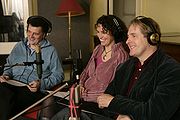 The first series was released on DVD on 29 May 2006. It contains audio commentaries on four of the episodes from Moffat, Bathurst, Gillies and Bennett. It also contains a featurette
, "Fool If You Think It's Over", with retrospective interviews. The second series was released on 17 March 2008 as a two-disc set. It contains audio commentaries on all episodes: five featuring a mix of Moffat, Bathurst, Gillies, Bennett, Raffield and Ptaszynski, with episode two featuring Spiers, and production manager Stacey Adair that concentrates on the behind-the-scenes production. The pilot from Comic Asides is also included on Disc 2, along with a complete set of Series Two scripts in Portable Document Format
(PDF) and a PDF article entitled "Joking Apart In The Studio". The release includes a companion booklet.
Replay DVD was commended in reviews for the quality of the disc. DVD Times reports that "Joking Apart looks much sharper than the average television show on DVD. The colours are also much richer and have obviously been fixed throughout to present a more uniform image while the picture is bright and clear." The featurette on the series 1 set is labelled "a great little feature", with Moffat particularly praised for his contribution. DVD Times identifies "a real sense of friendship and of a real liking for this show" within the commentaries, highlighting that Moffat "sounds really happy ... for Joking Apart to have finally gotten some recognition".
BBC Television
BBC Television is a service of the British Broadcasting Corporation. The corporation, which has operated in the United Kingdom under the terms of a Royal Charter since 1927, has produced television programmes from its own studios since 1932, although the start of its regular service of television...
sitcom
British sitcom
A British sitcom tends, as it does in most other countries, to be based on a family, workplace or other institution, where the same group of contrasting characters is brought together in each episode. Unlike American sitcoms, where twenty or more episodes in a season is the norm, British sitcoms...
written by Steven Moffat
Steven Moffat
Steven Moffat is a Scottish television writer and producer.Moffat's first television work was the teen drama series Press Gang. His first sitcom, Joking Apart, was inspired by the breakdown of his first marriage; conversely, his later sitcom Coupling was based upon the development of his...
about the rise and fall of a relationship. It juxtaposes a couple, Mark (Robert Bathurst
Robert Bathurst
Robert Guy Bathurst is an English actor. Bathurst was born in the Gold Coast in 1957, where his father was working as a management consultant. His family moved to Dublin, Ireland, in 1959 and Bathurst was enrolled at an Anglican boarding school...
) and Becky (Fiona Gillies
Fiona Gillies
Fiona Gillies is a British actress who has appeared on television and the stage.She first appeared in the 1988 version of The Hound of the Baskervilles as Beryl Stapleton. A year later she appeared in the mini-series Mother Love....
), who fall in love and marry, before getting separated and finally divorced. The twelve episodes, broadcast between 1993 and 1995, were directed by Bob Spiers
Bob Spiers
Bob Spiers was a director. He is particularly noted as the director of the early series of Absolutely Fabulous , the musical comedy Spiceworld, and of the second series of Fawlty Towers . He also worked with Steven Moffat on Press Gang and Joking Apart...
and produced by Andre Ptaszynski
Andre Ptaszynski
André Ptaszynski is a British theatre producer. He studied English at Jesus College, Oxford.He was Chief Executive of the Really Useful Group from 2005 to 2011 and Chief Executive of Really Useful Theatres from 2000 to 2005...
for independent production company Pola Jones.
The show is semi-autobiographical; it was inspired by the then-recent separation of Moffat and his first wife. Some of the episodes in the first series followed a non-linear parallel structure, contrasting the rise of the relationship with the fall. Other episodes were ensemble
Ensemble cast
An ensemble cast is made up of cast members in which the principal actors and performers are assigned roughly equal amounts of importance and screen time in a dramatic production. This kind of casting became more popular in television series because it allows flexibility for writers to focus on...
farce
Farce
In theatre, a farce is a comedy which aims at entertaining the audience by means of unlikely, extravagant, and improbable situations, disguise and mistaken identity, verbal humour of varying degrees of sophistication, which may include word play, and a fast-paced plot whose speed usually increases,...
s, predominantly including the couple's friends Robert (Paul Raffield
Paul Raffield
Paul Raffield is a British academic, director and actor.He has played two different characters in Coronation Street: in 1996 as Dr Stirling, and in 2005 as a vicar. Other TV credits include After You've Gone, The Worst Week of My Life, The Robinsons, The Bill, Karaoke and 2point4 Children...
) and Tracy (Tracie Bennett
Tracie Bennett
Tracie Bennett is an English stage and television actress. She trained at the Italia Conti Academy of Theatre Arts in Clapham, London...
). Paul-Mark Elliott
Paul-Mark Elliott
Paul-Mark Elliott is a British actor who has appeared in several television comedies and dramas. He is sometimes credited as Mark Elliott, or without the hyphen in his first name....
also appeared as Trevor, Becky's lover.
Scheduling problems meant that the show attracted low viewing figures. However, it scored highly on the Appreciation Index
Appreciation Index
The Audience Appreciation Index is a score out of 100 which is used as an indicator of the public's appreciation for a television or radio programme, or broadcast service, in the United Kingdom. Until 2002, the AI of a programme was calculated by BARB, the organisation that compiles television...
and accrued a loyal fanbase. One fan acquired the home video rights from the BBC and released both series on his own DVD label.
Inception
By 1990, Moffat had written two series of Press GangPress Gang
Press Gang is a British children's television comedy-drama consisting of forty-three episodes across five series that were broadcast from 1989 to 1993...
, but the programme's high cost along with organisational changes at Central
Central Independent Television
Central Independent Television, more commonly known as Central is the Independent Television contractor for the Midlands, created following the restructuring of ATV and commencing broadcast on 1 January 1982. The station is owned and operated by ITV plc, under the licensee of ITV Broadcasting...
cast its future in doubt. As Moffat wondered what to do next and worried about his future employment, Bob Spiers
Bob Spiers
Bob Spiers was a director. He is particularly noted as the director of the early series of Absolutely Fabulous , the musical comedy Spiceworld, and of the second series of Fawlty Towers . He also worked with Steven Moffat on Press Gang and Joking Apart...
, Press Gangs primary director, suggested that he meet with producer Andre Ptaszynski
Andre Ptaszynski
André Ptaszynski is a British theatre producer. He studied English at Jesus College, Oxford.He was Chief Executive of the Really Useful Group from 2005 to 2011 and Chief Executive of Really Useful Theatres from 2000 to 2005...
to discuss writing a sitcom. Moffat's father had been a headteacher and Moffat himself had taught English before writing Press Gang, so his initial proposal was a programme similar to what would become Chalk
Chalk (TV series)
Chalk is a British television sitcom set in a comprehensive school named Galfast High. Two series, both written by Steven Moffat, were broadcast on BBC1 in 1997...
, a series that eventually aired in 1997.
As he was separating from his wife, Moffat was going through a difficult period and aspects of it coloured his creative output. He introduced a proxy of his wife's new partner into the Press Gang episode "The Big Finish?", the character Brian Magboy (Simon Schatzberger
Simon Schatzberger
Simon Schatzberger is an English television actor of Jewish origin. He has appeared on several television programmes in both guest roles and starring roles, including Your Mother Wouldn't Like It, Press Gang, Audrey and Friends, Comin' Atcha!, Band of Brothers, Black Books, Doctors and The Cottage...
). Moffat scripted unfortunate situations for the Magboy character, such as having a typewriter drop on his foot. Moffat says that the character's name was inspired by his wife's: "Magboy: Maggie's boy".
During the pitch meeting at the Groucho Club
Groucho Club
The Groucho Club is a well-known private social club located at Dean Street in Soho, London. Its members are mostly drawn from the media, entertainment, arts and fashion industries....
, Ptaszynski realised that Moffat was talking passionately about his impending divorce and suggested that he write about that instead of his initial proposal, a school sitcom. Taking Ptaszynski's advice, Moffat's new idea was about "a sitcom writer whose wife leaves him". Speaking about the autobiographical elements of the show, the writer jokes that he has to remember that his wife didn't leave him for an estate agent
Estate agent
An estate agent is a person or business that arranges the selling, renting or management of properties, and other buildings, in the United Kingdom and Ireland. An agent that specialises in renting is often called a letting or management agent...
; his wife was an estate agent. In 2003, Moffat told The New York Times
The New York Times
The New York Times is an American daily newspaper founded and continuously published in New York City since 1851. The New York Times has won 106 Pulitzer Prizes, the most of any news organization...
that his "ex-wife wasn't terribly pleased about her failed marriage being presented as a sitcom on BBC2 on Monday nights". In an interview with Richard Herring
Richard Herring
Richard Keith Herring is a British comedian and writer, whose early work includes his involvement in the double-act, Lee and Herring...
, Moffat says that "the sit-com actually lasted slightly longer than my marriage". Conversely, his later sitcom Coupling
Coupling (UK TV series)
Coupling is a British television sitcom written by Steven Moffat that aired on BBC2 from May 2000 to June 2004. Produced by Hartswood Films for the BBC, the show centres on the dating and sexual adventures and mishaps of six friends in their thirties, often depicting the three women and the three...
was based on his relationship with his second wife, TV producer Sue Vertue
Sue Vertue
Sue Vertue is a British television producer. She has produced many comedy shows, including Mr. Bean and Coupling.Vertue worked for Tiger Aspect, a production company run by Peter Bennett-Jones, where she produced episodes of Mr. Bean, The Vicar of Dibley and Gimme Gimme Gimme.Vertue met writer...
. Moffat reused the surname 'Taylor', which is Mark's surname in Joking Apart, for Jack Davenport
Jack Davenport
Jack Davenport is an English actor, best known for his roles in the television series This Life, Coupling and as James Norrington in the Pirates of the Caribbean series. He has also appeared in many other Hollywood films such as The Talented Mr. Ripley...
's character Steve in Coupling.
Recording
Pebble Mill Studios
The BBC 's Pebble Mill Studios were located in Edgbaston, a suburb of Birmingham, England. The views from the roof overlooked Cannon Hill Park, a nature centre, as well as Birmingham's city centre...
in Birmingham
Birmingham
Birmingham is a city and metropolitan borough in the West Midlands of England. It is the most populous British city outside the capital London, with a population of 1,036,900 , and lies at the heart of the West Midlands conurbation, the second most populous urban area in the United Kingdom with a...
on 9–10 August 1990. It is practically identical to the first episode of the series proper; some scenes are even reused, notably the scene with Mark and Becky meeting when he accidentally turns up at a funeral. The reused footage gave rise to the first episode's shared director credit between Spiers and Kilby. The stand-up sequences were shot against a black background. Although this made it clearer that they were not "real", Moffat thought that it looked odd. The pilot was transmitted on BBC2 as part of its Comic Asides series of pilot shows on 12 July 1991.
Moffat had written all six episodes of the first series before recording commenced. Never again would he be so far in advance of production. With series two, he had written only the first four episodes by the time recording had commenced, only delivering the final episode by the first day of rehearsals.
All of the location shots were filmed at the beginning of the production block. Recording for the first series of six episodes began on location in the first half of April 1992 and were mainly filmed in Chelsea
Chelsea, London
Chelsea is an area of West London, England, bounded to the south by the River Thames, where its frontage runs from Chelsea Bridge along the Chelsea Embankment, Cheyne Walk, Lots Road and Chelsea Harbour. Its eastern boundary was once defined by the River Westbourne, which is now in a pipe above...
within a short distance from the director's home. The stand-up sequences were filmed in the Café Des Artistes on London's Fulham Road
Fulham Road
Fulham Road is a street in London, England, that runs from the A219 road in right in the centre of Fulham, in the London Borough of Hammersmith and Fulham, through Chelsea to Brompton Road Knightsbridge and the A4 in Brompton, in the Royal Borough of Kensington and Chelsea.Fulham Road runs parallel...
, now known as the Valmont Club, and were shot for the benefit of the studio audience, with the intention of reshooting them later for the broadcast version. Robert Bathurst has complained that, in order to save £5,000, this promised reshoot never materialised. The close ups of Bathurst were filmed in the studio for the second series, with stock footage of the club's audience reused.
After the exterior shots had been filmed, the episodes were recorded at BBC Television Centre
BBC Television Centre
BBC Television Centre at White City in West London is the headquarters of BBC Television. Officially opened on 29 June 1960, it remains one of the largest to this day; having featured over the years as backdrop to many BBC programmes, it is one of the most readily recognisable such facilities...
in April and May 1992 for the first series, and 12 November until 18 December 1993 for the second. Studio recording sessions were normally completed quickly; Gillies recalls "an hour and a half, tops". To a large extent, the editing
Editing
Editing is the process of selecting and preparing written, visual, audible, and film media used to convey information through the processes of correction, condensation, organization, and other modifications performed with an intention of producing a correct, consistent, accurate, and complete...
occurred live during the studio recording with only tightening later. At the end of the recording on Sunday evenings Spiers would review the show before retiring to the bar, with the bulk of the work complete. Moffat compares this to the editing of modern sitcoms, which, he says, are edited more like film.
Structure
Many of the first six episodes of Joking Apart were constructed non-sequentially, with scenes from the beginning of the relationship juxtaposed with those from the end. Moffat describes this non-linearNonlinearity
In mathematics, a nonlinear system is one that does not satisfy the superposition principle, or one whose output is not directly proportional to its input; a linear system fulfills these conditions. In other words, a nonlinear system is any problem where the variable to be solved for cannot be...
technique as a "romantic comedy, but a romantic comedy backwards because it ends with the couple unhappy". Moffat had experimented with non-linear narrative in Press Gang, notably the episode "Monday-Tuesday". Various episodes of Coupling
Coupling (UK TV series)
Coupling is a British television sitcom written by Steven Moffat that aired on BBC2 from May 2000 to June 2004. Produced by Hartswood Films for the BBC, the show centres on the dating and sexual adventures and mishaps of six friends in their thirties, often depicting the three women and the three...
played with structure, such as the fourth series episode "9½ Minutes" which showed the same events from three perspectives.
Stand-up comedy
Stand-up comedy is a comedic art form. Usually, a comedian performs in front of a live audience, speaking directly to them. Their performances are sometimes filmed for later release via DVD, the internet, and television...
in a small comedy club
Comedy club
A comedy club is a venue, typically a nightclub, bar, or restaurant where people watch or listen to performances, including stand-up comedians, improvisational comedians, impersonators, magicians, ventriloquists and other comedy acts...
. These performances are fantasy sequences, playing out in the character's mind and portraying his internal creative processes as comedic monologues; these monologues mainly employ material from the character's failing marriage and are intended to show that "he thinks in punchlines
Punch line
A punch line is the final part of a joke, comedy sketch, or profound statement, usually the word, sentence or exchange of sentences which is intended to be funny or to provoke laughter or thought from listeners...
, in comedy". Episodes regularly cut back to these fantasy performances, which usually open with the signature line: "My wife left me ...". Moffat felt that audiences needed to know from the start that the relationship would not survive. However, it was unclear to some viewers that the fantasy sequences were set in the writer's mind; many journalists reported that the character Mark was a stand-up comic, not a sitcom writer.
In the fantasy sequences for the pilot, Bathurst was filmed against a completely black backdrop, which Moffat describes as "hell to look at". For the series, the sequences were filmed in a real club. Moffat describes this as the "wrong direction" as it became unclear that the fantasy sequences were "not real". Moffat observes that, like Seinfeld
Seinfeld
Seinfeld is an American television sitcom that originally aired on NBC from July 5, 1989, to May 14, 1998, lasting nine seasons, and is now in syndication. It was created by Larry David and Jerry Seinfeld, the latter starring as a fictionalized version of himself...
, an American sitcom that used a similar device, Joking Apart would use less of the stand-up as the series progressed. In retrospect, Moffat regrets including the stand-up sequences. Bathurst, however, has considered refilming them as a video diary. Now with older features, he can portray a Mark Taylor reflecting on his earlier life. Both are very critical of the sequences in the DVD audio commentaries. The sequences have also drawn the sharpest criticisms from reviewers. The second series followed a more linear structure, although it retained the stand-up sequences.
Music and titles
"Fool (If You Think It's Over)Fool (If You Think It's Over)
"Fool " is the title of a popular song from 1978 by the British singer-songwriter Chris Rea. Rea also wrote the song, which appears on his 1978 debut album, Whatever Happened to Benny Santini?....
", written by Chris Rea
Chris Rea
Chris Rea is an English singer-songwriter, recognisable for his distinctive, husky voice and slide guitar playing. The British Hit Singles & Albums stated that Rea was "one of the most popular UK singer-songwriters of the late 1980s. He was already a major European star by the time he finally...
, was used for both the opening and closing credit sequences. The original Rea version was used for the pilot's closing credits, but for the series it was performed by Kenny Craddock
Kenny Craddock
Kenny Craddock was an instrumentalist, composer and producer. Throughout his career he worked with artists including Ringo Starr, Ginger Baker, Billy Bragg, Gerry Rafferty and Alan White...
, who arranged the incidental music
Incidental music
Incidental music is music in a play, television program, radio program, video game, film or some other form not primarily musical. The term is less frequently applied to film music, with such music being referred to instead as the "film score" or "soundtrack"....
with Colin Gibson. Beginning with a saxophone, only the chorus of the theme song accompanied the opening titles. These ran over legal imagery and a sequence of images of famous separated couples, including Arthur Miller
Arthur Miller
Arthur Asher Miller was an American playwright and essayist. He was a prominent figure in American theatre, writing dramas that include plays such as All My Sons , Death of a Salesman , The Crucible , and A View from the Bridge .Miller was often in the public eye,...
and Marilyn Monroe
Marilyn Monroe
Marilyn Monroe was an American actress, singer, model and showgirl who became a major sex symbol, starring in a number of commercially successful motion pictures during the 1950s....
; Winnie and Nelson Mandela
Nelson Mandela
Nelson Rolihlahla Mandela served as President of South Africa from 1994 to 1999, and was the first South African president to be elected in a fully representative democratic election. Before his presidency, Mandela was an anti-apartheid activist, and the leader of Umkhonto we Sizwe, the armed wing...
; The Princess Anne
Anne, Princess Royal
Princess Anne, Princess Royal , is the only daughter of Elizabeth II and Prince Philip, Duke of Edinburgh...
and Mark Phillips
Mark Phillips
-Ancestry:-Issue:-Sources:...
, and culminating in Mark and Becky. The closing credits featured a verse and chorus. The first part of the closing credits was usually over a still of the final frame
Film frame
In filmmaking, video production, animation, and related fields, a film frame or video frame is one of the many still images which compose the complete moving picture...
, and faded to black with the line "All dressed in black."
Characters
Mark Taylor (Robert BathurstRobert Bathurst
Robert Guy Bathurst is an English actor. Bathurst was born in the Gold Coast in 1957, where his father was working as a management consultant. His family moved to Dublin, Ireland, in 1959 and Bathurst was enrolled at an Anglican boarding school...
) is a television sitcom writer. Other than episode one, where he is shown working on a script, and references to a show of his that had aired during a dinner with Robert and Tracy the night before, his work is hardly mentioned. Mark is quick-witted, and the stand-up sequences indicate that he thinks in one-liners. However, this proves to be the downfall of his marriage with Becky, who says that she didn't sign on to become his "lawfully wedded straight man". In one episode, Mark jokes about worrying if his virginity will heal back; Becky articulates her frustration by responding "What page is that on?" Identifying his insecurities, she points out that the "thing about someone who uses humour as a weapon, is not the sense of humour, but the fact that they need a weapon". In interviews, Bathurst has compared Steven Moffat to his character: Mark is "a man whose wife leaves him because he talks in one-liners. And Steven Moffat's wife had just left him, because he talks in one-liners."
Robert Bathurst, a former Footlights
Footlights
Cambridge University Footlights Dramatic Club, commonly referred to simply as the Footlights, is an amateur theatrical club in Cambridge, England, founded in 1883 and run by the students of Cambridge University....
president, was cast as Mark Taylor. He was performing on a live topical programme on BSB
British Satellite Broadcasting
British Satellite Broadcasting was a British television company which provided direct broadcast satellite television services to the United Kingdom...
called Up Yer News. A fellow performer on that show also auditioned for the part at what is now the Soho Theatre
Soho Theatre
Soho Theatre is a theatre in the eponymous Soho district of the City of Westminster. It presents new works of theatre, together with comedy and cabaret....
, then the old Soho Synagogue in Dean Street
Dean Street
Dean Street is a street in Soho, London, England, running between Oxford Street to the north and Shaftesbury Avenue to the south.-Historical figures:The street has a rich history. In 1764 a young Mozart gave a recital at 21 Dean Street...
, and claimed that he would break Bathurst's legs if the latter got the job. In a 2005 interview, Bathurst recalls that the threat seemed not to be entirely jocular. Bathurst speaks very highly of Joking Apart, identifying it as a "career highlight" and the most enjoyable job he has ever done. Retrospectively, he wishes that he had "roughened up" Mark, as he was "too designery".
Becky Johnson/Taylor (Fiona Gillies
Fiona Gillies
Fiona Gillies is a British actress who has appeared on television and the stage.She first appeared in the 1988 version of The Hound of the Baskervilles as Beryl Stapleton. A year later she appeared in the mini-series Mother Love....
) meets Mark at a funeral and they eventually marry. Although irritated at being his comic foil, she is capable of her own quick-witted put-downs. In episode 3, for example, she wins an impromptu one-liner contest over Mark, whose put-downs fall flat. Becky is shown as an independent woman, meeting Mark on her terms. The first series revolves around her leaving Mark for estate agent
Estate agent
An estate agent is a person or business that arranges the selling, renting or management of properties, and other buildings, in the United Kingdom and Ireland. An agent that specialises in renting is often called a letting or management agent...
Trevor, whom she subsequently cheats in series two. This was Fiona Gillies' first major television role, having appeared in "The Hound of the Baskervilles
The Hound of the Baskervilles
The Hound of the Baskervilles is the third of four crime novels by Sir Arthur Conan Doyle featuring the detective Sherlock Holmes. Originally serialised in The Strand Magazine from August 1901 to April 1902, it is set largely on Dartmoor in Devon in England's West Country and tells the story of an...
", a 1988 episode of The Adventures of Sherlock Holmes
The Adventures of Sherlock Holmes (TV series)
The Adventures of Sherlock Holmes is the name given to the TV series of Sherlock Holmes adaptations produced by British television company Granada Television between 1984 and 1994, although only the first two series bore that title on screen. The series was broadcast on the ITV network in the UK,...
, and the mini-series Mother Love
Mother Love (TV series)
Mother Love is a British television drama that first aired in 1989. It was adapted by Andrew Davies from Laura Black's novel concerning a mother's obsessive love for her son, vengeful hatred of his father, her ex-husband, and the effect on her daughter-in-law and grandchildren...
. She was aware that some of her dialogue was based on what had been said to Moffat during his own separation.
Robert and Tracy Glazebrook (Paul Raffield
Paul Raffield
Paul Raffield is a British academic, director and actor.He has played two different characters in Coronation Street: in 1996 as Dr Stirling, and in 2005 as a vicar. Other TV credits include After You've Gone, The Worst Week of My Life, The Robinsons, The Bill, Karaoke and 2point4 Children...
and Tracie Bennett
Tracie Bennett
Tracie Bennett is an English stage and television actress. She trained at the Italia Conti Academy of Theatre Arts in Clapham, London...
) are their "increasingly bizarre and totally dim friends". They are initially Becky's friends, but soon befriend Mark, comforting him on the night Becky leaves him. Tracy, as Tracie Bennett identifies, is a stereotypical Tracy—normally a dysphemism
Dysphemism
In language, dysphemism, malphemism, and cacophemism refer to the usage of an intentionally harsh, rather than polite, word or expression; roughly the opposite of euphemism...
for an intellectually inadequate, usually blonde, female. However, "she's not a bimbo
Bimbo
Bimbo, in its popular English language usage, describes a woman who is physically attractive but is perceived to have a low intelligence or poor education. The term can also be used to describe a woman who acts in a sexually promiscuous manner...
: she's quite clever in her own logic". Bennett jokes that she was quite offended that such a character was named Tracy. Tracy's catchphrase of "you're a silly" was originally Moffat's typographical error, which Bennett faithfully reproduced in her performance. They decided that the amended version worked well for the character.
They are both naive about sex and technology. Tracy, for example, attempts to telephone Robert to inform him that he's lost his mobile phone, and believes that she is a lesbian when she discovers her husband in women's clothing
Cross-dressing
Cross-dressing is the wearing of clothing and other accoutrement commonly associated with a gender within a particular society that is seen as different than the one usually presented by the dresser...
. They have a baby, who is seen or referred to occasionally. This reflects, as the writer observes, Moffat's inexperience of looking after children at the time.
Trevor (Paul-Mark Elliott
Paul-Mark Elliott
Paul-Mark Elliott is a British actor who has appeared in several television comedies and dramas. He is sometimes credited as Mark Elliott, or without the hyphen in his first name....
) is Becky's lover. His job as an estate agent regularly provokes derision from Mark. (Moffat's ex-wife was an estate agent.) He is himself cheated on in the second series, as Becky dates her solicitor
Solicitor
Solicitors are lawyers who traditionally deal with any legal matter including conducting proceedings in courts. In the United Kingdom, a few Australian states and the Republic of Ireland, the legal profession is split between solicitors and barristers , and a lawyer will usually only hold one title...
Michael (Tony Gardner
Tony Gardner
Tony Gardner is an English actor and doctor. He qualified as a doctor at Guy's Hospital in 1987, then as a General Practitioner in 1993...
). His debut appearance is in the third episode where he and Becky go to Robert and Tracy's house for dinner, but generally features less regularly than the main ensemble.
Series one
The first episode showed the couple meeting at a funeral, marrying, and going through the honeymoon phase. The last section of the episode features a confrontation between Becky and Mark, in which the former admits that she is an adulteress before realising that all of her friends were hiding around her living roomLiving room
A living room, also known as sitting room, lounge room or lounge , is a room for entertaining adult guests, reading, or other activities...
in preparation for a surprise party for her. The story continues directly into episode two, when Robert and Tracy return to the flat to check on Mark after his wife's departure. The three recall the circumstances in which they had first met. After their first date, the couple go back to Becky's flat. While she is in the bathroom, he strips down to his boxer shorts and handcuffs himself to the bedpost. Unable to free himself, Robert and Tracy walk in on him. Moffat used a similar scenario for the Coupling episode "The Freckle, the Key, and the Couple who Weren't" and reveals in its audio commentary that it is based on a situation with one of his ex-girlfriends.
In the third episode, Mark arrives at Robert and Tracy's house on the wrong night for a dinner party. The couple are entertaining that night, but are instead expecting Becky and her new boyfriend Trevor. Hopeful of a reconciliation, Mark assumes that his friends are trying to smooth things over between them. They spend the evening trying to keep Mark and Trevor apart, each not knowing that the other is also there. Episode five makes extensive use of what Moffat labels "techno-farce", which uses technology, predominantly telephones, to facilitate the farcical situations. Moffat considers this episode the best of the show. Discussing the series as a whole, he feels that the story ends after this episode. It begins when Mark attempts to return Robert's "portable telephone
Mobile phone
A mobile phone is a device which can make and receive telephone calls over a radio link whilst moving around a wide geographic area. It does so by connecting to a cellular network provided by a mobile network operator...
" and ends with Robert threatening to shoot Mark after the latter has slept with Tracy. The series ends with Becky and Trevor, and Robert and Tracy reconciling their relationships and Mark being left alone.
Series two
The format was changed for this series, with the dual timelines and much of the flashbacks dropped for a more linear narrative. Moffat felt that the relationship had already been sufficiently established in the first series so there was little point going back to the start. Set two months after the end of series one, Mark meets Becky in a newsagent, where he is purchasing pornographic magazines. He discovers the location of Becky and Trevor's house and breaks in using Tracy's keys. However, he is forced to hide under the bed when Becky and Trevor return home. Listening to them having sex, he becomes optimistic when he thinks that Becky begins to shout his name ("M..."). The name turns out to be Michael (Tony GardnerTony Gardner
Tony Gardner is an English actor and doctor. He qualified as a doctor at Guy's Hospital in 1987, then as a General Practitioner in 1993...
), Becky's solicitor with whom she is now cheating on Trevor.
Robert and Tracy are given more stories than in the first series. Their main story arc begins in the third episode when Robert is caught by all of the main characters and his parents in a maid's outfit being spanked
BDSM
BDSM is an erotic preference and a form of sexual expression involving the consensual use of restraint, intense sensory stimulation, and fantasy power role-play. The compound acronym BDSM is derived from the terms bondage and discipline , dominance and submission , and sadism and masochism...
by a prostitute. The couple temporarily separate while Robert experiments with cross-dressing, but they are reunited by the end of the series.
The fourth episode features a scene where Mark jams his dressing gown in the door and is forced to hide naked in his new neighbour's flat. This sequence was Moffat's revenge for Bathurst's late arrival at the series one press launch at the Café Royal
Café Royal
The Café Royal was a restaurant and meeting place on 68 Regent Street in London's Piccadilly.-History:The establishment was originally conceived and set up in 1865 by Daniel Nicholas Thévenon, who was a French wine merchant. He had to flee France due to bankruptcy, arriving in Britain in 1863 with...
in Regent Street
Regent Street
Regent Street is one of the major shopping streets in London's West End, well known to tourists and Londoners alike, and famous for its Christmas illuminations...
, London
London
London is the capital city of :England and the :United Kingdom, the largest metropolitan area in the United Kingdom, and the largest urban zone in the European Union by most measures. Located on the River Thames, London has been a major settlement for two millennia, its history going back to its...
. Moffat threatened that if they ever did a second series he would write a whole episode in which Bathurst was naked. After being mistaken for a flasher
Indecent exposure
Indecent exposure is the deliberate exposure in public or in view of the general public by a person of a portion or portions of his or her body, in circumstances where the exposure is contrary to local moral or other standards of appropriate behavior. Indecent exposure laws vary in different...
, Mark is punched by his neighbour's brother. When he awakens he is confronted by a man (Kerry Shale
Kerry Shale
Kerry Shale is a UK-based actor, writer and voice-over artist. He is married to Suzanne Shale, a former Oxford University law don, now a specialist in the field of medical ethics.-Theatre:...
) in a red polo neck
Polo neck
A polo neck or turtle neck or skivvy is a garment—usually a sweater—with a close-fitting, round, and high collar that folds over and covers the neck...
jumper who claims to be "his very best friend". In the fifth episode it transpires that the man, who identifies himself as Dick, is the personification of Mark's penis.
The final episode begins after Becky and Michael had slept together while house sitting
House sitting
House sitting is the practice whereby a landlord , leaving their house for a period of time, entrusts it to one or more "house sitters", who by a mutual agreement are entitled to live there rent-free in exchange for assuming responsibilities such as taking care of the homeowner's pets, performing...
for Tracy and Robert, and Michael hides in the bathroom when the latter couple return. Tracy phones a morning television phone-in show (hosted by Michael Thomas and Helen Atkinson-Wood
Helen Atkinson-Wood
Helen Atkinson-Wood is an English actress and comedian born in Cheadle Hulme, Stockport, Cheshire.Atkinson-Wood studied fine art at the Ruskin School, Oxford University, where she performed with Rowan Atkinson...
, with appearances by Rachael Fielding and Jonathan Barlow), and when she realises that the show's divorce expert is hiding in her bathroom she takes on his role (with a heavy Northern accent) to give herself advice on the other line. Bennett says this was the hardest thing she has had to do in her career.
Scheduling
After the pilot was transmitted on 12 July 1991, the BBC were interested in a series. However, Moffat had signed on to write the third and fourth series of Press Gang as one twelve-episode block so it was not until 1992 that they produced the series. After being postponed from the autumn schedules, the first series was transmitted on Thursday evenings on BBC2 from 7 January until 11 February 1993.The second series was filmed in late 1993. However, the controller of BBC2, Michael Jackson
Michael Jackson (TV)
Michael Richard Jackson is a British television producer and executive. He is notable for being one of only three people to have been Controller of both BBC One and BBC Two, the main television channels of the British Broadcasting Corporation, and for being the first media studies graduate to...
, had little faith in the project at the time, which, according to the writer, he now admits was wrong. Jackson felt that it was too mainstream
Mainstream
Mainstream is, generally, the common current thought of the majority. However, the mainstream is far from cohesive; rather the concept is often considered a cultural construct....
for BBC2 and not mainstream enough for BBC1. The second series was scheduled to air from 11 June 1994, but was delayed many times. Bathurst articulates the group's frustration at the delay:
Every so often, I’d get a call from the producer saying, it’s going out at this time. The publicity people would be alerted, then we’d get a call saying no, it’s not, it’s been put back. That happened six times, I think, altogether – seven reschedules in a year or so ... It was extraordinary and inexplicable, and just one of these things that happen. I mean, a lot of shows are left on people’s desks and they hardly get seen, and Joking Apart was certainly one of those. Meanwhile, they were making about four series of The Brittas EmpireThe Brittas EmpireThe Brittas Empire is a British sitcom created and originally written by Richard Fegen and Andrew Norriss. Chris Barrie plays Gordon Brittas, the well-meaning but incompetent manager of Whitbury New Town Leisure Centre....
, and you thought, “Bloody Hell! Come on, surely….?” To my mind, our show was a very superior product, and it upset me that other shows, which I, personally, felt were broader and less interesting, were getting precedence.
The first series was repeated in preparation for the six episodes of the second series, which began transmission on Tuesday evenings from 3 January until 7 February 1995. The second series was only transmitted once even though the BBC had paid to show it twice. Moffat feels that the delay damaged the series because such bad scheduling hinders returning audiences and that the two-year gap meant that it seemed as if Mark "had been banging on about this sodding divorce for an awfully long time!"
After winning the Montreux award it seemed inevitable that the show would get a third series. At a Christmas party, a BBC executive had plans for the ratings of a third series "to go like Everest
Mount Everest
Mount Everest is the world's highest mountain, with a peak at above sea level. It is located in the Mahalangur section of the Himalayas. The international boundary runs across the precise summit point...
", indicating a steep slope with his hands. Bathurst replied, "But, Everest goes down the other side ..." The show was not recommissioned. Moffat says that he had no idea for a third series anyway, as it would have been difficult to contrive how a group of people who did not particularly like each other would get together so regularly.
Reception
The scheduling problems meant that the show did not get the momentum to achieve high viewing figures. Moffat jokes that "the eight people who saw it were very happy indeed". However, as Bathurst observes, "there's an underground of people who like it". The show rated highly on the Appreciation IndexAppreciation Index
The Audience Appreciation Index is a score out of 100 which is used as an indicator of the public's appreciation for a television or radio programme, or broadcast service, in the United Kingdom. Until 2002, the AI of a programme was calculated by BARB, the organisation that compiles television...
, meaning that viewers thought very highly of the programme. Bathurst says that drunks on the London Underground
London Underground
The London Underground is a rapid transit system serving a large part of Greater London and some parts of Buckinghamshire, Hertfordshire and Essex in England...
tell him in detail the plot of their favourite episode. The cast claim that the programme has a timeless, universal appeal as there are no time-specific references apart from the typewriter and the size of the mobile telephones. Gillies says that her accountant watches it to cheer himself up, while Bathurst recalls that a friend cheered so loudly when Mark pushes avocado into Trevor's face in the third episode that he woke his son.
Critical reception was generally positive. In his overview of Moffat's celebrated Press Gang, Paul Cornell
Paul Cornell
Paul Cornell is a British writer best known for his work in television drama as well as Doctor Who fiction, and as the creator of one of the Doctor's spin-off companions, Bernice Summerfield....
said that the writer "continues to impress" with Joking Apart. The Daily Express
Daily Express
The Daily Express switched from broadsheet to tabloid in 1977 and was bought by the construction company Trafalgar House in the same year. Its publishing company, Beaverbrook Newspapers, was renamed Express Newspapers...
said that it was "flavoured with a delicious bitterness about the perfidy of women and the conscious-less nature of the male orgasm, it was plotted with the intricacy of a French farce". Another reviewer for the Express commented that "it's quite funny and an acute analysis" of the modern divorce, and that the first episode was "distinctly promising". Similarly DVD Review comments that "Moffat's distillation of his marriage melting down is as precise a piece of comic writing as you're likely to find."
Not all reviews were completely positive. Criticising Bathurst for being too handsome to convey the frustrations of a writer, the Daily Telegraph said that the show had "its problems but possesses a dark, mordant wit". William Gallagher comments that "Press Gang was pretty flawless, but Joking Apart would veer from brilliance to schoolboy humour from week to week."
While the transmission of series two was being delayed by BBC 2 controller Michael Jackson
Michael Jackson (TV)
Michael Richard Jackson is a British television producer and executive. He is notable for being one of only three people to have been Controller of both BBC One and BBC Two, the main television channels of the British Broadcasting Corporation, and for being the first media studies graduate to...
, the show won the Bronze Rose of Montreux
Rose d'Or
The Rose d’Or is one of the most important international festivals in entertainment television. It was founded in Montreux in 1961 and has taken place in Lucerne since 2004. Producers, executives from independent and public service broadcasters and heads of production companies from over 40...
and was entered for the Emmys. The show was remade in Portugal
Portugal
Portugal , officially the Portuguese Republic is a country situated in southwestern Europe on the Iberian Peninsula. Portugal is the westernmost country of Europe, and is bordered by the Atlantic Ocean to the West and South and by Spain to the North and East. The Atlantic archipelagos of the...
but used a linear structure rather than the flashbacks. Moffat reflects that although the remake is "not as dark or ground-breaking" as the original, it is "probably more fun" because it ends happily.
DVD release
Both series have been released on DVDDVD
A DVD is an optical disc storage media format, invented and developed by Philips, Sony, Toshiba, and Panasonic in 1995. DVDs offer higher storage capacity than Compact Discs while having the same dimensions....
. The DVD is notable because a fan of the show, Craig Robins, bought the rights from 2Entertain, BBC Worldwide
BBC Worldwide
BBC Worldwide Limited is the wholly owned commercial subsidiary of the British Broadcasting Corporation, formed out of a restructuring of its predecessor BBC Enterprises in 1995. In the year to 31 March 2010 it made a profit of £145m on a turnover of £1.074bn. The company had made a profit of £106m...
's DVD interest, and released it on his own independent label
Independent record label
An independent record label is a record label operating without the funding of or outside the organizations of the major record labels. A great number of bands and musical acts begin on independent labels.-Overview:...
, Replay DVD. Robins put up £30,000 of his own money to buy the rights and produced the series one disc. As a professional videotape editor, Robins was able to restore
Photo restoration
Photo restoration is the practice of restoring a photograph which has been damaged or affected by age.- Digital photo restoration :Digital photo restoration uses digital image editing techniques to remove visible damage and aging effects from photographs...
the video, and author
DVD authoring
DVD authoring is the process of creating a DVD video capable of playing on a DVD player. DVD authoring software must conform to the specifications set by the DVD Forum group in 1995...
the disc himself, using a piece of freeware
Freeware
Freeware is computer software that is available for use at no cost or for an optional fee, but usually with one or more restricted usage rights. Freeware is in contrast to commercial software, which is typically sold for profit, but might be distributed for a business or commercial purpose in the...
to transcribe the dialogue for the subtitles.
Featurette
Featurette is a term used in the American film industry to designate a film whose length is approximately three quarters of a reel, or about 20–44 minutes in running time - thus midway between a short subject and a feature film; thus it is a "small feature"...
, "Fool If You Think It's Over", with retrospective interviews. The second series was released on 17 March 2008 as a two-disc set. It contains audio commentaries on all episodes: five featuring a mix of Moffat, Bathurst, Gillies, Bennett, Raffield and Ptaszynski, with episode two featuring Spiers, and production manager Stacey Adair that concentrates on the behind-the-scenes production. The pilot from Comic Asides is also included on Disc 2, along with a complete set of Series Two scripts in Portable Document Format
Portable Document Format
Portable Document Format is an open standard for document exchange. This file format, created by Adobe Systems in 1993, is used for representing documents in a manner independent of application software, hardware, and operating systems....
(PDF) and a PDF article entitled "Joking Apart In The Studio". The release includes a companion booklet.
Replay DVD was commended in reviews for the quality of the disc. DVD Times reports that "Joking Apart looks much sharper than the average television show on DVD. The colours are also much richer and have obviously been fixed throughout to present a more uniform image while the picture is bright and clear." The featurette on the series 1 set is labelled "a great little feature", with Moffat particularly praised for his contribution. DVD Times identifies "a real sense of friendship and of a real liking for this show" within the commentaries, highlighting that Moffat "sounds really happy ... for Joking Apart to have finally gotten some recognition".
External links
- Joking Apart Unofficial Site, with episode guides and extended interviews with Moffat and Bathurst