
|
|
|
|
Daily Express
|
| |
|
| |
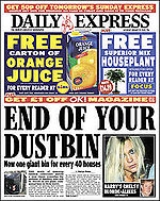
The Daily Express is a conservative, British tabloid newspaper, in its heyday a middle-market title but nowadays very much downmarket. It is the flagship title of Express Newspapers and is currently owned by Richard Desmond. , it has a circulation of 728,296.
Express Newspapers publishes the Daily Express, Sunday Express (launched in 1918), Daily Star and Daily Star Sunday.
Daily Express was founded in 1900 by Cyril Arthur Pearson, publisher of Pearson's Own and other titles.

Discussion
Ask a question about 'Daily Express'
Start a new discussion about 'Daily Express'
Answer questions from other users
|
Encyclopedia
The Daily Express is a conservative, British tabloid newspaper, in its heyday a middle-market title but nowadays very much downmarket. It is the flagship title of Express Newspapers and is currently owned by Richard Desmond. , it has a circulation of 728,296.
Express Newspapers publishes the Daily Express, Sunday Express (launched in 1918), Daily Star and Daily Star Sunday.
History
The Daily Express was founded in 1900 by Cyril Arthur Pearson, publisher of Pearson's Own and other titles. Pearson sold the title after losing his sight and it was bought in 1916 by the future Lord Beaverbrook. It was one of the first papers to carry gossip, sports, and women's features, and the first newspaper in Britain to have a crossword. It moved in 1931 to 120 Fleet Street, a specially-commissioned art deco building. Under Beaverbrook the newspaper achieved a phenomenally high circulation, setting records for newspaper sales several times throughout the 1930s. Its success was partly due to an aggressive marketing campaign and a vigorous circulation war with other populist newspapers. Beaverbrook also discovered and encouraged a gifted editor named Arthur Christiansen, who showed an uncommon gift for staying in touch with the interests of the reading public. The paper also featured Alfred Bestall's Rupert Bear cartoon and satirical cartoons by Carl Giles. An infamous front page headline of these years was "Judea Declares War on Germany", published on March 24, 1933.
In March 1962, Beaverbrook was attacked in the House of Commons for running "a sustained vendetta" against the Royal Family in the Express titles. In the same month Prince Philip, Duke of Edinburgh, in one of his famous unguarded moments, described the Express as "a bloody awful newspaper. It is full of lies, scandal and imagination. It is a vicious paper."
At the height of Beaverbrook's time in control, he told a Royal Commission on the press that he ran his papers "purely for the purpose of making propaganda". The arrival of television and the public's changing interests took their toll on circulation, and following Beaverbrook's death in 1964, the paper's circulation declined for several years.
The Daily Express switched from broadsheet to tabloid in 1977 and was bought by the construction company Trafalgar House in the same year. Its publishing company, Beaverbrook Newspapers, was renamed Express Newspapers. In 1982 Trafalgar House spun off its publishing interests into a new company, Fleet Holdings, but this succumbed to a hostile takeover by United Newspapers in 1985. Under United's ownership, the Express titles moved from Fleet Street to Blackfriars Road in 1989. As part of a marketing campaign designed to increase circulation, the paper was renamed The Express in 1996 (with the Sunday Express becoming The Express on Sunday).
Express Newspapers was sold to publisher Richard Desmond in 2000, by which time the names had reverted to Daily Express and Sunday Express. In 2004 the newspaper moved to its present location on Lower Thames Street in the City of London.
On October 31 2005 UK Media Group Entertainment Rights secured majority interest from the Daily Express on Rupert Bear. They paid £6 million for a 66.6% control of the character. The Express Newspaper retains minority interest in Rupert Bear of 33.33% plus the right to publish Rupert Bear stories in certain Express publications.
Desmond era
In 2000, it was bought by Richard Desmond, publisher of a range of magazines including the celebrity magazine OK!. Controversy surrounded the acquisition because, at the time, Desmond also owned a selection of pornographic magazines such as Big Ones and Asian Babes (which led to him being nicknamed "Dirty Des" by Private Eye). He is still the owner of the most popular pornographic television channel in the UK, Television X. Desmond's purchase of the paper led to the departure of many staff including the then editor, Rosie Boycott, and columnist Peter Hitchens moved to The Mail on Sunday, stating that he could not morally work for a newspaper owned by a pornographer. Boycott, despite her different politics, had an unlikely respect for Hitchens. Stars of old Fleet Street, like the showbiz interviewer and feature writer Paul Callan, were brought in to restore some of the journalistic weight enjoyed by the paper in its peak years.
Sunday Express
The Sunday Express was launched in 1918. It is currently edited by Martin Townsend.
The Daily Express and the Daily Mail
The Daily Express has for many decades been a rival of the Daily Mail, and each frequently attacks the other's journalistic integrity. In the late 1990s, when Tony Blair's New Labour government was at its most popular, the Express attempted to reinvent itself somewhat: it developed a less stridently right wing political stance than the Mail and, under editor Rosie Boycott, presented an agenda to the left of the Mails, referring to itself as "the voice of New Britain". However, the Boycott era was a very short-lived blip in the Express's long history, and since its acquisition by Richard Desmond the paper has moved back to the conservative right. It is known for its frequent headlines about immigration. It also focuses frequently on Muslims, in cases such as Aishah Azmi, a teacher who wore a burka, and the establishment of Shariah courts. In the 2001 general election it supported the Labour Party, but in 2004 it switched its support back to the Conservative Party, which had been its traditional political home for many decades.
The Daily Express has a banner on its front page saying "The World's Greatest Newspaper".
Circulation figures according to the Audit Bureau of Circulations in December 2008 showed gross sales of its long-standing rival the Daily Mail are at 2,139,178, compared with 728,296 for the Daily Express. This is an increase of about 270,000 over the sales figures for the Daily Mail 25 years ago, when it sold 1.87 million copies a day. By comparison, the Daily Express was at that time selling more than 2 million copies a day, so its sales have reduced by roughly 60% over the same period.
More than a third of the Daily Expresss sales today are at less than the full price, a much higher proportion than is the case with the Daily Mail.
Controversial themes
John Bodkin Adams
Suspected serial killer Dr John Bodkin Adams was arrested in 1956 on suspicion of killing up to 400 of his wealthy patients in Eastbourne, England. The press, egged on by police leaks, unanimously declared Adams guilty except for Percy Hoskins, chief crime reporter for the Express. Hoskins was adamant that Adams was merely a naive doctor prosecuted by an overzealous detective, Herbert Hannam, who Hoskins disliked from previous cases. The Express, under Hoskins' direction, was therefore the only major paper to defend Adams, causing Lord Beaverbrook to frequently question Hoskins' stance on the matter. Adams was tried on one count of murder in 1957 and found not guilty (a second count was withdrawn controversially). After the case a jubilant Beaverbrook phoned Hoskins and said: "Two people were acquitted today" - meaning Hoskins as well. The Express then carried an exclusive interview with Adams, who Hoskins interviewed for two weeks after the trial in a safe house away from other newspapers. According to archives released in 2003, Adams was thought by police to have killed 163 patients.
"Diana Express"
The Daily Express has a reputation for consistently printing conspiracy theories based on the death of Princess Diana as front page news, earning it the nickname, the Daily Ex-Princess; this is often satirised in Private Eye, the newspaper being labelled the Diana Express or the Di'ly Express, possibly due to Desmond's close friendship with regular Eye target Mohamed Fayed. Even on July 7, 2006, the anniversary of the London bombings (used by most other newspapers to publish commemorations) the front page was given over to Diana. This tendency was also mocked on Have I Got News for You when on November 6, 2006, the day other papers reported the death sentence given to Saddam Hussein on their front pages, the Express led with “SPIES COVER UP DIANA 'MURDER'”.
According to The Independent "The Diana stories appear on Mondays because Sunday is often a quiet day."
"Madeleine Express"
In the second half of 2007 the Daily Express gave a large amount of coverage to the missing child Madeleine McCann. From August 3, 2007, the Express dedicated at least part of the next 100 front pages to Madeleine in a run that lasted until November 10, 2007. Of the 100, 82 of these were the main headline (often stylised by "MADELEINE" in red block capitals, plus a picture of the child).
Though the family initially said that some journalists may have "overstepped their mark" they acknowledged the benefits in keeping the case in the public eye, but argued that the coverage needed to be toned down since daily headlines are not necessarily helpful. However, in March 2008, the McCanns launched a libel suit against the Daily Express and its sister newspaper, the Daily Star, as well as their Sunday equivalents, following the newspapers' coverage of the case. The action concerned more than 100 stories across the four newspapers, which accused the McCanns of involvement in their daughter's disappearance. One immediate consequence of the action was that Express Newspapers pulled all references to Madeleine from its websites.
In a settlement reached at the High Court of Justice, the newspapers agreed to run a front-page apology to the McCanns on March 19, 2008, publish another apology on the front pages of the Sunday editions of March 23 and make a statement of apology at the High Court. These apologies were described by media commentator Roy Greenslade as "unprecedented". The newspapers also agreed to pay costs and substantial damages, which the McCanns said they would use to fund the search for their daughter. In its apology, the Express stated that "a number of articles in the newspaper have suggested that the couple caused the death of their missing daughter Madeleine and then covered it up. We acknowledge that there is no evidence whatsoever to support this theory and that Kate and Gerry are completely innocent of any involvement in their daughter's disappearance." This was followed in October by an apology and payout (forwarded to the fund again) to a group who had become known as the "Tapas Seven" in relation to the case.
Editors
Daily Express
Sunday Express
- 1928: John Gordon
- 1952: Harold Keeble
- 1954: John Junor
- 1986: Robin Esser
- 1989: Robin Morgan
- 1991: Eve Pollard
- 1994: Brian Hitchen
- 1995: Sue Douglas
- 1996:
- 1998: Amanda Platell
- 1999: Michael Pilgrim
- 2001: Martin Townsend
Columnists
Present columnists:
Past columnists:
See also
External links
-
- - Archive of each Daily Mail cover featuring Princess Diana since January 2006.
-
|
| |
|
|