

Qingdao

Encyclopedia
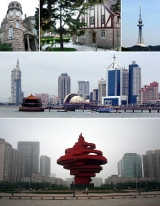
also known in the West by its postal map spelling Tsingtao, is a major city with a population of over 8.715 million (2010 census) in eastern Shandong
province, Eastern China
. Its built up area, made of 7 urban districts plus Jimo
city, is home to about 4,346,000 inhabitants in 2010.
It borders Yantai
to the northeast, Weifang
to the west and Rizhao
to the southwest. The character (qīng) in Chinese means "green" or "lush", while the character (dǎo) means "island". Qingdao is administered at the sub-provincial level
.
Lying across the Shandong Peninsula while looking out to the Yellow Sea
, Qingdao is a major seaport, naval base
, and industrial centre. It is also the site of the Tsingtao Brewery
. The world's longest sea bridge, the Qingdao Haiwan Bridge
, links the main urban area of Qingdao with Huangdao district, straddling the Jiaozhou Bay
sea areas. In 2009, Qingdao was named China's most livable city.
nationality, one of the important origins of the Chinese nation, lived here and created the Dawenkou, Longshan
and Dongyeshi cultures. In the Eastern Zhou Dynasty (770BC~256BC), the town of Jimo
was established, which was then the second largest one in the Shandong region. The area in which Qingdao is located today was named Jiao'ao (胶澳) when it was administered by the Qing Dynasty on 14 June 1891.
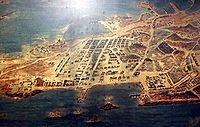

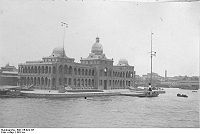
In 1891 the Qing government decided to make the area a defense base against naval attack and began to improve Qingdao's existing fortifications. German naval officials observed and reported on this Chinese activity during a formal survey of Jiaozhou Bay
in May 1897. Subsequently, German troops seized and occupied the fortification. China conceded the area to Germany the following year, and the Kiautschou Bay concession, as it became known, existed from 1898 to 1914. With an area of 552 km² (136,402 acre; 213.1 sq mi), it was located in the imperial province of Shandong
(alternately romanized as Shantung or Shan-tung) on the southern coast of the Shandong Peninsula in northern China. Jiaozhou was romanized as Kiaochow, Kiauchau or Kiao-Chau in English and Kiautschou in German. Qingdao was its administrative center. "The so-called Marktstrasse (Market street) was nothing more than the old main street of the Chinese village of Tsingtao, and the buildings lining it were the former homes of fishermen and farmers. Having sold their property, they resettled their homes and fields in the villages further east." Upon gaining control of the area, the Germans outfitted the impoverished fishing village of "Tsingtao" (Qingdao) with wide streets, solid housing areas, government buildings, electrification throughout, a sewer system and a safe drinking water supply, a rarity in large parts of Asia at that time and later. The area had the highest school density and the highest per capita student enrollment in all of China, with primary, secondary and vocational schools funded by the Imperial German
treasury and Protestant and Roman Catholic missions. Commercial interests established the Germania Brewery in 1903, which later became the world-famous Tsingtao Brewery
. German influence extended to other areas of Shandong Province, including the establishment of diverse commercial enterprises.
Identified by the German authorities as a strategically important port, Qingdao was administered by the Imperial Department of the Navy (Reichsmarineamt) rather than the Imperial Colonial Office (Reichskolonialamt). The navy based their Far East Squadron
there, allowing the ships to conduct operations throughout the Pacific. Beginning January 1898 the marines of III. Seebatallion
were based at Tsingtao.
Before the outbreak of World War I the ships of the German naval forces under Admiral Count von Spee
were located at central Pacific colonies on routine missions. The fleet then rendezvoused in the Marianas to plan a transit to Germany rather than be trapped in the Pacific by Allied fleets.
After a minor British naval attack on the German colony in 1914, Japan occupied the city and the surrounding province during the Siege of Tsingtao after Japan's declaration of war on Germany in accordance with the Anglo-Japanese Alliance
. The failure of the Allied powers to restore Chinese rule to Shandong after the war triggered the May Fourth Movement
.
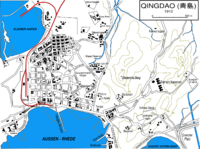 The city reverted to Chinese rule in December, 1922, under control of the Republic of China
. The city became a direct-controlled municipality
of the ROC Government in 1929. Japan re-occupied Qingdao in 1938 with its plans of territorial expansion onto China's coast.
allowed Qingdao to serve as the headquarters of the Western Pacific Fleet of the US Navy in 1945. On 2 June 1949 the CCP-led Red Army entered Qingdao and the city and province have been under PRC
control since that time.
Since the 1984 inauguration of China's open-door policy to foreign trade and investment, western Qingdao developed quickly as a port city. It is now the headquarters of the Chinese navy's northern fleet. An early example of the open-door policy occurred on 5 November 1984, when three United States Naval vessels visited Qingdao. This was the first US port call in more than 37 years to China. , and and their crews were officially hosted by the Chinese People's Liberation Army Navy
(PLAN).
Northern Qingdao, particularly Shibei and Chengyang districts, is now a manufacturing center. The city has recently experienced a strong growth period, with a new central business district created to the east of the older business district. Outside of the center of the city there is a large industrial zone, which includes chemical processing, rubber and heavy manufacturing, in addition to a growing high-tech area. Numerous local and national service companies, rather than manufacturers, are based in the city's southern district; this, as well as local wind patterns, allows Qingdao to enjoy clean, clear air year round.
(区 qu) and 5 county-level cities
(市 shi):
*These codes are also being used by ID cards.
Geographically, Shinan is viewed as the old downtown, located in the south of Qingdao city proper, while Sifang and Shibei are located in the center of the city with Shibei designated as the new downtown, and Licang located further up the peninsula in the outskirts of the city. In 2003, the percentage of Qingdao's population in these four districts was 21.0 percent, 20.8 percent, 16.8 percent, and 12.5 percent, respectively.
to the northeast, Weifang
to the west, and Rizhao
to the southwest. The city's total jurisdiction area occupies 10654 square kilometres (4,114 sq mi), and stretches in latitude from 35° 35' to 37° 09' N and in longitude from 119° 30' to 121° 00' E. The populated sections of the city are relatively flat while mountains spur up within city limits and nearby. The highest elevation in the city is 1133 metres (3,717.2 ft) above sea level. 15.5% of the total area is highland, while the foothill, plain and lowland areas constitute 25.1%, 37.8% and 21.7%. The city has a 730.64 kilometres (454 mi) coastline. Five significant rivers that flow for more than 50 kilometres (31 mi) can be found in the region.
Qingdao has a temperate, four-season, monsoon
-influenced climate that falls on the borderline between humid subtropical
(Köppen
Cwa) and humid continental
(Köppen Dwa). Winter is cool to cold and windy, but generally dry, with a January average of -0.5 °C. Summer is generally hot and humid, but very hot days are rare, with an August average of 25.3 °C (77.5 °F). Due to its proximity to the coast and being on a peninsula, it experiences a one-month delayed spring compared to most inland areas of China. Conversely, autumn is milder than inland areas in Shandong. The water temperature peaks at about 25 °C (77 °F) in late August, with swimming possible two months on either side. The annual mean temperature is 12.6 °C (54.7 °F).
of 10.15 per year per thousand, and a death rate of 6.32, both calculated on an annual basis. Living standards are among highest of leading Chinese cities due to the strong export economy and relatively high family wages.
Qingdao is home to 38 Chinese ethnic minorities, which account for 0.14% of the city's total population.
There is a large Korean community in Qingdao. By 2009, there are approximately 100,000 Koreans working, studying and living in Qingdao, which makes Qingdao the second in terms of Korean population in China, following Beijing which has about 200,000 Koreans.
per capita comprised RMB¥
52,895 (US$7,616) in 2008. The GDP has grown steadily at an average pace of 16% annually. In 2006, Qingdao was ranked one of six "golden cities" by the World Bank, out of 120 Chinese cities assessed on factors including investment climate and government effectiveness.
Internationally, Qingdao is perhaps best known for its Tsingtao Brewery
, founded by a German-British joint venture in 1903 that produces Tsingtao beer, the most well-known Chinese export beer. It is also home to Haier
, a large white goods manufacturer, and Hisense
, a major electronics company. In 2002 guitar manufacturer Epiphone
opened a factory in Qingdao.
In 1984 the Chinese government named a district of Qingdao a Special Economic and Technology Development Zone (SETDZ). Along with this district, the entire city had gone through amazing development of secondary and tertiary industries. As an important trading port in the province, Qingdao flourishes with foreign investment and international trade. South Korea
and Japan in particular made extensive investment in the city. Approximately 80,000 South Korean citizens reside there. Construction proceeds at a relatively fast pace in Qingdao.
In terms of primary industry, Qingdao has an estimated 50,000 acres (200 km²) of arable land
. Qingdao has a zigzagging pattern coastline, and thus possesses an invaluable stock of fish, shrimp
, and other sea resources.
Qingdao is also home to a variety of mineral resources. Up to thirty different kinds have been mined. Qingdao's wind power
electricity generation performs at among the best levels in the region. The city has also a number of paper mills. One plant is called Qingdao Bei Fa paper mill. Mill's machine is Karlstads Mekaniska Werkstad (KMW)-made (width 3048 mm) and it was acquired from Kajaani paper mill in Finland in the middle of the 1980s.
Approved by the State Council in October 1984, Qingdao Economic and Technical Development Zone has a planned of 12.5 square kilometers. In 2004 the local GDP is 27.51 billion RMB, increased by 28.9%; the total industrial output value is 60.6 billion RMB, increased by 31%. There have been 48 projects invested by companies listed among the Global Fortune 500 in the zone. With the fast development of reform and opening-up, Haier, Hisense, Aucma, Sinopec, CSIC, CNOOC, CIMC etc. all locate in the zone.
Qingdao Free Trade Zone was established by the State Council in 1992. The zone is 60 km away from Qingdao Liuting Airport. It is also close to Qingdao Qianwan Harbor. At present, more than 40 foreign-invested enterprises have moved in and 2000 projects have been approved. It is one of the special economic areas which enjoys the most favorable investment policies on customs, foreign exchange, foreign trade and taxation in China.
Qingdao High-Tech Industrial Development Zone was approved the State Council in 1992. The zone is located close to Qingdao Liuting Airport and Qingdao Harbor. Encouraged industries include electronic information, biotechnology, medicine, new materials, new energy, advanced equipment manufacturing, marine science & technology, national defense technology.
.
, and the Blue Sea Ferry operates between Qingdao and Gunsan
.
Qingdao hosts one of China's largest seaports. Cooperative relations have been established with 450 ports in 130 countries worldwide. The 1999 annual cargo handling capacity was 72 million ton
s. Exported commodities amounted to more than 35 million tons and of cargo.
, 65 kilometres away from city centre, is served by 13 domestic and international airline
s, operating 94 routes, 12 of which are international and regional. It is estimated that in 2007 that 7.868 million people, including 1,082,000 international travelers, were transported through the airport.
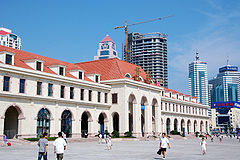 Qingdao's railway development was picked up during the late 1990s. It is at the beginning of the Jiaoji Railway
. Qingdao's city proper has some major railway stations, Qingdao Station
, Sifang Station
, Cangkou Station, Great-Seaport Station, etc. At the present, domestic rail lines connect Qingdao with cities including Beijing, Lanzhou
, Chengdu
, Xi'an
, Zhengzhou
, Jinan
and Jining
.
buses and trolleybus
es, operating more than 200 routes. All of these buses and trolleybuses can be accessed using the Qingdao Public Traffic IC Card (Ri-Xin Card ), which uses radio frequencies so the card does not have to physically touch the scanner. The volume of road passenger transport approaches 0.8 billion per year. The Public Transport Brand of 'Ri-Xin Bus ' is also known in China.
There are a number of taxi companies in Qingdao including Yiqing Company, Zhongqing Company, Jiaoyun Company and, Huaqing Company.
of the People's Liberation Army Navy
.
Other notable people include:
(青岛话, pinyin qingdao hua) distinguishes the residents of the city from those of the surrounding Shandong
province. Due to the efforts by the city government to promote standard Mandarin, most educated people can speak that language in addition to their native language. With reform policies and English teaching, some young citizens have been taught English and many can converse with foreigners. Business and traffic signs in English are becoming more and more common.
s, abalone
s, shark
's fin, prawn
s, crabs, conch
, and some big fish, and "Little Seafood" comprising squid
, shrimp
s, octopus
, oyster
s, razor clams, clam
s, periwinkle
s, yellow croakers, etc. Generally, fresh seafood is served in every hotel.
The distinctive cuisine of the area is Lu Cai
, the Shandong
regional style.
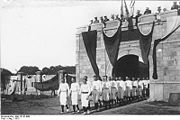
Qingdao's major attractions include:
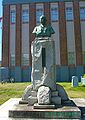
, Qingdao was the host city for the Olympic Sailing competitions which took place along the shoreline by the city. These events were hosted at the Qingdao International Sailing Centre
and held in Fushan Bay, near the city's central business district. A hotel and an international broadcasting centre were built.
race in Qingdao in 2012. The race will take place on a 3.87 mi (6.2 km) street circuit.
with:
Shandong
' is a Province located on the eastern coast of the People's Republic of China. Shandong has played a major role in Chinese history from the beginning of Chinese civilization along the lower reaches of the Yellow River and served as a pivotal cultural and religious site for Taoism, Chinese...
province, Eastern China
East China
East China is a geographical and a loosely-defined cultural region that covers the eastern coastal area of China.Although an intangible and loosely defined concept, for administrative and governmental purposes, the region is defined by the government of the People's Republic of China to include...
. Its built up area, made of 7 urban districts plus Jimo
Jimo
Jimo or JIMO may refer to:* Jimo, county-level city of Qingdao, Shandong, China* Jupiter Icy Moons Orbiter , a formerly proposed NASA probe to Jupiter and Europa* Java-based Instant Messenger One* Joint Institute for Marine Observations...
city, is home to about 4,346,000 inhabitants in 2010.
It borders Yantai
Yantai
Yantai is a prefecture-level city in northeastern Shandong province, People's Republic of China. Located on the southern coast of the Bohai Sea and the eastern coast of the Laizhou Bay, Yantai borders the cities of Qingdao and Weihai to the southwest and east respectively.The largest fishing...
to the northeast, Weifang
Weifang
Weifang is a prefecture-level city in central Shandong province, People's Republic of China. It borders Dongying to the northwest, Zibo to the west, Linyi to the southwest, Rizhao to the south, Qingdao to the east, and looks out to the Laizhou Bay to the north.-History:Weifang is a historical city...
to the west and Rizhao
Rizhao
Rizhao is a prefecture-level city in southeastern Shandong province, People's Republic of China. It is situated on the coastline along the Yellow Sea, borders Qingdao to the northeast, Weifang to the north, Linyi to the west and southwest, and faces Korea and Japan across the Yellow Sea to the east...
to the southwest. The character (qīng) in Chinese means "green" or "lush", while the character (dǎo) means "island". Qingdao is administered at the sub-provincial level
Sub-provincial city
A sub-provincial divisions in the People's Republic of China, is like a prefecture-level city that is ruled by a province, but is administered independently in regard to economy and law....
.
Lying across the Shandong Peninsula while looking out to the Yellow Sea
Yellow Sea
The Yellow Sea is the name given to the northern part of the East China Sea, which is a marginal sea of the Pacific Ocean. It is located between mainland China and the Korean Peninsula. Its name comes from the sand particles from Gobi Desert sand storms that turn the surface of the water golden...
, Qingdao is a major seaport, naval base
Naval base
A naval base is a military base, where warships and naval ships are deployed when they have no mission at sea or want to restock. Usually ships may also perform some minor repairs. Some naval bases are temporary homes to aircraft that usually stay on the ships but are undergoing maintenance while...
, and industrial centre. It is also the site of the Tsingtao Brewery
Tsingtao Brewery
Tsingtao Brewery Co.,Ltd. is China's second largest brewery. It was founded in 1903 by German settlers and now claims about 15% of domestic market share. The beer is produced in Tsingtao/Qingdao in Shandong province , but the name of the beer uses the old École française d'Extrême-Orient...
. The world's longest sea bridge, the Qingdao Haiwan Bridge
Qingdao Haiwan Bridge
Jiaozhou Bay Bridge is a roadway bridge in eastern China's Shandong province. It transects Jiaozhou Bay, connecting Huangdao District, the city of Qingdao and Hongdao Island . Opened on 30 June 2011, it reduces the road distance between Qingdao and Huangdao...
, links the main urban area of Qingdao with Huangdao district, straddling the Jiaozhou Bay
Jiaozhou Bay
The Jiaozhou Bay is a sea gulf located in Qingdao Prefecture of Shandong Province. It was a German colonial concession from 1898 until 1914....
sea areas. In 2009, Qingdao was named China's most livable city.
Other names
- Jiāo'ào : former name during Qing DynastyQing DynastyThe Qing Dynasty was the last dynasty of China, ruling from 1644 to 1912 with a brief, abortive restoration in 1917. It was preceded by the Ming Dynasty and followed by the Republic of China....
. - Qindao (岛, lit. "Stringed Instrument Isle"): additional modern name for the area, refers according to locals to the shape of the coastline.
- Tsingtau: German name during concession period, written in German romanization of Chinese, known as Lessing-OthmerLessing-OthmerLessing-Othmer is a romanisation of Mandarin Chinese that was once used by Germans written by F. Lessing and Dr. W. Othmer, who in 1912 printed their book "Lehrgang der nordchinesischen Umgangssprache" in Qingdao whilst it was a German colony in 1912 through the "Deutsch-Chinesische Druckerei und...
- Tsingtao: western postal name.
Ancient times
Human settlement in the area dates back 6,000 years. The DongyiDongyi
Dongyi was a collective term for people in eastern China and in lands located to the east of ancient China. People referred to as Dongyi vary across the ages.The early Dongyi culture was one of earliest neolithic cultures in China....
nationality, one of the important origins of the Chinese nation, lived here and created the Dawenkou, Longshan
Longshan culture
The Longshan culture was a late Neolithic culture in China, centered on the central and lower Yellow River and dated from about 3000 BC to 2000 BC...
and Dongyeshi cultures. In the Eastern Zhou Dynasty (770BC~256BC), the town of Jimo
Jimo, Shandong
Jimo is a county-level city in Shandong province, China, located north of Qingdao.-Location:Jimo is located in the southwest of the Shandong Peninsula, bordered by the Yellow Sea on the east and Mount Lao on the south.-Climate:...
was established, which was then the second largest one in the Shandong region. The area in which Qingdao is located today was named Jiao'ao (胶澳) when it was administered by the Qing Dynasty on 14 June 1891.
German colonial period and Japanese occupation
In 1891 the Qing government decided to make the area a defense base against naval attack and began to improve Qingdao's existing fortifications. German naval officials observed and reported on this Chinese activity during a formal survey of Jiaozhou Bay
Jiaozhou Bay
The Jiaozhou Bay is a sea gulf located in Qingdao Prefecture of Shandong Province. It was a German colonial concession from 1898 until 1914....
in May 1897. Subsequently, German troops seized and occupied the fortification. China conceded the area to Germany the following year, and the Kiautschou Bay concession, as it became known, existed from 1898 to 1914. With an area of 552 km² (136,402 acre; 213.1 sq mi), it was located in the imperial province of Shandong
Shandong
' is a Province located on the eastern coast of the People's Republic of China. Shandong has played a major role in Chinese history from the beginning of Chinese civilization along the lower reaches of the Yellow River and served as a pivotal cultural and religious site for Taoism, Chinese...
(alternately romanized as Shantung or Shan-tung) on the southern coast of the Shandong Peninsula in northern China. Jiaozhou was romanized as Kiaochow, Kiauchau or Kiao-Chau in English and Kiautschou in German. Qingdao was its administrative center. "The so-called Marktstrasse (Market street) was nothing more than the old main street of the Chinese village of Tsingtao, and the buildings lining it were the former homes of fishermen and farmers. Having sold their property, they resettled their homes and fields in the villages further east." Upon gaining control of the area, the Germans outfitted the impoverished fishing village of "Tsingtao" (Qingdao) with wide streets, solid housing areas, government buildings, electrification throughout, a sewer system and a safe drinking water supply, a rarity in large parts of Asia at that time and later. The area had the highest school density and the highest per capita student enrollment in all of China, with primary, secondary and vocational schools funded by the Imperial German
German Empire
The German Empire refers to Germany during the "Second Reich" period from the unification of Germany and proclamation of Wilhelm I as German Emperor on 18 January 1871, to 1918, when it became a federal republic after defeat in World War I and the abdication of the Emperor, Wilhelm II.The German...
treasury and Protestant and Roman Catholic missions. Commercial interests established the Germania Brewery in 1903, which later became the world-famous Tsingtao Brewery
Tsingtao Brewery
Tsingtao Brewery Co.,Ltd. is China's second largest brewery. It was founded in 1903 by German settlers and now claims about 15% of domestic market share. The beer is produced in Tsingtao/Qingdao in Shandong province , but the name of the beer uses the old École française d'Extrême-Orient...
. German influence extended to other areas of Shandong Province, including the establishment of diverse commercial enterprises.
Identified by the German authorities as a strategically important port, Qingdao was administered by the Imperial Department of the Navy (Reichsmarineamt) rather than the Imperial Colonial Office (Reichskolonialamt). The navy based their Far East Squadron
German East Asia Squadron
The German East Asia Squadron was a German Navy cruiser squadron which operated mainly in the Pacific Ocean between the 1870s and 1914...
there, allowing the ships to conduct operations throughout the Pacific. Beginning January 1898 the marines of III. Seebatallion
Seebatallione
The Seebatallione [sea battalions] were naval infantry troops or marines serving in the Prussian navy, the navy of the North German Confederation, the Imperial German Navy, the Wehrmacht, and briefly in the modern Federal German Navy, the Bundesmarine....
were based at Tsingtao.
Before the outbreak of World War I the ships of the German naval forces under Admiral Count von Spee
Maximilian von Spee
Vice Admiral Maximilian Reichsgraf von Spee was a German admiral. Although he was born in Copenhagen, Denmark, the counts von Spee belonged to the prominent families of the Rhenish nobility. He joined the Kaiserliche Marine in 1878. In 1887–88 he commanded the Kamerun ports, in German West...
were located at central Pacific colonies on routine missions. The fleet then rendezvoused in the Marianas to plan a transit to Germany rather than be trapped in the Pacific by Allied fleets.
After a minor British naval attack on the German colony in 1914, Japan occupied the city and the surrounding province during the Siege of Tsingtao after Japan's declaration of war on Germany in accordance with the Anglo-Japanese Alliance
Anglo-Japanese Alliance
The first was signed in London at what is now the Lansdowne Club, on January 30, 1902, by Lord Lansdowne and Hayashi Tadasu . A diplomatic milestone for its ending of Britain's splendid isolation, the alliance was renewed and extended in scope twice, in 1905 and 1911, before its demise in 1921...
. The failure of the Allied powers to restore Chinese rule to Shandong after the war triggered the May Fourth Movement
May Fourth Movement
The May Fourth Movement was an anti-imperialist, cultural, and political movement growing out of student demonstrations in Beijing on May 4, 1919, protesting the Chinese government's weak response to the Treaty of Versailles, especially the Shandong Problem...
.
Republic of China
The Republic of China , commonly known as Taiwan , is a unitary sovereign state located in East Asia. Originally based in mainland China, the Republic of China currently governs the island of Taiwan , which forms over 99% of its current territory, as well as Penghu, Kinmen, Matsu and other minor...
. The city became a direct-controlled municipality
Direct-controlled municipality
A direct-controlled municipality is the highest level classification for cities used by unitary state, with status equal to that of the provinces in the respective countries...
of the ROC Government in 1929. Japan re-occupied Qingdao in 1938 with its plans of territorial expansion onto China's coast.
Post–World War II
After World War II the KMTKuomintang
The Kuomintang of China , sometimes romanized as Guomindang via the Pinyin transcription system or GMD for short, and translated as the Chinese Nationalist Party is a founding and ruling political party of the Republic of China . Its guiding ideology is the Three Principles of the People, espoused...
allowed Qingdao to serve as the headquarters of the Western Pacific Fleet of the US Navy in 1945. On 2 June 1949 the CCP-led Red Army entered Qingdao and the city and province have been under PRC
People's Republic of China
China , officially the People's Republic of China , is the most populous country in the world, with over 1.3 billion citizens. Located in East Asia, the country covers approximately 9.6 million square kilometres...
control since that time.
Since the 1984 inauguration of China's open-door policy to foreign trade and investment, western Qingdao developed quickly as a port city. It is now the headquarters of the Chinese navy's northern fleet. An early example of the open-door policy occurred on 5 November 1984, when three United States Naval vessels visited Qingdao. This was the first US port call in more than 37 years to China. , and and their crews were officially hosted by the Chinese People's Liberation Army Navy
People's Liberation Army Navy
The People's Liberation Army Navy is the naval branch of the People's Liberation Army , the military of the People's Republic of China. Until the early 1990s, the navy performed a subordinate role to the PLA Land Forces. Since then, it has undergone rapid modernisation...
(PLAN).
Northern Qingdao, particularly Shibei and Chengyang districts, is now a manufacturing center. The city has recently experienced a strong growth period, with a new central business district created to the east of the older business district. Outside of the center of the city there is a large industrial zone, which includes chemical processing, rubber and heavy manufacturing, in addition to a growing high-tech area. Numerous local and national service companies, rather than manufacturers, are based in the city's southern district; this, as well as local wind patterns, allows Qingdao to enjoy clean, clear air year round.
Administrative divisions
The sub-provincial city of Qingdao has direct jurisdiction over 7 districtsDistrict (PRC)
The term district, in the context of the People's Republic of China refers to several unrelated political divisions in both ancient and modern China....
(区 qu) and 5 county-level cities
County-level city
A county-level city is a county-level administrative division of mainland China. County-level cities are usually governed by prefecture-level divisions, but a few are governed directly by province-level divisions....
(市 shi):
| Subdivision | Population | Land area | Post Code | Admin. Area Code* | ||
|---|---|---|---|---|---|---|
| as of 2007 | km² | |||||
| Qingdao City Proper | ||||||
| ■ Shinan-qu Shinan District Shinan District is a district of Qingdao in the Chinese province of Shandong. It has an area of and had approximately 527,000 inhabitants as of 2007. Shinan is located in coastal hilled terrain, and has a temperate monsoon climate. Common features include moderate temperatures, moist air,... |
市南区 / 市南區 | 430,000 | 30.01 | 266000 | 370202 | |
| ■ Shibei-qu Shibei District Shibei is a district of Qingdao in the Chinese province of Shandong. It has an area of 28.63 km² and around 474,529 inhabitants .- External links :*... |
市北区 / 市北區 | 470,000 | 28.63 | 266000 | 370203 | |
| ■ Sifang-qu Sifang District Sifang is a district of Qingdao in the Chinese province of Shandong. It has an area of 34.55 km² and around 383,700 inhabitants .- External links :*... |
四方区 / 四方區 | 360,000 | 34.55 | 266000 | 370205 | |
| ■ Licang-qu Licang District Licang is a district of Qingdao in the Chinese province of Shandong. It has an area of 95.52 km² and around 280,800 inhabitants .- External links :*... |
李沧区 / 李滄區 | 280,000 | 95.52 | 266000 | 370213 | |
| Qingdao Suburban and Rural | ||||||
| ■ Laoshan-qu Laoshan District -Laoshan District:Laoshan District is an administrative division of Qingdao. Its area is 389 km².-Geography:Laoshan District is located in the south of Shandong Peninsula, facing the Yellow Sea in the east and south. It covers 389.34square kilometer with 103.7km coastline.The district belongs to... |
崂山区 / 嶗山區 | 190,000 | 389.34 | 266100 | 370212 | |
| ■ Chengyang-qu Chengyang District Chengyang is a district of Qingdao, Shandong, People's Republic of China. It has an area of and around 447,000 inhabitants .- External links :*... |
城阳区 / 城陽區 | 430,000 | 553.2 | 266000 | 370214 | |
| ■ Huangdao-qu Huangdao District Huangdao District is a district in Qingdao, Shandong, China. It is situated on the west bank of Jiaozhou Bay. It is identical to Qingdao Economic and Technological Development Zone which was launched in 1985 after the zone was merged with Huangdao District and set up the Free Trade Zone in... |
黄岛区 / 黃島區 | 260,000 | 274.1 | 266000 | 370211 | |
| ■ Jiaozhou-shi | 胶州市 / 膠州市 | 750,000 | 1210 | 266300 | 370281 | |
| ■ Jiaonan-shi Jiaonan Jiaonan is a county-level city of Qingdao sub-provincial city, Shandong Province, China.... |
胶南市 / 膠南市 | 840,000 | 1927 | 266400 | 370284 | |
| ■ Jimo-shi Jimo, Shandong Jimo is a county-level city in Shandong province, China, located north of Qingdao.-Location:Jimo is located in the southwest of the Shandong Peninsula, bordered by the Yellow Sea on the east and Mount Lao on the south.-Climate:... |
即墨市 / 即墨市 | 1,070,000 | 1727 | 266200 | 370282 | |
| ■ Pingdu-shi Pingdu Pingdu is a county-level city of Qingdao sub-provincial city, Shandong Province, China.It is located in the centre of the Shandong Peninsula. It has an area of 3,166 km2 and a population of 1,340,000 people.... |
平度市 / 平度市 | 1,330,000 | 3166 | 266700 | 370283 | |
| ■ Laixi-shi Laixi Laixi is a county-level city of Qingdao sub-provincial city, Shandong Province, China.... |
莱西市 / 萊西市 | 720,000 | 1522 | 266600 | 370285 | |
*These codes are also being used by ID cards.
Geographically, Shinan is viewed as the old downtown, located in the south of Qingdao city proper, while Sifang and Shibei are located in the center of the city with Shibei designated as the new downtown, and Licang located further up the peninsula in the outskirts of the city. In 2003, the percentage of Qingdao's population in these four districts was 21.0 percent, 20.8 percent, 16.8 percent, and 12.5 percent, respectively.
Geography and climate
Qingdao is located on the south facing coast of the Shandong Peninsula. It borders three prefecture-level cities, namely YantaiYantai
Yantai is a prefecture-level city in northeastern Shandong province, People's Republic of China. Located on the southern coast of the Bohai Sea and the eastern coast of the Laizhou Bay, Yantai borders the cities of Qingdao and Weihai to the southwest and east respectively.The largest fishing...
to the northeast, Weifang
Weifang
Weifang is a prefecture-level city in central Shandong province, People's Republic of China. It borders Dongying to the northwest, Zibo to the west, Linyi to the southwest, Rizhao to the south, Qingdao to the east, and looks out to the Laizhou Bay to the north.-History:Weifang is a historical city...
to the west, and Rizhao
Rizhao
Rizhao is a prefecture-level city in southeastern Shandong province, People's Republic of China. It is situated on the coastline along the Yellow Sea, borders Qingdao to the northeast, Weifang to the north, Linyi to the west and southwest, and faces Korea and Japan across the Yellow Sea to the east...
to the southwest. The city's total jurisdiction area occupies 10654 square kilometres (4,114 sq mi), and stretches in latitude from 35° 35' to 37° 09' N and in longitude from 119° 30' to 121° 00' E. The populated sections of the city are relatively flat while mountains spur up within city limits and nearby. The highest elevation in the city is 1133 metres (3,717.2 ft) above sea level. 15.5% of the total area is highland, while the foothill, plain and lowland areas constitute 25.1%, 37.8% and 21.7%. The city has a 730.64 kilometres (454 mi) coastline. Five significant rivers that flow for more than 50 kilometres (31 mi) can be found in the region.
Qingdao has a temperate, four-season, monsoon
Monsoon
Monsoon is traditionally defined as a seasonal reversing wind accompanied by corresponding changes in precipitation, but is now used to describe seasonal changes in atmospheric circulation and precipitation associated with the asymmetric heating of land and sea...
-influenced climate that falls on the borderline between humid subtropical
Humid subtropical climate
A humid subtropical climate is a climate zone characterized by hot, humid summers and mild to cool winters...
(Köppen
Köppen climate classification
The Köppen climate classification is one of the most widely used climate classification systems. It was first published by Crimea German climatologist Wladimir Köppen in 1884, with several later modifications by Köppen himself, notably in 1918 and 1936...
Cwa) and humid continental
Humid continental climate
A humid continental climate is a climatic region typified by large seasonal temperature differences, with warm to hot summers and cold winters....
(Köppen Dwa). Winter is cool to cold and windy, but generally dry, with a January average of -0.5 °C. Summer is generally hot and humid, but very hot days are rare, with an August average of 25.3 °C (77.5 °F). Due to its proximity to the coast and being on a peninsula, it experiences a one-month delayed spring compared to most inland areas of China. Conversely, autumn is milder than inland areas in Shandong. The water temperature peaks at about 25 °C (77 °F) in late August, with swimming possible two months on either side. The annual mean temperature is 12.6 °C (54.7 °F).
Demographics
By the end of 2006, Qingdao was estimated to be the home of about 8 million inhabitants, of which around 3 million reside in the Qingdao urban area. Another estimated 5 million live in other cities under Qingdao's jurisdiction. The annual birth rate is calculated around 76,507, with a birth rateBirth rate
Crude birth rate is the nativity or childbirths per 1,000 people per year . Another word used interchangeably with "birth rate" is "natality". When the crude birth rate is subtracted from the crude death rate, it reveals the rate of natural increase...
of 10.15 per year per thousand, and a death rate of 6.32, both calculated on an annual basis. Living standards are among highest of leading Chinese cities due to the strong export economy and relatively high family wages.
Qingdao is home to 38 Chinese ethnic minorities, which account for 0.14% of the city's total population.
There is a large Korean community in Qingdao. By 2009, there are approximately 100,000 Koreans working, studying and living in Qingdao, which makes Qingdao the second in terms of Korean population in China, following Beijing which has about 200,000 Koreans.
Economy
An important region in Eastern China, Shandong Province has seen substantial change in its economic landscape in recent years. Much of this development has been concentrated in Qingdao. Qingdao has seen rapid development. With an annual growth rate of 18.9 percent in 2006, the city's GDP reached 42.3 billion, ranking first in Shandong Province and tenth out of China's top 20 cities. GDPGross domestic product
Gross domestic product refers to the market value of all final goods and services produced within a country in a given period. GDP per capita is often considered an indicator of a country's standard of living....
per capita comprised RMB¥
Renminbi
The Renminbi is the official currency of the People's Republic of China . Renminbi is legal tender in mainland China, but not in Hong Kong or Macau. It is issued by the People's Bank of China, the monetary authority of the PRC...
52,895 (US$7,616) in 2008. The GDP has grown steadily at an average pace of 16% annually. In 2006, Qingdao was ranked one of six "golden cities" by the World Bank, out of 120 Chinese cities assessed on factors including investment climate and government effectiveness.
Internationally, Qingdao is perhaps best known for its Tsingtao Brewery
Tsingtao Brewery
Tsingtao Brewery Co.,Ltd. is China's second largest brewery. It was founded in 1903 by German settlers and now claims about 15% of domestic market share. The beer is produced in Tsingtao/Qingdao in Shandong province , but the name of the beer uses the old École française d'Extrême-Orient...
, founded by a German-British joint venture in 1903 that produces Tsingtao beer, the most well-known Chinese export beer. It is also home to Haier
Haier
Haier Group is a multinational consumer electronics and home appliances company headquartered in Qingdao, Shandong, People's Republic of China. Its products include air conditioners, mobile phones, computers, microwave ovens, washing machines, refrigerators, and televisions...
, a large white goods manufacturer, and Hisense
Hisense
Hisense is a multinational electronics manufacturer based in China. It is a state-owned enterprise with publicly traded subsidiaries.The Hisense Group comprises two publicly traded companies, Hisense Electric Co Ltd, listed on the Shanghai stock exchange and Hisense Kelon Electrical Holdings Co...
, a major electronics company. In 2002 guitar manufacturer Epiphone
Epiphone
The Epiphone Company is a musical instrument manufacturer founded in 1873 by Anastasios Stathopoulos. Epiphone was bought by Chicago Musical Instrument Company, which also owned Gibson Guitar Corporation, in 1957. Epiphone was Gibson's main rival in the archtop market...
opened a factory in Qingdao.
In 1984 the Chinese government named a district of Qingdao a Special Economic and Technology Development Zone (SETDZ). Along with this district, the entire city had gone through amazing development of secondary and tertiary industries. As an important trading port in the province, Qingdao flourishes with foreign investment and international trade. South Korea
South Korea
The Republic of Korea , , is a sovereign state in East Asia, located on the southern portion of the Korean Peninsula. It is neighbored by the People's Republic of China to the west, Japan to the east, North Korea to the north, and the East China Sea and Republic of China to the south...
and Japan in particular made extensive investment in the city. Approximately 80,000 South Korean citizens reside there. Construction proceeds at a relatively fast pace in Qingdao.
In terms of primary industry, Qingdao has an estimated 50,000 acres (200 km²) of arable land
Arable land
In geography and agriculture, arable land is land that can be used for growing crops. It includes all land under temporary crops , temporary meadows for mowing or pasture, land under market and kitchen gardens and land temporarily fallow...
. Qingdao has a zigzagging pattern coastline, and thus possesses an invaluable stock of fish, shrimp
Shrimp
Shrimp are swimming, decapod crustaceans classified in the infraorder Caridea, found widely around the world in both fresh and salt water. Adult shrimp are filter feeding benthic animals living close to the bottom. They can live in schools and can swim rapidly backwards. Shrimp are an important...
, and other sea resources.
Qingdao is also home to a variety of mineral resources. Up to thirty different kinds have been mined. Qingdao's wind power
Wind power
Wind power is the conversion of wind energy into a useful form of energy, such as using wind turbines to make electricity, windmills for mechanical power, windpumps for water pumping or drainage, or sails to propel ships....
electricity generation performs at among the best levels in the region. The city has also a number of paper mills. One plant is called Qingdao Bei Fa paper mill. Mill's machine is Karlstads Mekaniska Werkstad (KMW)-made (width 3048 mm) and it was acquired from Kajaani paper mill in Finland in the middle of the 1980s.
Industrial zones
- Qingdao Economic & Technological Development Area
Approved by the State Council in October 1984, Qingdao Economic and Technical Development Zone has a planned of 12.5 square kilometers. In 2004 the local GDP is 27.51 billion RMB, increased by 28.9%; the total industrial output value is 60.6 billion RMB, increased by 31%. There have been 48 projects invested by companies listed among the Global Fortune 500 in the zone. With the fast development of reform and opening-up, Haier, Hisense, Aucma, Sinopec, CSIC, CNOOC, CIMC etc. all locate in the zone.
- Qingdao Free Trade Zone
Qingdao Free Trade Zone was established by the State Council in 1992. The zone is 60 km away from Qingdao Liuting Airport. It is also close to Qingdao Qianwan Harbor. At present, more than 40 foreign-invested enterprises have moved in and 2000 projects have been approved. It is one of the special economic areas which enjoys the most favorable investment policies on customs, foreign exchange, foreign trade and taxation in China.
- Qingdao High-tech Industrial Zone
Qingdao High-Tech Industrial Development Zone was approved the State Council in 1992. The zone is located close to Qingdao Liuting Airport and Qingdao Harbor. Encouraged industries include electronic information, biotechnology, medicine, new materials, new energy, advanced equipment manufacturing, marine science & technology, national defense technology.
Road
The lengths of highways on operation are 14,326 km, including 700 km Expressways. At the present, the traffic mileage is more than 6.02 billion km per year. There are a total of 1,145 km of roads in the Qingdao area, with nearly 500 km of expressways. Expressways connect Qingdao with JinanJinan
Jinan is the capital of Shandong province in Eastern China. The area of present-day Jinan has played an important role in the history of the region from the earliest beginnings of civilisation and has evolved into a major national administrative, economic, and transportation hub...
.
Marine
The Orient Ferry connects Qingdao with Shimonoseki, Japan. There are two ferry lines connecting Qingdao with South Korea. The New Golden Bridge II operates between Qingdao and IncheonIncheon
The Incheon Metropolitan City is located in northwestern South Korea. The city was home to just 4,700 people when Jemulpo port was built in 1883. Today 2.76 million people live in the city, making it Korea’s third most populous city after Seoul and Busan Metropolitan City...
, and the Blue Sea Ferry operates between Qingdao and Gunsan
Gunsan
Gunsan is a city in North Jeolla Province, South Korea. It is located on the south bank of the Geum River just upstream from its exit into the Yellow Sea. Gunsan is served by frequent railway service on the Gunsan Line from Iksan. It is also connected to the Seohaean Expressway.Kunsan Air Base...
.
Qingdao hosts one of China's largest seaports. Cooperative relations have been established with 450 ports in 130 countries worldwide. The 1999 annual cargo handling capacity was 72 million ton
Ton
The ton is a unit of measure. It has a long history and has acquired a number of meanings and uses over the years. It is used principally as a unit of weight, and as a unit of volume. It can also be used as a measure of energy, for truck classification, or as a colloquial term.It is derived from...
s. Exported commodities amounted to more than 35 million tons and of cargo.
Aviation
The Qingdao Liuting International AirportQingdao Liuting International Airport
Qingdao Liuting International Airport is located in the city of Qingdao, Shandong Province, People's Republic of China and serves as the main airport for the city. It is about 31 km away from the city of Qingdao...
, 65 kilometres away from city centre, is served by 13 domestic and international airline
Airline
An airline provides air transport services for traveling passengers and freight. Airlines lease or own their aircraft with which to supply these services and may form partnerships or alliances with other airlines for mutual benefit...
s, operating 94 routes, 12 of which are international and regional. It is estimated that in 2007 that 7.868 million people, including 1,082,000 international travelers, were transported through the airport.
Intercity rail
Jiaoji railway
The Jiaozhou–Jinan Railway or Jiaoji Railway is railway in Shandong Province, China. The railway is 440.7km in length and connects Qingdao, on the Jiaozhou Bay, and Jinan, the provincial capital of Shandong...
. Qingdao's city proper has some major railway stations, Qingdao Station
Qingdao Railway Station
Qingdao Railway Station is a railway station in Qingdao, Shandong in the People's Republic of China. In the years leading up to the 2008 Summer Olympics, the station underwent a significant renovation in order to accommodate increased passenger traffic for the Olympic period and afterwards...
, Sifang Station
Sifang railway station
Sifang Railway Station is a railway station in Qingdao, Shandong in the People's Republic of China. Until August 2008, because the larger Qingdao Railway Station was undergoing renovations, the railway station in Qingdao's Sifang District served as Qingdao's primary railway station.-References:*...
, Cangkou Station, Great-Seaport Station, etc. At the present, domestic rail lines connect Qingdao with cities including Beijing, Lanzhou
Lanzhou
Lanzhou is the capital and largest city of Gansu Province in Northwest China. A prefecture-level city, it is a key regional transportation hub, allowing areas further west to maintain railroad connections to the eastern half of the country....
, Chengdu
Chengdu
Chengdu , formerly transliterated Chengtu, is the capital of Sichuan province in Southwest China. It holds sub-provincial administrative status...
, Xi'an
Xi'an
Xi'an is the capital of the Shaanxi province, and a sub-provincial city in the People's Republic of China. One of the oldest cities in China, with more than 3,100 years of history, the city was known as Chang'an before the Ming Dynasty...
, Zhengzhou
Zhengzhou
Zhengzhou , is the capital and largest city of Henan province in north-central China. A prefecture-level city, it also serves as the political, economic, technological, and educational centre of the province, as well as a major transportation hub for Central China...
, Jinan
Jinan
Jinan is the capital of Shandong province in Eastern China. The area of present-day Jinan has played an important role in the history of the region from the earliest beginnings of civilisation and has evolved into a major national administrative, economic, and transportation hub...
and Jining
Jining, Shandong
Jining is a prefecture-level city in southwestern Shandong province, People's Republic of China. It borders Heze to the southwest, Zaozhuang to the southeast, Tai'an to the northeast, and the provinces of Henan and Jiangsu to the northwest and south respectively...
.
Public transport
Qingdao's public traffic owns about 4,500 large and medium-sized fangpi buses, CNGCompressed natural gas
Compressed natural gas is a fossil fuel substitute for gasoline , diesel, or propane/LPG. Although its combustion does produce greenhouse gases, it is a more environmentally clean alternative to those fuels, and it is much safer than other fuels in the event of a spill...
buses and trolleybus
Trolleybus
A trolleybus is an electric bus that draws its electricity from overhead wires using spring-loaded trolley poles. Two wires and poles are required to complete the electrical circuit...
es, operating more than 200 routes. All of these buses and trolleybuses can be accessed using the Qingdao Public Traffic IC Card (Ri-Xin Card ), which uses radio frequencies so the card does not have to physically touch the scanner. The volume of road passenger transport approaches 0.8 billion per year. The Public Transport Brand of 'Ri-Xin Bus ' is also known in China.
There are a number of taxi companies in Qingdao including Yiqing Company, Zhongqing Company, Jiaoyun Company and, Huaqing Company.
Subway
Qingdao is ready to spend more than 29 billion yuan ($4.2 billion) before 2016 on its subway construction, the government announced on 18 August 2009 after getting the approval from the State Council. The construction of 54.7 km mileage of subway line will be completed before 2016 with a total investment of 29.2 billion yuan ($4.3 billion). The city plans to build eight subway lines in downtown and some suburban districts, which account for 231.5 kilometers in future.Military
Qingdao is headquarters of the North Sea FleetNorth Sea Fleet
The North Sea Fleet is one of three fleets of the People's Liberation Army Navy.It includes nuclear powered submarines: five Han class attack submarines and China's single Xia class ballistic missile submarine, all based at Qingdao....
of the People's Liberation Army Navy
People's Liberation Army Navy
The People's Liberation Army Navy is the naval branch of the People's Liberation Army , the military of the People's Republic of China. Until the early 1990s, the navy performed a subordinate role to the PLA Land Forces. Since then, it has undergone rapid modernisation...
.
Architecture
The unique combination of German and Chinese architecture in the city centre, combined with German demographic roots and a large Korean expatriate population, gives Qingdao a distinct atmosphere. A larger number of areas in former foreign styles are well preserved. Although the new city area is under large-scale reconstruction, the old city area (especially Taixi) still retains some traditional buildings.Celebrities
- Kang YouweiKang YouweiKang Youwei , was a Chinese scholar, noted calligrapher and prominent political thinker and reformer of the late Qing Dynasty. He led movements to establish a constitutional monarchy and was an ardent Chinese nationalist. His ideas inspired a reformation movement that was supported by the Guangxu...
(康有为) - Wen YiduoWen YiduoWen Yiduo , born Wén Jiāhuá , courtesy names Yǒusān , Youshan , was a Chinese poet and scholar.-Biography:Wen was born in Xishui County, Hubei. After receiving a traditional education he went on to continue studying at the Tsinghua University. In 1922, he traveled to the United States to study fine...
(闻一多) - Laoshe (舒庆春,字老舍)
- Shen CongwenShen CongwenShen Congwen was the pen name of a Miao Chinese writer from the May Fourth Movement. He was known for combining the vernacular style of writing with classical Chinese writing techniques, and his writing also reflects a strong influence from western literature. He was born as Shen Yuehuan on 1902...
(沈从文) - Xiao HongXiao HongXiao Hong , also spelled Hsiao Hung, was a Chinese writer. Her real name was Zhang Naiying ; she also used the pen name Qiao Yin.Xiao Hong was born in Hulan county, Heilongjiang Province, on the day of the Dragon Boat Festival to a landowning family. Her mother died when Xiao Hong was young, and...
(萧红) - Xiao JunXiao JunXiao Jun is a male Chinese sport shooter. He competed at the 1996 Atlanta Olympic Games, and won a silver medal in Men's 10 m Running Target.-References:...
(萧军) - Liang Shiqiu (梁实秋)
- Duanmu HongliangDuanmu HongliangDuanmu Hongliang is a notable Chinese author whose works were prominent during the Second Sino-Japanese War and for whom the land and environment were pivotal fictional elements...
(端木蕻良) - Zang KejiaZang KejiaZang Kejia was a Chinese poet.He was born in the Shandong province, Zhucheng county. Zang entered the Shandong Provincial First Normal School in 1923 and later trained at the Wuhan Branch of the Central Military and Political School....
(臧克家) - Sun LiSun LiSun Li is a fictional character in the Water Margin, one of the Four Great Classical Novels of Chinese literature. He ranks 39th of the 108 Liangshan heroes and 3rd of the 72 Earthly Fiends. He is nicknamed "Sick Yuchi".-Background:...
(孙犁) - Tong DizhouTong DizhouTong Dizhou was a Chinese embryologist remembered for his contributions to the field of cloning. He was the former vice president of Chinese Academy of Science-Biography:...
(童第周) - Li ZhaoxingLi ZhaoxingLi Zhaoxing is a former foreign minister of the People's Republic of China. He held that office from 2003 to 2007.He graduated from Peking University in 1964...
(李肇星) - Victoria SongVictoria SongSong Qian , better known as Victoria Song or mononymously as Victoria was born February 2, 1987, is a Chinese singer, dancer and model, leader of the 5 member South Korean girl group f....
(宋茜)
Other notable people include:
- Qiu ChujiQiu ChujiQiu Chuji was a Daoist disciple of Wang Chongyang. He was the most famous among the Seven True Daoists of the North...
(丘处机) - Gao FenghanGao FenghanGāo Fènghàn was born in Shandong to a minor bureaucrat. He was a painter, poet, and seal-carver. He later became associated with the Yangzhou school of painters. These painters were known as eccentrics for their unorthodox style and preference for individualism. Gāo Fènghàn is not usually...
(高凤翰) - Mifune Toshiro (was born in Qingdao)
- Li CunxinLi CunxinLi Cunxin is a Chinese-Australian former ballet dancer and current stockbroker.-Early life:Li was born into poverty in the Li Commune near the city of Qingdao in the Shandong province of People's Republic of China...
(李存信) - Erin PizzeyErin PizzeyErin Patria Margaret Pizzey is a British family care activist and a best-selling novelist. She became internationally famous for having started one of the first Women's refuges in the modern world, Chiswick Women's Aid, in 1971, the organisation known today as Refuge...
- Huang XiaomingHuang XiaomingHuang Xiaoming is a mainland Chinese actor, singer, and model. He is often referred to as China's "number one heartthrob" or "number one young male"...
(黃曉明) - Chen Hao (陈好)
- Xia YuXia YuXia Yu is a Chinese actor.-Biography:He was born in Qingdao, Shandong Province. He was initially discovered by Jiang Wen during his semi-autobiographical film In the Heat of the Sun . Xia was chosen partly because of facial resemblance to a young Jiang...
(夏雨) - Fan Bingbing(范冰冰)
- Wang DongWang DongWang Dong is a Chinese football player who currently plays for Changchun Yatai in the Chinese Super League.-Club career:Wang Dong began his professional football career in the 2000 league season for second tier football club Shanghai Pudong, however he believed that the club wasn't right for him,...
(Chinese Footballer)
Language
A local accent known as Qingdao dialectQingdao dialect
Qingdao dialect is the local dialect of the city of Qingdao, in China's Shandong Province.Often characterized as requiring a "fat tongue", the Qingdao dialect often adds a "th" sound to Mandarin's "sh", "x", and "s"...
(青岛话, pinyin qingdao hua) distinguishes the residents of the city from those of the surrounding Shandong
Shandong
' is a Province located on the eastern coast of the People's Republic of China. Shandong has played a major role in Chinese history from the beginning of Chinese civilization along the lower reaches of the Yellow River and served as a pivotal cultural and religious site for Taoism, Chinese...
province. Due to the efforts by the city government to promote standard Mandarin, most educated people can speak that language in addition to their native language. With reform policies and English teaching, some young citizens have been taught English and many can converse with foreigners. Business and traffic signs in English are becoming more and more common.
Cuisine
Seafood is a typical delicacy of the coastal city, divided into two categories: "Great Seafood" including sea cucumberSea cucumber (food)
Sea cucumbers are marine animals of the class Holothuroidea used in fresh or dried form in various cuisines.The creature and the food product is commonly known as bêche-de-mer in French, trepang in Indonesian, namako in Japanese and in the Philippines it is called balatan...
s, abalone
Abalone
Abalone , from aulón, are small to very large-sized edible sea snails, marine gastropod molluscs in the family Haliotidae and the genus Haliotis...
s, shark
Shark
Sharks are a type of fish with a full cartilaginous skeleton and a highly streamlined body. The earliest known sharks date from more than 420 million years ago....
's fin, prawn
Prawn
Prawns are decapod crustaceans of the sub-order Dendrobranchiata. There are 540 extant species, in seven families, and a fossil record extending back to the Devonian...
s, crabs, conch
Conch
A conch is a common name which is applied to a number of different species of medium-sized to large sea snails or their shells, generally those which are large and have a high spire and a siphonal canal....
, and some big fish, and "Little Seafood" comprising squid
Squid
Squid are cephalopods of the order Teuthida, which comprises around 300 species. Like all other cephalopods, squid have a distinct head, bilateral symmetry, a mantle, and arms. Squid, like cuttlefish, have eight arms arranged in pairs and two, usually longer, tentacles...
, shrimp
Shrimp
Shrimp are swimming, decapod crustaceans classified in the infraorder Caridea, found widely around the world in both fresh and salt water. Adult shrimp are filter feeding benthic animals living close to the bottom. They can live in schools and can swim rapidly backwards. Shrimp are an important...
s, octopus
Octopus
The octopus is a cephalopod mollusc of the order Octopoda. Octopuses have two eyes and four pairs of arms, and like other cephalopods they are bilaterally symmetric. An octopus has a hard beak, with its mouth at the center point of the arms...
, oyster
Oyster
The word oyster is used as a common name for a number of distinct groups of bivalve molluscs which live in marine or brackish habitats. The valves are highly calcified....
s, razor clams, clam
Clam
The word "clam" can be applied to freshwater mussels, and other freshwater bivalves, as well as marine bivalves.In the United States, "clam" can be used in several different ways: one, as a general term covering all bivalve molluscs...
s, periwinkle
Littorina
Littorina is a genus of small sea snails, marine gastropod molluscs in the family Littorinidae, the winkles or periwinkles. These small snails live in the tidal zone of rocky shores.-Overview:...
s, yellow croakers, etc. Generally, fresh seafood is served in every hotel.
The distinctive cuisine of the area is Lu Cai
Shandong cuisine
Shandong cuisine , in Chinese more commonly known as Lu cuisine , is one the Eight Culinary Traditions of China and is also ranked among the four most influential among these . It is derived from the native cooking styles of Shandong, an eastern coastal province of China...
, the Shandong
Shandong
' is a Province located on the eastern coast of the People's Republic of China. Shandong has played a major role in Chinese history from the beginning of Chinese civilization along the lower reaches of the Yellow River and served as a pivotal cultural and religious site for Taoism, Chinese...
regional style.
Festivals
- Qingdao International Beer FestivalQingdao International Beer FestivalThe Qingdao International Beer Festival is a yearly festival held in Qingdao in Shandong province, China. The event is jointly sponsored by national state ministries and the Qingdao Municipal Government.-History:...
in August/September, held annually since 1991 - China International Afforestation Fair, since 2003
- APEC SMEs Technology Conference and Fair
- China Qingdao Fishing Competition
- Qingdao Bar-Culture Festival
- China International Exposition of electronic home appliances
- China Qingdao Ocean Festival
- China International Maritime Exhibition
- Qingdao International Fashion Week
- China International Fishery Fair
- China Qingdao International Hot Air Balloon Festival
- Qingdao International Beach Festival
Tourism
Qingdao attracts many tourists due to its seaside setting and temperate weather. Parks, beaches, sculpture and unique German and modern architecture line the shore. For more information head over to the Qingdao Information Centre for International Visitors located on Mid-Hong Kong Road (Xianggang Zhong Lu).Qingdao's major attractions include:
Historical Euro-Asia Area
- Zhan Qiao (Pier, 栈桥)Zhan QiaoZhan Qiao pier is at the southern shore of Qingdao off Zhongshan Road. This now 440 meter long strip stretches into the sea and was the first wharf at Qingdao. An octagonal pavilion called the Billowing Back and Forth Tower , loosely translated, stands at the end of the pier and was constructed...
- Little Qingdao Isle (小青岛)
- Tian Hou Temple (天后宫), Qingdao Folk Museum
- Ba Da Guan (Eight Great Passes, 八大关)Ba Da GuanBa Da Guan is a major tourist-attraction close to the coast of Qingdao. It's made up of eight streets named after the eight great military forts of the ancient times. Along the streets are many classic European houses built when Qingdao was a German protectorate...
, the older area of town with some surviving German and Japanese architecture. - Lu Xun ParkLu Xun Park (Qingdao)Lu Xun Park is a small park in the city of Qingdao of the People's Republic of China. It is dedicated to the memory of Lu Xun, a famous writer during the May Fourth Movement. It should not be confused with the more famous Lu Xun Park of Shanghai....
, named after Lu XunLu XunLu Xun or Lu Hsün , was the pen name of Zhou Shuren , one of the major Chinese writers of the 20th century. Considered by many to be the leading figure of modern Chinese literature, he wrote in baihua as well as classical Chinese...
(鲁迅), a famous modern Chinese writer and critic, who lived and taught in 1930s. - Zhongshan Park, named after the style name 'Zhongshan' of Sun Zhongshan (孙文,字中山), a famous modern Chinese politician.
- Xiao Yu Shan (Little Fish Hill, 小鱼山)
- Qingdao Botanical Garden
- Qingdao Zoological Garden
- The twin-spired St. Michael's CathedralSt. Michael's Cathedral, QingdaoSt. Michael's Cathedral is a Catholic church in Qingdao , Shandong Province, China and is the seat of the Bishop of the Roman Catholic Diocese of Qingdao. It is located in the oldest part of Qingdao, at 15 Zhejiang Road, on the east side of Zhongshan Road in Shinan District...
(天主教堂), one piece of the famous Neo-romanesque architecture in Qingdao, designed by German architect Alfred Fräbel, completed in 1934. - Flower-floor (花石楼), the place for previous German governors to fish, hunt or rest.
- Qingdao Underwater World, Qingdao Aquarium
- Jiaozhou Governor's HallJiaozhou Governor's HallJiaozhou Governor's Hall is the former colonial government building during the German concession period at Qingdao, Shandong province of China...
(提督府), office building of former German governors [Gouverneurspalast] and former municipal government - Guest House, a classic German Castle
- Xinhao Hill (信号山)
- Astronomical Observatory Hill (观象山)
- Tuan Dao Shan|Tuan Dao Shan (Dumpling Peninsula Hill, 团岛山)
- Underground World of Chinese Mythology, life-size figures and groups depicting scenes from the Chinese mythology.
- Qingdao Hill Fort ruins
- Qingdao Naval Museum
- The Protestant Church(基督教堂)
- Qingdao Bathing Beaches, there are 6 well-known beaches with complete facilities.
The Flourishing Eastern Area
- May Fourth SquareMay Fourth SquareMay Fourth Square is a large public square in Qingdao's central business district. It is located between the new municipal government building and Fushan Bay and is composed of Shizhengting Square, the central square and the coastal park...
Coastal plaza with the Wind of May sculpture - Music Square, famous for the Sail of Music
- Qingdao Seaside Sightseeing Path
- Qingdao International Beer town, the primary site of the annual Qingdao International Beer FestivalQingdao International Beer FestivalThe Qingdao International Beer Festival is a yearly festival held in Qingdao in Shandong province, China. The event is jointly sponsored by national state ministries and the Qingdao Municipal Government.-History:...
. - Tsingtao BreweryTsingtao BreweryTsingtao Brewery Co.,Ltd. is China's second largest brewery. It was founded in 1903 by German settlers and now claims about 15% of domestic market share. The beer is produced in Tsingtao/Qingdao in Shandong province , but the name of the beer uses the old École française d'Extrême-Orient...
, originally founded by Germans and the most exported beer from China. - Qingdao Sculpture Museum
- Qingdao Etsong Natural Grass Ski Field
- Zhanshan TempleZhanshan TempleZhanshan Temple is a Buddhist temple in Qingdao, Shandong, China. It is located on the southern side of Zhanshan , facing the sea.The monastery was built in 1945 and is an active, functional Buddhist sanctuary...
, Qingdao's oldest BuddhistBuddhismBuddhism is a religion and philosophy encompassing a variety of traditions, beliefs and practices, largely based on teachings attributed to Siddhartha Gautama, commonly known as the Buddha . The Buddha lived and taught in the northeastern Indian subcontinent some time between the 6th and 4th...
temple.
State-level Mount Lao Scenic Area
- Lao Shan (Mount Lao, 崂山), 40 km east of Qingdao, the most famous TaoistTaoismTaoism refers to a philosophical or religious tradition in which the basic concept is to establish harmony with the Tao , which is the mechanism of everything that exists...
mountain with Taoist retreat - Great Purity Palace (太清宫).- Jufeng (Huge Peak, 巨峰)
- Nine Waters & Eighteen Pools (九水十八潭)
- Kang Cheng Shuyuan (Kang Cheng Study House, 康成书院)
- Yangkou (仰口)
- Yakou (垭口)
Outlying Area
- Qingdao Museum
- Stone Old Man (Shi Laoren, 石老人) Sightseeing Garden
- QD Polar World
- Langya Observation Resort (瑯琊台度假区), located in the previous Qi State, JiaonanJiaonanJiaonan is a county-level city of Qingdao sub-provincial city, Shandong Province, China....
City. - Great Wall of Qi
- Chanzhi Reservoir, located 10 kilometres to the north of LaixiLaixiLaixi is a county-level city of Qingdao sub-provincial city, Shandong Province, China....
city, on the middle and upperreaches of the Dagu River. - Sanlihe Garden, Jiaozhou City
- Jiaozhou Governor's HallJiaozhou Governor's HallJiaozhou Governor's Hall is the former colonial government building during the German concession period at Qingdao, Shandong province of China...
, former seat of the present and previous two governments.
Post-secondary educational institutions
- Ocean University of ChinaOcean University of ChinaThe Ocean University of China , located in Qingdao, is one of the key comprehensive universities under the direct jurisdiction of the Ministry of Education of the People's Republic of China...
(formerly Ocean University of Qingdao), the primary university of the specialty in China - Petroleum University of China, Qingdao campus
- Qingdao UniversityQingdao UniversityQingdao University is located in Qingdao, China. The modern Qingdao University was founded in 1993 with incorporating 3 other local colleges of Qingdao.-Composition:...
- Qingdao University of Science and TechnologyQingdao University of Science and TechnologyQingdao University of Science and Technology(formerly Qingdao Institute of Chemical Technology) is a university located in Qingdao, China.Founded in 1950, QUST was among the five institutes of chemical technology subordinated directly to Ministry of Chemical Industry of People's Republic of China...
- Qingdao Technological UniversityQingdao Technological UniversityQingdao Technological University , also Qingdao Polytechnic University, is a university located in Qingdao, Shandong, China. The university offers programs in civil, mechanical, and environmental engineering.-Location:...
- Shandong University of Economics and Trade
- Qingdao Hotel and Management College
- Qingdao Agricultural University
- Shandong University of Science and Technology, Qingdao campus
International schools
- Qingdao Oxford International College
- Qingdao American International School
- Qingdao No.1 International School
- Qingdao MTI International School
- Yew Chung International School of Qingdao
Stadiums
- Qingdao second stadium
- Qingdao Hongcheng stadium
- Qingdao Tiantai stadium
- Qingdao Chengyang sports training base
- Qingdao Jiaonan Paper zoned rowing base
Olympic Games
Along with Beijing's hosting of the 2008 Summer Olympics2008 Summer Olympics
The 2008 Summer Olympics, officially known as the Games of the XXIX Olympiad, was a major international multi-sport event that took place in Beijing, China, from August 8 to August 24, 2008. A total of 11,028 athletes from 204 National Olympic Committees competed in 28 sports and 302 events...
, Qingdao was the host city for the Olympic Sailing competitions which took place along the shoreline by the city. These events were hosted at the Qingdao International Sailing Centre
Qingdao International Sailing Centre
The Qingdao International Sailing Centre is a sailing marina located on the former site of the Beihai Shipyard by Qingdao's Fushan Bay at Shandong Province in China. It was constructed for the 2008 Summer Olympics. It hosted the Olympic and Paralympic Sailing competitions. Wind conditions vary...
and held in Fushan Bay, near the city's central business district. A hotel and an international broadcasting centre were built.
Football
Qingdao Jonoon Football Club (former name of Qingdao hainiu Football Club) was founded in 1993. They joined the first Chinese professional football as a second-class league club in 1994. They got the champion in their first season and were promoted to the top league (the first two could be promoted). In 1995, they finished as 11th (total 12 teams, last two would be relegated) and was relegated from the top league. In the next year, they got the runner-up in the second-class league and came back to the top league. Till now, they have been playing in the top league for 12 successive seasons.Motorsport
The IZOD IndyCar Series has signed a contract with the Qingdao city council to hold an IndyCarIndyCar
IndyCar is the trade name of an American-based open-wheel auto racing sanctioning body. IndyCar sanctions three racing series, the premier IZOD IndyCar Series with its centerpiece Indianapolis 500, and developmental series Firestone Indy Lights and the U.S...
race in Qingdao in 2012. The race will take place on a 3.87 mi (6.2 km) street circuit.
Surfing
Qingdao is one of the few cities in northern China where surfing is possible. The best surfing season is during the typhoon season (June–October). The south oriented beaches of Qingdao are the most appropriate to receive swells. Shinan and Laoshan districts are reported to have the best wave and wind orientation.Twin towns — Sister cities
Qingdao is twinnedTown twinning
Twin towns and sister cities are two of many terms used to describe the cooperative agreements between towns, cities, and even counties in geographically and politically distinct areas to promote cultural and commercial ties.- Terminology :...
with:
| - Shimonoseki, Japan (3 October 1979) - Long Beach, California Long Beach, California Long Beach is a city situated in Los Angeles County in Southern California, on the Pacific coast of the United States. The city is the 36th-largest city in the nation and the seventh-largest in California. As of 2010, its population was 462,257... , USA (12 April 1985)http://www.lbqa.org - Acapulco Acapulco Acapulco is a city, municipality and major sea port in the state of Guerrero on the Pacific coast of Mexico, southwest from Mexico City. Acapulco is located on a deep, semi-circular bay and has been a port since the early colonial period of Mexico’s history... , Mexico (21 August 1985) - Wilhelmshaven Wilhelmshaven Wilhelmshaven is a coastal town in Lower Saxony, Germany. It is situated on the western side of the Jade Bight, a bay of the North Sea.-History:... , Germany (1992) - Odessa Odessa Odessa or Odesa is the administrative center of the Odessa Oblast located in southern Ukraine. The city is a major seaport located on the northwest shore of the Black Sea and the fourth largest city in Ukraine with a population of 1,029,000 .The predecessor of Odessa, a small Tatar settlement,... , Ukraine (29 April 1993) - Daegu Daegu Daegu , also known as Taegu, and officially the Daegu Metropolitan City, is a city in South Korea, the fourth largest after Seoul, Busan, and Incheon, and the third largest metropolitan area in the country with over 2.5 million residents. The city is the capital and principal city of the... , South Korea (4 December 1993) - Nes Ziyyona, Israel (2 December 1997) - Velsen Velsen Velsen is a municipality in the Netherlands, in the province of North Holland. It is located on both sides of the North Sea Canal.On the north side of the North Sea Canal, in IJmuiden, there is a major steel plant, Corus Strip Products IJmuiden, formerly known as Koninklijke Hoogovens... , the Netherlands (9 December 1998) |
- Southampton Southampton Southampton is the largest city in the county of Hampshire on the south coast of England, and is situated south-west of London and north-west of Portsmouth. Southampton is a major port and the closest city to the New Forest... , UK (27 December 1998) - Galway Galway Galway or City of Galway is a city in County Galway, Republic of Ireland. It is the sixth largest and the fastest-growing city in Ireland. It is also the third largest city within the Republic and the only city in the Province of Connacht. Located on the west coast of Ireland, it sits on the... , Ireland (1999) - Puerto Montt Puerto Montt Puerto Montt is a port city and commune in southern Chile, located at the northern end of the Reloncaví Sound in the Llanquihue Province, Los Lagos Region. The commune spans an area of and had a population of 175,938 in 2002. It is located 1,055 km to the south of the capital, Santiago... , Chile (17 August 1999) - Paderborn Paderborn Paderborn is a city in North Rhine-Westphalia, Germany, capital of the Paderborn district. The name of the city derives from the river Pader, which originates in more than 200 springs near Paderborn Cathedral, where St. Liborius is buried.-History:... , Germany (2003) - Perm Perm Perm is a city and the administrative center of Perm Krai, Russia, located on the banks of the Kama River, in the European part of Russia near the Ural Mountains. From 1940 to 1957 it was named Molotov .... , Russia (2003)
|
- Bilbao Bilbao Bilbao ) is a Spanish municipality, capital of the province of Biscay, in the autonomous community of the Basque Country. With a population of 353,187 , it is the largest city of its autonomous community and the tenth largest in Spain... , Spain (21 August 2004) - Nantes Nantes Nantes is a city in western France, located on the Loire River, from the Atlantic coast. The city is the 6th largest in France, while its metropolitan area ranks 8th with over 800,000 inhabitants.... , France (4 June 2005) - Miami, Florida Miami, Florida Miami is a city located on the Atlantic coast in southeastern Florida and the county seat of Miami-Dade County, the most populous county in Florida and the eighth-most populous county in the United States with a population of 2,500,625... , USA (30 August 2005) - St Petersburg, Russia (8 October 2006) - Makassar Makassar Makassar, is the provincial capital of South Sulawesi, Indonesia, and the largest city on Sulawesi Island. From 1971 to 1999, the city was named Ujung Pandang, after a precolonial fort in the city, and the two names are often used interchangeably... , Indonesia - North Shore City, New Zealand (9 August 2008) - Vila Velha Vila Velha Vila Velha is a coastal town in Espírito Santo, Brazil. It lies across from Vitória, the state capital. Its population was 396,323 and its area is 208.82 km².Vila Velha forms part of the Greater Vitória metropolitan area... , Brazil (27 October 2009) - Rijeka Rijeka Rijeka is the principal seaport and the third largest city in Croatia . It is located on Kvarner Bay, an inlet of the Adriatic Sea and has a population of 128,735 inhabitants... , Croatia (22 August 2010) |
 -
- Friendly co-operative cities
Qingdao is a friendly co-operative city of the following cities around the world.| - Gothenburg Gothenburg Gothenburg is the second-largest city in Sweden and the fifth-largest in the Nordic countries. Situated on the west coast of Sweden, the city proper has a population of 519,399, with 549,839 in the urban area and total of 937,015 inhabitants in the metropolitan area... , Sweden (1994) - Mannheim Mannheim Mannheim is a city in southwestern Germany. With about 315,000 inhabitants, Mannheim is the second-largest city in the Bundesland of Baden-Württemberg, following the capital city of Stuttgart.... , Germany (1995) - Incheon Incheon The Incheon Metropolitan City is located in northwestern South Korea. The city was home to just 4,700 people when Jemulpo port was built in 1883. Today 2.76 million people live in the city, making it Korea’s third most populous city after Seoul and Busan Metropolitan City... , South Korea (1995) - San Francisco, USA (1997) - Chişinău Chisinau Chișinău is the capital and largest municipality of Moldova. It is also its main industrial and commercial centre and is located in the middle of the country, on the river Bîc... , Moldova (1997) - Port Sudan Port Sudan Port Sudan is the capital of Red Sea State, Sudan; it has 489,725 residents . Located on the Red Sea, it is the Republic of Sudan's main port city.-History:... , Sudan (1998) - Orlando, Florida Orlando, Florida Orlando is a city in the central region of the U.S. state of Florida. It is the county seat of Orange County, and the center of the Greater Orlando metropolitan area. According to the 2010 US Census, the city had a population of 238,300, making Orlando the 79th largest city in the United States... , USA (1998) - Tangier Tangier Tangier, also Tangiers is a city in northern Morocco with a population of about 700,000 . It lies on the North African coast at the western entrance to the Strait of Gibraltar where the Mediterranean meets the Atlantic Ocean off Cape Spartel... , Morocco (1999) - Rijeka Rijeka Rijeka is the principal seaport and the third largest city in Croatia . It is located on Kvarner Bay, an inlet of the Adriatic Sea and has a population of 128,735 inhabitants... , Croatia (1999) - Pyeongtaek Pyeongtaek Pyeongtaek is a city in Gyeonggi Province, South Korea. Located in the southwestern part of the province, Pyeongtaek was founded as a union of two districts in 940 AD, during the Goryeo dynasty. It was elevated to city status in 1986, and is home to a South Korean naval base and a large... , South Korea (1999) - Naruto Naruto, Tokushima is a city in Tokushima Prefecture, Japan.In the quinquennial census of 2010, the city had a population of 61,522 . With a total area of the population density is 454 persons per km².The city was founded on March 15, 1947.... , Japan (1999) - Västergötland Västergötland ', English exonym: West Gothland, is one of the 25 traditional non-administrative provinces of Sweden , situated in the southwest of Sweden. In older English literature one may also encounter the Latinized version Westrogothia.... , Sweden (1999) - Adelaide Adelaide Adelaide is the capital city of South Australia and the fifth-largest city in Australia. Adelaide has an estimated population of more than 1.2 million... , Australia (2000) |
- Da Nang Da Nang Đà Nẵng , occasionally Danang, is a major port city in the South Central Coast of Vietnam, on the coast of the South China Sea at the mouth of the Han River. It is the commercial and educational center of Central Vietnam; its well-sheltered, easily accessible port and its location on the path of... , Vietnam (2000) - Nicosia Nicosia Nicosia from , known locally as Lefkosia , is the capital and largest city in Cyprus, as well as its main business center. Nicosia is the only divided capital in the world, with the southern and the northern portions divided by a Green Line... , Cyprus (2000) - Edmonton Edmonton Edmonton is the capital of the Canadian province of Alberta and is the province's second-largest city. Edmonton is located on the North Saskatchewan River and is the centre of the Edmonton Capital Region, which is surrounded by the central region of the province.The city and its census... , Canada (2000) - Oakland, USA (2000) - Los Angeles, USA (2000) - Skagen Skagen Skagen is a projection of land and a town, with a population of 8,515 , in Region Nordjylland on the northernmost tip of Vendsyssel-Thy, a part of the Jutland peninsula in northern Denmark... , Denmark (2000) - Brest Brest, France Brest is a city in the Finistère department in Brittany in northwestern France. Located in a sheltered position not far from the western tip of the Breton peninsula, and the western extremity of metropolitan France, Brest is an important harbour and the second French military port after Toulon... , France (2002) - Kobe Kobe , pronounced , is the fifth-largest city in Japan and is the capital city of Hyōgo Prefecture on the southern side of the main island of Honshū, approximately west of Osaka... , Japan (2003) - Fukuoka Fukuoka, Fukuoka is the capital city of Fukuoka Prefecture and is situated on the northern shore of the island of Kyushu in Japan.Voted number 14 in a 2010 poll of the World's Most Livable Cities, Fukuoka is praised for its green spaces in a metropolitan setting. It is the most populous city in Kyushu, followed by... , Japan (2003) - Busan Busan Busan , formerly spelled Pusan is South Korea's second largest metropolis after Seoul, with a population of around 3.6 million. The Metropolitan area population is 4,399,515 as of 2010. It is the largest port city in South Korea and the fifth largest port in the world... , South Korea (2003) - Gunsan Gunsan Gunsan is a city in North Jeolla Province, South Korea. It is located on the south bank of the Geum River just upstream from its exit into the Yellow Sea. Gunsan is served by frequent railway service on the Gunsan Line from Iksan. It is also connected to the Seohaean Expressway.Kunsan Air Base... , South Korea (2003) - Cairns, Australia (2003)
|
- Braunau Braunau am Inn Braunau am Inn is a town in the Innviertel region of Upper Austria , the north-western state of Austria. It lies about 90 km west of Linz and about 60 km north of Salzburg, on the border with the German state of Bavaria. The population in 2001 was 16,372... , Austria (2004) - St Louis, USA (2004) - Kitakyushu, Japan (2005) - Houston, USA (2006) - Saint Petersburg Saint Petersburg Saint Petersburg is a city and a federal subject of Russia located on the Neva River at the head of the Gulf of Finland on the Baltic Sea... , Russia (2007) - Rhine-Ruhr Rhine-Ruhr The Rhine-Ruhr metropolitan region is the largest metropolitan region in Germany with about 10,100,000 inhabitants. It is of polycentric nature and the only megacity in Germany. It covers an area of 7,110 square kilometers and lies entirely within the federal state of North Rhine-Westphalia... , Germany (2008) - Vila Velha Vila Velha Vila Velha is a coastal town in Espírito Santo, Brazil. It lies across from Vitória, the state capital. Its population was 396,323 and its area is 208.82 km².Vila Velha forms part of the Greater Vitória metropolitan area... , Brazil (2009) - Richmond Richmond, British Columbia Richmond is a coastal city, incorporated in the Canadian province of British Columbia. Part of Metro Vancouver, its neighbouring communities are Vancouver and Burnaby to the north, New Westminster to the east, and Delta to the south, while the Strait of Georgia forms its western border... , Canada (2009) - Regensburg Regensburg Regensburg is a city in Bavaria, Germany, located at the confluence of the Danube and Regen rivers, at the northernmost bend in the Danube. To the east lies the Bavarian Forest. Regensburg is the capital of the Bavarian administrative region Upper Palatinate... , Germany (2009) - Kyoto Kyoto is a city in the central part of the island of Honshū, Japan. It has a population close to 1.5 million. Formerly the imperial capital of Japan, it is now the capital of Kyoto Prefecture, as well as a major part of the Osaka-Kobe-Kyoto metropolitan area.-History:... , Japan (2011) |