

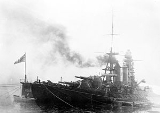
Japanese battleship Nagato

Encyclopedia
Nagato (Japanese
: 長門, named after Nagato province
) was a battleship
of the Imperial Japanese Navy
; the lead ship of her class
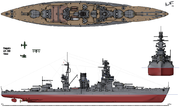
. She was the first battleship in the world to mount 16 inch (actually 16.1 inch, or 410 mm) guns, her armour
protection and speed made her one of the most powerful capital ships at the time of her commissioning.
She was the flagship of Admiral
Isoroku Yamamoto
at the time of the attack on Pearl Harbor
. She participated in a number of naval actions, but fired her main armament against enemy surface vessels only once, during the Battle of Leyte Gulf
. She survived the war and was sunk by the underwater nuclear test BAKER
at Bikini Atoll in 1946.
 Nagato was laid down at the Kure
Naval Arsenal on August 28, 1917, launched on November 9, 1919 and completed on November 15, 1920.
She underwent a major refit in 1936, replacing her coal-burning boilers and upgrading her armour and anti-aircraft guns. Following the refit she was able to achieve a top speed of 27 knots.
issued the signal "Niitaka yama nobore" (Climb Mount Niitaka) December 2, 1941 from the Nagato at anchor at Hashirajima
to signal the Carrier Strike Force in the North Pacific to proceed in its attack on Pearl Harbor
, committing Japan to the Pacific War
. On 7 December she sortied for the Bonin Islands, (known in Japan as the Ogasawara Group) as flagship of the battle fleet, along with her sister ship Mutsu
of Battle Division 1 and Hyūga
and Ise
of Battle Division 3. The force returned to the Combined Fleet's anchorage at Hashirajima on 12 December 1941 and remained there until a 4 March raid against the Japanese base on Marcus Island (Minami Tori Shima), 1,200 miles off the coast of Japan, by Halsey and his Task Force 16 caused the IJN to sortie out in search of the American raiders. Halsey had steamed away at high speed once he recovered his aircraft and the Japanese were unable to make contact. April saw Halsey return, this time steaming within 650 miles of the Japanese home islands along with the Hornet of Task Force 18 to launch the Doolittle Raid
. Once again Nagato and the elements of Combined Fleet sortied in chase, but Halsey and his group slipped away before the IJN could engage him.
In May 1942 Nagato conducted gunnery practice along with Mutsu, Yamashiro
, and the Hyūga. A deadly gun turret explosion on Hyūga caused the battleship group to return early to Hashirajima.
In June 1942 Nagato sailed with Admiral Yamamoto's Main Body during the Battle of Midway
, along with Yamato
, Mutsu
, Hosho
, Sendai
, nine destroyers and four auxiliary ships. Following the disastrous events to the Japanese carrier force on 4 June, Admiral Yamamoto attempted to lure the American forces west to within range of the Japanese air groups at the Wake Island base, and into a night engagement with his surface forces, but the American forces withdrew and Nagato saw no action. Following the link up with cruisers Nagara
, Tone, Chikuma, battleships Haruna
and Kirishima
and the screening destroyers that were all that remained from the Mobile Force, survivors from the aircraft carrier Kaga
were transferred to Nagato for the rest of the trip back to Japan.
1943 saw an intensification of the fighting in the South Pacific, and the Central Pacific came under threat. In August of 1943 Nagato, along with Yamato
and the majority of the Combined Fleet sailed for Truk in the Caroline Islands
where she was stationed to be in position to respond to allied threats in the Central Pacific. With the 18 September 1943 Task Force 15 raid of Tarawa led by Admiral Charles Pownall, the fleet sortied for Eniwetok. They returned to Truk on 23 September, having failed to engage the American Task Force. Task Force 14's attack of the Japanese base on Wake Island resulted in another attempt by the Japanese to engage the American forces, and Nagato and the bulk of the fleet sortied out from Truk on 17 October 1943 to meet them, but they failed to make contact.
After the evacuation of Truk in February 1944, she was based at Lingga
near Singapore
until the fleet sortied again in June of 1944 for the disastrous Battle of the Philippine Sea
. Four months later she sortied from Brunei Bay
as a part of Admiral Kurita's
Center Force in the desperate Battle of Leyte Gulf
, which spelled an end to the Japanese Navy as an effective fighting force.
in June 1944, and in the Battle of the Philippine Sea
where she came under air attack on June 19 but was undamaged.
In October 1944 she took part in Operation Shō-1, an attack on the Allied landings at Leyte
. In the battle of the Sibuyan Sea Nagato was attacked on October 24 by several waves of American dive-bombers. At 14:16 she was hit by two bombs dropped by planes from USS Franklin
and Cabot
. The first bomb disabled a number of guns and damaged the air intake to the No. 1 boiler room, immobilizing one propellor shaft for 25 minutes until the air intake was cleared. The second bomb hit the canteen and forward radio room, killing 52 men and wounding 106. On October 25 the Central Force (including Yamato, Nagato, Kongō and Haruna), navigated the San Bernardino Strait
and headed for Leyte Gulf
. In the battle off Samar
, Nagato engaged the escort carriers and destroyers of US Task Group 77.4.3. At 06:01 she opened fire on St. Lo
, the first time she fired her guns at an enemy ship, but missed. At 06:54 the destroyer Heermann
fired a spread of torpedo
es at Haruna; the torpedoes missed Haruna and headed for Yamato and Nagato which were on a parallel course. The two battleships were forced to turn away, and were taken 10 miles (16 km) to the north away from the engagement. Turning back and returning to the action, Nagato continued to engage the American escort carriers and their screening ships, firing 45 16.1 inch (410 mm) and 92 5.5 inch (140 mm) shells. At 09:10 Admiral Takeo Kurita
ordered the fleet to break off the engagement and head north. At 10:20 he ordered the fleet south once more, but as the fleet came under increasingly severe air attack he ordered a retreat again at 12:36. At 12:43 Nagato was hit in the bow by two bombs but the damage was not severe.
As it retreated on October 26, the Japanese fleet came under continuous air assault. Nagato was attacked by dive-bombers from the aircraft carrier Hornet
and hit by four bombs, suffering 38 killed and 105 wounded. In the course of the day she fired 99 16.1 inch (410 mm) and 653 5.5 inch (140 mm) shells.
On November 25, 1944 Nagato arrived at Yokosuka, Japan for repairs. Lack of fuel and materials meant that she could not be brought back into service, and in February 1945 she was reassigned as a coastal defence ship. In June 1945 her secondary and anti-aircraft armament were moved ashore. On July 18, 1945 she was attacked at Yokusuka
by fighter bombers and torpedo bombers from Essex
, Randolph
, Bennington
, Shangri-La
and Belleau Wood
and hit by three bombs, one hitting the bridge and killing her commanding officer, Rear Admiral
Otsuka Miki.
and Royal Marines from the Royal Navy Battleship .
In March 1946 she was taken to Bikini Atoll
for Operation Crossroads
, a series of nuclear weapon tests. On this, her last voyage, she was commanded by Captain W. J. Whipple with a United States Navy
crew of about 180 men. She was in such poor repair that on the way she had to be towed to Eniwetok Atoll for emergency repairs.
In the first test ("Able", an airburst) on July 1, 1946 she was 1,640 yards from ground zero
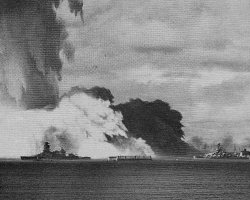
and was not severely damaged. In the second test ("Baker", an underwater explosion
) on July 25, 1946 she was severely damaged, eventually capsized and sank five days later.
The Times
has named the Nagato as one of the top ten wreck diving
sites in the world.
in September 2005. The Ensign was valued at 10 million yen. After the show, the host, Kouji Ishizaka, bought the Ensign for 10 million yen and donated it to the Yamato Museum
in Kure, Hiroshima
in September 2006.
, a film depicting the attack on Pearl Harbor and the events that led to it, a large, accurate fullscale replica of Nagato was built, which is first seen in the opening credits of the film.
IJN Nagato
Japanese language
is a language spoken by over 130 million people in Japan and in Japanese emigrant communities. It is a member of the Japonic language family, which has a number of proposed relationships with other languages, none of which has gained wide acceptance among historical linguists .Japanese is an...
: 長門, named after Nagato province
Nagato Province
, often called , was a province of Japan. It was at the extreme western end of Honshū, in the area that is today Yamaguchi Prefecture. Nagato bordered on Iwami and Suō Provinces....
) was a battleship
Battleship
A battleship is a large armored warship with a main battery consisting of heavy caliber guns. Battleships were larger, better armed and armored than cruisers and destroyers. As the largest armed ships in a fleet, battleships were used to attain command of the sea and represented the apex of a...
of the Imperial Japanese Navy
Imperial Japanese Navy
The Imperial Japanese Navy was the navy of the Empire of Japan from 1869 until 1947, when it was dissolved following Japan's constitutional renunciation of the use of force as a means of settling international disputes...
; the lead ship of her class
Nagato class battleship
The were two battleships of the Imperial Japanese Navy. The name Nagato comes from the Nagato province. They were the first battleships to be built entirely in Japan...
. She was the first battleship in the world to mount 16 inch (actually 16.1 inch, or 410 mm) guns, her armour
Armour
Armour or armor is protective covering used to prevent damage from being inflicted to an object, individual or a vehicle through use of direct contact weapons or projectiles, usually during combat, or from damage caused by a potentially dangerous environment or action...
protection and speed made her one of the most powerful capital ships at the time of her commissioning.
She was the flagship of Admiral
Admiral
Admiral is the rank, or part of the name of the ranks, of the highest naval officers. It is usually considered a full admiral and above vice admiral and below admiral of the fleet . It is usually abbreviated to "Adm" or "ADM"...
Isoroku Yamamoto
Isoroku Yamamoto
was a Japanese Naval Marshal General and the commander-in-chief of the Combined Fleet during World War II, a graduate of the Imperial Japanese Naval Academy and a student of Harvard University ....
at the time of the attack on Pearl Harbor
Attack on Pearl Harbor
The attack on Pearl Harbor was a surprise military strike conducted by the Imperial Japanese Navy against the United States naval base at Pearl Harbor, Hawaii, on the morning of December 7, 1941...
. She participated in a number of naval actions, but fired her main armament against enemy surface vessels only once, during the Battle of Leyte Gulf
Battle of Leyte Gulf
The Battle of Leyte Gulf, also called the "Battles for Leyte Gulf", and formerly known as the "Second Battle of the Philippine Sea", is generally considered to be the largest naval battle of World War II and, by some criteria, possibly the largest naval battle in history.It was fought in waters...
. She survived the war and was sunk by the underwater nuclear test BAKER
Operation Crossroads
Operation Crossroads was a series of nuclear weapon tests conducted by the United States at Bikini Atoll in mid-1946. It was the first test of a nuclear weapon after the Trinity nuclear test in July 1945...
at Bikini Atoll in 1946.
Construction
Kure, Hiroshima
is a city in Hiroshima prefecture, Japan.As of October 1, 2010, the city has an estimated population of 240,820 and a population density of 681 persons per km². The total area is 353.74 km².- History :...
Naval Arsenal on August 28, 1917, launched on November 9, 1919 and completed on November 15, 1920.
She underwent a major refit in 1936, replacing her coal-burning boilers and upgrading her armour and anti-aircraft guns. Following the refit she was able to achieve a top speed of 27 knots.
World War II
At the outbreak of the Pacific war, the Nagato was flagship for the Combined Fleet. Admiral Isoroku YamamotoIsoroku Yamamoto
was a Japanese Naval Marshal General and the commander-in-chief of the Combined Fleet during World War II, a graduate of the Imperial Japanese Naval Academy and a student of Harvard University ....
issued the signal "Niitaka yama nobore" (Climb Mount Niitaka) December 2, 1941 from the Nagato at anchor at Hashirajima
Hashirajima
is an island in southern Hiroshima Bay of the Inland Sea, Yamaguchi Prefecture, Japan. Located 26 kilometers southeast of Iwakuni, it is part of the Kutsuna Islands within the Bōyō Islands group....
to signal the Carrier Strike Force in the North Pacific to proceed in its attack on Pearl Harbor
Attack on Pearl Harbor
The attack on Pearl Harbor was a surprise military strike conducted by the Imperial Japanese Navy against the United States naval base at Pearl Harbor, Hawaii, on the morning of December 7, 1941...
, committing Japan to the Pacific War
Pacific War
The Pacific War, also sometimes called the Asia-Pacific War refers broadly to the parts of World War II that took place in the Pacific Ocean, its islands, and in East Asia, then called the Far East...
. On 7 December she sortied for the Bonin Islands, (known in Japan as the Ogasawara Group) as flagship of the battle fleet, along with her sister ship Mutsu
Japanese battleship Mutsu
thumb|right|300px|Mutsu shortly after commissioning in c. 1922Mutsu , named after Mutsu Province, as per Japanese ship naming conventions, was the Imperial Japanese Navy's second Nagato class battleship...
of Battle Division 1 and Hyūga
Japanese battleship Hyuga
Hyūga , named for Hyūga Province in Kyūshū, was an of the Imperial Japanese Navy laid down by Mitsubishi on 6 May 1915, launched on 27 January 1917 and completed on 30 April 1918. She was initially designed as the fourth ship of the , but was heavily redesigned to fix shortcomings...
and Ise
Japanese battleship Ise
, was the lead ship of the two-vessel Ise-class battleship of the Imperial Japanese Navy, which saw combat service during the Pacific War. Ise was named after Ise Province, one of the traditional provinces of Japan, now part of Mie Prefecture....
of Battle Division 3. The force returned to the Combined Fleet's anchorage at Hashirajima on 12 December 1941 and remained there until a 4 March raid against the Japanese base on Marcus Island (Minami Tori Shima), 1,200 miles off the coast of Japan, by Halsey and his Task Force 16 caused the IJN to sortie out in search of the American raiders. Halsey had steamed away at high speed once he recovered his aircraft and the Japanese were unable to make contact. April saw Halsey return, this time steaming within 650 miles of the Japanese home islands along with the Hornet of Task Force 18 to launch the Doolittle Raid
Doolittle Raid
The Doolittle Raid, on 18 April 1942, was the first air raid by the United States to strike the Japanese Home Islands during World War II. By demonstrating that Japan itself was vulnerable to American air attack, it provided a vital morale boost and opportunity for U.S. retaliation after the...
. Once again Nagato and the elements of Combined Fleet sortied in chase, but Halsey and his group slipped away before the IJN could engage him.
In May 1942 Nagato conducted gunnery practice along with Mutsu, Yamashiro
Japanese battleship Yamashiro
Yamashiro was the Imperial Japanese Navy's second Fusō-class battleship, and was laid down at the Yokosuka Naval Arsenal on November 20, 1913, launched on November 3, 1915, and commissioned on March 31, 1917. She was the first Japanese vessel equipped with aircraft catapults...
, and the Hyūga. A deadly gun turret explosion on Hyūga caused the battleship group to return early to Hashirajima.
In June 1942 Nagato sailed with Admiral Yamamoto's Main Body during the Battle of Midway
Battle of Midway
The Battle of Midway is widely regarded as the most important naval battle of the Pacific Campaign of World War II. Between 4 and 7 June 1942, approximately one month after the Battle of the Coral Sea and six months after Japan's attack on Pearl Harbor, the United States Navy decisively defeated...
, along with Yamato
Japanese battleship Yamato
, named after the ancient Japanese Yamato Province, was the lead ship of the Yamato class of battleships that served with the Imperial Japanese Navy during World War II. She and her sister ship, Musashi, were the heaviest and most powerfully armed battleships ever constructed, displacing...
, Mutsu
Japanese battleship Mutsu
thumb|right|300px|Mutsu shortly after commissioning in c. 1922Mutsu , named after Mutsu Province, as per Japanese ship naming conventions, was the Imperial Japanese Navy's second Nagato class battleship...
, Hosho
Japanese aircraft carrier Hosho
Hōshō |phoenix]]") was the world's first commissioned ship that was designed and built as an aircraft carrier,The HMS Argus pre-dated Hōshō and had a long landing deck, but was designed and initially built as an ocean liner. and the first aircraft carrier of the Imperial Japanese Navy...
, Sendai
Japanese cruiser Sendai
was a Sendai-class light cruiser in the Imperial Japanese Navy. She was named after the Sendai River in southern Kyūshū.-Background:Sendai was the lead ship of the three vessels completed in her class of light cruisers, and like other vessels of her class, she was intended for use as the flagship...
, nine destroyers and four auxiliary ships. Following the disastrous events to the Japanese carrier force on 4 June, Admiral Yamamoto attempted to lure the American forces west to within range of the Japanese air groups at the Wake Island base, and into a night engagement with his surface forces, but the American forces withdrew and Nagato saw no action. Following the link up with cruisers Nagara
Japanese cruiser Nagara
was the lead ship of her class of light cruiser in the Imperial Japanese Navy. She was named after the Nagara River in the Chūbu region of Japan.-Background:...
, Tone, Chikuma, battleships Haruna
Japanese battleship Haruna
, named after Mount Haruna, was a warship of the Imperial Japanese Navy during :World War I and :World War II. Designed by the British naval engineer George Thurston, she was the fourth and last battlecruiser of the , among the most heavily armed ships in any navy when built...
and Kirishima
Japanese battleship Kirishima
was a warship of the Imperial Japanese Navy during World War I and World War II. Designed by British naval engineer George Thurston, she was the third launched of the four Kongō-class battlecruisers, among the most heavily armed ships in any navy when built...
and the screening destroyers that were all that remained from the Mobile Force, survivors from the aircraft carrier Kaga
Japanese aircraft carrier Kaga
Kaga was an aircraft carrier of the Imperial Japanese Navy , named after the former Kaga Province in present-day Ishikawa Prefecture...
were transferred to Nagato for the rest of the trip back to Japan.
1943 saw an intensification of the fighting in the South Pacific, and the Central Pacific came under threat. In August of 1943 Nagato, along with Yamato
Japanese battleship Yamato
, named after the ancient Japanese Yamato Province, was the lead ship of the Yamato class of battleships that served with the Imperial Japanese Navy during World War II. She and her sister ship, Musashi, were the heaviest and most powerfully armed battleships ever constructed, displacing...
and the majority of the Combined Fleet sailed for Truk in the Caroline Islands
Caroline Islands
The Caroline Islands are a widely scattered archipelago of tiny islands in the western Pacific Ocean, to the north of New Guinea. Politically they are divided between the Federated States of Micronesia in the eastern part of the group, and Palau at the extreme western end...
where she was stationed to be in position to respond to allied threats in the Central Pacific. With the 18 September 1943 Task Force 15 raid of Tarawa led by Admiral Charles Pownall, the fleet sortied for Eniwetok. They returned to Truk on 23 September, having failed to engage the American Task Force. Task Force 14's attack of the Japanese base on Wake Island resulted in another attempt by the Japanese to engage the American forces, and Nagato and the bulk of the fleet sortied out from Truk on 17 October 1943 to meet them, but they failed to make contact.
After the evacuation of Truk in February 1944, she was based at Lingga
Lingga Islands
Not to be confused with "Linga", a common Scottish island name, see Linga The Lingga Islands or Lingga Archipelago are a group of islands in Indonesia, located south of Singapore, along both sides of the equator, off the eastern coast of Riau Islands province on Sumatra island...
near Singapore
Singapore
Singapore , officially the Republic of Singapore, is a Southeast Asian city-state off the southern tip of the Malay Peninsula, north of the equator. An island country made up of 63 islands, it is separated from Malaysia by the Straits of Johor to its north and from Indonesia's Riau Islands by the...
until the fleet sortied again in June of 1944 for the disastrous Battle of the Philippine Sea
Battle of the Philippine Sea
The Battle of the Philippine Sea was a decisive naval battle of World War II which effectively eliminated the Imperial Japanese Navy's ability to conduct large-scale carrier actions. It took place during the United States' amphibious invasion of the Mariana Islands during the Pacific War...
. Four months later she sortied from Brunei Bay
Brunei Bay
Brunei Bay is the gateway to Brunei and Borneo. It is located 4°45'-5°02'N, 114°58'-115°10'E; east of Bandar Seri Begawan. The Brunei portion of the bay is in two sections separated by a finger of Sarawak about 6km wide at the coast...
as a part of Admiral Kurita's
Takeo Kurita
Vice Admiral was a vice-admiral in the Imperial Japanese Navy during World War II.-Early life:Kurita was born in Mito city, Ibaraki Prefecture in 1889. He was sent off to Etajima in 1905 and graduated from the 38th class of the Imperial Japanese Naval Academy in 1910, ranked 28th out of a class of...
Center Force in the desperate Battle of Leyte Gulf
Battle of Leyte Gulf
The Battle of Leyte Gulf, also called the "Battles for Leyte Gulf", and formerly known as the "Second Battle of the Philippine Sea", is generally considered to be the largest naval battle of World War II and, by some criteria, possibly the largest naval battle in history.It was fought in waters...
, which spelled an end to the Japanese Navy as an effective fighting force.
Leyte Gulf
Nagato took part in Operation A-Go, an attack on Allied forces in the Mariana IslandsMariana Islands
The Mariana Islands are an arc-shaped archipelago made up by the summits of 15 volcanic mountains in the north-western Pacific Ocean between the 12th and 21st parallels north and along the 145th meridian east...
in June 1944, and in the Battle of the Philippine Sea
Battle of the Philippine Sea
The Battle of the Philippine Sea was a decisive naval battle of World War II which effectively eliminated the Imperial Japanese Navy's ability to conduct large-scale carrier actions. It took place during the United States' amphibious invasion of the Mariana Islands during the Pacific War...
where she came under air attack on June 19 but was undamaged.
In October 1944 she took part in Operation Shō-1, an attack on the Allied landings at Leyte
Battle of Leyte Gulf
The Battle of Leyte Gulf, also called the "Battles for Leyte Gulf", and formerly known as the "Second Battle of the Philippine Sea", is generally considered to be the largest naval battle of World War II and, by some criteria, possibly the largest naval battle in history.It was fought in waters...
. In the battle of the Sibuyan Sea Nagato was attacked on October 24 by several waves of American dive-bombers. At 14:16 she was hit by two bombs dropped by planes from USS Franklin
USS Franklin (CV-13)
The USS Franklin , nicknamed "Big Ben," was one of 24 s built during World War II for the United States Navy, and the fifth US Navy ship to bear the name. Commissioned in January 1944, she served in several campaigns in the Pacific Theater of Operations, earning four battle stars...
and Cabot
USS Cabot (CVL-28)
USS Cabot was an in the United States Navy, the second ship to carry the name. Cabot was commissioned in 1943 and served until 1947. She was recommissioned as a training carrier from 1948 to 1955. From 1967 to 1989, she served in Spain as '...
. The first bomb disabled a number of guns and damaged the air intake to the No. 1 boiler room, immobilizing one propellor shaft for 25 minutes until the air intake was cleared. The second bomb hit the canteen and forward radio room, killing 52 men and wounding 106. On October 25 the Central Force (including Yamato, Nagato, Kongō and Haruna), navigated the San Bernardino Strait
San Bernardino Strait
The San Bernardino Strait is a strait in the Philippines. It separates the Bicol Peninsula of Luzon island from the island of Samar in the south.-Filipinos and San Bernardino Strait:...
and headed for Leyte Gulf
Leyte Gulf
Leyte Gulf is a body of water immediately east of the island of Leyte in the Philippines, adjoining the Philippine Sea of the Pacific Ocean, at . The Gulf is bounded on the north by the island of Samar, which is separated from Leyte on the west by the narrow San Juanico Strait, and on the south by...
. In the battle off Samar
Battle off Samar
The Battle off Samar was the centermost action of the Battle of Leyte Gulf, one of the largest naval battles in history, which took place in the Philippine Sea off Samar Island, in the Philippines on 25 October 1944...
, Nagato engaged the escort carriers and destroyers of US Task Group 77.4.3. At 06:01 she opened fire on St. Lo
USS St. Lo (CVE-63)
USS St. Lo was a of the United States Navy during World War II. On 25 October 1944, St. Lo became the first major warship to sink as the result of a kamikaze attack. The attack occurred during the Battle of Leyte Gulf.St...
, the first time she fired her guns at an enemy ship, but missed. At 06:54 the destroyer Heermann
USS Heermann (DD-532)
USS Heermann was a World War II-era Fletcher-class destroyer in the service of the United States Navy, named after Fleet Surgeon Lewis Heermann ....
fired a spread of torpedo
Torpedo
The modern torpedo is a self-propelled missile weapon with an explosive warhead, launched above or below the water surface, propelled underwater towards a target, and designed to detonate either on contact with it or in proximity to it.The term torpedo was originally employed for...
es at Haruna; the torpedoes missed Haruna and headed for Yamato and Nagato which were on a parallel course. The two battleships were forced to turn away, and were taken 10 miles (16 km) to the north away from the engagement. Turning back and returning to the action, Nagato continued to engage the American escort carriers and their screening ships, firing 45 16.1 inch (410 mm) and 92 5.5 inch (140 mm) shells. At 09:10 Admiral Takeo Kurita
Takeo Kurita
Vice Admiral was a vice-admiral in the Imperial Japanese Navy during World War II.-Early life:Kurita was born in Mito city, Ibaraki Prefecture in 1889. He was sent off to Etajima in 1905 and graduated from the 38th class of the Imperial Japanese Naval Academy in 1910, ranked 28th out of a class of...
ordered the fleet to break off the engagement and head north. At 10:20 he ordered the fleet south once more, but as the fleet came under increasingly severe air attack he ordered a retreat again at 12:36. At 12:43 Nagato was hit in the bow by two bombs but the damage was not severe.
As it retreated on October 26, the Japanese fleet came under continuous air assault. Nagato was attacked by dive-bombers from the aircraft carrier Hornet
USS Hornet (CV-12)
USS Hornet is a United States Navy aircraft carrier of the Essex class. Construction started in August 1942; she was originally named , but was renamed in honor of the , which was lost in October 1942, becoming the eighth ship to bear the name.Hornet was commissioned in November 1943, and after...
and hit by four bombs, suffering 38 killed and 105 wounded. In the course of the day she fired 99 16.1 inch (410 mm) and 653 5.5 inch (140 mm) shells.
On November 25, 1944 Nagato arrived at Yokosuka, Japan for repairs. Lack of fuel and materials meant that she could not be brought back into service, and in February 1945 she was reassigned as a coastal defence ship. In June 1945 her secondary and anti-aircraft armament were moved ashore. On July 18, 1945 she was attacked at Yokusuka
Attack on Yokosuka
The attack on Yokosuka was an air raid conducted by the United States Navy on 18 July 1945 during the Pacific War. The Japanese battleship Nagato was the raid's main target, though anti-aircraft positions and other warships at Yokosuka Naval Arsenal were also attacked. Other U.S. Navy and...
by fighter bombers and torpedo bombers from Essex
USS Essex (CV-9)
USS Essex was an aircraft carrier, the lead ship of the 24-ship built for the United States Navy during World War II. She was the fourth US Navy ship to bear the name. Commissioned in December 1942, Essex participated in several campaigns in the Pacific Theater of Operations, earning the...
, Randolph
USS Randolph (CV-15)
USS Randolph was one of 24 s built during World War II for the United States Navy. The second US Navy ship to bear the name, she was named for Peyton Randolph, president of the First Continental Congress. Randolph was commissioned in October 1944, and served in several campaigns in the Pacific...
, Bennington
USS Bennington (CV-20)
USS Bennington was one of 24 s built during World War II for the United States Navy. The ship was the second US Navy ship to bear the name, and was named for the Revolutionary War Battle of Bennington...
, Shangri-La
USS Shangri-La (CV-38)
USS Shangri-La was one of 24 s completed during or shortly after World War II for the United States Navy.Commissioned in 1944, Shangri-La participated in several campaigns in the Pacific Theater of Operations in World War II, earning two battle stars...
and Belleau Wood
USS Belleau Wood (CVL-24)
USS Belleau Wood was a United States Navy active during World War II in the Pacific Theater, from 1943 to 1945. The ship also served in the First Indochina War under French Navy temporary service as Bois Belleau....
and hit by three bombs, one hitting the bridge and killing her commanding officer, Rear Admiral
Rear Admiral
Rear admiral is a naval commissioned officer rank above that of a commodore and captain, and below that of a vice admiral. It is generally regarded as the lowest of the "admiral" ranks, which are also sometimes referred to as "flag officers" or "flag ranks"...
Otsuka Miki.
After the war
Bikini Atoll
On August 30, 1945, following the Japanese surrender, Nagato, the last surviving Japanese battleship, was boarded and secured by American sailors from the USS Horace A. Bass (LPR-124)USS Horace A. Bass (APD-124)
USS Horace A. Bass was a United States Navy high-speed transport in commission from 1944 to 1969.-Construction and commissioning:Originally projected as a Rudderow-class destroyer escort , Horace A...
and Royal Marines from the Royal Navy Battleship .
In March 1946 she was taken to Bikini Atoll
Bikini Atoll
Bikini Atoll is an atoll, listed as a World Heritage Site, in the Micronesian Islands of the Pacific Ocean, part of Republic of the Marshall Islands....
for Operation Crossroads
Operation Crossroads
Operation Crossroads was a series of nuclear weapon tests conducted by the United States at Bikini Atoll in mid-1946. It was the first test of a nuclear weapon after the Trinity nuclear test in July 1945...
, a series of nuclear weapon tests. On this, her last voyage, she was commanded by Captain W. J. Whipple with a United States Navy
United States Navy
The United States Navy is the naval warfare service branch of the United States Armed Forces and one of the seven uniformed services of the United States. The U.S. Navy is the largest in the world; its battle fleet tonnage is greater than that of the next 13 largest navies combined. The U.S...
crew of about 180 men. She was in such poor repair that on the way she had to be towed to Eniwetok Atoll for emergency repairs.
In the first test ("Able", an airburst) on July 1, 1946 she was 1,640 yards from ground zero
Ground zero
The term ground zero describes the point on the Earth's surface closest to a detonation...
and was not severely damaged. In the second test ("Baker", an underwater explosion
Underwater explosion
An underwater explosion, also known as an UNDEX, is an explosion beneath the surface of water. The type of explosion may be chemical or nuclear...
) on July 25, 1946 she was severely damaged, eventually capsized and sank five days later.
The Times
The Times
The Times is a British daily national newspaper, first published in London in 1785 under the title The Daily Universal Register . The Times and its sister paper The Sunday Times are published by Times Newspapers Limited, a subsidiary since 1981 of News International...
has named the Nagato as one of the top ten wreck diving
Wreck diving
Wreck diving is a type of recreational diving where shipwrecks are explored. Although most wreck dive sites are at shipwrecks, there is an increasing trend to scuttle retired ships to create artificial reef sites...
sites in the world.
The ensign
Nagatos Naval Ensign was taken by a commander of the US Navy. It was put on a Japanese TV antique appraisal show, "Nandemo Kanteidan", by his daughter, and broadcast on TV TokyoTV Tokyo
is a television station headquartered in Toranomon, Minato, Tokyo, Japan. Also known as , a blend of "terebi" and "Tokyo", it is the key station of TX Network. It is one of the major Tokyo television stations, particularly specializing in anime...
in September 2005. The Ensign was valued at 10 million yen. After the show, the host, Kouji Ishizaka, bought the Ensign for 10 million yen and donated it to the Yamato Museum
Yamato Museum
The Yamato Museum is a nickname of the "Kure Maritime Museum" in Kure, Hiroshima, Japan.-History:The museum opened on April 23, 2005. It is nicknamed the Yamato Museum due to the display in the lobby of the large model ship Yamato Hiroba, a 1/10 scale model of the Japanese battleship Yamato...
in Kure, Hiroshima
Kure, Hiroshima
is a city in Hiroshima prefecture, Japan.As of October 1, 2010, the city has an estimated population of 240,820 and a population density of 681 persons per km². The total area is 353.74 km².- History :...
in September 2006.
Replica in movie
In Tora! Tora! Tora!Tora! Tora! Tora!
is a 1970 American-Japanese war film that dramatizes the Japanese attack on Pearl Harbor, to the extent these facts were known at the time of production. The film was directed by Richard Fleischer and stars an all-star cast, including So Yamamura, E.G...
, a film depicting the attack on Pearl Harbor and the events that led to it, a large, accurate fullscale replica of Nagato was built, which is first seen in the opening credits of the film.
IJN Nagato