

Wreck diving

Encyclopedia
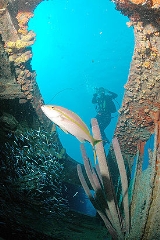
Wreck diving is a type of recreational diving
where shipwreck
s are explored. Although most wreck dive sites are at shipwrecks, there is an increasing trend to scuttle retired ships to create artificial reef sites
. Wreck diving can also pertain to diving to crashed aircraft.
sub-divides wreck diving into three categories:
Each succeeding level involves greater risk, and therefore will normally require greater levels of training, experience and equipment.
Non-penetration wreck diving is the least hazardous form of wreck diving, although divers still need to be aware of the entanglement risks presented by fishing nets and fishing lines which may be snagged to the wreck (wrecks are often popular fishing sites), and the underlying terrain may present greater risk of sharp edges.
Penetration within the light zone presents greater hazards due to overhead and greater proximity of the wreck's structure, but because of the proximity of a visible exit point, and some amount of external light, those hazards are more manageable. However, there is clearly a much greater risk of entanglement and siltout inside of the structure, as well as the requirement to move laterally to a defined exit point before one can surface in the event of an emergency.
Full penetration involves the greatest level of risks, including the risk of getting lost within the structure, the risk of complete darkness in the event of multiple light failures, and the inability to escape unassisted in the event of a disruption to air supply.
These categorisations broadly coincides with the traditional division between "recreational
" wreck diving (taught as a speciality course by recreational diver training agency which is normally expressed to be limited to the "light zone" and/or 100 cumulative feet of depth plus penetration) and "technical
" wreck diving (taught as a stand alone course by technical diver training agencies).
, where the diver enters a shipwreck is an advanced skill requiring special training and equipment. Many attractive or well preserved wrecks are in deeper water requiring deep diving
precautions. It is essential that at least one cutting device be carried in the event that the diver is entangled with fishing lines or ropes and to have a spare light source in case the primary light fails. If penetrating a wreck, a guideline tied off before entering a wreck and run out inside the wreck is advisable. A guideline helps a wreck diver in finding the way out easier in case of low visibility due to stirred up sediments. For penetration diving, a greater reserve of breathing gas
should be allowed for, to ensure there is sufficient to get out of the wreck. Most wreck divers use a minimum of the rule-of-thirds
for gas management. This allows for 1/3 of the gas down and into the wreck, 1/3 for exit and ascent and 1/3 reserve. In addition, because of the potential fragility of the wreck, the likelihood of disturbing sediments or disturbing the many marine animals that take advantage of the artificial habitat offered by the wreck, extra care is required when moving and finning. Many divers are taught to use alternative finning methods such as frog kick
when inside a wreck. Perfect buoyancy control is a must for diving in the environment of a wreck.
 Many diver training organizations provide specialist wreck diver training
courses, such as SDI
, and PADI
Wreck Diver, which divers are advised to take before wreck diving. Such courses typically teach skills such as air management and the proper use of guidelines and reels. Most recreational diving organizations teach divers only to penetrate to limit of the "light zone" or a maximum aggregate surface distance (depth + penetration) of 100 feet (whichever is the lesser). Other technical diving
organizations, such as IANTD, TDI
, and ANDI
teach advanced wreck courses, that emphasize a higher level of training, experience and equipment and prepare divers for deeper levels of wreck penetration. The Nautical Archaeology Society
in the UK, teaches awareness of underwater cultural heritage
issues as well as practical diver and archaeological
skills. Other organizations, such as the Artificial Reef Society of British Columbia (ARSBC) deliberately create artificial reefs to provide features for divers to explore, as well as substrates for marine life to thrive upon.
An alternative approach, popularised by deep wreck divers in the American Northeast, is referred to as "progressive penetration". Progressive penetration eschews the use of reels, but the diver makes several successive penetrations, each successively deeper than the last, memorising the layout for both the inward and outward journeys. As a diving technique, progressive penetration is not taught by any of the mainstream diver training agencies.
Divers engaging in penetration diving are conventionally taught to carry three lights - a primary light and two backup lights - thereby virtually eliminating the risk of completely losing light inside the wreck. Nonetheless, total loss of visibility due to a silt-out remains a risk.
cylinders. However, it is difficult to penetrate many wrecks with sidemount cylinders, requiring divers to either use a different configuration, or leave their decompression gases outside the wreck prior to penetration. This creates the possibility of a diver being unable to relocate their decompression gases if they exit the wreck at a different point from which they enter it.
or desecration.
In the United Kingdom, three Acts protect wrecks:
Wrecks that are protected are denoted as such on nautical chart
s (such as admiralty chart
s); any diving restrictions should be adhered to.
In Greece, during the year 2003 the Greek Government (ministry of culture), issued a Ministerial Order classifying "any wreck of ship or aeroplane, sunk for longer than 50 years from the present" as Cultural Assets / Monuments, setting also a protection zone of 300 meters around them. Terms and conditions for visiting any monument in Greece are set by the Ministry of Culture in Greece.
(such as the and the in Florida
, the Bianca C in Grenada
, and the wrecks of Recife
in Pernambuco
/Brazil
which include artificial and disaster wrecks).
Others are wrecks of vessels lost in disasters (such as the in the British Virgin Islands
, the Zenobia
in Cyprus
and the many shipwrecks off the Isles of Scilly in England). In the Marlborough Sounds
, New Zealand, the wreck of the MS Mikhail Lermontov is a popular dive site of the 177m cruise liner which was lost in 1986. Lying at 37 meters underwater, this wreck is an excellent base for recreational and technical divers.
A number of the most enigmatic wreck diving sites relate to ships lost to wartime hostilities, such as the in the Red Sea, the in Vanuatu
and the "ghost fleet" of Truk Lagoon
.
In the Encyclopedia of Recreational Diving, four "Mecca
s" of wreck diving are identified: (1) Truk Lagoon
in Micronesia
, (2) Scapa Flow in Orkney Islands, Scotland
, (3) the Outer Banks
of North Carolina
(known as the "Graveyard of the Atlantic
"), and (4) the Great Lakes
.
For technical divers there are fewer wrecks that have attracted widespread popularity, although for years the SS Andrea Doria was regarded as the "Mount Everest
" of wrecks to challenge the diver. However, since the popularisation of using trimix as a breathing gas, technical divers now routinely dive much deeper and more challenging wrecks, and the Andrea Doria is argued by some to now be a good training wreck for trimix divers. Trimix can also be used to visit wrecks in Marlborough Sounds
, New Zealand (MS Mikhail Lermontov), as well as in Brazil at Recife
, and Fernando de Noronha
(Corveta Ipiranga, where technical discovery diving is available).
Recreational diving
Recreational diving or sport diving is a type of diving that uses SCUBA equipment for the purpose of leisure and enjoyment. In some diving circles, the term "recreational diving" is used in contradistinction to "technical diving", a more demanding aspect of the sport which requires greater levels...
where shipwreck
Shipwreck
A shipwreck is what remains of a ship that has wrecked, either sunk or beached. Whatever the cause, a sunken ship or a wrecked ship is a physical example of the event: this explains why the two concepts are often overlapping in English....
s are explored. Although most wreck dive sites are at shipwrecks, there is an increasing trend to scuttle retired ships to create artificial reef sites
Sinking ships for wreck diving sites
Sinking ships for wreck diving sites is the practice of scuttling old ships to produce artificial reefs suitable for wreck diving, to benefit from commercial revenues from recreational diving of the shipwreck, or to produce a diver training site....
. Wreck diving can also pertain to diving to crashed aircraft.
Reasons for diving wrecks
A shipwreck is attractive to divers for several reasons:- it is an artificial reefReefIn nautical terminology, a reef is a rock, sandbar, or other feature lying beneath the surface of the water ....
, which creates a habitat for many types of marine lifeMarine biologyMarine biology is the scientific study of organisms in the ocean or other marine or brackish bodies of water. Given that in biology many phyla, families and genera have some species that live in the sea and others that live on land, marine biology classifies species based on the environment rather... - it often is a large structure with many interesting parts and machinery, which is not normally closely observable on working, floating vessels
- it often has an exciting or tragic history
- it presents new skill challenges for scuba diversScuba divingScuba diving is a form of underwater diving in which a diver uses a scuba set to breathe underwater....
- it is part of the underwater cultural heritage and may be an important archaeological resourceArchaeology of shipwrecksThe archaeology of shipwrecks is the field of archaeology specialised in the study and exploration of shipwrecks. Its techniques combine those of archaeology with those of diving....
and aviation archaeologyAviation archaeologyAviation archaeology is a recognized sub-discipline within archaeology and underwater archaeology as a whole. It is an activity practiced by both enthusiasts and academics in pursuit of finding, documenting, recovering, and preserving sites important in aviation history... - it provides a first-hand insight into context for the loss, such as causal connections, geographical associations, trade patterns and many other areas, providing a microcosm of our maritime heritage and maritime historyMaritime historyMaritime history is the study of human activity at sea. It covers a broad thematic element of history that often uses a global approach, although national and regional histories remain predominant...
.
Types of wreck diving
In his seminal work on the subject, The Advanced Wreck Diving Handbook, Gary GentileGary Gentile
Gary Gentile is an American author and pioneering technical diver.-Diving:Gary Gentile is a wreck diver. It has been suggested that Gary Gentile may be the most experienced wreck diver in the world...
sub-divides wreck diving into three categories:
- Non-penetration diving (i.e. swimming over the wreck)
- Limited penetration diving, within the "light zone"
- Full penetration diving, beyond the "light zone"
Each succeeding level involves greater risk, and therefore will normally require greater levels of training, experience and equipment.
Non-penetration wreck diving is the least hazardous form of wreck diving, although divers still need to be aware of the entanglement risks presented by fishing nets and fishing lines which may be snagged to the wreck (wrecks are often popular fishing sites), and the underlying terrain may present greater risk of sharp edges.
Penetration within the light zone presents greater hazards due to overhead and greater proximity of the wreck's structure, but because of the proximity of a visible exit point, and some amount of external light, those hazards are more manageable. However, there is clearly a much greater risk of entanglement and siltout inside of the structure, as well as the requirement to move laterally to a defined exit point before one can surface in the event of an emergency.
Full penetration involves the greatest level of risks, including the risk of getting lost within the structure, the risk of complete darkness in the event of multiple light failures, and the inability to escape unassisted in the event of a disruption to air supply.
These categorisations broadly coincides with the traditional division between "recreational
Recreational diving
Recreational diving or sport diving is a type of diving that uses SCUBA equipment for the purpose of leisure and enjoyment. In some diving circles, the term "recreational diving" is used in contradistinction to "technical diving", a more demanding aspect of the sport which requires greater levels...
" wreck diving (taught as a speciality course by recreational diver training agency which is normally expressed to be limited to the "light zone" and/or 100 cumulative feet of depth plus penetration) and "technical
Technical diving
Technical diving is a form of scuba diving that exceeds the scope of recreational diving...
" wreck diving (taught as a stand alone course by technical diver training agencies).
Wreck diver training and safety
Wrecks may pose a variety of unique hazards to divers. Wrecks are often snagged by fishing lines or nets and the structure may be fragile and break without notice. Penetration divingPenetration diving
Penetration diving or no clear surface diving is a type of diving where the scuba diver enters a space from which there is no direct, purely vertical ascent to the safety of breathable air of the atmosphere at the surface...
, where the diver enters a shipwreck is an advanced skill requiring special training and equipment. Many attractive or well preserved wrecks are in deeper water requiring deep diving
Deep diving
The meaning of the term deep diving is a form of technical diving. It is defined by the level of the diver's diver training, diving equipment, breathing gas, and surface support:...
precautions. It is essential that at least one cutting device be carried in the event that the diver is entangled with fishing lines or ropes and to have a spare light source in case the primary light fails. If penetrating a wreck, a guideline tied off before entering a wreck and run out inside the wreck is advisable. A guideline helps a wreck diver in finding the way out easier in case of low visibility due to stirred up sediments. For penetration diving, a greater reserve of breathing gas
Breathing gas
Breathing gas is a mixture of gaseous chemical elements and compounds used for respiration.Air is the most common and only natural breathing gas...
should be allowed for, to ensure there is sufficient to get out of the wreck. Most wreck divers use a minimum of the rule-of-thirds
Rule of thirds (diving)
In scuba diving, the rule of thirds is a rule of thumb that divers use to plan dives so they do not consume all the breathing gas from the diving cylinder before the end of the dive....
for gas management. This allows for 1/3 of the gas down and into the wreck, 1/3 for exit and ascent and 1/3 reserve. In addition, because of the potential fragility of the wreck, the likelihood of disturbing sediments or disturbing the many marine animals that take advantage of the artificial habitat offered by the wreck, extra care is required when moving and finning. Many divers are taught to use alternative finning methods such as frog kick
Frog kick
The frog kick is a swimming action sometimes used by scuba divers when they are swimming near a soft silty seabed or lakebed which they do not want to stir up damaging the visibility. It is like the swimming action of a frog or the leg part of the breaststroke...
when inside a wreck. Perfect buoyancy control is a must for diving in the environment of a wreck.
Diver training
Diver training is the process of developing skills and building experience in the use of diving equipment and techniques so that the diver is able to dive safely and have fun....
courses, such as SDI
SCUBA Diving International
Scuba Diving International is a SCUBA training and certification agency. It is the recreational arm of Technical Diving International, the world’s largest technical diver training organization...
, and PADI
Padi
Padi or PADI may refer to:* Padi, Chennai, India* Padi , a musical group* Paddy field, a type of cultivated land * Professional Association of Diving Instructors, a scuba organization...
Wreck Diver, which divers are advised to take before wreck diving. Such courses typically teach skills such as air management and the proper use of guidelines and reels. Most recreational diving organizations teach divers only to penetrate to limit of the "light zone" or a maximum aggregate surface distance (depth + penetration) of 100 feet (whichever is the lesser). Other technical diving
Technical diving
Technical diving is a form of scuba diving that exceeds the scope of recreational diving...
organizations, such as IANTD, TDI
Technical Diving International
Technical Diving International is the largest technical diving certification agency in the world. As one of the first agencies to provide training in mixed gas diving and rebreathers, TDI is seen as an innovator of new diving techniques and programs which previously were not available to the...
, and ANDI
American Nitrox Divers International
American Nitrox Divers International was founded by Ed Betts and Dick Rutkowski in 1988 as a Scuba diving training agency. As a former dive supervisor of NOAA, and the original founder of IANTD, Dick Rutkowski is responsible for many of the developments in the recreational diving industry.ANDI has...
teach advanced wreck courses, that emphasize a higher level of training, experience and equipment and prepare divers for deeper levels of wreck penetration. The Nautical Archaeology Society
Nautical Archaeology Society
The Nautical Archaeology Society is a charity registered in England and Wales and in Scotland and is a company limited by guarantee.The charitable aims and object of the company are to further research in Nautical Archaeology and publish the results of such research and to advance education and...
in the UK, teaches awareness of underwater cultural heritage
Cultural heritage
Cultural heritage is the legacy of physical artifacts and intangible attributes of a group or society that are inherited from past generations, maintained in the present and bestowed for the benefit of future generations...
issues as well as practical diver and archaeological
Underwater archaeology
Underwater archaeology is archaeology practised underwater. As with all other branches of archaeology it evolved from its roots in pre-history and in the classical era to include sites from the historical and industrial eras...
skills. Other organizations, such as the Artificial Reef Society of British Columbia (ARSBC) deliberately create artificial reefs to provide features for divers to explore, as well as substrates for marine life to thrive upon.
Penetration diving
In technical penetration diving, there are broadly two approaches. The conventional approach involves the use of continuous guidelines laid from a wreck reel, tied just outside of the entrance point, just inside the entrance point, and at regular intervals inside (to mitigate the risk of a cut line, or a "line trap"). In deeper penetrations, two reels are used, so that in the event of a total loss of visibility where the diver loses contact with the primary line or the primary line gets cut, the secondary line can be anchored and then used as a reference point to sweep for the primary line.An alternative approach, popularised by deep wreck divers in the American Northeast, is referred to as "progressive penetration". Progressive penetration eschews the use of reels, but the diver makes several successive penetrations, each successively deeper than the last, memorising the layout for both the inward and outward journeys. As a diving technique, progressive penetration is not taught by any of the mainstream diver training agencies.
Divers engaging in penetration diving are conventionally taught to carry three lights - a primary light and two backup lights - thereby virtually eliminating the risk of completely losing light inside the wreck. Nonetheless, total loss of visibility due to a silt-out remains a risk.
Deep diving and wreck diving
Wrecks in shallower waters tend to deteriorate faster than wrecks in deeper water due to higher biological activity. Accordingly, many of the older and larger shipwrecks that tend to offer full penetration dives tend to be deeper dives. This can present additional complications; if a wreck dive is intended to be a decompression dive, then the diver will normally carry decompression gases in sidemountSidemount
Sidemount is a scuba diving configuration which has tanks mounted alongside the diver, below the shoulders and along the hips, instead of on the back of the diver. It is a popular configuration with advanced cave divers, as smaller sections of cave can be penetrated and tanks can be changed with...
cylinders. However, it is difficult to penetrate many wrecks with sidemount cylinders, requiring divers to either use a different configuration, or leave their decompression gases outside the wreck prior to penetration. This creates the possibility of a diver being unable to relocate their decompression gases if they exit the wreck at a different point from which they enter it.
Protection of wrecks
In many countries, wrecks are legally protected from unauthorized salvageMarine salvage
Marine salvage is the process of rescuing a ship, its cargo, or other property from peril. Salvage encompasses rescue towing, refloating a sunken or grounded vessel, or patching or repairing a ship...
or desecration.
In the United Kingdom, three Acts protect wrecks:
- Protection of Wrecks Act 1973Protection of Wrecks Act 1973The Protection of Wrecks Act 1973 is an Act of the Parliament of the United Kingdom which provides protection for designated shipwrecks. Section 1 of the act provides for wrecks to be designated because of historical, archaeological or artistic value. Section 2 provides for designation of...
: certain designated, charted, historic or dangerous sites may not be dived without a license - Protection of Military Remains Act 1986Protection of Military Remains Act 1986The Protection of Military Remains Act 1986 is an Act of Parliament in the United Kingdom which provides protection for the wreckage of military aircraft and designated military vessels. The Act provides for two types of protection: protected places and controlled sites. Military aircraft are...
: all military aircraft and 16 designated ships are considered war graveWar graveA war grave is a burial place for soldiers or civilians who died during military campaigns or operations. The term does not only apply to graves: ships sunk during wartime are often considered to be war graves, as are military aircraft that crash into water...
s that can only be dived with a license. Other non-designated ships may be dived providing the divers do not enter, disturb or remove artifacts - Merchant Shipping Act 1995Receiver of WreckThe Receiver of Wreck is an official who administers law dealing with wreck and salvage in some countries having a British administrative heritage.-Countries having a Receiver of Wreck:...
: all wrecks and cargoes are owned: each artifact removed must be reported to the Receiver of WreckReceiver of WreckThe Receiver of Wreck is an official who administers law dealing with wreck and salvage in some countries having a British administrative heritage.-Countries having a Receiver of Wreck:...
Wrecks that are protected are denoted as such on nautical chart
Nautical chart
A nautical chart is a graphic representation of a maritime area and adjacent coastal regions. Depending on the scale of the chart, it may show depths of water and heights of land , natural features of the seabed, details of the coastline, navigational hazards, locations of natural and man-made aids...
s (such as admiralty chart
Admiralty chart
Admiralty charts are nautical charts issued by the United Kingdom Hydrographic Office and subject to Crown Copyright. Over 3,000 charts are available and cover virtually the entire world in various levels of detail depending on the density of traffic and hazards...
s); any diving restrictions should be adhered to.
In Greece, during the year 2003 the Greek Government (ministry of culture), issued a Ministerial Order classifying "any wreck of ship or aeroplane, sunk for longer than 50 years from the present" as Cultural Assets / Monuments, setting also a protection zone of 300 meters around them. Terms and conditions for visiting any monument in Greece are set by the Ministry of Culture in Greece.
Wreck diving sites
There are thousands of popular wreck diving sites throughout the world. Some of these are artificial wrecks or sunk deliberately to attract diversSinking ships for wreck diving sites
Sinking ships for wreck diving sites is the practice of scuttling old ships to produce artificial reefs suitable for wreck diving, to benefit from commercial revenues from recreational diving of the shipwreck, or to produce a diver training site....
(such as the and the in Florida
Florida
Florida is a state in the southeastern United States, located on the nation's Atlantic and Gulf coasts. It is bordered to the west by the Gulf of Mexico, to the north by Alabama and Georgia and to the east by the Atlantic Ocean. With a population of 18,801,310 as measured by the 2010 census, it...
, the Bianca C in Grenada
Grenada
Grenada is an island country and Commonwealth Realm consisting of the island of Grenada and six smaller islands at the southern end of the Grenadines in the southeastern Caribbean Sea...
, and the wrecks of Recife
Recife
Recife is the fifth-largest metropolitan area in Brazil with 4,136,506 inhabitants, the largest metropolitan area of the North/Northeast Regions, the 5th-largest metropolitan influence area in Brazil, and the capital and largest city of the state of Pernambuco. The population of the city proper...
in Pernambuco
Pernambuco
Pernambuco is a state of Brazil, located in the Northeast region of the country. To the north are the states of Paraíba and Ceará, to the west is Piauí, to the south are Alagoas and Bahia, and to the east is the Atlantic Ocean. There are about of beaches, some of the most beautiful in the...
/Brazil
Brazil
Brazil , officially the Federative Republic of Brazil , is the largest country in South America. It is the world's fifth largest country, both by geographical area and by population with over 192 million people...
which include artificial and disaster wrecks).
Others are wrecks of vessels lost in disasters (such as the in the British Virgin Islands
British Virgin Islands
The Virgin Islands, often called the British Virgin Islands , is a British overseas territory and overseas territory of the European Union, located in the Caribbean to the east of Puerto Rico. The islands make up part of the Virgin Islands archipelago, the remaining islands constituting the U.S...
, the Zenobia
Zenobia (shipwreck)
MS Zenobia was a Swedish built Challenger-class RO-RO ferry launched in 1979 that capsized and sank close to Larnaca, Cyprus, in June 1980 on her maiden voyage...
in Cyprus
Cyprus
Cyprus , officially the Republic of Cyprus , is a Eurasian island country, member of the European Union, in the Eastern Mediterranean, east of Greece, south of Turkey, west of Syria and north of Egypt. It is the third largest island in the Mediterranean Sea.The earliest known human activity on the...
and the many shipwrecks off the Isles of Scilly in England). In the Marlborough Sounds
Marlborough Sounds
The Marlborough Sounds are an extensive network of sea-drowned valleys created by a combination of land subsidence and rising sea levels at the north of the South Island of New Zealand...
, New Zealand, the wreck of the MS Mikhail Lermontov is a popular dive site of the 177m cruise liner which was lost in 1986. Lying at 37 meters underwater, this wreck is an excellent base for recreational and technical divers.
A number of the most enigmatic wreck diving sites relate to ships lost to wartime hostilities, such as the in the Red Sea, the in Vanuatu
Vanuatu
Vanuatu , officially the Republic of Vanuatu , is an island nation located in the South Pacific Ocean. The archipelago, which is of volcanic origin, is some east of northern Australia, northeast of New Caledonia, west of Fiji, and southeast of the Solomon Islands, near New Guinea.Vanuatu was...
and the "ghost fleet" of Truk Lagoon
Truk Lagoon
Truk Lagoon, also known as Chuuk, is a sheltered body of water in the central Pacific. North of New Guinea, it is located mid-ocean at 7 degrees North latitude. The atoll consists of a protective reef, around, enclosing a natural harbour 79 by 50 kilometres , with an area of . It has a land...
.
In the Encyclopedia of Recreational Diving, four "Mecca
Mecca
Mecca is a city in the Hijaz and the capital of Makkah province in Saudi Arabia. The city is located inland from Jeddah in a narrow valley at a height of above sea level...
s" of wreck diving are identified: (1) Truk Lagoon
Truk Lagoon
Truk Lagoon, also known as Chuuk, is a sheltered body of water in the central Pacific. North of New Guinea, it is located mid-ocean at 7 degrees North latitude. The atoll consists of a protective reef, around, enclosing a natural harbour 79 by 50 kilometres , with an area of . It has a land...
in Micronesia
Federated States of Micronesia
The Federated States of Micronesia or FSM is an independent, sovereign island nation, made up of four states from west to east: Yap, Chuuk, Pohnpei and Kosrae. It comprises approximately 607 islands with c...
, (2) Scapa Flow in Orkney Islands, Scotland
Scotland
Scotland is a country that is part of the United Kingdom. Occupying the northern third of the island of Great Britain, it shares a border with England to the south and is bounded by the North Sea to the east, the Atlantic Ocean to the north and west, and the North Channel and Irish Sea to the...
, (3) the Outer Banks
Outer Banks
The Outer Banks is a 200-mile long string of narrow barrier islands off the coast of North Carolina, beginning in the southeastern corner of Virginia Beach on the east coast of the United States....
of North Carolina
North Carolina
North Carolina is a state located in the southeastern United States. The state borders South Carolina and Georgia to the south, Tennessee to the west and Virginia to the north. North Carolina contains 100 counties. Its capital is Raleigh, and its largest city is Charlotte...
(known as the "Graveyard of the Atlantic
Graveyard of the Atlantic
Graveyard of the Atlantic is a nickname of two locations known for numerous shipwrecks: the treacherous waters in the Atlantic Ocean along the Outer Banks of North Carolina and the Virginia coastline south of the entrance to the Chesapeake Bay at Cape Henry; and around Sable Island, off the coast...
"), and (4) the Great Lakes
Great Lakes
The Great Lakes are a collection of freshwater lakes located in northeastern North America, on the Canada – United States border. Consisting of Lakes Superior, Michigan, Huron, Erie, and Ontario, they form the largest group of freshwater lakes on Earth by total surface, coming in second by volume...
.
For technical divers there are fewer wrecks that have attracted widespread popularity, although for years the SS Andrea Doria was regarded as the "Mount Everest
Mount Everest
Mount Everest is the world's highest mountain, with a peak at above sea level. It is located in the Mahalangur section of the Himalayas. The international boundary runs across the precise summit point...
" of wrecks to challenge the diver. However, since the popularisation of using trimix as a breathing gas, technical divers now routinely dive much deeper and more challenging wrecks, and the Andrea Doria is argued by some to now be a good training wreck for trimix divers. Trimix can also be used to visit wrecks in Marlborough Sounds
Marlborough Sounds
The Marlborough Sounds are an extensive network of sea-drowned valleys created by a combination of land subsidence and rising sea levels at the north of the South Island of New Zealand...
, New Zealand (MS Mikhail Lermontov), as well as in Brazil at Recife
Recife
Recife is the fifth-largest metropolitan area in Brazil with 4,136,506 inhabitants, the largest metropolitan area of the North/Northeast Regions, the 5th-largest metropolitan influence area in Brazil, and the capital and largest city of the state of Pernambuco. The population of the city proper...
, and Fernando de Noronha
Fernando de Noronha
Fernando de Noronha is an archipelago of 21 islands and islets in the Atlantic Ocean, offshore from the Brazilian coast. The main island has an area of and had a population of 3,012 in the year 2010...
(Corveta Ipiranga, where technical discovery diving is available).
External links
- WRECKSITE Worldwide free database of + 65.000 wrecks with history, maritime charts and GPS positions
- Sea Research Society
- Wikitravel article Diving the Cape Peninsula and False Bay dive guide includes about 35 wreck sites in varying detail
See also
- Shipwrecks
- Zenobia wreck
- Archaeology of shipwrecksArchaeology of shipwrecksThe archaeology of shipwrecks is the field of archaeology specialised in the study and exploration of shipwrecks. Its techniques combine those of archaeology with those of diving....
- Aviation archaeologyAviation archaeologyAviation archaeology is a recognized sub-discipline within archaeology and underwater archaeology as a whole. It is an activity practiced by both enthusiasts and academics in pursuit of finding, documenting, recovering, and preserving sites important in aviation history...
- Nautical Archaeology SocietyNautical Archaeology SocietyThe Nautical Archaeology Society is a charity registered in England and Wales and in Scotland and is a company limited by guarantee.The charitable aims and object of the company are to further research in Nautical Archaeology and publish the results of such research and to advance education and...
- Marine salvageMarine salvageMarine salvage is the process of rescuing a ship, its cargo, or other property from peril. Salvage encompasses rescue towing, refloating a sunken or grounded vessel, or patching or repairing a ship...
- Diver trainingDiver trainingDiver training is the process of developing skills and building experience in the use of diving equipment and techniques so that the diver is able to dive safely and have fun....
- List of shipwrecks
- Sinking ships for wreck diving sitesSinking ships for wreck diving sitesSinking ships for wreck diving sites is the practice of scuttling old ships to produce artificial reefs suitable for wreck diving, to benefit from commercial revenues from recreational diving of the shipwreck, or to produce a diver training site....
- Michigan Underwater PreservesMichigan Underwater PreservesMichigan Underwater Preserves or Michigan Bottomland Preserves are protected areas of the Great Lakes on Michigan's coast. The eleven designated areas, comprising a surface area of over , are considered to be "Underwater museums" and serve to protect concentrations of shipwrecks, unique geologic...