

James Brian Tait

Encyclopedia
Group Captain
James Brian Tait (nicknamed Willie) DSO
and three bars
, DFC
and bar (9 December 1916 - 31 August 2007) was an officer in the Royal Air Force
during and after World War II
. He conducted 101 bombing missions during the war, including those which finally sank the German battleship Tirpitz
in 1944. He succeeded Leonard Cheshire
as commander of the famous 617 Squadron and, with six gallantry decorations to his name, he remains one of the most distinguished airmen in the history of the nations of the British Commonwealth.
and educated at Wellingborough School
. After visiting a Schneider Trophy
event in 1928, he decided to join the RAF. He graduated from the RAF College Cranwell and was commissioned as pilot officer
in the RAF on 1 August 1936 and joined No. 51 Squadron RAF
, flying Whitley bomber
s. He was promoted to flying officer
on 1 February 1938.
and the first British air raid on Italy, crossing the Alps
to bomb Turin
, and was awarded the Distinguished Flying Cross
(DFC). He was promoted to flight lieutenant
on 1 February 1940. By the end of the year, he was commanding 51 Squadron. On 10 February 1941, he led the aircraft involved in Operation Colossus
flying from Malta
to drop paratroops in southern Italy. For this mission, he was awarded the DSO. He was given a temporary promotion to squadron leader
on 1 March 1941, which was later made substantive with the same seniority.
After Colossus, Tait joined 35 Squadron
, the first squadron to be equipped with Handley Page Halifax
es. He was awarded the first bar to his DSO for his exploits in leading a daylight raid on Kiel
on 30 June 1941. He was mentioned in despatches in September 1941. Tait was rested from operations and posted to a training unit, but managed nevertheless to fly on the three "Thousand Bomber Raids" in early 1942.
In mid-1942, Tait was appointed to command No. 78 Squadron RAF
, and was mentioned in despatches during his period in command. He was made a temporary wing commander
on 1 June 1942. In March 1944, he became base operations commander at RAF Waddington
where he continued to fly missions with RAAF Lancaster
crews despite holding a non-flying job. He was given a substantive promotion to wing commander on 1 March 1944.
He returned to operational duties in May 1944, becoming Master Bomber of 5 Group
. His service in this role resulted in his being awarded a second bar to his DSO.
He succeeded Leonard Cheshire
as commander of No. 617 Squadron RAF
in July 1944. 617 Squadron, the famous "Dambusters"
squadron, specialised in low-level target marking and precision attacks. Under his command, the squadron bombed a series of V-1
storage sites and V-2
launching sites using Barnes Wallis
's "Tallboy" 12,000 lb earthquake bomb. Tait was awarded a bar to his DFC for pressing home a low-level attack in a daylight raid on the Kembs Dam in southern Germany against fierce defensive fire despite having a damaged aircraft.
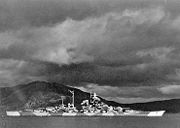
.jpg) On 15 September 1944, Tait led a force of 37 Avro Lancaster
On 15 September 1944, Tait led a force of 37 Avro Lancaster
bombers of 617 Squadron and 9 Squadron
on Operation Paravane
. Flying from an airfield at Yagodnik
, near Arkhangelsk
on the Kola Peninsula
in northern Russia, they attacked the German battleship Tirpitz in the Kaa Fjord
. Despite smoke obscuring the target, the Tirpitz was so severely damaged the German High Command decided the ship could not be restored to seaworthiness. Tirpitz was therefore moved to Tromsø
so its armament could be used as defensive artillery against an anticipated Allied invasion. The Germans were able to keep the ship's lack of seaworthiness a secret and so its destruction remained a high priority. Tait led his force in a second attack on 28 October named Operation Obviate
, this time from RAF Lossiemouth
in Scotland (the ship's move having brought her within range). This raid was unsuccessful because of heavy cloud obscuring the target shortly before the bombers arrived. On 12 November, Tait led his force against the Tirpitz for a third and final raid, Operation Catechism
. The Luftwaffe
failed to intercept the British bombers, and three direct hits by "Tallboy" bombs left the ship capsized west of Tromsø
, in the bay of Håkøybotn.
In mid-December 1944 Tait, having completed 101 missions, was grounded, and assigned to train Canadian bomber crews. Like his predecessor at 617 Squadron he was recommended for the Victoria Cross
for his "sustained gallantry" over almost five years of operations. However, unlike Cheshire he was awarded a third bar to his DSO, unique to any member of the RAF. The citation for this award, published in a Supplement to the London Gazette
of 5 January 1945 (dated 9 January 1945), reads:
, was promoted to group captain
in 1953 and was appointed Aide-de-camp
to the Queen in 1959, and retired from the RAF in 1964.
He retrained as a computer programmer, and joined ICL as a technical representative, working in Eastern Europe. After a period with a haulage company, he became an investment adviser with Scottish Widows
. He finally retired in 1981.
He married his wife, Betty Plummer, in 1945. They met during the war, when she was an officer in the Women's Auxiliary Air Force
. They had a son and two daughters. His wife died in 1990. He was survived by his three children.
Group Captain
Group captain is a senior commissioned rank in the Royal Air Force and the air forces of many other Commonwealth countries. It ranks above wing commander and immediately below air commodore...
James Brian Tait (nicknamed Willie) DSO
Distinguished Service Order
The Distinguished Service Order is a military decoration of the United Kingdom, and formerly of other parts of the British Commonwealth and Empire, awarded for meritorious or distinguished service by officers of the armed forces during wartime, typically in actual combat.Instituted on 6 September...
and three bars
Medal bar
A medal bar or medal clasp is a thin metal bar attached to the ribbon of a military decoration, civil decoration, or other medal. It is most commonly used to indicate the campaign or operation the recipient received the award for, and multiple bars on the same medal are used to indicate that the...
, DFC
Distinguished Flying Cross (United Kingdom)
The Distinguished Flying Cross is a military decoration awarded to personnel of the United Kingdom's Royal Air Force and other services, and formerly to officers of other Commonwealth countries, for "an act or acts of valour, courage or devotion to duty whilst flying in active operations against...
and bar (9 December 1916 - 31 August 2007) was an officer in the Royal Air Force
Royal Air Force
The Royal Air Force is the aerial warfare service branch of the British Armed Forces. Formed on 1 April 1918, it is the oldest independent air force in the world...
during and after World War II
World War II
World War II, or the Second World War , was a global conflict lasting from 1939 to 1945, involving most of the world's nations—including all of the great powers—eventually forming two opposing military alliances: the Allies and the Axis...
. He conducted 101 bombing missions during the war, including those which finally sank the German battleship Tirpitz
German battleship Tirpitz
Tirpitz was the second of two s built for the German Kriegsmarine during World War II. Named after Grand Admiral Alfred von Tirpitz, the architect of the Imperial Navy, the ship was laid down at the Kriegsmarinewerft in Wilhelmshaven in November 1936 and launched two and a half years later in April...
in 1944. He succeeded Leonard Cheshire
Leonard Cheshire
Group Captain Geoffrey Leonard Cheshire, Baron Cheshire, VC, OM, DSO and Two Bars, DFC was a highly decorated British RAF pilot during the Second World War....
as commander of the famous 617 Squadron and, with six gallantry decorations to his name, he remains one of the most distinguished airmen in the history of the nations of the British Commonwealth.
Early career
Tait was born in ManchesterManchester
Manchester is a city and metropolitan borough in Greater Manchester, England. According to the Office for National Statistics, the 2010 mid-year population estimate for Manchester was 498,800. Manchester lies within one of the UK's largest metropolitan areas, the metropolitan county of Greater...
and educated at Wellingborough School
Wellingborough School
Wellingborough School is an independent fee-paying day school in Wellingborough, Northamptonshire, England. It was established in 1595 and is one of the oldest schools in the country.-History:...
. After visiting a Schneider Trophy
Schneider Trophy
The Coupe d'Aviation Maritime Jacques Schneider was a prize competition for seaplanes. Announced by Jacques Schneider, a financier, balloonist and aircraft enthusiast, in 1911, it offered a prize of roughly £1,000. The race was held eleven times between 1913 and 1931...
event in 1928, he decided to join the RAF. He graduated from the RAF College Cranwell and was commissioned as pilot officer
Pilot Officer
Pilot officer is the lowest commissioned rank in the Royal Air Force and the air forces of many other Commonwealth countries. It ranks immediately below flying officer...
in the RAF on 1 August 1936 and joined No. 51 Squadron RAF
No. 51 Squadron RAF
No. 51 Squadron of the Royal Air Force most recently operated the Nimrod R1 from RAF Waddington, Lincolnshire until June 2011. Crews from No. 51 Squadron are currently training alongside the US Air Force on the Boeing RC-135, which is planned to enter service with the RAF over the next seven years...
, flying Whitley bomber
Armstrong Whitworth Whitley
The Armstrong Whitworth A.W.38 Whitley was one of three British twin-engine, front line medium bomber types in service with the Royal Air Force at the outbreak of the Second World War...
s. He was promoted to flying officer
Flying Officer
Flying officer is a junior commissioned rank in the Royal Air Force and the air forces of many countries which have historical British influence...
on 1 February 1938.
World War II
Tait was active on bombing operations with 51 Squadron in 1940, including several long distance raids on BerlinBerlin
Berlin is the capital city of Germany and is one of the 16 states of Germany. With a population of 3.45 million people, Berlin is Germany's largest city. It is the second most populous city proper and the seventh most populous urban area in the European Union...
and the first British air raid on Italy, crossing the Alps
Alps
The Alps is one of the great mountain range systems of Europe, stretching from Austria and Slovenia in the east through Italy, Switzerland, Liechtenstein and Germany to France in the west....
to bomb Turin
Turin
Turin is a city and major business and cultural centre in northern Italy, capital of the Piedmont region, located mainly on the left bank of the Po River and surrounded by the Alpine arch. The population of the city proper is 909,193 while the population of the urban area is estimated by Eurostat...
, and was awarded the Distinguished Flying Cross
Distinguished Flying Cross (United Kingdom)
The Distinguished Flying Cross is a military decoration awarded to personnel of the United Kingdom's Royal Air Force and other services, and formerly to officers of other Commonwealth countries, for "an act or acts of valour, courage or devotion to duty whilst flying in active operations against...
(DFC). He was promoted to flight lieutenant
Flight Lieutenant
Flight lieutenant is a junior commissioned rank in the Royal Air Force and the air forces of many Commonwealth countries. It ranks above flying officer and immediately below squadron leader. The name of the rank is the complete phrase; it is never shortened to "lieutenant"...
on 1 February 1940. By the end of the year, he was commanding 51 Squadron. On 10 February 1941, he led the aircraft involved in Operation Colossus
Operation Colossus
Operation Colossus was the codename given to the first airborne operation undertaken by the British military, which occurred on 10 February 1941 during World War II...
flying from Malta
Malta
Malta , officially known as the Republic of Malta , is a Southern European country consisting of an archipelago situated in the centre of the Mediterranean, south of Sicily, east of Tunisia and north of Libya, with Gibraltar to the west and Alexandria to the east.Malta covers just over in...
to drop paratroops in southern Italy. For this mission, he was awarded the DSO. He was given a temporary promotion to squadron leader
Squadron Leader
Squadron Leader is a commissioned rank in the Royal Air Force and the air forces of many countries which have historical British influence. It is also sometimes used as the English translation of an equivalent rank in countries which have a non-English air force-specific rank structure. In these...
on 1 March 1941, which was later made substantive with the same seniority.
After Colossus, Tait joined 35 Squadron
No. XXXV Squadron RAF
No. 35 Squadron is a squadron of the Royal Air Force.It was formed on February 1, 1916 at Thetford, training as a Corps reconnaissance squadron...
, the first squadron to be equipped with Handley Page Halifax
Handley Page Halifax
The Handley Page Halifax was one of the British front-line, four-engined heavy bombers of the Royal Air Force during the Second World War. A contemporary of the famous Avro Lancaster, the Halifax remained in service until the end of the war, performing a variety of duties in addition to bombing...
es. He was awarded the first bar to his DSO for his exploits in leading a daylight raid on Kiel
Kiel
Kiel is the capital and most populous city in the northern German state of Schleswig-Holstein, with a population of 238,049 .Kiel is approximately north of Hamburg. Due to its geographic location in the north of Germany, the southeast of the Jutland peninsula, and the southwestern shore of the...
on 30 June 1941. He was mentioned in despatches in September 1941. Tait was rested from operations and posted to a training unit, but managed nevertheless to fly on the three "Thousand Bomber Raids" in early 1942.
In mid-1942, Tait was appointed to command No. 78 Squadron RAF
No. 78 Squadron RAF
No. 78 Squadron of the Royal Air Force operates the Merlin HC3/3A transport helicopter from RAF Benson.Until December 2007 it was the operator of two Westland Sea King HAR3s from RAF Mount Pleasant, Falkland Islands.-History:No...
, and was mentioned in despatches during his period in command. He was made a temporary wing commander
Wing Commander (rank)
Wing commander is a commissioned rank in the Royal Air Force and the air forces of many other Commonwealth countries...
on 1 June 1942. In March 1944, he became base operations commander at RAF Waddington
RAF Waddington
RAF Waddington is a Royal Air Force station in Lincolnshire, England.-Formation:Waddington opened as a Royal Flying Corps flying training station in 1916 until 1920, when the station went into care and maintenance....
where he continued to fly missions with RAAF Lancaster
Avro Lancaster
The Avro Lancaster is a British four-engined Second World War heavy bomber made initially by Avro for the Royal Air Force . It first saw active service in 1942, and together with the Handley Page Halifax it was one of the main heavy bombers of the RAF, the RCAF, and squadrons from other...
crews despite holding a non-flying job. He was given a substantive promotion to wing commander on 1 March 1944.
He returned to operational duties in May 1944, becoming Master Bomber of 5 Group
No. 5 Group RAF
No. 5 Group was a Royal Air Force bomber group of the Second World War, led during the latter part by AVM Sir Ralph Cochrane.-History:The Group was formed on 1 September 1937 with headquarters at RAF Mildenhall....
. His service in this role resulted in his being awarded a second bar to his DSO.
He succeeded Leonard Cheshire
Leonard Cheshire
Group Captain Geoffrey Leonard Cheshire, Baron Cheshire, VC, OM, DSO and Two Bars, DFC was a highly decorated British RAF pilot during the Second World War....
as commander of No. 617 Squadron RAF
No. 617 Squadron RAF
No. 617 Squadron is a Royal Air Force aircraft squadron based at RAF Lossiemouth in Scotland. It currently operates the Tornado GR4 in the ground attack and reconnaissance role...
in July 1944. 617 Squadron, the famous "Dambusters"
Operation Chastise
Operation Chastise was an attack on German dams carried out on 16–17 May 1943 by Royal Air Force No. 617 Squadron, subsequently known as the "Dambusters", using a specially developed "bouncing bomb" invented and developed by Barnes Wallis...
squadron, specialised in low-level target marking and precision attacks. Under his command, the squadron bombed a series of V-1
V-1 flying bomb
The V-1 flying bomb, also known as the Buzz Bomb or Doodlebug, was an early pulse-jet-powered predecessor of the cruise missile....
storage sites and V-2
V-2 rocket
The V-2 rocket , technical name Aggregat-4 , was a ballistic missile that was developed at the beginning of the Second World War in Germany, specifically targeted at London and later Antwerp. The liquid-propellant rocket was the world's first long-range combat-ballistic missile and first known...
launching sites using Barnes Wallis
Barnes Wallis
Sir Barnes Neville Wallis, CBE FRS, RDI, FRAeS , was an English scientist, engineer and inventor. He is best known for inventing the bouncing bomb used by the RAF in Operation Chastise to attack the dams of the Ruhr Valley during World War II...
's "Tallboy" 12,000 lb earthquake bomb. Tait was awarded a bar to his DFC for pressing home a low-level attack in a daylight raid on the Kembs Dam in southern Germany against fierce defensive fire despite having a damaged aircraft.
Avro Lancaster
The Avro Lancaster is a British four-engined Second World War heavy bomber made initially by Avro for the Royal Air Force . It first saw active service in 1942, and together with the Handley Page Halifax it was one of the main heavy bombers of the RAF, the RCAF, and squadrons from other...
bombers of 617 Squadron and 9 Squadron
No. IX Squadron RAF
No. 9 Squadron of the Royal Air Force was the first in the service to receive the Panavia Tornado, which it currently operates from RAF Marham, Norfolk.-First World War:...
on Operation Paravane
Operation Paravane
Operation Paravane was the attack carried out by RAF Bomber Command on September 15, 1944 against the German battleship Tirpitz at harbour in the far north of Norway. The Tirpitz was a major threat to the convoys supplying the Soviet Union. Flying via a Soviet airfield, two squadrons attacked...
. Flying from an airfield at Yagodnik
Yagodnik
Yagodnik, Arkhangelsk Oblast, north west Russia, was the site of a World War II airfield. It is located near Arkhangelsk, on the Northern Dvina river, 9 kilometres from the sea at Dvina Bay.-Operation Paravane:...
, near Arkhangelsk
Arkhangelsk
Arkhangelsk , formerly known as Archangel in English, is a city and the administrative center of Arkhangelsk Oblast, Russia. It lies on both banks of the Northern Dvina River near its exit into the White Sea in the north of European Russia. The city spreads for over along the banks of the river...
on the Kola Peninsula
Kola Peninsula
The Kola Peninsula is a peninsula in the far northwest of Russia. Constituting the bulk of the territory of Murmansk Oblast, it lies almost completely to the north of the Arctic Circle and is washed by the Barents Sea in the north and the White Sea in the east and southeast...
in northern Russia, they attacked the German battleship Tirpitz in the Kaa Fjord
Kåfjord, Alta
Kåfjord is a fjord in northern Norway, an arm of the Altafjord, in the county of Finnmark, and a village located on the fjord. The village is in the municipality of Alta, 18 km west of the town of Alta on the European route E6....
. Despite smoke obscuring the target, the Tirpitz was so severely damaged the German High Command decided the ship could not be restored to seaworthiness. Tirpitz was therefore moved to Tromsø
Tromsø
Tromsø is a city and municipality in Troms county, Norway. The administrative centre of the municipality is the city of Tromsø.Tromsø city is the ninth largest urban area in Norway by population, and the seventh largest city in Norway by population...
so its armament could be used as defensive artillery against an anticipated Allied invasion. The Germans were able to keep the ship's lack of seaworthiness a secret and so its destruction remained a high priority. Tait led his force in a second attack on 28 October named Operation Obviate
Operation Obviate
Operation Obviate was the RAF Bomber Command attack on the German battleship Tirpitz at Tromsø on 29 October 1944. The attack was foiled by cloud covering the ship at the last minute, and the bombs that were dropped caused only minor damage...
, this time from RAF Lossiemouth
RAF Lossiemouth
RAF Lossiemouth is a Royal Air Force station to the west of the town of Lossiemouth in Moray, Scotland. It is one of the RAF's biggest bases and is currently Britain's main base for Tornado GR4s. From 2013 the Northern QRA force of Typhoon F2 will relocate to Lossiemouth following the closure of...
in Scotland (the ship's move having brought her within range). This raid was unsuccessful because of heavy cloud obscuring the target shortly before the bombers arrived. On 12 November, Tait led his force against the Tirpitz for a third and final raid, Operation Catechism
Operation Catechism
Operation Catechism was the last of nine attempts to sink or sabotage the Kriegsmarine battleship Tirpitz during World War II. On November 12, 1944, the RAF Bomber Command dispatched 30 Avro Lancaster heavy bombers from No. 9 Squadron RAF and No. 617 Squadron RAF Operation Catechism was the last of...
. The Luftwaffe
Luftwaffe
Luftwaffe is a generic German term for an air force. It is also the official name for two of the four historic German air forces, the Wehrmacht air arm founded in 1935 and disbanded in 1946; and the current Bundeswehr air arm founded in 1956....
failed to intercept the British bombers, and three direct hits by "Tallboy" bombs left the ship capsized west of Tromsø
Tromsø
Tromsø is a city and municipality in Troms county, Norway. The administrative centre of the municipality is the city of Tromsø.Tromsø city is the ninth largest urban area in Norway by population, and the seventh largest city in Norway by population...
, in the bay of Håkøybotn.
In mid-December 1944 Tait, having completed 101 missions, was grounded, and assigned to train Canadian bomber crews. Like his predecessor at 617 Squadron he was recommended for the Victoria Cross
Victoria Cross
The Victoria Cross is the highest military decoration awarded for valour "in the face of the enemy" to members of the armed forces of various Commonwealth countries, and previous British Empire territories....
for his "sustained gallantry" over almost five years of operations. However, unlike Cheshire he was awarded a third bar to his DSO, unique to any member of the RAF. The citation for this award, published in a Supplement to the London Gazette
London Gazette
The London Gazette is one of the official journals of record of the British government, and the most important among such official journals in the United Kingdom, in which certain statutory notices are required to be published...
of 5 January 1945 (dated 9 January 1945), reads:
Post-war career
Tait remained in the RAF after the war, initially reverting to the rank of squadron leader, he was re-promoted to wing commander in 1947 (back-dated to October 1946). He served in South East Asia, India, the Middle East and Singapore. He commanded RAF ConingsbyRAF Coningsby
RAF Coningsby , is a Royal Air Force station in Lincolnshire, England. It has been commanded by Group Captain Martin Sampson since 10 December 2010.-Operational units:...
, was promoted to group captain
Group Captain
Group captain is a senior commissioned rank in the Royal Air Force and the air forces of many other Commonwealth countries. It ranks above wing commander and immediately below air commodore...
in 1953 and was appointed Aide-de-camp
Aide-de-camp
An aide-de-camp is a personal assistant, secretary, or adjutant to a person of high rank, usually a senior military officer or a head of state...
to the Queen in 1959, and retired from the RAF in 1964.
He retrained as a computer programmer, and joined ICL as a technical representative, working in Eastern Europe. After a period with a haulage company, he became an investment adviser with Scottish Widows
Scottish Widows
Scottish Widows plc is a life, pensions and investment company located in Edinburgh, Scotland, and is a subsidiary of Lloyds Banking Group. Its product range includes life assurance, pensions, investments and savings...
. He finally retired in 1981.
He married his wife, Betty Plummer, in 1945. They met during the war, when she was an officer in the Women's Auxiliary Air Force
Women's Auxiliary Air Force
The Women's Auxiliary Air Force , whose members were invariably referred to as Waafs , was the female auxiliary of the Royal Air Force during World War II, established in 1939. At its peak strength, in 1943, WAAF numbers exceeded 180,000, with over 2,000 women enlisting per week.A Women's Royal Air...
. They had a son and two daughters. His wife died in 1990. He was survived by his three children.