

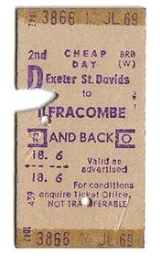
Ilfracombe Branch Line

Encyclopedia
The Ilfracombe Branch of the London & South Western Railway
(LSWR), ran between Barnstaple
and Ilfracombe
in North Devon
. The branch opened as a single-track line in 1874, but was sufficiently popular that it needed to be upgraded to double-track in 1889.
The 1-in-36 gradient between Ilfracombe and Mortehoe stations was one of the steepest sections of double track railway line in the country, and was most certainly the fiercest climb from any terminus station in the UK. In the days of steam traction, it was often necessary to double-head
departing passenger trains.
'Named' trains like the Atlantic Coast Express
and the Devon Belle
both started and terminated at Ilfracombe.
Despite nearly a century of bringing much-needed revenue into this remote corner of the county, passenger numbers dropped dramatically in the years following the Second World War due to a massive increase in the number of cars on Britain's roads, and the line finally closed in 1970.
Much of the course of the line is still visible today, and sections of it have been converted into public cycleways.
Popularity led to expansion, and much of the line was converted to double track
between 1889 and 1891. This was a major exercise, requiring the rebuilding of most stations, and cutting a second bore for the Slade tunnel.
The line was mentioned as a candidate for closure in the Reshaping of British Railways report (The Beeching Axe
) review, in 1963, but it was not closed by British Railways until 1970. Indeed, steam-hauled passenger services and freight operations ceased on 7 September 1964 (with one special running on 3 October 1965), and the rationalisation of the line began. DMU
services began, the Waterloo through services were stopped, and the line was down-graded to single track on 25 November 1967.
 It was in May 1967, that the Network for Development Plans were issued by Barbara Castle, the then Labour Minister of Transport following a study. Where lines were at the remunerative end of the scale, such as the main trunk routes and some secondary lines, these would be developed. But those that failed to meet the financial criterion, but served a social need were to be retained and subsidised under the 1968 Transport Act. The problem would be for lines that were not in the abovementioned categories could be candidates for closure as they did not form part of the basic railway network. The Illfracombe line was one of those that fell into this category. It was a line that may well have carried considerable traffic, and perhaps made a small profit, but it did not meet the Government's social, economic and commercial criteria for retention.
The line was closed on 5 October 1970 the last train being on 3 October. The final train, an 8-car Class 118 DMU
, was packed to bursting point.
There was an abortive attempt at saving the line, in the early 1970s, but the preservation movement
was in its infancy and the project was to founder as it could not raise the required sum to purchase the line outright. This was because BR had valued the line at £410,000 in 1974, and certainly BR was criticised for charging market values for a potential heritage railway that wanted to preserve it. It must be appreciated that the BR board was under instruction from the Ministry to fix the highest price possible in an attempt to recoup funds to offset the deficit that the line produced.
The last train was formed of a single inspection saloon hauled by a Class 25
, 25 063, on Wednesday 26 February 1975. This carried engineers inspecting the condition of the track for possible reinstatement of services. However this was not to be and track lifting commenced in June 1975. The following link has a number of rare pictures of the last train on the line. http://freepages.nostalgia.rootsweb.com/~cyberheritage/ilfra.htm
The distinctive curved steel girder bridge over the River Taw
in Barnstaple was demolished in 1977, adding a significant cost to any future reopening scheme.
Connections to:
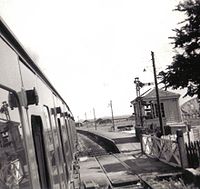
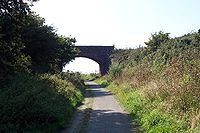 Mortehoe & Woolacombe station, originally named just Mortehoe, was over a mile away from either Woolacombe
or Mortehoe
, the villages being reached by steep twisty roads from the station. It was also the nearest station for Lee Bay
, although the route to that village was even more steep and twisty.
The bridge at the north end of the station was the summit
of the line.
Several sidings were provided for the stabling of banking locomotives, vital for assisting trains up the steep gradients to the station from Ilfracombe (1-in-36) or Braunton (1-in-40).
The station is still largely intact. The main station building, signal box and platforms are still extant, and some of the original concrete lampposts are still in place. The 'canopy' opposite the station building, however, was added long after the line had closed.
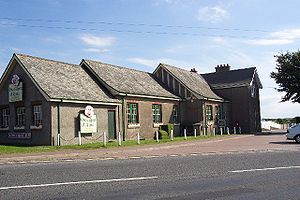 For a number of years the station was the site of a young children's theme park called Once Upon a Time, which was operated by the owners of Watermouth Castle
.
The station site is in a prominent position on the main road leading to Woolacombe. From outside the site could be seen four (BR Mk 1
) carriages (retired from the Dart Valley Railway
) sited between the platforms, while scattered around the grounds were a number of '12 ton' van
bodies used for storage or housing attractions. (Several of these were of the BR type 'VANWIDE', their double sliding doors being particularly useful for the purpose.)
The business closed at the end of the 2005 season. The site was sold in 2006, and was earmarked for re-development as affordable rural housing. By August 2007, all of the external amusement rides and constructions had been auctioned off or demolished, leaving just the main buildings and platforms intact. Two years later, despite a planning application having been made, no progress had been made on developing the site.
Other lines had steep banks too. The now closed Folkestone Harbour branch was at 1 in 30. The famous Lickey Incline
, between Bromsgrove
and Blackwell
on the Gloucester
to Birmingham
line, is now the steepest sustained adhesion
-worked gradient on British railways, with a northbound climb of 1 in 37¾ for two miles. In steam days, all except the lightest trains required the services of a banker
; however, since dieselisation, this is no longer necessary, except for certain freight services.
Rather nearer are the Dainton Banks - a 4-mile stretch of the GWR
main line between Newton Abbot
and Totnes
. This section was designed for atmospheric
propulsion, rather than steam haulage, and consequently has curves and gradients that would not be dreamed of for a loco-hauled line. The westbound ascent to Dainton
Tunnel includes gradients between 1 in 57 and 1 in 36 over a two-mile stretch. Eastbound is slightly easier, comprising, in the space of one mile, gradients of 1 in 55 to 1 in 37.
Nevertheless, The Mortehoe banks were much harsher. Northbound there was a 3½ mile continuous climb of 1 in 41, from Heddon Mill Crossing to Mortehoe. While southbound, from Ilfracombe to Mortehoe, the climb was 1 in 36 for 2½ miles, with severe S-curves past Lower Slade making the journey even harder.
Banking engines were kept at Braunton and Ilfracombe, to assist when required. Mortehoe station provided a number of sidings for stabling the banking engines after assisting with the climb.
The original motive power was provided by a class of small 0-6-0
tender locos that later became known as the Ilfracombe Goods (see below).
LSWR "Jubilee" Class A12 0-4-2
s replaced the Ilfracombe Goods engines on passenger work, and were themselves replaced by the T1 Class
0-4-4
Ts around the turn of the century. From about 1914, LSWR Class M7 0-4-4
Ts were commonly used.
After the Grouping
, the Southern Railway
introduced the new Maunsell
N class 2-6-0
s, in 1925. These were used for services to Exeter and beyond until the arrival of the 'light pacifics' in 1945.
The Bulleid West Country
and Battle of Britain
classes of 'Light Pacific' were the largest engines to visit Ilfracombe, and were the preferred choice for the Waterloo services and the Devon Belle
. In later years, despite the removal of their 'air-smoothed' boiler casings, the rebuilt examples of these engines would not have been seen, as they were too heavy to use the line.
As may be inferred from the name, the West Country locos were named after places in south-west England to which the Southern Railway ran. Enthusiasts always delighted in trying to take pictures of these engines at their 'home town'; and they had many opportunities on the Ilfracombe branch, since there were locos named: Woolacombe, Mortehoe, Barnstaple, Ilfracombe and Braunton.
Following Nationalisation, many more through trains were timetabled from Taunton
, leading to an increase in the number of ex-GWR
locos that visited the branch. Ideally suited to the work were the 43xx class
'Moguls' (2-6-0
tender locos) and the 2251 class
'Colletts' (0-6-0
tender locos).
In September 1964, all steam haulage was withdrawn from the line, and most services were thereafter provided by diesel multiple units. However, some long-distance trains still operated, and these were usually loco-hauled.
In later years many different diesel-hydraulic classes appeared on the line, including Baby Warships
, Hymeks
, and Warships
.
A pair of Class 33
(Cromptons) were also noted on the line, including 33 048 (now preserved on the West Somerset Railway
), on 30 August 1970 with the West Sussex Railway Touring Trust 'Chartex Special'.
The last train was also hauled by a Class 25
: 25 063 on Wednesday 26 February 1975.
s.
A year after the end of regular steam operations, the Southern Counties Touring Society ran the "Exeter Flyer", a special train on the 3rd October 1965 (hauled by BR Standard Class 4MT
2-6-4
T no 80043).
The introduction of a full DMU service in September 1964 resulted in through workings from Exmouth
, Sidmouth
, Honiton
and Salisbury
, but direct Waterloo services were discontinued.
 The trackbed between Mortehoe Station and Ilfracombe has been restored as a cycleway and forms part of the Tarka Trail
. It is possible to walk or cycle from the north road bridge parapet by Woolacombe & Mortehoe Station, down the long descent towards Ilfracombe, passing the Slade reservoirs and going through one of the twin-bore tunnels south of Ilfracombe station.
The former line is surrounded by The Cairn - heathland planted with trees during the 1960s and transformed into a Local Nature Reserve.
South of Woolacombe, it is easy to follow the course of the line by car, as the trackbed closely follows the A361 road
for much of the route between Barnstaple and Mullacott Cross (just outside Woolacombe/Ilfracombe).
Ilfracombe Museum contains many photographs and relics from the line, including a gradient post and one of the concrete station name boards from Ilfracombe Station (both visible outside the building).
London and South Western Railway
The London and South Western Railway was a railway company in England from 1838 to 1922. Its network extended from London to Plymouth via Salisbury and Exeter, with branches to Ilfracombe and Padstow and via Southampton to Bournemouth and Weymouth. It also had many routes connecting towns in...
(LSWR), ran between Barnstaple
Barnstaple
Barnstaple is a town and civil parish in the local government district of North Devon in the county of Devon, England, UK. It lies west southwest of Bristol, north of Plymouth and northwest of the county town of Exeter. The old spelling Barnstable is now obsolete.It is the main town of the...
and Ilfracombe
Ilfracombe
Ilfracombe is a seaside resort and civil parish on the North Devon coast, England with a small harbour, surrounded by cliffs.The parish stretches along the coast from 'The Coastguard Cottages' in Hele Bay toward the east and 4 miles along The Torrs to Lee Bay toward the west...
in North Devon
North Devon
North Devon is the northern part of the English county of Devon. It is also the name of a local government district in Devon. Its council is based in Barnstaple. Other towns and villages in the North Devon District include Braunton, Fremington, Ilfracombe, Instow, South Molton, Lynton and Lynmouth...
. The branch opened as a single-track line in 1874, but was sufficiently popular that it needed to be upgraded to double-track in 1889.
The 1-in-36 gradient between Ilfracombe and Mortehoe stations was one of the steepest sections of double track railway line in the country, and was most certainly the fiercest climb from any terminus station in the UK. In the days of steam traction, it was often necessary to double-head
Double-heading
In railroad terminology, double-heading or double heading indicates the use of two locomotives at the front of a train, each operated individually by its own crew. The practice of triple-heading involves the use of three locomotives....
departing passenger trains.
'Named' trains like the Atlantic Coast Express
Atlantic Coast Express
The Atlantic Coast Express was an express passenger train in England between Waterloo station, London and seaside resorts in the south-west...
and the Devon Belle
Devon Belle
The Devon Belle was a luxury express passenger train in England which ran between London Waterloo station and Ilfracombe and Plymouth in Devon in the years from 1947 to 1954.-The train:...
both started and terminated at Ilfracombe.
Despite nearly a century of bringing much-needed revenue into this remote corner of the county, passenger numbers dropped dramatically in the years following the Second World War due to a massive increase in the number of cars on Britain's roads, and the line finally closed in 1970.
Much of the course of the line is still visible today, and sections of it have been converted into public cycleways.
History
On 20 July 1874 a railway link was opened between Barnstaple and Ilfracombe. The line was originally laid as a single-track light railway, which restricted the type of trains that could use it.Popularity led to expansion, and much of the line was converted to double track
Double track
A double track railway usually involves running one track in each direction, compared to a single track railway where trains in both directions share the same track.- Overview :...
between 1889 and 1891. This was a major exercise, requiring the rebuilding of most stations, and cutting a second bore for the Slade tunnel.
The line was mentioned as a candidate for closure in the Reshaping of British Railways report (The Beeching Axe
Beeching Axe
The Beeching Axe or the Beeching Cuts are informal names for the British Government's attempt in the 1960s to reduce the cost of running British Railways, the nationalised railway system in the United Kingdom. The name is that of the main author of The Reshaping of British Railways, Dr Richard...
) review, in 1963, but it was not closed by British Railways until 1970. Indeed, steam-hauled passenger services and freight operations ceased on 7 September 1964 (with one special running on 3 October 1965), and the rationalisation of the line began. DMU
Diesel multiple unit
A diesel multiple unit or DMU is a multiple unit train consisting of multiple carriages powered by one or more on-board diesel engines. They may also be referred to as a railcar or railmotor, depending on country.-Design:...
services began, the Waterloo through services were stopped, and the line was down-graded to single track on 25 November 1967.
The line was closed on 5 October 1970 the last train being on 3 October. The final train, an 8-car Class 118 DMU
British Rail Class 118
The British Rail Class 118 diesel multiple units were built by the Birmingham Railway Carriage & Wagon Company and introduced from 1960....
, was packed to bursting point.
There was an abortive attempt at saving the line, in the early 1970s, but the preservation movement
Heritage railway
thumb|right|the Historical [[Khyber train safari|Khyber Railway]] goes through the [[Khyber Pass]], [[Pakistan]]A heritage railway , preserved railway , tourist railway , or tourist railroad is a railway that is run as a tourist attraction, in some cases by volunteers, and...
was in its infancy and the project was to founder as it could not raise the required sum to purchase the line outright. This was because BR had valued the line at £410,000 in 1974, and certainly BR was criticised for charging market values for a potential heritage railway that wanted to preserve it. It must be appreciated that the BR board was under instruction from the Ministry to fix the highest price possible in an attempt to recoup funds to offset the deficit that the line produced.
The last train was formed of a single inspection saloon hauled by a Class 25
British Rail Class 25
The British Rail Class 25 diesel locomotives were also known as Sulzer Type 2 and nicknamed Rats, as it was alleged they could be seen everywhere in Britain, and hence were "as common as rats"...
, 25 063, on Wednesday 26 February 1975. This carried engineers inspecting the condition of the track for possible reinstatement of services. However this was not to be and track lifting commenced in June 1975. The following link has a number of rare pictures of the last train on the line. http://freepages.nostalgia.rootsweb.com/~cyberheritage/ilfra.htm
The distinctive curved steel girder bridge over the River Taw
River Taw
The River Taw rises at Taw Head, a spring on the central northern flanks of Dartmoor. It reaches the Bristol Channel away on the north coast of Devon at a joint estuary mouth which it shares with the River Torridge.-Watercourse:...
in Barnstaple was demolished in 1977, adding a significant cost to any future reopening scheme.
Barnstaple Junction
- Simply named Barnstaple before the building of the Ilfracombe branch.
Connections to:
- LSWR Route to ExeterExeterExeter is a historic city in Devon, England. It lies within the ceremonial county of Devon, of which it is the county town as well as the home of Devon County Council. Currently the administrative area has the status of a non-metropolitan district, and is therefore under the administration of the...
(still active as The Tarka LineTarka LineThe Tarka Line is a railway line from Exeter to Barnstaple in Devon, England. The line follows the River Creedy, River Yeo and River Taw for some of its route...
) - GWRGreat Western RailwayThe Great Western Railway was a British railway company that linked London with the south-west and west of England and most of Wales. It was founded in 1833, received its enabling Act of Parliament in 1835 and ran its first trains in 1838...
Barnstaple to Taunton railway - LSWR route to BidefordBidefordBideford is a small port town on the estuary of the River Torridge in north Devon, south-west England. It is also the main town of the Torridge local government district.-History:...
, Great TorringtonGreat TorringtonGreat Torrington is a small market town in the north of Devon, England. Parts of it are sited on high ground with steep drops down to the River Torridge below...
and beyond
Barnstaple Quay
- The original station to the north of the bridge
- Renamed Barnstaple Town in 1886
- Closed in the same year, when the larger new Barnstaple Town opened, to cope with the Lynton and Barnstaple RailwayLynton and Barnstaple RailwayThe Lynton & Barnstaple Railway opened as an independent railway in May 1898. It was a single track narrow gauge railway slightly over long running through the rugged and picturesque area bordering Exmoor in North Devon, England. Although opened after the 1896 Light Railways Act came into force,...
.
Barnstaple Town
- 250yards west of the site of Barnstaple Quay
- Moved to the wider site to allow provision of a second platform
- Connection for the Lynton & Barnstaple RailwayLynton and Barnstaple RailwayThe Lynton & Barnstaple Railway opened as an independent railway in May 1898. It was a single track narrow gauge railway slightly over long running through the rugged and picturesque area bordering Exmoor in North Devon, England. Although opened after the 1896 Light Railways Act came into force,...
- See station article for more pictures
Wrafton
- The smallest station on the line
- Served the village of WraftonWraftonWrafton is a village on the outskirts of Braunton in North Devon, England. It is the location of Wrafton Laboratories, division of over-the-counter preparations and contract medications producer Perrigo UK, the manufacturer at Wrafton for Bayer UK of Germolene...
and the aerodrome of RAF Chivenor - Single platform and two goods sidings, one for the RAF base
- In later years housed a couple of camping coachCamping coachCamping coaches were offered by many railway companies in the United Kingdom as accommodation for holiday makers in rural or coastal areas.The coaches were old passenger vehicles no longer suitable for use in trains, which were converted to provide basic sleeping and living space at static locations...
es in goods yard - Station building is now a private house
Braunton
- Served the village of BrauntonBrauntonBraunton is situated west of Barnstaple, Devon, England and is claimed to be the largest village in England, with a population in 2001 of 7,510. It is home to the nearby Braunton Great Field and Braunton Burrows, a National Nature and UNESCO Biosphere Reserve....
- Station building now used as a newsagent
- Goods shed was converted for use as a local youth club
Mortehoe & Woolacombe
Woolacombe
Woolacombe is a seaside resort on the coast of North Devon, England, which lies at the mouth of a valley . The beach, which has Blue Flag and Premier Seaside Beach awards for its cleanliness, water quality and facilities, is long, sandy, gently sloping and faces the Atlantic Ocean near the...
or Mortehoe
Mortehoe
thumb|right|250px|Mortehoe, Devon - the main street, looking southMortehoe is a village on the north coast of Devon near Woolacombe, sited on the hilly land behind Morte Point. A nearby village is Lee Bay....
, the villages being reached by steep twisty roads from the station. It was also the nearest station for Lee Bay
Lee Bay
Lee Bay is a small village on the North Devon coast near Woolacombe.The village of Lee lies at the foot of what is known locally as the Fuchsia Valley, and consists of around 100 properties, mostly old in style. The village centre is about a quarter of a mile from the sea, and is linked to the area...
, although the route to that village was even more steep and twisty.
The bridge at the north end of the station was the summit
Route summit
A route summit is the highest point on a transportation route crossing higher ground. The term is often used in describing railway routes, less often in road transportation...
of the line.
Several sidings were provided for the stabling of banking locomotives, vital for assisting trains up the steep gradients to the station from Ilfracombe (1-in-36) or Braunton (1-in-40).
The station is still largely intact. The main station building, signal box and platforms are still extant, and some of the original concrete lampposts are still in place. The 'canopy' opposite the station building, however, was added long after the line had closed.
'Once Upon a Time'
Watermouth Castle
Watermouth Castle is a building in Watermouth, Devon, England, designed by George Wightwick as a residence for the Basset family in the mid 19th-century and is not a true castle but a country house built to resemble one...
.
The station site is in a prominent position on the main road leading to Woolacombe. From outside the site could be seen four (BR Mk 1
British Railways Mark 1
British Railways Mark 1 was the family designation for the first standardised designs of railway carriages built by British Railways. Following nationalisation in 1948, BR had continued to build carriages to the designs of the "Big Four" companies , and the Mark 1 was intended to be the...
) carriages (retired from the Dart Valley Railway
Dart Valley Railway
The Dart Valley Railway could refer to one of two heritage railways in Devon:* The South Devon Railway , which was reopened by Dart Valley Light Railway plc in 1969, and taken over by South Devon Railway Trust in 1992....
) sited between the platforms, while scattered around the grounds were a number of '12 ton' van
Boxcar
A boxcar is a railroad car that is enclosed and generally used to carry general freight. The boxcar, while not the simplest freight car design, is probably the most versatile, since it can carry most loads...
bodies used for storage or housing attractions. (Several of these were of the BR type 'VANWIDE', their double sliding doors being particularly useful for the purpose.)
The business closed at the end of the 2005 season. The site was sold in 2006, and was earmarked for re-development as affordable rural housing. By August 2007, all of the external amusement rides and constructions had been auctioned off or demolished, leaving just the main buildings and platforms intact. Two years later, despite a planning application having been made, no progress had been made on developing the site.
Ilfracombe
- The terminus.
- Included an engine shed, turntable, goods yard and many sidings to cope with stabling the lengthy passenger trains used on summer Saturdays.
- The site is now the location of the Pall Europe factory.
Mortehoe Bank
The most notable feature of the line were the steep climbs - from both directions - to the summit at Mortehoe station.Other lines had steep banks too. The now closed Folkestone Harbour branch was at 1 in 30. The famous Lickey Incline
Lickey Incline
The Lickey Incline is the steepest sustained main-line railway incline in Great Britain and is situated south of Birmingham, in England. The climb is a gradient of 1-in-37.7 for a continuous distance of two miles ....
, between Bromsgrove
Bromsgrove railway station
Bromsgrove railway station serves the town of Bromsgrove in Worcestershire. It is located at the foot of the two-mile Lickey Incline which ascends at a gradient of 1-in-37.7 towards Barnt Green on the line between Birmingham and Worcester. The station opened as part of the Birmingham and Gloucester...
and Blackwell
Blackwell railway station
Blackwell railway station was a railway station serving Blackwell in the English county of Worcestershire. It was opened by the Birmingham and Gloucester Railway in 1841 a year after the line opened. In 1846 it became part of the Midland Railway which had been formed two years before...
on the Gloucester
Gloucester
Gloucester is a city, district and county town of Gloucestershire in the South West region of England. Gloucester lies close to the Welsh border, and on the River Severn, approximately north-east of Bristol, and south-southwest of Birmingham....
to Birmingham
Birmingham
Birmingham is a city and metropolitan borough in the West Midlands of England. It is the most populous British city outside the capital London, with a population of 1,036,900 , and lies at the heart of the West Midlands conurbation, the second most populous urban area in the United Kingdom with a...
line, is now the steepest sustained adhesion
Adhesion
Adhesion is any attraction process between dissimilar molecular species that can potentially bring them in close contact. By contrast, cohesion takes place between similar molecules....
-worked gradient on British railways, with a northbound climb of 1 in 37¾ for two miles. In steam days, all except the lightest trains required the services of a banker
Bank engine
A bank engine or helper engine or pusher engine is a railway locomotive that temporarily assists a train that requires additional power or traction to climb a grade...
; however, since dieselisation, this is no longer necessary, except for certain freight services.
Rather nearer are the Dainton Banks - a 4-mile stretch of the GWR
Great Western Railway
The Great Western Railway was a British railway company that linked London with the south-west and west of England and most of Wales. It was founded in 1833, received its enabling Act of Parliament in 1835 and ran its first trains in 1838...
main line between Newton Abbot
Newton Abbot railway station
Newton Abbot railway station serves the town of Newton Abbot in Devon, England. It is from London on the Exeter to Plymouth line via the Reading to Taunton line, at the junction for the branch to . For many years it was also the junction for Moretonhampstead and the site of a large locomotive...
and Totnes
Totnes railway station
Totnes railway station serves the towns of Totnes and Dartington in Devon, England. It is situated on the Exeter to Plymouth line and is operated by First Great Western...
. This section was designed for atmospheric
Atmospheric railway
An atmospheric railway uses air pressure to provide power for propulsion. In one plan a pneumatic tube is laid between the rails, with a piston running in it suspended from the train through a sealable slot in the top of the tube. Alternatively, the whole tunnel may be the pneumatic tube with the...
propulsion, rather than steam haulage, and consequently has curves and gradients that would not be dreamed of for a loco-hauled line. The westbound ascent to Dainton
Dainton
Dainton may refer to:* Dainton, Devon, a location in the county of Devon, England* Frederick Dainton, Baron Dainton , a British academic chemist and university administrator* Lee Dainton...
Tunnel includes gradients between 1 in 57 and 1 in 36 over a two-mile stretch. Eastbound is slightly easier, comprising, in the space of one mile, gradients of 1 in 55 to 1 in 37.
Nevertheless, The Mortehoe banks were much harsher. Northbound there was a 3½ mile continuous climb of 1 in 41, from Heddon Mill Crossing to Mortehoe. While southbound, from Ilfracombe to Mortehoe, the climb was 1 in 36 for 2½ miles, with severe S-curves past Lower Slade making the journey even harder.
Banking engines were kept at Braunton and Ilfracombe, to assist when required. Mortehoe station provided a number of sidings for stabling the banking engines after assisting with the climb.
Locomotives
The severe gradients and sharp curves of the line have always limited choice to the smallest engines in the fleet.The original motive power was provided by a class of small 0-6-0
0-6-0
Under the Whyte notation for the classification of steam locomotives, 0-6-0 represents the wheel arrangement of no leading wheels, six powered and coupled driving wheels on three axles, and no trailing wheels...
tender locos that later became known as the Ilfracombe Goods (see below).
LSWR "Jubilee" Class A12 0-4-2
0-4-2
Under the Whyte notation for the classification of steam locomotives, 0-4-2 represents the wheel arrangement with no leading wheels, four powered and coupled driving wheels on two axles, and two trailing wheels on one axle...
s replaced the Ilfracombe Goods engines on passenger work, and were themselves replaced by the T1 Class
LSWR Class T1
The London and South Western Railway T1 class was a class of fifty 0-4-4T steam tank locomotives designed for suburban passenger work, designed by William Adams and built between 1888–1896....
0-4-4
0-4-4
Under the Whyte notation for the classification of steam locomotives, 0-4-4 represents the wheel arrangement of no leading wheels, four powered and coupled driving wheels on two axles, and four trailing wheels on two axles...
Ts around the turn of the century. From about 1914, LSWR Class M7 0-4-4
0-4-4
Under the Whyte notation for the classification of steam locomotives, 0-4-4 represents the wheel arrangement of no leading wheels, four powered and coupled driving wheels on two axles, and four trailing wheels on two axles...
Ts were commonly used.
After the Grouping
Railways Act 1921
The Railways Act 1921, also known as the Grouping Act, was an enactment by the British government of David Lloyd George intended to stem the losses being made by many of the country's 120 railway companies, move the railways away from internal competition, and to retain some of the benefits which...
, the Southern Railway
Southern Railway (Great Britain)
The Southern Railway was a British railway company established in the 1923 Grouping. It linked London with the Channel ports, South West England, South coast resorts and Kent...
introduced the new Maunsell
Richard Maunsell
Richard Edward Lloyd Maunsell held the post of Chief Mechanical Engineer of the South Eastern and Chatham Railway from 1913 until the 1923 Grouping and then the post of CME of the Southern Railway in England until 1937....
N class 2-6-0
2-6-0
Under the Whyte notation for the classification of steam locomotives, 2-6-0 represents the wheel arrangement of two leading wheels on one axle, usually in a leading truck, six powered and coupled driving wheels on three axles, and no trailing wheels. This arrangement is commonly called a Mogul...
s, in 1925. These were used for services to Exeter and beyond until the arrival of the 'light pacifics' in 1945.
The Bulleid West Country
SR West Country Class
The SR West Country and Battle of Britain classes, collectively known as Light Pacifics or informally as Spam Cans, are classes of air-smoothed 4-6-2 Pacific steam locomotive designed for the Southern Railway by its Chief Mechanical Engineer Oliver Bulleid...
and Battle of Britain
SR West Country Class
The SR West Country and Battle of Britain classes, collectively known as Light Pacifics or informally as Spam Cans, are classes of air-smoothed 4-6-2 Pacific steam locomotive designed for the Southern Railway by its Chief Mechanical Engineer Oliver Bulleid...
classes of 'Light Pacific' were the largest engines to visit Ilfracombe, and were the preferred choice for the Waterloo services and the Devon Belle
Devon Belle
The Devon Belle was a luxury express passenger train in England which ran between London Waterloo station and Ilfracombe and Plymouth in Devon in the years from 1947 to 1954.-The train:...
. In later years, despite the removal of their 'air-smoothed' boiler casings, the rebuilt examples of these engines would not have been seen, as they were too heavy to use the line.
As may be inferred from the name, the West Country locos were named after places in south-west England to which the Southern Railway ran. Enthusiasts always delighted in trying to take pictures of these engines at their 'home town'; and they had many opportunities on the Ilfracombe branch, since there were locos named: Woolacombe, Mortehoe, Barnstaple, Ilfracombe and Braunton.
Following Nationalisation, many more through trains were timetabled from Taunton
Taunton
Taunton is the county town of Somerset, England. The town, including its suburbs, had an estimated population of 61,400 in 2001. It is the largest town in the shire county of Somerset....
, leading to an increase in the number of ex-GWR
Great Western Railway
The Great Western Railway was a British railway company that linked London with the south-west and west of England and most of Wales. It was founded in 1833, received its enabling Act of Parliament in 1835 and ran its first trains in 1838...
locos that visited the branch. Ideally suited to the work were the 43xx class
GWR 4300 Class
The Great Western Railway 4300 Class is a class of 2-6-0 steam locomotive.- Overview :The class was introduced in 1911 to a G.J. Churchward design. 342 were built until 1932...
'Moguls' (2-6-0
2-6-0
Under the Whyte notation for the classification of steam locomotives, 2-6-0 represents the wheel arrangement of two leading wheels on one axle, usually in a leading truck, six powered and coupled driving wheels on three axles, and no trailing wheels. This arrangement is commonly called a Mogul...
tender locos) and the 2251 class
GWR 2251 Class
The Great Western Railway 2251 Class was a class of 0-6-0 steam tender locomotive designed for medium-powered freight. They were introduced in 1930 as a replacement for the earlier Dean Goods 0-6-0s and built up to 1948.- Overview :...
'Colletts' (0-6-0
0-6-0
Under the Whyte notation for the classification of steam locomotives, 0-6-0 represents the wheel arrangement of no leading wheels, six powered and coupled driving wheels on three axles, and no trailing wheels...
tender locos).
In September 1964, all steam haulage was withdrawn from the line, and most services were thereafter provided by diesel multiple units. However, some long-distance trains still operated, and these were usually loco-hauled.
In later years many different diesel-hydraulic classes appeared on the line, including Baby Warships
British Rail Class 22
The British Rail Class 22 or "Baby Warship" was a class of diesel-hydraulic locomotives designed for the Western Region of British Railways and built by the North British Locomotive Company. They were very similar in appearance to the Class 21 diesel-electrics...
, Hymeks
British Rail Class 35
The British Rail Class 35 is a class of mixed-traffic B-B diesel locomotive with hydraulic transmission. Because of their Mekydro-design hydraulic transmission units, the locomotives became known as the Hymeks....
, and Warships
British Rail Class 42
British Railways' Type 4 Warship class diesel-hydraulic locomotives were introduced in 1958. It was apparent at that time that the largest centre of expertise on diesel-hydraulic locomotives was in Germany...
.
A pair of Class 33
British Rail Class 33
The British Rail Class 33 also known as the BRCW Type 3 or Crompton is a class of Bo-Bo diesel-electric locomotives ordered in 1957 and built for the Southern Region of British Railways between 1960 and 1962....
(Cromptons) were also noted on the line, including 33 048 (now preserved on the West Somerset Railway
West Somerset Railway
The West Somerset Railway is a railway line that originally linked and in Somerset, England.It opened in 1862 and was extended from Watchet to by the Minehead Railway in 1874. Although just a single track, improvements were needed in the first half of the twentieth century to accommodate the...
), on 30 August 1970 with the West Sussex Railway Touring Trust 'Chartex Special'.
The last train was also hauled by a Class 25
British Rail Class 25
The British Rail Class 25 diesel locomotives were also known as Sulzer Type 2 and nicknamed Rats, as it was alleged they could be seen everywhere in Britain, and hence were "as common as rats"...
: 25 063 on Wednesday 26 February 1975.
Services
The 'N'-class locomotives were limited to fifteen loaded wagons over the Mortehoe bank, however if there were more than eleven trucks, the train was required to have two manned brake vanBrake van
Brake van and guard's van are terms used mainly in the UK, Australia and India for a railway vehicle equipped with a hand brake which can be applied by the guard...
s.
A year after the end of regular steam operations, the Southern Counties Touring Society ran the "Exeter Flyer", a special train on the 3rd October 1965 (hauled by BR Standard Class 4MT
BR standard class 4 tank
The British Railways Standard Class 4 tank was a class of steam locomotive, one of the BR standard classes built during the 1950s. They were used primarily on commuter and outer suburban services.- Background :...
2-6-4
2-6-4
Under the Whyte notation for the classification of steam locomotives, a 2-6-4 locomotive has two leading wheels, six coupled driving wheels and four trailing wheels...
T no 80043).
The introduction of a full DMU service in September 1964 resulted in through workings from Exmouth
Exmouth railway station
Exmouth station serves the town of Exmouth in Devon, England and is south east of -History:The railway to Exmouth was opened on 1 May 1861. New docks designed by Eugenius Birch were opened in 1868 and a short branch was laid to connect them to the goods yard.A branch line with a junction...
, Sidmouth
Sidmouth railway station
Sidmouth railway station was a fully operational single platform station located in Sidmouth, Devon, England until its closure in 1967. The station is now a privately owned property at the top of Alexandria Road, Sidmouth...
, Honiton
Honiton railway station
Honiton railway station serves the town of Honiton in East Devon, England. It was opened by the London and South Western Railway in 1860 but is now operated by South West Trains which provides services on the London Waterloo to Exeter route.-History:...
and Salisbury
Salisbury railway station
Salisbury is a railway station serving the city of Salisbury, Wiltshire. Located southwest of London Waterloo, the station is the crossing point of the West of England Main Line and the Wessex Main Line...
, but direct Waterloo services were discontinued.
Walking the Line Today
Tarka Trail
The Tarka Trail is a series of footpaths and cyclepaths around north Devon, England that follow the route taken by Tarka the Otter in the book of that name. It is a figure-of-eight route, based on Barnstaple, and covers some of path....
. It is possible to walk or cycle from the north road bridge parapet by Woolacombe & Mortehoe Station, down the long descent towards Ilfracombe, passing the Slade reservoirs and going through one of the twin-bore tunnels south of Ilfracombe station.
The former line is surrounded by The Cairn - heathland planted with trees during the 1960s and transformed into a Local Nature Reserve.
South of Woolacombe, it is easy to follow the course of the line by car, as the trackbed closely follows the A361 road
A361 road
The A361 is a major road in England and at is the longest 3 digit A road in the UK. It runs south from Ilfracombe on the north Devon coast to Barnstaple, turning south-east to Tiverton then, after a break , north east from Taunton in Somerset through Street and Glastonbury, past Frome and then...
for much of the route between Barnstaple and Mullacott Cross (just outside Woolacombe/Ilfracombe).
Ilfracombe Museum contains many photographs and relics from the line, including a gradient post and one of the concrete station name boards from Ilfracombe Station (both visible outside the building).
Further reading
- "Southern gone west! – The Ilfracombe branch" – Back Track magazine
- Part 1 – Volume 18, Number 7, July 2004
- Part 2 – Volume 18, Number 9, September 2004
See also
- Southern Railway routes west of SalisburySouthern Railway routes west of SalisburyThis article describes the history and operation of the railway routes west of Salisbury that ultimately became part of the Southern Railway in the United Kingdom...
- other local railway attractions:
- Bideford and Instow RailwayBideford and Instow RailwayThe Bideford Railway Heritage Centre CIC in Devon, England, is responsible for the management of the Bideford station site....
- Lynton and Barnstaple RailwayLynton and Barnstaple RailwayThe Lynton & Barnstaple Railway opened as an independent railway in May 1898. It was a single track narrow gauge railway slightly over long running through the rugged and picturesque area bordering Exmoor in North Devon, England. Although opened after the 1896 Light Railways Act came into force,...
- Lynton and Lynmouth Cliff RailwayLynton and Lynmouth Cliff RailwayThe Lynton and Lynmouth Cliff Railway is a water-powered funicular railway joining the twin towns of Lynton and Lynmouth on the rugged coast of North Devon.-Origins:...
- Dartmoor RailwayDartmoor RailwayThe Dartmoor Railway is a long railway line in Devon, England. From Crediton the line parallels the Tarka Line to the site of the former Coleford Junction. Heading west it then serves Sampford Courtenay, Okehampton and Meldon Quarry. The route is owned from Coleford to Meldon by Aggregate...
- Bideford and Instow Railway
External links
- Further details of the stations, including maps and grid references.
- Article about the Ilfracombe Goods loco, with pictures (from the K&ESR's 'Colonel Stephens Museum' website)
- Pictures of the final train inspecting the line
- Barnstaple to Ilfracombe Railway 1874-1970, Explore Braunton project, Undated. Accessed: 27 January 2010.