


Southern Railway (Great Britain)

Encyclopedia
The Southern Railway was a British railway company established in the 1923 Grouping
. It linked London with the Channel
ports, South West England
, South coast resorts and Kent
. The railway was formed by the amalgamation of several smaller railway companies, the largest of which were the London & South Western Railway (LSWR), the London, Brighton and South Coast Railway
(LBSC) and the South Eastern and Chatham Railway
(SECR). The construction of what was to become the Southern Railway began in 1838 with the opening of the London and Southampton Railway, which was renamed the London & South Western Railway.
The railway was noted for its astute use of public relations and a coherent management structure headed by Sir Herbert Walker
. At 2,186 miles (3,518 km), the Southern Railway was the smallest of the "Big Four" railway companies and, unlike the others, the majority of its revenue came from passengers rather than freight. It created what was at that time the world's largest electrified railway system and the first electrified InterCity
route (London--Brighton
). There were two Chief Mechanical Engineers; Richard Maunsell between 1923 and 1937 and Oliver Bulleid from 1937 to 1948, both of whom designed new locomotives and rolling stock to replace much of that which was inherited in 1923. The Southern Railway played a vital role in the Second World War, embarking the British Expeditionary Force, during the Dunkirk operations, and supplying Operation Overlord
in 1944; because the railway was primarily a passenger network, its success was an even more remarkable achievement.
The Southern Railway operated a number of famous named trains, including the Brighton Belle
, the Bournemouth Belle
, the Golden Arrow and the Night Ferry
(London - Paris and Brussels). The West Country services were dominated by lucrative summer holiday traffic and included named trains such as the Atlantic Coast Express
and the Devon Belle
. The company's best-known livery was highly distinctive: locomotives and carriages were painted in a bright Malachite green
above plain black frames, with bold, bright yellow lettering. The Southern Railway was nationalised in 1948, becoming the Southern Region of British Railways
.
(LBSCR), and the South Eastern Railway, UK and the London Chatham and Dover Railway. (The last two had formed a working union known as the South Eastern and Chatham Railway
(SECR) in 1899.) These companies were amalgamated, together with several small independently operated lines
and non-working companies, to form the Southern Railway in 1923, which operated 2186 route miles (3518 km) of railway. The new railway also partly owned several joint lines: notably the East London Railway, the West London Extension Joint Railway, the Somerset and Dorset Joint Railway
and the Weymouth and Portland Railway.
The first main line
railway in southern England was the London and Southampton Railway, (renamed LSWR in 1838), which completed its line in May 1840. It was quickly followed by the London and Brighton Railway
(September 1841), and the South Eastern Railway (formerly the South Eastern and Dover Railway) in February 1844. The LSWR branched out to destinations including Portsmouth
, Salisbury
and later Exeter
and Plymouth
. It grew to be the largest of the four constituent companies. The LBSCR was a smaller railway than its LSWR neighbour, serving the port of Newhaven
and several popular holiday resorts on the south coast and operating much of the south London suburban network. It had been almost bankrupt in 1867, but during the last twenty-five years of its existence it had been well-managed and profitable. It had begun to electrify routes around London (using an overhead line system) from 1909 to compete with the new electric trams that were taking away some of its traffic. Finally, the SECR had been created after years of wasteful and damaging competition between the two companies involved, with duplication of routes and services. Both companies had been unpopular with the travelling public and operated poorly maintained plant and infrastructure. Nevertheless real progress had been made in rectifying this during the period 1899-1922.
The formation of the Southern Railway was rooted in the outbreak of the First World War, when all British railway companies were taken into government control. Many members of staff joined the armed forces and it was not possible to build and maintain equipment at peacetime levels. After the war the government considered permanent nationalisation but instead decided on a compulsory amalgamation of the railways into four large groups through the 1921 Railways Act
, known as the Grouping. The resultant amalgamation of the four south coast railways to form the Southern Railway meant that several duplicate routes and management structures were inherited. The LSWR had most influence on the new company, although genuine attempts were made to integrate the services and staff after 1923. The rationalisation of the system led to the downgrading of some routes in favour of more direct lines to the channel ports, and the creation of a coordinated, but not necessarily centralised form of management based at the former LSWR headquarters in Waterloo station.
In addition to its railway operations, the Southern Railway inherited several important port and harbour facilities along the south coast, including Southampton
, Newhaven
and Folkestone
. It also ran services to the harbours at Portsmouth
, Dover
and Plymouth
. These had come into being for handling ocean-going and cross-channel
passenger traffic and the size of the railway-owned installations reflected the prosperity that the industry generated. This source of traffic, together with the density of population served in the London suburbs ensured that the Southern would be a predominantly passenger-orientated railway.
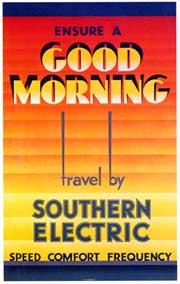 In 1929, the third-rail electrification
of the London suburban network was completed. The introduction of electric multiple units (EMUs) on principal suburban routes ensured fast, efficient commuter services into London and increased the volume of commuter traffic. The Southern Railway's commitment to electrification made the railway more innovative in its approach to handling traffic that its rivals; compare the Southern Railway's legacy with the absence from the Great Western Railway of even a single electrified route.
The intensive commuter system located within a small geographical area made the Southern Railway a natural candidate for electrification and the LSWR and LBSCR had already introduced it in the London area before the Grouping. However, the two schemes were incompatible, as the LBSCR adopted a 6,600V AC overhead system (similar to that used by the Midland Railway for their Lancaster to Morecambe
trial section), whilst the LSWR used a 660V DC third rail standard. After the Grouping, comparisons between the two systems were made and the LSWR system was adopted as standard for the whole system. This was because it had the advantage of being cheaper to install and the lack of catenary
equipment meant that bridge and tunnel clearances were not affected.
Most of the area immediately south of London was converted, together with the long-distance lines to Brighton
, Eastbourne
, Hastings
(via the LBSCR line), Guildford
, Portsmouth
and Reading
, between 1931 and 1939. This was one of the world's first modern mainline electrification schemes. On the former SECR routes, the lines to Sevenoaks
and Maidstone
were electrified by 1939. The routes to the Kent coast were next in line for electrification and would have been followed by the electrification of the Southampton/Bournemouth route. The Second World War delayed these plans until the late 1950s and late 1960s respectively.
(CME) Richard Maunsell
when the Southern Railway led the field in steam locomotive design. The lack of funds affected the development of new, standardised motive power, and it would take until the Second World War for the Southern Railway to take the initiative in steam locomotive design once again.
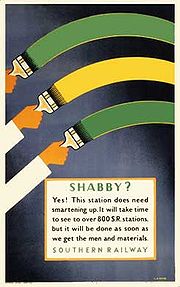 Holiday makers using the lines to the Channel ports and the West Country were replaced with troops during this period, especially with the threat of a German invasion on the south coast in 1940. Before hostilities, 75% of traffic was passenger, compared with 25% freight; during the war roughly the same number of passengers was carried, but freight grew to 60% of total traffic. A desperate shortage of freight locomotives was remedied by CME Oliver Bulleid
, while the volume of military freight and soldiers moved by a primarily commuter and holidaymaker carrying railway was a breathtaking feat.
When the threat of invasion receded, the area served by the Southern Railway became the marshalling area for troops preparing to invade Normandy
in Operation Overlord
, and once again the railway played its part by providing a link in the logistics chain. This came at a cost, as the Southern Railway's location around London and the Channel ports meant that it was subjected to heavy bombing, whilst permanent way, locomotive, carriage and wagon maintenance was deferred until peacetime.
ways. The Southern Railway retained a separate identity as the Southern Region of British Railways
. The Southern Railway Company continued to exist as a legal entity until it went into voluntary liquidation on 10 June 1949. Many lines in London and Kent
had been damaged during the war and much rolling stock
was either damaged or in need of replacement. Just prior to nationalisation the Southern Railway had started a vigorous renewal programme, and this was continued throughout the early 1950s.
The name Southern has been revived as a rebranding of South Central, which operates the former LBSCR routes to South London, Surrey and Sussex from Victoria and London Bridge. Southern is owned by Govia
— a joint venture between transport groups Go-Ahead Group
and Keolis
— which also owns the neighbouring Southeastern
. Officially named Southern Railway Ltd, it was branded Southern on 30 May 2004, recalling the pre-nationalisation Southern Railway, with a green roundel logo with "Southern" written in yellow in a green bar.
(GWR). To the east of this area it held a monopoly of rail services in the counties of Hampshire
, Surrey
, Sussex
and Kent
. Above all, it had a monopoly of the London suburbs south or the River Thames
, where it provided a complex network of secondary routes that intertwined between mainlines.
Unlike the London, Midland and Scottish Railway
, the London and North Eastern Railway
and the GWR, the Southern Railway was predominantly a passenger railway. Despite its small size it carried more than a quarter of Britain’s passenger traffic because of its network of commuter lines around London, serving some of the most densely populated parts of the country. In addition, South London's geology was largely unsuitable for underground railways, meaning that the Southern Railway faced little competition from underground lines, encouraging a denser network stretching from stations located in close proximity to central London.
and there were six other London termini at Blackfriars
, Cannon Street
, Charing Cross
, Holborn Viaduct
, Victoria and London Bridge
. The last of these also held the headquarters of the Eastern and Central Divisions. Other major terminal stations were at Dover, Brighton
and Southampton
. The railway also had one of Europe's busiest stations at Clapham Junction
.
Locomotives were constructed and maintained at works inherited from constituent companies at Eastleigh, Ashford
and Brighton
. The largest was Eastleigh, which was built by the LSWR in 1909 to replace the cramped Nine Elms Locomotive Works
in South London. Brighton had been constructing locomotives since 1852 for the LBSCR, and built 104 of 110 Bulleid Light Pacifics between 1945 and 1951. Ashford was inherited from the SECR, and had been built in 1847, and was the works that constructed half of the SR Q1 class. Ashford completed its final locomotive in March 1944, a War Department Stanier 8F 2-8-0
number 8764.
Carriage works had also been inherited at Eastleigh, and Lancing
(which had been built in 1912 for the LBSCR). During the Second World War, both were turned over to wartime production such as Horsa
and Hamilcar
gliders
. Wagon workshops were situated at Ashford and Eastleigh.
A concrete
works was located near Exmouth Junction
locomotive shed, responsible for platform seat fittings, pre-cast concrete fencing and station lamp posts. A power station was also maintained at Durnsford Road Wimbledon
.
of the former LSWR between London and Southampton was completed by Joseph Locke
with easy gradients, leading to several cuttings, tunnels and embankments across the Loddon
, Test
and Itchen
Valleys, with brick arches constructed across South London to the site of Waterloo station. Such was the emphasis on minimising gradients that the stretch between Micheldever
and Winchester
has the longest constant gradient of any British main line.
The remainder of its area was traversed by three significant rows of hills: the North Downs
, the Wealden Ridge
and the South Downs
. Thus Rastrick's
Brighton Main Line
of 1841, included one of the largest cuttings in the country at Merstham, significant tunnels at Merstham
, Balcombe
, Clayton
and Patcham
as well as the famous Ouse Valley Viaduct
. The major tunnels on the SECR network were at Merstham, Sevenoaks
and Shakespeare Cliff
.
, Percy Tempest and William Forbes, although Walker was the sole occupant in the post within a year. The position of Chief Mechanical Engineer of the Southern Railway was given to a former employee of the SECR, Richard Maunsell
. For ease of administration, the lines inherited in 1923 were divided into three geographical sections with a Traffic Department for each, loosely based upon the areas covered by the amalgamated companies:
Operational and Commercial aspects of railway operation were brought under the control of Traffic Managers, relieving the General Manager of many tasks, allowing him to make policy decisions. Specialised Superintendents served under the Traffic Manager, breaking down the task of operating their respective sections. As such , the Southern Railway operated a hybrid system of centralised and decentralised management.
Passenger services, especially the intensive London suburban services, constituted the key breadwinner of the Southern Railway. The railway also served Channel Ports and a number of attractive coastal destinations which provided the focus for media attention. This meant that the railway operated a number of famous named trains, providing another source of publicity for John Elliot. The Eastern and Central Sections of the network served popular Seaside resort
s such as Brighton
, Eastbourne
, Hastings
and the Channel ports, whilst the Western Section catered for the heavy summer holiday traffic to the West Country resorts. Passenger services on the Southern Railway consisted of luxury Pullman dining trains and normal passenger services, which gave the railway a high total number of carriages at 10,800.
(London - Paris and Brussels), the Brighton Belle
on the Central Section, and the Bournemouth Belle
and Devon Belle
on the Western Section.
The Golden Arrow was the best-known train of the Southern Railway, and was introduced on 15 May 1929. The train consisted of Pullmans and luggage vans, linking London Victoria to Dover, with transfer to the French equivalent at Calais
. The Brighton Belle
, which had its origins in 1881 with the 'Pullman Limited' of the London, Brighton and South Coast Railway
, which renamed the service the 'Southern Belle' in 1908. The train was steam-hauled until 1933 when electric units were introduced after the electrification of the London-Brighton mainline. On 29 June 1934 the train was renamed the Brighton Belle and continued until withdrawal in 1972.
The SECR had introduced a Pullman train called the "Thanet Pullman Limited" from Victoria to Margate
in 1921. The service was not a success and ceased to run in 1928. The service was however re-introduced by British Railways as the Thanet Belle
in 1948.
("ACE"). With a large variety of holiday destinations including Bude
, Exmouth
, Ilfracombe, Padstow
, Plymouth
, Seaton
, Sidmouth
and Torrington
, the 11am "ACE" from Waterloo, as the Atlantic Coast Express became known, was the most multi-portioned train in the UK from its introduction in 1926. This was due to sections of the train splitting at selected junctions for onward journey to their final destinations in the West Country. Padstow railway station in Cornwall
was the westernmost point of the Southern Railway, and marked the end or beginning of the "ACE", which was the longest timetabled journey on the network.
The importance of the destination dictated the motive power selected to haul each portion to their final destinations. Through carriages to East Devon and North Cornwall were invariably hauled by diminutive Drummond M7 tank locomotives, and from 1952, BR Standard Class 3 2-6-2T's; the rest of the train continued behind a Bulleid Light Pacific to Plymouth. The final "ACE" was hauled on 5 September 1964 when the Western Section of the former Southern Railway network was absorbed into the Western Region of British Railways
.
, Brighton
and Eastbourne
.
Passenger services on secondary routes were given motive power that befitted the lacklustre nature of the duty, with elderly locomotives used to provide a local service that fed into the major mainline stations such as Basingstoke. The use of elderly locomotives and stock was invariably a financial consideration, intended to prolong the life of locomotives that would otherwise be scrapped. In some cases, the route was such that some of the newer classes were precluded from operating because of restrictions in loading gauge, the Lyme Regis
branch from Axminster
providing an example.
The Southern Railway also operated push-pull trains of up to two carriages in commuter areas. Push-pull operations did not need the time-consuming use of a turntable or run-around at the end of a suburban branch line, and enabled the driver to use a cab in the end coach to drive the locomotive in reverse. Such operations were similar to the autotrains, with a Drummond M7 providing the motive power.
for freight on the outskirts of South London, at Feltham
, Norwood and Hither Green
, where freight could be sorted for onward travel to their final destinations. It also handled a large volume of cross-London freight from these to other yards north of the river via the West London
and East London Line
s which were jointly owned by the Southern Railway.
As locomotives increased in size so did the length of goods trains from 40 to as many as 100 four-wheeled wagons, although the gradient of the line and the braking capabilities of the locomotive often limited this. The vacuum brake, which was standard equipment on passenger trains, was gradually fitted to a number of ordinary goods wagons, allowing a number of vacuum "fitted" trains to run faster than 40 mph (64 km/h). While typical goods wagons could carry 8, 10 or (later) 12 tons, the load placed into a wagon could be as little as 1 ton, as the railway was designated as a common carrier that could not choose what goods it could carry.
The Southern inherited docks at Southampton, Newhaven
, Plymouth
, Folkestone
, Dover
, Littlehampton
, Whitstable
, Strood
, Rye
, Queenborough
, Port Victoria
and Padstow
. The Southern continued to invest heavily in these facilities, and Southampton
overtook Liverpool
as Britain's main port for Trans-Atlantic liners. The Southern inherited 38 large turbine or other steamers and a number of other vessels branded under Channel Packet, the maritime arm of the railway, all of which passed to British Railways control after nationalisation in 1948.
routes, where holidays by car were beginning to become popular. Services to the Channel Islands
began in 1924, along with services to Brittany
in 1933 and finally Normandy
commencing just prior to nationalisation in 1947.
ex-LSWR ships
SS Alberta, SS Ardena, SS Brittany, SS Caesarea, SS Cherbourg, SS Hantonia, SS Laura, SS Lorina, SS Normannia, SS Princess Ena, SS Vera.
ex-LBSC ships
SS Arundel, SS Brighton, SS Dieppe, SS La France, SS Newhaven, SS Paris, SS Rouen, SS Versailles.
ex-SECR ships
SS Biarritz, SS Canterbury, SS Empress, SS Engadine, SS Invicta, SS Maid of Orleans, SS Riviera, SS Victoria.
Ships built for the SR
SS Arromanches, SS Autocarrier, SS Brighton, SS Brittany, SS Canterbury, SS Dinard, SS Falaise, PS Freshwater, SS Hampton Ferry, SS Invicta, SS Isle of Guernsey, SS Isle of Jersey, SS Isle of Sark,SS Isle of Thanet, SS Londres, SS Maid of Kent, PS Merstone, PS Portsdown, PS Ryde
, SS Shepperton Ferry, PS Shanklin, PS Southsea, SS St Briac, SS Twickenham Ferry, SS Worthing
, PS Whippingham.
Ships managed by SR
During the Second World War and afterwards, Southern managed a number of ships for the Ministry of War Transport.
Empire Alde
.
an ornate frontage in the French Renaissance
style. At Cannon Street station
in London, an Italianate
style hotel was constructed in 1867, designed by Barry. This provided much of the station's passenger facilities as well as an impressive architectural frontispiece to the street prior to demolition in 1960. London Bridge station
boasted The Terminus hotel of 1861, which was turned into offices for the LBSCR in 1892, and destroyed by bombing in 1941. Victoria station had the 300-bedroom Grosvenor hotel, which was rebuilt in 1908. Other hotels were to be found at Southampton and other port locations connected to the railway.
From 1929, the Southern Railway invested in bus companies providing feeder services to its trains. The brand names Southern National
(a joint venture with the National Omnibus & Transport Co. Ltd.) and Southern Vectis
have long outlived the railway company they originally served.
The Southern Railway also undertook freight transfer by road, owning a fleet of goods vehicles providing a door-to-door delivery service. This was especially useful for bulky items that required delivery to areas not immediately served by a railway. Conflat-type wagons were used to carry containers by rail to a destination close to the delivery address, where they would be transferred by crane onto the trailer of a vehicle for onward travel by road.
In conjunction with other Big Four
companies the Southern Railway also invested in providing air services for passengers, notably to the Channel Islands
and Isle of Wight
, which complemented the shipping operations. Such operations provided the chance to take revenue from non-railway passengers, and enabled fast air-freight services between the islands and the mainland. However, this operation was disrupted during the Second World War due to the occupation of the Channel Islands, and the rationing of aviation fuel.
Gloss black (common to most freight designs at grouping, adopted by Maunsell as standard in 1923) LBSCR dark umber (1905–1923) LSWR Urie sage green (1912–1924; this became the standard passenger locomotive livery immediately after grouping) LSWR holly green (1912–1923; freight livery inherited from the LSWR at grouping) SECR grey (until 1923; inherited from the SECR at grouping) SR Maunsell olive green (1924–1939; introduced as the first standard passenger livery for the Southern Railway) Wartime matt black (1940–1950; a wartime labour-saving livery) SR Bulleid light green (1938–1940; first applied to N15 and H15 classes, dropped in favour of malachite green) SR Bulleid malachite green (1939–1950; became standard livery for all Southern passenger locomotives)
Maunsell locomotives featured name and number plates of polished brass with a red or black background in 1924. Bulleid nameplates were generally gunmetal with polished brass lettering, and featured crests depicting aspects of the class theme (Merchant Navy, West Country or Battle of Britain).
Until 1931 the Southern Railway initially maintained the locomotive numbers from its constituents, and solved the problem of more than one locomotive having the same number by letter prefixes denoting the main works of the former owning company. All ex-SECR locos were prefixed by "A" (for Ashford), ex-LBSCR by "B" (for Brighton) and ex-LSWR engines by "E" (for Eastleigh). New locomotives were prefixed by the letter of the works where they were built. In 1931 the fleet was re-numbered by dropping all prefixes, leaving E-prefixed numbers unchanged, adding 1000 to A-prefixed numbers and 2000 to B-prefixed ones, an exception being the Z-class 0-8-0 shunters whose numbers A950-A957 only lost the prefix, with no addition. (Some non-revenue-earning locos were exempt from this scheme).
Under Bulleid, a new continental system of numbering was introduced for his own locomotives, based upon his experiences at the French branch of Westinghouse Electric before the First World War, and his tenure in the rail operating department during that conflict. The Southern Railway number adapted a modified UIC classification
system where "2" and "1" refer to the number of un-powered leading and trailing axles respectively, and "C" refers to three driving axles (the system was only applied to new 6-coupled locos and one Co-Co elecric loco before nationalisation). As an example, the first Merchant Navy class locomotive was numbered 21C1.
s from its constituent companies at grouping The railway handed over in the region of 1789 locomotives to British Railways in 1948. Similarly, it inherited 84 DC multiple units
(later designated 3-SUB
) from the LSWR and 38 AC units (later designated CP
and SL
classes) from the LBSCR, and handed over in the region of 1480 DC units.
 The first locomotives constructed for the Southern Railway were to designs inherited from the pre-Grouping railway companies, such as the N15 class
and H15 class, though both were modified by Maunsell
from the original design. These were intended as interim solutions to motive power problems, since several designs in operation on the Southern Railway were obsolete. The 1920s was the era of standardisation, with ease of maintenance and repair key considerations in a successful locomotive design.
In 1926, the first of new Southern Railway designed and built locomotives emerged from Eastleigh works, the Maunsell Lord Nelson class
, reputedly the most powerful 4-6-0 in Britain at the time. So successful was the Lord Nelson class that the Royal Scot class
had its origins in the Maunsell design. However, the Depression of 1929 precluded further improvements in Southern Railway locomotive technology, apart from the V "Schools" class 4-4-0 and various electric designs. Maunsell also designed locomotives for use in freight yards such as that at Feltham
in south west London, the final example of which was the Q class. The design of the Q class coincided with Maunsell's ill health, resulting in a conservative approach to design. The first examples were completed in 1937, the year in which Maunsell retired from the CME's position.
Maunsell was succeeded in 1937 by Oliver Vaughan Snell Bulleid
, who brought experience gained under Sir Nigel Gresley at the LNER. He designed the Bulleid chain-driven valve gear
that was compact enough to fit within the restrictions of his Pacific designs, the Merchant Navy class
of 1941 and the Light Pacific design of 1945. Ever the innovator, Bulleid introduced welded steel boilers and steel fireboxes which were easier to repair than the copper variety, whilst a new emphasis on cab ergonomics was followed. Established locomotive design practices were altered in his designs, with the wheels changed from the traditional spoked to the boxpok
design, giving better all-round support to the tyre.
Visually, the most unusual of his designs was a small, heavy freight locomotive, the most powerful and last non-derivative design of 0-6-0 to operate in Britain. This Q1 class eliminated anything that might be considered unnecessary in locomotive design, including the traditional wheel splashers. With innovative lagging material that dictated the shape of the boiler cladding, the Q1 was regarded by many as one of the ugliest locomotives ever constructed. The 40 engines produced required the same amount of material needed for 38 more conventional machines, justifying the economies and design.
Bulleid's innovation stemmed from a belief in the continued development of steam traction, and culminated in the Leader class
of 1946, an 0-6-6-0 design that had two cabs, negating the use of a turntable. The entire locomotive was placed on two bogies, enabling negotiation around tight curves, while the slab-sided body could be cleaned by a labour-saving carriage washer.
Despite the successes of the Pacifics and the unusual 0-6-0 Q1 freight locomotives, the Pacifics were difficult to maintain and featured enough eccentricities to justify rebuilding in the mid-1950s. The innovations ensured that the Southern was once again leading the field in locomotive design, and earned Bulleid the title "last giant of steam" in Britain.
s for yard shunting in 1937. He ordered three locomotives
, which proved to be successful, but his retirement and the onset of the Second World War prevented further development. Bullied adapted and improved the design but his class
did not appear until 1949, after nationalisation. Bulleid also designed a class
of main line
diesel-electric locomotives, continuing to push back the boundaries of contemporary locomotive design and established practice, but this was built by British Railways.
electric locomotives, numbered CC1 and CC2 under Bulleid's numbering system. They were designed by Bulleid and Alfred Raworth, and were renumbered 20001 and 20002 after nationalisation. At this time a third locomotive was under construction, and was numbered 20003 in 1948. The locomotives were later classified as British Rail Class 70. These incorporated a cab design similar to that of the 2HAL
(2-car Half Lavatory electric stock) design constructed from 1938. This was due to ease of construction by welding, which allowed both cheap and speedy construction. With the outbreak of war in 1939, most new locomotive construction projects were put on hold in favour of the war effort, although construction of CC1 and CC2 was exempted from this because of promised savings in labour and fuel over steam locomotives.
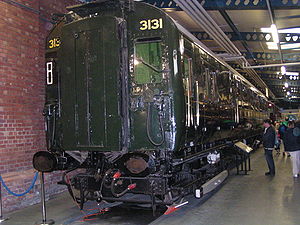 The early LBSCR AC overhead Electric multiple unit
s (EMU) were phased-out by September 1929 and converted into DC types. All further electrification was at 660 volts DC, and investment was made in modernising the fleet inherited from the pre-Grouping companies, and building new stock often by converting existing steam hauled carriages. The Southern Railway’s EMU classification meant the unit type was given a three-letter code (sometimes two letters), prefixed by the number of carriages within each unit. These early suburban units
, constructed between 1925 and 1937 were therefore designated 3-SUB, or later 4-SUB, depending on the number of coaches. The EMUs consisted of a fixed formation of two driving units at both ends of the train, and could have varying numbers of carriages in between (as indicated in the classification).
Newly built units of 4-LAV
6PUL
types were introduced in 1932 for the electrification of the Brighton main line
. Further types were introduced as electrification spread further. Thus the 2-BIL
units were constructed between 1935 and 1938 to work long-distance semi-fast services to Eastbourne, Portsmouth and Reading, or the 2-HAL
for those to Maidstone and Gillingham. 4-COR
units, handled fast trains on the London Waterloo railway station to Portsmouth Harbour railway station
from April 1937.
A total of 460 electric vehicles were to be built by the Southern Railway before nationalisation. Variants of the Southern Railway's electric stock included Pullman carriages or wagons for the carriage of parcels and newspapers, allowing flexibility of use on the London suburban lines and the Eastern Section of the network.
was bought in 1927 to test its operating cost and reliability on lightly used branch lines. It was not successful and was sold to the Weston, Clevedon and Portishead Railway
in 1934. Similarly, a Sentinel steam railcar was purchased in 1933 for use on the Devil's Dyke branch.
It was transferred from that line in March 1936 and tried in other areas, but was withdrawn in 1940.
.jpg) The Southern inherited many wooden-bodied carriage designs from its constituent companies. However, there was an emphasis on standardising the coaching stock, which led to Maunsell designing new carriages. These were classified between 0 and 4, so that an 8' 0¾" wide carriage was "Restriction 0". The restrictions related to the Southern's composite loading gauge
The Southern inherited many wooden-bodied carriage designs from its constituent companies. However, there was an emphasis on standardising the coaching stock, which led to Maunsell designing new carriages. These were classified between 0 and 4, so that an 8' 0¾" wide carriage was "Restriction 0". The restrictions related to the Southern's composite loading gauge
, so that some more restricted routes could be catered for. The new carriages were based upon the former LSWR "Ironclad" carriage designs, and comprised First and Third Class compartments, each of which contained a corridor and doors for each compartment, enabling quick egress on commuter services. Similar principles were applied to the electric train sets, where quick passenger egress promoted a punctual service.
The Southern Railway was one of the few railways to marshal its carriages into fixed numbered sets. This made maintenance easier, as the location of a particular set would always be known through its number, which was painted on the ends of the set. A pool of "loose" carriages was kept for train strengthening on summer Saturdays and to replace faulty stock.
.jpg) The second phase of carriage construction began towards the end of the Southern Railway's existence. Bulleid had vast experience in carriage design from his time with the LNER, and he applied this acquired knowledge to a new fleet of well-regarded carriages (see picture). One of his more unusual projects was his "Tavern Car" design, carriages that were to represent a typical country tavern
The second phase of carriage construction began towards the end of the Southern Railway's existence. Bulleid had vast experience in carriage design from his time with the LNER, and he applied this acquired knowledge to a new fleet of well-regarded carriages (see picture). One of his more unusual projects was his "Tavern Car" design, carriages that were to represent a typical country tavern
, with a bar and seating space provided within the carriage. The outside of the "Tavern Cars" were partially painted in a mock-Tudor style of architecture, and were given typical public house names. Poor ventilation from small windows made the "Tavern Cars" unpopular amongst the travelling public, with several being converted to ordinary use during the 1950s.
The Southern Railway was the only one of the "Big Four" British railway companies that did not operate sleeping cars other than those brought in from the continent on the 'Night Ferry
'. This was because the short distances meant that such provision was not financially viable. The Southern Railway also undertook the practice of converting inherited carriages into electric stock, therefore providing a cheaper alternative to constructing brand new EMUs. Bulleid initiated an unusual project that attempted to address the problem of overcrowding on suburban services. The answer to the problem was Britain's first double-deck carriages
, which were eventually built in 1949. Two sets of four cars were completed and saw use until the 1970s, powered by electric in the same way as the EMUS. However, further orders for these trains were not placed due to cramped conditions inside which were dictated by the restrictions of the loading gauge.
in London. As the railway was primarily passenger-orientated, there was little investment in freight wagons except for general utility vans, which could be used for both freight and luggage. These consisted of bogie and four wheel designs, and were frequently used on boat trains. At its peak, the Southern Railway owned 37,500 freight wagons, a small number when one considers 500,000 private owner wagons from collieries were brought under the control of the Railway Executive Committee during the Second World War.
that served Portsmouth was met with hostility by the general public, causing a public relations disaster. This stimulated the creation of the first "modern" public relations department with the appointment of John Elliot (later Sir John Elliot) in 1925. Elliot was instrumental in creating the positive image that the Southern enjoyed prior to the Second World War, building a publicity campaign for its electrification project that marketed the "World's Greatest Suburban Electric".
and be content" encouraged commuters to move out from London and patronise the Southern Railway's services. Posters also advertised ocean services from Ocean Terminal in Southampton and the docks at Dover. These also incorporated the corresponding rail connections with London, such as "The Cunarder" and the "Golden Arrow".
, Swanage Railway
, Spa Valley Railway
, and the Bluebell Railway
. Other remnants of the railway include Eastleigh works and the London termini, including Waterloo (the largest London railway station), Victoria
, Charing Cross
, Cannon Street
and London Bridge
(the oldest London terminus). There are several societies that specialise in the Southern Railway, including the Southern Railways Group and the Southern Electric Group. Both help to promote continued interest in the Southern Railway and have regular newsletters.
, KCB General Manager (1923–1937). Walker was an astute administrator of railways, having gained experience as General Manager of the LSWR from 1912. After retiring in 1937 he was a director of the Southern until the end of its existence in 1947. Two significant events occurred under Walker's tenure as General Manager: electrification in mid-1920s; and the appointment of Bulleid as CME in 1937.
Gilbert S. Szlumper
, TD, CBE General Manager (1937–1939). Trained as a civil engineer
and became Docks and Marine Manager at Southampton, before becoming Assistant General Manager in 1925. In 1939 he was recalled by the War Office as a Major-General to sort out the military movements at Southampton Docks. He was ousted from the General Managership, after the Traffic Manager, Eustace Missenden, refused to become Acting General Manager, and threatened to resign if not confirmed as GM proper.
Sir Eustace Missenden General Manager (1939–Nationalisation); Chairman, Railway Executive (1947–1951). Missenden had been Traffic Manager before becoming the GM in 1939. From the latter half of 1947, he was largely absent from the Southern Railway as Chairman of the Railway Executive.
Sir John Elliot Acting General Manager (1947); Assistant General Manager (1933 to nationalisation); Public Relations Assistant (1925 until 1933). Noted for being Britain's first expert in public relations, Elliot was brought in by Sir Herbert Walker after the bad press received following service delays and consolidation of the newly created company. It was at the suggestion of Elliot that the Southern's express passenger locomotives should be named, representing positive publicity for the railway, whilst distinctive locomotive liveries and well-known posters were created under his direction. He continued to serve the railways after nationalisation in 1948, and was created Chairman of London Transport
in 1953.
(1922 to 1937). Maunsell was responsible for initial attempts at locomotive standardisation on the Southern, as well as overseeing the introduction of electric traction. Among his many achievements was the introduction of the 4-6-0 SR Lord Nelson Class
locomotives and also the SR Class V
or "Schools" class, which were the ultimate and very successful development of the British 4-4-0
express passenger type. He also introduced new, standardised rolling stock designs for use on the Southern network, which were based upon the railway's composite loading gauge
.
O. V. S. Bulleid, CBE (CME 1937 to nationalisation). Bulleid moved to the Southern from the LNER, bringing several ideas for improving the efficiency of steam locomotives. Such innovations were used on the Merchant Navy class
, West Country and Battle of Britain classes
("Bulleid Light Pacifics"), Q1
and experimental Leader
designs. He also developed a host of innovative electric units and locomotives.
Company.
Railways Act 1921
The Railways Act 1921, also known as the Grouping Act, was an enactment by the British government of David Lloyd George intended to stem the losses being made by many of the country's 120 railway companies, move the railways away from internal competition, and to retain some of the benefits which...
. It linked London with the Channel
English Channel
The English Channel , often referred to simply as the Channel, is an arm of the Atlantic Ocean that separates southern England from northern France, and joins the North Sea to the Atlantic. It is about long and varies in width from at its widest to in the Strait of Dover...
ports, South West England
South West England
South West England is one of the regions of England defined by the Government of the United Kingdom for statistical and other purposes. It is the largest such region in area, covering and comprising Bristol, Gloucestershire, Somerset, Dorset, Wiltshire, Devon, Cornwall and the Isles of Scilly. ...
, South coast resorts and Kent
Kent
Kent is a county in southeast England, and is one of the home counties. It borders East Sussex, Surrey and Greater London and has a defined boundary with Essex in the middle of the Thames Estuary. The ceremonial county boundaries of Kent include the shire county of Kent and the unitary borough of...
. The railway was formed by the amalgamation of several smaller railway companies, the largest of which were the London & South Western Railway (LSWR), the London, Brighton and South Coast Railway
London, Brighton and South Coast Railway
The London, Brighton and South Coast Railway was a railway company in the United Kingdom from 1846 to 1922. Its territory formed a rough triangle, with London at its apex, practically the whole coastline of Sussex as its base, and a large part of Surrey...
(LBSC) and the South Eastern and Chatham Railway
South Eastern and Chatham Railway
The South Eastern and Chatham Railway Companies Joint Management Committee , known by its shorter name of the South Eastern and Chatham Railway was a working union of two neighbouring rival railways, the South Eastern Railway and London, Chatham and Dover Railway , that operated services between...
(SECR). The construction of what was to become the Southern Railway began in 1838 with the opening of the London and Southampton Railway, which was renamed the London & South Western Railway.
The railway was noted for its astute use of public relations and a coherent management structure headed by Sir Herbert Walker
Herbert Ashcombe Walker
Sir Herbert Ashcombe Walker, KCB was a British railway manager.-Early life:Walker was born in London 15 May 1868. He was educated at the North London Collegiate School and at Bruges.-Career:...
. At 2,186 miles (3,518 km), the Southern Railway was the smallest of the "Big Four" railway companies and, unlike the others, the majority of its revenue came from passengers rather than freight. It created what was at that time the world's largest electrified railway system and the first electrified InterCity
InterCity
InterCity is the classification applied to certain long-distance passenger train services in Europe...
route (London--Brighton
Brighton
Brighton is the major part of the city of Brighton and Hove in East Sussex, England on the south coast of Great Britain...
). There were two Chief Mechanical Engineers; Richard Maunsell between 1923 and 1937 and Oliver Bulleid from 1937 to 1948, both of whom designed new locomotives and rolling stock to replace much of that which was inherited in 1923. The Southern Railway played a vital role in the Second World War, embarking the British Expeditionary Force, during the Dunkirk operations, and supplying Operation Overlord
Operation Overlord
Operation Overlord was the code name for the Battle of Normandy, the operation that launched the invasion of German-occupied western Europe during World War II by Allied forces. The operation commenced on 6 June 1944 with the Normandy landings...
in 1944; because the railway was primarily a passenger network, its success was an even more remarkable achievement.
The Southern Railway operated a number of famous named trains, including the Brighton Belle
Brighton Belle
The Brighton Belle was a named train which ran on the Southern Railway from Victoria Station in London to Brighton, on the Sussex coast. The first electric all-Pullman service in the world, it ran from 29 June 1934 till 30 April 1972.-History:...
, the Bournemouth Belle
Bournemouth Belle
The Bournemouth Belle was a named train run by the Southern Railway from 1931 until nationalisation in 1948 and subsequently by British Railways until it was withdrawn on 9 July 1967....
, the Golden Arrow and the Night Ferry
Night Ferry
The Night Ferry was an international sleeper train between London Victoria and Paris Gare du Nord . It was operated by the SNCF and the Southern Railway then, following nationalisation on 1 January 1948, the Southern Region of British Railways.-Rolling stock:Introduced on the night of 5 October...
(London - Paris and Brussels). The West Country services were dominated by lucrative summer holiday traffic and included named trains such as the Atlantic Coast Express
Atlantic Coast Express
The Atlantic Coast Express was an express passenger train in England between Waterloo station, London and seaside resorts in the south-west...
and the Devon Belle
Devon Belle
The Devon Belle was a luxury express passenger train in England which ran between London Waterloo station and Ilfracombe and Plymouth in Devon in the years from 1947 to 1954.-The train:...
. The company's best-known livery was highly distinctive: locomotives and carriages were painted in a bright Malachite green
Malachite green
Malachite green is an organic compound that is used as a dyestuff and has emerged as a controversial agent in aquaculture. Malachite green is traditionally used as a dye for materials such as silk, leather, and paper...
above plain black frames, with bold, bright yellow lettering. The Southern Railway was nationalised in 1948, becoming the Southern Region of British Railways
Southern Region of British Railways
The Southern Region was a region of British Railways from 1948. The region ceased to be an operating unit in its own right in the 1980s and was wound up at the end of 1992. The region covered south London, southern England and the south coast, including the busy commuter belt areas of Kent, Sussex...
.
Constituent companies and formation in 1923
Four important railway companies operated along the south coast of England prior to 1923 – the London & South Western Railway (LSWR), the London, Brighton and South Coast RailwayLondon, Brighton and South Coast Railway
The London, Brighton and South Coast Railway was a railway company in the United Kingdom from 1846 to 1922. Its territory formed a rough triangle, with London at its apex, practically the whole coastline of Sussex as its base, and a large part of Surrey...
(LBSCR), and the South Eastern Railway, UK and the London Chatham and Dover Railway. (The last two had formed a working union known as the South Eastern and Chatham Railway
South Eastern and Chatham Railway
The South Eastern and Chatham Railway Companies Joint Management Committee , known by its shorter name of the South Eastern and Chatham Railway was a working union of two neighbouring rival railways, the South Eastern Railway and London, Chatham and Dover Railway , that operated services between...
(SECR) in 1899.) These companies were amalgamated, together with several small independently operated lines
and non-working companies, to form the Southern Railway in 1923, which operated 2186 route miles (3518 km) of railway. The new railway also partly owned several joint lines: notably the East London Railway, the West London Extension Joint Railway, the Somerset and Dorset Joint Railway
Somerset and Dorset Joint Railway
The Somerset & Dorset Joint Railway – almost always referred to as "the S&D" – was an English railway line connecting Bath in north east Somerset and Bournemouth now in south east Dorset but then in Hampshire...
and the Weymouth and Portland Railway.
The first main line
Main line (railway)
The Mainline or Main line of a railway is a track that is used for through trains or is the principal artery of the system from which branch lines, yards, sidings and spurs are connected....
railway in southern England was the London and Southampton Railway, (renamed LSWR in 1838), which completed its line in May 1840. It was quickly followed by the London and Brighton Railway
London and Brighton Railway
The London and Brighton Railway was a railway company in England which was incorporated in 1837 and survived until 1846. Its railway runs from a junction with the London & Croydon Railway at Norwood - which gives it access from London Bridge, just south of the River Thames in central London...
(September 1841), and the South Eastern Railway (formerly the South Eastern and Dover Railway) in February 1844. The LSWR branched out to destinations including Portsmouth
Portsmouth
Portsmouth is the second largest city in the ceremonial county of Hampshire on the south coast of England. Portsmouth is notable for being the United Kingdom's only island city; it is located mainly on Portsea Island...
, Salisbury
Salisbury
Salisbury is a cathedral city in Wiltshire, England and the only city in the county. It is the second largest settlement in the county...
and later Exeter
Exeter
Exeter is a historic city in Devon, England. It lies within the ceremonial county of Devon, of which it is the county town as well as the home of Devon County Council. Currently the administrative area has the status of a non-metropolitan district, and is therefore under the administration of the...
and Plymouth
Plymouth
Plymouth is a city and unitary authority area on the coast of Devon, England, about south-west of London. It is built between the mouths of the rivers Plym to the east and Tamar to the west, where they join Plymouth Sound...
. It grew to be the largest of the four constituent companies. The LBSCR was a smaller railway than its LSWR neighbour, serving the port of Newhaven
Newhaven, East Sussex
Newhaven is a town in the Lewes District of East Sussex in England. It lies at the mouth of the River Ouse, on the English Channel coast, and is a ferry port for services to France.-Origins:...
and several popular holiday resorts on the south coast and operating much of the south London suburban network. It had been almost bankrupt in 1867, but during the last twenty-five years of its existence it had been well-managed and profitable. It had begun to electrify routes around London (using an overhead line system) from 1909 to compete with the new electric trams that were taking away some of its traffic. Finally, the SECR had been created after years of wasteful and damaging competition between the two companies involved, with duplication of routes and services. Both companies had been unpopular with the travelling public and operated poorly maintained plant and infrastructure. Nevertheless real progress had been made in rectifying this during the period 1899-1922.
The formation of the Southern Railway was rooted in the outbreak of the First World War, when all British railway companies were taken into government control. Many members of staff joined the armed forces and it was not possible to build and maintain equipment at peacetime levels. After the war the government considered permanent nationalisation but instead decided on a compulsory amalgamation of the railways into four large groups through the 1921 Railways Act
Railways Act 1921
The Railways Act 1921, also known as the Grouping Act, was an enactment by the British government of David Lloyd George intended to stem the losses being made by many of the country's 120 railway companies, move the railways away from internal competition, and to retain some of the benefits which...
, known as the Grouping. The resultant amalgamation of the four south coast railways to form the Southern Railway meant that several duplicate routes and management structures were inherited. The LSWR had most influence on the new company, although genuine attempts were made to integrate the services and staff after 1923. The rationalisation of the system led to the downgrading of some routes in favour of more direct lines to the channel ports, and the creation of a coordinated, but not necessarily centralised form of management based at the former LSWR headquarters in Waterloo station.
In addition to its railway operations, the Southern Railway inherited several important port and harbour facilities along the south coast, including Southampton
Southampton
Southampton is the largest city in the county of Hampshire on the south coast of England, and is situated south-west of London and north-west of Portsmouth. Southampton is a major port and the closest city to the New Forest...
, Newhaven
Newhaven, East Sussex
Newhaven is a town in the Lewes District of East Sussex in England. It lies at the mouth of the River Ouse, on the English Channel coast, and is a ferry port for services to France.-Origins:...
and Folkestone
Folkestone
Folkestone is the principal town in the Shepway District of Kent, England. Its original site was in a valley in the sea cliffs and it developed through fishing and its closeness to the Continent as a landing place and trading port. The coming of the railways, the building of a ferry port, and its...
. It also ran services to the harbours at Portsmouth
Portsmouth
Portsmouth is the second largest city in the ceremonial county of Hampshire on the south coast of England. Portsmouth is notable for being the United Kingdom's only island city; it is located mainly on Portsea Island...
, Dover
Dover
Dover is a town and major ferry port in the home county of Kent, in South East England. It faces France across the narrowest part of the English Channel, and lies south-east of Canterbury; east of Kent's administrative capital Maidstone; and north-east along the coastline from Dungeness and Hastings...
and Plymouth
Plymouth
Plymouth is a city and unitary authority area on the coast of Devon, England, about south-west of London. It is built between the mouths of the rivers Plym to the east and Tamar to the west, where they join Plymouth Sound...
. These had come into being for handling ocean-going and cross-channel
English Channel
The English Channel , often referred to simply as the Channel, is an arm of the Atlantic Ocean that separates southern England from northern France, and joins the North Sea to the Atlantic. It is about long and varies in width from at its widest to in the Strait of Dover...
passenger traffic and the size of the railway-owned installations reflected the prosperity that the industry generated. This source of traffic, together with the density of population served in the London suburbs ensured that the Southern would be a predominantly passenger-orientated railway.
Electrification
Railway electrification in Great Britain
Railway electrification in Great Britain started towards of the 19th century. A great range of voltages have been used in the intervening period using both overhead lines and third rails, however the most common standard for mainline services is now 25 kV AC using overhead lines and the...
of the London suburban network was completed. The introduction of electric multiple units (EMUs) on principal suburban routes ensured fast, efficient commuter services into London and increased the volume of commuter traffic. The Southern Railway's commitment to electrification made the railway more innovative in its approach to handling traffic that its rivals; compare the Southern Railway's legacy with the absence from the Great Western Railway of even a single electrified route.
The intensive commuter system located within a small geographical area made the Southern Railway a natural candidate for electrification and the LSWR and LBSCR had already introduced it in the London area before the Grouping. However, the two schemes were incompatible, as the LBSCR adopted a 6,600V AC overhead system (similar to that used by the Midland Railway for their Lancaster to Morecambe
Morecambe
Morecambe is a resort town and civil parish within the City of Lancaster in Lancashire, England. As of 2001 it has a resident population of 38,917. It faces into Morecambe Bay...
trial section), whilst the LSWR used a 660V DC third rail standard. After the Grouping, comparisons between the two systems were made and the LSWR system was adopted as standard for the whole system. This was because it had the advantage of being cheaper to install and the lack of catenary
Overhead lines
Overhead lines or overhead wires are used to transmit electrical energy to trams, trolleybuses or trains at a distance from the energy supply point...
equipment meant that bridge and tunnel clearances were not affected.
Most of the area immediately south of London was converted, together with the long-distance lines to Brighton
Brighton railway station
Brighton railway station is the principal railway station in the city of Brighton and Hove, on the south coast of England. The station master is Mark Epsom...
, Eastbourne
Eastbourne railway station
Eastbourne railway station serves Eastbourne in East Sussex, England. It is on the East Coastway Line, and train services are provided by Southern. It is one of two railway stations in the town, the other being Hampden Park Station...
, Hastings
Hastings railway station
Hastings railway station is in Hastings in East Sussex, England. It is situated on the Hastings Line to Tunbridge Wells, the East Coastway Line to Brighton and the Marshlink Line to Ashford International....
(via the LBSCR line), Guildford
Guildford (Surrey) railway station
Guildford railway station is an important railway junction on the Portsmouth Direct Line serving the town of Guildford in Surrey, England. It is 30.3 miles from London Waterloo....
, Portsmouth
Portsmouth Harbour railway station
Portsmouth Harbour railway station is a railway station in Portsmouth, England. It is situated beside Gunwharf Quays in the city's harbour, and is an important transport terminal, with a bus interchange and ferry services to Gosport and the Isle of Wight. The station currently has four platforms:...
and Reading
Reading Southern railway station
Reading Southern railway station was the western terminus of the South Eastern Railway's route from . It was also used by London and South Western Railway services from London Waterloo....
, between 1931 and 1939. This was one of the world's first modern mainline electrification schemes. On the former SECR routes, the lines to Sevenoaks
Sevenoaks
Sevenoaks is a commuter town situated on the London fringe of west Kent, England, some 20 miles south-east of Charing Cross, on one of the principal commuter rail lines from the capital...
and Maidstone
Maidstone
Maidstone is the county town of Kent, England, south-east of London. The River Medway runs through the centre of the town linking Maidstone to Rochester and the Thames Estuary. Historically, the river was a source and route for much of the town's trade. Maidstone was the centre of the agricultural...
were electrified by 1939. The routes to the Kent coast were next in line for electrification and would have been followed by the electrification of the Southampton/Bournemouth route. The Second World War delayed these plans until the late 1950s and late 1960s respectively.
Economic crisis of the 1930s
The post-Wall Street Crash affected South Eastern England far less than other areas. The investment the company had already made in modernising the commuter network ensured that the Southern Railway remained in good financial health relative to the other railway companies despite the Depression. However, any available funds were devoted to electrification programme, and this marked the end of the first period under Chief Mechanical EngineerChief Mechanical Engineer
Chief Mechanical Engineer and Locomotive Superintendent are titles applied by British, Australian, and New Zealand railway companies to the person ultimately responsible to the board of the company for the building and maintaining of the locomotives and rolling stock...
(CME) Richard Maunsell
Richard Maunsell
Richard Edward Lloyd Maunsell held the post of Chief Mechanical Engineer of the South Eastern and Chatham Railway from 1913 until the 1923 Grouping and then the post of CME of the Southern Railway in England until 1937....
when the Southern Railway led the field in steam locomotive design. The lack of funds affected the development of new, standardised motive power, and it would take until the Second World War for the Southern Railway to take the initiative in steam locomotive design once again.
Second World War
Oliver Bulleid
Oliver Vaughan Snell Bulleid was a British railway and mechanical engineer best known as the Chief Mechanical Engineer of the Southern Railway between 1937 and the 1948 nationalisation, developing many well-known locomotives.- Early life and Great Northern Railway :He was born in Invercargill,...
, while the volume of military freight and soldiers moved by a primarily commuter and holidaymaker carrying railway was a breathtaking feat.
When the threat of invasion receded, the area served by the Southern Railway became the marshalling area for troops preparing to invade Normandy
Normandy
Normandy is a geographical region corresponding to the former Duchy of Normandy. It is in France.The continental territory covers 30,627 km² and forms the preponderant part of Normandy and roughly 5% of the territory of France. It is divided for administrative purposes into two régions:...
in Operation Overlord
Operation Overlord
Operation Overlord was the code name for the Battle of Normandy, the operation that launched the invasion of German-occupied western Europe during World War II by Allied forces. The operation commenced on 6 June 1944 with the Normandy landings...
, and once again the railway played its part by providing a link in the logistics chain. This came at a cost, as the Southern Railway's location around London and the Channel ports meant that it was subjected to heavy bombing, whilst permanent way, locomotive, carriage and wagon maintenance was deferred until peacetime.
Nationalisation
After a period of slow recovery in the late 1940s, the war-devastated company was nationalised along with the rest of the railway network in 1948 and incorporated into British RailBritish Rail
British Railways , which from 1965 traded as British Rail, was the operator of most of the rail transport in Great Britain between 1948 and 1997. It was formed from the nationalisation of the "Big Four" British railway companies and lasted until the gradual privatisation of British Rail, in stages...
ways. The Southern Railway retained a separate identity as the Southern Region of British Railways
Southern Region of British Railways
The Southern Region was a region of British Railways from 1948. The region ceased to be an operating unit in its own right in the 1980s and was wound up at the end of 1992. The region covered south London, southern England and the south coast, including the busy commuter belt areas of Kent, Sussex...
. The Southern Railway Company continued to exist as a legal entity until it went into voluntary liquidation on 10 June 1949. Many lines in London and Kent
Kent
Kent is a county in southeast England, and is one of the home counties. It borders East Sussex, Surrey and Greater London and has a defined boundary with Essex in the middle of the Thames Estuary. The ceremonial county boundaries of Kent include the shire county of Kent and the unitary borough of...
had been damaged during the war and much rolling stock
Rolling stock
Rolling stock comprises all the vehicles that move on a railway. It usually includes both powered and unpowered vehicles, for example locomotives, railroad cars, coaches and wagons...
was either damaged or in need of replacement. Just prior to nationalisation the Southern Railway had started a vigorous renewal programme, and this was continued throughout the early 1950s.
Revival in the privatised network
- See: Southern (train operating company)Southern (train operating company)Southern is a train operating company in the United Kingdom. Officially named Southern Railway Ltd., it is a subsidiary of Govia, a joint venture between transport groups Go-Ahead Group and Keolis, and has operated the South Central rail franchise since October 2000 and the Gatwick Express service...
The name Southern has been revived as a rebranding of South Central, which operates the former LBSCR routes to South London, Surrey and Sussex from Victoria and London Bridge. Southern is owned by Govia
Govia
Govia is a transport company based in the United Kingdom. A joint venture between Go-Ahead and Keolis SA it is a key operator of commuter services in London, the South East and on the West Coast Main Line...
— a joint venture between transport groups Go-Ahead Group
Go-Ahead Group
The Go-Ahead Group plc is a rail and bus operating company that was created following the privatisation of the UK's train and bus industries. It is listed on the London Stock Exchange and is a constituent of the FTSE 250 Index.-Early history:...
and Keolis
Keolis
Keolis is the largest private sector French transport group. It runs passenger railways, tramways, bus networks, funiculars, trolley buses, and airport services. The company, based in Paris, is majority owned by SNCF, the French state rail operator. AXA Private Equity and Caisse de dépôt et...
— which also owns the neighbouring Southeastern
Southeastern (train operating company)
London & South Eastern Railway Limited, trading as Southeastern is a train operating company in south-east England. On 1 April 2006 it became the franchisee for the new Integrated Kent Franchise , replacing the publicly owned South Eastern Trains on the former South East Franchise...
. Officially named Southern Railway Ltd, it was branded Southern on 30 May 2004, recalling the pre-nationalisation Southern Railway, with a green roundel logo with "Southern" written in yellow in a green bar.
Geography
The Southern railway covered a large territory in south-west England including Weymouth, Plymouth, Salisbury and Exeter, where it was in competition with the Great Western RailwayGreat Western Railway
The Great Western Railway was a British railway company that linked London with the south-west and west of England and most of Wales. It was founded in 1833, received its enabling Act of Parliament in 1835 and ran its first trains in 1838...
(GWR). To the east of this area it held a monopoly of rail services in the counties of Hampshire
Hampshire
Hampshire is a county on the southern coast of England in the United Kingdom. The county town of Hampshire is Winchester, a historic cathedral city that was once the capital of England. Hampshire is notable for housing the original birthplaces of the Royal Navy, British Army, and Royal Air Force...
, Surrey
Surrey
Surrey is a county in the South East of England and is one of the Home Counties. The county borders Greater London, Kent, East Sussex, West Sussex, Hampshire and Berkshire. The historic county town is Guildford. Surrey County Council sits at Kingston upon Thames, although this has been part of...
, Sussex
Sussex
Sussex , from the Old English Sūþsēaxe , is an historic county in South East England corresponding roughly in area to the ancient Kingdom of Sussex. It is bounded on the north by Surrey, east by Kent, south by the English Channel, and west by Hampshire, and is divided for local government into West...
and Kent
Kent
Kent is a county in southeast England, and is one of the home counties. It borders East Sussex, Surrey and Greater London and has a defined boundary with Essex in the middle of the Thames Estuary. The ceremonial county boundaries of Kent include the shire county of Kent and the unitary borough of...
. Above all, it had a monopoly of the London suburbs south or the River Thames
River Thames
The River Thames flows through southern England. It is the longest river entirely in England and the second longest in the United Kingdom. While it is best known because its lower reaches flow through central London, the river flows alongside several other towns and cities, including Oxford,...
, where it provided a complex network of secondary routes that intertwined between mainlines.
Unlike the London, Midland and Scottish Railway
London, Midland and Scottish Railway
The London Midland and Scottish Railway was a British railway company. It was formed on 1 January 1923 under the Railways Act of 1921, which required the grouping of over 120 separate railway companies into just four...
, the London and North Eastern Railway
London and North Eastern Railway
The London and North Eastern Railway was the second-largest of the "Big Four" railway companies created by the Railways Act 1921 in Britain...
and the GWR, the Southern Railway was predominantly a passenger railway. Despite its small size it carried more than a quarter of Britain’s passenger traffic because of its network of commuter lines around London, serving some of the most densely populated parts of the country. In addition, South London's geology was largely unsuitable for underground railways, meaning that the Southern Railway faced little competition from underground lines, encouraging a denser network stretching from stations located in close proximity to central London.
Key locations
The headquarters of the Southern was in the former LSWR offices at Waterloo stationWaterloo station
Waterloo station, also known as London Waterloo, is a central London railway terminus and London Underground complex. The station is owned and operated by Network Rail and is close to the South Bank of the River Thames, and in Travelcard Zone 1....
and there were six other London termini at Blackfriars
Blackfriars station
Blackfriars station, also known as London Blackfriars, is a central London railway terminus and London Underground complex in the City of London, England. Its platforms will eventually span the River Thames a short distance downstream from Blackfriars Bridge. The current entrance is located on the...
, Cannon Street
Cannon Street station
Cannon Street station, also known as London Cannon Street, is a central London railway terminus and London Underground complex in the City of London, England. It is built on the site of the medieval Steelyard, the trading base in England of the Hanseatic League...
, Charing Cross
Charing Cross railway station
Charing Cross railway station, also known as London Charing Cross, is a central London railway terminus in the City of Westminster, England. It is one of 18 stations managed by Network Rail, and trains serving it are operated by Southeastern...
, Holborn Viaduct
Holborn Viaduct railway station
Holborn Viaduct was a railway terminus in central London.-History:During the 1860s and 1870s, had begun to struggle with increasing numbers of trains. At the time, the LCDR was suffering financial problems, and so was unable to raise capital to expand the station...
, Victoria and London Bridge
London Bridge station
London Bridge railway station is a central London railway terminus and London Underground complex in the London Borough of Southwark, occupying a large area on two levels immediately south-east of London Bridge and 1.6 miles east of Charing Cross. It is one of the oldest railway stations in the...
. The last of these also held the headquarters of the Eastern and Central Divisions. Other major terminal stations were at Dover, Brighton
Brighton railway station
Brighton railway station is the principal railway station in the city of Brighton and Hove, on the south coast of England. The station master is Mark Epsom...
and Southampton
Southampton Terminus railway station
Southampton Terminus railway station served the docks and city centre of Southampton, England. The station was first authorized on the 25 July 1834, it began as the terminus of the London and South Western Railway...
. The railway also had one of Europe's busiest stations at Clapham Junction
Clapham Junction railway station
Clapham Junction railway station is near St John's Hill in the south-west of Battersea in the London Borough of Wandsworth. Although it is in Battersea, the area around the station is commonly identified as Clapham Junction....
.
Locomotives were constructed and maintained at works inherited from constituent companies at Eastleigh, Ashford
Ashford railway works
Ashford railway works was in the town of Ashford in the county of Kent in England.-South Eastern Railway:Ashford locomotive works was built by the South Eastern Railway on a new site in 1847, replacing an earlier locomotive repair facility at New Cross in London...
and Brighton
Brighton railway works
Brighton railway works was one of the earliest railway-owned locomotive repair works, founded in 1840 by the London and Brighton Railway in Brighton, England, and thus pre-dating the more famous railway works at Crewe, Doncaster and Swindon...
. The largest was Eastleigh, which was built by the LSWR in 1909 to replace the cramped Nine Elms Locomotive Works
Nine Elms Locomotive Works
Nine Elms locomotive works were built in 1839 by the London and South Western Railway adjoining their passenger terminus near the Vauxhall end of Nine Elms Lane, in the district of Nine Elms in the London Borough of Battersea. They were rebuilt in 1841 and remained the principal locomotive...
in South London. Brighton had been constructing locomotives since 1852 for the LBSCR, and built 104 of 110 Bulleid Light Pacifics between 1945 and 1951. Ashford was inherited from the SECR, and had been built in 1847, and was the works that constructed half of the SR Q1 class. Ashford completed its final locomotive in March 1944, a War Department Stanier 8F 2-8-0
2-8-0
Under the Whyte notation for the classification of steam locomotives, 2-8-0 represents the wheel arrangement of two leading wheels on one axle , eight powered and coupled driving wheels on four axles, and no trailing wheels...
number 8764.
Carriage works had also been inherited at Eastleigh, and Lancing
Lancing Carriage Works
Lancing carriage and wagon works was a railway carriage and wagon building and maintenance facility in the village of Lancing in the county of West Sussex in England from 1911 until 1965.-History under the LB&SCR:...
(which had been built in 1912 for the LBSCR). During the Second World War, both were turned over to wartime production such as Horsa
Airspeed Horsa
The Airspeed AS.51 Horsa was a British World War II troop-carrying glider built by Airspeed Limited and subcontractors and used for air assault by British and Allied armed forces...
and Hamilcar
General Aircraft Hamilcar
The General Aircraft Limited GAL. 49 Hamilcar or Hamilcar Mark I was a large British military glider produced during the Second World War, which was designed to carry heavy cargo, such as the Tetrarch or M22 Locust light tank...
gliders
Military glider
Military gliders have been used by the military of various countries for carrying troops and heavy equipment to a combat zone, mainly during the Second World War. These engineless aircraft were towed into the air and most of the way to their target by military transport planes, e.g...
. Wagon workshops were situated at Ashford and Eastleigh.
A concrete
Concrete
Concrete is a composite construction material, composed of cement and other cementitious materials such as fly ash and slag cement, aggregate , water and chemical admixtures.The word concrete comes from the Latin word...
works was located near Exmouth Junction
Exmouth Junction
Exmouth Junction is the railway junction where the Exmouth branch line diverges from the London Waterloo to Exeter main line in Exeter, Devon, England. It was for many years the location for one of the largest engine sheds in the former London and South Western Railway...
locomotive shed, responsible for platform seat fittings, pre-cast concrete fencing and station lamp posts. A power station was also maintained at Durnsford Road Wimbledon
Wimbledon, London
Wimbledon is a district in the south west area of London, England, located south of Wandsworth, and east of Kingston upon Thames. It is situated within Greater London. It is home to the Wimbledon Tennis Championships and New Wimbledon Theatre, and contains Wimbledon Common, one of the largest areas...
.
Engineering
The South Western Main LineSouth Western Main Line
The South Western Main Line is a railway line between London Waterloo and Weymouth on the Dorset coast, in the south of England. It is a major railway which serves many important commuter areas, as well as the major settlements of Southampton and Bournemouth...
of the former LSWR between London and Southampton was completed by Joseph Locke
Joseph Locke
Joseph Locke was a notable English civil engineer of the 19th century, particularly associated with railway projects...
with easy gradients, leading to several cuttings, tunnels and embankments across the Loddon
River Loddon
The River Loddon is a river in the English counties of Berkshire and Hampshire. It is a tributary of the River Thames, rising within the urban area of Basingstoke and flowing to meet the Thames near the village of Wargrave...
, Test
River Test
The River Test is a river in Hampshire, England. The river has a total length of 40 miles and it flows through downland from its source near Ashe, 10 km to the west of Basingstoke , to the sea at the head of Southampton Water...
and Itchen
River Itchen, Hampshire
The River Itchen is a river in Hampshire, England. It flows from mid-Hampshire to join with Southampton Water below the Itchen Bridge in the city of Southampton. The river has a total length of , and is noted as one of England's - if not one of the World's - premier chalk streams for fly fishing,...
Valleys, with brick arches constructed across South London to the site of Waterloo station. Such was the emphasis on minimising gradients that the stretch between Micheldever
Micheldever
Micheldever is a village in Hampshire, England, situated 6 miles north of Winchester.It lies upon the River Dever . The river, and village, formerly part of Stratton Park, lie on a Hampshire grass downland, underlain with chalk and flint...
and Winchester
Winchester
Winchester is a historic cathedral city and former capital city of England. It is the county town of Hampshire, in South East England. The city lies at the heart of the wider City of Winchester, a local government district, and is located at the western end of the South Downs, along the course of...
has the longest constant gradient of any British main line.
The remainder of its area was traversed by three significant rows of hills: the North Downs
North Downs
The North Downs are a ridge of chalk hills in south east England that stretch from Farnham in Surrey to the White Cliffs of Dover in Kent. The North Downs lie within two Areas of Outstanding Natural Beauty , the Surrey Hills and the Kent Downs...
, the Wealden Ridge
Weald
The Weald is the name given to an area in South East England situated between the parallel chalk escarpments of the North and the South Downs. It should be regarded as three separate parts: the sandstone "High Weald" in the centre; the clay "Low Weald" periphery; and the Greensand Ridge which...
and the South Downs
South Downs
The South Downs is a range of chalk hills that extends for about across the south-eastern coastal counties of England from the Itchen Valley of Hampshire in the west to Beachy Head, near Eastbourne, East Sussex, in the east. It is bounded on its northern side by a steep escarpment, from whose...
. Thus Rastrick's
John Urpeth Rastrick
John Urpeth Rastrick was one of the first English steam locomotive builders. In partnership with James Foster, he formed Foster, Rastrick and Company, the locomotive construction company that built the Stourbridge Lion in 1829 for export to the Delaware and Hudson Railroad in America.-Early...
Brighton Main Line
Brighton Main Line
The Brighton Main Line is a British railway line from London Victoria and London Bridge to Brighton. It is about 50 miles long, and is electrified throughout. Trains are operated by Southern, First Capital Connect, and Gatwick Express, now part of Southern.-Original proposals:There were no fewer...
of 1841, included one of the largest cuttings in the country at Merstham, significant tunnels at Merstham
Merstham tunnels
The Merstham and Quarry tunnels are two railway tunnels on the Brighton main line between Merstham and Coulsdon in Surrey, Great Britain...
, Balcombe
Balcombe tunnel
Balcombe tunnel is a railway tunnel on the Brighton Main Line through the Sussex Weald between Three Bridges and Balcombe. It is 1141 yards long.-History:The tunnel was constructed by the London and Brighton Railway during 1840-41...
, Clayton
Clayton Tunnel
Clayton Tunnel is a railway tunnel located near the village of Clayton, West Sussex between Hassocks and Preston Park railway stations on the Brighton Main Line...
and Patcham
Patcham Tunnel
Patcham tunnel is a railway tunnel on the Brighton Main Line through the South Downs between Preston Park and Hassocks in East Sussex, England. It is 488 yards long.-History:...
as well as the famous Ouse Valley Viaduct
Ouse Valley Viaduct
Built in 1841, the Ouse Valley Viaduct over the River Ouse on the London-Brighton Railway Line north of Haywards Heath and south of Balcombe is long.-Description:...
. The major tunnels on the SECR network were at Merstham, Sevenoaks
Sevenoaks
Sevenoaks is a commuter town situated on the London fringe of west Kent, England, some 20 miles south-east of Charing Cross, on one of the principal commuter rail lines from the capital...
and Shakespeare Cliff
Shakespeare Cliff Halt railway station
Shakespeare Cliff Halt is a private halt station on the South Eastern Main Line. It is located to the western end of the dual bore Shakespeare Cliff tunnel on the South Eastern Main Line to Folkestone...
.
Operations
The running of the Southern was undertaken by the Board of Directors, the first Chairman of which was Sir Hugh Drummond, appointed to the post in 1923. There were originally three general managers representing the interests of the three pre-Grouping railway companies: Sir Herbert WalkerHerbert Ashcombe Walker
Sir Herbert Ashcombe Walker, KCB was a British railway manager.-Early life:Walker was born in London 15 May 1868. He was educated at the North London Collegiate School and at Bruges.-Career:...
, Percy Tempest and William Forbes, although Walker was the sole occupant in the post within a year. The position of Chief Mechanical Engineer of the Southern Railway was given to a former employee of the SECR, Richard Maunsell
Richard Maunsell
Richard Edward Lloyd Maunsell held the post of Chief Mechanical Engineer of the South Eastern and Chatham Railway from 1913 until the 1923 Grouping and then the post of CME of the Southern Railway in England until 1937....
. For ease of administration, the lines inherited in 1923 were divided into three geographical sections with a Traffic Department for each, loosely based upon the areas covered by the amalgamated companies:
- The Western Section (former LSWR routes) included the South Western Main LineSouth Western Main LineThe South Western Main Line is a railway line between London Waterloo and Weymouth on the Dorset coast, in the south of England. It is a major railway which serves many important commuter areas, as well as the major settlements of Southampton and Bournemouth...
, the Portsmouth Direct LinePortsmouth Direct LineThe Portsmouth Direct Line is the route of a railway service operated by South West Trains which runs between London Waterloo and Portsmouth Harbour, England...
one quarter of the West Coastway LineWest Coastway LineThe West Coastway Line is a railway line in England, along the south coast of West Sussex and Hampshire, between Brighton and Southampton, plus the short branches to Littlehampton and Bognor Regis....
(between PortsmouthPortsmouthPortsmouth is the second largest city in the ceremonial county of Hampshire on the south coast of England. Portsmouth is notable for being the United Kingdom's only island city; it is located mainly on Portsea Island...
and SouthamptonSouthamptonSouthampton is the largest city in the county of Hampshire on the south coast of England, and is situated south-west of London and north-west of Portsmouth. Southampton is a major port and the closest city to the New Forest...
), and the West of England Main LineWest of England Main LineThe West of England Main Line is a British railway line that runs from , Hampshire to Exeter St Davids in Devon, England. Passenger services run between London Waterloo station and Exeter...
, both serving destinations popular with holidaymakers. It stretched into DevonDevonDevon is a large county in southwestern England. The county is sometimes referred to as Devonshire, although the term is rarely used inside the county itself as the county has never been officially "shired", it often indicates a traditional or historical context.The county shares borders with...
and CornwallCornwallCornwall is a unitary authority and ceremonial county of England, within the United Kingdom. It is bordered to the north and west by the Celtic Sea, to the south by the English Channel, and to the east by the county of Devon, over the River Tamar. Cornwall has a population of , and covers an area of...
, and this circuitous route was known derisively as the Southern Railway's "Withered Arm" because the GWR had a stronger presence in this region. - The Central Section (former LB&SCR routes) included the Brighton Main LineBrighton Main LineThe Brighton Main Line is a British railway line from London Victoria and London Bridge to Brighton. It is about 50 miles long, and is electrified throughout. Trains are operated by Southern, First Capital Connect, and Gatwick Express, now part of Southern.-Original proposals:There were no fewer...
(the most profitable and heavily used main line), the East Coastway LineEast Coastway LineEast Coastway is the name used by the train operating company, Southern , for the routes it operates along the south coast of Sussex and Kent to the east of Brighton, England. Those to the West of Brighton are named the West Coastway Line...
, three quarters of the West Coastway LineWest Coastway LineThe West Coastway Line is a railway line in England, along the south coast of West Sussex and Hampshire, between Brighton and Southampton, plus the short branches to Littlehampton and Bognor Regis....
, the Arun Valley LineArun Valley LineThe Arun Valley Line, also known as the Mid Sussex Line, is part of the Southern-operated railway services. For the initial part of the route trains follow the Brighton Main Line, and at a junction south of Three Bridges the route turns westwards...
and the Sutton & Mole Valley Lines. - The Eastern Section (former SECR routes) included the South Eastern Main Line, the Chatham Main LineChatham Main LineThe Chatham Main Line is a British railway line that runs from either London Victoria to Dover Priory / Ramsgate or London St Pancras to Faversham, with both services travelling via Medway...
, the Hastings LineHastings LineThe Hastings Line is a railway line in Kent and East Sussex linking Hastings with the main town of Tunbridge Wells, and from there into London via Sevenoaks.-Openings:The line was opened by the South Eastern Railway in main three stages: – :...
, the Kent Coast LineKent Coast LineThe Kent Coast Line is railway line that runs from Dover Priory to Margate in the English county of Kent.It was electrified by BR under the 1955 Modernisation Plan.- Services :...
and the North Downs LineNorth Downs LineThe North Downs Line is the name of the passenger train service connecting Reading, on the Great Western Main Line, to Gatwick Airport, on the Brighton Main Line...
.
Operational and Commercial aspects of railway operation were brought under the control of Traffic Managers, relieving the General Manager of many tasks, allowing him to make policy decisions. Specialised Superintendents served under the Traffic Manager, breaking down the task of operating their respective sections. As such , the Southern Railway operated a hybrid system of centralised and decentralised management.
Passenger operations
- See also Named trains: UKNamed trains: UKThis article contains a list of named passenger trains in the United Kingdom. These are specific regular journeys identified by a special name in the timetable, not to be confused with the names of engines or individual physical train rakes. One-off charter or sporadic special trains are not included...
Passenger services, especially the intensive London suburban services, constituted the key breadwinner of the Southern Railway. The railway also served Channel Ports and a number of attractive coastal destinations which provided the focus for media attention. This meant that the railway operated a number of famous named trains, providing another source of publicity for John Elliot. The Eastern and Central Sections of the network served popular Seaside resort
Seaside resort
A seaside resort is a resort, or resort town, located on the coast. Where a beach is the primary focus for tourists, it may be called a beach resort.- Overview :...
s such as Brighton
Brighton
Brighton is the major part of the city of Brighton and Hove in East Sussex, England on the south coast of Great Britain...
, Eastbourne
Eastbourne
Eastbourne is a large town and borough in East Sussex, on the south coast of England between Brighton and Hastings. The town is situated at the eastern end of the chalk South Downs alongside the high cliff at Beachy Head...
, Hastings
Hastings
Hastings is a town and borough in the county of East Sussex on the south coast of England. The town is located east of the county town of Lewes and south east of London, and has an estimated population of 86,900....
and the Channel ports, whilst the Western Section catered for the heavy summer holiday traffic to the West Country resorts. Passenger services on the Southern Railway consisted of luxury Pullman dining trains and normal passenger services, which gave the railway a high total number of carriages at 10,800.
Pullman services
Pullman services were the premier trains of the Southern, reflecting the pride felt towards the railway. These luxury services included several boat trains such as the Golden Arrow (London-Paris, translated as Flèche d'Or for the French part of its route), The Cunarder (London - Southampton Ocean Liner service) and the Night FerryNight Ferry
The Night Ferry was an international sleeper train between London Victoria and Paris Gare du Nord . It was operated by the SNCF and the Southern Railway then, following nationalisation on 1 January 1948, the Southern Region of British Railways.-Rolling stock:Introduced on the night of 5 October...
(London - Paris and Brussels), the Brighton Belle
Brighton Belle
The Brighton Belle was a named train which ran on the Southern Railway from Victoria Station in London to Brighton, on the Sussex coast. The first electric all-Pullman service in the world, it ran from 29 June 1934 till 30 April 1972.-History:...
on the Central Section, and the Bournemouth Belle
Bournemouth Belle
The Bournemouth Belle was a named train run by the Southern Railway from 1931 until nationalisation in 1948 and subsequently by British Railways until it was withdrawn on 9 July 1967....
and Devon Belle
Devon Belle
The Devon Belle was a luxury express passenger train in England which ran between London Waterloo station and Ilfracombe and Plymouth in Devon in the years from 1947 to 1954.-The train:...
on the Western Section.
The Golden Arrow was the best-known train of the Southern Railway, and was introduced on 15 May 1929. The train consisted of Pullmans and luggage vans, linking London Victoria to Dover, with transfer to the French equivalent at Calais
Calais
Calais is a town in Northern France in the department of Pas-de-Calais, of which it is a sub-prefecture. Although Calais is by far the largest city in Pas-de-Calais, the department's capital is its third-largest city of Arras....
. The Brighton Belle
Brighton Belle
The Brighton Belle was a named train which ran on the Southern Railway from Victoria Station in London to Brighton, on the Sussex coast. The first electric all-Pullman service in the world, it ran from 29 June 1934 till 30 April 1972.-History:...
, which had its origins in 1881 with the 'Pullman Limited' of the London, Brighton and South Coast Railway
London, Brighton and South Coast Railway
The London, Brighton and South Coast Railway was a railway company in the United Kingdom from 1846 to 1922. Its territory formed a rough triangle, with London at its apex, practically the whole coastline of Sussex as its base, and a large part of Surrey...
, which renamed the service the 'Southern Belle' in 1908. The train was steam-hauled until 1933 when electric units were introduced after the electrification of the London-Brighton mainline. On 29 June 1934 the train was renamed the Brighton Belle and continued until withdrawal in 1972.
The SECR had introduced a Pullman train called the "Thanet Pullman Limited" from Victoria to Margate
Margate
-Demography:As of the 2001 UK census, Margate had a population of 40,386.The ethnicity of the town was 97.1% white, 1.0% mixed race, 0.5% black, 0.8% Asian, 0.6% Chinese or other ethnicity....
in 1921. The service was not a success and ceased to run in 1928. The service was however re-introduced by British Railways as the Thanet Belle
Thanet Belle
The Thanet Belle was a named train run by the Southern Region of British Railways from 1948 until it was withdrawn in 1958 due to the electrification of the route...
in 1948.
Titled trains
Amongst the ordinary services, the Southern Railway also operated famous titled express trains such as the Atlantic Coast ExpressAtlantic Coast Express
The Atlantic Coast Express was an express passenger train in England between Waterloo station, London and seaside resorts in the south-west...
("ACE"). With a large variety of holiday destinations including Bude
Bude
Bude is a small seaside resort town in North Cornwall, England, at the mouth of the River Neet . It lies just south of Flexbury, north of Widemouth Bay and west of Stratton and is located along the A3073 road off the A39. Bude is twinned with Ergué-Gabéric in Brittany, France...
, Exmouth
Exmouth
Exmouth is a town in Devon. It may also refer to:Places*Exmouth Peninsula in Southern Chile*Exmouth, Western AustraliaPeople*Edward Pellew, 1st Viscount Exmouth , a British naval officerShips...
, Ilfracombe, Padstow
Padstow railway station
Padstow railway station was the western terminus of the North Cornwall Railway. It was opened in 1899 by the London and South Western Railway to serve the port of Padstow...
, Plymouth
Plymouth
Plymouth is a city and unitary authority area on the coast of Devon, England, about south-west of London. It is built between the mouths of the rivers Plym to the east and Tamar to the west, where they join Plymouth Sound...
, Seaton
Seaton, Devon
Seaton is a seaside town in East Devon on the south coast of England. It faces onto Lyme Bay, to the west of the mouth of the River Axe with red cliffs to one side and white cliffs on the other. Axmouth and Beer are nearby...
, Sidmouth
Sidmouth
Sidmouth is a small town on the English Channel coast in Devon, South West England. The town lies at the mouth of the River Sid in the East Devon district, south east of Exeter. It has a population of about 15,000, of whom 40% are over 65....
and Torrington
Great Torrington
Great Torrington is a small market town in the north of Devon, England. Parts of it are sited on high ground with steep drops down to the River Torridge below...
, the 11am "ACE" from Waterloo, as the Atlantic Coast Express became known, was the most multi-portioned train in the UK from its introduction in 1926. This was due to sections of the train splitting at selected junctions for onward journey to their final destinations in the West Country. Padstow railway station in Cornwall
Cornwall
Cornwall is a unitary authority and ceremonial county of England, within the United Kingdom. It is bordered to the north and west by the Celtic Sea, to the south by the English Channel, and to the east by the county of Devon, over the River Tamar. Cornwall has a population of , and covers an area of...
was the westernmost point of the Southern Railway, and marked the end or beginning of the "ACE", which was the longest timetabled journey on the network.
The importance of the destination dictated the motive power selected to haul each portion to their final destinations. Through carriages to East Devon and North Cornwall were invariably hauled by diminutive Drummond M7 tank locomotives, and from 1952, BR Standard Class 3 2-6-2T's; the rest of the train continued behind a Bulleid Light Pacific to Plymouth. The final "ACE" was hauled on 5 September 1964 when the Western Section of the former Southern Railway network was absorbed into the Western Region of British Railways
Western Region of British Railways
The Western Region was a region of British Railways from 1948. The region ceased to be an operating unit in its own right in the 1980s and was wound up at the end of 1992...
.
Commuter services
Inner London suburban services were fully electrified by 1929 and worked by electric multiple units of varying lengths according to demand, which had the advantage of rapid acceleration and braking. The railway then began a successful programme to electrify its most heavily used main lines, building up a substantial commuter traffic from towns such as GuildfordGuildford
Guildford is the county town of Surrey. England, as well as the seat for the borough of Guildford and the administrative headquarters of the South East England region...
, Brighton
Brighton
Brighton is the major part of the city of Brighton and Hove in East Sussex, England on the south coast of Great Britain...
and Eastbourne
Eastbourne
Eastbourne is a large town and borough in East Sussex, on the south coast of England between Brighton and Hastings. The town is situated at the eastern end of the chalk South Downs alongside the high cliff at Beachy Head...
.
Other passenger services
The remainder of passenger operations were non-Pullman, reflecting the ‘bread and butter’ of running a passenger railway. West Country services were dominated by lucrative summer holiday traffic and passengers wishing to travel to the Isle of Wight and further afield. In winter months, the western extremity of the Southern Railway network saw very little local use, as the railway served sparsely populated communities. Competition with the GWR also diluted passenger traffic within this area, as this carried the bulk of passengers to the major urban centres of the West Country. Steam-hauled passenger services in the east of the network were gradually replaced with electric traction, especially around London's suburbs.Passenger services on secondary routes were given motive power that befitted the lacklustre nature of the duty, with elderly locomotives used to provide a local service that fed into the major mainline stations such as Basingstoke. The use of elderly locomotives and stock was invariably a financial consideration, intended to prolong the life of locomotives that would otherwise be scrapped. In some cases, the route was such that some of the newer classes were precluded from operating because of restrictions in loading gauge, the Lyme Regis
Lyme Regis
Lyme Regis is a coastal town in West Dorset, England, situated 25 miles west of Dorchester and east of Exeter. The town lies in Lyme Bay, on the English Channel coast at the Dorset-Devon border...
branch from Axminster
Axminster
Axminster is a market town and civil parish on the eastern border of Devon in England. The town is built on a hill overlooking the River Axe which heads towards the English Channel at Axmouth, and is in the East Devon local government district. It has a population of 5,626. The market is still...
providing an example.
The Southern Railway also operated push-pull trains of up to two carriages in commuter areas. Push-pull operations did not need the time-consuming use of a turntable or run-around at the end of a suburban branch line, and enabled the driver to use a cab in the end coach to drive the locomotive in reverse. Such operations were similar to the autotrains, with a Drummond M7 providing the motive power.
Freight operations
Passenger traffic was the main source of revenue for the Southern Railway throughout its existence, although goods were also carried in separate trains. Goods such as milk and cattle from the agricultural areas of the West Country provided a regular source of freight traffic, whilst imports from the south coast ports also required carriage by rail to freight terminals such as the large Bricklayers Arms facility. The railway operated three large marshalling yardsClassification yard
A classification yard or marshalling yard is a railroad yard found at some freight train stations, used to separate railroad cars on to one of several tracks. First the cars are taken to a track, sometimes called a lead or a drill...
for freight on the outskirts of South London, at Feltham
Feltham marshalling yard
Feltham marshalling yard, also known as Feltham hump yard, was a large railway marshalling yard designed for the concentration of freight traffic to and from South West London, and for transfer to other marshalling yards in London. It was built on the Waterloo to Reading Line...
, Norwood and Hither Green
Hither Green railway station
Hither Green is a railway station located in Hither Green in the London Borough of Lewisham, in southeast London, United Kingdom. Hither Green is a busy commuter station with services to several London termini and destinations to the southeast Hither Green is a railway station located in Hither...
, where freight could be sorted for onward travel to their final destinations. It also handled a large volume of cross-London freight from these to other yards north of the river via the West London
West London Line
The West London Line is a short railway in inner West London which links lines at in the south to lines near Willesden Junction in the north. It has always been an important cross-London link especially for freight services...
and East London Line
East London Line
The East London Line is a London Overground line which runs north to south through the East End, Docklands and South areas of London.Built in 1869 by the East London Railway Company, which reused the Thames Tunnel, originally intended for horse-drawn carriages, the line became part of the London...
s which were jointly owned by the Southern Railway.
As locomotives increased in size so did the length of goods trains from 40 to as many as 100 four-wheeled wagons, although the gradient of the line and the braking capabilities of the locomotive often limited this. The vacuum brake, which was standard equipment on passenger trains, was gradually fitted to a number of ordinary goods wagons, allowing a number of vacuum "fitted" trains to run faster than 40 mph (64 km/h). While typical goods wagons could carry 8, 10 or (later) 12 tons, the load placed into a wagon could be as little as 1 ton, as the railway was designated as a common carrier that could not choose what goods it could carry.
Ancillary operations
The Southern Railway inherited a range of railway-related activities from its constituent companies, which it continued to develop until nationalisation in 1948. These activities included several ports, a fleet of ships, road services (both freight and passenger) and several hotels. These ancillary operations provided extra revenue for the railway at a time when railways were classified as a common carrier by the Railways Act of 1844, and could not compete with road with regards to pricing. This was because railways were obliged to advertise their rates of carriage at railway stations, which could subsequently be undercut by road haulage companies. The Southern Railway also invested in an air service during the 1930s, which supplemented the popular sea crossings to the Isle of Wight and the Channel Islands.Shipping
- See also Southern Railway ships
The Southern inherited docks at Southampton, Newhaven
Newhaven, East Sussex
Newhaven is a town in the Lewes District of East Sussex in England. It lies at the mouth of the River Ouse, on the English Channel coast, and is a ferry port for services to France.-Origins:...
, Plymouth
Plymouth
Plymouth is a city and unitary authority area on the coast of Devon, England, about south-west of London. It is built between the mouths of the rivers Plym to the east and Tamar to the west, where they join Plymouth Sound...
, Folkestone
Folkestone
Folkestone is the principal town in the Shepway District of Kent, England. Its original site was in a valley in the sea cliffs and it developed through fishing and its closeness to the Continent as a landing place and trading port. The coming of the railways, the building of a ferry port, and its...
, Dover
Dover
Dover is a town and major ferry port in the home county of Kent, in South East England. It faces France across the narrowest part of the English Channel, and lies south-east of Canterbury; east of Kent's administrative capital Maidstone; and north-east along the coastline from Dungeness and Hastings...
, Littlehampton
Littlehampton
Littlehampton is a seaside resort town and civil parish in the Arun District of West Sussex, England, on the east bank at the mouth of the River Arun. It lies south southwest of London, west of Brighton and east of the county town of Chichester....
, Whitstable
Whitstable
Whitstable is a seaside town in Northeast Kent, Southeast England. It is approximately north of the city of Canterbury and approximately west of the seaside town of Herne Bay. It is part of the City of Canterbury district and has a population of about 30,000.Whitstable is famous for its oysters,...
, Strood
Strood
Strood is a town in the unitary authority of Medway in South East England. It is part of the ceremonial county of Kent. It lies on the north west bank of the River Medway at its lowest bridging point, and is part of the Rochester post town....
, Rye
Rye, East Sussex
Rye is a small town in East Sussex, England, which stands approximately two miles from the open sea and is at the confluence of three rivers: the Rother, the Tillingham and the Brede...
, Queenborough
Queenborough
Queenborough is a small town on the Isle of Sheppey in the Swale borough of Kent in South East England.Queenborough is two miles south of Sheerness. It grew as a port near the Thames Estuary at the westward entrance to The Swale where it joins the River Medway...
, Port Victoria
Hoo Peninsula
The Hoo Peninsula is a peninsula in England separating the estuaries of the rivers Thames and Medway. It is dominated by a line of sand and clay hills, surrounded by an extensive area of marshland composed of alluvial silt. The name Hoo is the Old English word for spur of land.-History:The Romans...
and Padstow
Padstow
Padstow is a town, civil parish and fishing port on the north coast of Cornwall, England, United Kingdom. The town is situated on the west bank of the River Camel estuary approximately five miles northwest of Wadebridge, ten miles northwest of Bodmin and ten miles northeast of Newquay...
. The Southern continued to invest heavily in these facilities, and Southampton
Southampton
Southampton is the largest city in the county of Hampshire on the south coast of England, and is situated south-west of London and north-west of Portsmouth. Southampton is a major port and the closest city to the New Forest...
overtook Liverpool
Liverpool
Liverpool is a city and metropolitan borough of Merseyside, England, along the eastern side of the Mersey Estuary. It was founded as a borough in 1207 and was granted city status in 1880...
as Britain's main port for Trans-Atlantic liners. The Southern inherited 38 large turbine or other steamers and a number of other vessels branded under Channel Packet, the maritime arm of the railway, all of which passed to British Railways control after nationalisation in 1948.
Ships
The Southern inherited a number of ships from its constituent companies, some of which were converted to car ferries when this mode of transport became more common. Such conversions were needed on the FrenchFrance
The French Republic , The French Republic , The French Republic , (commonly known as France , is a unitary semi-presidential republic in Western Europe with several overseas territories and islands located on other continents and in the Indian, Pacific, and Atlantic oceans. Metropolitan France...
routes, where holidays by car were beginning to become popular. Services to the Channel Islands
Channel Islands
The Channel Islands are an archipelago of British Crown Dependencies in the English Channel, off the French coast of Normandy. They include two separate bailiwicks: the Bailiwick of Guernsey and the Bailiwick of Jersey...
began in 1924, along with services to Brittany
Brittany
Brittany is a cultural and administrative region in the north-west of France. Previously a kingdom and then a duchy, Brittany was united to the Kingdom of France in 1532 as a province. Brittany has also been referred to as Less, Lesser or Little Britain...
in 1933 and finally Normandy
Normandy
Normandy is a geographical region corresponding to the former Duchy of Normandy. It is in France.The continental territory covers 30,627 km² and forms the preponderant part of Normandy and roughly 5% of the territory of France. It is divided for administrative purposes into two régions:...
commencing just prior to nationalisation in 1947.
ex-LSWR ships
SS Alberta, SS Ardena, SS Brittany, SS Caesarea, SS Cherbourg, SS Hantonia, SS Laura, SS Lorina, SS Normannia, SS Princess Ena, SS Vera.
ex-LBSC ships
SS Arundel, SS Brighton, SS Dieppe, SS La France, SS Newhaven, SS Paris, SS Rouen, SS Versailles.
ex-SECR ships
SS Biarritz, SS Canterbury, SS Empress, SS Engadine, SS Invicta, SS Maid of Orleans, SS Riviera, SS Victoria.
Ships built for the SR
SS Arromanches, SS Autocarrier, SS Brighton, SS Brittany, SS Canterbury, SS Dinard, SS Falaise, PS Freshwater, SS Hampton Ferry, SS Invicta, SS Isle of Guernsey, SS Isle of Jersey, SS Isle of Sark,SS Isle of Thanet, SS Londres, SS Maid of Kent, PS Merstone, PS Portsdown, PS Ryde
PS Ryde
PS Ryde is a paddle steamer commissioned and run by Southern Railway as a passenger ferry between mainland England and the Isle of Wight from 1937 to 1969. She saw wartime service and later became a nightclub. After many years abandoned at moorings on the River Medina, scrapping started but was...
, SS Shepperton Ferry, PS Shanklin, PS Southsea, SS St Briac, SS Twickenham Ferry, SS Worthing
SS Worthing
SS Worthing was a steam-powered ferry operating between Newhaven and Dieppe Gare Maritime.The Worthing was built for the Southern Railway and launched on 3 May 1928. Her first captain was Charles Lever Cook MBE...
, PS Whippingham.
Ships managed by SR
During the Second World War and afterwards, Southern managed a number of ships for the Ministry of War Transport.
Empire Alde
MV Pelikan
Pelikan was a 3,264 ton refrigerated cargo ship which was built in 1934. She was seized by the United Kingdom and renamed Empire Alde in 1945. In 1946, she was renamed Pelikan...
.
Hotels, road transport and air transport
Ten large hotels were owned by the company, at the London termini and at the coast. The Charing Cross Hotel, designed by Edward Middleton Barry, opened on 15 May 1865 and gave the stationCharing Cross railway station
Charing Cross railway station, also known as London Charing Cross, is a central London railway terminus in the City of Westminster, England. It is one of 18 stations managed by Network Rail, and trains serving it are operated by Southeastern...
an ornate frontage in the French Renaissance
French Renaissance architecture
French Renaissance architecture is the style of architecture which was imported to France from Italy during the early 16th century and developed in the light of local architectural traditions....
style. At Cannon Street station
Cannon Street station
Cannon Street station, also known as London Cannon Street, is a central London railway terminus and London Underground complex in the City of London, England. It is built on the site of the medieval Steelyard, the trading base in England of the Hanseatic League...
in London, an Italianate
Italianate architecture
The Italianate style of architecture was a distinct 19th-century phase in the history of Classical architecture. In the Italianate style, the models and architectural vocabulary of 16th-century Italian Renaissance architecture, which had served as inspiration for both Palladianism and...
style hotel was constructed in 1867, designed by Barry. This provided much of the station's passenger facilities as well as an impressive architectural frontispiece to the street prior to demolition in 1960. London Bridge station
London Bridge station
London Bridge railway station is a central London railway terminus and London Underground complex in the London Borough of Southwark, occupying a large area on two levels immediately south-east of London Bridge and 1.6 miles east of Charing Cross. It is one of the oldest railway stations in the...
boasted The Terminus hotel of 1861, which was turned into offices for the LBSCR in 1892, and destroyed by bombing in 1941. Victoria station had the 300-bedroom Grosvenor hotel, which was rebuilt in 1908. Other hotels were to be found at Southampton and other port locations connected to the railway.
From 1929, the Southern Railway invested in bus companies providing feeder services to its trains. The brand names Southern National
Southern National
Southern National was a bus company operating in South West England from 1929 to 1969, and again from 1983 to 1999.-Original company :...
(a joint venture with the National Omnibus & Transport Co. Ltd.) and Southern Vectis
Southern Vectis
The Southern Vectis Omnibus Company Limited is the dominant bus operator on the Isle of Wight. It was purchased by the Go-Ahead Group in 2005 and is a part of the company's Go South Coast division. The firm employs 299 staff, with 105 single deck, double deck and open-top buses and coaches...
have long outlived the railway company they originally served.
The Southern Railway also undertook freight transfer by road, owning a fleet of goods vehicles providing a door-to-door delivery service. This was especially useful for bulky items that required delivery to areas not immediately served by a railway. Conflat-type wagons were used to carry containers by rail to a destination close to the delivery address, where they would be transferred by crane onto the trailer of a vehicle for onward travel by road.
In conjunction with other Big Four
Big Four British railway companies
The Big Four was a name used to describe the four largest railway companies in the United Kingdom in the period 1923-1947. The name was coined by the Railway Magazine in its issue of February 1923: "The Big Four of the New Railway Era".The Big Four were:...
companies the Southern Railway also invested in providing air services for passengers, notably to the Channel Islands
Channel Islands
The Channel Islands are an archipelago of British Crown Dependencies in the English Channel, off the French coast of Normandy. They include two separate bailiwicks: the Bailiwick of Guernsey and the Bailiwick of Jersey...
and Isle of Wight
Isle of Wight
The Isle of Wight is a county and the largest island of England, located in the English Channel, on average about 2–4 miles off the south coast of the county of Hampshire, separated from the mainland by a strait called the Solent...
, which complemented the shipping operations. Such operations provided the chance to take revenue from non-railway passengers, and enabled fast air-freight services between the islands and the mainland. However, this operation was disrupted during the Second World War due to the occupation of the Channel Islands, and the rationing of aviation fuel.
Livery and numbering system
For most of its existence the Southern Railway painted its 2,390 locomotives in a rich yellow/brown Olive green, with plain black frames and wheels, and fittings were lined in black with thin white edges. From 1937, the basic livery was changed by Bulleid to a matt blue/green Malachite green that was similar in appearance to copper oxide. This was complemented with black wheels and frames with bright yellow lettering and lining-out of the various locomotive fixtures. Some of Bulleid's locomotives had their wheels painted in Malachite green with yellow rims, though this combination was scarcely used. Pre-grouping and Maunsell locomotives were given yellow and black lining to complement the Malachite green livery. During the Second World War, engines that went for overhaul were painted in an overall matt black due to the scarcity of paint and labour. The yellow lettering remained, highlighted with Malachite green. The period leading up to nationalisation in 1948 saw a reversion to Malachite green, albeit in gloss form. Below are examples of Southern Railway livery, including the approximate dates of first application:Gloss black (common to most freight designs at grouping, adopted by Maunsell as standard in 1923) LBSCR dark umber (1905–1923) LSWR Urie sage green (1912–1924; this became the standard passenger locomotive livery immediately after grouping) LSWR holly green (1912–1923; freight livery inherited from the LSWR at grouping) SECR grey (until 1923; inherited from the SECR at grouping) SR Maunsell olive green (1924–1939; introduced as the first standard passenger livery for the Southern Railway) Wartime matt black (1940–1950; a wartime labour-saving livery) SR Bulleid light green (1938–1940; first applied to N15 and H15 classes, dropped in favour of malachite green) SR Bulleid malachite green (1939–1950; became standard livery for all Southern passenger locomotives)
Maunsell locomotives featured name and number plates of polished brass with a red or black background in 1924. Bulleid nameplates were generally gunmetal with polished brass lettering, and featured crests depicting aspects of the class theme (Merchant Navy, West Country or Battle of Britain).
Until 1931 the Southern Railway initially maintained the locomotive numbers from its constituents, and solved the problem of more than one locomotive having the same number by letter prefixes denoting the main works of the former owning company. All ex-SECR locos were prefixed by "A" (for Ashford), ex-LBSCR by "B" (for Brighton) and ex-LSWR engines by "E" (for Eastleigh). New locomotives were prefixed by the letter of the works where they were built. In 1931 the fleet was re-numbered by dropping all prefixes, leaving E-prefixed numbers unchanged, adding 1000 to A-prefixed numbers and 2000 to B-prefixed ones, an exception being the Z-class 0-8-0 shunters whose numbers A950-A957 only lost the prefix, with no addition. (Some non-revenue-earning locos were exempt from this scheme).
Under Bulleid, a new continental system of numbering was introduced for his own locomotives, based upon his experiences at the French branch of Westinghouse Electric before the First World War, and his tenure in the rail operating department during that conflict. The Southern Railway number adapted a modified UIC classification
UIC classification
The UIC classification of locomotive axle arrangements describes the wheel arrangement of locomotives, multiple units and trams. It is set out in the International Union of Railways "Leaflet 650 - Standard designation of axle arrangement on locomotives and multiple-unit sets". It is used in much...
system where "2" and "1" refer to the number of un-powered leading and trailing axles respectively, and "C" refers to three driving axles (the system was only applied to new 6-coupled locos and one Co-Co elecric loco before nationalisation). As an example, the first Merchant Navy class locomotive was numbered 21C1.
Motive power
The Southern Railway inherited in the region of 2,281 steam locomotiveSteam locomotive
A steam locomotive is a railway locomotive that produces its power through a steam engine. These locomotives are fueled by burning some combustible material, usually coal, wood or oil, to produce steam in a boiler, which drives the steam engine...
s from its constituent companies at grouping The railway handed over in the region of 1789 locomotives to British Railways in 1948. Similarly, it inherited 84 DC multiple units
Electric multiple unit
An electric multiple unit or EMU is a multiple unit train consisting of self-propelled carriages, using electricity as the motive power. An EMU requires no separate locomotive, as electric traction motors are incorporated within one or a number of the carriages...
(later designated 3-SUB
British Rail Class 405
Under the British Rail TOPS computer system, Class 415 was allocated to surviving examples of the Southern Railway 4-Sub Class electric multiple units built between 1941 and 1951...
) from the LSWR and 38 AC units (later designated CP
SR Class CP
The Southern Railway gave the designation CP to the fleet of AC electric multiple units used on the former London, Brighton and South Coast Railway lines in the Crystal Palace area.-Construction:...
and SL
SR Class SL
The Southern Railway gave the designation SL to the fleet of AC overhead electric multiple units used on the South London Line. These had been built by the London, Brighton and South Coast Railway in 1909, but with the abandonment of the Elevated Electric service in 1928 they were converted to DC...
classes) from the LBSCR, and handed over in the region of 1480 DC units.
Steam Locomotives
From 1924 Maunsell began standardising fleet of locomotives for ease of maintenance, whilst Bulleid undertook sweeping changes that propelled the Southern Railway into the forefront of locomotive design.LSWR N15 Class
The LSWR N15 class was a British 2–cylinder 4-6-0 express passenger steam locomotive designed by Robert W. Urie. The class has a complex build history spanning three sub-classes and eight years of construction from 1919 to 1926...
and H15 class, though both were modified by Maunsell
Richard Maunsell
Richard Edward Lloyd Maunsell held the post of Chief Mechanical Engineer of the South Eastern and Chatham Railway from 1913 until the 1923 Grouping and then the post of CME of the Southern Railway in England until 1937....
from the original design. These were intended as interim solutions to motive power problems, since several designs in operation on the Southern Railway were obsolete. The 1920s was the era of standardisation, with ease of maintenance and repair key considerations in a successful locomotive design.
In 1926, the first of new Southern Railway designed and built locomotives emerged from Eastleigh works, the Maunsell Lord Nelson class
SR Lord Nelson Class
The SR class LN or Lord Nelson class is a type of 4-cylinder 4-6-0 steam locomotive designed for the Southern Railway by Richard Maunsell in 1926. They were intended for Continental boat trains between London and Dover harbour, but were also later used for express passenger work to the South-West...
, reputedly the most powerful 4-6-0 in Britain at the time. So successful was the Lord Nelson class that the Royal Scot class
LMS Royal Scot Class
The London, Midland and Scottish Railway Royal Scot Class is a class of 4-6-0 express passenger locomotive introduced in 1927. Originally having parallel boilers, all members were later rebuilt with tapered type 2A boilers, and were in effect two classes.-Background:Until the mid-1920s, the LMS...
had its origins in the Maunsell design. However, the Depression of 1929 precluded further improvements in Southern Railway locomotive technology, apart from the V "Schools" class 4-4-0 and various electric designs. Maunsell also designed locomotives for use in freight yards such as that at Feltham
Feltham
Feltham is a town in the London Borough of Hounslow, west London. It is located about west south west of central London at Charing Cross and from Heathrow Airport Central...
in south west London, the final example of which was the Q class. The design of the Q class coincided with Maunsell's ill health, resulting in a conservative approach to design. The first examples were completed in 1937, the year in which Maunsell retired from the CME's position.
Maunsell was succeeded in 1937 by Oliver Vaughan Snell Bulleid
Oliver Bulleid
Oliver Vaughan Snell Bulleid was a British railway and mechanical engineer best known as the Chief Mechanical Engineer of the Southern Railway between 1937 and the 1948 nationalisation, developing many well-known locomotives.- Early life and Great Northern Railway :He was born in Invercargill,...
, who brought experience gained under Sir Nigel Gresley at the LNER. He designed the Bulleid chain-driven valve gear
Bulleid chain-driven valve gear
The Bulleid chain-driven valve gear is a design of steam locomotive valve gear designed by Oliver Bulleid for use on his Pacific designs during the Second World War...
that was compact enough to fit within the restrictions of his Pacific designs, the Merchant Navy class
SR Merchant Navy class
The SR Merchant Navy class , was a class of air-smoothed 4-6-2 Pacific steam locomotives designed for the Southern Railway of the United Kingdom by Oliver Bulleid...
of 1941 and the Light Pacific design of 1945. Ever the innovator, Bulleid introduced welded steel boilers and steel fireboxes which were easier to repair than the copper variety, whilst a new emphasis on cab ergonomics was followed. Established locomotive design practices were altered in his designs, with the wheels changed from the traditional spoked to the boxpok
Boxpok
A Boxpok is a steam locomotive wheel that gains its strength through being made of a number of box sections rather than having traditional solid spokes . Being hollow, they allow better counterbalancing than conventional drivers, which is important for fast locomotives...
design, giving better all-round support to the tyre.
Visually, the most unusual of his designs was a small, heavy freight locomotive, the most powerful and last non-derivative design of 0-6-0 to operate in Britain. This Q1 class eliminated anything that might be considered unnecessary in locomotive design, including the traditional wheel splashers. With innovative lagging material that dictated the shape of the boiler cladding, the Q1 was regarded by many as one of the ugliest locomotives ever constructed. The 40 engines produced required the same amount of material needed for 38 more conventional machines, justifying the economies and design.
Bulleid's innovation stemmed from a belief in the continued development of steam traction, and culminated in the Leader class
SR Leader Class
The Leader was a class of experimental 0-6-6-0T articulated steam locomotive, produced in the United Kingdom to the design of the innovative engineer Oliver Bulleid. The Leader was an attempt to extend the life of steam traction by eliminating many of the operational drawbacks associated with...
of 1946, an 0-6-6-0 design that had two cabs, negating the use of a turntable. The entire locomotive was placed on two bogies, enabling negotiation around tight curves, while the slab-sided body could be cleaned by a labour-saving carriage washer.
Despite the successes of the Pacifics and the unusual 0-6-0 Q1 freight locomotives, the Pacifics were difficult to maintain and featured enough eccentricities to justify rebuilding in the mid-1950s. The innovations ensured that the Southern was once again leading the field in locomotive design, and earned Bulleid the title "last giant of steam" in Britain.
Diesel locomotives
Maunsell began experimenting with the use of diesel locomotiveDiesel locomotive
A diesel locomotive is a type of railroad locomotive in which the prime mover is a diesel engine, a reciprocating engine operating on the Diesel cycle as invented by Dr. Rudolf Diesel...
s for yard shunting in 1937. He ordered three locomotives
British Rail Class D3/12
British Rail class D3/12 was a class of three experimental diesel-electric shunting locomotives designed by Richard Maunsell of the Southern Railway in 1937...
, which proved to be successful, but his retirement and the onset of the Second World War prevented further development. Bullied adapted and improved the design but his class
British Rail Class 12
The British Rail Class 12 is a diesel locomotive built primarily for shunting duties around London.-History:This was the second batch of Southern Railway shunters based on the English Electric 6KT 350 hp diesel engine. The first experimental batch were designed by Richard Maunsell of the SR in...
did not appear until 1949, after nationalisation. Bulleid also designed a class
British Rail Class D16/2
British Railways Class D16/2 was a class of prototype diesel locomotive built by BR at Ashford Works and introduced in 1950-1951, with a third example being introduced in 1954. They had been designed by Oliver Bulleid for the Southern Railway before the 1948 nationalisation but did not appear until...
of main line
Main line (railway)
The Mainline or Main line of a railway is a track that is used for through trains or is the principal artery of the system from which branch lines, yards, sidings and spurs are connected....
diesel-electric locomotives, continuing to push back the boundaries of contemporary locomotive design and established practice, but this was built by British Railways.
Electric locomotives
The Southern Railway also built two mixed-trafficMixed-traffic locomotive
A mixed-traffic locomotive is one designed to be capable of hauling both passenger trains and freight trains. The term is mostly used in the United Kingdom and those nations following British practice...
electric locomotives, numbered CC1 and CC2 under Bulleid's numbering system. They were designed by Bulleid and Alfred Raworth, and were renumbered 20001 and 20002 after nationalisation. At this time a third locomotive was under construction, and was numbered 20003 in 1948. The locomotives were later classified as British Rail Class 70. These incorporated a cab design similar to that of the 2HAL
British Rail Class 402
The Southern Railway gave the designation 2-HAL to the electric multiple units built during the late 1930s to work long-distance semi-fast services on the newly electrified lines from London to Maidstone and Gillingham...
(2-car Half Lavatory electric stock) design constructed from 1938. This was due to ease of construction by welding, which allowed both cheap and speedy construction. With the outbreak of war in 1939, most new locomotive construction projects were put on hold in favour of the war effort, although construction of CC1 and CC2 was exempted from this because of promised savings in labour and fuel over steam locomotives.
Electric Multiple Units (EMUs)
Electric multiple unit
An electric multiple unit or EMU is a multiple unit train consisting of self-propelled carriages, using electricity as the motive power. An EMU requires no separate locomotive, as electric traction motors are incorporated within one or a number of the carriages...
s (EMU) were phased-out by September 1929 and converted into DC types. All further electrification was at 660 volts DC, and investment was made in modernising the fleet inherited from the pre-Grouping companies, and building new stock often by converting existing steam hauled carriages. The Southern Railway’s EMU classification meant the unit type was given a three-letter code (sometimes two letters), prefixed by the number of carriages within each unit. These early suburban units
British Rail Class 405
Under the British Rail TOPS computer system, Class 415 was allocated to surviving examples of the Southern Railway 4-Sub Class electric multiple units built between 1941 and 1951...
, constructed between 1925 and 1937 were therefore designated 3-SUB, or later 4-SUB, depending on the number of coaches. The EMUs consisted of a fixed formation of two driving units at both ends of the train, and could have varying numbers of carriages in between (as indicated in the classification).
Newly built units of 4-LAV
SR Class 4Lav
The Southern Railway gave the designation 4-LAV to the electric multiple units built to work the semi-fast services on the route between London and Brighton...
6PUL
SR Class 6Pul
The Southern Railway gave the designations 6-PUL, 6-CITY and 6-PAN to electric multiple units built to work the routes between London and Brighton, West Worthing and Eastbourne. None of these units survived long enough in British Rail ownership to be allocated a TOPS class number...
types were introduced in 1932 for the electrification of the Brighton main line
Brighton Main Line
The Brighton Main Line is a British railway line from London Victoria and London Bridge to Brighton. It is about 50 miles long, and is electrified throughout. Trains are operated by Southern, First Capital Connect, and Gatwick Express, now part of Southern.-Original proposals:There were no fewer...
. Further types were introduced as electrification spread further. Thus the 2-BIL
British Rail Class 401
The Southern Railway gave the designation 2-BIL to the DC third rail electric multiple units built during the 1930s to work long-distance semi-fast services on the newly electrified lines from London to Eastbourne, Portsmouth and Reading...
units were constructed between 1935 and 1938 to work long-distance semi-fast services to Eastbourne, Portsmouth and Reading, or the 2-HAL
British Rail Class 402
The Southern Railway gave the designation 2-HAL to the electric multiple units built during the late 1930s to work long-distance semi-fast services on the newly electrified lines from London to Maidstone and Gillingham...
for those to Maidstone and Gillingham. 4-COR
British Rail Class 404
The Southern Railway gave the designations 4-COR, 4-RES, 4-BUF and 4-GRI to the different types of electric multiple unit built to work the route between London Waterloo and Portsmouth Harbour. The 4-COR type units survived long enough in British Rail ownership to be allocated TOPS Class 404...
units, handled fast trains on the London Waterloo railway station to Portsmouth Harbour railway station
Portsmouth Harbour railway station
Portsmouth Harbour railway station is a railway station in Portsmouth, England. It is situated beside Gunwharf Quays in the city's harbour, and is an important transport terminal, with a bus interchange and ferry services to Gosport and the Isle of Wight. The station currently has four platforms:...
from April 1937.
A total of 460 electric vehicles were to be built by the Southern Railway before nationalisation. Variants of the Southern Railway's electric stock included Pullman carriages or wagons for the carriage of parcels and newspapers, allowing flexibility of use on the London suburban lines and the Eastern Section of the network.
Other forms of traction
The railway also experimented with other forms of traction. A 50 hp petrol-driven Drewry RailcarRailcar
A railcar, in British English and Australian English, is a self-propelled railway vehicle designed to transport passengers. The term "railcar" is usually used in reference to a train consisting of a single coach , with a driver's cab at one or both ends. Some railways, e.g., the Great Western...
was bought in 1927 to test its operating cost and reliability on lightly used branch lines. It was not successful and was sold to the Weston, Clevedon and Portishead Railway
Weston, Clevedon and Portishead Railway
The Weston, Clevedon and Portishead Light Railway was conceived and built initially as a tramway to link the three small North Somerset coastal towns of Weston-super-Mare, Clevedon and Portishead in the 1880s.-Overview:...
in 1934. Similarly, a Sentinel steam railcar was purchased in 1933 for use on the Devil's Dyke branch.
The Dyke railway station
The Dyke railway station was a railway station near Devil's Dyke in West Sussex, England which opened in 1887 and closed in 1939.- History :The Dyke Station opened as the terminus for the standard gauge railway line which ran from Dyke Junction Station to 200 feet below the summit of Devil's Dyke...
It was transferred from that line in March 1936 and tried in other areas, but was withdrawn in 1940.
Carriages
Loading gauge
A loading gauge defines the maximum height and width for railway vehicles and their loads to ensure safe passage through bridges, tunnels and other structures...
, so that some more restricted routes could be catered for. The new carriages were based upon the former LSWR "Ironclad" carriage designs, and comprised First and Third Class compartments, each of which contained a corridor and doors for each compartment, enabling quick egress on commuter services. Similar principles were applied to the electric train sets, where quick passenger egress promoted a punctual service.
The Southern Railway was one of the few railways to marshal its carriages into fixed numbered sets. This made maintenance easier, as the location of a particular set would always be known through its number, which was painted on the ends of the set. A pool of "loose" carriages was kept for train strengthening on summer Saturdays and to replace faulty stock.
Tavern
A tavern is a place of business where people gather to drink alcoholic beverages and be served food, and in some cases, where travelers receive lodging....
, with a bar and seating space provided within the carriage. The outside of the "Tavern Cars" were partially painted in a mock-Tudor style of architecture, and were given typical public house names. Poor ventilation from small windows made the "Tavern Cars" unpopular amongst the travelling public, with several being converted to ordinary use during the 1950s.
The Southern Railway was the only one of the "Big Four" British railway companies that did not operate sleeping cars other than those brought in from the continent on the 'Night Ferry
Night Ferry
The Night Ferry was an international sleeper train between London Victoria and Paris Gare du Nord . It was operated by the SNCF and the Southern Railway then, following nationalisation on 1 January 1948, the Southern Region of British Railways.-Rolling stock:Introduced on the night of 5 October...
'. This was because the short distances meant that such provision was not financially viable. The Southern Railway also undertook the practice of converting inherited carriages into electric stock, therefore providing a cheaper alternative to constructing brand new EMUs. Bulleid initiated an unusual project that attempted to address the problem of overcrowding on suburban services. The answer to the problem was Britain's first double-deck carriages
SR Class 4DD
Conceived by Oliver Bulleid for the Southern Railway's Dartford commuter route, the two 4DD electric multiple units were the only double-deck trains to run on the main line railway network in Britain. Whilst common in Europe and North America the restrictive railway loading gauge in the United...
, which were eventually built in 1949. Two sets of four cars were completed and saw use until the 1970s, powered by electric in the same way as the EMUS. However, further orders for these trains were not placed due to cramped conditions inside which were dictated by the restrictions of the loading gauge.
Wagons
Throughout the existence of the Southern Railway, freight wagons were painted a dark brown colour. Most wagons were four-wheeled with the letters "SR" in white, although six-wheeled milk tankers were frequently seen on the South Western Main Line to and from United DairiesUnited Dairies
This article is about the former dairy products manufacturing and distribution company. For the United Dairies record label, see Steven Stapleton...
in London. As the railway was primarily passenger-orientated, there was little investment in freight wagons except for general utility vans, which could be used for both freight and luggage. These consisted of bogie and four wheel designs, and were frequently used on boat trains. At its peak, the Southern Railway owned 37,500 freight wagons, a small number when one considers 500,000 private owner wagons from collieries were brought under the control of the Railway Executive Committee during the Second World War.
Cultural impact
The Southern Railway was particularly successful at promoting itself to the public. The downgrading of the Mid-Sussex line via HorshamHorsham
Horsham is a market town with a population of 55,657 on the upper reaches of the River Arun in the centre of the Weald, West Sussex, in the historic County of Sussex, England. The town is south south-west of London, north-west of Brighton and north-east of the county town of Chichester...
that served Portsmouth was met with hostility by the general public, causing a public relations disaster. This stimulated the creation of the first "modern" public relations department with the appointment of John Elliot (later Sir John Elliot) in 1925. Elliot was instrumental in creating the positive image that the Southern enjoyed prior to the Second World War, building a publicity campaign for its electrification project that marketed the "World's Greatest Suburban Electric".
Tourism
The positive image of progress was enhanced by the promotion of the south and south-west as holiday destinations. "Sunny South Sam" became a character that embodied the railway, whilst slogans such as "Live in KentKent
Kent is a county in southeast England, and is one of the home counties. It borders East Sussex, Surrey and Greater London and has a defined boundary with Essex in the middle of the Thames Estuary. The ceremonial county boundaries of Kent include the shire county of Kent and the unitary borough of...
and be content" encouraged commuters to move out from London and patronise the Southern Railway's services. Posters also advertised ocean services from Ocean Terminal in Southampton and the docks at Dover. These also incorporated the corresponding rail connections with London, such as "The Cunarder" and the "Golden Arrow".
Heritage
The Southern Railway's memory lives on at several preserved railways in the south of England, including the Watercress LineWatercress Line
The Watercress Line is the marketing name of the Mid-Hants Railway, a heritage railway in Hampshire, England, running from New Alresford to Alton where it connects to the National Rail network. The line gained its popular name in the days that it was used to transport locally grown watercress to...
, Swanage Railway
Swanage Railway
The Swanage Railway is a long heritage railway in the Purbeck district of Dorset, England. The railway follows the route of the Purbeck branch line between Norden railway station, Corfe Castle railway station, Harman's Cross railway station, Herston Halt railway station and Swanage...
, Spa Valley Railway
Spa Valley Railway
The Spa Valley Railway is a standard gauge heritage railway that runs between Tunbridge Wells, High Rocks, Groombridge, and Eridge railway station, where it links with the Oxted Line. En route it crosses the Kent and East Sussex border, a distance of 5 miles , along the former Three Bridges to...
, and the Bluebell Railway
Bluebell Railway
The Bluebell Railway is a heritage line running for nine miles along the border between East and West Sussex, England. Steam trains are operated between and , with an intermediate station at .The railway is managed and run largely by volunteers...
. Other remnants of the railway include Eastleigh works and the London termini, including Waterloo (the largest London railway station), Victoria
Victoria station (London)
Victoria station, also known as London Victoria, is a central London railway terminus and London Underground complex. It is named after nearby Victoria Street and not Queen Victoria. It is the second busiest railway terminus in London after Waterloo, and includes an air terminal for passengers...
, Charing Cross
Charing Cross railway station
Charing Cross railway station, also known as London Charing Cross, is a central London railway terminus in the City of Westminster, England. It is one of 18 stations managed by Network Rail, and trains serving it are operated by Southeastern...
, Cannon Street
Cannon Street station
Cannon Street station, also known as London Cannon Street, is a central London railway terminus and London Underground complex in the City of London, England. It is built on the site of the medieval Steelyard, the trading base in England of the Hanseatic League...
and London Bridge
London Bridge station
London Bridge railway station is a central London railway terminus and London Underground complex in the London Borough of Southwark, occupying a large area on two levels immediately south-east of London Bridge and 1.6 miles east of Charing Cross. It is one of the oldest railway stations in the...
(the oldest London terminus). There are several societies that specialise in the Southern Railway, including the Southern Railways Group and the Southern Electric Group. Both help to promote continued interest in the Southern Railway and have regular newsletters.
Chairmen of the Board of Directors
- Sir Hugh Drummond (1923–1 August 1924). Drummond had been Chairman of the London and South Western RailwayLondon and South Western RailwayThe London and South Western Railway was a railway company in England from 1838 to 1922. Its network extended from London to Plymouth via Salisbury and Exeter, with branches to Ilfracombe and Padstow and via Southampton to Bournemouth and Weymouth. It also had many routes connecting towns in...
since 1911. Died in office. - The Hon. Everard BaringEverard BaringBrigadier-General, The Hon. Everard Baring was a Chairman of the Southern Railway.Baring was one of ten children of Edward Charles Baring and Louisa Emily Charlotte Baring . He was educated at Eton College and at the Royal Military College at Sandhurst...
(1924–7 May 1932). Died in Office. - Gerald Loder (1932–December 1934). Became Lord Wakehurst in June 1934, resigned at the end of the year.
- Robert Holland-Martin (1935–26 January 1944). Died in office.
- Col. Eric Gore-Brown (February 1944–nationalisation).
General Managers
Sir Herbert Ashcombe WalkerHerbert Ashcombe Walker
Sir Herbert Ashcombe Walker, KCB was a British railway manager.-Early life:Walker was born in London 15 May 1868. He was educated at the North London Collegiate School and at Bruges.-Career:...
, KCB General Manager (1923–1937). Walker was an astute administrator of railways, having gained experience as General Manager of the LSWR from 1912. After retiring in 1937 he was a director of the Southern until the end of its existence in 1947. Two significant events occurred under Walker's tenure as General Manager: electrification in mid-1920s; and the appointment of Bulleid as CME in 1937.
Gilbert S. Szlumper
Gilbert Szlumper
Major-General Gilbert Savill Szlumper was a British railwayman, and the penultimate General Manager of the Southern Railway. He left the Southern Railway for war service in 1939, becoming Director-General of Transportation & Movements, War Office ; Railway Control Officer, Ministry of Transport ...
, TD, CBE General Manager (1937–1939). Trained as a civil engineer
Civil engineer
A civil engineer is a person who practices civil engineering; the application of planning, designing, constructing, maintaining, and operating infrastructures while protecting the public and environmental health, as well as improving existing infrastructures that have been neglected.Originally, a...
and became Docks and Marine Manager at Southampton, before becoming Assistant General Manager in 1925. In 1939 he was recalled by the War Office as a Major-General to sort out the military movements at Southampton Docks. He was ousted from the General Managership, after the Traffic Manager, Eustace Missenden, refused to become Acting General Manager, and threatened to resign if not confirmed as GM proper.
Sir Eustace Missenden General Manager (1939–Nationalisation); Chairman, Railway Executive (1947–1951). Missenden had been Traffic Manager before becoming the GM in 1939. From the latter half of 1947, he was largely absent from the Southern Railway as Chairman of the Railway Executive.
Sir John Elliot Acting General Manager (1947); Assistant General Manager (1933 to nationalisation); Public Relations Assistant (1925 until 1933). Noted for being Britain's first expert in public relations, Elliot was brought in by Sir Herbert Walker after the bad press received following service delays and consolidation of the newly created company. It was at the suggestion of Elliot that the Southern's express passenger locomotives should be named, representing positive publicity for the railway, whilst distinctive locomotive liveries and well-known posters were created under his direction. He continued to serve the railways after nationalisation in 1948, and was created Chairman of London Transport
London Transport Executive
The London Transport Executive was the organisation responsible for public transport in the Greater London area, UK, between 1948-1962. In common with all London transport authorities from 1933 to 2000, the public name and operational brand of the organisation was London Transport.-Creation:On 1...
in 1953.
Chief Mechanical Engineers
R. E. L. Maunsell, the Southern's first Chief Mechanical EngineerChief Mechanical Engineer
Chief Mechanical Engineer and Locomotive Superintendent are titles applied by British, Australian, and New Zealand railway companies to the person ultimately responsible to the board of the company for the building and maintaining of the locomotives and rolling stock...
(1922 to 1937). Maunsell was responsible for initial attempts at locomotive standardisation on the Southern, as well as overseeing the introduction of electric traction. Among his many achievements was the introduction of the 4-6-0 SR Lord Nelson Class
SR Lord Nelson Class
The SR class LN or Lord Nelson class is a type of 4-cylinder 4-6-0 steam locomotive designed for the Southern Railway by Richard Maunsell in 1926. They were intended for Continental boat trains between London and Dover harbour, but were also later used for express passenger work to the South-West...
locomotives and also the SR Class V
SR Class V
The SR V class, more commonly known as the Schools class, is a class of steam locomotive designed by Richard Maunsell for the Southern Railway. The class was a cut down version of his Lord Nelson class but also incorporated components from Urie and Maunsell's LSWR/SR King Arthur class...
or "Schools" class, which were the ultimate and very successful development of the British 4-4-0
4-4-0
Under the Whyte notation for the classification of steam locomotives, 4-4-0 represents the wheel arrangement of four leading wheels on two axles , four powered and coupled driving wheels on two axles, and no trailing wheels...
express passenger type. He also introduced new, standardised rolling stock designs for use on the Southern network, which were based upon the railway's composite loading gauge
Loading gauge
A loading gauge defines the maximum height and width for railway vehicles and their loads to ensure safe passage through bridges, tunnels and other structures...
.
O. V. S. Bulleid, CBE (CME 1937 to nationalisation). Bulleid moved to the Southern from the LNER, bringing several ideas for improving the efficiency of steam locomotives. Such innovations were used on the Merchant Navy class
SR Merchant Navy class
The SR Merchant Navy class , was a class of air-smoothed 4-6-2 Pacific steam locomotives designed for the Southern Railway of the United Kingdom by Oliver Bulleid...
, West Country and Battle of Britain classes
SR West Country Class
The SR West Country and Battle of Britain classes, collectively known as Light Pacifics or informally as Spam Cans, are classes of air-smoothed 4-6-2 Pacific steam locomotive designed for the Southern Railway by its Chief Mechanical Engineer Oliver Bulleid...
("Bulleid Light Pacifics"), Q1
SR Class Q1
The SR Q1 class is a type of austerity steam locomotive constructed during the Second World War. The class was designed by Oliver Bulleid for use on the intensive freight turns experienced during wartime on the Southern Railway network. A total of 40 locomotives were built. Bulleid...
and experimental Leader
SR Leader Class
The Leader was a class of experimental 0-6-6-0T articulated steam locomotive, produced in the United Kingdom to the design of the innovative engineer Oliver Bulleid. The Leader was an attempt to extend the life of steam traction by eliminating many of the operational drawbacks associated with...
designs. He also developed a host of innovative electric units and locomotives.
Other engineers
Alfred Raworth (1882–1967) was Chief Electrical Engineer to the Southern Railway from 1938–1946, having joined the London and South Western Railway in 1912. After his retirement he became a Consulting Engineer to the English ElectricEnglish Electric
English Electric was a British industrial manufacturer. Founded in 1918, it initially specialised in industrial electric motors and transformers...
Company.
See also
- Locomotives of the Southern RailwayLocomotives of the Southern RailwayThe Southern Railway took a key role in expanding the 660 V DC third rail electrified network begun by the London & South Western Railway. As a result of this, and its smaller operating area, its steam locomotive stock was the smallest of the 'Big Four' companies. Yet its locomotives were unique...
- SR locomotive numbering and classificationSR locomotive numbering and classificationA number of different numbering and classification schemes were used for the locomotives owned by the Southern Railway and its constituent companies...
- SR multiple unit numbering and classificationSR multiple unit numbering and classificationThe Southern Railway created classification and numbering systems for its large fleet of electric multiple units that were perpetuated by the Southern Region of British Rail until the early 1980s, when the impact of TOPS was felt...
- Southern Railway routes west of SalisburySouthern Railway routes west of SalisburyThis article describes the history and operation of the railway routes west of Salisbury that ultimately became part of the Southern Railway in the United Kingdom...
External links
- Southern Railways Group – specialist society for the railways of Southern England, especially The Southern Railway, its predecessors and successors, publishers of a quarterly journal and bi-monthly newsletter, centre of excellence for research
- Southern E-mail Group – extensive source of information concerning the Southern Railway, its predecessors and successors
- Southern Posters – collection of Southern Railway promotional material
- George Keen GM – First railway worker to be awarded the George MedalGeorge MedalThe George Medal is the second level civil decoration of the United Kingdom and Commonwealth.The GM was instituted on 24 September 1940 by King George VI. At this time, during the height of The Blitz, there was a strong desire to reward the many acts of civilian courage...
, 1940