


London and South Western Railway

Encyclopedia
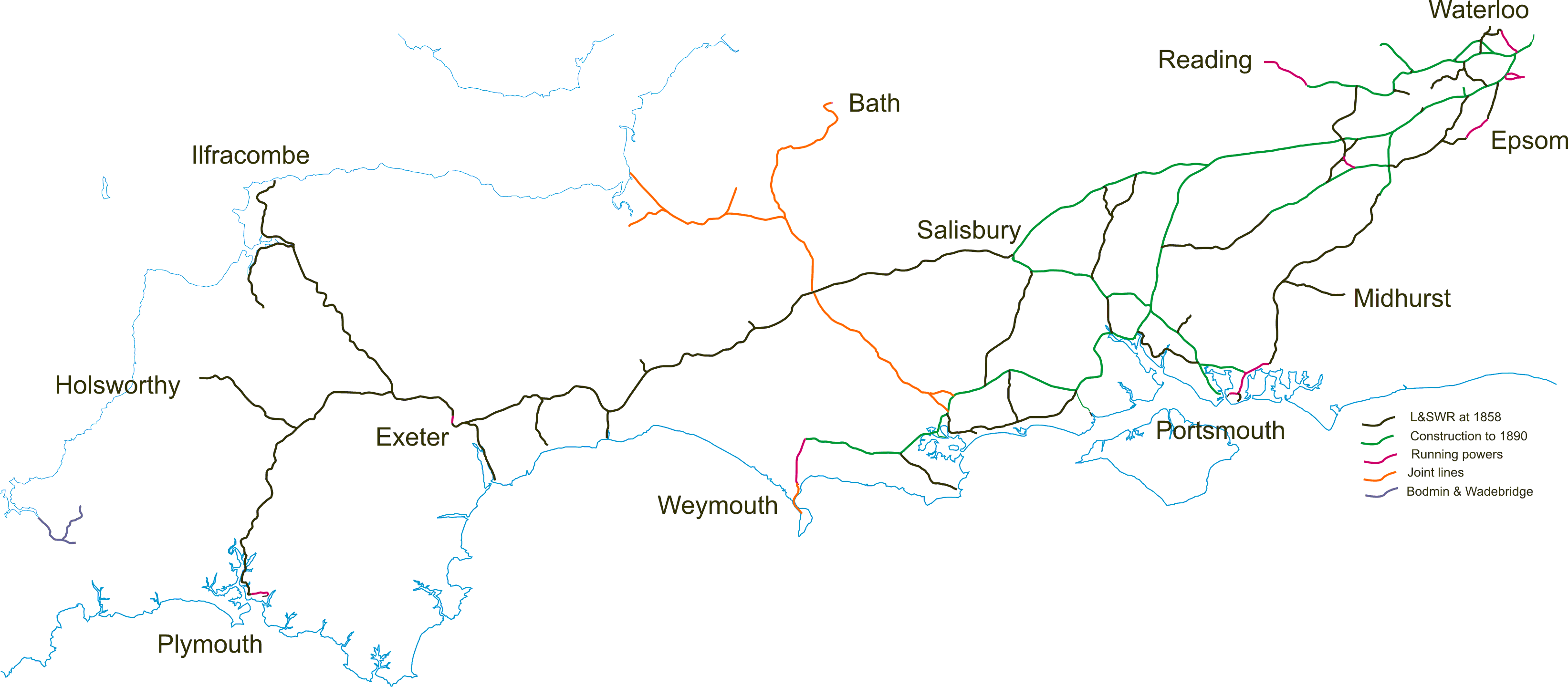
The London and South Western Railway (L&SWR) was a railway company in England from 1838 to 1922. Its network extended from London to Plymouth
via Salisbury
and Exeter
, with branches to Ilfracombe
and Padstow
and via Southampton
to Bournemouth
and Weymouth. It also had many routes connecting towns in Hampshire and Berkshire, including Portsmouth
and Reading
. In the grouping of railways in 1923
the L&SWR became part of the Southern Railway.
Among significant achievements of the L&SWR were the electrification of suburban lines, the introduction of power signalling, the development of Southampton Docks, the rebuilding of Waterloo Station as one of the great stations of the world, and the handling of the massive traffic involved in the First World War.
there was great concern about the security of coastal shipping routes between Southampton and London, and a number of canal schemes were put forward. After main line railways were seen to be feasible, the idea of connecting places in the South West of England to London was much discussed.
An early proposal for a railway came from Robert Johnson and Abel Ros Dottin, member of parliament for Southampton. A prospectus was published on 23 October 1830 and a public meeting in February 1831 gave unanimous support to the proposals. The railway was promoted as the Southampton, London and Branch Railway and Dock Company, with capital of £1.5 million in shares of £
20. The line was to link Southampton and London, and to extend a branch to districts between Hungerford and Bristol. At this time the Great Western Railway
(GWR) was being promoted, and the two schemes soon became competitors in providing railway connection to towns in the South West.
However commercial interests in Bristol and Bath seemed to favour the GWR's proposals over the Southampton company's, and a more modest initial scheme, linking only Southampton and London, was developed. Two alternative routes were surveyed by the engineer Francis Giles
. One was broadly the route finally adopted, from London via Kingston, Woking and Winchester; the other was a more southerly alignment through Guildford
, Farnham
and Alresford
to Winchester
. The southerly route passed through more prosperous agricultural land, but the northern route was preferred by the proprietors because of the better access to possible branch lines to Bristol
via Hungerford
, Devizes
, and Bath).
The railway was promoted as the London and Southampton Railway (L&SR) and authorised by Act of Parliament
on 25 July 1834.
 Construction started in September 1834 with Giles as engineer. His method was to employ a number of small contractors working concurrently at various places on the line. However their lack of resources meant that progress was slow and sporadic, and Giles was unable to maintain control of costs. With mounting delays, the projected cost to complete the line rose from the initial £894,000 to £1.5 million, and in 1837 parliamentary authority had to be sought to raise further capital. Following an examination of the accounts, instigated by a group of Lancashire shareholders, Giles was dismissed and replaced as engineer by Joseph Locke
. Locke replaced many of the small contractors with the established firm of Thomas Brassey
, and the rate of progress improved greatly.
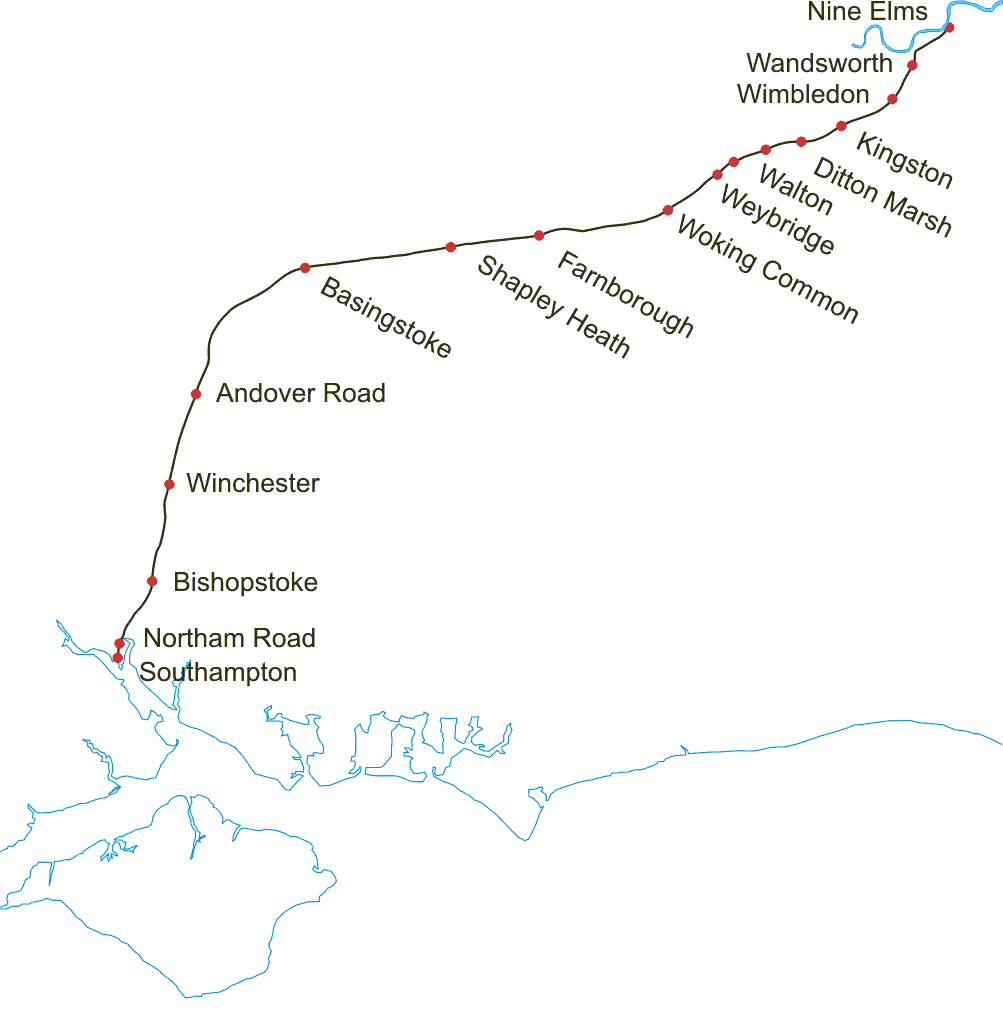
The new line was opened in stages; the first section was from Nine Elms
to Woking Common
(later renamed Woking) on 21 May 1838.
The opening of the remainder of the main line followed:
The section between Basingstoke and Winchester was the most difficult to engineer, as it crossed the Loddon
, Test
and Itchen
Valleys. It passed through four tunnels before descending to Winchester.
The stations on the line at the time of opening were:
(GWR) also planned to reach those towns and obtained its Act of Parliament on 31 August 1835 which for the time being removed Bath and Bristol from the L&SWR's ambit but there remained much disputed territory, and the L&SWR and its allies continually fought the GWR and its allies for possession of territory for expansion. The GWR was built on the broad gauge
of while the L&SWR gauge was standard gauge
, and the allegiance of any proposed independent railway was made clear by its intended gauge. The protracted competition for territory, investment funds, and parliamentary approval between the GWR and the standard gauge companies became called the gauge wars.
In early days government held that several competing railways could not be sustained in any particular area of the country, and a commission of experts referred to informally as the Five Kings was established by the Board of Trade to determine the preferred development, and therefore the preferred company, in certain districts, and this was formalised in the Railway Regulation Act 1844
.
In 1836 and later years there were proposals for a standard gauge extension to Exeter and Plymouth, but the Bristol & Exeter Railway, a broad gauge company, was successful in reaching Exeter first on 1 May 1844.
In 1844 a Wimborne solicitor put forward proposals for a Southampton and Dorchester Railway
, and explored with the L&SWR its interest in supporting his scheme. However these negotiations were not positive, and in September 1844 the GWR agreed to lease his line, implying that it would be built to the broad gauge. The L&SWR developed an independent, opposing scheme, but the Five Kings supported the Southampton & Dorchester line. Formal agreement was reached on 16 January 1845 between the L&SWR, the GWR and the Southampton & Dorchester, agreeing exclusive areas of influence for future railway construction as between the parties. Part of the agreement made the Southampton and Dorchester line a standard gauge route, and gave the L&SWR access over the GWR line to Weymouth.
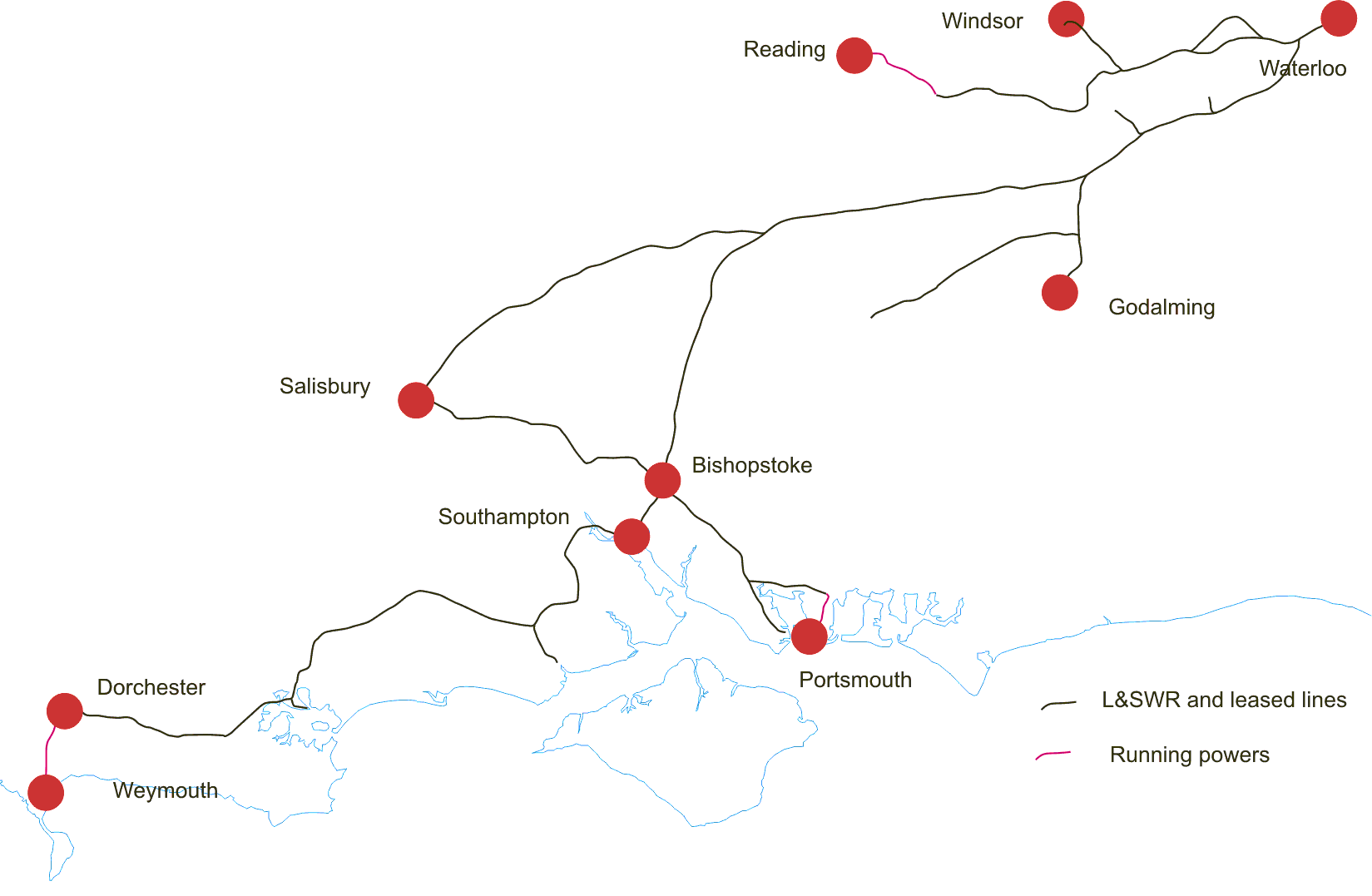 The L&SWR's energies were not confined to the gauge wars in the early years, and branch lines were constructed to Salisbury (as part of the thrust to the West), Richmond, Gosport (for Portsmouth), and Godalming.
In 1836 the promoters of the L&SR proposed a branch from Bishopstoke (Eastleigh
) to Portsmouth
, the Portsmouth Junction Railway. However the population of Portsmouth wanted a direct line to London rather than a branch from a main line to Southampton. Their opposition resulted in the defeat of the Bill at its second reading.
In January 1838 a direct independent line was proposed to London, through Chichester
, Arundel
and Dorking
. The promoters approached the L&SR, but they were rejected with a degree of vindictiveness. The L&SR was already planning a line to Gosport
on the western side of Portsmouth Harbour. The L&SR's Act succeeded on 4 June 1839. As a concession to Portsmouth the L&SR changed its name to the London and South Western Railway under Section 2 of the same Act.
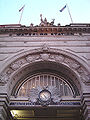 The company's first London terminus was at Nine Elms
on the edge of the built-up area. The wharf frontage on the river was advantageous to the railway's objective of competing with coastal shipping transits, but the site was inconvenient for passengers, who had to travel on to London either by road or by boat.
The "Metropolitan Extension" to a more central location had been discussed as early as 1836, and an extension northeast was authorised by Act of Parliament on 31 July 1845 with a supplementary Act of 1847 authorising a wider railway and a larger terminus; the capital authorised was £950,000. The line was to have an intermediate station at Vauxhall and two short branches, to Waterloo Bridge Road and to Hungerford Bridge. An unfulfilled intention was for a through station with services nearer to the City and the eventual terminus, named Waterloo Bridge until 1886, was planned to be a through station.
Opening was planned for 30 June 1848, but the Board of Trade Inspector did not approve some of the large-span bridges at the eastern end, however his superior was satisfied by later load tests, and the line opened on 11 July 1848. At first incoming trains stopped outside the station and were pulled in by capstan after the locomotive had been detached.
The Nine Elms site became dedicated to goods traffic and was much extended to fill the triangle of land eastwards to Wandsworth Road. An independent Richmond railway was promoted which would have run north of the L&SWR as far as Nine Elms, then would have crossed the L&SWR line and run to Waterloo. However the L&SWR adopted the Richmond line and so had four tracks from the junction of the routes, just east of the present Clapham Junction station, to Waterloo Bridge.
(opened on 12 May 1851), and the North Devon Railway
(opened on 1 August 1854) were leased to the London and South Western Railway from 1862/1863 and then bought out in 1865. The Exeter and Crediton line was a link in what became the West of England Main Line
, the LS&WR's main route from London to Plymouth. The rival Great Western Railway
had already reached Exeter at St Davids station
. The L&SWR was able to build its own station, called Queen Street station (now Exeter Central
), but due to the geography of the area the LS&WR was forced to construct a link line to the GWR station, where its trains would run briefly on GWR metals until they could proceed on their own line to Okehampton
which opened in 1871 and reached Plymouth
in 1876. The two stations were connected by a short tunnel on a severe 1-in-37 (2.7%) descent from the L&SWR to the GWR lines, a problem amplified by the GWR insisting that all LSWR trains stopped at its own Exeter station. Hauling heavily-laden boat trains or holiday specials from rest up the gradient frequently required three
powerful locomotives. An indication of the tortuous route the L&SWR had to take through Exeter is given by the fact that at Exeter St Davids London-bound trains from the two companies faced opposite directions at the platforms.
The L&SWR's lines reached their most westerly point at Padstow
(some 260 mi (418 km)) from Waterloo) on the completion of the North Cornwall Railway
in March 1899.
The company's routes west of Exeter
were known to railwaymen as 'The Withered Arm'. The name arose because these lines were constructed to much lower engineering standards than the routes nearer London, with steeper gradients, fewer major bridges, tunnels or cuttings, a lower maximum axle loading and often long stretches of single track. The name also referred to how these lines appeared on a map of the L&SWR system—in comparison to the dense, largely straight-running mainlines of the London suburbs and Hampshire
the sparse network in the west with the single main line splitting into a series of long, wandering, branches bore some resemblance to a withered limb and fingers.
 The L&SWR was the second British railway company to begin running what could be described as a modern 'commuter' service after the London and Greenwich Railway
which opened in 1836. In 1838 the L&SWR had built a station
on its original Southampton main line to serve Kingston upon Thames
. The corporation of Kingston objected to the railway and so the station was sited 1.5 miles (3 kilometres) from the town itself. The success of the railway and the easy and fast travel into London that it offered meant that new housing developments began to spring up, first around the station and then on the road between the station and Kingston proper. The new settlement was named Surbiton
(after a farm that had previously been in the area) after a brief period of being known as Kingston-on-Railway. This new settlement attracted affluent workers from The City
who could live outside the city centre (with its attendant noise, pollution and overcrowding) and yet easily travel to work. The traffic from Surbiton grew to such an extent that the L&SWR soon provided a branch
into Kingston itself, thus forming Britain's first suburban railway network on a mainline railway. Soon special trains and ticketing arrangements were being put in place to cope with the heavy twice-daily traffic from the London outskirts to Waterloo.
, opened in stages between 1838 and 1840, linked the Hampshire
towns of Basingstoke
, Winchester
and Southampton
. However the new line did not connect with Hampshire's most politically and commercially important city, Portsmouth
. Even during the construction of the SWML the company had drawn up plans to resolve this.
In 1841 the LSWR opened two separately-built lines that provided a link to the town of Gosport
, less than a mile away from Portsmouth across Portsmouth Harbour
. The Eastleigh to Fareham Line
branched off the main line at Eastleigh
and took an almost perfectly straight line to the market town
and port of Fareham
. Here the route joined the newly-built line to Gosport station
where a ferry service completed the journey to Portsmouth itself.
This situation continued until 1847 when the LSWR's eastern rival the London, Brighton and South Coast Railway
opened its route to Portsmouth proper via Havant
. The next year the LSWR built a short line via Portchester
to meet the new line as it entered Portsmouth. However, whilst Portsmouth now had its own station the route to London was still very indirect since it was via Brighton
or Southampton. Businessmen and civic leaders in Portsmouth raised enough money to back a private venture by a civil engineer
to build a direct route from the LSWR's station at Guildford
. The line reached Havant in 1850, sparking a fierce war (both legal and, at times, physical) battle between the LB&SCR and the LSWR (who managed the services over the independently-owned line) over access rights to Portsmouth over the former's line. This reached a peak at the so-called 'Battle of Havant
', but from 1859 the new Portsmouth Direct Line
was bought-out by the LSWR, providing the company with a second main line to the south coast.
Meanwhile, in northern Hampshire the company had opened its line to Alton
in 1852. Initially this was from a single branch from Farnham
, but in 1865 a new fast line from the SWML at Brookwood
through Aldershot
. An independent company, the Alton, Alresford and Winchester Railway Company, had built a line between those places
which also opened in 1865, with the LSWR running the trains, which worked through Alton station
. In 1884 the LSWR bought out the AA&WR, becoming the full owner of the Alton to Winchester line.
In 1863 the company took over the Bishops Waltham Railway Company, which had built the Bishops Waltham branch
between that village and the LSWR's Botley station
on the Eastleigh to Fareham Line
. The branch had not opened at the time that the BWR was taken over, so the LSWR was the first to operate services on the line.
In 1866 the LSWR built its short branch from Southampton to Netley
to service the newly-opened Royal Victoria Military Hospital
. A decade later, in 1876 the Portsmouth Direct Line was extended further south to reach Southsea
and to serve the Naval Dockyard
with a new station, Portsmouth Harbour
.
With all the major towns and cities in Hampshire now connected, the LSWR carried out little new building in the 1880s. The only notable openings were the link between the SWML and the newly-built Didcot, Newbury and Southampton Railway
(over the Hockley viaduct
, the longest in the county) and a short section of line from the Netley branch to Fareham through Swanwick
, finally completing the West Coastway Line
between Southampton and Brighton in 1889.
Hampshire saw a brief but significant burst of new-line building in the 1890s. In 1894 a new line from Gosport station
to Lee-on-the-Solent
was built to take advantage of the growth in tourist traffic to the Isle of Wight
. However the most significant new routes came about as the LSWR acted to block its greatest rival, the Great Western Railway
from building its own line to Portsmouth
from Reading
. This blocking action took the form of two lines. The Basingstoke and Alton Light Railway
was a minor route- the first in the country to be built under the terms of the 1896 Light Railways Act
. The second line was the Meon Valley Railway
between and Fareham
, built to main-line standards as a second London to Gosport
route. The new lines opened in 1901 and 1903 respectively, these being the last lines in Hampshire to be built by the LSWR before the 1923 grouping.
who came in 1912 from the London and North Western Railway
whose suburban lines he had electrified on a 630 V
DC
fourth rail system, chose 630 V DC third rail
electrification
for its suburban routes. Implementation was somewhat delayed by First World War and the first L&SWR electric service ran on 20 October 1915 between Waterloo and Wimbledon via East Putney. In the following year electric services began on the Hounslow
and Kingston Loop Line
s.
This system was incompatible with LBSCR's 6600 V 25 Hz
AC
overhead system
which after the 1923 grouping was replaced by the LSWR system.
, in Hampshire, were opened with the transfer of the carriage and wagon works from Nine Elms in London. The Locomotive Works were transferred from Nine Elms
under Drummond, opening in 1909.
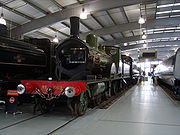
from 1838 to 1908. Under Drummond they were moved to a new spacious site at Eastleigh
in 1909.
Little information is available although from 1844 dark green with red and white lining, black wheels and red buffer beams seems to have become standard.
The company also operated a number of ships on the Isle of Wight
service jointly with the London, Brighton and South Coast Railway
.
Plymouth
Plymouth is a city and unitary authority area on the coast of Devon, England, about south-west of London. It is built between the mouths of the rivers Plym to the east and Tamar to the west, where they join Plymouth Sound...
via Salisbury
Salisbury
Salisbury is a cathedral city in Wiltshire, England and the only city in the county. It is the second largest settlement in the county...
and Exeter
Exeter
Exeter is a historic city in Devon, England. It lies within the ceremonial county of Devon, of which it is the county town as well as the home of Devon County Council. Currently the administrative area has the status of a non-metropolitan district, and is therefore under the administration of the...
, with branches to Ilfracombe
Ilfracombe
Ilfracombe is a seaside resort and civil parish on the North Devon coast, England with a small harbour, surrounded by cliffs.The parish stretches along the coast from 'The Coastguard Cottages' in Hele Bay toward the east and 4 miles along The Torrs to Lee Bay toward the west...
and Padstow
Padstow
Padstow is a town, civil parish and fishing port on the north coast of Cornwall, England, United Kingdom. The town is situated on the west bank of the River Camel estuary approximately five miles northwest of Wadebridge, ten miles northwest of Bodmin and ten miles northeast of Newquay...
and via Southampton
Southampton
Southampton is the largest city in the county of Hampshire on the south coast of England, and is situated south-west of London and north-west of Portsmouth. Southampton is a major port and the closest city to the New Forest...
to Bournemouth
Bournemouth
Bournemouth is a large coastal resort town in the ceremonial county of Dorset, England. According to the 2001 Census the town has a population of 163,444, making it the largest settlement in Dorset. It is also the largest settlement between Southampton and Plymouth...
and Weymouth. It also had many routes connecting towns in Hampshire and Berkshire, including Portsmouth
Portsmouth
Portsmouth is the second largest city in the ceremonial county of Hampshire on the south coast of England. Portsmouth is notable for being the United Kingdom's only island city; it is located mainly on Portsea Island...
and Reading
Reading, Berkshire
Reading is a large town and unitary authority area in England. It is located in the Thames Valley at the confluence of the River Thames and River Kennet, and on both the Great Western Main Line railway and the M4 motorway, some west of London....
. In the grouping of railways in 1923
Railways Act 1921
The Railways Act 1921, also known as the Grouping Act, was an enactment by the British government of David Lloyd George intended to stem the losses being made by many of the country's 120 railway companies, move the railways away from internal competition, and to retain some of the benefits which...
the L&SWR became part of the Southern Railway.
Among significant achievements of the L&SWR were the electrification of suburban lines, the introduction of power signalling, the development of Southampton Docks, the rebuilding of Waterloo Station as one of the great stations of the world, and the handling of the massive traffic involved in the First World War.
Origins
After the Napoleonic WarsNapoleonic Wars
The Napoleonic Wars were a series of wars declared against Napoleon's French Empire by opposing coalitions that ran from 1803 to 1815. As a continuation of the wars sparked by the French Revolution of 1789, they revolutionised European armies and played out on an unprecedented scale, mainly due to...
there was great concern about the security of coastal shipping routes between Southampton and London, and a number of canal schemes were put forward. After main line railways were seen to be feasible, the idea of connecting places in the South West of England to London was much discussed.
An early proposal for a railway came from Robert Johnson and Abel Ros Dottin, member of parliament for Southampton. A prospectus was published on 23 October 1830 and a public meeting in February 1831 gave unanimous support to the proposals. The railway was promoted as the Southampton, London and Branch Railway and Dock Company, with capital of £1.5 million in shares of £
Pound sterling
The pound sterling , commonly called the pound, is the official currency of the United Kingdom, its Crown Dependencies and the British Overseas Territories of South Georgia and the South Sandwich Islands, British Antarctic Territory and Tristan da Cunha. It is subdivided into 100 pence...
20. The line was to link Southampton and London, and to extend a branch to districts between Hungerford and Bristol. At this time the Great Western Railway
Great Western Railway
The Great Western Railway was a British railway company that linked London with the south-west and west of England and most of Wales. It was founded in 1833, received its enabling Act of Parliament in 1835 and ran its first trains in 1838...
(GWR) was being promoted, and the two schemes soon became competitors in providing railway connection to towns in the South West.
However commercial interests in Bristol and Bath seemed to favour the GWR's proposals over the Southampton company's, and a more modest initial scheme, linking only Southampton and London, was developed. Two alternative routes were surveyed by the engineer Francis Giles
Francis Giles
Francis Giles was a canal engineer and surveyor who worked under John Rennie and later became a railway engineer-Works and appointments:...
. One was broadly the route finally adopted, from London via Kingston, Woking and Winchester; the other was a more southerly alignment through Guildford
Guildford
Guildford is the county town of Surrey. England, as well as the seat for the borough of Guildford and the administrative headquarters of the South East England region...
, Farnham
Farnham
Farnham is a town in Surrey, England, within the Borough of Waverley. The town is situated some 42 miles southwest of London in the extreme west of Surrey, adjacent to the border with Hampshire...
and Alresford
New Alresford
New Alresford or simply Alresford is a small town and civil parish in the City of Winchester district of Hampshire, England. It is situated some 12 km north-east of the city of Winchester and 20 km south-west of the town of Alton...
to Winchester
Winchester
Winchester is a historic cathedral city and former capital city of England. It is the county town of Hampshire, in South East England. The city lies at the heart of the wider City of Winchester, a local government district, and is located at the western end of the South Downs, along the course of...
. The southerly route passed through more prosperous agricultural land, but the northern route was preferred by the proprietors because of the better access to possible branch lines to Bristol
Bristol
Bristol is a city, unitary authority area and ceremonial county in South West England, with an estimated population of 433,100 for the unitary authority in 2009, and a surrounding Larger Urban Zone with an estimated 1,070,000 residents in 2007...
via Hungerford
Hungerford
Hungerford is a market town and civil parish in Berkshire, England, 9 miles west of Newbury. It covers an area of and, according to the 2001 census, has a population of 5,559 .- Geography :...
, Devizes
Devizes
Devizes is a market town and civil parish in Wiltshire, England. The town is about southeast of Chippenham and about east of Trowbridge.Devizes serves as a centre for banks, solicitors and shops, with a large open market place where a market is held once a week...
, and Bath).
The railway was promoted as the London and Southampton Railway (L&SR) and authorised by Act of Parliament
Act of Parliament
An Act of Parliament is a statute enacted as primary legislation by a national or sub-national parliament. In the Republic of Ireland the term Act of the Oireachtas is used, and in the United States the term Act of Congress is used.In Commonwealth countries, the term is used both in a narrow...
on 25 July 1834.
Construction of the Southampton line
Joseph Locke
Joseph Locke was a notable English civil engineer of the 19th century, particularly associated with railway projects...
. Locke replaced many of the small contractors with the established firm of Thomas Brassey
Thomas Brassey
Thomas Brassey was an English civil engineering contractor and manufacturer of building materials who was responsible for building much of the world's railways in the 19th century. By 1847, he had built about one-third of the railways in Britain, and by time of his death in 1870 he had built one...
, and the rate of progress improved greatly.
The new line was opened in stages; the first section was from Nine Elms
Nine Elms railway station
Nine Elms Railway Station in the London district of Battersea was opened on 21 May 1838 as the London terminus of the London & Southampton Railway which on the same day became the London and South Western Railway. The building in the neo-classical style was designed by Sir William Tite...
to Woking Common
Woking railway station
Woking railway station is a railway station in England, serving the town of Woking, Surrey. It is a major stop on the South Western Main Line and is used by many commuters...
(later renamed Woking) on 21 May 1838.
The opening of the remainder of the main line followed:
- Woking to Shapley Heath: 24 September 1838
- Shapley Heath to Basingstoke: 10 June 1839
- Winchester to a temporary "Southampton" station at Northam Road: 10 June 1839
- Basingstoke to Winchester, and also the Southampton terminus: 11 May 1840.
The section between Basingstoke and Winchester was the most difficult to engineer, as it crossed the Loddon
River Loddon
The River Loddon is a river in the English counties of Berkshire and Hampshire. It is a tributary of the River Thames, rising within the urban area of Basingstoke and flowing to meet the Thames near the village of Wargrave...
, Test
River Test
The River Test is a river in Hampshire, England. The river has a total length of 40 miles and it flows through downland from its source near Ashe, 10 km to the west of Basingstoke , to the sea at the head of Southampton Water...
and Itchen
River Itchen, Hampshire
The River Itchen is a river in Hampshire, England. It flows from mid-Hampshire to join with Southampton Water below the Itchen Bridge in the city of Southampton. The river has a total length of , and is noted as one of England's - if not one of the World's - premier chalk streams for fly fishing,...
Valleys. It passed through four tunnels before descending to Winchester.
The stations on the line at the time of opening were:
- Nine ElmsNine Elms railway stationNine Elms Railway Station in the London district of Battersea was opened on 21 May 1838 as the London terminus of the London & Southampton Railway which on the same day became the London and South Western Railway. The building in the neo-classical style was designed by Sir William Tite...
; the London terminus on the south bank of the River Thames, adjacent to the present Nine Elms Way; the station was a little over a mile from Trafalgar Square; - Wandsworth; later renamed Clapham Common, on the northern margin of Wandsworth Common, about half a mile west of the present Clapham JunctionClapham Junction railway stationClapham Junction railway station is near St John's Hill in the south-west of Battersea in the London Borough of Wandsworth. Although it is in Battersea, the area around the station is commonly identified as Clapham Junction....
which replaced it; - Wimbledon; somewhat to the west of Wimbledon Hill Road and of the present station;
- Kingston; on the east side of King Charles Road, about half a mile east of the present Surbiton station;
- Ditton Marsh; now EsherEsher railway stationEsher railway station is served by the Waterloo to Woking service, operated by South West Trains. The station serves Esher via the main entrance, and a footpath leading to Sandown Park Racecourse. At off-peak times there are 2 trains per hour north and 2 trains per hour south. The station is...
; - Walton; now Walton-on-ThamesWalton-on-Thames railway stationWalton-on-Thames railway station serves the town of Walton-on-Thames in Surrey, England. The station is located in the Ashley Park area of the town. The station originally opened as Walton for Hersham.Only the two outer platforms on the slow lines are currently used...
; - WeybridgeWeybridge railway stationWeybridge railway station serves Weybridge in the Elmbridge district of Surrey, England. It is located on the South Western Main Line operated by South West Trains, 19 miles from London Waterloo....
- Woking Common; now WokingWoking railway stationWoking railway station is a railway station in England, serving the town of Woking, Surrey. It is a major stop on the South Western Main Line and is used by many commuters...
; - FarnboroughFarnborough railway stationFarnborough railway station serves the town of Farnborough in Hampshire, England. The station, and all trains serving it, are operated by South West Trains. It is one of two stations serving Farnborough: the other, Farnborough North, is situated on the North Downs Line...
; - Shapley Heath; now WinchfieldWinchfield railway stationWinchfield railway station is located in the small village of Winchfield and serves Hartley Wintney and other surrounding villages in Hampshire, England...
; - BasingstokeBasingstoke railway stationBasingstoke railway station, in the town of Basingstoke in the county of Hampshire in England, is on the South Western Main Line from London Waterloo, with local and fast services operated by South West Trains. It is also the terminus of First Great Western local services on the Reading to...
; - Andover Road; now MicheldeverMicheldever railway stationMicheldever railway station serves the village of Micheldever and surrounding area in Hampshire, England. The station is on the South Western Main Line, south west of London Waterloo towards Southampton and is managed by South West Trains....
; - WinchesterWinchester railway stationWinchester railway station is a railway station located in Winchester in the county of Hampshire in England. It is located on the South Western Main Line and was originally known as Winchester City to distinguish it from Winchester station....
; - Northam Road station; at the road of the same name;
- Southampton; later renamed Southampton Terminus, at the present Terminus Terrace, it was an elegant building in the classical style by Sir William TiteWilliam TiteSir William Tite, CB was an English architect who served as President of the Royal Institute of British Architects. He was particularly associated with various London buildings, with railway stations and cemetery projects....
.
Gauge wars
Between the first proposal for a railway from London to Southampton and the construction, the proprietors and other groups were considering rail connections to other towns, some in the territory towards Bath and Bristol. The Great Western RailwayGreat Western Railway
The Great Western Railway was a British railway company that linked London with the south-west and west of England and most of Wales. It was founded in 1833, received its enabling Act of Parliament in 1835 and ran its first trains in 1838...
(GWR) also planned to reach those towns and obtained its Act of Parliament on 31 August 1835 which for the time being removed Bath and Bristol from the L&SWR's ambit but there remained much disputed territory, and the L&SWR and its allies continually fought the GWR and its allies for possession of territory for expansion. The GWR was built on the broad gauge
Broad gauge
Broad-gauge railways use a track gauge greater than the standard gauge of .- List :For list see: List of broad gauges, by gauge and country- History :...
of while the L&SWR gauge was standard gauge
Standard gauge
The standard gauge is a widely-used track gauge . Approximately 60% of the world's existing railway lines are built to this gauge...
, and the allegiance of any proposed independent railway was made clear by its intended gauge. The protracted competition for territory, investment funds, and parliamentary approval between the GWR and the standard gauge companies became called the gauge wars.
In early days government held that several competing railways could not be sustained in any particular area of the country, and a commission of experts referred to informally as the Five Kings was established by the Board of Trade to determine the preferred development, and therefore the preferred company, in certain districts, and this was formalised in the Railway Regulation Act 1844
Railway Regulation Act 1844
The Railway Regulation Act 1844 was a British Act of Parliament introduced as a means of providing a minimum standard for rail passenger travel.-The prior situation:...
.
In 1836 and later years there were proposals for a standard gauge extension to Exeter and Plymouth, but the Bristol & Exeter Railway, a broad gauge company, was successful in reaching Exeter first on 1 May 1844.
In 1844 a Wimborne solicitor put forward proposals for a Southampton and Dorchester Railway
Southampton and Dorchester Railway
-Planning and Construction:The Southampton and Dorchester Railway, operating in the counties of Hampshire and Dorset, received Parliamentary Assent in 1845 and opened in 1847. The railway was promoted by a Wimborne solicitor, Charles Castleman...
, and explored with the L&SWR its interest in supporting his scheme. However these negotiations were not positive, and in September 1844 the GWR agreed to lease his line, implying that it would be built to the broad gauge. The L&SWR developed an independent, opposing scheme, but the Five Kings supported the Southampton & Dorchester line. Formal agreement was reached on 16 January 1845 between the L&SWR, the GWR and the Southampton & Dorchester, agreeing exclusive areas of influence for future railway construction as between the parties. Part of the agreement made the Southampton and Dorchester line a standard gauge route, and gave the L&SWR access over the GWR line to Weymouth.
Early expansion
In 1836 the promoters of the L&SR proposed a branch from Bishopstoke (Eastleigh
Eastleigh
Eastleigh is a railway town in Hampshire, England, and the main town in the Eastleigh borough which is part of Southampton Urban Area. The town lies between Southampton and Winchester, and is part of the South Hampshire conurbation...
) to Portsmouth
Portsmouth
Portsmouth is the second largest city in the ceremonial county of Hampshire on the south coast of England. Portsmouth is notable for being the United Kingdom's only island city; it is located mainly on Portsea Island...
, the Portsmouth Junction Railway. However the population of Portsmouth wanted a direct line to London rather than a branch from a main line to Southampton. Their opposition resulted in the defeat of the Bill at its second reading.
In January 1838 a direct independent line was proposed to London, through Chichester
Chichester
Chichester is a cathedral city in West Sussex, within the historic County of Sussex, South-East England. It has a long history as a settlement; its Roman past and its subsequent importance in Anglo-Saxon times are only its beginnings...
, Arundel
Arundel
Arundel is a market town and civil parish in the South Downs of West Sussex in the south of England. It lies south southwest of London, west of Brighton, and east of the county town of Chichester. Other nearby towns include Worthing east southeast, Littlehampton to the south and Bognor Regis to...
and Dorking
Dorking
Dorking is a historic market town at the foot of the North Downs approximately south of London, in Surrey, England.- History and development :...
. The promoters approached the L&SR, but they were rejected with a degree of vindictiveness. The L&SR was already planning a line to Gosport
Gosport
Gosport is a town, district and borough situated on the south coast of England, within the county of Hampshire. It has approximately 80,000 permanent residents with a further 5,000-10,000 during the summer months...
on the western side of Portsmouth Harbour. The L&SR's Act succeeded on 4 June 1839. As a concession to Portsmouth the L&SR changed its name to the London and South Western Railway under Section 2 of the same Act.
London terminal stations
Nine Elms railway station
Nine Elms Railway Station in the London district of Battersea was opened on 21 May 1838 as the London terminus of the London & Southampton Railway which on the same day became the London and South Western Railway. The building in the neo-classical style was designed by Sir William Tite...
on the edge of the built-up area. The wharf frontage on the river was advantageous to the railway's objective of competing with coastal shipping transits, but the site was inconvenient for passengers, who had to travel on to London either by road or by boat.
The "Metropolitan Extension" to a more central location had been discussed as early as 1836, and an extension northeast was authorised by Act of Parliament on 31 July 1845 with a supplementary Act of 1847 authorising a wider railway and a larger terminus; the capital authorised was £950,000. The line was to have an intermediate station at Vauxhall and two short branches, to Waterloo Bridge Road and to Hungerford Bridge. An unfulfilled intention was for a through station with services nearer to the City and the eventual terminus, named Waterloo Bridge until 1886, was planned to be a through station.
Opening was planned for 30 June 1848, but the Board of Trade Inspector did not approve some of the large-span bridges at the eastern end, however his superior was satisfied by later load tests, and the line opened on 11 July 1848. At first incoming trains stopped outside the station and were pulled in by capstan after the locomotive had been detached.
The Nine Elms site became dedicated to goods traffic and was much extended to fill the triangle of land eastwards to Wandsworth Road. An independent Richmond railway was promoted which would have run north of the L&SWR as far as Nine Elms, then would have crossed the L&SWR line and run to Waterloo. However the L&SWR adopted the Richmond line and so had four tracks from the junction of the routes, just east of the present Clapham Junction station, to Waterloo Bridge.
West of Salisbury
The Exeter and Crediton RailwayExeter and Crediton Railway
The Exeter and Crediton Railway was a broad gauge railway that linked Exeter and Crediton, Devon, England.Although built in 1847, it was not opened until 12 May 1851 due to disagreement about the gauge to be used...
(opened on 12 May 1851), and the North Devon Railway
North Devon Railway
The North Devon Railway was a British railway company which operated a line from Cowley Bridge Junction, near Exeter, to Bideford in Devon, later becoming part of the London and South Western Railway's system...
(opened on 1 August 1854) were leased to the London and South Western Railway from 1862/1863 and then bought out in 1865. The Exeter and Crediton line was a link in what became the West of England Main Line
West of England Main Line
The West of England Main Line is a British railway line that runs from , Hampshire to Exeter St Davids in Devon, England. Passenger services run between London Waterloo station and Exeter...
, the LS&WR's main route from London to Plymouth. The rival Great Western Railway
Great Western Railway
The Great Western Railway was a British railway company that linked London with the south-west and west of England and most of Wales. It was founded in 1833, received its enabling Act of Parliament in 1835 and ran its first trains in 1838...
had already reached Exeter at St Davids station
Exeter St Davids railway station
Exeter St Davids station is the most important of seven National Rail stations in the city of Exeter in southwest England. Today the station is owned by Network Rail and operated by First Great Western.-History:...
. The L&SWR was able to build its own station, called Queen Street station (now Exeter Central
Exeter Central railway station
Exeter Central railway station is the most centrally located of the railway stations in Exeter, Devon, England. It is smaller than St Davids which is on the west side of the city but it is served by trains on the London Waterloo to Exeter main line, and is also by local services to , and . From...
), but due to the geography of the area the LS&WR was forced to construct a link line to the GWR station, where its trains would run briefly on GWR metals until they could proceed on their own line to Okehampton
Okehampton
Okehampton is a town and civil parish in West Devon in the English county of Devon. It is situated at the northern edge of Dartmoor, and has an estimated population of 7,155.-History:...
which opened in 1871 and reached Plymouth
Plymouth Friary railway station
Plymouth Friary railway station was the London and South Western Railway terminus in Plymouth, Devon, England.-History:London and South Western Railway trains first arrived at Plymouth on 17 May 1876, entering the town from the east...
in 1876. The two stations were connected by a short tunnel on a severe 1-in-37 (2.7%) descent from the L&SWR to the GWR lines, a problem amplified by the GWR insisting that all LSWR trains stopped at its own Exeter station. Hauling heavily-laden boat trains or holiday specials from rest up the gradient frequently required three
Double-heading
In railroad terminology, double-heading or double heading indicates the use of two locomotives at the front of a train, each operated individually by its own crew. The practice of triple-heading involves the use of three locomotives....
powerful locomotives. An indication of the tortuous route the L&SWR had to take through Exeter is given by the fact that at Exeter St Davids London-bound trains from the two companies faced opposite directions at the platforms.
The L&SWR's lines reached their most westerly point at Padstow
Padstow
Padstow is a town, civil parish and fishing port on the north coast of Cornwall, England, United Kingdom. The town is situated on the west bank of the River Camel estuary approximately five miles northwest of Wadebridge, ten miles northwest of Bodmin and ten miles northeast of Newquay...
(some 260 mi (418 km)) from Waterloo) on the completion of the North Cornwall Railway
North Cornwall Railway
The North Cornwall Railway was a railway line running from Halwill in Devon to Padstow in Cornwall via Launceston, Camelford and Wadebridge, a distance of 49 miles 67 chains. Opened in the last decade of the nineteenth century, it was part of a drive by the London and South Western Railway to...
in March 1899.
The company's routes west of Exeter
Exeter
Exeter is a historic city in Devon, England. It lies within the ceremonial county of Devon, of which it is the county town as well as the home of Devon County Council. Currently the administrative area has the status of a non-metropolitan district, and is therefore under the administration of the...
were known to railwaymen as 'The Withered Arm'. The name arose because these lines were constructed to much lower engineering standards than the routes nearer London, with steeper gradients, fewer major bridges, tunnels or cuttings, a lower maximum axle loading and often long stretches of single track. The name also referred to how these lines appeared on a map of the L&SWR system—in comparison to the dense, largely straight-running mainlines of the London suburbs and Hampshire
Hampshire
Hampshire is a county on the southern coast of England in the United Kingdom. The county town of Hampshire is Winchester, a historic cathedral city that was once the capital of England. Hampshire is notable for housing the original birthplaces of the Royal Navy, British Army, and Royal Air Force...
the sparse network in the west with the single main line splitting into a series of long, wandering, branches bore some resemblance to a withered limb and fingers.
Suburban lines
London and Greenwich Railway
The London and Greenwich Railway was opened in London between 1836 and 1838. It was the first steam railway to have a terminus in the capital, the first of any to be built specifically for passenger service, and the first example of an elevated railway....
which opened in 1836. In 1838 the L&SWR had built a station
Surbiton railway station
Surbiton railway station is a National Rail station in Surbiton, south west London, in the Kingston upon Thames. The station is managed and served by South West Trains, and is in Travelcard Zone 6...
on its original Southampton main line to serve Kingston upon Thames
Royal Borough of Kingston upon Thames
The Royal Borough of Kingston upon Thames is a borough in southwest London, England. The main town is Kingston upon Thames and it includes Surbiton, Chessington, New Malden and Tolworth. It is the oldest of the three Royal Boroughs in England, the others are Kensington and Chelsea, also in London,...
. The corporation of Kingston objected to the railway and so the station was sited 1.5 miles (3 kilometres) from the town itself. The success of the railway and the easy and fast travel into London that it offered meant that new housing developments began to spring up, first around the station and then on the road between the station and Kingston proper. The new settlement was named Surbiton
Surbiton
Surbiton, a suburban area of London in the Royal Borough of Kingston upon Thames, is situated next to the River Thames, with a mixture of Art-Deco courts, more recent residential blocks and grand, spacious 19th century townhouses blending into a sea of semi-detached 20th century housing estates...
(after a farm that had previously been in the area) after a brief period of being known as Kingston-on-Railway. This new settlement attracted affluent workers from The City
City of London
The City of London is a small area within Greater London, England. It is the historic core of London around which the modern conurbation grew and has held city status since time immemorial. The City’s boundaries have remained almost unchanged since the Middle Ages, and it is now only a tiny part of...
who could live outside the city centre (with its attendant noise, pollution and overcrowding) and yet easily travel to work. The traffic from Surbiton grew to such an extent that the L&SWR soon provided a branch
Kingston Loop Line
The Kingston Loop Line is a railway line built by the London and South Western Railway in South West London. It runs in an overall southeasterly direction from a junction west of Twickenham on the Waterloo to Reading Line to join the South West Main Line west of New Malden; both connections face...
into Kingston itself, thus forming Britain's first suburban railway network on a mainline railway. Soon special trains and ticketing arrangements were being put in place to cope with the heavy twice-daily traffic from the London outskirts to Waterloo.
Routes in Hampshire
The original South Western Main LineSouth Western Main Line
The South Western Main Line is a railway line between London Waterloo and Weymouth on the Dorset coast, in the south of England. It is a major railway which serves many important commuter areas, as well as the major settlements of Southampton and Bournemouth...
, opened in stages between 1838 and 1840, linked the Hampshire
Hampshire
Hampshire is a county on the southern coast of England in the United Kingdom. The county town of Hampshire is Winchester, a historic cathedral city that was once the capital of England. Hampshire is notable for housing the original birthplaces of the Royal Navy, British Army, and Royal Air Force...
towns of Basingstoke
Basingstoke
Basingstoke is a town in northeast Hampshire, in south central England. It lies across a valley at the source of the River Loddon. It is southwest of London, northeast of Southampton, southwest of Reading and northeast of the county town, Winchester. In 2008 it had an estimated population of...
, Winchester
Winchester
Winchester is a historic cathedral city and former capital city of England. It is the county town of Hampshire, in South East England. The city lies at the heart of the wider City of Winchester, a local government district, and is located at the western end of the South Downs, along the course of...
and Southampton
Southampton
Southampton is the largest city in the county of Hampshire on the south coast of England, and is situated south-west of London and north-west of Portsmouth. Southampton is a major port and the closest city to the New Forest...
. However the new line did not connect with Hampshire's most politically and commercially important city, Portsmouth
Portsmouth
Portsmouth is the second largest city in the ceremonial county of Hampshire on the south coast of England. Portsmouth is notable for being the United Kingdom's only island city; it is located mainly on Portsea Island...
. Even during the construction of the SWML the company had drawn up plans to resolve this.
In 1841 the LSWR opened two separately-built lines that provided a link to the town of Gosport
Gosport
Gosport is a town, district and borough situated on the south coast of England, within the county of Hampshire. It has approximately 80,000 permanent residents with a further 5,000-10,000 during the summer months...
, less than a mile away from Portsmouth across Portsmouth Harbour
Portsmouth Harbour
Portsmouth Harbour is a large natural harbour in Hampshire, England. Geographically it is a ria: formerly it was the valley of a stream flowing from Portsdown into the Solent River. The city of Portsmouth lies to the east on Portsea Island, and Gosport to the west on the mainland...
. The Eastleigh to Fareham Line
Eastleigh to Fareham Line
The Eastleigh-Fareham Line is the railway line from Eastleigh to Fareham in the United Kingdom. At Eastleigh, trains join the South Western Main Line for onward travel to Basingstoke, Reading or to London Waterloo. At Fareham trains join the West Coastway line for onward travel to Portsmouth or...
branched off the main line at Eastleigh
Eastleigh railway station
Eastleigh railway station serves the town of Eastleigh in the county of Hampshire in England. It is located on the South Western Main Line and is the junction station for two other routes, the Eastleigh-Fareham Line and the Eastleigh-Romsey Line...
and took an almost perfectly straight line to the market town
Market town
Market town or market right is a legal term, originating in the medieval period, for a European settlement that has the right to host markets, distinguishing it from a village and city...
and port of Fareham
Fareham
The market town of Fareham lies in the south east of Hampshire, England, between the cities of Southampton and Portsmouth, roughly in the centre of the South Hampshire conurbation.It gives its name to the borough comprising the town and the surrounding area...
. Here the route joined the newly-built line to Gosport station
Gosport railway station
Gosport railway station was a terminus station designed by William Tite and opened to passenger and freight trains in 1841 by the London and South Western Railway . It was closed in 1953 to passenger trains, and in 1969 to the remaining freight services...
where a ferry service completed the journey to Portsmouth itself.
This situation continued until 1847 when the LSWR's eastern rival the London, Brighton and South Coast Railway
London, Brighton and South Coast Railway
The London, Brighton and South Coast Railway was a railway company in the United Kingdom from 1846 to 1922. Its territory formed a rough triangle, with London at its apex, practically the whole coastline of Sussex as its base, and a large part of Surrey...
opened its route to Portsmouth proper via Havant
Havant railway station
Havant railway station is a railway station near Portsmouth.It is located on the Portsmouth Direct Line which runs between London and Portsmouth...
. The next year the LSWR built a short line via Portchester
Portchester
Portchester is a locality and suburb 10km northwest of Portsmouth, England. It is part of the borough of Fareham in Hampshire. Once a small village, Portchester is now a busy part of the expanding conurbation between Portsmouth and Southampton, on the A27 main thoroughfare...
to meet the new line as it entered Portsmouth. However, whilst Portsmouth now had its own station the route to London was still very indirect since it was via Brighton
Brighton
Brighton is the major part of the city of Brighton and Hove in East Sussex, England on the south coast of Great Britain...
or Southampton. Businessmen and civic leaders in Portsmouth raised enough money to back a private venture by a civil engineer
Civil engineer
A civil engineer is a person who practices civil engineering; the application of planning, designing, constructing, maintaining, and operating infrastructures while protecting the public and environmental health, as well as improving existing infrastructures that have been neglected.Originally, a...
to build a direct route from the LSWR's station at Guildford
Guildford
Guildford is the county town of Surrey. England, as well as the seat for the borough of Guildford and the administrative headquarters of the South East England region...
. The line reached Havant in 1850, sparking a fierce war (both legal and, at times, physical) battle between the LB&SCR and the LSWR (who managed the services over the independently-owned line) over access rights to Portsmouth over the former's line. This reached a peak at the so-called 'Battle of Havant
Denvilles halt
Denvilles Halt was a station located between Havant and Rowlands Castle on the Portsmouth Direct Line. It was a temporary platform, erected by the L&SWR, as that company's adoption of the Portsmouth Direct line started a dispute with the LB&SCR....
', but from 1859 the new Portsmouth Direct Line
Portsmouth Direct Line
The Portsmouth Direct Line is the route of a railway service operated by South West Trains which runs between London Waterloo and Portsmouth Harbour, England...
was bought-out by the LSWR, providing the company with a second main line to the south coast.
Meanwhile, in northern Hampshire the company had opened its line to Alton
Alton Line
The Alton Line is a railway line operated by South West Trains. Today Alton station is the terminus of a main line branch, although it was at one time the junction for three lines. The branch leaves the South Western Main Line at Pirbright Junction near Brookwood...
in 1852. Initially this was from a single branch from Farnham
Farnham
Farnham is a town in Surrey, England, within the Borough of Waverley. The town is situated some 42 miles southwest of London in the extreme west of Surrey, adjacent to the border with Hampshire...
, but in 1865 a new fast line from the SWML at Brookwood
Brookwood railway station
Brookwood is a National Rail railway station in Brookwood in the English county of Surrey. It was constructed to serve the adjacent Brookwood Cemetery and was at one stage served by its own station in London for the funeral trains...
through Aldershot
Aldershot
Aldershot is a town in the English county of Hampshire, located on heathland about southwest of London. The town is administered by Rushmoor Borough Council...
. An independent company, the Alton, Alresford and Winchester Railway Company, had built a line between those places
Watercress Line
The Watercress Line is the marketing name of the Mid-Hants Railway, a heritage railway in Hampshire, England, running from New Alresford to Alton where it connects to the National Rail network. The line gained its popular name in the days that it was used to transport locally grown watercress to...
which also opened in 1865, with the LSWR running the trains, which worked through Alton station
Alton railway station
Alton railway station is a railway station in the town of Alton, in the English county of Hampshire. The station is the terminus for two railway lines; the Alton Line which runs to Brookwood and onto London Waterloo and the Mid Hants Watercress Railway, which runs to Alresford. The latter once ran...
. In 1884 the LSWR bought out the AA&WR, becoming the full owner of the Alton to Winchester line.
In 1863 the company took over the Bishops Waltham Railway Company, which had built the Bishops Waltham branch
Bishops Waltham branch
-Description:The Bishops Waltham branch was a railway line in Hampshire, England. It ran from Botley on the Eastleigh-Fareham line to Bishops Waltham...
between that village and the LSWR's Botley station
Botley railway station
Botley railway station is a railway station in Botley, Hampshire.-History:Botley station was opened in 1841 by the LSWR. Botley was once the junction for the Bishops Waltham branch which was opened in 1863 and finally closed to freight in 1962...
on the Eastleigh to Fareham Line
Eastleigh to Fareham Line
The Eastleigh-Fareham Line is the railway line from Eastleigh to Fareham in the United Kingdom. At Eastleigh, trains join the South Western Main Line for onward travel to Basingstoke, Reading or to London Waterloo. At Fareham trains join the West Coastway line for onward travel to Portsmouth or...
. The branch had not opened at the time that the BWR was taken over, so the LSWR was the first to operate services on the line.
In 1866 the LSWR built its short branch from Southampton to Netley
Netley railway station
Netley railway station is a railway station near the village of Netley in Hampshire, England. The station is run by South West Trains and is on the West Coastway Line. Near to the station is Royal Victoria Country Park. In former times a branch from the station conveyed patients to nearby Netley...
to service the newly-opened Royal Victoria Military Hospital
Netley Hospital
The Royal Victoria Hospital, or Netley Hospital was a large military hospital in Netley, near Southampton, Hampshire, England. Construction started in 1856 at the suggestion of Queen Victoria but its design caused some controversy, chiefly from Florence Nightingale. Often visited by Queen Victoria,...
. A decade later, in 1876 the Portsmouth Direct Line was extended further south to reach Southsea
Southsea
Southsea is a seaside resort located in Portsmouth at the southern end of Portsea Island in the county of Hampshire in England. Southsea is within a mile of Portsmouth's city centre....
and to serve the Naval Dockyard
HMNB Portsmouth
Her Majesty's Naval Base Portsmouth is one of three operating bases in the United Kingdom for the British Royal Navy...
with a new station, Portsmouth Harbour
Portsmouth Harbour railway station
Portsmouth Harbour railway station is a railway station in Portsmouth, England. It is situated beside Gunwharf Quays in the city's harbour, and is an important transport terminal, with a bus interchange and ferry services to Gosport and the Isle of Wight. The station currently has four platforms:...
.
With all the major towns and cities in Hampshire now connected, the LSWR carried out little new building in the 1880s. The only notable openings were the link between the SWML and the newly-built Didcot, Newbury and Southampton Railway
Didcot, Newbury and Southampton Railway
The Didcot, Newbury and Southampton Railway was a cross-country railway running north-south between Didcot, Newbury and Southampton although it actually reached the latter by running over the London and South Western Railway tracks from Shawford Junction, south of Winchester...
(over the Hockley viaduct
Hockley Railway Viaduct
The Hockley Railway Viaduct is a disused railway viaduct to the south of Winchester in Hampshire, England.-History:The viaduct, originally called the Twyford Viaduct, was built in the 1880s by the London and South Western Railway . It provided a link over the River Itchen and water meadows, from...
, the longest in the county) and a short section of line from the Netley branch to Fareham through Swanwick
Swanwick railway station
Swanwick railway station is a railway station serving Park Gate, Locks Heath, Whiteley and Swanwick, in the borough of Fareham, in Hampshire, England. Despite the name, the station is actually in Park Gate and not Swanwick .The station opened on 2 September 1889, and was specially built for the...
, finally completing the West Coastway Line
West Coastway Line
The West Coastway Line is a railway line in England, along the south coast of West Sussex and Hampshire, between Brighton and Southampton, plus the short branches to Littlehampton and Bognor Regis....
between Southampton and Brighton in 1889.
Hampshire saw a brief but significant burst of new-line building in the 1890s. In 1894 a new line from Gosport station
Gosport railway station
Gosport railway station was a terminus station designed by William Tite and opened to passenger and freight trains in 1841 by the London and South Western Railway . It was closed in 1953 to passenger trains, and in 1969 to the remaining freight services...
to Lee-on-the-Solent
Lee-on-the-Solent
Lee-on-the-Solent, often referred to as Lee-on-Solent, is a small seaside town in Hampshire, England about five miles west of Portsmouth. The town is located on the coast of the Solent and forms part of the borough of Gosport...
was built to take advantage of the growth in tourist traffic to the Isle of Wight
Isle of Wight
The Isle of Wight is a county and the largest island of England, located in the English Channel, on average about 2–4 miles off the south coast of the county of Hampshire, separated from the mainland by a strait called the Solent...
. However the most significant new routes came about as the LSWR acted to block its greatest rival, the Great Western Railway
Great Western Railway
The Great Western Railway was a British railway company that linked London with the south-west and west of England and most of Wales. It was founded in 1833, received its enabling Act of Parliament in 1835 and ran its first trains in 1838...
from building its own line to Portsmouth
Portsmouth
Portsmouth is the second largest city in the ceremonial county of Hampshire on the south coast of England. Portsmouth is notable for being the United Kingdom's only island city; it is located mainly on Portsea Island...
from Reading
Reading, Berkshire
Reading is a large town and unitary authority area in England. It is located in the Thames Valley at the confluence of the River Thames and River Kennet, and on both the Great Western Main Line railway and the M4 motorway, some west of London....
. This blocking action took the form of two lines. The Basingstoke and Alton Light Railway
Basingstoke and Alton Light Railway
The Basingstoke and Alton Light Railway was a railway in Hampshire, UK, opened on Saturday, 1 June 1901, with no formal ceremony.It was the first railway to be enabled by an Order of the Light Railway Commission under the Light Railways Act of 1896...
was a minor route- the first in the country to be built under the terms of the 1896 Light Railways Act
Light Railways Act 1896
The Light Railways Act 1896 was an Act of the Parliament of the United Kingdom of Great Britain and Ireland . Before the Act each new railway line built in the country required a specific Act of Parliament to be obtained by the company that wished to construct it, which greatly added to the cost...
. The second line was the Meon Valley Railway
Meon Valley Railway
The Meon Valley Railway was a cross-country railway in Hampshire, England that ran for between Alton and Fareham, closely following the course of the River Meon. At its northern end, it joined with the Mid-Hants Railway to Winchester, the Alton Line to Brookwood and the Basingstoke and Alton...
between and Fareham
Fareham
The market town of Fareham lies in the south east of Hampshire, England, between the cities of Southampton and Portsmouth, roughly in the centre of the South Hampshire conurbation.It gives its name to the borough comprising the town and the surrounding area...
, built to main-line standards as a second London to Gosport
Gosport
Gosport is a town, district and borough situated on the south coast of England, within the county of Hampshire. It has approximately 80,000 permanent residents with a further 5,000-10,000 during the summer months...
route. The new lines opened in 1901 and 1903 respectively, these being the last lines in Hampshire to be built by the LSWR before the 1923 grouping.
Electrification
In 1913 the L&SWR, led by Sir Herbert WalkerHerbert Ashcombe Walker
Sir Herbert Ashcombe Walker, KCB was a British railway manager.-Early life:Walker was born in London 15 May 1868. He was educated at the North London Collegiate School and at Bruges.-Career:...
who came in 1912 from the London and North Western Railway
London and North Western Railway
The London and North Western Railway was a British railway company between 1846 and 1922. It was created by the merger of three companies – the Grand Junction Railway, the London and Birmingham Railway and the Manchester and Birmingham Railway...
whose suburban lines he had electrified on a 630 V
Volt
The volt is the SI derived unit for electric potential, electric potential difference, and electromotive force. The volt is named in honor of the Italian physicist Alessandro Volta , who invented the voltaic pile, possibly the first chemical battery.- Definition :A single volt is defined as the...
DC
Direct current
Direct current is the unidirectional flow of electric charge. Direct current is produced by such sources as batteries, thermocouples, solar cells, and commutator-type electric machines of the dynamo type. Direct current may flow in a conductor such as a wire, but can also flow through...
fourth rail system, chose 630 V DC third rail
Third rail
A third rail is a method of providing electric power to a railway train, through a semi-continuous rigid conductor placed alongside or between the rails of a railway track. It is used typically in a mass transit or rapid transit system, which has alignments in its own corridors, fully or almost...
electrification
Railway electrification in Great Britain
Railway electrification in Great Britain started towards of the 19th century. A great range of voltages have been used in the intervening period using both overhead lines and third rails, however the most common standard for mainline services is now 25 kV AC using overhead lines and the...
for its suburban routes. Implementation was somewhat delayed by First World War and the first L&SWR electric service ran on 20 October 1915 between Waterloo and Wimbledon via East Putney. In the following year electric services began on the Hounslow
Hounslow Loop Line
The Hounslow Loop Line is a railway line in southwest London which was opened by the London and South Western Railway in 1850. It leaves the Waterloo to Reading Line at Barnes Junction and after some seven and a half miles rejoins it at a triangular junction between and...
and Kingston Loop Line
Kingston Loop Line
The Kingston Loop Line is a railway line built by the London and South Western Railway in South West London. It runs in an overall southeasterly direction from a junction west of Twickenham on the Waterloo to Reading Line to join the South West Main Line west of New Malden; both connections face...
s.
This system was incompatible with LBSCR's 6600 V 25 Hz
Hertz
The hertz is the SI unit of frequency defined as the number of cycles per second of a periodic phenomenon. One of its most common uses is the description of the sine wave, particularly those used in radio and audio applications....
AC
Alternating current
In alternating current the movement of electric charge periodically reverses direction. In direct current , the flow of electric charge is only in one direction....
overhead system
Overhead lines
Overhead lines or overhead wires are used to transmit electrical energy to trams, trolleybuses or trains at a distance from the energy supply point...
which after the 1923 grouping was replaced by the LSWR system.
Southampton Docks
When the company was founded it showed interest in Southampton Docks. The first docks had already been built and the development of the port of Southampton was accelerated by the arrival of the railway. In 1843 the L&SWR started running ships from Southampton as the New South Western Steam Navigation Company.. Later, the L&SWR took over the vessels and in 1892 it bought the docks and continued the rapid development of them.Eastleigh Works
In 1891, the works at EastleighEastleigh Works
Eastleigh Works is a locomotive, carriage and wagon building and repair facility in the town of Eastleigh in the county of Hampshire in England.-History under the LSWR:...
, in Hampshire, were opened with the transfer of the carriage and wagon works from Nine Elms in London. The Locomotive Works were transferred from Nine Elms
Nine Elms Locomotive Works
Nine Elms locomotive works were built in 1839 by the London and South Western Railway adjoining their passenger terminus near the Vauxhall end of Nine Elms Lane, in the district of Nine Elms in the London Borough of Battersea. They were rebuilt in 1841 and remained the principal locomotive...
under Drummond, opening in 1909.
LSWR infrastructure
For details of the LSWR Main Line routes, see:- South Western Main LineSouth Western Main LineThe South Western Main Line is a railway line between London Waterloo and Weymouth on the Dorset coast, in the south of England. It is a major railway which serves many important commuter areas, as well as the major settlements of Southampton and Bournemouth...
- West of England Main LineWest of England Main LineThe West of England Main Line is a British railway line that runs from , Hampshire to Exeter St Davids in Devon, England. Passenger services run between London Waterloo station and Exeter...
- LSWR Secondary RoutesLSWR Secondary RoutesSecondary routes of the London and South Western Railway included:* Richmond Railway: opened from Clapham Junction to Richmond on 27 July 1846....
Chairmen of the Board of Directors
- 1832–1833: Sir Thomas Baring, Bt, MPSir Thomas Baring, 2nd BaronetSir Thomas Baring, 2nd Baronet , was a British banker and MP.He was the eldest son of Sir Francis Baring, 1st Baronet, founder of Barings Bank. His grandfather John Baring had emigrated from Germany and established the family in England. Thomas became a partner in Baring Brothers & Co. in 1804,...
- 1834–1836: John Wright
- 1837–1840: Sir John EasthopeSir John Easthope, 1st BaronetSir John Easthope, 1st Baronet MP was a politician and journalist.Easthope, born at Tewkesbury on 29 October 1784, was the eldest son of Thomas Easthope by Elizabeth, daughter of John Leaver of Overbury, Worcestershire....
- 1841–1842: Robert Garnet, MP
- 1843–1852: W. J. Chaplin
- 1853: The Hon. Francis Scott, MPFrancis Scott (MP)Francis Scott was a British politician.Scott was the youngest son of Hugh Scott, 6th Lord Polwarth. Educated at Trinity College, Cambridge, he read for the bar at the Middle Temple. He was MP for Roxburghshire from 1841 to 1847, and for Berwickshire from 1847 to 1859...
- 1854: Sir William Heathcote, Bt
- 1854–1858: W. J. Chaplin (again)
- 1859–1872: Captain Charles Mangles
- 1873–1874: Charles Castleman
- 1875–1892: The Hon. Ralph H. Dutton
- 1892–1899: Wyndham S. Portal
- 1899–1904: Lieut-Col. the Hon. H. W. Campbell
- 1904–1910: Sir Charles Scotter
- 1911–1922: Sir Hugh Drummond
General Managers
- 1839–1852: Cornelius Stovin (as Traffic Manager)
- 1852–1885: Archibald Scott (as Traffic Manager 1852–1870)
- 1885–1898: Sir Charles Scotter
- 1898–1912: Sir Charles Owens
- 1912–1922: Sir Herbert Walker, KCBHerbert Ashcombe WalkerSir Herbert Ashcombe Walker, KCB was a British railway manager.-Early life:Walker was born in London 15 May 1868. He was educated at the North London Collegiate School and at Bruges.-Career:...
Resident engineers
- 1837–1849: Albinus [Albino] Martin
- 1849–1853: John Bass
- 1853–1870: John Strapp
- 1870–1887: William Jacomb (b. 1832)
- 1887–1901: E. Andrews
- 1901–1914: J. W. Jacomb-Hood
- 1914–1922: Alfred W. Szlumper
Consulting engineers
- 1834–1837: Francis Giles
- 1837-1849: Joseph LockeJoseph LockeJoseph Locke was a notable English civil engineer of the 19th century, particularly associated with railway projects...
- 1849-1862: John Edward ErringtonJohn Edward ErringtonJohn Edward Errington was an English civil engineer, particularly noted for his work on railway construction in the United Kingdom.-Biography:...
- 1862-1907: W. R. GalbraithW. R. GalbraithWilliam Robert Galbraith was a civil engineer in the United Kingdom during the late 19th and early 20th centuries...
Locomotive engineers, works and corporate liveries
- 1838–1840: Joseph Woods (as Locomotive Superintendent)
- 1841–1850: John Viret GoochJohn Viret GoochJohn Viret Gooch was the locomotive superintendent of the London and South Western Railway from 1841 to 1850. He was the brother of Sir Daniel Gooch, 1st Baronet , who was the first Locomotive Superintendent of the Great Western Railway from 1837 to 1864 and its Chairman from 1865 to...
(as Locomotive Superintendent) - 1850–1871: Joseph Hamilton BeattieJoseph Hamilton BeattieJoseph Hamilton Beattie was a locomotive engineer with the London and South Western Railway.Beattie was a highly innovative engineer, introducing the country's first successful 2-4-0 locomotive, pioneering coal-burning fireboxes, feedwater heating and balanced slide valves. His locomotives were...
(as Locomotive Superintendent) - 1871–1877: William George BeattieWilliam George BeattieWilliam George Beattie, locomotive engineer, was the son of Joseph Hamilton Beattie. He joined the London and South Western Railway in 1862 as a draughtsman at Nine Elms Locomotive Works. He succeeded his father as Locomotive Engineer of the LSWR following Joseph's death in 1871. He was not however...
(as Locomotive Superintendent) - 1877–1895: William AdamsWilliam Adams (locomotive engineer)William Adams was the Locomotive Superintendent of the North London Railway from 1858 to 1873; the Great Eastern Railway from 1873 until 1878 and the London and South Western Railway from then until his retirement in 1895...
(as Locomotive Superintendent) - 1895-1912: Dugald DrummondDugald DrummondDugald Drummond was a Scottish steam locomotive engineer. He had a career with the North British Railway, LB&SCR, Caledonian Railway and London and South Western Railway...
(as Chief Mechanical Engineer from 1904) - 1912–1922: Robert UrieRobert UrieRobert Wallace Urie was a Scottish locomotive engineer who was the last chief mechanical engineer of the London and South Western Railway....
(as Locomotive Engineer)
Locomotive works
The locomotive works were at Nine Elms Locomotive WorksNine Elms
Nine Elms is a suburb of London, situated in the far north-eastern corner of the London Borough of Wandsworth between Battersea and Vauxhall.It is primarily an industrial area, dominated by Battersea Power Station, Battersea Dogs and Cats Home, railway lines, a major Royal Mail sorting office and...
from 1838 to 1908. Under Drummond they were moved to a new spacious site at Eastleigh
Eastleigh Works
Eastleigh Works is a locomotive, carriage and wagon building and repair facility in the town of Eastleigh in the county of Hampshire in England.-History under the LSWR:...
in 1909.
- List of locomotive classes
John Viret Gooch
Little information is available although from 1844 dark green with red and white lining, black wheels and red buffer beams seems to have become standard.
1850–1866 (Joseph Hamilton Beattie)
- Passenger classes - Indian red with black panelling inside white. Driving splashers and cylinders lined white. Black wheels, smokebox and chimney. Vermilion buffer beams and buff footplate interior.
- Goods classes - unlined Indian red. Older engines painted black until 1859.
1866–1872 (Joseph Hamilton Beattie)
- All engines dark chocolate brown with 1 inches (25.4 mm) black bands edged internally in white and externally by vermillion. Tender sides divided into three panels.
1872–1878 (William George Beattie)
- Paler chocolate known as purple brown with the same lining. From 1874 the white lining was replaced by yellow ochre and the vermillion by crimson.
1878–1885 (William Adams)
- Umber brown with a 3in black band externally and bright green line internally. Boiler bands black with white edging. Buffer beams vermilion. Smokebox, chimney, frames etc. black.
1885–1895 (William Adams)
- Passenger classes - Pea green with black borders edged with a fine white line. Boiler bands black with a fine white line to either side.
- Goods classes - holly green with black borders edged by a fine bright green line.
1895–1914 (Dugald Drummond)
- Passenger classes - royal green lined in chocolate, triple lined in white, black and white. Boiler bands black lined in white with 3 inches (76.2 mm) tan stripes to either side. Outside cylinders with black borders and white lining. Smokebox, chimney, exterior frames, tops of splashers, platform etc. black. Inside of the main frames tan. Buffer beams vermilion and cab interiors grained pine.
- Goods classes - holly green edged in black and lined in light green. Boiler bands black edged in light green.
1914–1917 (Robert Urie)
- Passenger classes - olive green with Drummond lining.
- Goods classes holly green with black edging and white lining.
1917–1922 (Robert Urie)
- Passenger classes - olive green with a black border and white edging.
- Goods classes - holly green often without lining until 1918.
Ships
The LSWR operated a number of ships.| Ship | Launched | Tonnage (GRT) | Notes |
|---|---|---|---|
| 1900 | 1,236 | Sold in 1930 to Greece. | |
| 1857 | 635 | Purchased in 1869 from the Caledonian Railway Caledonian Railway The Caledonian Railway was a major Scottish railway company. It was formed in the early 19th century and it was absorbed almost a century later into the London, Midland and Scottish Railway, in the 1923 railway grouping, by means of the Railways Act 1921... , hulk Hulk (ship) A hulk is a ship that is afloat, but incapable of going to sea. Although sometimes used to describe a ship that has been launched but not completed, the term most often refers to an old ship that has had its rigging or internal equipment removed, retaining only its flotational qualities... ed in 1887. |
|
| 1855 | 400 | Scrapped in 1900. | |
| 1894 | 1,145 | Sold in 1912 to Eastern Shipping Co Ltd. | |
| 1915 | 1,092 | Ex-, purchased in 1919 and renamed Ardena. Sold in 1934 to Greece Greece Greece , officially the Hellenic Republic , and historically Hellas or the Republic of Greece in English, is a country in southeastern Europe.... . |
|
| 1864 | Scrapped in 1900 | ||
| 1910 | 618 | Purchased from the London, Brighton and South Coast Railway London, Brighton and South Coast Railway The London, Brighton and South Coast Railway was a railway company in the United Kingdom from 1846 to 1922. Its territory formed a rough triangle, with London at its apex, practically the whole coastline of Sussex as its base, and a large part of Surrey... in 1912. Renamed Aldershot in 1933. Sold in 1936 to Italy, renamed Hercules. |
|
| 1910 | 1,505 | Sold in 1928 to Isle of Man Steam Packet Company, renamed Manx Maid. | |
| 1873 | Scrapped in 1930 | ||
| 1894 | 1,178 | Sold in 1912 to Spain, renamed Sitges. | |
| 1847 | 255 | Scrapped in 1885. | |
| 1876 | 745 | Wrecked at St Malo in 1895. | |
| 1889 | 813 | Sold in 1901 to the Isle of Man Steam Packet Company. Renamed Douglas, the third IoMSPCo ship to bear that name. | |
| 1881 | 820 | Sold in 1913 to the Shipping Federation. | |
| 1847 | 256 | Wrecked in 1859. | |
| 1859 | 635 | Purchased in 1869 from the Caledonian Railway Caledonian Railway The Caledonian Railway was a major Scottish railway company. It was formed in the early 19th century and it was absorbed almost a century later into the London, Midland and Scottish Railway, in the 1923 railway grouping, by means of the Railways Act 1921... . Scrapped in 1880. |
|
| 1890 | 1,059 | Sold in 1911 to Turkey Turkey Turkey , known officially as the Republic of Turkey , is a Eurasian country located in Western Asia and in East Thrace in Southeastern Europe... , renamed Neylofer. |
|
| 1874 | Wrecked in 1915 off French coast. | ||
| 1912 | 1,560 | Scrapped in 1952. | |
| 1856 | 372 | Wrecked in 1875. | |
| 1882 | 820 | Wrecked in 1905 near St Malo with the loss of 105 lives. | |
| 1874 | Sold in 1911. | ||
| 1885 | 641 | Sold to the Bahamas in 1927 and renamed City of Nassau. | |
| 1918 | 1,504 | Bombed at Dunkirk in 1940. | |
| 1890 | 1,059 | Sold in 1920 to T Sales Ltd. | |
| 1910 | 618 | Purchased in 1912 from the London, Brighton and South Coast Railway. Torpedoed on 25 January 1918 and sunk off Cape La Hague. | |
| 1911 | 1,567 | Bombed and sunk at Dunkirk in 1940. | |
| 1906 | 1,198 | Requisitioned in 1915 and converted to a Q-ship Q-ship Q-ships, also known as Q-boats, Decoy Vessels, Special Service Ships, or Mystery Ships, were heavily armed merchant ships with concealed weaponry, designed to lure submarines into making surface attacks. This gave Q-ships the chance to open fire and sink them... . Returned postwar. Caught fire in 1935 off Jersey Jersey Jersey, officially the Bailiwick of Jersey is a British Crown Dependency off the coast of Normandy, France. As well as the island of Jersey itself, the bailiwick includes two groups of small islands that are no longer permanently inhabited, the Minquiers and Écréhous, and the Pierres de Lecq and... and wrecked. |
|
| 1910 | 1,498 | Torpedoed in 1918 at Alexandria Alexandria Alexandria is the second-largest city of Egypt, with a population of 4.1 million, extending about along the coast of the Mediterranean Sea in the north central part of the country; it is also the largest city lying directly on the Mediterranean coast. It is Egypt's largest seaport, serving... and sunk. |
|
| 1843 | 204 | Sold in 1863. | |
| 1874 | 657 | Torpedoed and sunk in 1918 with the loss of 24 lives. | |
| 1860 | 585 | Sold in 1897 for scrap. | |
| 1890 | 1,059 | Wrecked in 1899 off the Channel Islands Channel Islands The Channel Islands are an archipelago of British Crown Dependencies in the English Channel, off the French coast of Normandy. They include two separate bailiwicks: the Bailiwick of Guernsey and the Bailiwick of Jersey... with the loss of over 100 lives. |
|
| 1898 | 1,136 | Scrapped in 1933 | |
| 1896 | 709 | Sold in 1919 to Turkey, later sold to Greek owners. Scrapped in 1937. | |
| 1865 | 593 | Purchased in 1868 from the North British Railway North British Railway The North British Railway was a Scottish railway company that was absorbed into the London and North Eastern Railway at the Grouping in 1923.-History:... . Wrecked in 1873. |
|
| 1863 | 731 | Purchased in 1871. Sold in 1896 for use as a hospital ship Hospital ship A hospital ship is a ship designated for primary function as a floating medical treatment facility or hospital; most are operated by the military forces of various countries, as they are intended to be used in or near war zones.... . |
|
| 1844 | 250 | Scrapped in 1873. |
The company also operated a number of ships on the Isle of Wight
Isle of Wight
The Isle of Wight is a county and the largest island of England, located in the English Channel, on average about 2–4 miles off the south coast of the county of Hampshire, separated from the mainland by a strait called the Solent...
service jointly with the London, Brighton and South Coast Railway
London, Brighton and South Coast Railway
The London, Brighton and South Coast Railway was a railway company in the United Kingdom from 1846 to 1922. Its territory formed a rough triangle, with London at its apex, practically the whole coastline of Sussex as its base, and a large part of Surrey...
.
| Ship | Launched | Tonnage (GRT) | Notes |
|---|---|---|---|
| Duchess of Connaught | 1884 | 342 | Scrapped in 1910. |
| Duchess of Edinburgh | 1884 | 342 | Scrapped in 1910. |
| Duchess of Fife | 1899 | 443 | Scrapped in November 1929 at Bolnes Bolnes Bolnes is a Dutch village in the municipality of Ridderkerk in the province of South Holland. It is situated on the island IJsselmonde on the south bank of the river Nieuwe Maas, just east of the junction with the Hollandse IJssel, bordering on the municipality of Rotterdam... . |
| Duchess of Kent | 1897 | 399 | Sold to New Medway Steam Packet Co Ltd in 1933 and renamed Clacton Queen. Sold to Mersey & Blackpool Steamship Co Ltd in November 1935 and renamed Jubilee Queen. Sold to Jubilee Shipping Co and then S B Kelly in July 1936. Scrapped in June 1937 at Barrow in Furness. |
| Duchess of Norfolk PS Duchess of Norfolk Duchess of Norfolk was a 381 GRT paddle steamer which was built in 1911 for the London, Brighton and South Coast Railway and London and South Western Railway, who operated a joint service to the Isle of Wight. She was requisitioned by the Royal Navy for use as minesweeper HMS Duchess of Norfolk... |
1911 | 381 | Requisitioned by Royal Navy Royal Navy The Royal Navy is the naval warfare service branch of the British Armed Forces. Founded in the 16th century, it is the oldest service branch and is known as the Senior Service... in 1919 as . Returned to owners in 1920. Sold in 1937 to Cosens & Co Ltd, renamed Embassy. Requisitioned by Royal Navy in 1939 as . Returned to owners in 1945, renamed Embassy. Scrapped in 1967 at Boom, Belgium. |
| Duchess of Richmond | 1910 | 354 | Struck a mine on 28 June 1919 and sank. |
| Lymington | 1882 | 204 | |
| Mayflower | 1866 | 69 | Purchased from the Solent Steamship Co Ltd in July 1884. Scrapped 1910 |
| Princess Margaret | 1893 | 260 | |
| Solent | 1902 | 161 | |
| Victoria | 1881 | 366 | Scrapped in 1900 at Bolness. |
Other details
- The longest tunnel is Honiton Tunnel 1353 yards (1,237 m); there were six others longer than 500 yards (457 m)
- The Waterloo and City RailwayWaterloo & City LineThe Waterloo & City line is a short underground railway line in London, which was formally opened on 11 July 1898. It has only two stations, Waterloo and Bank...
was built by the LSWR to give them access to the City of London - The L&SWR and the Midland RailwayMidland RailwayThe Midland Railway was a railway company in the United Kingdom from 1844 to 1922, when it became part of the London, Midland and Scottish Railway....
were joint owners of the Somerset and Dorset Joint RailwaySomerset and Dorset Joint RailwayThe Somerset & Dorset Joint Railway – almost always referred to as "the S&D" – was an English railway line connecting Bath in north east Somerset and Bournemouth now in south east Dorset but then in Hampshire... - The anglicised script version of the Russian word for railway station is 'vokzal'. A longstanding legend has it that a party from RussiaRussiaRussia or , officially known as both Russia and the Russian Federation , is a country in northern Eurasia. It is a federal semi-presidential republic, comprising 83 federal subjects...
planning their own railway system arrived in London around the time that the L&SWR's Vauxhall station was opened. They saw the station nameboards, thought the word was the English word for railway station and took it back home. In fact, the first Russian railway station was built on the site of pleasure gardens based on those at Vauxhall — nothing to do with the English railway station. (Fuller details are in the VauxhallVauxhall-Demography:Many Vauxhall residents live in social housing. There are several gentrified areas, and areas of terraced townhouses on streets such as Fentiman Road and Heyford Avenue have higher property values in the private market, however by far the most common type of housing stock within...
article.)
Further reading
- Dendy-Marshall, C. F. (1968) A history of the Southern Railway , Kidner,R.W. (ed.), new ed., London: Ian Allan, ISBN 0-7110-0059-X.
- Hamilton E.C. (1956) The South Western Railway: its mechanical history and background, 1838-1922, George Allen & Unwin, 256 p.
- Nock, O. S. (1971) The London & South Western Railway, Ian Allan, ISBN 0-7110-0267-3
External links
- www.lswr.org - South Western Circle : The Historical Society for the London & South Western Railway