


Lynton and Lynmouth Cliff Railway

Encyclopedia
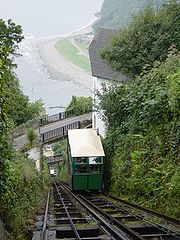
Lynton
Lynton is a small town in Devon, England. It lies on the northern edge of Exmoor and is located at the top of a gorge above Lynmouth, to which it is connected by the Lynton and Lynmouth Cliff Railway...
and Lynmouth
Lynmouth
Lynmouth is a village in Devon, England, on the north edge of Exmoor.The village straddles the confluence of the West Lyn and East Lyn rivers, in a gorge below Lynton, to which it is connected by the Lynton and Lynmouth Cliff Railway....
on the rugged coast of North Devon
Devon
Devon is a large county in southwestern England. The county is sometimes referred to as Devonshire, although the term is rarely used inside the county itself as the county has never been officially "shired", it often indicates a traditional or historical context.The county shares borders with...
.
Origins
The high cliffs separating the two towns (then villages) were a major obstacle to economic development in the 19th century. Because of the remoteness of the area, and rugged geography, villagers had to rely on the sea for most deliveries of coal, lime, foodstuffs and other essentials, which had then to be carried by packhorses and carts up the steep hill to Lynton.The cliffs also posed problems for the burgeoning tourist industry. Holiday makers began to arrive at Lynmouth on paddle steamers from Bristol, Swansea and other Bristol Channel ports, from about 1820. Ponies, donkeys and carriages were available for hire, but the steep gradients led to the animals having only short working lives.
The first proposals for a rail-based lift, able to carry passengers and goods, were made in 1881, although this first scheme was to have been steam powered.
Construction
The water-powered railway was designed by George Croydon Marks (later Baron Marks of Woolwich), and paid for mainly by his business partner, the publisher Sir George NewnesGeorge Newnes
Sir George Newnes, 1st Baronet was a publisher and editor in England.-Background and education:...
. Newnes owned a large residence at nearby Hollerday Hill, and who also backed the Lynton & Barnstaple Railway
Lynton and Barnstaple Railway
The Lynton & Barnstaple Railway opened as an independent railway in May 1898. It was a single track narrow gauge railway slightly over long running through the rugged and picturesque area bordering Exmoor in North Devon, England. Although opened after the 1896 Light Railways Act came into force,...
in 1898, and the Lynton Town Hall in 1900.
Construction work — relying entirely on manual labour — began in 1887 and was completed in less than three years.
Operations
Opened on Easter Monday in 1890, the railway has been in continuous use ever since. An Act of Parliament formed the Lynmouth & Lynton Lift Company in 1888, and a further Act gave the company perpetual rights to the water from the Lyn Valley.An unusual feature for such a line is a halt just below Lynton station, with road access, at North Walk. This was used to transport larger freight items (the car bodies can be removed to provide a flat load bed). Early motor cars were carried up the hill in this way. During rail replacement over the winter of 2006, the halt was used extensively for access and material storage.
The railway is now classified as a listed monument.
Function
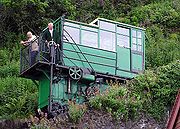
Water feeds through 5 inches (127 mm) pipes from the West Lyn River
West Lyn River
The West Lyn is a river which rises high in Exmoor, Somerset, and joins the East Lyn at Lynmouth in Devon.The upper reaches have been designated as a Site of Special Scientific Interest, because of the geomorphological landforms created in the 1952 flood....
— over a mile away — into tanks under the floor of the upper car. Each car has a 700 imp gal (841 US gal; 3,182 l) tank mounted between the wheels. Water is discharged from the lower car, until the heavier top car begins to descend, with the speed controlled by a brakeman travelling on each car.
The parallel 3ft 9in gauge tracks (which bow out at the centre point, to allow the cars to pass) rise 500 feet (152.4 m) and are 862 feet (262.7 m) long, giving the line a gradient of 1:1.724 (58%).
See also
- Other local railway attractions
- Bideford and Instow RailwayBideford and Instow RailwayThe Bideford Railway Heritage Centre CIC in Devon, England, is responsible for the management of the Bideford station site....
- Lynton and Barnstaple RailwayLynton and Barnstaple RailwayThe Lynton & Barnstaple Railway opened as an independent railway in May 1898. It was a single track narrow gauge railway slightly over long running through the rugged and picturesque area bordering Exmoor in North Devon, England. Although opened after the 1896 Light Railways Act came into force,...
- West Somerset RailwayWest Somerset RailwayThe West Somerset Railway is a railway line that originally linked and in Somerset, England.It opened in 1862 and was extended from Watchet to by the Minehead Railway in 1874. Although just a single track, improvements were needed in the first half of the twentieth century to accommodate the...
- Bideford and Instow Railway
- Funicular railwayFunicularA funicular, also known as an inclined plane or cliff railway, is a cable railway in which a cable attached to a pair of tram-like vehicles on rails moves them up and down a steep slope; the ascending and descending vehicles counterbalance each other.-Operation:The basic principle of funicular...
- List of funicular railways