

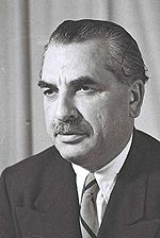
Haim-Moshe Shapira

Encyclopedia
Haim-Moshe Shapira was a key Israel
i politician in the early days of the state's existence. A signatory of Israel's declaration of independence, he served continuously as a minister from the country's foundation in 1948 until his death in 1970 apart from a brief spell in the late 1950s.
in Grodno
in what is today Belarus
. Shapira was educated in Cheder
and a Yeshiva
, where he organised a youth group called Bnei Zion (lit. Sons of Zion). He worked in the Education and Culture department of the National Jewish Council in Kaunas
(now in Lithuania
), and in 1919 set up the Young Mizrachi
, which became a leading player in the religious zionist
youth movement in Lithuania. In 1922 he started work as a teacher at an ultra-orthodox
school in Vilnius
, and also served on the board of the Mizrahi group in the city. Between 1923 and 1924 he was active in the Young Mizrahi group in Warsaw
, before attending a Rabbinical Seminary
in Berlin between 1924 and 1925.
In 1925 he was a delegate at the Zionist Congress, where he was elected onto the executive committee. In the same year he immigrated
to Mandate Palestine. In 1928 he was elected onto the Central Committee of the Hapoel HaMizrachi
movement, and also served as a member of the World Mizrachi committee.
In 1936 he was elected as a member of the Zionist Directorate and a Director of the Aliyah department of the Jewish Agency
, a role he filled until 1948. In 1938 he was sent on a special mission to try to save Jews in Austria
following the takeover
by Nazi Germany
.
and Minister of Immigration
in David Ben-Gurion
's provisional government
.
In Israel's first elections
in 1949, Shapira won a seat as a member of the United Religious Front
bloc, an alliance of Agudat Israel
, Agudat Israel Workers
, Mizrachi
and his Hapoel HaMizrachi
party. He was reappointed to his previous ministerial posts, and also became Minister of Internal Affairs.
After the 1951 elections
in which Hapoel HaMizrachi
ran as an independent party, Shapira was appointed Minister of Internal Affairs and Minister of Religions. Following a cabinet
reshuffle in 1952, he lost the Internal Affairs portfolio, but was appointed Minister of Welfare instead. Another reshuffle in 1955 saw him regain the Internal Affairs portfolio.
The 1955 elections
saw Mizrachi and Hapoel HaMizrachi run as a combined bloc, the National Religious Front, which later became the National Religious Party
(NRP). Shapira was reappointed Minister of Religions and Minister of Welfare. In 1957 he was seriously injured by a hand grenade
thrown into the Knesset
by Moshe Dwek
, but survived. He and all other NRP ministers resigned from the cabinet in July 1958, marking the only spell he spent out of office during his time in Israel.
Following the 1959 elections
, Shapira returned to the cabinet as Minister of Internal Affairs. After the early elections
in 1961, he re-added the health portfolio to his roles.
After elections in 1965
Shapira became just Internal Affairs Minister, a role he retained again after the 1969 elections
. He died in office on 16 July 1970.
. This camp held considerable power before the Six-Day War
, but was weakened significantly after the war in favor of hawkish Gush Emunim
, whose spiritual leader was Rabbi Tzvi Yehuda Kook.
Before the state of Israel was founded, Shapira opposed the dissident military organizations, Etzel
and Lehi
, although he resigned in response to the attack on the Etzel's arms ship Altalena, ordered by David Ben Gurion.
Before the United Nations voted in favor of the United Nations Partition Plan for Palestine, Shapira took a minority position in his movement, supporting the plan. When military actions were debated during the 1948 Arab-Israeli War
, Shapira voiced moderate and careful positions. After the state was founded, he supported giving a hundred thousand Palestinian refugees the option to return to Israel in exchange for a peace accord.
Regarding the Deir Yassin
and Qibya
affairs, he said,"It's wrong from a Jewish perspective. Jews should not act like that". His opinion differed from others in his party, including Zalman Shragai
.
Shapira supported retreat from the Sinai Peninsula
after the 1956 Sinai war. He said:"A bit more modesty, a bit less vanity and pride won't be unhelpful to us". In this context, he cited the decision of Rabbi Yochanan ben Zakai
to negotiate with the Romans.
Shapira was the most vocal of the ministers opposing a preemptive Israeli attack before the Six Day War. "How dare you go to war when all the circumstances are against us", he said to the IDF's chief of staff, Yitzhak Rabin
. The other National Religious Party
ministers joined Shapira in this stance. During the war, he opposed opening a new front in the Golan Heights. Despite his moderate worldview, he acted to include the right wing parties in the government on the eve of the war. This effort resulted in the establishment of a national unity government.
After the war, Shapira voiced support for the settlement movement but warned that future peace agreements would be based on territorial concessions. However, he believed that discussions were meaningless as long as the Arabs refused to consider peace with Israel. He was more determined about Jerusalem – "The eternal capital should not be taken from the eternal nation".
When the pupils of Rabbi Tzvi Yehuda Kook expressed indignation at his moderate worldview, he replied,"we should not distance ourselves from our few friends in the world". He cited the opinion of Rabbi Joseph B. Soloveitchik, who said that questions of territorial concessions should be decided by those who are experts in the fields of defense and national security.
When Moshe Dayan
demanded the annexation of the west bank to Israel, Shapira opposed it. Dayan wondered, "How can a religious Jew be so yielding". He remarked that Shapira's opinion differed from that of other party members.
Israel
The State of Israel is a parliamentary republic located in the Middle East, along the eastern shore of the Mediterranean Sea...
i politician in the early days of the state's existence. A signatory of Israel's declaration of independence, he served continuously as a minister from the country's foundation in 1948 until his death in 1970 apart from a brief spell in the late 1950s.
Background
Born to Zalman Shapira and Rosa Krupnik in the Russian EmpireRussian Empire
The Russian Empire was a state that existed from 1721 until the Russian Revolution of 1917. It was the successor to the Tsardom of Russia and the predecessor of the Soviet Union...
in Grodno
Hrodna
Grodno or Hrodna , is a city in Belarus. It is located on the Neman River , close to the borders of Poland and Lithuania . It has 327,540 inhabitants...
in what is today Belarus
Belarus
Belarus , officially the Republic of Belarus, is a landlocked country in Eastern Europe, bordered clockwise by Russia to the northeast, Ukraine to the south, Poland to the west, and Lithuania and Latvia to the northwest. Its capital is Minsk; other major cities include Brest, Grodno , Gomel ,...
. Shapira was educated in Cheder
Cheder
A Cheder is a traditional elementary school teaching the basics of Judaism and the Hebrew language.-History:...
and a Yeshiva
Yeshiva
Yeshiva is a Jewish educational institution that focuses on the study of traditional religious texts, primarily the Talmud and Torah study. Study is usually done through daily shiurim and in study pairs called chavrutas...
, where he organised a youth group called Bnei Zion (lit. Sons of Zion). He worked in the Education and Culture department of the National Jewish Council in Kaunas
Kaunas
Kaunas is the second-largest city in Lithuania and has historically been a leading centre of Lithuanian economic, academic, and cultural life. Kaunas was the biggest city and the center of a powiat in Trakai Voivodeship of the Grand Duchy of Lithuania since 1413. During Russian Empire occupation...
(now in Lithuania
Lithuania
Lithuania , officially the Republic of Lithuania is a country in Northern Europe, the biggest of the three Baltic states. It is situated along the southeastern shore of the Baltic Sea, whereby to the west lie Sweden and Denmark...
), and in 1919 set up the Young Mizrachi
Mizrachi (Religious Zionism)
The Mizrachi is the name of the religious Zionist organization founded in 1902 in Vilnius at a world conference of religious Zionists called by Rabbi Yitzchak Yaacov Reines. Bnei Akiva, which was founded in 1929, is the youth movement associated with Mizrachi...
, which became a leading player in the religious zionist
Religious Zionism
Religious Zionism is an ideology that combines Zionism and Jewish religious faith...
youth movement in Lithuania. In 1922 he started work as a teacher at an ultra-orthodox
Haredi Judaism
Haredi or Charedi/Chareidi Judaism is the most conservative form of Orthodox Judaism, often referred to as ultra-Orthodox. A follower of Haredi Judaism is called a Haredi ....
school in Vilnius
Vilnius
Vilnius is the capital of Lithuania, and its largest city, with a population of 560,190 as of 2010. It is the seat of the Vilnius city municipality and of the Vilnius district municipality. It is also the capital of Vilnius County...
, and also served on the board of the Mizrahi group in the city. Between 1923 and 1924 he was active in the Young Mizrahi group in Warsaw
Warsaw
Warsaw is the capital and largest city of Poland. It is located on the Vistula River, roughly from the Baltic Sea and from the Carpathian Mountains. Its population in 2010 was estimated at 1,716,855 residents with a greater metropolitan area of 2,631,902 residents, making Warsaw the 10th most...
, before attending a Rabbinical Seminary
Hildesheimer Rabbinical Seminary
The Hildesheimer Rabbinical Seminary was founded in Berlin on 22 October 1873 by Rabbi Dr. Azriel Hildesheimer for the training of rabbis in the tradition of Orthodox Judaism.-History:...
in Berlin between 1924 and 1925.
In 1925 he was a delegate at the Zionist Congress, where he was elected onto the executive committee. In the same year he immigrated
Aliyah
Aliyah is the immigration of Jews to the Land of Israel . It is a basic tenet of Zionist ideology. The opposite action, emigration from Israel, is referred to as yerida . The return to the Holy Land has been a Jewish aspiration since the Babylonian exile...
to Mandate Palestine. In 1928 he was elected onto the Central Committee of the Hapoel HaMizrachi
Hapoel HaMizrachi
Hapoel HaMizrachi |Mizrachi]] Workers) was a political party and settlement movement in Israel and is one of the predecessors of the National Religious Party.-History:...
movement, and also served as a member of the World Mizrachi committee.
In 1936 he was elected as a member of the Zionist Directorate and a Director of the Aliyah department of the Jewish Agency
Jewish Agency for Israel
The Jewish Agency for Israel , also known as the Sochnut or JAFI, served as the organization in charge of immigration and absorption of Jews from the Diaspora into the state of Israel.-History:...
, a role he filled until 1948. In 1938 he was sent on a special mission to try to save Jews in Austria
Austria
Austria , officially the Republic of Austria , is a landlocked country of roughly 8.4 million people in Central Europe. It is bordered by the Czech Republic and Germany to the north, Slovakia and Hungary to the east, Slovenia and Italy to the south, and Switzerland and Liechtenstein to the...
following the takeover
Anschluss
The Anschluss , also known as the ', was the occupation and annexation of Austria into Nazi Germany in 1938....
by Nazi Germany
Nazi Germany
Nazi Germany , also known as the Third Reich , but officially called German Reich from 1933 to 1943 and Greater German Reich from 26 June 1943 onward, is the name commonly used to refer to the state of Germany from 1933 to 1945, when it was a totalitarian dictatorship ruled by...
.
Political career
Shapira was one of the people to sign Israel's declaration of independence, and was immediately appointed Minister of HealthHealth Minister of Israel
The Ministry of Health is a ministry in the Israeli government. The current Minister of Health is Binyamin Netanyahu of Likud.There is occasionally a Deputy Minister of Health...
and Minister of Immigration
Immigrant Absorption Minister of Israel
The Ministry of Immigrant Absorption of Israel , known until 1951 as the Ministry of Immigration , a ministry in the Israeli government.In co-ordination with local authorities, the Ministry is responsible for new immigrants for three weeks after they arrive...
in David Ben-Gurion
David Ben-Gurion
' was the first Prime Minister of Israel.Ben-Gurion's passion for Zionism, which began early in life, led him to become a major Zionist leader and Executive Head of the World Zionist Organization in 1946...
's provisional government
Provisional government of Israel
The provisional government of Israel was the temporary cabinet which governed Israel from shortly before independence until the formation of the first government in March 1949 following the first Knesset elections in January that year....
.
In Israel's first elections
Israeli legislative election, 1949
Elections for the Constituent Assembly were held in newly independent Israel on 25 January 1949. Voter turnout was 86.9%. Two days after its first meeting on 14 February 1949, legislators voted to change the name of the body to the Knesset...
in 1949, Shapira won a seat as a member of the United Religious Front
United Religious Front
The United Religious Front was a political alliance of the four major religious parties in Israel, as well as the Union of Religious Independents, formed to fight the 1949 elections.-History:...
bloc, an alliance of Agudat Israel
Agudat Israel
Agudat Yisrael began as the original political party representing the ultra-Orthodox population of Israel. It was the umbrella party for almost all ultra-Orthodox Jews in Israel, and before that in the British Mandate of Palestine...
, Agudat Israel Workers
Agudat Israel Workers
Poalei Agudat Yisrael was a political party in Poland, and is a minor political party and settlement movement in Israel. It is also known as PAI or PAGI, its Hebrew acronym .-History:...
, Mizrachi
Mizrachi (political party)
Mizrachi was a political party in Israel and is one of the ancestors of the modern-day National Religious Party.-History:The Mizrachi movement was founded in 1902 in Vilnius as a religious Zionist organisation. It also had a trade union, Hapoel HaMizrachi, started in 1921...
and his Hapoel HaMizrachi
Hapoel HaMizrachi
Hapoel HaMizrachi |Mizrachi]] Workers) was a political party and settlement movement in Israel and is one of the predecessors of the National Religious Party.-History:...
party. He was reappointed to his previous ministerial posts, and also became Minister of Internal Affairs.
After the 1951 elections
Israeli legislative election, 1951
Elections for the second Knesset were held in Israel on 30 July 1951. Voter turnout was 75.1%.-Results:¹ Rostam Bastuni, Avraham Berman and Moshe Sneh left Mapam and set up the Left Faction. Bastuni later returned to Mapam whilst Berman and Sneh joined Maki. Hannah Lamdan and David Livschitz left...
in which Hapoel HaMizrachi
Hapoel HaMizrachi
Hapoel HaMizrachi |Mizrachi]] Workers) was a political party and settlement movement in Israel and is one of the predecessors of the National Religious Party.-History:...
ran as an independent party, Shapira was appointed Minister of Internal Affairs and Minister of Religions. Following a cabinet
Cabinet of Israel
The Cabinet of Israel is a formal body composed of government officials called ministers, chosen and led by the Prime Minister. The Prime Minister must appoint members based on the distribution of votes to political parties during legislative elections, and its composition must be approved by a...
reshuffle in 1952, he lost the Internal Affairs portfolio, but was appointed Minister of Welfare instead. Another reshuffle in 1955 saw him regain the Internal Affairs portfolio.
The 1955 elections
Israeli legislative election, 1955
Elections for the third Knesset were held in Israel on 26 July 1955. Voter turnout was 82.8%.-Results:Mapai retained its plurality in the Knesset, although its share of the vote dropped by 5.1 and its share of seats dropped from 47 to 40...
saw Mizrachi and Hapoel HaMizrachi run as a combined bloc, the National Religious Front, which later became the National Religious Party
National Religious Party
The National Religious Party ) was a political party in Israel representing the religious Zionist movement. Formed in 1956, at the time of its dissolution in 2008, it was the second oldest surviving party in the country after Agudat Yisrael, and was part of every government coalition until 1992...
(NRP). Shapira was reappointed Minister of Religions and Minister of Welfare. In 1957 he was seriously injured by a hand grenade
Hand grenade
A hand grenade is any small bomb that can be thrown by hand. Hand grenades are classified into three categories, explosive grenades, chemical and gas grenades. Explosive grenades are the most commonly used in modern warfare, and are designed to detonate after impact or after a set amount of time...
thrown into the Knesset
Knesset
The Knesset is the unicameral legislature of Israel, located in Givat Ram, Jerusalem.-Role in Israeli Government :The legislative branch of the Israeli government, the Knesset passes all laws, elects the President and Prime Minister , approves the cabinet, and supervises the work of the government...
by Moshe Dwek
Moshe Dwek
Moshe Dwek is a Yemenite-Israeli most notable for throwing a hand grenade in the Knesset while it was in session on 29 October 1957 and for a failed run for the Knesset in 1988....
, but survived. He and all other NRP ministers resigned from the cabinet in July 1958, marking the only spell he spent out of office during his time in Israel.
Following the 1959 elections
Israeli legislative election, 1959
Elections for the fourth Knesset were held in Israel on 3 November 1959. Voter turnout was 81.5%.-Results:¹ The General Zionists and the Progressive Party merged to form the Liberal Party....
, Shapira returned to the cabinet as Minister of Internal Affairs. After the early elections
Israeli legislative election, 1961
Elections for the fifth Knesset were held in Israel on 15 August 1961. Voter turnout was 81.6%.-Results:¹ Eight MKs broke away from Mapai to establish Rafi² Herut and the Liberal Party merged to form Gahal...
in 1961, he re-added the health portfolio to his roles.
After elections in 1965
Israeli legislative election, 1965
Elections for the sixth Knesset were held in Israel on 1 November 1965. Voter turnout was 85.9%.-Background:Prior to the elections, two major alliances were formed; Mapai and Ahdut HaAvoda united to form the Alignment, whilst Herut and the Liberal Party had formed the Gahal alliance towards the end...
Shapira became just Internal Affairs Minister, a role he retained again after the 1969 elections
Israeli legislative election, 1969
Elections for the seventh Knesset were held in Israel on 28 October 1969. Voter turnout was 81.7%.-Results:¹ Meir Avizohar defected from the National List to the Alignment² Avner Shaki left the National Religious Party and remained a single MK...
. He died in office on 16 July 1970.
His Positions regarding the Arab-Israeli Conflict
Shapira belonged to the dovish camp of religious ZionismReligious Zionism
Religious Zionism is an ideology that combines Zionism and Jewish religious faith...
. This camp held considerable power before the Six-Day War
Six-Day War
The Six-Day War , also known as the June War, 1967 Arab-Israeli War, or Third Arab-Israeli War, was fought between June 5 and 10, 1967, by Israel and the neighboring states of Egypt , Jordan, and Syria...
, but was weakened significantly after the war in favor of hawkish Gush Emunim
Gush Emunim
Gush Emunim was an Israeli messianic and political movement committed to establishing Jewish settlements in the West Bank. While not formally established as an organization until 1974 in the wake of the Yom Kippur War, Gush Emunim sprang out of the conquests of the Six-Day War in 1967, encouraging...
, whose spiritual leader was Rabbi Tzvi Yehuda Kook.
Before the state of Israel was founded, Shapira opposed the dissident military organizations, Etzel
Irgun
The Irgun , or Irgun Zevai Leumi to give it its full title , was a Zionist paramilitary group that operated in Mandate Palestine between 1931 and 1948. It was an offshoot of the earlier and larger Jewish paramilitary organization haHaganah...
and Lehi
Lehi (group)
Lehi , commonly referred to in English as the Stern Group or Stern Gang, was a militant Zionist group founded by Avraham Stern in the British Mandate of Palestine...
, although he resigned in response to the attack on the Etzel's arms ship Altalena, ordered by David Ben Gurion.
Before the United Nations voted in favor of the United Nations Partition Plan for Palestine, Shapira took a minority position in his movement, supporting the plan. When military actions were debated during the 1948 Arab-Israeli War
1948 Arab-Israeli War
The 1948 Arab–Israeli War, known to Israelis as the War of Independence or War of Liberation The war commenced after the termination of the British Mandate for Palestine and the creation of an independent Israel at midnight on 14 May 1948 when, following a period of civil war, Arab armies invaded...
, Shapira voiced moderate and careful positions. After the state was founded, he supported giving a hundred thousand Palestinian refugees the option to return to Israel in exchange for a peace accord.
Regarding the Deir Yassin
Deir Yassin massacre
The Deir Yassin massacre took place on April 9, 1948, when around 120 fighters from the Irgun Zevai Leumi and Lohamei Herut Israel Zionist paramilitary groups attacked Deir Yassin near Jerusalem, a Palestinian-Arab village of roughly 600 people...
and Qibya
Qibya massacre
The Qibya massacre, also known as the Qibya incident, occurred in October 1953 when Israeli troops under Ariel Sharon attacked the village of Qibya in the West Bank. Sixty-nine Palestinian Arabs, two thirds of them women and children were killed. Forty-five houses, a school, and a mosque were...
affairs, he said,"It's wrong from a Jewish perspective. Jews should not act like that". His opinion differed from others in his party, including Zalman Shragai
Zalman Shragai
Shlomo Zalman Shragai was an Israeli politician and Jerusalem's first elected mayor.Shragai was born into an Polish Orthodox Jewish family in Gorzkowice in 1899. He then became active in the religious Zionist movement and settled in Palestine in 1924, already playing an important political role...
.
Shapira supported retreat from the Sinai Peninsula
Sinai Peninsula
The Sinai Peninsula or Sinai is a triangular peninsula in Egypt about in area. It is situated between the Mediterranean Sea to the north, and the Red Sea to the south, and is the only part of Egyptian territory located in Asia as opposed to Africa, effectively serving as a land bridge between two...
after the 1956 Sinai war. He said:"A bit more modesty, a bit less vanity and pride won't be unhelpful to us". In this context, he cited the decision of Rabbi Yochanan ben Zakai
Yochanan ben Zakai
Johanan ben Zakai , also known as Johanan B. Zakkai was one of the tannaim, an important Jewish sage in the era of the Second Temple, and a primary contributor to the core text of Rabbinical Judaism, the Mishnah. He is widely regarded as one of the most important Jewish figures of his time...
to negotiate with the Romans.
Shapira was the most vocal of the ministers opposing a preemptive Israeli attack before the Six Day War. "How dare you go to war when all the circumstances are against us", he said to the IDF's chief of staff, Yitzhak Rabin
Yitzhak Rabin
' was an Israeli politician, statesman and general. He was the fifth Prime Minister of Israel, serving two terms in office, 1974–77 and 1992 until his assassination in 1995....
. The other National Religious Party
National Religious Party
The National Religious Party ) was a political party in Israel representing the religious Zionist movement. Formed in 1956, at the time of its dissolution in 2008, it was the second oldest surviving party in the country after Agudat Yisrael, and was part of every government coalition until 1992...
ministers joined Shapira in this stance. During the war, he opposed opening a new front in the Golan Heights. Despite his moderate worldview, he acted to include the right wing parties in the government on the eve of the war. This effort resulted in the establishment of a national unity government.
After the war, Shapira voiced support for the settlement movement but warned that future peace agreements would be based on territorial concessions. However, he believed that discussions were meaningless as long as the Arabs refused to consider peace with Israel. He was more determined about Jerusalem – "The eternal capital should not be taken from the eternal nation".
When the pupils of Rabbi Tzvi Yehuda Kook expressed indignation at his moderate worldview, he replied,"we should not distance ourselves from our few friends in the world". He cited the opinion of Rabbi Joseph B. Soloveitchik, who said that questions of territorial concessions should be decided by those who are experts in the fields of defense and national security.
When Moshe Dayan
Moshe Dayan
Moshe Dayan was an Israeli military leader and politician. The fourth Chief of Staff of the Israel Defense Forces , he became a fighting symbol to the world of the new State of Israel...
demanded the annexation of the west bank to Israel, Shapira opposed it. Dayan wondered, "How can a religious Jew be so yielding". He remarked that Shapira's opinion differed from that of other party members.