

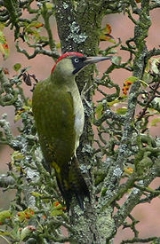
Green Woodpecker

Encyclopedia
The European Green Woodpecker (Picus viridis) is a member of the woodpecker
family Picidae. There are four subspecies and it occurs in most parts of Europe
and in western Asia
. All have green upperparts, paler yellowish underparts, a red crown and moustachial stripe which has a red centre in males but is all black in females.
The European Green Woodpecker spends much of its time feeding on ant
s on the ground and does not often 'drum' on trees like other woodpecker species. It is a shy bird but usually draws attention with its loud calls. A nest hole is excavated in a tree; four to six eggs are laid which hatch after 19–20 days.
n race P. v. subsp. sharpei, in which it is dark grey and males have only a lower black border to the moustache. Juveniles are spotty and streaked all over; the moustache is dark initially, though juvenile males can show some red feathers by early June or usually by July or August.
Although the European Green Woodpecker is shy and wary, it is usually its loud calls, known as yaffling, which first draw attention. It 'drums' rarely (a soft, fast roll), but often gives a noisy 'kyü-kyü-kyück' while flying. The song is a loud series of 10-18 'klü' sounds which gets slightly faster towards the end and falls slightly in pitch. The female makes a thinner 'pü-pü-pü-pü-pü-pü-pü'. The flight is undulating, with 3-4 wingbeats followed by a short glide when the wings are held by the body.
It can be distinguished from the similar, but smaller, Grey-headed Woodpecker
by its yellowish, not grey, underparts, and the black lores and facial 'mask'. In Europe, its green upperparts and yellow rump can lead to confusion with the Grey-headed Woodpecker or possibly female Golden Oriole
, though the latter is smaller and more slender with narrower wings and longer tail. The closely related, very similar Levaillant's Woodpecker
occurs only in north-west Africa
.
, the woodpecker
family Picidae
and the genus Picus. It was first described by Linnaeus
in 1758. The scientific name
is derived from the Greek
pikos, meaning 'woodpecker', and Latin viridis, 'green'. There are four subspecies
, with subtle and mostly clinal differences between them.
, where it is absent from some northern and eastern parts and from Ireland
, Greenland
and the Macaronesian Islands, but otherwise distributed widely. Over half of the European population is thought to be in France, Spain and Germany, with substantial numbers also in Portugal
, the United Kingdom
, Sweden
, Russia
, Croatia
, Romania
and Bulgaria
. It also occurs in western Asia
.
The European Green Woodpecker has a large range and an Estimated Global Extent of Occurrence of between 1 million to 10 million square kilometres, and a population in the region of 920,000 to 2.9 million birds. Populations appear to be stable, so the species is considered of Least Concern. The species is highly sedentary and individuals rarely move more than around 500 m between breeding seasons.
A combination of old deciduous trees for nesting, and nearby feeding grounds with plenty of ant
s, is essential. This is usually found in semi-open landscapes with small woodlands, hedges, scattered old trees, edges of forests and floodplain forests. Suitable habitats for foraging include grassland, heath
s, plantations
, orchard
s and lawn
s.
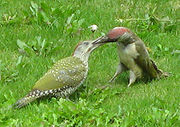 The nesting hole is larger but similar to those of the other woodpeckers. It may be a few feet above the ground or at the top of a tall tree; Oaks, Beeches, Willows and fruit trees are the preferred nest trees in western and central Europe, and Aspens in the north. The hole may be excavated in sound or rotten wood, with an entrance hole of 60 mm x 75 mm. The cavity inside may be 150 mm wide and up to 400 mm deep and the work is performed mostly by the male over 15–30 days. Some tree holes are used for breeding for more than 10 years, but not necessarily by the same pair.
There is a single brood of four to six white eggs, measuring 31 x 23 mm and weighing 8.9 g each, of which 7% is shell. After the last egg is laid, they are incubated for 19–20 days by both parents taking shifts of between 1.5 to 2.5 hours. The chicks are naked and altricial
at hatching and fledge after 21–24 days.
s of the genera
Lasius
and Formica
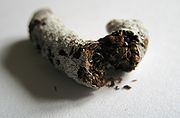
for which it spends much of its time foraging on the ground, though insects are also taken from branches. The bird's distinctive, elongated, cylindrical droppings often consist entirely of ant remains. At ant nests, it probes into the ground and licks up adult ants and their larvae. They have tongues that wrap to the back of their head. It will also take small reptiles.
 A study of a nest in Romania
found that 10 species of ant were fed to the chicks. During the first 10 days, the young received an average of 15 g each, from days 10-20, 39.5 g, and from day 20, 49.3 g. The seven chicks consumed an estimated 1.5 million ants and pupae before leaving the nest.
The beak is relatively weak and used for pecking in soft wood only. In common with other woodpecker
species, the Green Woodpecker's tongue is long (10 cm) and has to be curled around its skull. It lacks the barbs of the Dendrocopos
woodpecker
s and Black Woodpecker
but is made sticky by secretions from the enlarged salivary glands. Heavy, prolonged snow cover makes feeding difficult for the Green Woodpecker and can result in high mortality, from which it may take 10 years for the population to recover. Ant nests can be located under the snow; one bird was observed to dig 85 cm to reach a nest.
character in the 1974 children's animation series Bagpuss
, was based loosely upon the Green Woodpecker. 'Yaffle' was among many English
folk names for the European Green Woodpecker relating to its laughing call; others include Laughing Betsey, Yaffingale, Yappingale and Jack Eikle. Other names, including Rain-bird, Weather Cock and Wet Bird, suggest its supposed ability to bring on rain. The species has been the subject of postage stamp
s from several countries. The European Green Woodpecker is associated with Woodpecker Cider
, an image of the bird is used on the merchandise.
Woodpecker
Woodpeckers are near passerine birds of the order Piciformes. They are one subfamily in the family Picidae, which also includes the piculets and wrynecks. They are found worldwide and include about 180 species....
family Picidae. There are four subspecies and it occurs in most parts of Europe
Europe
Europe is, by convention, one of the world's seven continents. Comprising the westernmost peninsula of Eurasia, Europe is generally 'divided' from Asia to its east by the watershed divides of the Ural and Caucasus Mountains, the Ural River, the Caspian and Black Seas, and the waterways connecting...
and in western Asia
Asia
Asia is the world's largest and most populous continent, located primarily in the eastern and northern hemispheres. It covers 8.7% of the Earth's total surface area and with approximately 3.879 billion people, it hosts 60% of the world's current human population...
. All have green upperparts, paler yellowish underparts, a red crown and moustachial stripe which has a red centre in males but is all black in females.
The European Green Woodpecker spends much of its time feeding on ant
Ant
Ants are social insects of the family Formicidae and, along with the related wasps and bees, belong to the order Hymenoptera. Ants evolved from wasp-like ancestors in the mid-Cretaceous period between 110 and 130 million years ago and diversified after the rise of flowering plants. More than...
s on the ground and does not often 'drum' on trees like other woodpecker species. It is a shy bird but usually draws attention with its loud calls. A nest hole is excavated in a tree; four to six eggs are laid which hatch after 19–20 days.
Description
The European Green Woodpecker measures 30–36 cm in length with a 45–51 cm wingspan. Both sexes are green above and pale yellowish green below, with yellow rump and red crown and nape; the moustachial stripe has a red centre in the male but is solid black in the female. The lores and around the white eye are black in both male and female, except in the IberiaIberian Peninsula
The Iberian Peninsula , sometimes called Iberia, is located in the extreme southwest of Europe and includes the modern-day sovereign states of Spain, Portugal and Andorra, as well as the British Overseas Territory of Gibraltar...
n race P. v. subsp. sharpei, in which it is dark grey and males have only a lower black border to the moustache. Juveniles are spotty and streaked all over; the moustache is dark initially, though juvenile males can show some red feathers by early June or usually by July or August.
Although the European Green Woodpecker is shy and wary, it is usually its loud calls, known as yaffling, which first draw attention. It 'drums' rarely (a soft, fast roll), but often gives a noisy 'kyü-kyü-kyück' while flying. The song is a loud series of 10-18 'klü' sounds which gets slightly faster towards the end and falls slightly in pitch. The female makes a thinner 'pü-pü-pü-pü-pü-pü-pü'. The flight is undulating, with 3-4 wingbeats followed by a short glide when the wings are held by the body.
It can be distinguished from the similar, but smaller, Grey-headed Woodpecker
Grey-headed Woodpecker
The Grey-headed Woodpecker , also known as the Grey-faced Woodpecker, is a Eurasian member of the woodpecker family Piciformes....
by its yellowish, not grey, underparts, and the black lores and facial 'mask'. In Europe, its green upperparts and yellow rump can lead to confusion with the Grey-headed Woodpecker or possibly female Golden Oriole
Golden Oriole
The Eurasian Golden Oriole or simply Golden Oriole is the only member of the oriole family of passerine birds breeding in northern hemisphere temperate regions...
, though the latter is smaller and more slender with narrower wings and longer tail. The closely related, very similar Levaillant's Woodpecker
Levaillant's Woodpecker
The Levaillant’s Woodpecker or Levaillant’s Green Woodpecker is a large member of the woodpecker family Piciformes. It occurs as a resident breeder in the three Maghreb countries Morocco, Algeria and Tunisia in northwest Africa....
occurs only in north-west Africa
Africa
Africa is the world's second largest and second most populous continent, after Asia. At about 30.2 million km² including adjacent islands, it covers 6% of the Earth's total surface area and 20.4% of the total land area...
.
Taxonomy
The Euopean Green Woodpecker is a member of the order PiciformesPiciformes
Nine families of largely arboreal birds make up the order Piciformes, the best-known of them being the Picidae, which includes the woodpeckers and close relatives...
, the woodpecker
Woodpecker
Woodpeckers are near passerine birds of the order Piciformes. They are one subfamily in the family Picidae, which also includes the piculets and wrynecks. They are found worldwide and include about 180 species....
family Picidae
Picidae
The woodpeckers, piculets and wrynecks are a family, Picidae, of near-passerine birds. Members of this family are found worldwide, except for Australia and New Zealand, Madagascar, and the extreme polar regions...
and the genus Picus. It was first described by Linnaeus
Carolus Linnaeus
Carl Linnaeus , also known after his ennoblement as , was a Swedish botanist, physician, and zoologist, who laid the foundations for the modern scheme of binomial nomenclature. He is known as the father of modern taxonomy, and is also considered one of the fathers of modern ecology...
in 1758. The scientific name
Binomial nomenclature
Binomial nomenclature is a formal system of naming species of living things by giving each a name composed of two parts, both of which use Latin grammatical forms, although they can be based on words from other languages...
is derived from the Greek
Greek language
Greek is an independent branch of the Indo-European family of languages. Native to the southern Balkans, it has the longest documented history of any Indo-European language, spanning 34 centuries of written records. Its writing system has been the Greek alphabet for the majority of its history;...
pikos, meaning 'woodpecker', and Latin viridis, 'green'. There are four subspecies
Subspecies
Subspecies in biological classification, is either a taxonomic rank subordinate to species, ora taxonomic unit in that rank . A subspecies cannot be recognized in isolation: a species will either be recognized as having no subspecies at all or two or more, never just one...
, with subtle and mostly clinal differences between them.
- P. v. viridis, which breeds in EuropeEuropeEurope is, by convention, one of the world's seven continents. Comprising the westernmost peninsula of Eurasia, Europe is generally 'divided' from Asia to its east by the watershed divides of the Ural and Caucasus Mountains, the Ural River, the Caspian and Black Seas, and the waterways connecting...
south to France (except south RoussillonRoussillonRoussillon is one of the historical counties of the former Principality of Catalonia, corresponding roughly to the present-day southern French département of Pyrénées-Orientales...
), the AlpsAlpsThe Alps is one of the great mountain range systems of Europe, stretching from Austria and Slovenia in the east through Italy, Switzerland, Liechtenstein and Germany to France in the west....
, northern YugoslaviaYugoslaviaYugoslavia refers to three political entities that existed successively on the western part of the Balkans during most of the 20th century....
and RomaniaRomaniaRomania is a country located at the crossroads of Central and Southeastern Europe, on the Lower Danube, within and outside the Carpathian arch, bordering on the Black Sea... - P. v. karelini, which breeds in ItalyItalyItaly , officially the Italian Republic languages]] under the European Charter for Regional or Minority Languages. In each of these, Italy's official name is as follows:;;;;;;;;), is a unitary parliamentary republic in South-Central Europe. To the north it borders France, Switzerland, Austria and...
, south-east Europe south from southern Yugoslavia, BulgariaBulgariaBulgaria , officially the Republic of Bulgaria , is a parliamentary democracy within a unitary constitutional republic in Southeast Europe. The country borders Romania to the north, Serbia and Macedonia to the west, Greece and Turkey to the south, as well as the Black Sea to the east...
, Asia MinorAsia MinorAsia Minor is a geographical location at the westernmost protrusion of Asia, also called Anatolia, and corresponds to the western two thirds of the Asian part of Turkey...
, northern IranIranIran , officially the Islamic Republic of Iran , is a country in Southern and Western Asia. The name "Iran" has been in use natively since the Sassanian era and came into use internationally in 1935, before which the country was known to the Western world as Persia...
and south-west TurkmenistanTurkmenistanTurkmenistan , formerly also known as Turkmenia is one of the Turkic states in Central Asia. Until 1991, it was a constituent republic of the Soviet Union, the Turkmen Soviet Socialist Republic . Turkmenistan is one of the six independent Turkic states...
. It has duller green upperparts, cheeks and underparts than viridis - P. v. sharpeiIberian WoodpeckerThe Iberian Woodpecker , is a medium-sized woodpecker endemic to Spain. It is also known as the Iberic Green Woodpecker. It is considered to be a subspecies of the European Green Woodpecker, although some taxonomists consider it to be distinct....
, which breeds in the IberiaIberian PeninsulaThe Iberian Peninsula , sometimes called Iberia, is located in the extreme southwest of Europe and includes the modern-day sovereign states of Spain, Portugal and Andorra, as well as the British Overseas Territory of Gibraltar...
north to the SpanishSpainSpain , officially the Kingdom of Spain languages]] under the European Charter for Regional or Minority Languages. In each of these, Spain's official name is as follows:;;;;;;), is a country and member state of the European Union located in southwestern Europe on the Iberian Peninsula...
side of the western and central PyreneesPyreneesThe Pyrenees is a range of mountains in southwest Europe that forms a natural border between France and Spain...
and south Roussillon, has upperparts like karelini but black on the head is limited to the moustachial stripe and lores; the red stripe on males has only a narrow black border - P. v. innominatus, which breeds in south-west and southern Iran, is like karelini but with nearly white cheeks, throat and chest and more defined barring on the tail.
Distribution and habitat
More than 75% of the range of the European Green Woodpecker is in EuropeEurope
Europe is, by convention, one of the world's seven continents. Comprising the westernmost peninsula of Eurasia, Europe is generally 'divided' from Asia to its east by the watershed divides of the Ural and Caucasus Mountains, the Ural River, the Caspian and Black Seas, and the waterways connecting...
, where it is absent from some northern and eastern parts and from Ireland
Ireland
Ireland is an island to the northwest of continental Europe. It is the third-largest island in Europe and the twentieth-largest island on Earth...
, Greenland
Greenland
Greenland is an autonomous country within the Kingdom of Denmark, located between the Arctic and Atlantic Oceans, east of the Canadian Arctic Archipelago. Though physiographically a part of the continent of North America, Greenland has been politically and culturally associated with Europe for...
and the Macaronesian Islands, but otherwise distributed widely. Over half of the European population is thought to be in France, Spain and Germany, with substantial numbers also in Portugal
Portugal
Portugal , officially the Portuguese Republic is a country situated in southwestern Europe on the Iberian Peninsula. Portugal is the westernmost country of Europe, and is bordered by the Atlantic Ocean to the West and South and by Spain to the North and East. The Atlantic archipelagos of the...
, the United Kingdom
United Kingdom
The United Kingdom of Great Britain and Northern IrelandIn the United Kingdom and Dependencies, other languages have been officially recognised as legitimate autochthonous languages under the European Charter for Regional or Minority Languages...
, Sweden
Sweden
Sweden , officially the Kingdom of Sweden , is a Nordic country on the Scandinavian Peninsula in Northern Europe. Sweden borders with Norway and Finland and is connected to Denmark by a bridge-tunnel across the Öresund....
, Russia
Russia
Russia or , officially known as both Russia and the Russian Federation , is a country in northern Eurasia. It is a federal semi-presidential republic, comprising 83 federal subjects...
, Croatia
Croatia
Croatia , officially the Republic of Croatia , is a unitary democratic parliamentary republic in Europe at the crossroads of the Mitteleuropa, the Balkans, and the Mediterranean. Its capital and largest city is Zagreb. The country is divided into 20 counties and the city of Zagreb. Croatia covers ...
, Romania
Romania
Romania is a country located at the crossroads of Central and Southeastern Europe, on the Lower Danube, within and outside the Carpathian arch, bordering on the Black Sea...
and Bulgaria
Bulgaria
Bulgaria , officially the Republic of Bulgaria , is a parliamentary democracy within a unitary constitutional republic in Southeast Europe. The country borders Romania to the north, Serbia and Macedonia to the west, Greece and Turkey to the south, as well as the Black Sea to the east...
. It also occurs in western Asia
Asia
Asia is the world's largest and most populous continent, located primarily in the eastern and northern hemispheres. It covers 8.7% of the Earth's total surface area and with approximately 3.879 billion people, it hosts 60% of the world's current human population...
.
The European Green Woodpecker has a large range and an Estimated Global Extent of Occurrence of between 1 million to 10 million square kilometres, and a population in the region of 920,000 to 2.9 million birds. Populations appear to be stable, so the species is considered of Least Concern. The species is highly sedentary and individuals rarely move more than around 500 m between breeding seasons.
A combination of old deciduous trees for nesting, and nearby feeding grounds with plenty of ant
Ant
Ants are social insects of the family Formicidae and, along with the related wasps and bees, belong to the order Hymenoptera. Ants evolved from wasp-like ancestors in the mid-Cretaceous period between 110 and 130 million years ago and diversified after the rise of flowering plants. More than...
s, is essential. This is usually found in semi-open landscapes with small woodlands, hedges, scattered old trees, edges of forests and floodplain forests. Suitable habitats for foraging include grassland, heath
Heath (habitat)
A heath or heathland is a dwarf-shrub habitat found on mainly low quality acidic soils, characterised by open, low growing woody vegetation, often dominated by plants of the Ericaceae. There are some clear differences between heath and moorland...
s, plantations
Forestry
Forestry is the interdisciplinary profession embracing the science, art, and craft of creating, managing, using, and conserving forests and associated resources in a sustainable manner to meet desired goals, needs, and values for human benefit. Forestry is practiced in plantations and natural stands...
, orchard
Orchard
An orchard is an intentional planting of trees or shrubs that is maintained for food production. Orchards comprise fruit or nut-producing trees which are grown for commercial production. Orchards are also sometimes a feature of large gardens, where they serve an aesthetic as well as a productive...
s and lawn
Lawn
A lawn is an area of aesthetic and recreational land planted with grasses or other durable plants, which usually are maintained at a low and consistent height. Low ornamental meadows in natural landscaping styles are a contemporary option of a lawn...
s.
Breeding
There is a single brood of four to six white eggs, measuring 31 x 23 mm and weighing 8.9 g each, of which 7% is shell. After the last egg is laid, they are incubated for 19–20 days by both parents taking shifts of between 1.5 to 2.5 hours. The chicks are naked and altricial
Altricial
Altricial, meaning "requiring nourishment", refers to a pattern of growth and development in organisms which are incapable of moving around on their own soon after hatching or being born...
at hatching and fledge after 21–24 days.
Food and feeding
The main food of the European Green Woodpecker is antAnt
Ants are social insects of the family Formicidae and, along with the related wasps and bees, belong to the order Hymenoptera. Ants evolved from wasp-like ancestors in the mid-Cretaceous period between 110 and 130 million years ago and diversified after the rise of flowering plants. More than...
s of the genera
Genus
In biology, a genus is a low-level taxonomic rank used in the biological classification of living and fossil organisms, which is an example of definition by genus and differentia...
Lasius
Lasius
Lasius Latr. is a genus of boreal formicine ants.Included within this genus is the common black garden ant, Lasius niger, and its close relatives from dry heathland, L. alienus and L. neoniger....
and Formica
Formica
Formica is a genus of ants of the family Formicidae, commonly known as wood ants, mound ants, or field ants. Formica is the type genus of the Formicidae, and of the subfamily Formicinae...
for which it spends much of its time foraging on the ground, though insects are also taken from branches. The bird's distinctive, elongated, cylindrical droppings often consist entirely of ant remains. At ant nests, it probes into the ground and licks up adult ants and their larvae. They have tongues that wrap to the back of their head. It will also take small reptiles.
Romania
Romania is a country located at the crossroads of Central and Southeastern Europe, on the Lower Danube, within and outside the Carpathian arch, bordering on the Black Sea...
found that 10 species of ant were fed to the chicks. During the first 10 days, the young received an average of 15 g each, from days 10-20, 39.5 g, and from day 20, 49.3 g. The seven chicks consumed an estimated 1.5 million ants and pupae before leaving the nest.
The beak is relatively weak and used for pecking in soft wood only. In common with other woodpecker
Woodpecker
Woodpeckers are near passerine birds of the order Piciformes. They are one subfamily in the family Picidae, which also includes the piculets and wrynecks. They are found worldwide and include about 180 species....
species, the Green Woodpecker's tongue is long (10 cm) and has to be curled around its skull. It lacks the barbs of the Dendrocopos
Dendrocopos
Dendrocopos is a widespread genus of woodpeckers from Asia and Europe and Northern Africa. They range from the Philippines to the British Isles.-Species:* Sulawesi Pygmy Woodpecker, Dendrocopos temminckii...
woodpecker
Woodpecker
Woodpeckers are near passerine birds of the order Piciformes. They are one subfamily in the family Picidae, which also includes the piculets and wrynecks. They are found worldwide and include about 180 species....
s and Black Woodpecker
Black Woodpecker
The Black Woodpecker, Dryocopus martius, is a large woodpecker, 45–50 cm long with a 64–84 cm wingspan. Body weight is approximately 300-400 grams on average. It is easily the largest woodpecker in its range...
but is made sticky by secretions from the enlarged salivary glands. Heavy, prolonged snow cover makes feeding difficult for the Green Woodpecker and can result in high mortality, from which it may take 10 years for the population to recover. Ant nests can be located under the snow; one bird was observed to dig 85 cm to reach a nest.
In culture
'Professor Yaffle', the wooden bookendBookend
A bookend is an object that is designed to buttress, or support, an upright row of books. It is placed on either end to prevent books from falling over, such as in a half-filled bookshelf. Bookends are both utilitarian and, often, decorative. They are common in libraries and in homes...
character in the 1974 children's animation series Bagpuss
Bagpuss
Bagpuss is a 1974 UK children's television series, made by Peter Firmin and Oliver Postgate through their company Smallfilms. The title character is "an old, saggy cloth cat, baggy, and a bit loose at the seams"...
, was based loosely upon the Green Woodpecker. 'Yaffle' was among many English
England
England is a country that is part of the United Kingdom. It shares land borders with Scotland to the north and Wales to the west; the Irish Sea is to the north west, the Celtic Sea to the south west, with the North Sea to the east and the English Channel to the south separating it from continental...
folk names for the European Green Woodpecker relating to its laughing call; others include Laughing Betsey, Yaffingale, Yappingale and Jack Eikle. Other names, including Rain-bird, Weather Cock and Wet Bird, suggest its supposed ability to bring on rain. The species has been the subject of postage stamp
Postage stamp
A postage stamp is a small piece of paper that is purchased and displayed on an item of mail as evidence of payment of postage. Typically, stamps are made from special paper, with a national designation and denomination on the face, and a gum adhesive on the reverse side...
s from several countries. The European Green Woodpecker is associated with Woodpecker Cider
Woodpecker Cider
Woodpecker Cider is an alcoholic drink originally made in 1894 by Percy Bulmer in Herefordshire, today it is still brewed by Bulmers .Woodpecker is noted for having a lower percentage of alcohol than most other ciders, as well as its sweet taste. It is usually available in pubs and bars and is...
, an image of the bird is used on the merchandise.
Further reading
- Lees, Antony Clare (2002) The Cult of the Green Bird: the mythology of the green woodpecker. Lancaster: Scotforth Books ISBN 1904244130
- Gorman, Gerard (2004) Woodpeckers of Europe: a study of the European Picidae. Bruce Coleman ISBN 1 872842 05 4