


American folk music revival

Encyclopedia
The American folk music revival was a phenomenon in the United States
that began during the 1940s and peaked in popularity in the mid-1960s. Its roots went earlier, and performers like Josh White
, Burl Ives
, Woody Guthrie
, Lead Belly, Richard Dyer-Bennett, Oscar Brand
, Jean Ritchie
, John Jacob Niles
, Susan Reed, and Cisco Houston
had enjoyed a limited general popularity in decades prior to the 1950s. The revival brought forward musical styles that had, in earlier times, contributed to the development of country & western
, jazz
, and rock and roll
music.
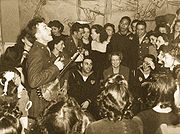 The roots of the folk revival in New York City were in square dancing and folk dancing and musicians like Pete Seeger
being involved providing the music and songs. The folk revival more generally as a popular and commercial phenomenon begins with the career of The Weavers
, formed in November 1948 by Pete Seeger
, Lee Hays, Fred Hellerman
, and Ronnie Gilbert
of People's Songs, of which Seeger had been president and Hays executive secretary. People's Songs, which disbanded in 1948-49, had been a clearing house for labor movement songs (and in particular, the CIO
, which at the time was one of the few if not the only union that was racially integrated), and in 1948 had thrown all its resources to the failed presidential campaign of Progressive Party
candidate Henry Wallace
, a folk music aficionado (his running mate was a country music singer-guitarist). Hays and Seeger had formerly sung together as the politically activist Almanac Singers
, a group which they founded in 1941 and whose personnel often included Woody Guthrie
, Josh White
, Lead Belly, Cisco Houston
, and Bess Lomax Hawes
. The Weavers had a big hit in 1950 with the single of Lead Belly's "Goodnight, Irene
". This was number one on the Billboard charts for thirteen weeks. On its flip side was "Tzena, Tzena, Tzena
", an Israeli dance song that concurrently reached number two on the charts. This was followed by a string of Weaver hit singles that sold millions, including "So Long It's Been Good to Know You" (by Woody Guthrie) and "Kisses Sweeter Than Wine
". The Weavers' career ended abruptly when they were dropped from Decca
's catalog because Pete Seeger had been listed in the publication Red Channels
as a probable subversive. Radio stations refused to play their records and concert venues canceled their engagements. A former employee of People's Songs, Harvey Matusow
, himself a former Communist Party member, had informed the FBI that the Weavers were Communists, too, although Matsuow later recanted and admitted he had lied. Pete Seeger and Lee Hays were called to testify before the House Un-American Activities Committee
in 1955. Despite this, a Christmas Weaver reunion concert in 1955 was a smash success and the Vanguard LP album of that concert, issued in 1957, was one of the top sellers of that year, followed by other successful albums.
Folk music, which often carried the stigma of left-wing associations during the 1950s Red Scare
, was driven underground and carried along by a handful of artists releasing records. Barred from mainstream outlets, artists like Seeger were restricted to performing in schools and summer camps, and the folk-music scene became a phenomenon associated with vaguely rebellious bohemian
ism in places like New York City
(especially Greenwich Village
), North Beach
, and in the college
and university
districts of cities like Chicago, Boston, Denver
, and elsewhere.
Ron Eyerman and Scott Baretta speculate that:
, a chronicler of the 60s Folk Revival, who himself was drawn into the movement through an interest in folk dancing, communicated to Ron Eyerman that he himself was unaware for many years of the movement's 1930s and early '40s antecedents in left-wing political activism.
In the early and mid-1950s, acoustic-guitar-accompanied folk songs were mostly heard in coffee houses, private parties, open-air concerts, and sing-alongs, hootenannies, and at college-campus concerts. Often associated with political dissent, folk music now blended, to some degree, with the so-called beatnik
scene; and dedicated singers of folk songs (as well as folk-influenced original material) traveled through what was called "the coffee-house circuit" across the U.S. and Canada
, home also to cool jazz
and recitations of highly personal beatnik poetry. It was not long before the folk music category came to include less traditional material and more personal and poetic creations by individual performers, who called themselves "singer-songwriter
s". Two singers of the 1950s who sang folk material but crossed over into the mainstream were Odetta
and Harry Belafonte
, both of whom sang Lead Belly and Josh White material. Odetta, who had trained as an opera singer, performed traditional blues, spirituals, and songs by Lead Belly. Belafonte had hits with Jamaican calypso material as well as the folk song-like sentimental ballad "Scarlet Ribbons"
(composed in 1949).
 The Kingston Trio
, a group originating on the West Coast, were directly inspired by the Weavers in their style and presentation and covered some of the Weaver's material, which was predominantly traditional. The Kingston Trio avoided overtly political or protest song
s and cultivated a clean-cut, collegiate persona. They were discovered while playing at a college club called the Cracked Pot by Frank Werber, who became their manager and secured them a deal with Capitol Records
. Their first hit was a catchy rendition of an old-time folk murder ballad, "Tom Dooley
", which had been sung at Lead Belly's funeral concert. This went gold in 1958
and sold more than three million copies. The success of the album and the single earned the Kingston Trio a Grammy award
for Best Country & Western Performance
at the awards' inaugural ceremony in 1959. At the time, no folk music category existed in the Grammy's scheme. The next year, largely as a result of The Kingston Trio
album and "Tom Dooley", the National Academy of Recording Arts and Sciences
instituted a folk category and the Trio won the first Grammy Award for Best Ethnic or Traditional Folk Recording
for its second studio album At Large
. At one point, The Kingston Trio had four records at the same time among the Top 10 selling albums for five consecutive weeks in November and December 1959 according to Billboard
Magazine's "Top LPs" chart, a record unmatched for more than 50 years and noted at the time by a cover story in Life Magazine. The huge commercial success of the Kingston Trio, whose recordings between 1958 and 1961 earned more than $25 million for Capitol records or about $185 million in 2010 dollars spawned a host of groups that were similar in some respects like the Brothers Four
, Peter, Paul and Mary
, The Limeliters
, The Chad Mitchell Trio, The New Christy Minstrels and more. As noted by critic Bruce Eder in the All Music Guide, the popularity of the commercialized version of folk music represented by these groups emboldened record companies to sign, record, and promote artists with more traditionalist and political sensibilities.
The Kingston Trio's popularity would be followed by that of Joan Baez
, whose debut album Joan Baez
, reached the top ten in late 1960 and remained on the Billboard charts for over two years. Baez's early albums contained mostly traditional material such as the Scottish ballad, "Mary Hamilton
", as well as many covers of melancholy ballads that had appeared in Harry Smith
's Anthology of American Folk Music
, such as "The Wagoner's Lad" and "The Butcher Boy"
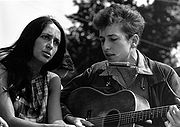
. She did not try to imitate the singing style of her source material, however, but used a rich soprano with vibrato. Her popularity (and that of the folk revival itself) would place Baez on the cover of Time Magazine in November 1962. Baez, unlike the Kingston Trio, was openly political, and as the civil rights movement gathered steam, aligned herself with Pete Seeger, Guthrie and others. She was one of the singers, along with Seeger, Josh White
, Peter, Paul and Mary
and Bob Dylan
, who appeared at Martin Luther King's 1963 March on Washington and sang "We Shall Overcome
", a song that had been introduced by People's Songs. Harry Belafonte was also present on that occasion, along with Odetta
, whom Martin Luther King introduced as "the queen of folk music", when she sang "Oh, Freedom" (Odetta Sings Folk Songs
was one of 1963's best-selling folk albums). Also on hand were the SNCC Freedom Singers
, the personnel of which went on to form Sweet Honey in the Rock
.
The critical role played by Freedom Songs in the voter registration drives, freedom rides, and lunch counter sit-ins during the Civil Rights Movement of the late 1950s and early '60s in the South, gave folk music tremendous new visibility and prestige. The peace movement was likewise energized by the rise of the Campaign for Nuclear Disarmament
in the UK, protesting the British testing of the H-bomb in 1958, as well as by the ever-proliferating arms race and the increasingly unpopular Vietnam War
. Young singer-songwriter Bob Dylan
, playing acoustic guitar
and harmonica
, had been signed and recorded for Columbia
by producer John Hammond
in 1961
. Dylan's record enjoyed some popularity among Greenwich Village folk-music enthusiasts, but he was "discovered" by an immensely larger audience when a pop-folk
-music group, Peter, Paul & Mary had a hit with a cover of his song "Blowing in the Wind". Peter, Paul & Mary's also brought the Weavers' "If I Had a Hammer
" and Pete Seeger and Joe Hickerson
's anti-war "Where have all the Flowers Gone" to nationwide audiences, as well as covering songs by other artists such as Dylan and John Denver
.
Dylan’s general popularity was soon so great that record companies began to sign up and distribute records by a new generation of folk revival and singer-songwriters—Phil Ochs
, Tom Paxton
, Eric von Schmidt
, Buffy Sainte-Marie
, Dave Van Ronk
, Judy Collins
, Tom Rush
, Fred Neil
, Gordon Lightfoot
, Billy Ed Wheeler, John Denver
, Arlo Guthrie
, John Hartford
, and others, among them. Some of this wave had emerged from family singing and playing traditions, and some had not. These singers frequently prided themselves on performing traditional material in imitations of the style of the source singers whom they had discovered, frequently by listening to Harry Smith
's celebrated LP compilation forgotten or obscure commercial 78rpm "race" and "hillbilly" recordings of the 1920s and 30s, the Folkways Anthology of American Folk Music
(1951). A number of the artists who had made these old recordings were still very much alive and had been "rediscovered" and brought to the 1963 and 64 Newport Folk Festival
s. One of these, Clarence Ashley
, for example, introduced folk revivalists to the music of friends of his who still actively played traditional music, such as Doc Watson
and the The Stanley Brothers
.
and from urban inner-cities. New LP compilations of commercial 78-rpm race
and hillbilly
studio recordings stretching back to the 1920s and 1930s were published by major record labels. The expanding market in LP records
increased the availability of folk-music field recordings originally made by John
and Alan Lomax
and other collectors during the New Deal
era of the 1930s and 40s. Small record labels, such as Yazoo Records
, grew up to distribute reissued older recordings and to make new recordings of the survivors among these artists. This was how many urban white American
audiences of the 1950s and 60s first heard country blues
and especially Delta blues
that had been recorded by Mississippi
folk artists 30 or 40 years before.
In 1952, Folkways Records
released the Anthology of American Folk Music
, compiled by anthopologist and experimental film maker Harry Smith
. The Anthology featured 84 songs by traditional country and blues artists, initially recorded between 1927 and 1932, and was credited with making a large amount of pre-War material accessible to younger musicians. (The Anthology was re-released on CD in 1997, and Smith was belatedly presented with a Grammy Award
for his achievement in 1991.)
Artists like the Carter Family, Robert Johnson, Blind Lemon Jefferson
, Clarence Ashley
, Buell Kazee
, Uncle Dave Macon
, Mississippi John Hurt
, and the Stanley Brothers
, as well as Jimmie Rodgers
, the Reverend Gary Davis
, and Bill Monroe
came to have something more than a regional or ethnic reputation. The revival turned up a tremendous wealth and diversity of music and put it out through radio
shows and record stores.
Living representatives of some of the varied regional and ethnic traditions, including younger performers like Southern-traditional singer Jean Ritchie
, who had first begun recording in the 1940s, also enjoyed a resurgence of popularity through enthusiasts' widening discovery of this music and appeared regularly at folk festivals.
(see Electric Dylan controversy
), many other still-young folk artists followed suit. Meanwhile, bands like The Lovin' Spoonful
and the Byrds, whose individual members often had a background in the folk-revival coffee-house scene, were getting recording contracts with folk-tinged music played with a rock-band line-up. Before long, the public appetite for the more acoustic music of the folk revival began to wane.
"Crossover" hits ("folk songs" that became rock-music-scene staples) happened now and again. One well-known example is the song "Hey Joe
", copyrighted by folk artist Billy Roberts
, and recorded by rock singer/guitarist Jimi Hendrix
just as he was about to burst into stardom in 1967. The anthem "Woodstock
" was written and first sung and accompanied on keyboard by Joni Mitchell
– while her records were still nearly entirely acoustic, and while she was labeled a "folk singer" – receiving big airplay when Crosby, Stills, Nash & Young recorded a full-on rock version.
, Marais and Miranda
, and Martha Schlamme
also included Hebrew and Jewish material, as well as Afrikaans
. The Weavers' first big hit, the flipside of Lead Belly's "Good Night Irene", and a top selling it its own right, was in Hebrew (Tzena, Tzena, Tzena
) and they, and later Joan Baez, who was of Spanish descent, occasionally included Spanish-language material in their repertoires.
The more commercially oriented folk-music revival in North America however, (as it existed in coffee houses, concert halls, and radio and TV) was predominantly an English-language phenomenon. In that sense, it bypassed a lot of ethnic folk traditions to be found in North America (e.g., Italian
, French
, Portuguese
, German
, Polish
, Russian
and Finnish
), except in a small proportion of instances where songs’ lyrics had been translated into English.
United States
The United States of America is a federal constitutional republic comprising fifty states and a federal district...
that began during the 1940s and peaked in popularity in the mid-1960s. Its roots went earlier, and performers like Josh White
Josh White
Joshua Daniel White , better known as Josh White, was an American singer, guitarist, songwriter, actor, and civil rights activist. He also recorded under the names "Pinewood Tom" and "Tippy Barton" in the 1930s....
, Burl Ives
Burl Ives
Burl Icle Ivanhoe Ives was an American actor, writer and folk music singer. As an actor, Ives's work included comedies, dramas, and voice work in theater, television, and motion pictures. Music critic John Rockwell said, "Ives's voice .....
, Woody Guthrie
Woody Guthrie
Woodrow Wilson "Woody" Guthrie is best known as an American singer-songwriter and folk musician, whose musical legacy includes hundreds of political, traditional and children's songs, ballads and improvised works. He frequently performed with the slogan This Machine Kills Fascists displayed on his...
, Lead Belly, Richard Dyer-Bennett, Oscar Brand
Oscar Brand
Oscar Brand is a folk singer, songwriter, and author. In his career, spanning over 60 years, he has composed at least 300 songs and released nearly 100 albums, among them Canadian and American patriotic songs...
, Jean Ritchie
Jean Ritchie
Jean Ritchie is an American folk singer, songwriter, and Appalachian dulcimer player.- Out of Kentucky :Abigail and Balis Ritchie of Viper, Kentucky had 14 children, and Jean was the youngest...
, John Jacob Niles
John Jacob Niles
John Jacob Niles was an American composer, singer, and collector of traditional ballads. Called the "Dean of American Balladeers", Niles was an important influence on the American folk music revival of the 1950s and 1960s, with Joan Baez, Burl Ives, and Peter, Paul and Mary, among others,...
, Susan Reed, and Cisco Houston
Cisco Houston
Gilbert Vandine 'Cisco' Houston was an American folk singer and songwriter who is closely associated with Woody Guthrie due to their extensive history of recording together....
had enjoyed a limited general popularity in decades prior to the 1950s. The revival brought forward musical styles that had, in earlier times, contributed to the development of country & western
Country music
Country music is a popular American musical style that began in the rural Southern United States in the 1920s. It takes its roots from Western cowboy and folk music...
, jazz
Jazz
Jazz is a musical style that originated at the beginning of the 20th century in African American communities in the Southern United States. It was born out of a mix of African and European music traditions. From its early development until the present, jazz has incorporated music from 19th and 20th...
, and rock and roll
Rock and roll
Rock and roll is a genre of popular music that originated and evolved in the United States during the late 1940s and early 1950s, primarily from a combination of African American blues, country, jazz, and gospel music...
music.
Overview
Pete Seeger
Peter "Pete" Seeger is an American folk singer and was an iconic figure in the mid-twentieth century American folk music revival. A fixture on nationwide radio in the 1940s, he also had a string of hit records during the early 1950s as a member of The Weavers, most notably their recording of Lead...
being involved providing the music and songs. The folk revival more generally as a popular and commercial phenomenon begins with the career of The Weavers
The Weavers
The Weavers were an American folk music quartet based in the Greenwich Village area of New York City. They sang traditional folk songs from around the world, as well as blues, gospel music, children's songs, labor songs, and American ballads, and selling millions of records at the height of their...
, formed in November 1948 by Pete Seeger
Pete Seeger
Peter "Pete" Seeger is an American folk singer and was an iconic figure in the mid-twentieth century American folk music revival. A fixture on nationwide radio in the 1940s, he also had a string of hit records during the early 1950s as a member of The Weavers, most notably their recording of Lead...
, Lee Hays, Fred Hellerman
Fred Hellerman
Fred Hellerman, born in Brooklyn, New York and educated at Brooklyn College, is an American folk singer, guitarist, producer and song writer, primarily known as one of the members of The Weavers, together with Pete Seeger, Lee Hays, and Ronnie Gilbert...
, and Ronnie Gilbert
Ronnie Gilbert
Ronnie Gilbert is an American folk-singer. She is one of the original members of the Weavers with Pete Seeger, Lee Hays, and Fred Hellerman.-Career:...
of People's Songs, of which Seeger had been president and Hays executive secretary. People's Songs, which disbanded in 1948-49, had been a clearing house for labor movement songs (and in particular, the CIO
Congress of Industrial Organizations
The Congress of Industrial Organizations, or CIO, proposed by John L. Lewis in 1932, was a federation of unions that organized workers in industrial unions in the United States and Canada from 1935 to 1955. The Taft-Hartley Act of 1947 required union leaders to swear that they were not...
, which at the time was one of the few if not the only union that was racially integrated), and in 1948 had thrown all its resources to the failed presidential campaign of Progressive Party
Progressive Party (United States, 1948)
The United States Progressive Party of 1948 was a left-wing political party that ran former Vice President Henry A. Wallace of Iowa for president and U.S. Senator Glen H. Taylor of Idaho for vice president in 1948.-Foundation:...
candidate Henry Wallace
Henry A. Wallace
Henry Agard Wallace was the 33rd Vice President of the United States , the Secretary of Agriculture , and the Secretary of Commerce . In the 1948 presidential election, Wallace was the nominee of the Progressive Party.-Early life:Henry A...
, a folk music aficionado (his running mate was a country music singer-guitarist). Hays and Seeger had formerly sung together as the politically activist Almanac Singers
Almanac Singers
The Almanac Singers were a group of folk musicians who, as their name indicates, specialized in topical songs, especially songs connected with the labor movement...
, a group which they founded in 1941 and whose personnel often included Woody Guthrie
Woody Guthrie
Woodrow Wilson "Woody" Guthrie is best known as an American singer-songwriter and folk musician, whose musical legacy includes hundreds of political, traditional and children's songs, ballads and improvised works. He frequently performed with the slogan This Machine Kills Fascists displayed on his...
, Josh White
Josh White
Joshua Daniel White , better known as Josh White, was an American singer, guitarist, songwriter, actor, and civil rights activist. He also recorded under the names "Pinewood Tom" and "Tippy Barton" in the 1930s....
, Lead Belly, Cisco Houston
Cisco Houston
Gilbert Vandine 'Cisco' Houston was an American folk singer and songwriter who is closely associated with Woody Guthrie due to their extensive history of recording together....
, and Bess Lomax Hawes
Bess Lomax Hawes
Bess Lomax Hawes was an American folk musician, folklorist, and researcher. She was the daughter of John Avery Lomax and Bess Bauman-Brown Lomax, and the sister of Alan Lomax.-Early life and education:...
. The Weavers had a big hit in 1950 with the single of Lead Belly's "Goodnight, Irene
Goodnight, Irene
"Goodnight, Irene" or "Irene, Goodnight," is a 20th century American folk standard, written in 3/4 time, first recorded by American blues musician Huddie 'Lead Belly' Ledbetter in 1932....
". This was number one on the Billboard charts for thirteen weeks. On its flip side was "Tzena, Tzena, Tzena
Tzena, Tzena, Tzena
"Tzena, Tzena, Tzena" is a song, originally written in Hebrew by Issachar Miron , a Polish emigrant to what was then The British Mandate of Palestine but is now Israel, and Jehiel Hagges .-History and development:...
", an Israeli dance song that concurrently reached number two on the charts. This was followed by a string of Weaver hit singles that sold millions, including "So Long It's Been Good to Know You" (by Woody Guthrie) and "Kisses Sweeter Than Wine
Kisses Sweeter than Wine (song)
"Kisses Sweeter than Wine" is a popular love song written by The Weavers in 1950, and a hit for Jimmie Rodgers in 1957 and Frankie Vaughan in 1958.-History:...
". The Weavers' career ended abruptly when they were dropped from Decca
Decca Records
Decca Records began as a British record label established in 1929 by Edward Lewis. Its U.S. label was established in late 1934; however, owing to World War II, the link with the British company was broken for several decades....
's catalog because Pete Seeger had been listed in the publication Red Channels
Red Channels
Red Channels: The Report of Communist Influence in Radio and Television is an anti-Communist tract published in the United States at the height of the Red Scare...
as a probable subversive. Radio stations refused to play their records and concert venues canceled their engagements. A former employee of People's Songs, Harvey Matusow
Harvey Matusow
Harvey Matusow was a U.S. Communist who protected himself from HUAC by providing evidence against his former left-wing colleagues. His false accusations led to his own perjury conviction and to being blacklisted...
, himself a former Communist Party member, had informed the FBI that the Weavers were Communists, too, although Matsuow later recanted and admitted he had lied. Pete Seeger and Lee Hays were called to testify before the House Un-American Activities Committee
House Un-American Activities Committee
The House Committee on Un-American Activities or House Un-American Activities Committee was an investigative committee of the United States House of Representatives. In 1969, the House changed the committee's name to "House Committee on Internal Security"...
in 1955. Despite this, a Christmas Weaver reunion concert in 1955 was a smash success and the Vanguard LP album of that concert, issued in 1957, was one of the top sellers of that year, followed by other successful albums.
Folk music, which often carried the stigma of left-wing associations during the 1950s Red Scare
Red Scare
Durrell Blackwell Durrell Blackwell The term Red Scare denotes two distinct periods of strong Anti-Communism in the United States: the First Red Scare, from 1919 to 1920, and the Second Red Scare, from 1947 to 1957. The First Red Scare was about worker revolution and...
, was driven underground and carried along by a handful of artists releasing records. Barred from mainstream outlets, artists like Seeger were restricted to performing in schools and summer camps, and the folk-music scene became a phenomenon associated with vaguely rebellious bohemian
Bohemianism
Bohemianism is the practice of an unconventional lifestyle, often in the company of like-minded people, with few permanent ties, involving musical, artistic or literary pursuits...
ism in places like New York City
New York City
New York is the most populous city in the United States and the center of the New York Metropolitan Area, one of the most populous metropolitan areas in the world. New York exerts a significant impact upon global commerce, finance, media, art, fashion, research, technology, education, and...
(especially Greenwich Village
Greenwich Village
Greenwich Village, , , , .in New York often simply called "the Village", is a largely residential neighborhood on the west side of Lower Manhattan in New York City. A large majority of the district is home to upper middle class families...
), North Beach
North Beach, San Francisco, California
North Beach is a neighborhood in the northeast of San Francisco adjacent to Chinatown, Fisherman's Wharf and Russian Hill. The neighborhood is San Francisco's Little Italy, and has historically been home to a large Italian American population. It still holds many Italian restaurants today, though...
, and in the college
College
A college is an educational institution or a constituent part of an educational institution. Usage varies in English-speaking nations...
and university
University
A university is an institution of higher education and research, which grants academic degrees in a variety of subjects. A university is an organisation that provides both undergraduate education and postgraduate education...
districts of cities like Chicago, Boston, Denver
Denver, Colorado
The City and County of Denver is the capital and the most populous city of the U.S. state of Colorado. Denver is a consolidated city-county, located in the South Platte River Valley on the western edge of the High Plains just east of the Front Range of the Rocky Mountains...
, and elsewhere.
Ron Eyerman and Scott Baretta speculate that:
[I]t is interesting to consider that had it not been for the explicit political sympathies of the Weavers and other folk singers or, another way of looking at it, the hysterical anti-communism of the Cold War, folk music would very likely have entered mainstream American culture in even greater force in the early 1950s, perhaps making the second wave of the revival nearly a decade later [i.e., in the 1960s] redundant.The media blackout of performers with alleged communist sympathies or ties was so effective that Israel Young
Izzy Young
Israel Goodman Young or Izzy Young is a noted figure in the world of folk music, both in America and Sweden.He is the former owner of the Folklore Center in Greenwich Village, New York, and since 1973, he has owned and operated the Folklore Centrum store in Stockholm.- Biography :In 1957, on...
, a chronicler of the 60s Folk Revival, who himself was drawn into the movement through an interest in folk dancing, communicated to Ron Eyerman that he himself was unaware for many years of the movement's 1930s and early '40s antecedents in left-wing political activism.
In the early and mid-1950s, acoustic-guitar-accompanied folk songs were mostly heard in coffee houses, private parties, open-air concerts, and sing-alongs, hootenannies, and at college-campus concerts. Often associated with political dissent, folk music now blended, to some degree, with the so-called beatnik
Beatnik
Beatnik was a media stereotype of the 1950s and early 1960s that displayed the more superficial aspects of the Beat Generation literary movement of the 1950s and violent film images, along with a cartoonish depiction of the real-life people and the spiritual quest in Jack Kerouac's autobiographical...
scene; and dedicated singers of folk songs (as well as folk-influenced original material) traveled through what was called "the coffee-house circuit" across the U.S. and Canada
Canada
Canada is a North American country consisting of ten provinces and three territories. Located in the northern part of the continent, it extends from the Atlantic Ocean in the east to the Pacific Ocean in the west, and northward into the Arctic Ocean...
, home also to cool jazz
Cool jazz
Cool is a style of modern jazz music that arose following the Second World War. It is characterized by its relaxed tempos and lighter tone, in contrast to the bebop style that preceded it...
and recitations of highly personal beatnik poetry. It was not long before the folk music category came to include less traditional material and more personal and poetic creations by individual performers, who called themselves "singer-songwriter
Singer-songwriter
Singer-songwriters are musicians who write, compose and sing their own musical material including lyrics and melodies. As opposed to contemporary popular music singers who write their own songs, the term singer-songwriter describes a distinct form of artistry, closely associated with the...
s". Two singers of the 1950s who sang folk material but crossed over into the mainstream were Odetta
Odetta
Odetta Holmes, known as Odetta, was an American singer, actress, guitarist, songwriter, and a human rights activist, often referred to as "The Voice of the Civil Rights Movement". Her musical repertoire consisted largely of American folk music, blues, jazz, and spirituals...
and Harry Belafonte
Harry Belafonte
Harold George "Harry" Belafonte, Jr. is an American singer, songwriter, actor and social activist. He was dubbed the "King of Calypso" for popularizing the Caribbean musical style with an international audience in the 1950s...
, both of whom sang Lead Belly and Josh White material. Odetta, who had trained as an opera singer, performed traditional blues, spirituals, and songs by Lead Belly. Belafonte had hits with Jamaican calypso material as well as the folk song-like sentimental ballad "Scarlet Ribbons"
Scarlet Ribbons (For Her Hair)
"Scarlet Ribbons " is a popular song. The music was written by Evelyn Danzig and the lyrics by Jack Segal."Scarlet Ribbons" was written in only 15 minutes in 1949 at Danzig's home in Port Washington New York after she invited lyricist Segal to hear her music...
(composed in 1949).
The Kingston Trio
The Kingston Trio is an American folk and pop music group that helped launch the folk revival of the late 1950s to late 1960s. The group started as a San Francisco Bay Area nightclub act with an original lineup of Dave Guard, Bob Shane, and Nick Reynolds...
, a group originating on the West Coast, were directly inspired by the Weavers in their style and presentation and covered some of the Weaver's material, which was predominantly traditional. The Kingston Trio avoided overtly political or protest song
Protest song
A protest song is a song which is associated with a movement for social change and hence part of the broader category of topical songs . It may be folk, classical, or commercial in genre...
s and cultivated a clean-cut, collegiate persona. They were discovered while playing at a college club called the Cracked Pot by Frank Werber, who became their manager and secured them a deal with Capitol Records
Capitol Records
Capitol Records is a major United States based record label, formerly located in Los Angeles, but operating in New York City as part of Capitol Music Group. Its former headquarters building, the Capitol Tower, is a major landmark near the corner of Hollywood and Vine...
. Their first hit was a catchy rendition of an old-time folk murder ballad, "Tom Dooley
Tom Dooley (song)
"Tom Dooley" is an old North Carolina folk song based on the 1866 murder of a woman named Laura Foster in Wilkes County, North Carolina. It is best known today because of a hit version recorded in 1958 by The Kingston Trio. This version was a multi-format hit, reaching #1 in Billboard, the...
", which had been sung at Lead Belly's funeral concert. This went gold in 1958
1958 in music
-Events:*February - 45,000 peoplein one week watch performances of "rokabirī" music by Japanese singers at the first Nichigeki Western Carnival....
and sold more than three million copies. The success of the album and the single earned the Kingston Trio a Grammy award
Grammy Award
A Grammy Award — or Grammy — is an accolade by the National Academy of Recording Arts and Sciences of the United States to recognize outstanding achievement in the music industry...
for Best Country & Western Performance
Grammy Award for Best Country & Western Recording
The Grammy Award for Best Country & Western Recording was awarded from 1959 to 1968. From 1959 to 1961 the award was presented as the Grammy Award for Best Country & Western Performance...
at the awards' inaugural ceremony in 1959. At the time, no folk music category existed in the Grammy's scheme. The next year, largely as a result of The Kingston Trio
The Kingston Trio (album)
The Kingston Trio is The Kingston Trio's debut album, released in 1958 . It entered the album charts in late October 1958, where it resided for nearly four years, spending one week at #1 in early 1959...
album and "Tom Dooley", the National Academy of Recording Arts and Sciences
National Academy of Recording Arts and Sciences
The National Academy of Recording Arts & Sciences, Inc., known variously as The Recording Academy or NARAS, is a U.S. organization of musicians, producers, recording engineers and other recording professionals dedicated to improving the quality of life and cultural condition for music and its...
instituted a folk category and the Trio won the first Grammy Award for Best Ethnic or Traditional Folk Recording
Grammy Award for Best Ethnic or Traditional Folk Recording
The Grammy Award for Best Ethnic or Traditional Folk Recording was awarded from 1960 to 1986. During this time the award had several minor name changes:*From 1960 to 1961 the award was known as Best Performance - Folk...
for its second studio album At Large
At Large
In reviewing At Large for Allmusic, music critic Bruce Eder wrote the album "shows in the far more complex sound achieved by the trio throughout this album, with voices and instruments more closely interwoven than on their earlier studio recordings and achieving control over their volume that, even...
. At one point, The Kingston Trio had four records at the same time among the Top 10 selling albums for five consecutive weeks in November and December 1959 according to Billboard
Billboard (magazine)
Billboard is a weekly American magazine devoted to the music industry, and is one of the oldest trade magazines in the world. It maintains several internationally recognized music charts that track the most popular songs and albums in various categories on a weekly basis...
Magazine's "Top LPs" chart, a record unmatched for more than 50 years and noted at the time by a cover story in Life Magazine. The huge commercial success of the Kingston Trio, whose recordings between 1958 and 1961 earned more than $25 million for Capitol records or about $185 million in 2010 dollars spawned a host of groups that were similar in some respects like the Brothers Four
The Brothers Four
The Brothers Four are an American folk singing group, founded in 1957 in Seattle, Washington, known for their 1960 hit song "Greenfields".-History:...
, Peter, Paul and Mary
Peter, Paul and Mary
Peter, Paul and Mary were an American folk-singing trio whose nearly 50-year career began with their rise to become a paradigm for 1960s folk music. The trio was composed of Peter Yarrow, Paul Stookey and Mary Travers...
, The Limeliters
The Limeliters
The Limeliters are an American folk music group, formed in July 1959 by Lou Gottlieb , Alex Hassilev , and Glenn Yarbrough . The group was active from 1959 until 1965, when they disbanded. After a hiatus of sixteen years Yarbrough, Hassilev, and Gottlieb reunited and began performing as...
, The Chad Mitchell Trio, The New Christy Minstrels and more. As noted by critic Bruce Eder in the All Music Guide, the popularity of the commercialized version of folk music represented by these groups emboldened record companies to sign, record, and promote artists with more traditionalist and political sensibilities.
The Kingston Trio's popularity would be followed by that of Joan Baez
Joan Baez
Joan Chandos Baez is an American folk singer, songwriter, musician and a prominent activist in the fields of human rights, peace and environmental justice....
, whose debut album Joan Baez
Joan Baez (album)
Joan Baez was singer Joan Baez's 1960 self-titled debut album, featuring 13 traditional folk songs.-History:Though Baez was reportedly offered a contract with Columbia at the time, she chose to go instead with the independent Vanguard label, hoping for increased artistic license...
, reached the top ten in late 1960 and remained on the Billboard charts for over two years. Baez's early albums contained mostly traditional material such as the Scottish ballad, "Mary Hamilton
Mary Hamilton
"Mary Hamilton" and "The Fower Maries" are two common names for a famous, apparently fictional sixteenth-century ballad from Scotland....
", as well as many covers of melancholy ballads that had appeared in Harry Smith
Harry Everett Smith
Harry Everett Smith was an American archivist, ethnomusicologist, student of anthropology, record collector, experimental filmmaker, artist, bohemian and mystic...
's Anthology of American Folk Music
Anthology of American Folk Music
The Anthology of American Folk Music is a six-album compilation released in 1952 by Folkways Records , comprising eighty-four American folk, blues and country music recordings that were originally issued from 1927 to 1932.Experimental filmmaker and notable eccentric Harry Smith compiled the music...
, such as "The Wagoner's Lad" and "The Butcher Boy"
The Butcher Boy (folk song)
The Butcher’s Boy is a British folk song, likely an amalgam of several Broadside ballads. It is also found in American versions. It is a song telling of a girl who hanged herself because her lover abandoned her after getting her pregnant...
. She did not try to imitate the singing style of her source material, however, but used a rich soprano with vibrato. Her popularity (and that of the folk revival itself) would place Baez on the cover of Time Magazine in November 1962. Baez, unlike the Kingston Trio, was openly political, and as the civil rights movement gathered steam, aligned herself with Pete Seeger, Guthrie and others. She was one of the singers, along with Seeger, Josh White
Josh White
Joshua Daniel White , better known as Josh White, was an American singer, guitarist, songwriter, actor, and civil rights activist. He also recorded under the names "Pinewood Tom" and "Tippy Barton" in the 1930s....
, Peter, Paul and Mary
Peter, Paul and Mary
Peter, Paul and Mary were an American folk-singing trio whose nearly 50-year career began with their rise to become a paradigm for 1960s folk music. The trio was composed of Peter Yarrow, Paul Stookey and Mary Travers...
and Bob Dylan
Bob Dylan
Bob Dylan is an American singer-songwriter, musician, poet, film director and painter. He has been a major and profoundly influential figure in popular music and culture for five decades. Much of his most celebrated work dates from the 1960s when he was an informal chronicler and a seemingly...
, who appeared at Martin Luther King's 1963 March on Washington and sang "We Shall Overcome
We Shall Overcome
"We Shall Overcome" is a protest song that became a key anthem of the African-American Civil Rights Movement . The title and structure of the song are derived from an early gospel song by African-American composer Charles Albert Tindley...
", a song that had been introduced by People's Songs. Harry Belafonte was also present on that occasion, along with Odetta
Odetta
Odetta Holmes, known as Odetta, was an American singer, actress, guitarist, songwriter, and a human rights activist, often referred to as "The Voice of the Civil Rights Movement". Her musical repertoire consisted largely of American folk music, blues, jazz, and spirituals...
, whom Martin Luther King introduced as "the queen of folk music", when she sang "Oh, Freedom" (Odetta Sings Folk Songs
Odetta Sings Folk Songs
Odetta Sings Folk Songs is an album by American folk singer Odetta, first released in 1963. It was her second release on her new label, RCA Victor and is out of print...
was one of 1963's best-selling folk albums). Also on hand were the SNCC Freedom Singers
The Freedom Singers
The Freedom Singers is a band that was founded in 1962 by Cordell Reagon, Bernice Johnson , Matthew Jones, Charles Neblett and Rutha Mae Harris ....
, the personnel of which went on to form Sweet Honey in the Rock
Sweet Honey in the Rock
Sweet Honey in the Rock is an all-woman, African-American a cappella ensemble. They are an American Grammy Award-winning troupe who express their history as women of color through song, while entertaining their audience. They have together worked from four women to the difficult five-part harmony...
.
The critical role played by Freedom Songs in the voter registration drives, freedom rides, and lunch counter sit-ins during the Civil Rights Movement of the late 1950s and early '60s in the South, gave folk music tremendous new visibility and prestige. The peace movement was likewise energized by the rise of the Campaign for Nuclear Disarmament
Campaign for Nuclear Disarmament
The Campaign for Nuclear Disarmament is an anti-nuclear organisation that advocates unilateral nuclear disarmament by the United Kingdom, international nuclear disarmament and tighter international arms regulation through agreements such as the Nuclear Non-Proliferation Treaty...
in the UK, protesting the British testing of the H-bomb in 1958, as well as by the ever-proliferating arms race and the increasingly unpopular Vietnam War
Vietnam War
The Vietnam War was a Cold War-era military conflict that occurred in Vietnam, Laos, and Cambodia from 1 November 1955 to the fall of Saigon on 30 April 1975. This war followed the First Indochina War and was fought between North Vietnam, supported by its communist allies, and the government of...
. Young singer-songwriter Bob Dylan
Bob Dylan
Bob Dylan is an American singer-songwriter, musician, poet, film director and painter. He has been a major and profoundly influential figure in popular music and culture for five decades. Much of his most celebrated work dates from the 1960s when he was an informal chronicler and a seemingly...
, playing acoustic guitar
Acoustic guitar
An acoustic guitar is a guitar that uses only an acoustic sound board. The air in this cavity resonates with the vibrational modes of the string and at low frequencies, which depend on the size of the box, the chamber acts like a Helmholtz resonator, increasing or decreasing the volume of the sound...
and harmonica
Harmonica
The harmonica, also called harp, French harp, blues harp, and mouth organ, is a free reed wind instrument used primarily in blues and American folk music, jazz, country, and rock and roll. It is played by blowing air into it or drawing air out by placing lips over individual holes or multiple holes...
, had been signed and recorded for Columbia
Columbia Records
Columbia Records is an American record label, owned by Japan's Sony Music Entertainment, operating under the Columbia Music Group with Aware Records. It was founded in 1888, evolving from an earlier enterprise, the American Graphophone Company — successor to the Volta Graphophone Company...
by producer John Hammond
John H. Hammond
John Henry Hammond II was an American record producer, musician and music critic from the 1930s to the early 1980s...
in 1961
1961 in music
-Events:*January 15 – Motown Records signs The Supremes.*January 20 – Francis Poulenc's Gloria receives its premiėre in Boston, USA.*February 12 – The Miracles' "Shop Around" becomes Motown's first million-selling single....
. Dylan's record enjoyed some popularity among Greenwich Village folk-music enthusiasts, but he was "discovered" by an immensely larger audience when a pop-folk
Pop-folk
Pop-folk is the umbrella term for the popular musical genres originating in the Balkans and Eastern Europe that are characteristic by the fusion of commercial folk music and "nightclub" music. The term is used alternatively for Turbo-folk and Chalga and is mostly used in Bulgaria...
-music group, Peter, Paul & Mary had a hit with a cover of his song "Blowing in the Wind". Peter, Paul & Mary's also brought the Weavers' "If I Had a Hammer
If I Had a Hammer
"If I Had a Hammer " is a song written by Pete Seeger and Lee Hays. It was written in 1949 in support of the progressive movement, and was first recorded by The Weavers, a folk music quartet composed of Seeger, Hays, Ronnie Gilbert and Fred Hellerman, and then by Peter, Paul and Mary.- Early...
" and Pete Seeger and Joe Hickerson
Joe Hickerson
Joe Hickerson is a noted folk singer and songleader. For 35 years he was Librarian and Director of the Archive of Folk Song at the American Folklife Center of the Library of Congress...
's anti-war "Where have all the Flowers Gone" to nationwide audiences, as well as covering songs by other artists such as Dylan and John Denver
John Denver
Henry John Deutschendorf, Jr. , known professionally as John Denver, was an American singer/songwriter, activist, and humanitarian. After growing up in numerous locations with his military family, Denver began his music career in folk music groups in the late 1960s. His greatest commercial success...
.
Dylan’s general popularity was soon so great that record companies began to sign up and distribute records by a new generation of folk revival and singer-songwriters—Phil Ochs
Phil Ochs
Philip David Ochs was an American protest singer and songwriter who was known for his sharp wit, sardonic humor, earnest humanism, political activism, insightful and alliterative lyrics, and haunting voice...
, Tom Paxton
Tom Paxton
Thomas Richard Paxton is an American folk singer and singer-songwriter who has been writing, performing and recording music for over forty years...
, Eric von Schmidt
Eric Von Schmidt
Eric "Rick" Von Schmidt was an American singer-songwriter and Grammy Award recipient. He was associated with the folk/blues revival of the 1960s and a key part of the East Coast folk music scene that included Bob Dylan and Joan Baez.-Background and associations with Dylan:Von Schmidt's father,...
, Buffy Sainte-Marie
Buffy Sainte-Marie
Buffy Sainte-Marie, OC is a Canadian Cree singer-songwriter, musician, composer, visual artist, educator, pacifist, and social activist. Throughout her career in all of these areas, her work has focused on issues of Indigenous peoples of the Americas. Her singing and writing repertoire includes...
, Dave Van Ronk
Dave Van Ronk
Dave Van Ronk was an American folk singer, born in Brooklyn, New York, who settled in Greenwich Village, New York, and was eventually nicknamed the "Mayor of MacDougal Street" ....
, Judy Collins
Judy Collins
Judith Marjorie "Judy" Collins is an American singer and songwriter, known for her eclectic tastes in the material she records ; and for her social activism. She is an alumna of the University of Colorado.-Musical career:Collins was born and raised in Seattle, Washington...
, Tom Rush
Tom Rush
Tom Rush is an American folk and blues singer, songwriter, musician and recording artist.- Life and career :Rush was born in Portsmouth, New Hampshire. His father was a teacher at St. Paul's School, in Concord, New Hampshire. Tom began performing in 1961 while studying at Harvard University after...
, Fred Neil
Fred Neil
Fred Neil was an American folk singer-songwriter in the 1960s and early 1970s. He did not achieve commercial success as a performer, and is mainly known through other people's recordings of his material – particularly "Everybody's Talkin'", which became a hit for Harry Nilsson after being...
, Gordon Lightfoot
Gordon Lightfoot
Gordon Meredith Lightfoot, Jr. is a Canadian singer-songwriter who achieved international success in folk, folk-rock, and country music, and has been credited for helping define the folk-pop sound of the 1960s and 1970s...
, Billy Ed Wheeler, John Denver
John Denver
Henry John Deutschendorf, Jr. , known professionally as John Denver, was an American singer/songwriter, activist, and humanitarian. After growing up in numerous locations with his military family, Denver began his music career in folk music groups in the late 1960s. His greatest commercial success...
, Arlo Guthrie
Arlo Guthrie
Arlo Davy Guthrie is an American folk singer. Like his father, Woody Guthrie, Arlo often sings songs of protest against social injustice...
, John Hartford
John Hartford
John Cowan Hartford was an American folk, country and bluegrass composer and musician known for his mastery of the fiddle and banjo, as well as for his witty lyrics, unique vocal style, and extensive knowledge of Mississippi River lore...
, and others, among them. Some of this wave had emerged from family singing and playing traditions, and some had not. These singers frequently prided themselves on performing traditional material in imitations of the style of the source singers whom they had discovered, frequently by listening to Harry Smith
Harry Everett Smith
Harry Everett Smith was an American archivist, ethnomusicologist, student of anthropology, record collector, experimental filmmaker, artist, bohemian and mystic...
's celebrated LP compilation forgotten or obscure commercial 78rpm "race" and "hillbilly" recordings of the 1920s and 30s, the Folkways Anthology of American Folk Music
Anthology of American Folk Music
The Anthology of American Folk Music is a six-album compilation released in 1952 by Folkways Records , comprising eighty-four American folk, blues and country music recordings that were originally issued from 1927 to 1932.Experimental filmmaker and notable eccentric Harry Smith compiled the music...
(1951). A number of the artists who had made these old recordings were still very much alive and had been "rediscovered" and brought to the 1963 and 64 Newport Folk Festival
Newport Folk Festival
The Newport Folk Festival is an American annual folk-oriented music festival in Newport, Rhode Island, which began in 1959 as a counterpart to the previously established Newport Jazz Festival...
s. One of these, Clarence Ashley
Clarence Ashley
"Tom" Clarence Ashley was an American clawhammer banjo player, guitarist and singer. He began performing at medicine shows in the Southern Appalachian region as early as 1911, and gained initial fame during the late 1920s as both a solo recording artist and as a member of various string bands...
, for example, introduced folk revivalists to the music of friends of his who still actively played traditional music, such as Doc Watson
Doc Watson
Arthel Lane "Doc" Watson is an American guitar player, songwriter and singer of bluegrass, folk, country, blues and gospel music. He has won seven Grammy awards as well as a Grammy Lifetime Achievement Award. Watson's flatpicking skills and knowledge of traditional American music are highly regarded...
and the The Stanley Brothers
The Stanley Brothers
The Stanley Brothers were an American bluegrass duo made up of brothers Carter and Ralph Stanley.-Biography:Carter and Ralph Stanley hailed originally from Dickenson County, Virginia. The family soon moved to McClure, Virginia where their parents worked a small farm in the Clinch Mountains...
.
Archivists, collectors, and re-issued recordings
During the 1950s, the growing folk-music crowd that had developed in the United States began to buy records by older, traditional musicians from the Southeastern hill countryAppalachian Mountains
The Appalachian Mountains #Whether the stressed vowel is or ,#Whether the "ch" is pronounced as a fricative or an affricate , and#Whether the final vowel is the monophthong or the diphthong .), often called the Appalachians, are a system of mountains in eastern North America. The Appalachians...
and from urban inner-cities. New LP compilations of commercial 78-rpm race
Race record
Race records were 78 rpm phonograph records marketed to African Americans during the early 20th century, particularly during the 1920s and 1930s. They primarily contained race music, comprising a variety of African American musical genres including blues, jazz, and gospel music, though comedy...
and hillbilly
Old-time music
Old-time music is a genre of North American folk music, with roots in the folk music of many countries, including England, Scotland, Ireland and countries in Africa. It developed along with various North American folk dances, such as square dance, buck dance, and clogging. The genre also...
studio recordings stretching back to the 1920s and 1930s were published by major record labels. The expanding market in LP records
LP record
The LP, or long-playing microgroove record, is a format for phonograph records, an analog sound storage medium. Introduced by Columbia Records in 1948, it was soon adopted as a new standard by the entire record industry...
increased the availability of folk-music field recordings originally made by John
John Lomax
John Avery Lomax was an American teacher, a pioneering musicologist and folklorist who did much for the preservation of American folk songs...
and Alan Lomax
Alan Lomax
Alan Lomax was an American folklorist and ethnomusicologist. He was one of the great field collectors of folk music of the 20th century, recording thousands of songs in the United States, Great Britain, Ireland, the Caribbean, Italy, and Spain.In his later career, Lomax advanced his theories of...
and other collectors during the New Deal
New Deal
The New Deal was a series of economic programs implemented in the United States between 1933 and 1936. They were passed by the U.S. Congress during the first term of President Franklin D. Roosevelt. The programs were Roosevelt's responses to the Great Depression, and focused on what historians call...
era of the 1930s and 40s. Small record labels, such as Yazoo Records
Yazoo Records
Yazoo Records is an American record label, founded in the late 1960s by Nick Perls. It specializes in early American blues, country, jazz, and other rural American genres ....
, grew up to distribute reissued older recordings and to make new recordings of the survivors among these artists. This was how many urban white American
White American
White Americans are people of the United States who are considered or consider themselves White. The United States Census Bureau defines White people as those "having origins in any of the original peoples of Europe, the Middle East, or North Africa...
audiences of the 1950s and 60s first heard country blues
Country blues
Country blues is a general term that refers to all the acoustic, mainly guitar-driven forms of the blues. It often incorporated elements of rural gospel, ragtime, hillbilly, and dixieland jazz...
and especially Delta blues
Delta blues
The Delta blues is one of the earliest styles of blues music. It originated in the Mississippi Delta, a region of the United States that stretches from Memphis, Tennessee in the north to Vicksburg, Mississippi in the south, Helena, Arkansas in the west to the Yazoo River on the east. The...
that had been recorded by Mississippi
Mississippi
Mississippi is a U.S. state located in the Southern United States. Jackson is the state capital and largest city. The name of the state derives from the Mississippi River, which flows along its western boundary, whose name comes from the Ojibwe word misi-ziibi...
folk artists 30 or 40 years before.
In 1952, Folkways Records
Folkways Records
Folkways Records was a record label founded by Moses Asch that documented folk, world, and children's music. It was acquired by the Smithsonian Institution in 1987, and is now part of Smithsonian Folkways.-History:...
released the Anthology of American Folk Music
Anthology of American Folk Music
The Anthology of American Folk Music is a six-album compilation released in 1952 by Folkways Records , comprising eighty-four American folk, blues and country music recordings that were originally issued from 1927 to 1932.Experimental filmmaker and notable eccentric Harry Smith compiled the music...
, compiled by anthopologist and experimental film maker Harry Smith
Harry Everett Smith
Harry Everett Smith was an American archivist, ethnomusicologist, student of anthropology, record collector, experimental filmmaker, artist, bohemian and mystic...
. The Anthology featured 84 songs by traditional country and blues artists, initially recorded between 1927 and 1932, and was credited with making a large amount of pre-War material accessible to younger musicians. (The Anthology was re-released on CD in 1997, and Smith was belatedly presented with a Grammy Award
Grammy Award
A Grammy Award — or Grammy — is an accolade by the National Academy of Recording Arts and Sciences of the United States to recognize outstanding achievement in the music industry...
for his achievement in 1991.)
Artists like the Carter Family, Robert Johnson, Blind Lemon Jefferson
Blind Lemon Jefferson
"Blind" Lemon Jefferson was an American blues singer and guitarist from Texas. He was one of the most popular blues singers of the 1920s, and has been titled "Father of the Texas Blues"....
, Clarence Ashley
Clarence Ashley
"Tom" Clarence Ashley was an American clawhammer banjo player, guitarist and singer. He began performing at medicine shows in the Southern Appalachian region as early as 1911, and gained initial fame during the late 1920s as both a solo recording artist and as a member of various string bands...
, Buell Kazee
Buell Kazee
Buell Kazee was an American country and folk singer. He is considered one of the most successful folk musicians of the 1920s and experienced a career comeback during the American folk music revival of the 1960s due in part to his inclusion on the Anthology of American Folk Music.- Early life...
, Uncle Dave Macon
Uncle Dave Macon
Uncle Dave Macon , born David Harrison Macon—also known as "The Dixie Dewdrop"—was an American banjo player, singer, songwriter, and comedian...
, Mississippi John Hurt
Mississippi John Hurt
John Smith Hurt, better known as Mississippi John Hurt was an American country blues singer and guitarist.Raised in Avalon, Mississippi, Hurt taught himself how to play the guitar around age nine...
, and the Stanley Brothers
The Stanley Brothers
The Stanley Brothers were an American bluegrass duo made up of brothers Carter and Ralph Stanley.-Biography:Carter and Ralph Stanley hailed originally from Dickenson County, Virginia. The family soon moved to McClure, Virginia where their parents worked a small farm in the Clinch Mountains...
, as well as Jimmie Rodgers
Jimmie Rodgers (country singer)
James Charles Rodgers , known as Jimmie Rodgers, was an American country singer in the early 20th century known most widely for his rhythmic yodeling...
, the Reverend Gary Davis
Reverend Gary Davis
Reverend Gary Davis, also Blind Gary Davis, was an American blues and gospel singer and guitarist, who was also proficient on the banjo and harmonica...
, and Bill Monroe
Bill Monroe
William Smith Monroe was an American musician who created the style of music known as bluegrass, which takes its name from his band, the "Blue Grass Boys," named for Monroe's home state of Kentucky. Monroe's performing career spanned 60 years as a singer, instrumentalist, composer and bandleader...
came to have something more than a regional or ethnic reputation. The revival turned up a tremendous wealth and diversity of music and put it out through radio
Radio
Radio is the transmission of signals through free space by modulation of electromagnetic waves with frequencies below those of visible light. Electromagnetic radiation travels by means of oscillating electromagnetic fields that pass through the air and the vacuum of space...
shows and record stores.
Living representatives of some of the varied regional and ethnic traditions, including younger performers like Southern-traditional singer Jean Ritchie
Jean Ritchie
Jean Ritchie is an American folk singer, songwriter, and Appalachian dulcimer player.- Out of Kentucky :Abigail and Balis Ritchie of Viper, Kentucky had 14 children, and Jean was the youngest...
, who had first begun recording in the 1940s, also enjoyed a resurgence of popularity through enthusiasts' widening discovery of this music and appeared regularly at folk festivals.
Rock subsumes folk
After Bob Dylan began to record with a rocking rhythm section and electric instruments in 19651965 in music
-Events:*January 4 – Fender Musical Instruments Corporation is sold to CBS for $13 million.*January 12 – Hullabaloo premieres on NBC. The first show included performances by The New Christy Minstrels, comedian Woody Allen, actress Joey Heatherton and a segment from London in which Brian Epstein...
(see Electric Dylan controversy
Electric Dylan controversy
By 1965, Bob Dylan had achieved the status of leading songwriter of the American folk music revival.Paul Simon suggested that Dylan's early compositions virtually took over the folk genre: "[Dylan's] early songs were very rich ... with strong melodies. 'Blowin' in the Wind' has a really strong...
), many other still-young folk artists followed suit. Meanwhile, bands like The Lovin' Spoonful
The Lovin' Spoonful
The Lovin' Spoonful is an American pop rock band of the 1960s, named to the Rock and Roll Hall of Fame in 2000. When asked about his band, leader John Sebastian said it sounded like a combination of "Mississippi John Hurt and Chuck Berry," prompting his friend, Fritz Richmond, to suggest the name...
and the Byrds, whose individual members often had a background in the folk-revival coffee-house scene, were getting recording contracts with folk-tinged music played with a rock-band line-up. Before long, the public appetite for the more acoustic music of the folk revival began to wane.
"Crossover" hits ("folk songs" that became rock-music-scene staples) happened now and again. One well-known example is the song "Hey Joe
Hey Joe
"Hey Joe" is an American popular song from the 1960s that has become a rock standard and as such, has been performed in a multitude of musical styles by hundreds of different artists since it was first written. "Hey Joe" tells the story of a man who is on the run and planning to head to Mexico...
", copyrighted by folk artist Billy Roberts
Billy Roberts
Billy Roberts is an American songwriter and musician credited with composing the 1960s rock music standard "Hey Joe"...
, and recorded by rock singer/guitarist Jimi Hendrix
Jimi Hendrix
James Marshall "Jimi" Hendrix was an American guitarist and singer-songwriter...
just as he was about to burst into stardom in 1967. The anthem "Woodstock
Woodstock (song)
"Woodstock" is a song about the Woodstock Music and Art Festival of 1969.Joni Mitchell wrote the song from what she had heard from then-boyfriend, Graham Nash, about the festival. She had not been there herself, since she was told it would be more advantageous to appear on The Dick Cavett Show by...
" was written and first sung and accompanied on keyboard by Joni Mitchell
Joni Mitchell
Joni Mitchell, CC is a Canadian musician, singer songwriter, and painter. Mitchell began singing in small nightclubs in her native Saskatchewan and Western Canada and then busking in the streets and dives of Toronto...
– while her records were still nearly entirely acoustic, and while she was labeled a "folk singer" – receiving big airplay when Crosby, Stills, Nash & Young recorded a full-on rock version.
Legacy
By the late 1960s, the scene had returned to being more of a lower-key, aficionado phenomenon, although sizable annual acoustic-music festivals were established in many parts of North America during this period. The acoustic music coffee-house scene survived at a reduced scale. Through the luminary young singer-songwriters of the 1960s, the American folk-music revival has influenced songwriting and musical styles throughout the world.Major figures
- Burl IvesBurl IvesBurl Icle Ivanhoe Ives was an American actor, writer and folk music singer. As an actor, Ives's work included comedies, dramas, and voice work in theater, television, and motion pictures. Music critic John Rockwell said, "Ives's voice .....
- as a youth, Ives dropped out of college to travel around as an itinerant singer during the early 1930s, earning his way by doing odd jobs and playing his banjoBanjoIn the 1830s Sweeney became the first white man to play the banjo on stage. His version of the instrument replaced the gourd with a drum-like sound box and included four full-length strings alongside a short fifth-string. There is no proof, however, that Sweeney invented either innovation. This new...
. In 1930 he had a brief, local radio career on WBOW radio in Terre Haute, Indiana, and in the 1940s he had his own radio show, titled The Wayfaring Stranger, titled after one of the popular balladBalladA ballad is a form of verse, often a narrative set to music. Ballads were particularly characteristic of British and Irish popular poetry and song from the later medieval period until the 19th century and used extensively across Europe and later the Americas, Australia and North Africa. Many...
s he sang. The show was very popular, and in 19461946 in filmThe year 1946 in film involved some significant events.-Events:*November 21 - William Wyler's The Best Years of Our Lives premieres in New York featuring an ensemble cast including Fredric March, Myrna Loy, Dana Andrews, Teresa Wright, and Harold Russell.*December 20 - Frank Capra's It's a...
Ives was cast as a singing cowboy in the film Smoky. Ives went on to play parts in other popular films, as well. His first book, The Wayfaring Stranger, was published in 1948.
- Pete SeegerPete SeegerPeter "Pete" Seeger is an American folk singer and was an iconic figure in the mid-twentieth century American folk music revival. A fixture on nationwide radio in the 1940s, he also had a string of hit records during the early 1950s as a member of The Weavers, most notably their recording of Lead...
had met, and been influenced, by many important folk musicians (and singer-songwriters with folk roots), such as Woody GuthrieWoody GuthrieWoodrow Wilson "Woody" Guthrie is best known as an American singer-songwriter and folk musician, whose musical legacy includes hundreds of political, traditional and children's songs, ballads and improvised works. He frequently performed with the slogan This Machine Kills Fascists displayed on his...
and LeadbellyLeadbellyHuddie William Ledbetter was an iconic American folk and blues musician, notable for his strong vocals, his virtuosity on the twelve-string guitar, and the songbook of folk standards he introduced....
. Seeger had labor movement involvements, and he met Woody at a "Grapes of Wrath" migrant workers’ concert on March 3, 1940, and the two thereafter began a musical collaboration (which included the Almanac SingersAlmanac SingersThe Almanac Singers were a group of folk musicians who, as their name indicates, specialized in topical songs, especially songs connected with the labor movement...
). In 1948 Seeger wrote the first version of his now-classic How to Play the Five-String Banjo, an instructional book that many banjo players credit with starting them off on the instrument.
- The WeaversThe WeaversThe Weavers were an American folk music quartet based in the Greenwich Village area of New York City. They sang traditional folk songs from around the world, as well as blues, gospel music, children's songs, labor songs, and American ballads, and selling millions of records at the height of their...
were formed in 1947 by Seeger, Ronnie GilbertRonnie GilbertRonnie Gilbert is an American folk-singer. She is one of the original members of the Weavers with Pete Seeger, Lee Hays, and Fred Hellerman.-Career:...
, Lee Hays, and Fred HellermanFred HellermanFred Hellerman, born in Brooklyn, New York and educated at Brooklyn College, is an American folk singer, guitarist, producer and song writer, primarily known as one of the members of The Weavers, together with Pete Seeger, Lee Hays, and Ronnie Gilbert...
. After they debuted at the Village Vanguard in New York in 1948, they were then discovered by arranger Gordon Jenkins and signed with Decca RecordsDecca RecordsDecca Records began as a British record label established in 1929 by Edward Lewis. Its U.S. label was established in late 1934; however, owing to World War II, the link with the British company was broken for several decades....
, releasing a series of successful but heavily orchestrated single songs. The group's political associations in the era of the Red Scare forced them to break up in 1952; they re-formed in 1955 with a series of successful concerts and album recordings on Vanguard Records. A fifth member, Erik Darling, sometimes sat in with the group when Seeger was unavailable and ultimately replaced Seeger in The Weavers when the latter resigned from the quartet in a dispute about its commercialism in general and its specific agreement to record a cigarette commercial.
- Josh WhiteJosh WhiteJoshua Daniel White , better known as Josh White, was an American singer, guitarist, songwriter, actor, and civil rights activist. He also recorded under the names "Pinewood Tom" and "Tippy Barton" in the 1930s....
was an authentic singer of rural blues and folk music, a man who had been born into abject conditions in South CarolinaSouth CarolinaSouth Carolina is a state in the Deep South of the United States that borders Georgia to the south, North Carolina to the north, and the Atlantic Ocean to the east. Originally part of the Province of Carolina, the Province of South Carolina was one of the 13 colonies that declared independence...
during the Jim Crow years. As a young black singer, he was initially dubbed “the Singing Christian” (he sang some Gospel songs, and was the son of a preacher), but also recorded blues songs under the name Pinewood Tom. Later discovered by John H. HammondJohn H. HammondJohn Henry Hammond II was an American record producer, musician and music critic from the 1930s to the early 1980s...
and groomed for both stage performance and a major-label recording career, his repertoire expanded to include urban blues, jazz, and gleanings from a broad folk repertoire, in addition to rural blues and gospel. Josh White gained a very wide following in the 1940s and had a huge influence on later blues artists and groups, as well as the general folk-music scene. His pro-justice and civil-rights stance provoked harsh treatment during the suspicious HUAC era, seriously harming his performing career in the ‘50s, and keeping him off TV until 1963. In folk-music circles, however, he retained respect and was admired both as a musical hero and a link with the Southern rural-blues and gospel traditions.
- Harry BelafonteHarry BelafonteHarold George "Harry" Belafonte, Jr. is an American singer, songwriter, actor and social activist. He was dubbed the "King of Calypso" for popularizing the Caribbean musical style with an international audience in the 1950s...
, another influential performer, started his career as a club singer in New York to pay for his acting classes. In 1952, he signed a contract with RCA Victor and released his first record album, Mark Twain and Other Folk FavoritesMark Twain and other Folk FavoritesMark Twain and other Folk Favorites is the debut album by Harry Belafonte, released by RCA Victor in 1954. It is out of print. All songs are however available on the CD box Island in the Sun: The Complete Recordings 1949 – 1957 from Bear Family Records, Germany.- Track listing :# "Mark Twain" –...
. His breakthrough album Calypso (1956) was the first LP to sell over a million copies. The album spent 31 weeks at number one, 58 weeks in the top ten, and 99 weeks on the US charts. It introduced American audiences to Calypso music and Belafonte was dubbed the "King of Calypso." Belafonte went on to record in many genres, including blues, American folk, gospelGospelA gospel is an account, often written, that describes the life of Jesus of Nazareth. In a more general sense the term "gospel" may refer to the good news message of the New Testament. It is primarily used in reference to the four canonical gospels of Matthew, Mark, Luke, and John...
, and nore. In 1959, he starred in Tonight With Belafonte a nationally televised special, that introduced OdettaOdettaOdetta Holmes, known as Odetta, was an American singer, actress, guitarist, songwriter, and a human rights activist, often referred to as "The Voice of the Civil Rights Movement". Her musical repertoire consisted largely of American folk music, blues, jazz, and spirituals...
in her debut to a prime time audience. She sang Water Boy and performed a duet with Belafonte of There's a Hole in My BucketThere's a Hole in My Bucket"There's a Hole in My Bucket" is a children's song, along the same lines as "Found a Peanut". The song is based on a dialogue about a leaky bucket between two characters, called Henry and Liza. The song incorporates an infinite-loop motif: Henry has got a leaky bucket, and Liza tells him to repair...
that hit the national charts in 1961.
- OdettaOdettaOdetta Holmes, known as Odetta, was an American singer, actress, guitarist, songwriter, and a human rights activist, often referred to as "The Voice of the Civil Rights Movement". Her musical repertoire consisted largely of American folk music, blues, jazz, and spirituals...
- *OdettaOdettaOdetta Holmes, known as Odetta, was an American singer, actress, guitarist, songwriter, and a human rights activist, often referred to as "The Voice of the Civil Rights Movement". Her musical repertoire consisted largely of American folk music, blues, jazz, and spirituals...
- Starting in 1953 singers Odetta and Larry MohrOdetta & LarryOdetta & Larry was a short-lived blues-folk duo in the mid-1950s. It consisted of Odetta and Lawrence B. Mohr, the former of whom became the more well-known in ensuing decades....
recorded some songs, with the LP being released in 1954 as Odetta and LarryThe Tin AngelThe Tin Angel is now the common name for Odetta & Larry's only album, a collection of all their recordings, originally released in 1954 as "Odetta And Larry".- Background :...
, an album that was partially recorded live at San Francisco's Tin Angel bar. Odetta enjoyed a long and respected career with a repertoire of traditional songs (e.g., spirituals) and blues until her death in 2009.
- The Kingston TrioThe Kingston TrioThe Kingston Trio is an American folk and pop music group that helped launch the folk revival of the late 1950s to late 1960s. The group started as a San Francisco Bay Area nightclub act with an original lineup of Dave Guard, Bob Shane, and Nick Reynolds...
was formed in 19571957 in music-Events:*January 5 – Renato Carosone and his band start their American tour in Cuba.*January 6 – Elvis Presley makes his final appearance on the The Ed Sullivan Show.*January 16 – The Cavern Club opens in Liverpool, UK....
in the Palo Alto, CaliforniaPalo Alto, CaliforniaPalo Alto is a California charter city located in the northwest corner of Santa Clara County, in the San Francisco Bay Area of California, United States. The city shares its borders with East Palo Alto, Mountain View, Los Altos, Los Altos Hills, Stanford, Portola Valley, and Menlo Park. It is...
area by Bob ShaneBob ShaneBob Shane is an American singer and guitarist and, with Nick Reynolds' passing in October 2008, the only surviving founding member of The Kingston Trio. In that capacity, Shane became a seminal figure in the revival of folk and other acoustic music as a popular art form in the U.S...
, Nick ReynoldsNick ReynoldsNick Reynolds was an American folk musician and recording artist. Reynolds was one of the founding members of The Kingston Trio, whose largely folk-based material captured international attention during the late fifties and early sixties.- Early life :Growing up in Coronado, California, his...
, and Dave GuardDave GuardDonald David "Dave" Guard was an American folk singer, songwriter, arranger and recording artist. Along with Nick Reynolds and Bob Shane, he was one of the founding members of The Kingston Trio.Guard was educated in Honolulu, Hawaii, at Punahou School in what was then the pre-statehood U.S....
, who were just out of college. They were greatly influenced by the Weavers, the calypso sounds of Belafonte, and other semi-pop folk artists such as The Gateway Singers and The TarriersThe TarriersThe Tarriers were an American vocal group, specializing in folk music and folk-flavored popular music. Named after the folk song "Drill, Ye Tarriers, Drill", and founded in 1956 by Erik Darling, Alan Arkin, and Bob Carey, the group had two hit songs during 1956-57: "Cindy, Oh Cindy" and "The...
. The unprecedented popularity and album sales of this group from 1957 to 1963 (including fourteen top ten and five number one LPs on the Billboard charts) was a significant factor in creating a commercial and mainstream audience for folk-styled music where little had existed prior to their emergence.The Kingston Trio's success was followed by other highly successful pop-folk acts, such as The LimelitersThe LimelitersThe Limeliters are an American folk music group, formed in July 1959 by Lou Gottlieb , Alex Hassilev , and Glenn Yarbrough . The group was active from 1959 until 1965, when they disbanded. After a hiatus of sixteen years Yarbrough, Hassilev, and Gottlieb reunited and began performing as...
.
- Joan BaezJoan BaezJoan Chandos Baez is an American folk singer, songwriter, musician and a prominent activist in the fields of human rights, peace and environmental justice....
’s career got started in 1958 in Cambridge, Massachusetts, where at 17 she gave her first coffee-house concert. She was invited to perform at the 1959 Newport Folk Festival in 1959 by pop folk star Bob GibsonBob Gibson (musician)Samuel Robert Gibson was a folk singer who led a folk music revival in the late 1950s and early 1960s. He was known for playing both the banjo and the 12-string guitar. He introduced a then largely unknown Joan Baez at the Newport Folk Festival of 1959. He produced a number of LPs in the decade...
, after which Baez was sometimes called “the barefootBarefootBarefoot is the state of not wearing any footwear. Being barefoot is regarded as a human's natural state, though for functional, fashion and social reasons footwear is worn, at least on some occasions...
MadonnaMary (mother of Jesus)Mary , commonly referred to as "Saint Mary", "Mother Mary", the "Virgin Mary", the "Blessed Virgin Mary", or "Mary, Mother of God", was a Jewish woman of Nazareth in Galilee...
", gaining renown for her clear voice and three-octave range. She recorded her first album for an established label the following year – a collection of laments and traditional folk ballads from the British Isles, accompanying the songs with guitar. Her second LP release went gold, as did her next (live) albums. One record featured her rendition of a song by the then-unknown Bob Dylan. In the early 1960s, Baez moved into the forefront of the American folk-music revival. Increasingly, her personal convictions – peace, social justice, anti-poverty – were reflected in the topical songs that made up a growing portion of her repertoire, to the point that Baez became a symbol for these particular concerns.
- Bob DylanBob DylanBob Dylan is an American singer-songwriter, musician, poet, film director and painter. He has been a major and profoundly influential figure in popular music and culture for five decades. Much of his most celebrated work dates from the 1960s when he was an informal chronicler and a seemingly...
often performed, and sometimes toured, with Joan Baez, starting when she was a singer of mostly traditional songs. As Baez adopted some of Dylan's songs into her repertoire and even introduced Dylan to her avid audiences, a large following on the folk circuit, it helped the young songwriter to gain initial recognition. By the time Dylan recorded his first LP (1962) he had developed a style reminiscent of Woody Guthrie. He began to write songs that captured the "progressive" mood on the college campuses and in the coffee houses. Though by 1964 there were many new guitar-playing singer/songwriters, it is arguable that Dylan eventually became the most popular of these younger folk-music-revival performers.
Ethnicity
Books such as the very popular best seller, the Fireside Book of Folk Songs (1947), which helped spark the folk song revival, featured a fair amount of material in languages other than English, including German, Spanish, Italian, French, Yiddish, and Russian. The repertoires of Theodore BikelTheodore Bikel
Theodore Meir Bikel is a character actor, folk singer and musician. He made his film debut in The African Queen and was nominated for an Academy award for his supporting role as Sheriff Max Muller in The Defiant Ones ....
, Marais and Miranda
Josef Marais
Josef Marais was a popular singer from South Africa.In 1945 he met Rosa de Miranda and they teamed up, performing for more than 30 years as "Marais and Miranda", recording many South African traditional folk ballads and original songs such as Zulu Warrior.-Marais & Miranda:#Josef Marais and his...
, and Martha Schlamme
Martha Schlamme
Martha Schlamme was born Martha Haftel to a Jewish family in Vienna, Austria in 1923. Forced to flee to France in 1938 after the annexation of Austria by Nazi Germany, Haftel soon after joined her family in England, where they were then interred as 'enemy aliens' on the Isle of Man...
also included Hebrew and Jewish material, as well as Afrikaans
Afrikaans
Afrikaans is a West Germanic language, spoken natively in South Africa and Namibia. It is a daughter language of Dutch, originating in its 17th century dialects, collectively referred to as Cape Dutch .Afrikaans is a daughter language of Dutch; see , , , , , .Afrikaans was historically called Cape...
. The Weavers' first big hit, the flipside of Lead Belly's "Good Night Irene", and a top selling it its own right, was in Hebrew (Tzena, Tzena, Tzena
Tzena, Tzena, Tzena
"Tzena, Tzena, Tzena" is a song, originally written in Hebrew by Issachar Miron , a Polish emigrant to what was then The British Mandate of Palestine but is now Israel, and Jehiel Hagges .-History and development:...
) and they, and later Joan Baez, who was of Spanish descent, occasionally included Spanish-language material in their repertoires.
The more commercially oriented folk-music revival in North America however, (as it existed in coffee houses, concert halls, and radio and TV) was predominantly an English-language phenomenon. In that sense, it bypassed a lot of ethnic folk traditions to be found in North America (e.g., Italian
Italian American
An Italian American , is an American of Italian ancestry. The designation may also refer to someone possessing Italian and American dual citizenship...
, French
French American
French Americans or Franco-Americans are Americans of French or French Canadian descent. About 11.8 million U.S. residents are of this descent, and about 1.6 million speak French at home.An additional 450,000 U.S...
, Portuguese
Luso American
The prefix Luso- indicates a relation to the Lusitania, Portugal or the Portuguese people, as in the terms Portuguese American, Luso- Brasileiros, Luso-Africans, Luso-Asian. It is often used alone, somewhat loosely, to refer to people of Portugal descent in United States, South America, Africa,...
, German
German American
German Americans are citizens of the United States of German ancestry and comprise about 51 million people, or 17% of the U.S. population, the country's largest self-reported ancestral group...
, Polish
Polish American
A Polish American , is a citizen of the United States of Polish descent. There are an estimated 10 million Polish Americans, representing about 3.2% of the population of the United States...
, Russian
Russian American
Russian Americans are primarily Americans who traces their ancestry to Russia. The definition can be applied to recent Russian immigrants to the United States, as well as to settlers of 19th century Russian settlements in northwestern America which includes today's California, Alaska and...
and Finnish
Culture of Finland
The culture of Finland combines indigenous heritage, as represented for example by the country's Uralic national language Finnish, and the sauna, with common Nordic and European culture. Because of its history and geographic location Finland has been influenced by the adjacent areas' various...
), except in a small proportion of instances where songs’ lyrics had been translated into English.
Other performers
- Eric AndersenEric AndersenEric Andersen is an American singer-songwriter.-Biography:In the early 1960s, Eric Andersen was part of the Greenwich Village folk scene in New York...
- David Blue
- The Brothers FourThe Brothers FourThe Brothers Four are an American folk singing group, founded in 1957 in Seattle, Washington, known for their 1960 hit song "Greenfields".-History:...
- The Chad Mitchell Trio
- The Clancy Brothers & Tommy Makem
- Paul Clayton
- Leonard CohenLeonard CohenLeonard Norman Cohen, is a Canadian singer-songwriter, musician, poet and novelist. Cohen published his first book of poetry in Montreal in 1956 and his first novel in 1963. His work often explores religion, isolation, sexuality and interpersonal relationships...
- Erik Darling
- DonovanDonovanDonovan Donovan Donovan (born Donovan Philips Leitch (born 10 May 1946) is a Scottish singer-songwriter and guitarist. Emerging from the British folk scene, he developed an eclectic and distinctive style that blended folk, jazz, pop, psychedelia, and world music...
- Ramblin' Jack ElliottRamblin' Jack ElliottRamblin' Jack Elliott is an American folk singer and performer.-Life and career:Elliot Charles Adnopoz was born in Brooklyn, New York to Jewish parents in 1931. Elliott grew up inspired by the rodeos at Madison Square Garden, and wanted to be a cowboy...
- Mimi FariñaMimi FariñaMimi Baez Fariña was a singer-songwriter and activist, the youngest of three daughters to a Scottish mother and Mexican-American physicist Albert Baez .- Early years:Fariña's father, a physicist affiliated with Stanford University and MIT, moved his family...
- Richard FariñaRichard FariñaRichard George Fariña was an American writer and folksinger.-Early years and education:Richard Fariña was born in Brooklyn, New York, of Cuban and Irish descent. He grew up in the Flatbush neighborhood of Brooklyn and attended Brooklyn Technical High School...
- Bob GibsonBob Gibson (musician)Samuel Robert Gibson was a folk singer who led a folk music revival in the late 1950s and early 1960s. He was known for playing both the banjo and the 12-string guitar. He introduced a then largely unknown Joan Baez at the Newport Folk Festival of 1959. He produced a number of LPs in the decade...
- The Greenbriar BoysThe Greenbriar BoysThe Greenbriar Boys were a seminal northern bluegrass music group who first got together in jam sessions in New York's Washington Square Park. Along with the New Lost City Ramblers, their urban traditional country sound inspired a generation of musicians and fans.-Biography:In 1959,...
- John P. HammondJohn P. HammondJohn Paul Hammond is an American blues singer and guitarist. The son of record producer John H. Hammond, he is sometimes referred to as "John Hammond, Jr.".-Background:...
- Richie HavensRichie HavensRichard P. "Richie" Havens is an African American folk singer and guitarist. He is best known for his intense, rhythmic guitar style , soulful covers of pop and folk songs, and his opening performance at the 1969 Woodstock Festival.-Career:Born in Brooklyn, Havens was the eldest of nine children...
- John HeraldJohn HeraldJohn Herald was an American folk and bluegrass songwriter, solo and studio musician, and one-time member of The Greenbriar Boys trio.-Biography:...
- Carolyn HesterCarolyn HesterCarolyn Hester is an American folk singer and songwriter. She was a figure in the early 1960s folk music revival.-Biography:...
- The HighwaymenThe Highwaymen (folk band)The Highwaymen were a circa 1960 "collegiate folk" group, which originated at Wesleyan University and had a Billboard number-one hit in 1961 with "Michael" and another Top 20 hit in 1962 with "Cottonfields"...
- Lisa KindredLisa KindredLisa Kindred is an American folk and blues singer.Kindred, born in Buffalo, was a figure in the Greenwich Village/Cambridge folk scene of the 1960s; she played with Bob Dylan and other folk singers, playing at the Cafe Wha?, Club 47, The Bitter End and other venues.Kindred's debut album, I Like It...
- Peter La FargePeter La FargePeter La Farge was a New York-based folksinger and songwriter of the 1950s and 1960s...
- Bruce LanghorneBruce LanghorneBruce Langhorne is an American folk musician. He was active in the Greenwich Village folk scene in the 1960s, primarily as a session guitarist for folk albums and performances...
- Ewan MacCollEwan MacCollEwan MacColl was an English folk singer, songwriter, socialist, actor, poet, playwright, and record producer. He was married to theatre director Joan Littlewood, and later to American folksinger Peggy Seeger. He collaborated with Littlewood in the theatre and with Seeger in folk music...
- Ed McCurdyEd McCurdyEd McCurdy was an American folk singer, songwriter, and television actor. His anti-war classic, "Last Night I Had the Strangest Dream" , inspired and gave hope to those in the peace movement.-Career:...
- Bob NeuwirthBob NeuwirthBob Neuwirth is an American singer, songwriter, record producer and visual artist. A mainstay of the early 1960s Cambridge, Massachusetts, folk scene, he subsequently became a friend and associate of Bob Dylan alongside whom he appears in D.A...
- Peter, Paul and MaryPeter, Paul and MaryPeter, Paul and Mary were an American folk-singing trio whose nearly 50-year career began with their rise to become a paradigm for 1960s folk music. The trio was composed of Peter Yarrow, Paul Stookey and Mary Travers...
- Malvina ReynoldsMalvina ReynoldsMalvina Reynolds was an American folk/blues singer-songwriter and political activist, best known for her song-writing, particularly the songs "Little Boxes" and "Morningtown Ride".-Early life:...
- Gil RobbinsGil RobbinsGilbert Lee "Gil" Robbins was an American folk singer, folk musician and actor. Robbins was a former member of the folk band, The Highwaymen. The New York Times described Robbins as a "fixture on the folk-music scene." He was the father of actor and director, Tim Robbins.-Early life:Robbins was...
- Peggy SeegerPeggy SeegerMargaret "Peggy" Seeger is an American folksinger. She is also well known in Britain, where she lived for more than 30 years with her husband, singer and songwriter Ewan MacColl.- The first American period :...
- Rosalie SorrelsRosalie SorrelsRosalie Sorrels is an American folk singer-songwriter who resides in the mountains near Boise, Idaho. She began her public career as a singer and collector of traditional folksongs in the late 1950s. During the early 1960s she left her husband and began traveling and performing at music festivals...
- Artie TraumArtie TraumArtie Traum was a New Age Voice Award-winning guitarist, producer and songwriter. Traum's work appeared on more than 35 albums...
- Happy TraumHappy TraumHappy Traum is an American folk musician who started playing music in the Fifties. Happy is most famously known as one half of Happy and Artie Traum, a duo he began with his brother...
- Ian and Sylvia TysonIan and SylviaIan & Sylvia were a Canadian folk and country music duo which consisted of Ian and Sylvia Tyson, née Fricker. They began performing together in 1959, married in 1964, and divorced and stopped performing together in 1975.-Early lives:...
See also
- Almanac SingersAlmanac SingersThe Almanac Singers were a group of folk musicians who, as their name indicates, specialized in topical songs, especially songs connected with the labor movement...
- Anthology of American Folk MusicAnthology of American Folk MusicThe Anthology of American Folk Music is a six-album compilation released in 1952 by Folkways Records , comprising eighty-four American folk, blues and country music recordings that were originally issued from 1927 to 1932.Experimental filmmaker and notable eccentric Harry Smith compiled the music...
- Newport Folk FestivalNewport Folk FestivalThe Newport Folk Festival is an American annual folk-oriented music festival in Newport, Rhode Island, which began in 1959 as a counterpart to the previously established Newport Jazz Festival...
- New Weird AmericaNew Weird AmericaNew Weird America describes a subgenre of psychedelic and indie music, often psych folk, of the late 20th and early 21st centuries.-Origin of the term:...
- Gate of HornGate of HornFor writings, including the Greek myth involving a "Gate of horn", see Gates of horn and ivory.The Gate of Horn was a 100-seatfolk music club, located in the basement of the Rice Hotel on the southeast corner of Chicago Avenue and Dearborn Street, on the near north side of Chicago, Illinois, in the...
- The Bitter EndThe Bitter EndThe Bitter End is a nightclub in New York City's Greenwich Village. It opened its doors in 1961 at 147 Bleecker Street under the auspices of owner Fred Weintraub. The club changed its name to The Other End during the 1970s...
- Gerdes Folk City
- Hungry iHungry iThe hungry i was originally a nightclub in North Beach, San Francisco. It was launched by Eric "Big Daddy" Nord, who sold it to Enrico Banducci in 1950.-The name:How the club's name came about is something of a mystery...
- The Gaslight CafeThe Gaslight CafeThe Gaslight Cafe was an American coffee house located in the basement of 116 MacDougal Street in the Greenwich Village neighborhood of the Manhattan borough of New York City, New York...
- Cafe Au Go GoCafe Au Go GoThe Cafe au Go Go was a Greenwich Village night club located in the basement of 152 Bleecker Street. The club featured many well known musical groups, folksingers and comedy acts between the opening in February 1964 until closing in October 1969. Originally owned by Howard Solomon who sold the club...
- FestivalFestival (1967 film)Festival! is a 1967 American documentary film about the Newport Folk Festival, directed by Murray Lerner.Filmed over the course of three festivals at Newport , the film features performances by Johnny Cash, Joan Baez & Peter Yarrow, Joan Baez, Pete Seeger, Peter, Paul and Mary, Odetta, Bob Dylan,...
- Lee Hays
- Joe HickersonJoe HickersonJoe Hickerson is a noted folk singer and songleader. For 35 years he was Librarian and Director of the Archive of Folk Song at the American Folklife Center of the Library of Congress...
- March on Washington for Jobs and FreedomMarch on Washington for Jobs and FreedomThe March on Washington for Jobs and Freedom was the largest political rally for human rights in United States history and called for civil and economic rights for African Americans. It took place in Washington, D.C. on Wednesday, August 28, 1963. Martin Luther King, Jr...
- No Direction HomeNo Direction HomeNo Direction Home is a documentary film by Martin Scorsese that traces the life of Bob Dylan, and his impact on 20th century American popular music and culture. The film does not cover Dylan's entire career; it concentrates on the period between Dylan's arrival in New York in January 1961 and his...
- British folk revivalBritish folk revivalThe British folk revival incorporates a number of movements for the collection, preservation and performance of traditional music in the United Kingdom and related territories and countries, which had origins as early as the 18th century...
- Roots revivalRoots revivalA roots revival is a trend which includes young performers popularizing the traditional musical styles of their ancestors. Often, roots revivals include an addition of newly-composed songs with socially and politically aware lyrics, as well as a general modernization of the folk sound.After an...
- People's Songs
- Sing Out!Sing Out!Sing Out! is a quarterly journal of folk music and folk songs that has been published since May 1950.-Background:Sing Out! is the primary publication of the tax exempt, not-for-profit, educational corporation of the same name...
- Singer-songwriterSinger-songwriterSinger-songwriters are musicians who write, compose and sing their own musical material including lyrics and melodies. As opposed to contemporary popular music singers who write their own songs, the term singer-songwriter describes a distinct form of artistry, closely associated with the...
External links
- Folk Music Revival. American Folklife Center. Library of Congress.
- National Folklife Festival
- Field Recorders Collective - a collection of CDs of American traditional styles; Appalachian, fiddling, banjo, Cajun, Gospel from private collections now made available to the public
- "Blowin in the Wind: Pop discovers folk music" Part 1. Show 18 of John GillilandJohn GillilandJohn Sanford Gilliland, Jr. was an American radio broadcaster and documentarian best known for the Pop Chronicles music documentaries and as one of the original members of The Credibility Gap. He was born and died in his hometown of Quanah, Texas...
's The Pop Chronicles, Digital Library of the University of North TexasUniversity of North TexasThe University of North Texas is a public institution of higher education and research in Denton. Founded in 1890, UNT is part of the University of North Texas System. As of the fall of 2010, the University of North Texas, Denton campus, had a certified enrollment of 36,067...
. The story of the origins of the American Folk Revival is narrated by Arlo GuthrieArlo GuthrieArlo Davy Guthrie is an American folk singer. Like his father, Woody Guthrie, Arlo often sings songs of protest against social injustice...
, Pete SeegerPete SeegerPeter "Pete" Seeger is an American folk singer and was an iconic figure in the mid-twentieth century American folk music revival. A fixture on nationwide radio in the 1940s, he also had a string of hit records during the early 1950s as a member of The Weavers, most notably their recording of Lead...
, Nick ReynoldsNick ReynoldsNick Reynolds was an American folk musician and recording artist. Reynolds was one of the founding members of The Kingston Trio, whose largely folk-based material captured international attention during the late fifties and early sixties.- Early life :Growing up in Coronado, California, his...
of The Kingston TrioThe Kingston TrioThe Kingston Trio is an American folk and pop music group that helped launch the folk revival of the late 1950s to late 1960s. The group started as a San Francisco Bay Area nightclub act with an original lineup of Dave Guard, Bob Shane, and Nick Reynolds...
, Roger McGuinnRoger McGuinnJames Roger McGuinn is an American singer-songwriter and guitarist. He is best known for being the lead singer and lead guitarist on many of The Byrds' records...
of The ByrdsThe ByrdsThe Byrds were an American rock band, formed in Los Angeles, California in 1964. The band underwent multiple line-up changes throughout its existence, with frontman Roger McGuinn remaining the sole consistent member until the group disbanded in 1973...
, with satirist Stan FrebergStan FrebergStanley Victor "Stan" Freberg is an American author, recording artist, animation voice actor, comedian, radio personality, puppeteer, and advertising creative director whose career began in 1944...
(as a bongo-playing 1950s beatnik). It features Lead Belly, The Almanac Singers, Woody GuthrieWoody GuthrieWoodrow Wilson "Woody" Guthrie is best known as an American singer-songwriter and folk musician, whose musical legacy includes hundreds of political, traditional and children's songs, ballads and improvised works. He frequently performed with the slogan This Machine Kills Fascists displayed on his...
, Harry BelafonteHarry BelafonteHarold George "Harry" Belafonte, Jr. is an American singer, songwriter, actor and social activist. He was dubbed the "King of Calypso" for popularizing the Caribbean musical style with an international audience in the 1950s...
, and The Kingston TrioThe Kingston TrioThe Kingston Trio is an American folk and pop music group that helped launch the folk revival of the late 1950s to late 1960s. The group started as a San Francisco Bay Area nightclub act with an original lineup of Dave Guard, Bob Shane, and Nick Reynolds...
. In it, Pete Seeger is heard repeatedly crediting Alan LomaxAlan LomaxAlan Lomax was an American folklorist and ethnomusicologist. He was one of the great field collectors of folk music of the 20th century, recording thousands of songs in the United States, Great Britain, Ireland, the Caribbean, Italy, and Spain.In his later career, Lomax advanced his theories of...
as the most important figure in initiating the American folk revival by taking folk music out of the archives and "giving it to singers". Nick ReynoldsNick ReynoldsNick Reynolds was an American folk musician and recording artist. Reynolds was one of the founding members of The Kingston Trio, whose largely folk-based material captured international attention during the late fifties and early sixties.- Early life :Growing up in Coronado, California, his...
and Roger McGuinnRoger McGuinnJames Roger McGuinn is an American singer-songwriter and guitarist. He is best known for being the lead singer and lead guitarist on many of The Byrds' records...
credit The Weavers and the labor songs of the Almanac SingersAlmanac SingersThe Almanac Singers were a group of folk musicians who, as their name indicates, specialized in topical songs, especially songs connected with the labor movement...
as the inspiration for The Kingston TrioThe Kingston TrioThe Kingston Trio is an American folk and pop music group that helped launch the folk revival of the late 1950s to late 1960s. The group started as a San Francisco Bay Area nightclub act with an original lineup of Dave Guard, Bob Shane, and Nick Reynolds...
and The ByrdsThe ByrdsThe Byrds were an American rock band, formed in Los Angeles, California in 1964. The band underwent multiple line-up changes throughout its existence, with frontman Roger McGuinn remaining the sole consistent member until the group disbanded in 1973...
. The role of TimeTime (magazine)Time is an American news magazine. A European edition is published from London. Time Europe covers the Middle East, Africa and, since 2003, Latin America. An Asian edition is based in Hong Kong...
magazine in stoking invidious distinctions between pop versus "purist" folk music is also alluded to. See also the continuation of this show "Blowin in the Wind: Pop discovers folk music" Part 2 Show 19, featuring OdettaOdettaOdetta Holmes, known as Odetta, was an American singer, actress, guitarist, songwriter, and a human rights activist, often referred to as "The Voice of the Civil Rights Movement". Her musical repertoire consisted largely of American folk music, blues, jazz, and spirituals...
, The LimelitersThe LimelitersThe Limeliters are an American folk music group, formed in July 1959 by Lou Gottlieb , Alex Hassilev , and Glenn Yarbrough . The group was active from 1959 until 1965, when they disbanded. After a hiatus of sixteen years Yarbrough, Hassilev, and Gottlieb reunited and began performing as...
, The Brothers FourThe Brothers FourThe Brothers Four are an American folk singing group, founded in 1957 in Seattle, Washington, known for their 1960 hit song "Greenfields".-History:...
, Peter Paul and Mary, Glenn YarbroughGlenn YarbroughGlenn Yarbrough is an American folk singer. He was the lead singer with The Limeliters between 1959 and 1963, and had a prolific solo career, recording on various labels.-Biography:...
, Buffy Sainte-MarieBuffy Sainte-MarieBuffy Sainte-Marie, OC is a Canadian Cree singer-songwriter, musician, composer, visual artist, educator, pacifist, and social activist. Throughout her career in all of these areas, her work has focused on issues of Indigenous peoples of the Americas. Her singing and writing repertoire includes...
, Judy CollinsJudy CollinsJudith Marjorie "Judy" Collins is an American singer and songwriter, known for her eclectic tastes in the material she records ; and for her social activism. She is an alumna of the University of Colorado.-Musical career:Collins was born and raised in Seattle, Washington...
, and Joan BaezJoan BaezJoan Chandos Baez is an American folk singer, songwriter, musician and a prominent activist in the fields of human rights, peace and environmental justice....
.