

Grand Fir

Encyclopedia
Abies grandis is a fir
native to the Pacific Northwest
and Northern California
of North America
, occurring at altitudes of sea level to 1,800 m. It is a major constituent of the Grand Fir/Douglas Fir Ecoregion of the Cascade Range
.
 Abies grandis is a large evergreen
coniferous
tree
growing to 40–70 m (exceptionally 80 m) tall and with a trunk diameter of up to 2 m. The leaves
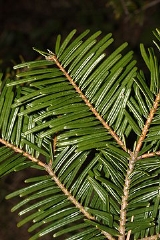
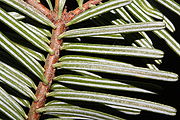
are needle-like, flattened, 3-6 cm long and 2 mm wide by 0.5 mm thick, glossy dark green above, and with two green-white bands of stomata below, and slightly notched at the tip. The leaf arrangement is spiral on the shoot, but with each leaf variably twisted at the base so they all lie in two more-or-less flat ranks on either side of the shoot. The leaf arrangement is spiral on the shoot, but with each leaf variably twisted at the base so they all lie in two more-or-less flat ranks on either side of the shoot. The cones
are 6–12 cm long and 3.5–4.5 cm broad, with about 100-150 scales; the scale bracts are short, and hidden in the closed cone. The winged seed
s are released when the cones disintegrate at maturity about 6 months after pollination.
, probably better treated at subspecies
rank though not yet formally published as such:
Grand Fir is very closely related to White Fir
, with the interior variety idahoensis particularly similar to the western forms of White Fir from western Oregon and California, intergrading with it where they meet in the Cascades of central Oregon.
is soft and not very strong; it is used for paper
making, packing crates and other cheap construction work. The foliage has an attractive, citrus-like scent, and is sometimes used for Christmas
decoration, including Christmas tree
s. It is also planted as an ornamental tree in large parks.
The inner bark of the grand fir was used by some Plateau Indian tribes for treating cold
s and fever
.
Fir
Firs are a genus of 48–55 species of evergreen conifers in the family Pinaceae. They are found through much of North and Central America, Europe, Asia, and North Africa, occurring in mountains over most of the range...
native to the Pacific Northwest
Pacific Northwest
The Pacific Northwest is a region in northwestern North America, bounded by the Pacific Ocean to the west and, loosely, by the Rocky Mountains on the east. Definitions of the region vary and there is no commonly agreed upon boundary, even among Pacific Northwesterners. A common concept of the...
and Northern California
Northern California
Northern California is the northern portion of the U.S. state of California. The San Francisco Bay Area , and Sacramento as well as its metropolitan area are the main population centers...
of North America
North America
North America is a continent wholly within the Northern Hemisphere and almost wholly within the Western Hemisphere. It is also considered a northern subcontinent of the Americas...
, occurring at altitudes of sea level to 1,800 m. It is a major constituent of the Grand Fir/Douglas Fir Ecoregion of the Cascade Range
Cascade Range
The Cascade Range is a major mountain range of western North America, extending from southern British Columbia through Washington and Oregon to Northern California. It includes both non-volcanic mountains, such as the North Cascades, and the notable volcanoes known as the High Cascades...
.
Description
Evergreen
In botany, an evergreen plant is a plant that has leaves in all seasons. This contrasts with deciduous plants, which completely lose their foliage during the winter or dry season.There are many different kinds of evergreen plants, both trees and shrubs...
coniferous
Pinophyta
The conifers, division Pinophyta, also known as division Coniferophyta or Coniferae, are one of 13 or 14 division level taxa within the Kingdom Plantae. Pinophytes are gymnosperms. They are cone-bearing seed plants with vascular tissue; all extant conifers are woody plants, the great majority being...
tree
Tree
A tree is a perennial woody plant. It is most often defined as a woody plant that has many secondary branches supported clear of the ground on a single main stem or trunk with clear apical dominance. A minimum height specification at maturity is cited by some authors, varying from 3 m to...
growing to 40–70 m (exceptionally 80 m) tall and with a trunk diameter of up to 2 m. The leaves
Leaf
A leaf is an organ of a vascular plant, as defined in botanical terms, and in particular in plant morphology. Foliage is a mass noun that refers to leaves as a feature of plants....
are needle-like, flattened, 3-6 cm long and 2 mm wide by 0.5 mm thick, glossy dark green above, and with two green-white bands of stomata below, and slightly notched at the tip. The leaf arrangement is spiral on the shoot, but with each leaf variably twisted at the base so they all lie in two more-or-less flat ranks on either side of the shoot. The leaf arrangement is spiral on the shoot, but with each leaf variably twisted at the base so they all lie in two more-or-less flat ranks on either side of the shoot. The cones
Conifer cone
A cone is an organ on plants in the division Pinophyta that contains the reproductive structures. The familiar woody cone is the female cone, which produces seeds. The male cones, which produce pollen, are usually herbaceous and much less conspicuous even at full maturity...
are 6–12 cm long and 3.5–4.5 cm broad, with about 100-150 scales; the scale bracts are short, and hidden in the closed cone. The winged seed
Seed
A seed is a small embryonic plant enclosed in a covering called the seed coat, usually with some stored food. It is the product of the ripened ovule of gymnosperm and angiosperm plants which occurs after fertilization and some growth within the mother plant...
s are released when the cones disintegrate at maturity about 6 months after pollination.
Varieties
There are two varietiesVariety (biology)
In botanical nomenclature, variety is a taxonomic rank below that of species: as such, it gets a three-part infraspecific name....
, probably better treated at subspecies
Subspecies
Subspecies in biological classification, is either a taxonomic rank subordinate to species, ora taxonomic unit in that rank . A subspecies cannot be recognized in isolation: a species will either be recognized as having no subspecies at all or two or more, never just one...
rank though not yet formally published as such:
- Abies grandis var. grandis. Coast Grand Fir. Coastal lowland forests, at sea level to 900 m altitude, from Vancouver IslandVancouver IslandVancouver Island is a large island in British Columbia, Canada. It is one of several North American locations named after George Vancouver, the British Royal Navy officer who explored the Pacific Northwest coast of North America between 1791 and 1794...
and coastal British ColumbiaBritish ColumbiaBritish Columbia is the westernmost of Canada's provinces and is known for its natural beauty, as reflected in its Latin motto, Splendor sine occasu . Its name was chosen by Queen Victoria in 1858...
, CanadaCanadaCanada is a North American country consisting of ten provinces and three territories. Located in the northern part of the continent, it extends from the Atlantic Ocean in the east to the Pacific Ocean in the west, and northward into the Arctic Ocean...
, south to Sonoma County, CaliforniaSonoma County, CaliforniaSonoma County, located on the northern coast of the U.S. state of California, is the largest and northernmost of the nine San Francisco Bay Area counties. Its population at the 2010 census was 483,878. Its largest city and county seat is Santa Rosa....
, United StatesUnited StatesThe United States of America is a federal constitutional republic comprising fifty states and a federal district...
. A large, very fast-growing tree to 70 m tall. Foliage strongly flattened on all shoots. Cones slightly narrower (mostly less than 4 cm broad), with thinner, fairly flexible scales. Tolerates winter temperatureTemperatureTemperature is a physical property of matter that quantitatively expresses the common notions of hot and cold. Objects of low temperature are cold, while various degrees of higher temperatures are referred to as warm or hot...
s down to about -25° to -30°C; growth on good sites may exceed 1.5 m per year when young. - Abies grandis var. idahoensis. Interior Grand Fir. Interior forests, at (600–) 900–1800 m altitude, on the east slope of the Cascades in Washington and northern OregonOregonOregon is a state in the Pacific Northwest region of the United States. It is located on the Pacific coast, with Washington to the north, California to the south, Nevada on the southeast and Idaho to the east. The Columbia and Snake rivers delineate much of Oregon's northern and eastern...
and in the Rocky MountainsRocky MountainsThe Rocky Mountains are a major mountain range in western North America. The Rocky Mountains stretch more than from the northernmost part of British Columbia, in western Canada, to New Mexico, in the southwestern United States...
from southeast British ColumbiaBritish ColumbiaBritish Columbia is the westernmost of Canada's provinces and is known for its natural beauty, as reflected in its Latin motto, Splendor sine occasu . Its name was chosen by Queen Victoria in 1858...
south to central IdahoIdahoIdaho is a state in the Rocky Mountain area of the United States. The state's largest city and capital is Boise. Residents are called "Idahoans". Idaho was admitted to the Union on July 3, 1890, as the 43rd state....
, northeast OregonOregonOregon is a state in the Pacific Northwest region of the United States. It is located on the Pacific coast, with Washington to the north, California to the south, Nevada on the southeast and Idaho to the east. The Columbia and Snake rivers delineate much of Oregon's northern and eastern...
and western MontanaMontanaMontana is a state in the Western United States. The western third of Montana contains numerous mountain ranges. Smaller, "island ranges" are found in the central third of the state, for a total of 77 named ranges of the Rocky Mountains. This geographical fact is reflected in the state's name,...
. A smaller, slow-growing tree to 40–45 m tall. Foliage not strongly flattened on all shoots, the leaves often raised above the shoot, particularly on upper crown shoots. Cones slightly stouter (mostly over 4 cm broad), with thicker, slightly woody scales. Tolerates winter temperatures down to about -40°C; growth on good sites not exceeding 0.6 m per year even when young.
Grand Fir is very closely related to White Fir
White Fir
White Fir is a fir native to the mountains of western North America, occurring at altitudes of 900-3,400 m. It is a medium to large evergreen coniferous tree growing to 25–60 m tall and with a trunk diameter of up to 2 m . It is popular as an ornamental landscaping tree and as a Christmas Tree...
, with the interior variety idahoensis particularly similar to the western forms of White Fir from western Oregon and California, intergrading with it where they meet in the Cascades of central Oregon.
Uses
Grand Fir woodWood
Wood is a hard, fibrous tissue found in many trees. It has been used for hundreds of thousands of years for both fuel and as a construction material. It is an organic material, a natural composite of cellulose fibers embedded in a matrix of lignin which resists compression...
is soft and not very strong; it is used for paper
Paper
Paper is a thin material mainly used for writing upon, printing upon, drawing or for packaging. It is produced by pressing together moist fibers, typically cellulose pulp derived from wood, rags or grasses, and drying them into flexible sheets....
making, packing crates and other cheap construction work. The foliage has an attractive, citrus-like scent, and is sometimes used for Christmas
Christmas
Christmas or Christmas Day is an annual holiday generally celebrated on December 25 by billions of people around the world. It is a Christian feast that commemorates the birth of Jesus Christ, liturgically closing the Advent season and initiating the season of Christmastide, which lasts twelve days...
decoration, including Christmas tree
Christmas tree
The Christmas tree is a decorated evergreen coniferous tree, real or artificial, and a tradition associated with the celebration of Christmas. The tradition of decorating an evergreen tree at Christmas started in Livonia and Germany in the 16th century...
s. It is also planted as an ornamental tree in large parks.
The inner bark of the grand fir was used by some Plateau Indian tribes for treating cold
Common cold
The common cold is a viral infectious disease of the upper respiratory system, caused primarily by rhinoviruses and coronaviruses. Common symptoms include a cough, sore throat, runny nose, and fever...
s and fever
Fever
Fever is a common medical sign characterized by an elevation of temperature above the normal range of due to an increase in the body temperature regulatory set-point. This increase in set-point triggers increased muscle tone and shivering.As a person's temperature increases, there is, in...
.