


Glasgow Subway

Encyclopedia
The Glasgow Subway is an underground metro
line in Glasgow
, Scotland. Opened on 14 December 1896, it is the third-oldest underground metro system in the world after the London Underground
and the Budapest Metro
. Formerly a cable railway
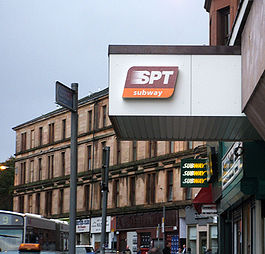
, the Subway was later electrified, but its twin circular lines were never expanded. The line was originally known as the Glasgow District Subway, but for legal reasons was renamed Glasgow Subway Railway. It was so called when taken over by the Corporation who renamed it the Glasgow Underground in 1936. Despite this rebranding, many Glaswegians resolutely continued to refer to the network as "the Subway". In 2003 the name "Subway" was officially readopted by its operator, the Strathclyde Partnership for Transport
(SPT). A £40,000 study examining the feasibility of an expansion into the city’s south side is in progress.
The system is not the oldest underground railway in Glasgow; that distinction belongs to a 5 km (3.1 mi) section of the Glasgow City and District Railway
opened in 1863, now part of the North Clyde Line
of the suburban railway network, which runs in a sub-surface tunnel under the city centre between High Street and west of Charing Cross
. Another major section of underground suburban railway line in Glasgow is the Argyle Line
, which was formerly part of the Glasgow Central Railway
.
. The tracks have the unusual narrow gauge of , and a nominal tunnel
diameter of 11 feet (3.35 m), even smaller than that of the deep-level lines of the London Underground
(11 foot at their smallest); the rolling stock is considerably smaller.
There are two adjacent lines, the Outer Circle and Inner Circle, which have trains running clockwise and anticlockwise respectively around the same route although in separate tunnels. Stations on the Glasgow Subway use a variety of platform layouts including single island platforms, opposing side platforms and in some stations such as Hillhead one side and one island platform.
The subway’s running lines are entirely underground, but the maintenance depot at Broomloan Road (located between the Govan
and Ibrox stations) is above ground, as was the earlier depot, also at Govan. Prior to modernisation, trains used to be hoisted by crane onto and off the tracks. Modernisation brought the installation of points and a ramp between Govan and Ibrox where trains can exit the tunnel system to terminate for engineering, cleaning or storage.
The system is owned and operated by the Strathclyde Partnership for Transport
(SPT), formerly Strathclyde Passenger Transport, and carried 13.16 million passengers in the period 2005/06. The Subway has been policed by British Transport Police
since 2007.
's Circle Line until 2009 when that route was extended onto the Hammersmith & City Line
.
system, with one cable for each direction. The cable was driven from a steam-powered plant between West Street
and Shields Road
stations. There was no additional cable to allow trains to reach the depot; instead, they were transferred to and from the running lines by crane
operating over a pit at the Govan workshops. This also meant that the two tracks could be completely separate, with no points
anywhere. The company's headquarters were in the upper rooms at St Enoch subway station
; this distinctive ornate building still stands in St Enoch Square and was subsequently used as a travel information office by SPT and is now a coffee shop.
When the Subway first opened, single-carriage four axle (twin truck)trains were operated. An accident on the opening day entailed the closure of the Subway until 19 January 1897. The 20 original wooden bodied carriages were built by the Oldbury Railway Carriage and Wagon Company, of Oldbury
, Worcestershire
. Many continued in service until 1977 in an upgraded form. A further 10 were delivered by the same manufacturer in 1897. From 1898, second four axle (trailer) carriages without a cable gripper mechanism were added, though they were considerably shorter than the front (gripper) carriage. These additional carriages, eventually numbering 30, were built by Hurst Nelson & Company
, Motherwell, Lanarkshire. These carriages were soon expanded to match the length of the front carriages, although carriage 41T has been restored to its original length and cut longitudinally and can be seen preserved at Buchanan Street subway station
and No39T in preserved in the Riverside Museum . Most of the gripper carriages were subsequently converted to electric traction in 1935. All carriages were originally built with lattice gates (instead of doors) at the ends; many were converted to air-operated sliding doors in the 1960s, but a few retained the gates until 1977.
All 15 stations were built with island platform
s. The trains were thus built with doors on one side only. Power for the electric lighting in the trains was supplied by two parallel wall-mounted rails
(known as "T-irons") at window level on the non-platform side of the trains; trains were originally equipped with wheels to pick up the electricity but changed to skids at electrification. . The trains remained cable-hauled until 1935, though the anachronistic way of supplying power for the lighting continued until 1977. The lighting circuit was also part of the operation of the signalling system.
Glasgow Corporation took over the company in 1923. In 1935, the existing trains were converted to electric power delivered by a third rail
at 600 volt
s, direct current. From March until December 1935, clockwise trains were cable-hauled, whilst anti-clockwise ones were electric. The trains lost their original plum and cream-coloured liveries, being painted red and white instead. From the 1950s the trains became all red — in a shade similar to that of London buses
. During the early 1970s, trailer carriage number 41 was repainted in the original 1896 livery.
After the Beeching Axe
of the 1960s, both St Enoch
and Buchanan Street
mainline stations were closed and demolished, However there was no direct connection between the underground and mainline stations of Buchanan Street as they were over 0.5 km distant. The Subway had had no direct passenger connection to the national railway network — a major weakness — although Buchanan Street and Merkland Street stations were a short walk from Queen Street and Partickhill British Rail stations respectively.
Before the 1977–1980 modernisation, the stations had a distinctive earthy odour. The trains (mostly dating back to 1896) were always formed with two carriages — the front (motor) carriage with red leather seats and the rear (trailer) carriage with brown leather seats. Smoking
was permitted in the rear carriage only. The backs of the seats were attached to the sides of the carriages, which moved semi-independently from the floor (to which the seats themselves were attached); passengers were rocked forwards and backwards while the carriage 'shoogled' them around. Passengers always entered at the middle of the train ("Q[ueue] Here" signs were painted on the platforms), leaving by the front door of the front carriage or the rear door of the rear carriage.
By the 1970s, the stations were very dilapidated. Stations were marked with circular signs often attached to lampposts. This sign had a white background in the top three quarters (containing a large red letter "U") and black in the bottom quarter (containing the word "UNDERGROUND" and an arrow to the station entrance). No station had an escalator
; Kelvinbridge
had a lift
. Each station had a ticket office (often very small, little more than a booth with a window). The ticketing system was identical to that of most cinemas of the era, with tickets emerging from slots in the counters of the station ticket offices (the words "Control Systems Ltd" or "Automaticket Ltd" were printed on all tickets). Tickets were invariably collected on leaving the train. Until 1977, the staff wore dark green uniforms, with black braid on the cuffs, which had been introduced at the time of the funeral of Queen Victoria in 1901.
Glasgow’s Museum of Transport has an area dedicated to the subway, with models showing the operation of the clutch-and-cable system, as well as a full-scale replica of part of a subway station, complete with different rolling stock of the pre-modernisation era.
s south of the River Clyde. The original carriages, mostly dating back to 1896, were still in use, though adapted for electric traction in 1935. Breakdowns were becoming increasingly frequent; because trains could only be removed from the tracks to the depot by crane, a single inoperable train could cause major delays. The future of the Subway became a major issue for the Greater Glasgow Passenger Transport Executive
, which took over responsibility for the line from Glasgow Corporation in the late 1960s.
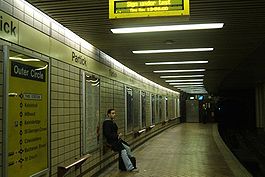 On 24 March 1977, cracks were noticed in the roof of Govan Cross station, leading to suspension of services until 2 May. The service resumed with only four trains per circle. On 21 May 1977, the system was shut down eight days prematurely for a major refurbishment and modernisation; the date was brought forward because of the appearance of more cracks in the roof of Govan Cross (now Govan) station. Badly deteriorated tunnels were repaired; stations were rebuilt and enlarged, with additional platforms at Buchanan Street, Partick, Govan, Ibrox, Hillhead, and St Enoch. The entrance to Kelvinbridge was reversed, with a new entrance and car park built at South Woodside Road, an escalator to Great Western Road, and stairs down to the west end of the platform; the former entrance and stairway at the east end became an emergency exit, and the lift was withdrawn from service. Merkland Street station was closed; a new station to the north was built at Partick
to provide an interchange with the
North Clyde
suburban rail system. The site of the former Merkland Street subway station can be noticed by the characteristic hump and the larger-diameter tunnel with both tracks. Many fittings from Merkland Street were used to build a replica pre-modernisation station at the Glasgow Museum of Transport, containing three preserved cars.
A further interchange via moving walkway was installed between Buchanan Street station and Queen Street
mainline station as part of the modernisation.
In August 1977, all redundant fittings and equipment from the old system were sold at a public sale at Broomloan Works. During the 1977–1980 modernisation, two Clayton battery locomotives were used by the contractors Taylor Woodrow
to haul construction trains. The locomotives were nicknamed Roger and Claus, the latter allegedly because of its habit of bringing unwelcome "presents" and surprises through reliability problems.
 Heavier track was installed (although still at the unique, gauge), the original Broomloan Depot was modernised and equipped with connecting tracks (with points) to replace the crane transfer, and a new electrical supply from Westinghouse Electric Corporation was installed. A new ticketing system, provided by Crouzet
, with passenger-operated ticket vending machines and automatic turnstile
barriers, replaced the old, perforated cinema-style tickets and conductors
. The post-1980 yellow tickets have since been replaced by a newer system, issuing magnetic stripe card
tickets.
on 1 November 1979. However, rebuilding work was still incomplete, and the line did not reopen to passengers until 16 April 1980. Thirty-three new carriages were built by Metro Cammell
at its Washwood Heath
works in Birmingham
, and equipped with GEC electric motors. The exterior design of the trains was carried out in partnership with Glasgow School of Art
, which, according to SPT publicity films of the day, was largely responsible for the trains' "cute" appearance. Eight additional centre-trailer carriages were built in 1992 (the body shells by Hunslet Gyro Mining Transport Ltd in Leeds
for completion by Hunslet-Barclay Ltd
in Kilmarnock
), making all trains three carriages long. Smoking has never been permitted on the modernised system.
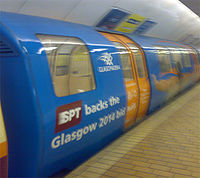
A new corporate identity was introduced (following contemporary fashions of the 1970s), with trains painted bright orange, stations largely rebuilt with dark brown bricks, orange-yellow wall tiles and other surfaces in off-white, plus brown uniforms for the staff. Large, illuminated orange "U" signs were placed at station entrances (since removed, with the re-adoption of the name "Subway"). Since the 1990s, ongoing renovation work has resulted in most stations adopting individual colour schemes. The trains' initial orange livery of 1980 (with a white stripe) was soon replaced by a darker, more durable shade of orange, itself now being replaced by SPT's latest carmine-red and cream livery.
The system was resignalled using Virtual Processor Interlocking in 1996 and subsequently an upgraded Supervisory & Control System was installed.
 The system is unusual compared to other metro systems, as it has never been expanded from its original route in more than 100 years, although ambitious plans were unveiled during 2005. Many schemes for extending the system have been proposed, but none has come to fruition, owing to the cost of providing additional custom made rolling stock, and technical problems — tunnelling beneath the city is difficult owing to its geology, which is composed of solid rock and abandoned mineshafts, making underground construction hazardous and expensive.
In early 2005, SPT announced that they would employ consultants to look into extending the system in the West End, East End, South Side and Glasgow Harbour areas of the city. The extension will take advantage of existing unused tunnels underneath the city, and there is a possibility that roads will be dug up to install tunnels before being replaced and resurfaced (cut-and-cover tunnelling). The plans are expected to take twelve years to come to fruition. In the meantime, there are plans to replace the fleet of trains. New electronic destination signs were installed in the stations in 2008.
The trains themselves are undergoing a minor refurbishment which is being carried out by Alstom
(the successor company to Metro Cammell, the original manufacturer of the trains) at its St. Rollox railway works
works in Springburn
, although they will be expected to be life expired within the next 10–15 years.
As of 2007, the Partick station modernisation project is underway, which will result in a complete redevelopment at the station, which hosts a rail station, a subway station and a bus terminal on the outside.
Should the Crossrail Glasgow project be approved, then West Street station
will be redeveloped as an interchange between the new surface railway and the Subway. This was projected to have been completed by 2010, but has yet to begin. This is probably due to funding not being made available.
On 14 March 2007, SPT announced the plans that the consultants have recommended. These include major refurbishment of the existing rolling stock and stations, at an overall cost of £270million. The expansion of the existing network is also considered at a cost of £2.3billion, including a new East End Circle, with seven new stations at St. Mungo's
, Onslow
, Duke Street
, Celtic Park
, Dalmarnock
, Newhall
and Gorbals
. The aim is to improve transport links in an area of the city which is currently poorly served by rail, in the hope that this will aid regeneration, and the city's 2014 Commonwealth Games
bid. This circle would interchange at Cowcaddens
, Buchanan Street
and St Enoch
. Other proposals include extending the system southwards to Cathcart
and further westwards to the SECC
and Maryhill
using an older railway line.
In January 2009 there was an increase in ticket prices to £1.20 for a single and £2.40 for a return.
All tickets are bought at any station either through a machine or at the ticket office. Tickets must be placed through a machine to validate the ticket before a passenger can access the platform. Once on the train, tickets are rarely checked but SPT
advise that passengers keep their tickets with them in case of inspection.
The Zonecard
is also valid on the Subway as long as it is valid in zones G1 or G2.
Unlike the London Underground System, a ticket is not needed to exit stations.
and film A Clockwork Orange
) is subject to dispute. Some believe that it was originally coined by the media of the period, whilst others credit it to the then chairman of British Rail
, Sir Peter Parker
, who was quoted in a late 1970s publicity video of the new trains as saying "so these are the original Clockwork Orange". Most of its carriages were painted orange
(although called "Strathclyde PTE red" because "Orange
" has sectarian connotations in Glasgow
), the corporate colour of Greater Glasgow Passenger Transport Executive
at the time. Most of the units have since been replaced with a new colour scheme of carmine
and cream with a thin orange band, which will be implemented progressively throughout the fleet as cars are refurbished.
While the "Clockwork Orange" nickname is often used in tourist guidebooks and local literature, it is virtually unused by locals, who will refer to the system simply as "the Subway" or, less commonly, "the Underground".
composed a satirical song about the pre-modernisation era Subway entitled "The Underground Song". It was popular as a stage piece performed by the comedians Rikki Fulton
and Jack Milroy
in their Francie and Josie
act.
known as the Subcrawl. Participants buy an all day Discovery ticket, disembark at each of the 15 stations and have a drink in the nearest bar. Two of the stations (West Street and Shields Road) are not very near a pub or bar; however, Subcrawls are popular amongst young Glaswegians and especially students at the city's universities. During the journey between stations, participants are usually required to stand in the train and not hold onto any supports, known as Subsurfing. A subcrawl usually takes a whole day, and completing a crawl (drinking in the same pub you started in) is regarded as quite an achievement.
Rapid transit
A rapid transit, underground, subway, elevated railway, metro or metropolitan railway system is an electric passenger railway in an urban area with a high capacity and frequency, and grade separation from other traffic. Rapid transit systems are typically located either in underground tunnels or on...
line in Glasgow
Glasgow
Glasgow is the largest city in Scotland and third most populous in the United Kingdom. The city is situated on the River Clyde in the country's west central lowlands...
, Scotland. Opened on 14 December 1896, it is the third-oldest underground metro system in the world after the London Underground
London Underground
The London Underground is a rapid transit system serving a large part of Greater London and some parts of Buckinghamshire, Hertfordshire and Essex in England...
and the Budapest Metro
Budapest Metro
The Budapest Metro is the rapid transit system in the Hungarian capital Budapest. It is the second-oldest underground metro system in the world after the London Underground. Its iconic Line 1, dating from 1896, was declared a World Heritage Site in 2002.-Lines:The Metro consists of three lines,...
. Formerly a cable railway
Cable railway
A cable railway is a steeply graded railway that uses a cable or rope to haul trains.-Introduction:...
, the Subway was later electrified, but its twin circular lines were never expanded. The line was originally known as the Glasgow District Subway, but for legal reasons was renamed Glasgow Subway Railway. It was so called when taken over by the Corporation who renamed it the Glasgow Underground in 1936. Despite this rebranding, many Glaswegians resolutely continued to refer to the network as "the Subway". In 2003 the name "Subway" was officially readopted by its operator, the Strathclyde Partnership for Transport
Strathclyde Partnership for Transport
The Strathclyde Partnership for Transport is a public body which is responsible for planning and co-ordinating regional transport, and especially the public transport system, in the Strathclyde area of western Scotland...
(SPT). A £40,000 study examining the feasibility of an expansion into the city’s south side is in progress.
The system is not the oldest underground railway in Glasgow; that distinction belongs to a 5 km (3.1 mi) section of the Glasgow City and District Railway
Glasgow City and District Railway
The Glasgow City and District Railway is a railway line in Glasgow, Scotland. With the exception of a short spur to Bridgeton Central, that closed in 1979 upon the opening of the Argyle Line, the line is still open to passenger trains....
opened in 1863, now part of the North Clyde Line
North Clyde Line
The North Clyde Line is a suburban railway in West Central Scotland. The route is operated by First ScotRail, on behalf of Transport Scotland...
of the suburban railway network, which runs in a sub-surface tunnel under the city centre between High Street and west of Charing Cross
Charing Cross, Glasgow
Charing Cross is a major road junction in the Scottish city of Glasgow. It is situated north of the River Clyde on Sauchiehall Street, at a major interchange of the M8 motorway. Formerly the gateway from the shopping area of Sauchiehall Street to the more prosperous Woodlands area, its...
. Another major section of underground suburban railway line in Glasgow is the Argyle Line
Argyle Line
The Argyle Line is a suburban railway located in West Central Scotland. It connects the Lanarkshire towns of Lanark, Larkhall and Motherwell to West Dunbartonshire via central Glasgow using sub-surface running...
, which was formerly part of the Glasgow Central Railway
Glasgow Central Railway
The Glasgow Central Railway was a railway that ran from Maryhill in the north west of Glasgow through the West End and City Centre to Rutherglen and Newton to the south east of the city.- Early days :...
.
Route
The route is a loop almost 6.5 miles (10.5 km) long and extends both north and south of the River ClydeRiver Clyde
The River Clyde is a major river in Scotland. It is the ninth longest river in the United Kingdom, and the third longest in Scotland. Flowing through the major city of Glasgow, it was an important river for shipbuilding and trade in the British Empire....
. The tracks have the unusual narrow gauge of , and a nominal tunnel
Tunnel
A tunnel is an underground passageway, completely enclosed except for openings for egress, commonly at each end.A tunnel may be for foot or vehicular road traffic, for rail traffic, or for a canal. Some tunnels are aqueducts to supply water for consumption or for hydroelectric stations or are sewers...
diameter of 11 feet (3.35 m), even smaller than that of the deep-level lines of the London Underground
London Underground
The London Underground is a rapid transit system serving a large part of Greater London and some parts of Buckinghamshire, Hertfordshire and Essex in England...
(11 foot at their smallest); the rolling stock is considerably smaller.
There are two adjacent lines, the Outer Circle and Inner Circle, which have trains running clockwise and anticlockwise respectively around the same route although in separate tunnels. Stations on the Glasgow Subway use a variety of platform layouts including single island platforms, opposing side platforms and in some stations such as Hillhead one side and one island platform.
The subway’s running lines are entirely underground, but the maintenance depot at Broomloan Road (located between the Govan
Govan
Govan is a district and former burgh now part of southwest City of Glasgow, Scotland. It is situated west of Glasgow city centre, on the south bank of the River Clyde, opposite the mouth of the River Kelvin and the district of Partick....
and Ibrox stations) is above ground, as was the earlier depot, also at Govan. Prior to modernisation, trains used to be hoisted by crane onto and off the tracks. Modernisation brought the installation of points and a ramp between Govan and Ibrox where trains can exit the tunnel system to terminate for engineering, cleaning or storage.
The system is owned and operated by the Strathclyde Partnership for Transport
Strathclyde Partnership for Transport
The Strathclyde Partnership for Transport is a public body which is responsible for planning and co-ordinating regional transport, and especially the public transport system, in the Strathclyde area of western Scotland...
(SPT), formerly Strathclyde Passenger Transport, and carried 13.16 million passengers in the period 2005/06. The Subway has been policed by British Transport Police
British Transport Police
The British Transport Police is a special police force that polices those railways and light-rail systems in Great Britain for which it has entered into an agreement to provide such services...
since 2007.
Orbital routes
Orbital routes have an intrinsic timetabling robustness problem. The trains are constantly "in orbit" so there is little scope for "recovery time" if they are delayed. A single delay can have a long lasting knock on effect and be much more disruptive than on a non-orbital railway. Recovery time can be created by timetabling for longer stops at some stations but this increases journey times and reduces train frequency. A similar problem was also seen on the London UndergroundLondon Underground
The London Underground is a rapid transit system serving a large part of Greater London and some parts of Buckinghamshire, Hertfordshire and Essex in England...
's Circle Line until 2009 when that route was extended onto the Hammersmith & City Line
Hammersmith & City Line
The Hammersmith & City line is a subsurface London Underground line. It connects Hammersmith in the west with Barking in the east, running through the northern part of central London. It is coloured salmon pink on the Tube map...
.
1896–1977
As built and opened on 14 December 1896 by the Glasgow District Subway Company, the subway was powered by a clutch-and-cableCable car (railway)
A cable car or cable railway is a mass transit system using rail cars that are hauled by a continuously moving cable running at a constant speed. Individual cars stop and start by releasing and gripping this cable as required...
system, with one cable for each direction. The cable was driven from a steam-powered plant between West Street
West Street subway station
West Street subway station serves the Tradeston area of Glasgow, Scotland. The station will become a major interchange if the Glasgow Crossrail is given the green light....
and Shields Road
Shields Road subway station
Shields Road subway station is a station of Glasgow Subway, serving the Pollokshields areas of Glasgow, Scotland. Nearby is Charles Rennie Mackintosh's Scotland Street School Museum...
stations. There was no additional cable to allow trains to reach the depot; instead, they were transferred to and from the running lines by crane
Crane (machine)
A crane is a type of machine, generally equipped with a hoist, wire ropes or chains, and sheaves, that can be used both to lift and lower materials and to move them horizontally. It uses one or more simple machines to create mechanical advantage and thus move loads beyond the normal capability of...
operating over a pit at the Govan workshops. This also meant that the two tracks could be completely separate, with no points
Railroad switch
A railroad switch, turnout or [set of] points is a mechanical installation enabling railway trains to be guided from one track to another at a railway junction....
anywhere. The company's headquarters were in the upper rooms at St Enoch subway station
St Enoch subway station
St Enoch subway station is the first station on the north of the River Clyde on the Glasgow Subway. It is located in Glasgow city centre, Scotland...
; this distinctive ornate building still stands in St Enoch Square and was subsequently used as a travel information office by SPT and is now a coffee shop.
When the Subway first opened, single-carriage four axle (twin truck)trains were operated. An accident on the opening day entailed the closure of the Subway until 19 January 1897. The 20 original wooden bodied carriages were built by the Oldbury Railway Carriage and Wagon Company, of Oldbury
Oldbury, West Midlands
Oldbury is a town in the West Midlands in England. It is a part of the Black Country and the administrative centre of the borough of Sandwell.-Local government:...
, Worcestershire
Worcestershire
Worcestershire is a non-metropolitan county, established in antiquity, located in the West Midlands region of England. For Eurostat purposes it is a NUTS 3 region and is one of three counties that comprise the "Herefordshire, Worcestershire and Warwickshire" NUTS 2 region...
. Many continued in service until 1977 in an upgraded form. A further 10 were delivered by the same manufacturer in 1897. From 1898, second four axle (trailer) carriages without a cable gripper mechanism were added, though they were considerably shorter than the front (gripper) carriage. These additional carriages, eventually numbering 30, were built by Hurst Nelson & Company
Hurst Nelson
Hurst, Nelson and Company Ltd was a railway rolling stock manufacturer based in Motherwell, Scotland. The company also built many railway wagons, as well as trams for several local authorities.-Products:...
, Motherwell, Lanarkshire. These carriages were soon expanded to match the length of the front carriages, although carriage 41T has been restored to its original length and cut longitudinally and can be seen preserved at Buchanan Street subway station
Buchanan Street subway station
Buchanan Street subway station is a station on the Glasgow Subway in Scotland. It serves Buchanan Street, which is popular with shoppers. Close to Buchanan Bus Station and providing interchange with Glasgow Queen Street railway station via a travelator, it is the busiest station on the Subway, with...
and No39T in preserved in the Riverside Museum . Most of the gripper carriages were subsequently converted to electric traction in 1935. All carriages were originally built with lattice gates (instead of doors) at the ends; many were converted to air-operated sliding doors in the 1960s, but a few retained the gates until 1977.
All 15 stations were built with island platform
Island platform
An island platform is a station layout arrangement where a single platform is positioned between two tracks within a railway station, tram stop or transitway interchange...
s. The trains were thus built with doors on one side only. Power for the electric lighting in the trains was supplied by two parallel wall-mounted rails
Busbar
In electrical power distribution, a bus bar is a strip of copper or aluminium that conducts electricity within a switchboard, distribution board, substation or other electrical apparatus....
(known as "T-irons") at window level on the non-platform side of the trains; trains were originally equipped with wheels to pick up the electricity but changed to skids at electrification. . The trains remained cable-hauled until 1935, though the anachronistic way of supplying power for the lighting continued until 1977. The lighting circuit was also part of the operation of the signalling system.
Glasgow Corporation took over the company in 1923. In 1935, the existing trains were converted to electric power delivered by a third rail
Third rail
A third rail is a method of providing electric power to a railway train, through a semi-continuous rigid conductor placed alongside or between the rails of a railway track. It is used typically in a mass transit or rapid transit system, which has alignments in its own corridors, fully or almost...
at 600 volt
Volt
The volt is the SI derived unit for electric potential, electric potential difference, and electromotive force. The volt is named in honor of the Italian physicist Alessandro Volta , who invented the voltaic pile, possibly the first chemical battery.- Definition :A single volt is defined as the...
s, direct current. From March until December 1935, clockwise trains were cable-hauled, whilst anti-clockwise ones were electric. The trains lost their original plum and cream-coloured liveries, being painted red and white instead. From the 1950s the trains became all red — in a shade similar to that of London buses
London Buses
London Buses is the subsidiary of Transport for London that manages bus services within Greater London, UK. Buses are required to carry similar red colour schemes and conform to the same fare scheme...
. During the early 1970s, trailer carriage number 41 was repainted in the original 1896 livery.
After the Beeching Axe
Beeching Axe
The Beeching Axe or the Beeching Cuts are informal names for the British Government's attempt in the 1960s to reduce the cost of running British Railways, the nationalised railway system in the United Kingdom. The name is that of the main author of The Reshaping of British Railways, Dr Richard...
of the 1960s, both St Enoch
St Enoch railway station
-External links:* *...
and Buchanan Street
Buchanan Street railway station
Buchanan Street Station was the least known of Glasgow's four main terminal railway stations, the other three being Central, Queen St and St Enoch...
mainline stations were closed and demolished, However there was no direct connection between the underground and mainline stations of Buchanan Street as they were over 0.5 km distant. The Subway had had no direct passenger connection to the national railway network — a major weakness — although Buchanan Street and Merkland Street stations were a short walk from Queen Street and Partickhill British Rail stations respectively.
Before the 1977–1980 modernisation, the stations had a distinctive earthy odour. The trains (mostly dating back to 1896) were always formed with two carriages — the front (motor) carriage with red leather seats and the rear (trailer) carriage with brown leather seats. Smoking
Tobacco smoking
Tobacco smoking is the practice where tobacco is burned and the resulting smoke is inhaled. The practice may have begun as early as 5000–3000 BCE. Tobacco was introduced to Eurasia in the late 16th century where it followed common trade routes...
was permitted in the rear carriage only. The backs of the seats were attached to the sides of the carriages, which moved semi-independently from the floor (to which the seats themselves were attached); passengers were rocked forwards and backwards while the carriage 'shoogled' them around. Passengers always entered at the middle of the train ("Q[ueue] Here" signs were painted on the platforms), leaving by the front door of the front carriage or the rear door of the rear carriage.
By the 1970s, the stations were very dilapidated. Stations were marked with circular signs often attached to lampposts. This sign had a white background in the top three quarters (containing a large red letter "U") and black in the bottom quarter (containing the word "UNDERGROUND" and an arrow to the station entrance). No station had an escalator
Escalator
An escalator is a moving staircase – a conveyor transport device for carrying people between floors of a building. The device consists of a motor-driven chain of individual, linked steps that move up or down on tracks, allowing the step treads to remain horizontal.Escalators are used around the...
; Kelvinbridge
Kelvinbridge subway station
Kelvinbridge subway station serves the Woodlands, Woodside and Hillhead areas of Glasgow, Scotland. It is named after the bridge crossing the River Kelvin, next to the station...
had a lift
Elevator
An elevator is a type of vertical transport equipment that efficiently moves people or goods between floors of a building, vessel or other structures...
. Each station had a ticket office (often very small, little more than a booth with a window). The ticketing system was identical to that of most cinemas of the era, with tickets emerging from slots in the counters of the station ticket offices (the words "Control Systems Ltd" or "Automaticket Ltd" were printed on all tickets). Tickets were invariably collected on leaving the train. Until 1977, the staff wore dark green uniforms, with black braid on the cuffs, which had been introduced at the time of the funeral of Queen Victoria in 1901.
Glasgow’s Museum of Transport has an area dedicated to the subway, with models showing the operation of the clutch-and-cable system, as well as a full-scale replica of part of a subway station, complete with different rolling stock of the pre-modernisation era.
Modernisation (1977–1980)
By the 1970s, use of the Subway had declined significantly. This was caused partly by the closure of some of the dockyards and by widescale demolition of tenementTenement
A tenement is, in most English-speaking areas, a substandard multi-family dwelling, usually old, occupied by the poor.-History:Originally the term tenement referred to tenancy and therefore to any rented accommodation...
s south of the River Clyde. The original carriages, mostly dating back to 1896, were still in use, though adapted for electric traction in 1935. Breakdowns were becoming increasingly frequent; because trains could only be removed from the tracks to the depot by crane, a single inoperable train could cause major delays. The future of the Subway became a major issue for the Greater Glasgow Passenger Transport Executive
Strathclyde Partnership for Transport
The Strathclyde Partnership for Transport is a public body which is responsible for planning and co-ordinating regional transport, and especially the public transport system, in the Strathclyde area of western Scotland...
, which took over responsibility for the line from Glasgow Corporation in the late 1960s.
Partick
Partick is an area of Glasgow on the north bank of the River Clyde, just across from Govan. To the west lies Whiteinch. Partick was a Police burgh from 1852 until 1912 when it was incorporated into the city.-History:...
to provide an interchange with the
North Clyde
North Clyde Line
The North Clyde Line is a suburban railway in West Central Scotland. The route is operated by First ScotRail, on behalf of Transport Scotland...
suburban rail system. The site of the former Merkland Street subway station can be noticed by the characteristic hump and the larger-diameter tunnel with both tracks. Many fittings from Merkland Street were used to build a replica pre-modernisation station at the Glasgow Museum of Transport, containing three preserved cars.
A further interchange via moving walkway was installed between Buchanan Street station and Queen Street
Glasgow Queen Street railway station
Glasgow Queen Street is a railway station in Glasgow, Scotland, the smaller of the city's two main line railway termini and the third-busiest station in Scotland. It is between George Street to the south and Cathedral Street Bridge to the north, at the northern end of Queen Street adjacent to...
mainline station as part of the modernisation.
In August 1977, all redundant fittings and equipment from the old system were sold at a public sale at Broomloan Works. During the 1977–1980 modernisation, two Clayton battery locomotives were used by the contractors Taylor Woodrow
Taylor Woodrow
Taylor Woodrow was one of the largest British housebuilding and general construction companies. It was listed on the London Stock Exchange and was once a constituent of the FTSE 100 Index but merged with rival George Wimpey to create Taylor Wimpey on 3 July 2007.-Early years:Frank Taylor was...
to haul construction trains. The locomotives were nicknamed Roger and Claus, the latter allegedly because of its habit of bringing unwelcome "presents" and surprises through reliability problems.
Crouzet
Crouzet is a brand of Custom Sensors and Technologies . The company was founded in 1921, and is involved in the field of electronic, electromechanical and magnetic technologies, Crouzet addresses the full spectrum of automation functions, including sensing, monitoring, actuating, processing and...
, with passenger-operated ticket vending machines and automatic turnstile
Turnstile
A turnstile, also called a baffle gate, is a form of gate which allows one person to pass at a time. It can also be made so as to enforce one-way traffic of people, and in addition, it can restrict passage only to people who insert a coin, a ticket, a pass, or similar...
barriers, replaced the old, perforated cinema-style tickets and conductors
Conductor (transportation)
A conductor is a member of a railway train's crew that is responsible for operational and safety duties that do not involve the actual operation of the train. The title of conductor is most associated with railway operations in North America, but the role of conductor is common to railways...
. The post-1980 yellow tickets have since been replaced by a newer system, issuing magnetic stripe card
Magnetic stripe card
A magnetic stripe card is a type of card capable of storing data by modifying the magnetism of tiny iron-based magnetic particles on a band of magnetic material on the card...
tickets.
Since modernisation
The line was formally reopened by Queen Elizabeth IIElizabeth II of the United Kingdom
Elizabeth II is the constitutional monarch of 16 sovereign states known as the Commonwealth realms: the United Kingdom, Canada, Australia, New Zealand, Jamaica, Barbados, the Bahamas, Grenada, Papua New Guinea, the Solomon Islands, Tuvalu, Saint Lucia, Saint Vincent and the Grenadines, Belize,...
on 1 November 1979. However, rebuilding work was still incomplete, and the line did not reopen to passengers until 16 April 1980. Thirty-three new carriages were built by Metro Cammell
Metro Cammell
The Metropolitan Cammell Carriage and Wagon Company was a Birmingham, England based manufacturer of railway carriages and wagons, based in Saltley and subsequently Washwood Heath....
at its Washwood Heath
Washwood Heath
Washwood Heath is a ward in Birmingham, within the formal district of Hodge Hill, roughly two miles north-east of Birmingham city centre, England...
works in Birmingham
Birmingham
Birmingham is a city and metropolitan borough in the West Midlands of England. It is the most populous British city outside the capital London, with a population of 1,036,900 , and lies at the heart of the West Midlands conurbation, the second most populous urban area in the United Kingdom with a...
, and equipped with GEC electric motors. The exterior design of the trains was carried out in partnership with Glasgow School of Art
Glasgow School of Art
Glasgow School of Art is one of only two independent art schools in Scotland, situated in the Garnethill area of Glasgow.-History:It was founded in 1845 as the Glasgow Government School of Design. In 1853, it changed its name to The Glasgow School of Art. Initially it was located at 12 Ingram...
, which, according to SPT publicity films of the day, was largely responsible for the trains' "cute" appearance. Eight additional centre-trailer carriages were built in 1992 (the body shells by Hunslet Gyro Mining Transport Ltd in Leeds
Leeds
Leeds is a city and metropolitan borough in West Yorkshire, England. In 2001 Leeds' main urban subdivision had a population of 443,247, while the entire city has a population of 798,800 , making it the 30th-most populous city in the European Union.Leeds is the cultural, financial and commercial...
for completion by Hunslet-Barclay Ltd
Hunslet Engine Company
The Hunslet Engine Company is a British locomotive-building company founded in 1864 at Jack Lane, Hunslet, Leeds, West Yorkshire, England by John Towlerton Leather, a civil engineering contractor, who appointed James Campbell as his Works Manager.In 1871, James Campbell bought the company for...
in Kilmarnock
Kilmarnock
Kilmarnock is a large burgh in East Ayrshire, Scotland, with a population of 44,734. It is the second largest town in Ayrshire. The River Irvine runs through its eastern section, and the Kilmarnock Water passes through it, giving rise to the name 'Bank Street'...
), making all trains three carriages long. Smoking has never been permitted on the modernised system.
A new corporate identity was introduced (following contemporary fashions of the 1970s), with trains painted bright orange, stations largely rebuilt with dark brown bricks, orange-yellow wall tiles and other surfaces in off-white, plus brown uniforms for the staff. Large, illuminated orange "U" signs were placed at station entrances (since removed, with the re-adoption of the name "Subway"). Since the 1990s, ongoing renovation work has resulted in most stations adopting individual colour schemes. The trains' initial orange livery of 1980 (with a white stripe) was soon replaced by a darker, more durable shade of orange, itself now being replaced by SPT's latest carmine-red and cream livery.
The system was resignalled using Virtual Processor Interlocking in 1996 and subsequently an upgraded Supervisory & Control System was installed.
Future development
In early 2005, SPT announced that they would employ consultants to look into extending the system in the West End, East End, South Side and Glasgow Harbour areas of the city. The extension will take advantage of existing unused tunnels underneath the city, and there is a possibility that roads will be dug up to install tunnels before being replaced and resurfaced (cut-and-cover tunnelling). The plans are expected to take twelve years to come to fruition. In the meantime, there are plans to replace the fleet of trains. New electronic destination signs were installed in the stations in 2008.
The trains themselves are undergoing a minor refurbishment which is being carried out by Alstom
Alstom
Alstom is a large multinational conglomerate which holds interests in the power generation and transport markets. According to the company website, in the years 2010-2011 Alstom had annual sales of over €20.9 billion, and employed more than 85,000 people in 70 countries. Alstom's headquarters are...
(the successor company to Metro Cammell, the original manufacturer of the trains) at its St. Rollox railway works
St. Rollox railway works
St. Rollox Locomotive Works and St Rollox Carriage and Wagon Works were built in 1856 in Springburn, an area in the north-east of Glasgow, for the Caledonian Railway, moving away from their works at Greenock...
works in Springburn
Springburn
Springburn is an inner city district in the north of the Scottish city of Glasgow, home to various working and middle-class households.Springburn developed from a small rural hamlet at the beginning of the nineteenth century. Its industrial expansion began with the establishment of a chemical...
, although they will be expected to be life expired within the next 10–15 years.
As of 2007, the Partick station modernisation project is underway, which will result in a complete redevelopment at the station, which hosts a rail station, a subway station and a bus terminal on the outside.
Should the Crossrail Glasgow project be approved, then West Street station
West Street subway station
West Street subway station serves the Tradeston area of Glasgow, Scotland. The station will become a major interchange if the Glasgow Crossrail is given the green light....
will be redeveloped as an interchange between the new surface railway and the Subway. This was projected to have been completed by 2010, but has yet to begin. This is probably due to funding not being made available.
On 14 March 2007, SPT announced the plans that the consultants have recommended. These include major refurbishment of the existing rolling stock and stations, at an overall cost of £270million. The expansion of the existing network is also considered at a cost of £2.3billion, including a new East End Circle, with seven new stations at St. Mungo's
St. Mungo's Cathedral, Glasgow
Glasgow Cathedral, also called the High Kirk of Glasgow or St Kentigern's or St Mungo's Cathedral, is today a gathering of the Church of Scotland in Glasgow....
, Onslow
Onslow
Onslow can represent:People*Denzil Onslow , British politician, Member of Parliament for several constituencies*Denzil Onslow , general in the British Army and amateur cricketer...
, Duke Street
Duke Street railway station
Duke Street Railway Station is a railway station in Glasgow, Scotland. The station is managed by First ScotRail and is served by trains on the North Clyde Line 2 km north east of ....
, Celtic Park
Celtic Park
Celtic Park is a football stadium in the Parkhead area of Glasgow, which is the home ground of Celtic FC. Celtic Park, an all-seater stadium with a capacity of 60,832, is the largest football stadium in Scotland and the sixth-largest stadium in the United Kingdom, after Murrayfield, Old Trafford,...
, Dalmarnock
Dalmarnock
Dalmarnock is a district in the Scottish city of Glasgow. It is situated north of the River Clyde. It is bounded by the Clyde to the south and east, Parkhead to the north, and Bridgeton at Dunn Street to the north west...
, Newhall
Newhall
Newhall may refer to:Places in England:*Newhall, Harlow, Essex*Newhall, Cheshire*Newhall, DerbyshirePlaces in the USA:* Newhall, Santa Clarita, California, a district of Santa Clarita that was formerly independent* Newhall, IowaPeople:* Christopher G...
and Gorbals
Gorbals
The Gorbals is an area on the south bank of the River Clyde in the city of Glasgow, Scotland. By the late 19th century, it had become over-populated and adversely affected by local industrialisation. Many people lived here because their jobs provided this home and they could not afford their own...
. The aim is to improve transport links in an area of the city which is currently poorly served by rail, in the hope that this will aid regeneration, and the city's 2014 Commonwealth Games
2014 Commonwealth Games
The 20th Commonwealth Games in 2014 will be held in Glasgow, the largest city in Scotland. The winning city was announced by the Commonwealth Games Federation on 9 November 2007 in Colombo, Sri Lanka. The Games will run over 11 days of competition from 24 July to 3 August 2014...
bid. This circle would interchange at Cowcaddens
Cowcaddens subway station
Cowcaddens subway station serves the Cowcaddens area of Glasgow, Scotland. It is located on the north side of the city centre and is served by the Glasgow Subway.-History:...
, Buchanan Street
Buchanan Street subway station
Buchanan Street subway station is a station on the Glasgow Subway in Scotland. It serves Buchanan Street, which is popular with shoppers. Close to Buchanan Bus Station and providing interchange with Glasgow Queen Street railway station via a travelator, it is the busiest station on the Subway, with...
and St Enoch
St Enoch subway station
St Enoch subway station is the first station on the north of the River Clyde on the Glasgow Subway. It is located in Glasgow city centre, Scotland...
. Other proposals include extending the system southwards to Cathcart
Cathcart
Cathcart is an area of Glasgow between Mount Florida, King's Park, Muirend and Newlands. The White Cart Water flows through Cathcart, downstream from Linn Park....
and further westwards to the SECC
Scottish Exhibition and Conference Centre
The Scottish Exhibition and Conference Centre , located on the north bank of the River Clyde, in Glasgow, is Scotland's largest exhibition centre....
and Maryhill
Maryhill
Maryhill is an area of the City of Glasgow in Scotland. Maryhill is a former burgh. The population of Maryhill is about 52,000. Maryhill stretches over along Maryhill Road...
using an older railway line.
Further modernisation
In April 2010, Strathclyde Partnership for Transport approved outline plans for a £290 million upgrade of the Subway — the first since the comprehensive modernisation of the late 1970s. The proposals were approved by the Scottish Government in March 2011, and changes to be brought in include:- integrated smartcard ticketing
- new trains
- improved signalling with automation
- refurbishing all subway stations, including making stations more accessible.
Connections
Before the modernisation, the Subway offered no formal connections to other transportation at ground level, although in practice two stations, Merkland Street and Buchanan Street, were only a short walk from British Rail stations. These links were improved at this modernisation:-- At , the system connects with the North Clyde line and Argyle lines of the Glasgow suburban railway network. This was achieved by physically relocating the original railway station at Partickhill, as well as moving and renaming the Merkland Street station.
- A connecting moving walkwayMoving walkwayA moving walkway or moving sidewalk is a slow moving conveyor mechanism that transports people, across a horizontal...
, linking Buchanan Street station to Queen StreetGlasgow Queen Street railway stationGlasgow Queen Street is a railway station in Glasgow, Scotland, the smaller of the city's two main line railway termini and the third-busiest station in Scotland. It is between George Street to the south and Cathedral Street Bridge to the north, at the northern end of Queen Street adjacent to...
main-line station. and Argyle Street railway stationArgyle Street railway stationArgyle Street railway station is a busy station in central Glasgow, Scotland, on the Argyle Line, which connects the North Clyde lines at Partick with Rutherglen in the south-east of the city. The station is located below the thoroughfare whose name it bears. It has a narrow and often crowded...
s (for the Argyle LineArgyle LineThe Argyle Line is a suburban railway located in West Central Scotland. It connects the Lanarkshire towns of Lanark, Larkhall and Motherwell to West Dunbartonshire via central Glasgow using sub-surface running...
) are both a short walk from St. Enoch, and most stations connect with bus routes.
Stations
The stations on the underground, in clockwise order from the northernmost, are:- HillheadHillhead subway stationHillhead subway station is a station on the Glasgow Subway, serving the Hillhead area of Glasgow, Scotland. The entrance is located on Byres Road.This station is the nearest to Glasgow Botanic Gardens and the University of Glasgow....
— Serves the University of GlasgowUniversity of GlasgowThe University of Glasgow is the fourth-oldest university in the English-speaking world and one of Scotland's four ancient universities. Located in Glasgow, the university was founded in 1451 and is presently one of seventeen British higher education institutions ranked amongst the top 100 of the...
, Glasgow Botanic GardensGlasgow Botanic GardensGlasgow Botanic Gardens is an Arboretum and public park located in the West End of Glasgow, Scotland. It features several glasshouses, the most notable of which is the Kibble Palace. The gardens were created in 1817, and run by the Royal Botanic Institution of Glasgow , and were intended to supply...
and Byres Road The busiest station outside the city centre. - KelvinbridgeKelvinbridge subway stationKelvinbridge subway station serves the Woodlands, Woodside and Hillhead areas of Glasgow, Scotland. It is named after the bridge crossing the River Kelvin, next to the station...
— For Great Western Road and Kelvingrove ParkKelvingrove ParkKelvingrove Park is a public park located on the River Kelvin in the West End of the city of Glasgow, Scotland, containing the world-famous Kelvingrove Art Gallery and Museum.-History:...
. Park and RidePark and ridePark and ride facilities are car parks with connections to public transport that allow commuters and other people wishing to travel into city centres to leave their vehicles and transfer to a bus, rail system , or carpool for the rest of their trip...
. - St. George’s CrossSt George's Cross subway stationSt George's Cross subway station serves the Woodlands area of Glasgow, as well as Queens Cross, Glasgow, in Scotland. The station name appears without an apostrophe on signs for no apparent reason....
- Surface building rebuilt during construction of M8 during late 1960s - CowcaddensCowcaddens subway stationCowcaddens subway station serves the Cowcaddens area of Glasgow, Scotland. It is located on the north side of the city centre and is served by the Glasgow Subway.-History:...
- Serves The Willow Tearooms and Glasgow School of ArtGlasgow School of ArtGlasgow School of Art is one of only two independent art schools in Scotland, situated in the Garnethill area of Glasgow.-History:It was founded in 1845 as the Glasgow Government School of Design. In 1853, it changed its name to The Glasgow School of Art. Initially it was located at 12 Ingram... - Buchanan StreetBuchanan Street subway stationBuchanan Street subway station is a station on the Glasgow Subway in Scotland. It serves Buchanan Street, which is popular with shoppers. Close to Buchanan Bus Station and providing interchange with Glasgow Queen Street railway station via a travelator, it is the busiest station on the Subway, with...
— connects to Glasgow Queen Street StationGlasgow Queen Street railway stationGlasgow Queen Street is a railway station in Glasgow, Scotland, the smaller of the city's two main line railway termini and the third-busiest station in Scotland. It is between George Street to the south and Cathedral Street Bridge to the north, at the northern end of Queen Street adjacent to...
via travelator - St EnochSt Enoch subway stationSt Enoch subway station is the first station on the north of the River Clyde on the Glasgow Subway. It is located in Glasgow city centre, Scotland...
— short walk to Glasgow Central Station and Argyle Street railway stationArgyle Street railway stationArgyle Street railway station is a busy station in central Glasgow, Scotland, on the Argyle Line, which connects the North Clyde lines at Partick with Rutherglen in the south-east of the city. The station is located below the thoroughfare whose name it bears. It has a narrow and often crowded... - Bridge StreetBridge Street subway stationBridge Street subway station serves Laurieston in Glasgow, Scotland. It is the main interchange between the Subway and buses travelling to and from the south side. It is the nearest subway station for the Citizens Theatre, O2 Academy Glasgow, Glasgow Sheriff Court and Glasgow Central Mosque.It was...
. Park and Ride.Serves the O2 Academy. - West StreetWest Street subway stationWest Street subway station serves the Tradeston area of Glasgow, Scotland. The station will become a major interchange if the Glasgow Crossrail is given the green light....
. (Park and Ride closed permanently as of 16/02/08) - Shields RoadShields Road subway stationShields Road subway station is a station of Glasgow Subway, serving the Pollokshields areas of Glasgow, Scotland. Nearby is Charles Rennie Mackintosh's Scotland Street School Museum...
. Park and Ride. - Kinning ParkKinning Park subway stationKinning Park subway station serves the Kinning Park area of Glasgow, Scotland. However, to reach Kinning Park, a footbridge is provided across the M8.It was opened in 1896 and comprehensively modernised in 1977-1980...
- CessnockCessnock subway stationCessnock subway station is a station on the Glasgow Subway that serves the eastern part of Ibrox and the Cessnock area of the city. It is also the nearest station to Festival Park. Along with Kelvinhall, it is one of only two stations to retain its pre-modernisation surface buildings and entryway...
— Serves the Glasgow Science CentreGlasgow Science CentreGlasgow Science Centre is a visitor attraction located on the south bank of the River Clyde in Glasgow, Scotland. It is a purpose-built science centre composed of three principal buildings which are the Science Mall, an IMAX cinema and the Glasgow Tower...
(including Glasgow Tower, the IMAXIMAXIMAX is a motion picture film format and a set of proprietary cinema projection standards created by the Canadian company IMAX Corporation. IMAX has the capacity to record and display images of far greater size and resolution than conventional film systems...
cinema), BBC ScotlandBBC ScotlandBBC Scotland is a constituent part of the British Broadcasting Corporation, the publicly-funded broadcaster of the United Kingdom. It is, in effect, the national broadcaster for Scotland, having a considerable amount of autonomy from the BBC's London headquarters, and is run by the BBC Trust, who...
and the STV Studios - IbroxIbrox subway stationIbrox subway station is a station serving the Ibrox area of Glasgow, Scotland. The station was known as Copland Road until 1977. The station's surface buildings were replaced during the Subway's modernisation programme, with the main entrance still located on Copland Road...
— (named Copland Road before modernisation) (also serves Ibrox stadiumIbrox StadiumIbrox Stadium is a football stadium located on the south side of the River Clyde, on Edmiston Drive in the Ibrox district of Glasgow. It is the home ground of Scottish Premier League club Rangers and has an all-seated capacity of 51,082...
) - GovanGovan subway stationGovan subway station is a station serving the area of Govan in Glasgow, Scotland. It is located on the south side of the River Clyde. Just to the south of the station is the main depot and test track for the Glasgow Subway. The station is located near the historic Govan Old Parish Church.This...
(named Govan Cross before modernisation) - Partick (replaced the pre-modernisation Merkland Street stationMerkland Street stationMerkland Street station was on the subway in Glasgow, Scotland. It is the only station on the system that has closed permanently. The station opened in 1896. It was located 25 metres to the south-west of Partick station, about 300 metres to the south of Partickhill railway station. It closed...
; the old station is slightly to the south-west of the current one) - KelvinhallKelvinhall subway stationKelvinhall is an underground station on the Glasgow Subway, renamed after the nearby Kelvin Hall. It is located in the West End of Glasgow, Scotland, near to many of the city's best known tourist destinations including:...
(named Partick Cross before modernisation).
Fares
A ticket on the Glasgow Subway, unlike many other underground systems, does not use a distance-based fare structure. A ticket allows passengers to stay on the underground for as long as they like. Excluding the Discovery Ticket, all child prices are half of those of adults. Single and Return tickets can be purchased for travel on the same day. Discovery tickets allow unlimited travel on the underground for one day, and as of 2010 can be purchased at any time. Previously, they had been available only after 9.30am on Mondays to Fridays. 10 journey, 20 journey and 7-day unlimited tickets can also be bought.In January 2009 there was an increase in ticket prices to £1.20 for a single and £2.40 for a return.
All tickets are bought at any station either through a machine or at the ticket office. Tickets must be placed through a machine to validate the ticket before a passenger can access the platform. Once on the train, tickets are rarely checked but SPT
Strathclyde Partnership for Transport
The Strathclyde Partnership for Transport is a public body which is responsible for planning and co-ordinating regional transport, and especially the public transport system, in the Strathclyde area of western Scotland...
advise that passengers keep their tickets with them in case of inspection.
The Zonecard
ZoneCard
ZoneCard is a travel card issued by the Strathclyde Partnership for Transport, formerly Strathclyde Passenger Transport in Scotland.-Usage:The scheme divides the SPT area into 9 regions distinguished by a letterD for DumbartonS for Strathkelvin...
is also valid on the Subway as long as it is valid in zones G1 or G2.
Unlike the London Underground System, a ticket is not needed to exit stations.
Nicknames
The origin of the Subway's supposed nickname, "The Clockwork Orange" (coined from the title of the bookA Clockwork Orange
A Clockwork Orange is a 1962 dystopian novella by Anthony Burgess. The novel contains an experiment in language: the characters often use an argot called "Nadsat", derived from Russian....
and film A Clockwork Orange
A Clockwork Orange (film)
A Clockwork Orange is a 1971 film adaptation of Anthony Burgess's 1962 novel of the same name. It was written, directed and produced by Stanley Kubrick...
) is subject to dispute. Some believe that it was originally coined by the media of the period, whilst others credit it to the then chairman of British Rail
British Rail
British Railways , which from 1965 traded as British Rail, was the operator of most of the rail transport in Great Britain between 1948 and 1997. It was formed from the nationalisation of the "Big Four" British railway companies and lasted until the gradual privatisation of British Rail, in stages...
, Sir Peter Parker
Peter Parker (British businessman)
Sir Peter Parker KBE LVO was a British businessman, best known as chairman of the British Railways Board from 1976 to 1983.-Early life:...
, who was quoted in a late 1970s publicity video of the new trains as saying "so these are the original Clockwork Orange". Most of its carriages were painted orange
Orange (colour)
The colour orange occurs between red and yellow in the visible spectrum at a wavelength of about 585–620 nm, and has a hue of 30° in HSV colour space. It is numerically halfway between red and yellow in a gamma-compressed RGB colour space, the expression of which is the RGB colour wheel. The...
(although called "Strathclyde PTE red" because "Orange
Grand Orange Lodge of Scotland
The Grand Orange Lodge of Scotland is the autonomous Grand Lodge that organises the Orange Institution in Scotland. A staunchly protestant fraternity, the Grand Orange Lodge of Scotland is one of the largest political forces advocating unionism in Scotland and the continuance of the United Kingdom...
" has sectarian connotations in Glasgow
Sectarianism in Glasgow
Sectarianism in Glasgow takes the form of religious and political sectarian rivalry between Roman Catholics and Protestants. It is reinforced by the fierce rivalry between Celtic F.C. and Rangers F.C., the two Old Firm football clubs...
), the corporate colour of Greater Glasgow Passenger Transport Executive
Strathclyde Partnership for Transport
The Strathclyde Partnership for Transport is a public body which is responsible for planning and co-ordinating regional transport, and especially the public transport system, in the Strathclyde area of western Scotland...
at the time. Most of the units have since been replaced with a new colour scheme of carmine
Carmine (color)
Carmine is the general term for a particularly deep red color. Some Rubies are colored the color shown below as rich carmine. The deep red color shown below as carmine is the color of the raw unprocessed pigment, but lighter, richer, or brighter colors are produced when the raw pigment is...
and cream with a thin orange band, which will be implemented progressively throughout the fleet as cars are refurbished.
While the "Clockwork Orange" nickname is often used in tourist guidebooks and local literature, it is virtually unused by locals, who will refer to the system simply as "the Subway" or, less commonly, "the Underground".
"The Underground Song"
The celebrated Glaswegian writer and broadcaster Cliff HanleyCliff Hanley
Clifford Leonard Clark Hanley was a journalist, novelist, playwright and broadcaster from Glasgow in Scotland...
composed a satirical song about the pre-modernisation era Subway entitled "The Underground Song". It was popular as a stage piece performed by the comedians Rikki Fulton
Rikki Fulton
Robert Kerr Fulton, OBE , more commonly known as Rikki Fulton, was a Scottish comedian and actor best remembered for writing and performing in the long-running BBC Scotland sketch show, Scotch and Wry. He was also known for his appearances as one half of the double act, Francie and Josie, alongside...
and Jack Milroy
Jack Milroy
Jack Milroy was a Scottish comedian . Born James Cruden in Govanhill and educated at Shawlands Academy, Milroy is noted for his partnership with comedy actor Rikki Fulton, as Francie and Josie...
in their Francie and Josie
Francie and Josie
Francie and Josie was a double act performed by two Scottish comedians Jack Milroy as Francie and Rikki Fulton as Josie. from 1958 - 1990's.-History:...
act.
The Subcrawl
The Glasgow Subway and its adjacent public houses are the focal point of a pub crawlPub crawl
A pub crawl is the act of one or more people drinking in multiple pubs or bars in a single night, normally walking or busing to each one between drinking.-Origin of the term:...
known as the Subcrawl. Participants buy an all day Discovery ticket, disembark at each of the 15 stations and have a drink in the nearest bar. Two of the stations (West Street and Shields Road) are not very near a pub or bar; however, Subcrawls are popular amongst young Glaswegians and especially students at the city's universities. During the journey between stations, participants are usually required to stand in the train and not hold onto any supports, known as Subsurfing. A subcrawl usually takes a whole day, and completing a crawl (drinking in the same pub you started in) is regarded as quite an achievement.
See also
- Glasgow Corporation TramwaysGlasgow Corporation TramwaysGlasgow Corporation Tramways were formerly one of the largest urban tramway systems in Europe. Over 1000 municipally-owned trams served the city of Glasgow, Scotland with over 100 route miles by 1922...
(until 1962) - List of rapid transit systems
- Scottish Tramway and Transport SocietyScottish Tramway and Transport SocietyThe Scottish Tramway and Transport Society was founded on 27 June 1951. Until 1983 it was known as the Scottish Tramway Museum Society. The Society was originally formed by tramway enthusiasts, mainly living in the Glasgow area, with a view to preserve a Glasgow "Room and Kitchen" type single deck...
Further reading
- J. Wright and I. Maclean, Circles under the Clyde: A history of the Glasgow Underground, Capital Transport, 1997, ISBN 1-85414-190-2
External links
- Photos of the Glasgow Subway Before/During Modernisation, ca. 1977-80
- Strathclyde Partnership for Transport — Subway
- Photographs of Glasgow’s rolling stock
- Article and photo gallery about the Merkland Street station (now Partick)
- A website displaying many different items from the Glasgow Subway
- Collection of Google Earth locations of SPT Subway stations (Requires Google Earth software) from the Google Earth Community forum.
- Glasgow Page at Urbanrail.net
- Details and pictures of the Subway renovation in the 1970s