
All Topics  
Escalator


   Email Print
   Bookmark   Link


Escalator


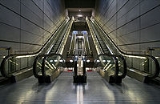
An escalator is a conveyor transport
Conveyor transport

Conveyor transport is the broad category of transport that includes modes developed from the idea of a conveyor belt. Examples include:* Conveyor belt...
 device for transporting
Transport

Transport or transportation is the movement of passenger and cargo from one location to another. Transport is performed by various modes of transport, such as aviation, rail transport, road transport, ship transport, cable transport, pipeline transport and space transport....
 people, consisting of individual, linked steps that move up or down on tracks, which keep the treads horizontal.

As a power-driven, continuous moving stairway designed to transport passengers up and down vertical distances, escalators are used around the world to move pedestrian traffic in places where elevators would be impractical. Principal areas of usage include department stores
Department store

A department store is a retail establishment which specializes in selling a wide range of products without a single predominant Merchandise#Product_line....
, shopping malls
Shopping mall

File:Nordstrom wing , Pentagon City Mall.jpgA shopping mall or shopping centre is a building or set of buildings which contain retail units, with interconnecting walkways enabling visitors to easily walk from unit to unit....
, airports
Airport

An airport is a location where aircraft such as Fixed-wing aircraft, helicopters, and Non-rigid airship take off and land. Aircraft may also be stored or maintained at an airport....
, transit systems, convention centers
Convention center

A convention center, in American English, is an exhibition hall, or conference center, that is designed to hold a Convention . In British English very large venues suitable for major trade shows are known as exhibition centres while the term "convention centre" is sometimes used for intermediate venues between exhibitions centres and...
, hotels
Hotel

----A hotel is an establishment that provides paid lodging on a short-term basis. The provision of basic accommodation, in times past, consisting only of a room with a bed, a cupboard, a small table and a washstand has largely been replaced by rooms with modern facilities, including Bathroom#Types of bathroomss and air conditioning or clima...
, and public buildings.

The benefits of escalators are many.


Discussion
Ask a question about 'Escalator'
Start a new discussion about 'Escalator'
Answer questions from other users
Full Discussion Forum


Recent Posts


Encyclopedia


An escalator is a conveyor transport
Conveyor transport

Conveyor transport is the broad category of transport that includes modes developed from the idea of a conveyor belt. Examples include:* Conveyor belt...
 device for transporting
Transport

Transport or transportation is the movement of passenger and cargo from one location to another. Transport is performed by various modes of transport, such as aviation, rail transport, road transport, ship transport, cable transport, pipeline transport and space transport....
 people, consisting of individual, linked steps that move up or down on tracks, which keep the treads horizontal.

As a power-driven, continuous moving stairway designed to transport passengers up and down vertical distances, escalators are used around the world to move pedestrian traffic in places where elevators would be impractical. Principal areas of usage include department stores
Department store

A department store is a retail establishment which specializes in selling a wide range of products without a single predominant Merchandise#Product_line....
, shopping malls
Shopping mall

File:Nordstrom wing , Pentagon City Mall.jpgA shopping mall or shopping centre is a building or set of buildings which contain retail units, with interconnecting walkways enabling visitors to easily walk from unit to unit....
, airports
Airport

An airport is a location where aircraft such as Fixed-wing aircraft, helicopters, and Non-rigid airship take off and land. Aircraft may also be stored or maintained at an airport....
, transit systems, convention centers
Convention center

A convention center, in American English, is an exhibition hall, or conference center, that is designed to hold a Convention . In British English very large venues suitable for major trade shows are known as exhibition centres while the term "convention centre" is sometimes used for intermediate venues between exhibitions centres and...
, hotels
Hotel

----A hotel is an establishment that provides paid lodging on a short-term basis. The provision of basic accommodation, in times past, consisting only of a room with a bed, a cupboard, a small table and a washstand has largely been replaced by rooms with modern facilities, including Bathroom#Types of bathroomss and air conditioning or clima...
, and public buildings.

The benefits of escalators are many. They have the capacity to move large numbers of people, and they can be placed in the same physical space as one might install a staircase. They have no waiting interval (except during very heavy traffic), they can be used to guide people toward main exits or special exhibits, and they may be weatherproofed for outdoor use.

In 2004, it was estimated that the United States
United States

The United States of America is a Federal government constitutional republic comprising U.S. state and a federal district. The country is situated mostly in central North America, where its Contiguous United States and Washington, D.C., the Capital districts and territories, lie between the Pacific Ocean and Atlantic Oceans, Borders of the U...
 had 30,000 escalators, and that people used escalators 90 billion times each year.

Design, components, and operation


Operation


Escalators, like moving walkway
Moving walkway

A moving walkway, moving sidewalk , moving pavement , autopedescalator, walkalator , travelator, autowalk, horizontal escalator, slidewalk or moveator is a slow conveyor belt that transports people horizontally or on an incline in a similar manner to an escalator....
s, are powered by constant-speed alternating current
Alternating current

In alternating current the movement of electric charge periodically reverses direction. An electric charge would for instance move forward, then backward, then forward, then backward, over and over again....
 motors and move at approximately per second. The maximum angle of inclination of an escalator to the horizontal floor level is 30 degrees with a standard rise up to about . Modern escalators have single piece aluminum
Aluminium

Aluminium or aluminum is a silvery white and ductile member of the boron group of chemical elements. It has the symbol Al; its atomic number is 13....
 or steel
Steel

Steel is an alloy consisting mostly of iron, with a carbon content between 0.2% and 2.14% by weight , depending on grade. Carbon is the most cost-effective alloying material for iron, but various other alloying elements are used such as manganese, chromium, vanadium, and tungsten....
 steps that move on a system of tracks in a continuous loop. Escalators have three typical configuration options: parallel (up and down escalators "side by side or separated by a distance", seen often in multilevel motion picture theatres), crisscross (minimizes structural space requirements by "stacking" escalators that go in one direction, frequently used in department stores or shopping centers), and multiple parallel (two or more escalators together that travel in one direction next to one or two escalators in the same bank that travel in the other direction).

Escalators are required to have moving handrails that keep pace with the movement of the steps. The direction of movement (up or down) can be permanently the same, or be controlled by personnel according to the time of day, or automatically be controlled by whoever arrives first, whether at the bottom or at the top (the system is programmed so that the direction is not reversed while a passenger is on the escalator).

Design and layout considerations

A number of factors affect escalator design, including physical requirements, location, traffic patterns, safety considerations, and aesthetic preferences. Foremost, physical factors like the vertical and horizontal distance to be spanned must be considered. These factors will determine the pitch of the escalator and its actual length. The ability of the building infrastructure to support the heavy components is also a critical physical concern. Location is important because escalators should be situated where they can be easily seen by the general public. In department stores, customers should be able to view the merchandise easily. Furthermore, up and down escalator traffic should be physically separated and should not lead into confined spaces.

Traffic patterns must also be anticipated in escalator design. In some buildings, the objective is simply to move people from one floor to another, but in others there may be a more specific requirement, such as funneling visitors towards a main exit or exhibit. The number of passengers is important because escalators are designed to carry a certain maximum number of people. For example, a single-width escalator traveling at about per second can move an estimated 170 persons per five minute period. The carrying capacity of an escalator system must match the expected peak traffic demand, presuming that passengers ride single file. This is crucial for applications in which there are sudden increases in the number of riders. For example, escalators at stations must be designed to cater for the peak traffic flow discharged from a train, without causing excessive bunching at the escalator entrance.

In this regard, escalators help in controlling traffic flow of people. For example, an escalator to an exit effectively discourages most people from using it as an entrance, and may reduce security concerns. Similarly, escalators often are used as the exit of airport security checkpoints
Airport security

Airport security refers to the techniques and methods used in protecting airports and aircraft from crime.Large numbers of people pass through airports....
. Such an exit would generally be staffed to prevent its use as an entrance, as well.

It is preferred that staircases be located adjacent to the escalator if the escalator is the primary means of transport between floors. It may also be necessary to provide an elevator lift adjacent to an escalator for wheelchairs and disabled persons. Finally, consideration should be given to the aesthetics of the escalator. The architects and designers can choose from a wide range of styles and colors for the handrails and balustrades.

Model sizes and other specifications

Escalator step widths Energy usage
Size Width (Between Balustrade Panels), in Millimeters Width (Between Balustrade Panels), in Inches Single-step capacity Applications Energy consumption, in Kilowatts Energy consumption, in Horsepower
Very small 400 mm 16 in One passenger, with feet together A rare historic design, especially in older department stores 3.75 kW 5 HP
Small 600 mm 24 in One passenger Low-volume sites, uppermost levels of department stores, when space is limited 3.75 kW 5 HP
Medium 800 mm 32 in One passenger + one package or one piece of luggage. Shopping malls, department stores, smaller airports 7.5 KW 10 HP
Large 1000 mm 40 in Two passengers — one may walk past another Mainstay of metro systems, larger airports, train stations, some retail usage 7.5 KW 10 HP


Components

Landing platforms: These two platforms house the curved sections of the tracks, as well as the gears and motors that drive the stairs. The top platform contains the motor assembly and the main drive gear, while the bottom holds the step return idler sprockets. These sections also anchor the ends of the escalator truss. In addition, the platforms contain a floor plate and a combplate. The floor plate provides a place for the passengers to stand before they step onto the moving stairs. This plate is flush with the finished floor and is either hinged or removable to allow easy access to the machinery below. The combplate is the piece between the stationary floor plate and the moving step. It is so named because its edge has a series of cleats that resemble the teeth of a comb. These teeth mesh with matching cleats on the edges of the steps. This design is necessary to minimize the gap between the stair and the landing, which helps prevent objects from getting caught in the gap. Truss: The truss is a hollow metal structure that bridges the lower and upper landings. It is composed of two side sections joined together with cross braces across the bottom and just below the top. The ends of the truss are attached to the top and bottom landing platforms via steel or concrete supports. The truss carries all the straight track sections connecting the upper and lower sections.

Tracks: The track system is built into the truss to guide the step chain, which continuously pulls the steps from the bottom platform and back to the top in an endless loop. There are actually two tracks: one for the front wheels of the steps (called the step-wheel track) and one for the back wheels of the steps (called the trailer-wheel track). The relative positions of these tracks cause the steps to form a staircase as they move out from under the combplate. Along the straight section of the truss the tracks are at their maximum distance apart. This configuration forces the back of one step to be at a 90-degree angle relative to the step behind it. This right angle bends the steps into a shape resembling a staircase. At the top and bottom of the escalator, the two tracks converge so that the front and back wheels of the steps are almost in a straight line. This causes the stairs to lay in a flat sheetlike arrangement, one after another, so they can easily travel around the bend in the curved section of track. The tracks carry the steps down along the underside of the truss until they reach the bottom landing, where they pass through another curved section of track before exiting the bottom landing. At this point the tracks separate and the steps once again assume a staircase configuration. This cycle is repeated continually as the steps are pulled from bottom to top and back to the bottom again.

Steps: The steps themselves are solid, one piece, die-cast aluminum or steel. Yellow demarcation lines may be added to clearly indicate their edges. In most escalator models manufactured after 1950, both the riser and the tread of each step is cleated (given a ribbed appearance) with comblike protrusions that mesh with the combplates on the top and bottom platforms and the succeeding steps in the chain. Seeberger- or "step-type" escalators (see below) featured flat treads and smooth risers; other escalator models have cleated treads and smooth risers. The steps are linked by a continuous metal chain that forms a closed loop. The front and back edges of the steps are each connected to two wheels. The rear wheels are set further apart to fit into the back track and the front wheels have shorter axles to fit into the narrower front track. As described above, the position of the tracks controls the orientation of the steps.

Handrail: The handrail provides a convenient handhold for passengers while they are riding the escalator. In an escalator, the handrail is pulled along its track by a chain that is connected to the main drive gear by a series of pulleys. It is constructed of four distinct sections. At the center of the handrail is a "slider", also known as a "glider ply", which is a layer of a cotton or synthetic textile. The purpose of the slider layer is to allow the handrail to move smoothly along its track. The next layer, known as the "tension member", consists of either steel cable or flat steel tape, and provides the handrail with tensile strength and flexibility. On top of tension member are the inner construction components, which are made of chemically treated rubber designed to prevent the layers from separating. Finally, the outer layer—the only part that passengers actually see—is the cover, which is a blend of synthetic polymers and rubber. This cover is designed to resist degradation from environmental conditions, mechanical wear and tear, and human vandalism.

In the factory, handrails are constructed by feeding rubber through a computer-controlled extrusion machine to produce layers of the required size and type in order to match specific orders. The component layers of fabric, rubber, and steel are shaped by skilled workers before being fed into the presses, where they are fused together.


In the mid-twentieth century, some handrail designs consisted of a rubber bellows, with rings of smooth metal cladding called "bracelets" placed between each coil. This gave the handrail a rigid yet flexible feel. Additionally, each bellows section was no more than a few feet long, so if part of the handrail was damaged, only the bad segment needed to be replaced. These forms of handrail have largely been replaced with conventional fabric-and-rubber railings.


Safety

Safety is also major concern in escalator design. Fire protection of an escalator floor opening may be provided by adding automatic sprinklers or fireproof shutters to the opening, or by installing the escalator in an enclosed fire-protected hall. To limit the danger of overheating, adequate ventilation for the spaces that contain the motors and gears must be provided.

Accidents and litigation


Accidents
There have been various reports of people actually falling off a moving escalator or getting one’s shoe stuck in part of the escalator; shoe laces are a particular hazard when untied and/or loose. A few fatal accidents in the recent past are:
  • Eight people died and 30 more were injured on February 17, 1982, when an escalator collapsed on the Moscow Metro
    Moscow Metro

    The Moscow Metro , which spans almost the entire Moscow, is the world's Metro systems by annual passenger rides rapid-transit system. Opened in 1935, it is well known for the ornate design of many of its metro station, which contain outstanding examples of socialist realism art....
    . Wrongly set up emergency brakes were later blamed for the accident.
  • 31 people died after a fire, begun in the undercarriage of an M-type Otis escalator, exploded into the ticketing hall at King's Cross St. Pancras station
    King's Cross St. Pancras tube station

    King's Cross St. Pancras is a tube station in the London Borough of Camden, on the London Underground network, serving both London King's Cross railway station and St Pancras railway station main line stations....
     in 1987.
  • On December 13, 1999, 8-year-old Jyotsna Jethani was killed at New Delhi's international airport. Jethani fell into a gaping hole that resulted from improper maintenance.
  • On June 15, 2002, Andrea Albright, a 24-year-old J.C. Penney
    J.C. Penney

    J. C. Penney Company, Inc. is a mid-range chain of United States department stores based in Plano, Texas, a suburb north of Dallas, Texas. The company operates 1,093 department stores in 49 of the 50 U.S....
     employee in Columbia, Maryland
    Columbia, Maryland

    Columbia is a new town that consists of ten self-contained villages, located in Howard County, Maryland, Maryland, United States. It is a suburb of Baltimore and, to a lesser degree, Washington, DC....
    , was critically injured while riding the store's escalator from the first to the second level. She somehow got her head caught between the escalator rail and a low ceiling. Albright died 10 days later of massive injuries to the brain
    Brain

    The brain is the center of the nervous system in all vertebrate, and most invertebrate, animals. Some primitive animals such as cnidarian and echinoderm have a decentralized nervous system without a brain, while sponges lack any nervous system at all....
     from lack of oxygen
    Oxygen

    Oxygen no O2 produced; 2) O2 produced, but absorbed in oceans & seabed rock; 3) O2 starts to gas out of the oceans, but is absorbed by land surfaces and formation of ozone layer; 4-5) O2 sinks filled and the gas accumulates]]...
    . In 2005, her parents sued the property manager, two design firms, and the escalator company for $5 million.
  • Francisco Portillo, a Salvadoran
    El Salvador

    El Salvador is the smallest country in the Americas and Central America by size, and the most densely populated nation in Central America. It borders on the Pacific Ocean between Guatemala and Honduras....
     sushi chef, died after being strangled when his sweatshirt caught in a Boston
    Boston, Massachusetts

    Boston is the State capital and largest city of the Commonwealth of Massachusetts, and is one of the oldest cities in the United States. The largest city in New England, Boston is considered the economic and cultural center of the region, and is sometimes regarded as the unofficial "Capital of New England." Boston city proper had a 2007 est...
     subway escalator on February 21, 2005 at Porter Square
    Porter Square

    Porter Square is a neighborhood of Cambridge, Massachusetts, Massachusetts in the USA, located around the intersection of Massachusetts Avenue and Somerville Avenue, between Harvard Square and Davis Square Squares....
    . He was allegedly drunk at the time.
  • A number of people have been injured on escalators while wearing lightweight plastic or foam sandals.


Lessons of the King’s Cross fire
The King's Cross fire
King's Cross fire

The King's Cross fire was a fatal underground fire in London which broke out at approximately 19:30 on 18 November 1987, and which killed 31 people....
 illustrated the demanding nature of escalator upkeep and the devices’ propensity to collect “fluff” when not properly maintained.

Since the station was part of a public institution (the London Underground
London Underground

The London Underground is a metro system serving a large part of Greater London and neighbouring areas of Essex, Hertfordshire and Buckinghamshire in the UK....
) and there was a substantial casualty rate, the incident yielded vociferous public outcry as riders and victims’ families demanded the removal of all wooden escalators systemwide. In the official inquiry that followed, the Fennell Report
King's Cross fire

The King's Cross fire was a fatal underground fire in London which broke out at approximately 19:30 on 18 November 1987, and which killed 31 people....
, it was determined that the fire started slowly, smoldered virtually undetected for a time, then exploded into the ticketing hall above in a phenomenon known as the “trench effect
Trench effect

The trench effect is a combination of two well-understood but separate ideas: the Coanda effect from fluid dynamics and the flashover concept from fire dynamics....
.” This slow-burning fire, Fennell found, was allegedly kindled by a discarded unextinguished cigarette, which was shown in laboratory tests to be a more powerful ignition source than a lit match. In the escalators’ undercarriage, approximately of accumulated detritus
Detritus

Detritus is a biological term used to describe dead or waste organic material.Detritus may also refer to:* Detritus , a geological term used to describe the particles of rock produced by weathering...
 acted as a wick to a neglected buildup of interior lubricants; wood veneers, paper and plastic advertisements, solvent-based paint, plywood in the ticket hall, and melamine combustion added to the impact of the calamity. Taking this particular situation as an example, one could easily speculate that any accretion of flammable fuels, cloth, or scraps (the “fluff” denoted by Fennell) could likewise lead to a devastating fire.

Consequentially, older wooden escalators were removed from service in the London Underground, though at least one set remains in operation, at Greenford Station
Greenford station

Greenford station is a London Underground and National Rail station in Greenford, Greater London, and is owned/managed by LUL. Greenford is the terminus of National Rail's Greenford Branch Line, and is in Travelcard Zone 4....
. Additionally, sections of the London Underground that were actually belowground were made nonsmoking; eventually the whole system became a smoke-free zone.

Litigation
In the 1930s, at least one suit was filed against a department store, alleging that its escalators posed an attractive nuisance
Attractive nuisance doctrine

Under the attractive nuisance doctrine of the law of torts, a landowner may be held liable for injuries to children trespassing on the land if the injury is caused by a hazardous object or condition on the land that is likely to attract children who are unable to appreciate the risk posed by the object or condition....
, responsible for a child’s injury. These cases were almost always dismissed. Moreover, continual updating of escalator safety codes facilitated increased levels of consumer safety as well as a reduction in court cases.

Legislation and escalators


United States
Despite their considerable scope, two Congressional Acts
United States Congress

The United States Congress is the Bicameralism legislature of the Federal government of the United States of the United States of America, consisting of two houses, the United States Senate and the United States House of Representatives....
, the Rehabilitation Act of 1973
1973 Rehabilitation Act

The U.S. Rehabilitation Act of 1973 prohibits discrimination on the basis of disability in programs conducted by Federal agencies, in programs receiving Federal financial assistance, in Federal employment, and in the employment practices of Federal contractors....
 and the Americans with Disabilities Act of 1990 (ADA)
Americans with Disabilities Act of 1990

The Americans with Disabilities Act of 1990 is the short title of United States , codified at et seq. It was List of United States federal legislation on July 26, 1990, by President George H....
, did not directly affect escalators or their public installations. Since Section 504 of the Rehabilitation Act included public transportation systems, for a few years, the United States Department of Transportation
United States Department of Transportation

The United States Department of Transportation is a federal United States Cabinet department of the United States government of the United States concerned with transportation....
 considered designs to retrofit existing escalators for wheelchair access. Nonetheless, Foster-Miller Associates’
Foster-Miller

Foster-Miller, Inc. is a company in the United States with offices in Washington, D.C., Albany, New York, and near Boston, Massachusetts. It was founded in 1956 by three MIT graduates who decided that there was a need for a company that could excel in analysis and design....
 1980 plan, Escalator Modification for the Handicapped was ultimately ignored in favor of increased elevator installations in subway systems. Likewise, the ADA provided more accessibility options, but expressly excluded escalators as “accessible means of egress,” advocating neither their removal nor retention in public structures.

Codes and regulation

In the United States and Canada
Canada

Canada is a country occupying most of northern North America, extending from the Atlantic Ocean in the east to the Pacific Ocean in the west and northward into the Arctic Ocean....
, new escalators must abide by ASME A17.1 standards, and old/historic escalators must conform to the safety guidelines of ASME A17.3. In Europe
Europe

Europe is, conventionally, one of the world's seven continents. Comprising the westernmost peninsula of Eurasia, Europe is generally divided from Asia to its east by the water divide of the Ural Mountains, the Ural , the Caspian Sea, and by the Caucasus Mountains to the southeast....
, the escalator safety code is EN115.

Key safety features developed over time

To enhance passenger safety, newer models of escalators are equipped with one or more of the following safety implementations, as per ASME A17.1 code:

  • Antislide devices: Raised circular objects that often stud the escalator balustrade. Sometimes informally called "hockey pucks" due to their appearance, their purpose is to prevent objects (and people) from precipitously sliding down the otherwise smooth metallic surface.
  • Combplate impact switches: Stop the escalator if a foreign object gets caught between the steps and the combplate on either end.
  • Deflector brush: A long continuous brush made of stiff bristles running up the sides of the escalator just above the step level. This helps deflect garments, shoes, and other items away from the gap between the moving steps and the skirt board.
  • Emergency stop button: At each end of the escalator (in some models, also on the balustrade), a large red button can be pressed to stop the device in the event of an emergency. Typically, an alarmed transparent plastic guardplate covers the button; restarting requires turning a key.
  • Extended balustrades: Allows riders to grasp the handrail before setting foot on an escalator, to ease customer comfort and stability/equilibrium. (The effect is similar to the flat steps described below.)
  • Flat steps: Like a moving walkway, the first two or three steps at either end of the escalator are flat. This gives the passenger extra time to orient him/herself when boarding, and more time to maintain balance when exiting. Longer escalators often have four or more flat steps.
  • Handrail inlet switches: . Sensors located at the bottom and top of the unit that guard the handrail termini. If something gets caught in these locations, a hard fault is generated in the controller, and the escalator shuts down automatically.
  • Handrail speed sensors: These sensors are usually optical, and monitor how fast the handrail moves. If the sensor notices a speed difference between the handrail and the steps, it sounds an alarm, pauses, and then automatically stops the escalator. In these situations, the escalator must be serviced by authorized personnel before returning to an operable state.
  • Missing step detectors: Depending on the manufacturer and model, this sensor is either optical or physical. When a missing step is detected, the escalator automatically shuts down.
  • Raised step edges: In some models, a difference in tread height is utilized to keep passengers' feet from the skirt board.
  • Safety instructions: A sign, typically posted on both escalator newels at the entrance landing platform. In some situations, safety precautions are posted on walls near the escalator, included on freestanding signs, or—as in some models—printed on the riser surface itself.
  • Sensor switch: In automatic-start/stop escalators, this sensor automatically engages the escalator motion when a rider is detected on the first step of the entrance landing platform, and stops the escalator when there are no riders on the unit.
  • Step demarcation lights: Either fluorescent or LED lights (traditionally green in color) located inside the truss. The illumination between the steps improves the passengers' awareness of the step divisions.
  • Step demarcation lines: In order to clearly delineate the edges of each individual step, manufacturers offer steps trimmed in yellow, either painted or with plastic inserts.


Safe riding: official safety foundation guidelines
While some escalator accidents are caused by a mechanical failure, most can be avoided by following some simple safety precautions. The Elevator Escalator Safety Foundation is a major advocate for safe riding in the United States and Canada, sponsors National Elevator Escalator Safety Week each year, and publishes its own suggestions for safe riding.

History


Inventors and manufacturers


Nathan Ames
Nathan Ames
Nathan Ames

Nathan Ames was a patent solicitor who held the first patent in the United States for an escalator-like machine. The patent was granted on March 9, 1859 for an invention he called "Revolving Stairs"....
, a patent solicitor from Saugus, Massachusetts
Saugus, Massachusetts

Saugus is a New England town in Essex County, Massachusetts, Massachusetts, United States. The population was 26,078 at the 2000 census....
, is credited with patenting the first "escalator" in 1859, despite the fact that no working model of his design was ever built. His invention, the "revolving stairs", is largely speculative and the patent specifications indicate that he had no preference for materials or potential use (he noted that steps could be upholstered or made of wood, and suggested that the units might benefit the infirm within a household use), though the mechanization was suggested to run either by manual or hydraulic power.

Leamon Souder
In 1889, Leamon Souder successfully patented the "stairway", an escalator-type device that featured a "series of steps and links jointed to each other". No model was ever built. This was the first of at least four escalator-style patents issued to Souder, including two for spiral designs (U. S. Patent Nos. 723,325 and 792,623).

Jesse Wilford Reno, George A. Wheeler, and Charles Seeberger
In 1892, Jesse W. Reno
Jesse W. Reno

Jesse W. Reno invented the first working escalator in 1891 used at the Old Iron Pier, Coney Island, New York City. His invention was referred to as the "inclined elevator." An earlier escalator machine, termed "revolving stairs" by its inventor Nathan Ames, was patented March 9, 1859, but was never built....
, son of American Civil War
American Civil War

The American Civil War , also known as the War Between the States and several Naming the American Civil War, was a civil war in the United States....
 notable Jesse L. Reno
Jesse L. Reno

Jesse Lee Reno was a career United States Army officer who served in the Mexican-American War, the western frontier, and as a Union Army General officer during the American Civil War....
, and an 1883 engineering graduate of Lehigh University
Lehigh University

Lehigh University is a private university, co-educational university located in Bethlehem, Pennsylvania, Pennsylvania, in the Lehigh Valley region of the United States....
, patented the "Endless Conveyor or Elevator." A few months after Reno's patent was approved, George A. Wheeler patented his ideas for a more recognizable moving staircase, though it was never built. Wheeler’s patents were bought by Charles Seeberger
Charles Seeberger

Charles D. Seeberger was an American inventor.In 1899, he joined the Otis Elevator Company. The Seeberger-Otis partnership produced the first step-type escalator made for public use, and it was installed at the Exposition Universelle , where it won first prize....
; some features of Wheeler’s designs were incorporated in Seeberger’s prototype built by the Otis Elevator Company in 1899.

Reno
Jesse W. Reno

Jesse W. Reno invented the first working escalator in 1891 used at the Old Iron Pier, Coney Island, New York City. His invention was referred to as the "inclined elevator." An earlier escalator machine, termed "revolving stairs" by its inventor Nathan Ames, was patented March 9, 1859, but was never built....
 produced the first working escalator (he actually called it the "inclined elevator") and installed it alongside the Old Iron Pier at Coney Island
Coney Island

Coney Island is a peninsula, formerly an island, in southernmost Brooklyn, New York City, USA, with a beach on the Atlantic Ocean. The Neighbourhood of the same name is a community of 60,000 people in the western part of the peninsula, with Seagate, Brooklyn to its west; Brighton Beach and Manhattan Beach, Brooklyn, New York to its east; a...
, New York in 1896. This particular device was little more than an inclined belt with cast-iron slats or cleats on the surface for traction, and traveled along a 25° incline. A few months later, the same prototype was used for a monthlong trial period on the Manhattan side of the Brooklyn Bridge
Brooklyn Bridge

The Brooklyn Bridge, one of the oldest suspension bridges in the United States, stretches 5,989 feet over the East River, connecting the New York City borough s of Manhattan and Brooklyn ....
. Reno eventually joined forces with Otis Elevator Company
Otis Elevator Company

The Otis Elevator Company is the world's largest manufacturer of vertical transportation systems today, principally elevators and escalators. Founded in Yonkers, New York, New York, USA in 1853 by Elisha Otis, the company pioneered the development of the safety elevator, invented by Otis, which used a special mechanism to lock the elevator ca...
, and retired once his patents were purchased outright. Some Reno-type escalators were still being used in the Boston subway until construction for the Big Dig
Big Dig

The Big Dig is the unofficial name of the Central Artery/Tunnel Project , a megaproject that rerouted the Central Artery , the chief highway through the heart of Boston, into a 3.5 mile tunnel under the city....
 precipitated their removal. The Smithsonian Institution
Smithsonian Institution

The Smithsonian Institution is an educational and research institute and associated museum complex, administered and funded by the government of the United States and by funds from its Financial endowment, contributions, and profits from its shops and its magazine....
 considered re-assembling one of these historic units from 1914 in their collection of Americana, but "logistics and reassembly costs won out over nostalgia", and the project was discarded.

Around May 1895, Charles Seeberger began drawings on a form of escalator similar to those patented by Wheeler in 1892. This device actually consisted of flat, moving stairs, not unlike the escalators of today, except for one important detail: the step surface was smooth, with no comb effect to safely guide the rider's feet off at the ends. Instead, the passenger had to step off sideways. To facilitate this, at the top or bottom of the escalator the steps continued moving horizontally beyond the end of the handrail (like a miniature moving sidewalk) until they disappeared under a triangular "divider" which guided the passenger to either side. Seeberger teamed with Otis Elevator Company
Otis Elevator Company

The Otis Elevator Company is the world's largest manufacturer of vertical transportation systems today, principally elevators and escalators. Founded in Yonkers, New York, New York, USA in 1853 by Elisha Otis, the company pioneered the development of the safety elevator, invented by Otis, which used a special mechanism to lock the elevator ca...
 in 1899, and together they produced the first commercial escalator which won the first prize at the Paris
Paris

Paris is the Capital of France and the country's largest city. It is situated on the river Seine, in northern France, at the heart of the ?le-de-France Regions of France ....
 1900 Exposition Universelle
Exposition Universelle (1900)

The Exposition Universelle of 1900 was a world's fair held in Paris, France, to celebrate the achievements of the past century and to accelerate development into the next....
 in France
France

France , officially the French Republic , is a country whose Metropolitan France is located in Western Europe and that also comprises various Overseas departments and territories of France....
. Also on display at the Exposition were Reno's inclined elevator, a similar model by James M. Dodge and the Link Belt Machinery Co., and two different devices by French manufacturers Hallé and Piat.

Early European manufacturers: Hallé, Hocquardt, and Piat
Piat installed its "stepless" escalator in Harrods
Harrods

Harrods is a department store located on Brompton Road in Knightsbridge, London, England. The Harrods brand also applies to other enterprises undertaken by the Harrods group of companies including Harrods Bank, Harrods Estates, Harrods Aviation and Air Harrods....
 Knightsbridge store in 1898. Noted by Bill Lancaster in The Department Store: a Social History, "customers unnerved by the experience were revived by shopmen dispensing free smelling salts and cognac." Hocquardt received European patent rights for the Fahrtreppe in 1906. After the Exposition, Hallé continued to sell its escalator device in Europe, but was eventually eclipsed in sales by other major manufacturers.

Major competitors and product nomenclature
In the first half of the twentieth century, several manufacturers developed their own escalator products, though they had to market their devices under different names, due to Otis’ hold on the trademark rights to the word “escalator.” New York-based Peelle Company called their models the Motorstair, and Westinghouse called their model an Electric Stairway. The Toledo
Toledo, Ohio

Toledo is a city in the U.S. state of Ohio and the county seat of Lucas County, Ohio. Named after Toledo, Spain, it is located on the western end of Lake Erie, on the Michigan border....
-based Haughton Elevator company referred to their product as simply Moving Stairs.

Manufacturing mergers and buyouts: the playing field narrows
Kone
KONE

Kone Corporation , founded in 1910 and headquartered in Espoo, Finland, is an international engineering and service company employing some 32,500 personnel worldwide....
 and Schindler
Schindler Group

The Schindler Group was founded in Switzerland in 1874 and is the largest manufacturer of escalators and the second largest manufacturer of elevators world wide....
 introduced their first escalator models several decades after the Otis Elevator Co., but grew to dominance in the field over time. Today, they and Mitsubishi are Otis' primary rivals.

Schindler now stands as the second largest maker of escalators and elevators in the world, though their first escalator installation did not occur until 1936. In 1979, the company entered the United States market by purchasing Haughton Elevator; nine years later, Schindler assumed control of the North American escalator/elevator operations of Westinghouse.

Kone expanded internationally by acquisition in the 1970s, buying out Swedish elevator manufacturer Asea-Graham, and purchasing other minor French, German, and Austrian elevator makers before assuming control of Westinghouse’s European elevator business. As the last "big four" manufacturers held on to the escalator market, Kone first acquired Montgomery Elevator Company, then took control of Germany’s Orenstein & Koppel Rolltreppen.

Model development and design types


"Cleat-type" escalators
Jesse Reno's escalators did not resemble modern escalators too closely. Passengers' feet tilted upward at an angle, and the treads consisted of cleated metal (initially) or wood (later models). Reno worked on his own for several years, gaining success with installations from Toronto to Cape Town, South Africa. Similar units of the day by other manufacturers resembled conveyor belts more than moving staircases. For a time, Otis Elevator sold Reno's escalators as their own "cleat-type" escalators.

"Step-type" escalators
Seeberger's model, bought by Otis, clearly became the first "step-type" escalator, so called after its visual likeness to steps on a regular staircase. The company later combined the best aspects of both inventions (guiding slats and flat steps) and in 1921 produced an escalator similar to the type used today: they called it the "L-type" escalator. It was succeeded by the "M-type", the "O-type", and current models by Otis such as the "NCE-type" escalator.

Spiral escalators: from Reno to Mitsubishi
Reno
Jesse W. Reno

Jesse W. Reno invented the first working escalator in 1891 used at the Old Iron Pier, Coney Island, New York City. His invention was referred to as the "inclined elevator." An earlier escalator machine, termed "revolving stairs" by its inventor Nathan Ames, was patented March 9, 1859, but was never built....
, in addition to his notoriety for the first “practical” escalator in public use, also bears the unique distinction of designing the very first escalators installed in any underground subway system – a single spiral escalator in the London Underground in 1906, forgotten for several decades. Also the first fully operational spiral escalator, Reno’s design was nonetheless only one in a series of several similar proposed contraptions. Souder patented two spiral designs (see above), Wheeler drafted spiral stairway plans in 1905, Seeberger devised at least two different spiral units between 1906 and 1911 (including an unrealized arrangement for the London Underground), and Gilbert Luna obtained West German, Japanese, and United States patents for his version of a spiral escalator by 1973. When interviewed for the Los Angeles Times
Los Angeles Times

The Los Angeles Times is a daily newspaper published in Los Angeles, California and distributed throughout the Western United States. It is the second-largest metropolitan newspaper in the United States and the fourth-most widely distributed newspaper in the United States....
 that year, Luna was in the process of soliciting “major firms” for acquisition of his patents and company, but statistics are unclear on the outcome of his endeavors in that regard.

The Mitsubishi Electric Corporation was most successful in its development of "spiral" (more "curve" than true spiral) escalators, and has sold them exclusively since the mid-1980s. The world's first "practical" spiral escalator—a Mitsubishi model—was installed in Osaka
Osaka

is a Cities of Japan in Japan, located at the mouth of the Yodo River on Osaka Bay, in the Kansai region of the main island of Honshu.Osaka is a City designated by government ordinance under the Local Autonomy Law and the capital city of Osaka Prefecture....
, Japan
Japan

Japan is an island country in East Asia. Located in the Pacific Ocean, it lies to the east of the Sea of Japan, People's Republic of China, North Korea, South Korea and Russia, stretching from the Sea of Okhotsk in the north to the East China Sea and Taiwan in the south....
, in 1985.

In use, a major planning advantage presented by spiral escalators is that they take up much less horizontal floor space than traditional units, which frequently house large machine rooms underneath the truss.

Etymology

Several authors and historians have contributed their own differing interpretations of the source of the word “escalator”, and some degree of misinformation has heretofore proliferated on the Internet
Internet

The Internet is a global network of interconnected computers, enabling users to share information along multiple channels. Typically, a computer that connects to the Internet can access information from a vast array of available server and other computers by moving information from them to the computer's local memory....
. For reference, contradictory citations by seven separate individuals, including the Otis Elevator Company itself, are provided below.

Name development and original intentions

Charles Seeberger
Charles Seeberger

Charles D. Seeberger was an American inventor.In 1899, he joined the Otis Elevator Company. The Seeberger-Otis partnership produced the first step-type escalator made for public use, and it was installed at the Exposition Universelle , where it won first prize....
 trademarked
TradeMark

TradeMark is a tall, primarily residential, skyscraper in Charlotte, North Carolina. It was completed in 2007 and has 28 floors. There are 200 hundred residential units....
 the word "escalator" in 1900, to coincide with his device’s debut at the Exposition Universelle. According to his own account, in 1895, his legal counsel advised him to name his new invention, and he then set out to devise a title for it on his own. As evidenced in Seeberger's own handwritten documents, archived at the Otis Elevator Company
Otis Elevator Company

The Otis Elevator Company is the world's largest manufacturer of vertical transportation systems today, principally elevators and escalators. Founded in Yonkers, New York, New York, USA in 1853 by Elisha Otis, the company pioneered the development of the safety elevator, invented by Otis, which used a special mechanism to lock the elevator ca...
 headquarters in Farmington, Connecticut
Farmington, Connecticut

Farmington is a town located in Hartford County in central Connecticut in the United States. The population was 23,641 at the 2000 United States Census....
, the inventor consulted "a Latin
Latin

Latin is an Italic language, historically spoken in Latium and Ancient Rome. Through the Military history of the Roman Empire, Latin spread throughout the Mediterranean and a large part of Europe....
 lexicon" and "adopted as the root of the new word, 'Scala'; as a prefix, 'E' and as a suffix, 'Tor.'" His own rough translation of the word thus created was "means of traversing from", and he intended for the word to be pronounced, "es?kal'??t?r" (es-CAL-a-tor).

"Escalator" was not a combination of other French
French language

French is a Romance language spoken around the world by around 80 million people as first language, by 190 million as second language, and by about another 200 million people as an acquired tongue, with significant speakers in 54 countries....
 or Greek
Greek language

Greek is an Indo-European languages native to the southern Balkan peninsula, the language of the Greek people. It forms an independent branch within Indo-European....
 words, and was never a derivative of "elevator
Elevator

An elevator or lift is a vertical transport vehicle that efficiently moves people or goods between floors of a building. They are generally powered by electric motors that either drive traction cables and counterweight systems, or pump hydraulic fluid to raise a cylindrical piston....
" in the original sense, which means "one who raises up, a deliverer" in Latin. Similarly, the root word "scala" does not mean "a flight of steps", but is defined by Lewis and Short’s A Latin Dictionary as the singular form of the plural noun "scalae", which denotes any of the following: "a flight of steps or stairs, a staircase; a ladder, [or] a scaling-ladder."

The alleged intended capitalization
Capitalization

Capitalization is writing a word with its first grapheme as a majuscule and the remaining letters in Lower case , in those writing systems which have a letter case....
 of "escalator" is likewise a topic of debate. Seeberger’s trademark application lists the word not only with the "E" but also with all of the letters capitalized (in two different instances), and he specifies that, "any other form and character of type may be employed . . . without altering in any essential manner the character of [the] trade-mark." That his initial specifications are ostensibly inconsistent, and since Otis Elevator Co. advertisements so frequently capitalized all of the letters in the word, suppositions about the "capital ‘e’" are difficult to formulate.

Derivatives of 'escalator'
The verb
Verb

In syntax, a verb is a word that usually denotes an action , an occurrence , or a state of being . Depending on the language, a verb may vary in form according to many factors, possibly including its grammatical tense, grammatical aspect, grammatical mood and grammatical voice....
 "escalate" originated in 1922, and has two uses, the primary: "to climb or reach by means of an escalator" or "to travel on an escalator", and the secondary: "to increase or develop by successive stages; spec. to develop from 'conventional' warfare into nuclear warfare." The latter definition was first printed in the Manchester Guardian
The Guardian

Sorry, no overview for this topic
 in 1959, but grew to prominent use during the late 1960s and early 1970s.

Loss of trademark rights

In 1950, the landmark case Haughton Elevator Co. v. Seeberger precipitated the end of Otis' reign over exclusive use of the word "escalator", and simultaneously created a cautionary study for companies and individuals interested in trademark retention. Confirming the contention of the Examiner of Trademark Interferences, Assistant Commissioner of Patents Murphy’s decision rejected the Otis Elevator Company’s appeal to keep their trademark intact, and noted that "the term 'escalator' is recognized by the general public as the name for a moving stairway and not the source thereof", observing that the Otis Elevator Co. had "used the term as a generic descriptive term…in a number of patents which [had] been issued to them and…in their advertising matter." All trademark protections were removed from the word "escalator", the term was officially genericized, and it fell into the public domain
Public domain

File:PD-icon.svgThe public domain is a range of abstract materials?commonly referred to as intellectual property?which are not owned or controlled by anyone....
.

Primary uses and application


Department stores/shopping

As noted above, a few escalator types were installed in major department stores (including Harrods) before the Expo. Escalators proved instrumental in the layout and design of shopping venues in the twentieth century.

By 1898, the first of Reno’s "inclined elevators" were incorporated into the Bloomingdale Bros.
Bloomingdale's

Bloomingdale's is a chain of upscale United States department stores owned by Macy's, Inc., which is also the parent company of Macy's. Bloomingdale's has 36 stores nationwide, with annual sales of $1.9 billion....
 store at Third Avenue and 59th Street
59th Street (Manhattan)

59th Street in the New York City borough of Manhattan runs east-west, from York Avenue to the West Side Highway, with a discontinuity between Ninth Avenue /Columbus Avenue and Eighth Avenue /Central Park West for the Time Warner Center....
. This was the first retail application of the devices in the US, and no small coincidence, considering that Reno's primary financier was Lyman Bloomingdale, co-owner of the department store with brother Joseph Bloomingdale.

Public transportation

The first "standard" escalator installed on the London Underground
London Underground

The London Underground is a metro system serving a large part of Greater London and neighbouring areas of Essex, Hertfordshire and Buckinghamshire in the UK....
 was a Seeberger model at Earls Court
Earl's Court tube station

Earl's Court tube station is a London Underground station in Earls Court. The station is located between Earls Court Road and Warwick Road . It is on the boundary of Travelcard Zone 1 and Travelcard Zone 2 and is in both zones....
. Noted above, London's Underground installed a rare spiral escalator designed by Reno, William Henry Aston and Scott Kietzman for the Holloway Road Underground station
Holloway Road tube station

Holloway Road is a station on the London Underground. It is on the Piccadilly Line between Caledonian Road tube station and Arsenal tube station stations, and in Travelcard Zone 2....
 in 1906; it was run for a short time but was taken out of service the same day it debuted. The older lines of the London Underground had many escalators with wooden steps (ca. 1930s) until they were rapidly replaced following the King's Cross fire
King's Cross fire

The King's Cross fire was a fatal underground fire in London which broke out at approximately 19:30 on 18 November 1987, and which killed 31 people....
, noted above.

Other applications


Factories and other industrial production environments

In 1905, the American Woolen Company’s
American Woolen Company

The American Woolen Company was established in 1899 under the leadership of William Madison Wood and his father-in-law Frederick Ayer through the consolidation of eight financially troubled New England woolen mills....
 Wood Mill in Lawrence, Massachusetts
Lawrence, Massachusetts

Lawrence is a city in Essex County, Massachusetts, United States on the Merrimack River. As of the 2000 census, the city had a total population of 72,043....
 (then "the largest single worsted mill in the world") utilized Otis' Seeberger-type "reversible" escalators to carry its workers between floors four times a day. The machines did not run all day: rather, escalators ran solely to transport employees to/from midday meals and in/out of the mill. In its advertising, Otis Elevator Company hailed this unconventional use for its unique benefits to both workers and owners: "The profitable and practicable feature of the Escalator, from the viewpoint of the owner, is the increased efficiency of each operator due to the elimination of stair climbing."

Military use

In San Francisco, an escalator at Hunters Point Naval Shipyard
San Francisco Naval Shipyard

The San Francisco Naval Shipyard was a United States Navy shipyard in San Francisco, California, located on 638 acres of waterfront at Hunters Point, San Francisco, California in the southeast corner of the city....
 was used to convey personnel between the first and third floors. At the time of its construction in 1948, it was touted thus: "[it has the] highest lift of any industrial building in the world. It rises 42 feet."

Escalators were also utilized on aircraft carriers such as the , to transport pilots from "ready rooms" to the flight deck.

Extant historic escalator models

A number of historic escalators still operate across the globe. A few notable examples are:

Australia

  • Town Hall Railway Station
    Town Hall railway station, Sydney

    Town Hall railway station is the second-busiest railway station on the CityRail network , located in Sydney, Australia. Located underground, it is situated in the Sydney central business district, under the street in front of the Sydney Town Hall, about 1.2 km north of Central....
    , Sydney, Australia
    Sydney

    Sydney is the List of cities in Australia by population in Australia, with a metropolitan area population of approximately 4.34 million . It is the List of Australian capital cities of New South Wales, and was the site of the first British Empire colony in Australia....


Europe

  • St. Anna Pedestrian Tunnel underneath the Schelde in Antwerp
    Antwerp

    ||-||-||-||}Antwerp is a city and municipality in Belgium and the capital of the Antwerp in Flanders, one of Belgium's three regions....
    , Belgium
    Belgium

    * A small German-speaking Community of Belgium exists in eastern Wallonia. Belgium's linguistic diversity and related political and cultural conflicts are reflected in the history of Belgium and a complex Communities and regions of Belgium....
  • Tyne Cyclist and Pedestrian Tunnel
    Tyne Tunnel

    The Tyne Tunnel is a two-lane Toll tunnel vehicular tunnel under the River Tyne, England, completed in 1967, and connecting Jarrow on the south side of the river with North Shields and Howdon on the north....
    , Tyne and Wear
    Tyne and Wear

    Tyne and Wear is a metropolitan county in North East England England around the mouths of the Rivers River Tyne and River Wear. It came into existence as a metropolitan county in 1974 after the passage of the Local Government Act 1972....
    , England
    England

    native_name =|conventional_long_name = England|common_name = England|image_flag = Flag of England.svg|image_coat = England COA.svg|symbol_type = Royal Coat of Arms...
-These escalators, manufactured by Waygood Otis in 1951, were "believed to be the longest single lift escalators in the world", at the time of installation. Presumably the first escalators in Britain designed specifically for cyclists, they are also "thought to be still" the longest escalators in the United Kingdom. At most, they may be the longest extant wooden escalators in operation in the world.
  • Greenford Station
    Greenford station

    Greenford station is a London Underground and National Rail station in Greenford, Greater London, and is owned/managed by LUL. Greenford is the terminus of National Rail's Greenford Branch Line, and is in Travelcard Zone 4....
    , Greenford
    Greenford

    Greenford, historically Greenford Magna, is a suburb in the London Borough of Ealing in west London, England. Greenford is one of the oldest recorded places in Ealing, first referred to in a legal document dated AD 845....
    , England
    England

    native_name =|conventional_long_name = England|common_name = England|image_flag = Flag of England.svg|image_coat = England COA.svg|symbol_type = Royal Coat of Arms...


North America

  • Macy's Herald Square
    Macy's

    Macy's is a chain of mid to high range United States department stores. Its flagship store in Herald Square, New York City has been billed as the "world's largest store" since 1924, although today it ties with London's Harrods in vastness of selling space....
     department store, Otis L-type units with wood treads and replacement metal treads, New York, New York
    New York City

    The City of New York is the List of United States cities by population in the United States, while the New York metropolitan area ranks among the List of urban areas by population....
  • Kaufmann's
    Kaufmann's

    Kaufmann's was an iconic department store that originated in Pittsburgh, Pennsylvania. The store became a regional chain in the eastern United States, and was last owned by Federated Department Stores....
     department store (now Macy's), two 16-inch (400 mm) Otis L-type units with original floorplates, several 40-inch (1000 mm) Otis escalators ca. 1950s, Pittsburgh, Pennsylvania
  • Westfield San Francisco Centre (formerly The Emporium
    The Emporium

    The Emporium was a mid-line department store chain headquartered in San Francisco, California, which operated for 99 years--from 1896 to 1995. The flagship location on San Francisco's Market Street was a destination shopping location for decades, and several branch stores operated in the various suburbs of the San Francisco Bay Area....
    ), chrome-and-glass escalator by Eleanor LeMaire for Otis, San Francisco, California
    San Francisco, California

    The City and County of San Francisco is the fourth most populous city in California and the List of United States cities by population in the United States, with a 2007 estimated population of 799,183....


Escalators: superlatives


Longest systems

  • Central-Mid-Levels escalator: in Hong Kong
    Hong Kong

    Hong Kong , officially the Hong Kong Special Administrative Region, is a territory located in Southern China in East Asia, bordering the province of Guangdong to the north and facing the South China Sea to the east, west and south....
    , tens of thousands of commuters travel each work day between Central
    Central, Hong Kong

    Central , the central business district of Hong Kong, was commonly known as part of Victoria City. It is an area on the north shore of Hong Kong Island....
    , the central business district
    Central business district

    A central business district is the commercial and often geographic heart of a city. In Australia, China , Republic of Ireland, Kenya, New Zealand, Philippines, Singapore and South Africa, the phrase is commonly used, and is often colloquially abbreviated to "CBD"....
    , and the Mid-levels
    Mid-levels

    Mid-levels is an expensive residential area on Hong Kong Island in Hong Kong. It is located halfway up Victoria Peak, directly above Central, Hong Kong....
    , a residential district hundreds of feet uphill, using this long distance system of escalators and moving walkways
    Moving walkway

    A moving walkway, moving sidewalk , moving pavement , autopedescalator, walkalator , travelator, autowalk, horizontal escalator, slidewalk or moveator is a slow conveyor belt that transports people horizontally or on an incline in a similar manner to an escalator....
    . It is the world's longest outdoor escalator system (not a single escalator span), at a total length of . It goes only one way at a time; the direction reverses depending on rush hour traffic direction.
  • Ocean Park, Hong Kong: a long escalator system connecting two parts of the Park, with an overall length of .


Longest individual escalators


Asia and Europe
The longest individual escalators in the world are found in the "metro" or "subway"
Rapid transit

A rapid transit, subway, underground, elevated railway or metro system is an railway electrification system public transport rail transport in an urban area with high capacity and frequency, and which is grade separation from other traffic....
 systems in several cities in Central and Eastern Europe.

  • In the Park Pobedy station of the famously deep Moscow Metro
    Moscow Metro

    The Moscow Metro , which spans almost the entire Moscow, is the world's Metro systems by annual passenger rides rapid-transit system. Opened in 1935, it is well known for the ornate design of many of its metro station, which contain outstanding examples of socialist realism art....
    , opened in 2003, the escalators are , or 740 steps, long, and take nearly three minutes to transit. Deep underground stations in St. Petersburg
    Saint Petersburg Metro

    Saint Petersburg Metro is the Rapid Transit system in Saint Petersburg and Leningrad Oblast, Russia. It has been open since November 15, 1955....
     have escalators up to approximately long.
  • The Kiev Metro
    Kiev Metro

    The Kiev Metro is a rapid transit system that is the mainstay of Kiev's public transport. It was the first rapid transit system in Ukraine and the third one built in the Soviet Union ....
     Kreschatik station's lower-level second exit escalator (a type ??-2, circa 1965), lifts riders , or 743 steps, up a -long incline.
  • The longest escalator in Prague
    Prague Metro

    The Prague Metro is a subway, rapid transit public transportation network in Prague, Czech Republic. It is the fastest means of transportation around the city and serves about one and half million passengers a day, which makes it the sixth busiest metro system in Europe....
     is at the Námestí Míru
    Námestí Míru

    N?mest? M?ru is a Prague Metro List of Prague metro stations on Line A . It is located in Vinohrady district under Korunn? Street and has one exit through an escalator tunnel with a sub-surface Vestibule under N?mest? M?ru Square....
     station at .
  • The tallest escalator on the London Underground system, and indeed in Western Europe
    Western Europe

    Western Europe refers to the countries in the western most half of Europe. This concept has had different meanings, political and cultural as well as geographical issues have influenced the area....
    , is at Angel station
    Angel tube station

    Angel tube station is a London Underground station in The Angel, Islington, Islington. It is on the Bank and Monument stations branch of the Northern Line, between Old Street station and King's Cross St....
     with a length of , and a vertical rise of .
  • The longest wooden escalators in the United Kingdom are at the Tyne Tunnel
    Tyne Tunnel

    The Tyne Tunnel is a two-lane Toll tunnel vehicular tunnel under the River Tyne, England, completed in 1967, and connecting Jarrow on the south side of the river with North Shields and Howdon on the north....
    , with a length of . (See above.)
  • The longest escalator on the Stockholm Metro
    Stockholm Metro

    The Stockholm Metro is the rapid transit system in Stockholm, Sweden. The system has 100 stations in use, of which 47 are subterranean and 53 are above ground stations....
     is at Västra skogen
    Västra skogen

    V?stra skogen is a Stockholm Stockholm Metro station in Huvudsta, Solna Municipality. The station was opened August 31 1975. It features the longest escalator in the Stockholm metro system, 66 meters....
     with a length of and in Helsinki Metro
    Helsinki Metro

    The Helsinki Metro , is the rapid transit system in Helsinki, Finland. It is the World's most northern metro system, and currently the only one in Finland....
     at Kamppi
    Kamppi

    Kamppi is a Subdivisions of Helsinki#Neighbourhoods in the centre of Helsinki, the capital of Finland. The name originally referred to a small area known as the "Kamppi field" , but according to the current official designation, "Kamppi" encompasses a much larger area with a population of 10,000 in 2004....
     station with a length of .
  • The largest "single truss escalator" is in the Bentall Centre
    Bentalls

    Bentalls is an England department store chain with branches in Kingston upon Thames, Greater London, and Bracknell, Berkshire. The well regarded 'county' department store began as a drapery Retailing#Shops and stores, founded by Frank Bentall in 1867....
     in Kingston upon Thames
    Kingston upon Thames

    Kingston upon Thames is the principal settlement of the Royal Borough of Kingston upon Thames in south-west London.It was the ancient market town where Anglo-Saxons kings were crowned and is now a suburb situated south west of Charing Cross....
     in Greater London
    Greater London

    Greater London is the top-level administrative subdivision covering London, England. The administrative area was officially created in 1965 and covers the City of London , the City of Westminster and the other 31 London boroughs....
    , UK. It connects the ground floor with the second floor with only top and bottom supports.


North and South America
  • The longest single-span uninterrupted escalator in the Western Hemisphere
    Western Hemisphere

    The Western Hemisphere, also Western hemisphere or western hemisphere, is a geography term for the half of the Earth that lies west of the Prime Meridian , the other half being the Eastern Hemisphere....
     is at the Wheaton
    Wheaton (Washington Metro)

    Wheaton is a Washington Metro metro station in Montgomery County, Maryland, Maryland on the Red Line .The station serves the suburb of Wheaton, Maryland, and is located at the intersection of Georgia Avenue and Reedie Drive....
     station of the Washington Metro
    Washington Metro

    The Washington Metro is the rapid transit system in Washington, D.C. and its surrounding suburbs. The system is administered by the Washington Metropolitan Area Transit Authority ....
     system. It is long, and takes almost 2 minutes and 45 seconds to ascend or descend without walking. The Washington Metro
    Washington Metro

    The Washington Metro is the rapid transit system in Washington, D.C. and its surrounding suburbs. The system is administered by the Washington Metropolitan Area Transit Authority ....
     system also boasts the third longest continuous-span escalator in the world: the Rosslyn
    Rosslyn (Washington Metro)

    Rosslyn is a Washington Metro metro station in the business district of Rosslyn, Virginia, in Arlington County, Virginia, Virginia. It is the station where the Blue Line and Orange Line Lines converge going east into Washington, D.C.; in the opposite direction, they split, the Blue Line heading south and the Orange Line west, with a interch...
     station, at .


  • The longest escalator in the United States west of the Mississippi is reportedly in the Wilshire/Vermont metro station
    Wilshire/Vermont (LACMTA Station)

    The Wilshire/Vermont station is a transfer point for the Wilshire/Western Purple Line subway and the North Hollywood Red Line subway, located at the intersection of Wilshire Boulevard and Vermont Avenue....
     in Los Angeles.


  • The longest freestanding (supported only at the ends) escalator in the world is inside CNN Center
    CNN Center

    The CNN Center is the world headquarters of the Cable News Network . The main news rooms and sets for the anchors of several of CNN's news channels are located in the building....
    ’s atrium in Atlanta, Georgia. It rises 8 stories and is long. Originally built as the entrance to the amusement park
    Amusement park

    Amusement park is the generic term for a collection of Amusement ride and other entertainment attractions assembled for the purpose of entertaining a large group of people....
     The World of Sid and Marty Krofft
    The World of Sid and Marty Krofft

    The World of Sid and Marty Krofft was an amusement park in Atlanta, Georgia . It was based on the various TV shows produced by the sibling duo Sid and Marty Krofft....
    , the escalator is now used for CNN
    CNN

    Cable News Network, almost always referred to by its initialism CNN, is a major US Cable News Network founded in 1980 by Ted Turner. Upon its launch, CNN was the first station to provide 24-hour television news coverage, and the first all-news television network in the United States....
     studio tours.


Shortest escalators


Asia
According to Guinness
Guinness World Records

Guinness World Records, known until 2000 as The Guinness Book of Records , is a reference book published annually, containing an internationally recognized...
, the shortest escalator in the world is in the Okadaya Mores shopping mall in Kawasaki, Japan
Japan

Japan is an island country in East Asia. Located in the Pacific Ocean, it lies to the east of the Sea of Japan, People's Republic of China, North Korea, South Korea and Russia, stretching from the Sea of Okhotsk in the north to the East China Sea and Taiwan in the south....
. Its vertical rise is only .
North America
The shortest escalator in the United States is a Schindler unit at the entrance to the JCPenney Department Store in Westfield Garden State Plaza
Westfield Garden State Plaza

Westfield Garden State Plaza is a large upscale shopping mall in Paramus, New Jersey, New Jersey, United States, owned and managed by the Westfield Group....
 in Paramus, New Jersey
New Jersey

New Jersey is a state in the Mid-Atlantic States and Northeastern United States regions of the United States. It is bordered on the north by New York, on the east by the Hudson River and the Atlantic Ocean, on the southwest by Delaware, and on the west by Pennsylvania....
.

Notable spiral escalator installations

Escalator

Asia

  • Jeddah
    Jeddah

    Jeddah is a Saudi Arabian city located on the coast of the Red Sea and is the major urban center of western Saudi Arabia. It is the largest city in Makkah Province, and the second largest city in Saudi Arabia after the capital city, Riyadh....
     Hilton
    Hilton Hotels

    Hilton Hotels is a international chain of full-service hotels and resorts founded by Conrad Hilton and now owned by the Hilton Hotels Corporation....
    , Saudi Arabia
    Saudi Arabia

    The Kingdom of Saudi Arabia, KSA , is an Arab country and the largest country of the Arabian Peninsula. It is bordered by Jordan on the northwest, Iraq on the north and northeast, Kuwait, Qatar, Bahrain, and the United Arab Emirates on the east, Oman on the southeast, and Yemen on the south....
  • Landmark Tower, Japan
  • Times Square
    Times Square (Hong Kong)

    Times Square is a major shopping centre and office tower complex in Causeway Bay, Hong Kong Island, Hong Kong.The complex, owned by Wharf Properties Limited, part of The Wharf Limited group, was opened in April 1994....
     shopping mall, Hong Kong
    Hong Kong

    Hong Kong , officially the Hong Kong Special Administrative Region, is a territory located in Southern China in East Asia, bordering the province of Guangdong to the north and facing the South China Sea to the east, west and south....
  • Lotte World
    Lotte World

    Lotte World is a recreation complex in Seoul, South Korea. It consists of a large indoor theme park, an outdoor amusement park, an island linked by monorail, shopping malls, a hotel, a Korean folk museum, sports facilities and movie theaters in one area....
    , South Korea
    South Korea

    South Korea, officially the Republic of Korea , ), often referred to as Korea and the "names of Korea#Revival of the names", is a Semi-presidential system republic in East Asia, located in the southern half of the Korean Peninsula....
  • The Venetian
    The Venetian Macao

    The Venetian Macao is a Renaissance Venice-themed luxury hotel and casino resort in Macau, People's Republic of China owned by the Las Vegas Sands corporation....
     hotel and casino, Macau
    Macau

    The Macau Special Administrative Region, , commonly known as Macau or Macao , is one of the two special administrative region of the People's Republic of China, the other being Hong Kong....
  • WTC Mangga Dua, Jakarta
    Jakarta

    Jakarta is the Capital and largest city of Indonesia. It also has a List of urban areas by population than any other city in Southeast Asia. It was formerly known as Sunda Kelapa , Jayakarta , Batavia, Dutch East Indies , and Djakarta ....
     (the one and only in Indonesia)


North America

  • The Forum Shops at Caesars
    The Forum Shops at Caesars

    The Forum Shops at Caesars is a shopping center connected to Caesars Palace on the Las Vegas Strip in Las Vegas, Nevada. Built as an extension wing of the main casino at Caesars Palace, this was the first destination mall on The Strip, the mall now fronts on The Strip....
    , Las Vegas
    Las Vegas, Nevada

    Las Vegas is the most populous city in the U.S. state of Nevada, the seat of Clark County, Nevada, and an internationally renowned major resort city for gambling, shopping, and entertainment....
    , Nevada
    Nevada

    Nevada is a U.S. state located in the Western United States of the United States of America. The capital is Carson City and the largest city is Las Vegas, Nevada....
  • (Former) San Francisco Centre
    Westfield San Francisco Centre

    Westfield San Francisco Centre is an upscale, urban shopping center located in San Francisco, California managed by The Westfield Group and co-owned by Westfield and Forest City Enterprises....
    , San Francisco, California
    San Francisco, California

    The City and County of San Francisco is the fourth most populous city in California and the List of United States cities by population in the United States, with a 2007 estimated population of 799,183....
    —the first such installation in the Western Hemisphere.


Gallery

Image:Copenhagen Metro escalators.jpg|Top and bottom landing platforms in a Copenhagen Metro
Copenhagen Metro

The Copenhagen Metro, also known simply as the Metro, is a railway rapid transit system serving Copenhagen, Frederiksberg and T?rnby, Denmark....
 station, 2007. Image:Escalator at Angel Underground Station.jpg|Escalators at Angel Station
Angel tube station

Angel tube station is a London Underground station in The Angel, Islington, Islington. It is on the Bank and Monument stations branch of the Northern Line, between Old Street station and King's Cross St....
,
London Underground,
London, England. Image:Esukare-ta.jpg|Okadaya Mores escalator, Kawasaki, Japan. Image:Short_Escalator.jpg|Westfield Garden State Plaza, Paramus, New Jersey. Image:Escalatorharrods.JPG|A very small escalator at Harrods
Harrods

Harrods is a department store located on Brompton Road in Knightsbridge, London, England. The Harrods brand also applies to other enterprises undertaken by the Harrods group of companies including Harrods Bank, Harrods Estates, Harrods Aviation and Air Harrods....
.


See also

  • Central-Mid-Levels escalator (Hong Kong
    Hong Kong

    Hong Kong , officially the Hong Kong Special Administrative Region, is a territory located in Southern China in East Asia, bordering the province of Guangdong to the north and facing the South China Sea to the east, west and south....
    )
  • Moving walkway
    Moving walkway

    A moving walkway, moving sidewalk , moving pavement , autopedescalator, walkalator , travelator, autowalk, horizontal escalator, slidewalk or moveator is a slow conveyor belt that transports people horizontally or on an incline in a similar manner to an escalator....
  • People mover
    People mover

    A people mover or automated people mover is a fully automated, grade separation mass transit system. The term is generally used only to describe systems serving relatively small areas such as airports, downtown districts or theme parks, but is sometimes applied to considerably more complex automated systems....
  • Cartveyor Shopping Cart Escalator


External links


  • , London Review of Books
  • Escalators may consume energy and incur extra "wear and tear", both of which add to the operating costs. This may be ameliorated by use of a "self-starting" escalator. This feature can be seen in action in this 13-second handheld video clip named 'Essen-self-starting-escalator320.mpg'.