


Cable railway

Encyclopedia

Wire rope
thumb|Steel wire rope Wire rope is a type of rope which consists of several strands of metal wire laid into a helix. Initially wrought iron wires were used, but today steel is the main material used for wire ropes....
or rope
Rope
A rope is a length of fibres, twisted or braided together to improve strength for pulling and connecting. It has tensile strength but is too flexible to provide compressive strength...
to haul trains.
Introduction
Cable railways are typically built where the gradient of the route is so steep that a conventional adhesionRail adhesion
The term adhesion railway or adhesion traction describes the most common type of railway, where power is applied by driving some or all of the wheels of the locomotive. Thus, it relies on the friction between a steel wheel and a steel rail. Note that steam locomotives of old were driven only by...
train could not climb the track. Most commonly the cable is operated by a stationary engine
Stationary engine
A stationary engine is an engine whose framework does not move. It is normally used not to propel a vehicle but to drive a piece of immobile equipment such as a pump or power tool. They may be powered by steam; or oil-burning or internal combustion engines....
, although other methods such as gravity or water-balance are also used.
Many cable railways connect to conventional adhesion lines at their top and bottom, allowing trains to be lifted from a lower line to a higher one. A specific type of cable railway is the funicular
Funicular
A funicular, also known as an inclined plane or cliff railway, is a cable railway in which a cable attached to a pair of tram-like vehicles on rails moves them up and down a steep slope; the ascending and descending vehicles counterbalance each other.-Operation:The basic principle of funicular...
, which is a cable railway with the cars permanently fixed to the cable. Usually funiculars are self-contained and not connected to other railway networks.
Use
The majority of inclines were used in industrial settings, predominantly in quarries and mines. The Welsh slate industry made extensive use of inclines to connect quarry galleries and underground chambers with the mills where slate was processed.Operation


Rail tracks
The track on a railway or railroad, also known as the permanent way, is the structure consisting of the rails, fasteners, sleepers and ballast , plus the underlying subgrade...
are arranged above and below the gradient to allow wagons to be moved onto the incline either singularly or in short rakes of two or more.
On the incline itself the tracks may be interlaced to reduce the width of land needed. This requires use of gauntlet track: either a single track of two rails, or a three-rail track where trains share a common rail; at the centre of the incline there will be a passing track to allow the ascending and descending trains to pass each other.
Railway workers attach the cable
Wire rope
thumb|Steel wire rope Wire rope is a type of rope which consists of several strands of metal wire laid into a helix. Initially wrought iron wires were used, but today steel is the main material used for wire ropes....
to the upper wagon, and detach it when it arrives at the other end of the incline. Generally, special-purpose safety couplings are used rather than the ordinary wagon couplings. The cables may be guided between the rails on the incline by a series of rollers so that they do not fall across the rail where they would be damaged by the wheels on the wagons.
Occasionally inclines were used to move locomotives between levels, but these were comparatively rare as it was normally cheaper to provide a separate fleet of locomotives on either side of the incline, or else to work the level sections with horses.
On early railways, cable-worked inclines were also used on some passenger lines, for example at Cowlairs in Glasgow
Glasgow
Glasgow is the largest city in Scotland and third most populous in the United Kingdom. The city is situated on the River Clyde in the country's west central lowlands...
.
Controls
The speed of the wagons was usually controlled by means of a brake that acted on the winding drum at the head of the incline. The incline cable passed round the drum several times to ensure there was sufficient friction for the brake to slow the rotation of the drum – and therefore the wagons – without the cable slipping.At the head of the incline various devices were employed to ensure that wagons did not start to descend before they were attached to the cable. These ranged from simple lumps of rock wedged behind the wagon's wheels to permanently installed chocks that were mechanically synchronized with the drum braking system. At Maenofferen Quarry
Maenofferen Quarry
Maenofferen Quarry is a major slate quarry in the town of Blaenau Ffestiniog, north Wales and one of the major users of the Ffestiniog Railway. It continues to produce crushed slate on a limited scale under the ownership of the nearby Llechwedd quarry....
a system was installed that raised a short section of the rail at the head of the incline to prevent runaways.
The operation of an incline was typically controlled by the brakesman positioned at the winding house. A variety of systems were used to communicate with workers at the bottom of the incline, whose job it was to attach and detach the wagons from the incline cable. One of the most common communication methods was a simple electrical bell system.
Turnouts
Cable railways were often used within quarriesQuarry
A quarry is a type of open-pit mine from which rock or minerals are extracted. Quarries are generally used for extracting building materials, such as dimension stone, construction aggregate, riprap, sand, and gravel. They are often collocated with concrete and asphalt plants due to the requirement...
to connect working levels. Sometimes a single cable railway would span multiple levels, allowing wagons to be moved between the furthest levels in a single movement. In order to accommodate intermediate levels, turnouts were used to allow wagons to leave and join the cable railway part way along its length. Various methods were used to achieve this.
One arrangement used at the Dinorwic Quarry
Dinorwic Quarry
The Dinorwic Slate Quarry is a large former slate quarry, now home to the Welsh National Slate Museum, located between the villages of Llanberis and Dinorwig in north Wales. It was the second largest slate quarry in Wales, indeed in the world, after the neighbouring Penrhyn Quarry....
was known as the "Ballast" method. This involved a two track incline with one track reserved for fully loaded wagons and the second used by partially loaded wagons. The line used by the partially loaded wagons was known as the "ballast" track and it had a stop placed on it part way down. The distance from the top of the incline to the stop was the same as the distance that the fully loaded wagons needed to travel. Empty wagons were hauled up the incline, counterbalanced by the descending ballast wagons. These empty wagons were replaced by fully loaded wagons ready to descend. The descending loaded wagons then returned the ballast wagons to the top of the incline. One of the major inclines at Dinorwic had four parallel tracks, two worked by the ballast method and two as conventional gravity balance.
Types
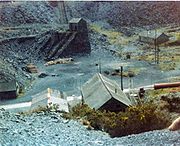
Stationary engine
A stationary engineStationary engine
A stationary engine is an engine whose framework does not move. It is normally used not to propel a vehicle but to drive a piece of immobile equipment such as a pump or power tool. They may be powered by steam; or oil-burning or internal combustion engines....
drives the winding drum that hauls the wagons to the top of the inclined plane and may provide braking for descending loads. Only a single track and cable is required for this type. The stationary engine may be a steam
Stationary steam engine
Stationary steam engines are fixed steam engines used for pumping or driving mills and factories, and for power generation. They are distinct from locomotive engines used on railways, traction engines for heavy steam haulage on roads, steam cars , agricultural engines used for ploughing or...
or internal combustion engine, or may be a water wheel
Water wheel
A water wheel is a machine for converting the energy of free-flowing or falling water into useful forms of power. A water wheel consists of a large wooden or metal wheel, with a number of blades or buckets arranged on the outside rim forming the driving surface...
.
Gravity balance
In a gravity balance system two parallel tracks are employed with ascending trains on one and descending trains on the adjacent track. A single cable is attached to both trains, wound round a winding drum at the top of the incline to provide braking. The weight of the loaded descending cars is used to lift the ascending empties.This form of cable railway can only be used to move loads downhill and requires a wider space than a stationary engine -driven incline, but has the advantage of not requiring external power, and therefore costs less to operate.
Tank inclines
A variation of the gravity balance incline was the "tank" incline found at several quarries in north WalesWales
Wales is a country that is part of the United Kingdom and the island of Great Britain, bordered by England to its east and the Atlantic Ocean and Irish Sea to its west. It has a population of three million, and a total area of 20,779 km²...
, notably the Dinorwic Quarry
Dinorwic Quarry
The Dinorwic Slate Quarry is a large former slate quarry, now home to the Welsh National Slate Museum, located between the villages of Llanberis and Dinorwig in north Wales. It was the second largest slate quarry in Wales, indeed in the world, after the neighbouring Penrhyn Quarry....
. These were worked by gravity, but instead of the wagons running on their own wheels, permanently attached angled wagons were used that had a horizontal platform on which the cargo-carrying wagons rode. Despite their name, these inclines were not a form of water balance incline.
Water balance
This is a variant of the gravity balance incline that can be used to move loads uphill. The weight of the unloaded descending train is increased using water until it is greater than the train travelling uphill. At this point gravity allows the uphill train to ascend. The water is either carried in an additional water wagon attached to the descending train, or is carried in a platform on which the train descends.This form of incline has the advantages of a gravity balance system with the added ability to haul loads uphill. It is only practical where a large supply of water is available at the top of the incline.
An example of this type of cable railway is the passenger carrying Lynton and Lynmouth Cliff Railway
Lynton and Lynmouth Cliff Railway
The Lynton and Lynmouth Cliff Railway is a water-powered funicular railway joining the twin towns of Lynton and Lynmouth on the rugged coast of North Devon.-Origins:...
.
Locomotive-hauled
An uncommon form of cable railway uses locomotives, fitted with a winding drum, to power the cable. With the cable or chain attached to the wagons to be drawn, but the drive to the drum disengaged, the locomotive climbs the slope under its own power. When the cable is nearly at its full extent, or when the summit is reached, the locomotive is fastened to the rails and the cable wound in.In a simpler form the cable is attached to a locomotive, usually at the upper end of the incline. The locomotive is driven away from the head of the incline, hauling wagons up the inclined plane. The locomotive itself does not travel on the steeply graded section. An example is at the Amberley Chalk Pits Museum. This is most commonly used for a temporary incline where setting up the infrastructure of a winding drum and stationary engine is not appropriate. It is similarly employed for recovery operations where derailed rolling stock
Derailment
A derailment is an accident on a railway or tramway in which a rail vehicle, or part or all of a train, leaves the tracks on which it is travelling, with consequent damage and in many cases injury and/or death....
must be hauled back to the permanent track.
Examples
- Opened in 1826, the Bowes RailwayBowes RailwayThe Bowes Railway, built by George Stephenson in 1826, is the world's only preserved operational standard gauge cable railway system. It was built to transport coal from Durham pits to boats on the River Tyne. Only part of the system now remains.-Background:...
on the outskirts of GatesheadGatesheadGateshead is a town in Tyne and Wear, England and is the main settlement in the Metropolitan Borough of Gateshead. Historically a part of County Durham, it lies on the southern bank of the River Tyne opposite Newcastle upon Tyne and together they form the urban core of Tyneside...
, in EnglandEnglandEngland is a country that is part of the United Kingdom. It shares land borders with Scotland to the north and Wales to the west; the Irish Sea is to the north west, the Celtic Sea to the south west, with the North Sea to the east and the English Channel to the south separating it from continental...
, is the world's only preserved operational (standard gaugeStandard gaugeThe standard gauge is a widely-used track gauge . Approximately 60% of the world's existing railway lines are built to this gauge...
) cable railway system.
- Cromford and High Peak RailwayCromford and High Peak RailwayThe Cromford and High Peak Railway in Derbyshire, England, was completed in 1831, to carry minerals and goods between the Cromford Canal wharf at High Peak Junction and the Peak Forest Canal at Whaley Bridge -Origins:...
opened in 1831 with grades up to 1 in 8. Had nine inclined planes: eight were engine-powered, one was a counterbalance (gravity) type operated by a horse gin. The Middleton Top winding engineWinding engineA winding engine is a stationary engine used to control a cable, for example to power a mining hoist at a pit head. Electric hoist controllers have replaced proper winding engines in modern mining, but use electric motors that are also traditionally referred to as winding engines.Most proper...
house at the summit of Middleton Incline has been preserved and the ancient steam engineSteam engineA steam engine is a heat engine that performs mechanical work using steam as its working fluid.Steam engines are external combustion engines, where the working fluid is separate from the combustion products. Non-combustion heat sources such as solar power, nuclear power or geothermal energy may be...
inside, once used to haul wagons up, is often demonstrated.
- Liverpool and Manchester RailwayLiverpool and Manchester RailwayThe Liverpool and Manchester Railway was the world's first inter-city passenger railway in which all the trains were timetabled and were hauled for most of the distance solely by steam locomotives. The line opened on 15 September 1830 and ran between the cities of Liverpool and Manchester in North...
- Opened with cable haulage down a 1 in 48 grade to the dockside at LiverpoolLiverpoolLiverpool is a city and metropolitan borough of Merseyside, England, along the eastern side of the Mersey Estuary. It was founded as a borough in 1207 and was granted city status in 1880...
. - Designed for cable haulage up and down 1 in 100 grades at RainhillRainhillRainhill is a large village and civil parish of the Metropolitan Borough of St Helens, in Merseyside, England.Historically a part of Lancashire, Rainhill was formerly a township within the ecclesiastical parish of Prescot, and hundred of West Derby...
in the belief that locomotiveLocomotiveA locomotive is a railway vehicle that provides the motive power for a train. The word originates from the Latin loco – "from a place", ablative of locus, "place" + Medieval Latin motivus, "causing motion", and is a shortened form of the term locomotive engine, first used in the early 19th...
haulage was impracticable. The Rainhill TrialsRainhill TrialsThe Rainhill Trials were an important competition in the early days of steam locomotive railways, run in October 1829 in Rainhill, Lancashire for the nearly completed Liverpool and Manchester Railway....
showed that locomotives could handle 1 in 100 gradients.
- Opened with cable haulage down a 1 in 48 grade to the dockside at Liverpool
- Brampton RailwayBrampton RailwayThe Brampton railway was a ten mile long track branch railway line on the borders of Cumberland and Northumberland, England, that ran from to on the Alston Line via three intermediate stations, Brampton Junction, and...
was reconfigured in 1836, and included a gravity balanced inclined plane between Kirkhouse and HallbankgateHallbankgateHallbankgate is a village in the English county of Cumbria. It is the principal settlement in the parish of Farlam, in the City of Carlisle district.. The village straddles the A689 Brampton to Alston road. It was formerly a mining village- both coal and lead were mined here. Limestone is quarried...
. It had a maximum gradient of 1 in 17. The mineral lines above the plane were operated after 1840 by Stephenson's RocketStephenson's RocketStephenson's Rocket was an early steam locomotive of 0-2-2 wheel arrangement, built in Newcastle Upon Tyne at the Forth Street Works of Robert Stephenson and Company in 1829.- Design innovations :...
.
- High Peak JunctionHigh Peak JunctionHigh Peak Junction, near Cromford, Derbyshire, England, is the name now used to describe the site where the former Cromford and High Peak Railway , whose workshops were located here, meets the Cromford Canal...
opened 29 May 1830 with railway incline connecting two canals.
- A Pit fishbelly gravitational railway operated between 1831-1846 to service the Australian Agricultural Company coal mine. B Pit opened 1837 and C Pit opened mid-1842. All were private-operations by the same company.
- Camden Incline, Between EustonEuston stationEuston station may refer to one of the following stations in London, United Kingdom:*Euston railway station, a major terminus for trains to the West Midlands, the North West, North Wales and part of Scotland...
and Primrose HillPrimrose Hill railway stationPrimrose Hill was a railway station at Primrose Hill, in the London Borough of Camden, London, England.It was opened on 5 May 1855 as Hampstead Road, replacing an earlier station of that name . It was renamed Chalk Farm on 1 December 1862 and became Primrose Hill on 25 September 1950...
on the London and Birmingham RailwayLondon and Birmingham RailwayThe London and Birmingham Railway was an early railway company in the United Kingdom from 1833 to 1846, when it became part of the London and North Western Railway ....
, 20 July 1837.
- The WelshWalesWales is a country that is part of the United Kingdom and the island of Great Britain, bordered by England to its east and the Atlantic Ocean and Irish Sea to its west. It has a population of three million, and a total area of 20,779 km²...
slateSlateSlate is a fine-grained, foliated, homogeneous metamorphic rock derived from an original shale-type sedimentary rock composed of clay or volcanic ash through low-grade regional metamorphism. The result is a foliated rock in which the foliation may not correspond to the original sedimentary layering...
industry made heavy use of gravity balance and water balance inclines to move slates from quarries down to transshipmentTransshipmentTransshipment or Transhipment is the shipment of goods or containers to an intermediate destination, and then from there to yet another destination....
points. Examples of substantial inclines were found in the quarries feeding the Ffestiniog RailwayFfestiniog RailwayThe Ffestiniog Railway is a narrow gauge heritage railway, located in Gwynedd, Wales. It is a major tourist attraction located mainly within the Snowdonia National Park....
, the Talyllyn RailwayTalyllyn RailwayThe Talyllyn Railway is a narrow-gauge preserved railway in Wales running for from Tywyn on the Mid-Wales coast to Nant Gwernol near the village of Abergynolwyn. The line was opened in 1866 to carry slate from the quarries at Bryn Eglwys to Tywyn, and was the first narrow gauge railway in Britain...
and the Corris RailwayCorris RailwayThe Corris Railway is a narrow gauge preserved railway based in Corris on the border between Merionethshire and Montgomeryshire in Mid-Wales....
amongst others.
- The Denniston Incline (1879–1967), north of Brunner, New ZealandBrunner, New ZealandBrunner is a town in the northwest of New Zealand's South Island. Together with Taylorville and Dobson to the south-west, it had a population of 672 at the 2006 census. It is 12 kilometres to the east of Greymouth, on the south bank of the Grey River. It is on the Midland Line railway near its...
, was gravity worked. It descended 518 m (1,699.5 ft) in a track distance of 1670 m (5,479 ft), separated into two inclines, and during its life carried 13000000 t (12,794,645.9 LT; 14,330,047 ST) of coal.
- The middle section of the Erkrath-Hochdahl Railway in Germany (1841–1926) had an inclined plane where trains were assisted by rope from a stationary engine. The height difference was 82 metres over a 2.5 kilometre length
Incline
Incline, inclined, inclining, or inclination may refer to:* Incline, California* Inclined plane, a flat surface whose endpoints are at different heights* Inclined orbit, an orbital plane is tipped away from the equator...
or inclined plane
Inclined plane
The inclined plane is one of the original six simple machines; as the name suggests, it is a flat surface whose endpoints are at different heights. By moving an object up an inclined plane rather than completely vertical, the amount of force required is reduced, at the expense of increasing the...
) is a steeply graded railway that uses a cable
Wire rope
thumb|Steel wire rope Wire rope is a type of rope which consists of several strands of metal wire laid into a helix. Initially wrought iron wires were used, but today steel is the main material used for wire ropes....
or rope
Rope
A rope is a length of fibres, twisted or braided together to improve strength for pulling and connecting. It has tensile strength but is too flexible to provide compressive strength...
to haul trains.
Introduction
Cable railways are typically built where the gradient of the route is so steep that a conventional adhesionRail adhesion
The term adhesion railway or adhesion traction describes the most common type of railway, where power is applied by driving some or all of the wheels of the locomotive. Thus, it relies on the friction between a steel wheel and a steel rail. Note that steam locomotives of old were driven only by...
train could not climb the track. Most commonly the cable is operated by a stationary engine
Stationary engine
A stationary engine is an engine whose framework does not move. It is normally used not to propel a vehicle but to drive a piece of immobile equipment such as a pump or power tool. They may be powered by steam; or oil-burning or internal combustion engines....
, although other methods such as gravity or water-balance are also used.
Many cable railways connect to conventional adhesion lines at their top and bottom, allowing trains to be lifted from a lower line to a higher one. A specific type of cable railway is the funicular
Funicular
A funicular, also known as an inclined plane or cliff railway, is a cable railway in which a cable attached to a pair of tram-like vehicles on rails moves them up and down a steep slope; the ascending and descending vehicles counterbalance each other.-Operation:The basic principle of funicular...
, which is a cable railway with the cars permanently fixed to the cable. Usually funiculars are self-contained and not connected to other railway networks.
Use
The majority of inclines were used in industrial settings, predominantly in quarries and mines. The Welsh slate industry made extensive use of inclines to connect quarry galleries and underground chambers with the mills where slate was processed.Operation
Rail tracks
The track on a railway or railroad, also known as the permanent way, is the structure consisting of the rails, fasteners, sleepers and ballast , plus the underlying subgrade...
are arranged above and below the gradient to allow wagons to be moved onto the incline either singularly or in short rakes of two or more.
On the incline itself the tracks may be interlaced to reduce the width of land needed. This requires use of gauntlet track: either a single track of two rails, or a three-rail track where trains share a common rail; at the centre of the incline there will be a passing track to allow the ascending and descending trains to pass each other.
Railway workers attach the cable
Wire rope
thumb|Steel wire rope Wire rope is a type of rope which consists of several strands of metal wire laid into a helix. Initially wrought iron wires were used, but today steel is the main material used for wire ropes....
to the upper wagon, and detach it when it arrives at the other end of the incline. Generally, special-purpose safety couplings are used rather than the ordinary wagon couplings. The cables may be guided between the rails on the incline by a series of rollers so that they do not fall across the rail where they would be damaged by the wheels on the wagons.
Occasionally inclines were used to move locomotives between levels, but these were comparatively rare as it was normally cheaper to provide a separate fleet of locomotives on either side of the incline, or else to work the level sections with horses.
On early railways, cable-worked inclines were also used on some passenger lines, for example at Cowlairs in Glasgow
Glasgow
Glasgow is the largest city in Scotland and third most populous in the United Kingdom. The city is situated on the River Clyde in the country's west central lowlands...
.
Controls
The speed of the wagons was usually controlled by means of a brake that acted on the winding drum at the head of the incline. The incline cable passed round the drum several times to ensure there was sufficient friction for the brake to slow the rotation of the drum – and therefore the wagons – without the cable slipping.At the head of the incline various devices were employed to ensure that wagons did not start to descend before they were attached to the cable. These ranged from simple lumps of rock wedged behind the wagon's wheels to permanently installed chocks that were mechanically synchronized with the drum braking system. At Maenofferen Quarry
Maenofferen Quarry
Maenofferen Quarry is a major slate quarry in the town of Blaenau Ffestiniog, north Wales and one of the major users of the Ffestiniog Railway. It continues to produce crushed slate on a limited scale under the ownership of the nearby Llechwedd quarry....
a system was installed that raised a short section of the rail at the head of the incline to prevent runaways.
The operation of an incline was typically controlled by the brakesman positioned at the winding house. A variety of systems were used to communicate with workers at the bottom of the incline, whose job it was to attach and detach the wagons from the incline cable. One of the most common communication methods was a simple electrical bell system.
Turnouts
Cable railways were often used within quarriesQuarry
A quarry is a type of open-pit mine from which rock or minerals are extracted. Quarries are generally used for extracting building materials, such as dimension stone, construction aggregate, riprap, sand, and gravel. They are often collocated with concrete and asphalt plants due to the requirement...
to connect working levels. Sometimes a single cable railway would span multiple levels, allowing wagons to be moved between the furthest levels in a single movement. In order to accommodate intermediate levels, turnouts were used to allow wagons to leave and join the cable railway part way along its length. Various methods were used to achieve this.
One arrangement used at the Dinorwic Quarry
Dinorwic Quarry
The Dinorwic Slate Quarry is a large former slate quarry, now home to the Welsh National Slate Museum, located between the villages of Llanberis and Dinorwig in north Wales. It was the second largest slate quarry in Wales, indeed in the world, after the neighbouring Penrhyn Quarry....
was known as the "Ballast" method. This involved a two track incline with one track reserved for fully loaded wagons and the second used by partially loaded wagons. The line used by the partially loaded wagons was known as the "ballast" track and it had a stop placed on it part way down. The distance from the top of the incline to the stop was the same as the distance that the fully loaded wagons needed to travel. Empty wagons were hauled up the incline, counterbalanced by the descending ballast wagons. These empty wagons were replaced by fully loaded wagons ready to descend. The descending loaded wagons then returned the ballast wagons to the top of the incline. One of the major inclines at Dinorwic had four parallel tracks, two worked by the ballast method and two as conventional gravity balance.
Types
Stationary engine
A stationary engineStationary engine
A stationary engine is an engine whose framework does not move. It is normally used not to propel a vehicle but to drive a piece of immobile equipment such as a pump or power tool. They may be powered by steam; or oil-burning or internal combustion engines....
drives the winding drum that hauls the wagons to the top of the inclined plane and may provide braking for descending loads. Only a single track and cable is required for this type. The stationary engine may be a steam
Stationary steam engine
Stationary steam engines are fixed steam engines used for pumping or driving mills and factories, and for power generation. They are distinct from locomotive engines used on railways, traction engines for heavy steam haulage on roads, steam cars , agricultural engines used for ploughing or...
or internal combustion engine, or may be a water wheel
Water wheel
A water wheel is a machine for converting the energy of free-flowing or falling water into useful forms of power. A water wheel consists of a large wooden or metal wheel, with a number of blades or buckets arranged on the outside rim forming the driving surface...
.
Gravity balance
In a gravity balance system two parallel tracks are employed with ascending trains on one and descending trains on the adjacent track. A single cable is attached to both trains, wound round a winding drum at the top of the incline to provide braking. The weight of the loaded descending cars is used to lift the ascending empties.This form of cable railway can only be used to move loads downhill and requires a wider space than a stationary engine -driven incline, but has the advantage of not requiring external power, and therefore costs less to operate.
Tank inclines
A variation of the gravity balance incline was the "tank" incline found at several quarries in north WalesWales
Wales is a country that is part of the United Kingdom and the island of Great Britain, bordered by England to its east and the Atlantic Ocean and Irish Sea to its west. It has a population of three million, and a total area of 20,779 km²...
, notably the Dinorwic Quarry
Dinorwic Quarry
The Dinorwic Slate Quarry is a large former slate quarry, now home to the Welsh National Slate Museum, located between the villages of Llanberis and Dinorwig in north Wales. It was the second largest slate quarry in Wales, indeed in the world, after the neighbouring Penrhyn Quarry....
. These were worked by gravity, but instead of the wagons running on their own wheels, permanently attached angled wagons were used that had a horizontal platform on which the cargo-carrying wagons rode. Despite their name, these inclines were not a form of water balance incline.
Water balance
This is a variant of the gravity balance incline that can be used to move loads uphill. The weight of the unloaded descending train is increased using water until it is greater than the train travelling uphill. At this point gravity allows the uphill train to ascend. The water is either carried in an additional water wagon attached to the descending train, or is carried in a platform on which the train descends.This form of incline has the advantages of a gravity balance system with the added ability to haul loads uphill. It is only practical where a large supply of water is available at the top of the incline.
An example of this type of cable railway is the passenger carrying Lynton and Lynmouth Cliff Railway
Lynton and Lynmouth Cliff Railway
The Lynton and Lynmouth Cliff Railway is a water-powered funicular railway joining the twin towns of Lynton and Lynmouth on the rugged coast of North Devon.-Origins:...
.
Locomotive-hauled
An uncommon form of cable railway uses locomotives, fitted with a winding drum, to power the cable. With the cable or chain attached to the wagons to be drawn, but the drive to the drum disengaged, the locomotive climbs the slope under its own power. When the cable is nearly at its full extent, or when the summit is reached, the locomotive is fastened to the rails and the cable wound in.In a simpler form the cable is attached to a locomotive, usually at the upper end of the incline. The locomotive is driven away from the head of the incline, hauling wagons up the inclined plane. The locomotive itself does not travel on the steeply graded section. An example is at the Amberley Chalk Pits Museum. This is most commonly used for a temporary incline where setting up the infrastructure of a winding drum and stationary engine is not appropriate. It is similarly employed for recovery operations where derailed rolling stock
Derailment
A derailment is an accident on a railway or tramway in which a rail vehicle, or part or all of a train, leaves the tracks on which it is travelling, with consequent damage and in many cases injury and/or death....
must be hauled back to the permanent track.Picture of recovery gear that uses a locomotive as its power source(Accessed 2008-03-26)
Examples
- Opened in 1826, the Bowes RailwayBowes RailwayThe Bowes Railway, built by George Stephenson in 1826, is the world's only preserved operational standard gauge cable railway system. It was built to transport coal from Durham pits to boats on the River Tyne. Only part of the system now remains.-Background:...
on the outskirts of GatesheadGatesheadGateshead is a town in Tyne and Wear, England and is the main settlement in the Metropolitan Borough of Gateshead. Historically a part of County Durham, it lies on the southern bank of the River Tyne opposite Newcastle upon Tyne and together they form the urban core of Tyneside...
, in EnglandEnglandEngland is a country that is part of the United Kingdom. It shares land borders with Scotland to the north and Wales to the west; the Irish Sea is to the north west, the Celtic Sea to the south west, with the North Sea to the east and the English Channel to the south separating it from continental...
, is the world's only preserved operational (standard gaugeStandard gaugeThe standard gauge is a widely-used track gauge . Approximately 60% of the world's existing railway lines are built to this gauge...
) cable railway system.
- Cromford and High Peak RailwayCromford and High Peak RailwayThe Cromford and High Peak Railway in Derbyshire, England, was completed in 1831, to carry minerals and goods between the Cromford Canal wharf at High Peak Junction and the Peak Forest Canal at Whaley Bridge -Origins:...
opened in 1831 with grades up to 1 in 8. Had nine inclined planes: eight were engine-powered, one was a counterbalance (gravity) type operated by a horse gin. The Middleton Top winding engineWinding engineA winding engine is a stationary engine used to control a cable, for example to power a mining hoist at a pit head. Electric hoist controllers have replaced proper winding engines in modern mining, but use electric motors that are also traditionally referred to as winding engines.Most proper...
house at the summit of Middleton Incline has been preserved and the ancient steam engineSteam engineA steam engine is a heat engine that performs mechanical work using steam as its working fluid.Steam engines are external combustion engines, where the working fluid is separate from the combustion products. Non-combustion heat sources such as solar power, nuclear power or geothermal energy may be...
inside, once used to haul wagons up, is often demonstrated.
- Liverpool and Manchester RailwayLiverpool and Manchester RailwayThe Liverpool and Manchester Railway was the world's first inter-city passenger railway in which all the trains were timetabled and were hauled for most of the distance solely by steam locomotives. The line opened on 15 September 1830 and ran between the cities of Liverpool and Manchester in North...
- Opened with cable haulage down a 1 in 48 grade to the dockside at LiverpoolLiverpoolLiverpool is a city and metropolitan borough of Merseyside, England, along the eastern side of the Mersey Estuary. It was founded as a borough in 1207 and was granted city status in 1880...
. - Designed for cable haulage up and down 1 in 100 grades at RainhillRainhillRainhill is a large village and civil parish of the Metropolitan Borough of St Helens, in Merseyside, England.Historically a part of Lancashire, Rainhill was formerly a township within the ecclesiastical parish of Prescot, and hundred of West Derby...
in the belief that locomotiveLocomotiveA locomotive is a railway vehicle that provides the motive power for a train. The word originates from the Latin loco – "from a place", ablative of locus, "place" + Medieval Latin motivus, "causing motion", and is a shortened form of the term locomotive engine, first used in the early 19th...
haulage was impracticable. The Rainhill TrialsRainhill TrialsThe Rainhill Trials were an important competition in the early days of steam locomotive railways, run in October 1829 in Rainhill, Lancashire for the nearly completed Liverpool and Manchester Railway....
showed that locomotives could handle 1 in 100 gradients.
- Opened with cable haulage down a 1 in 48 grade to the dockside at Liverpool
- Brampton RailwayBrampton RailwayThe Brampton railway was a ten mile long track branch railway line on the borders of Cumberland and Northumberland, England, that ran from to on the Alston Line via three intermediate stations, Brampton Junction, and...
was reconfigured in 1836, and included a gravity balanced inclined plane between Kirkhouse and HallbankgateHallbankgateHallbankgate is a village in the English county of Cumbria. It is the principal settlement in the parish of Farlam, in the City of Carlisle district.. The village straddles the A689 Brampton to Alston road. It was formerly a mining village- both coal and lead were mined here. Limestone is quarried...
. It had a maximum gradient of 1 in 17. The mineral lines above the plane were operated after 1840 by Stephenson's RocketStephenson's RocketStephenson's Rocket was an early steam locomotive of 0-2-2 wheel arrangement, built in Newcastle Upon Tyne at the Forth Street Works of Robert Stephenson and Company in 1829.- Design innovations :...
.
- High Peak JunctionHigh Peak JunctionHigh Peak Junction, near Cromford, Derbyshire, England, is the name now used to describe the site where the former Cromford and High Peak Railway , whose workshops were located here, meets the Cromford Canal...
opened 29 May 1830 with railway incline connecting two canals.
- A Pit fishbelly gravitational railway operated between 1831-1846 to service the Australian Agricultural Company coal mine. B Pit opened 1837 and C Pit opened mid-1842. All were private-operations by the same company.
- Camden Incline, Between EustonEuston stationEuston station may refer to one of the following stations in London, United Kingdom:*Euston railway station, a major terminus for trains to the West Midlands, the North West, North Wales and part of Scotland...
and Primrose HillPrimrose Hill railway stationPrimrose Hill was a railway station at Primrose Hill, in the London Borough of Camden, London, England.It was opened on 5 May 1855 as Hampstead Road, replacing an earlier station of that name . It was renamed Chalk Farm on 1 December 1862 and became Primrose Hill on 25 September 1950...
on the London and Birmingham RailwayLondon and Birmingham RailwayThe London and Birmingham Railway was an early railway company in the United Kingdom from 1833 to 1846, when it became part of the London and North Western Railway ....
, 20 July 1837.
- The WelshWalesWales is a country that is part of the United Kingdom and the island of Great Britain, bordered by England to its east and the Atlantic Ocean and Irish Sea to its west. It has a population of three million, and a total area of 20,779 km²...
slateSlateSlate is a fine-grained, foliated, homogeneous metamorphic rock derived from an original shale-type sedimentary rock composed of clay or volcanic ash through low-grade regional metamorphism. The result is a foliated rock in which the foliation may not correspond to the original sedimentary layering...
industry made heavy use of gravity balance and water balance inclines to move slates from quarries down to transshipmentTransshipmentTransshipment or Transhipment is the shipment of goods or containers to an intermediate destination, and then from there to yet another destination....
points. Examples of substantial inclines were found in the quarries feeding the Ffestiniog RailwayFfestiniog RailwayThe Ffestiniog Railway is a narrow gauge heritage railway, located in Gwynedd, Wales. It is a major tourist attraction located mainly within the Snowdonia National Park....
, the Talyllyn RailwayTalyllyn RailwayThe Talyllyn Railway is a narrow-gauge preserved railway in Wales running for from Tywyn on the Mid-Wales coast to Nant Gwernol near the village of Abergynolwyn. The line was opened in 1866 to carry slate from the quarries at Bryn Eglwys to Tywyn, and was the first narrow gauge railway in Britain...
and the Corris RailwayCorris RailwayThe Corris Railway is a narrow gauge preserved railway based in Corris on the border between Merionethshire and Montgomeryshire in Mid-Wales....
amongst others.
- The Denniston Incline (1879–1967), north of Brunner, New ZealandBrunner, New ZealandBrunner is a town in the northwest of New Zealand's South Island. Together with Taylorville and Dobson to the south-west, it had a population of 672 at the 2006 census. It is 12 kilometres to the east of Greymouth, on the south bank of the Grey River. It is on the Midland Line railway near its...
, was gravity worked. It descended 518 m (1,699.5 ft) in a track distance of 1670 m (5,479 ft), separated into two inclines, and during its life carried 13000000 t (12,794,645.9 LT; 14,330,047 ST) of coal.Denniston Incline (including video) (Access date: 18 June 2007)
- The middle section of the Erkrath-Hochdahl Railway in Germany (1841–1926) had an inclined plane where trains were assisted by rope from a stationary engine. The height difference was 82 metres over a 2.5 kilometre length
Incline
Incline, inclined, inclining, or inclination may refer to:* Incline, California* Inclined plane, a flat surface whose endpoints are at different heights* Inclined orbit, an orbital plane is tipped away from the equator...
or inclined plane
Inclined plane
The inclined plane is one of the original six simple machines; as the name suggests, it is a flat surface whose endpoints are at different heights. By moving an object up an inclined plane rather than completely vertical, the amount of force required is reduced, at the expense of increasing the...
) is a steeply graded railway that uses a cable
Wire rope
thumb|Steel wire rope Wire rope is a type of rope which consists of several strands of metal wire laid into a helix. Initially wrought iron wires were used, but today steel is the main material used for wire ropes....
or rope
Rope
A rope is a length of fibres, twisted or braided together to improve strength for pulling and connecting. It has tensile strength but is too flexible to provide compressive strength...
to haul trains.
Introduction
Cable railways are typically built where the gradient of the route is so steep that a conventional adhesionRail adhesion
The term adhesion railway or adhesion traction describes the most common type of railway, where power is applied by driving some or all of the wheels of the locomotive. Thus, it relies on the friction between a steel wheel and a steel rail. Note that steam locomotives of old were driven only by...
train could not climb the track. Most commonly the cable is operated by a stationary engine
Stationary engine
A stationary engine is an engine whose framework does not move. It is normally used not to propel a vehicle but to drive a piece of immobile equipment such as a pump or power tool. They may be powered by steam; or oil-burning or internal combustion engines....
, although other methods such as gravity or water-balance are also used.
Many cable railways connect to conventional adhesion lines at their top and bottom, allowing trains to be lifted from a lower line to a higher one. A specific type of cable railway is the funicular
Funicular
A funicular, also known as an inclined plane or cliff railway, is a cable railway in which a cable attached to a pair of tram-like vehicles on rails moves them up and down a steep slope; the ascending and descending vehicles counterbalance each other.-Operation:The basic principle of funicular...
, which is a cable railway with the cars permanently fixed to the cable. Usually funiculars are self-contained and not connected to other railway networks.
Use
The majority of inclines were used in industrial settings, predominantly in quarries and mines. The Welsh slate industry made extensive use of inclines to connect quarry galleries and underground chambers with the mills where slate was processed.Operation
Rail tracks
The track on a railway or railroad, also known as the permanent way, is the structure consisting of the rails, fasteners, sleepers and ballast , plus the underlying subgrade...
are arranged above and below the gradient to allow wagons to be moved onto the incline either singularly or in short rakes of two or more.
On the incline itself the tracks may be interlaced to reduce the width of land needed. This requires use of gauntlet track: either a single track of two rails, or a three-rail track where trains share a common rail; at the centre of the incline there will be a passing track to allow the ascending and descending trains to pass each other.
Railway workers attach the cable
Wire rope
thumb|Steel wire rope Wire rope is a type of rope which consists of several strands of metal wire laid into a helix. Initially wrought iron wires were used, but today steel is the main material used for wire ropes....
to the upper wagon, and detach it when it arrives at the other end of the incline. Generally, special-purpose safety couplings are used rather than the ordinary wagon couplings. The cables may be guided between the rails on the incline by a series of rollers so that they do not fall across the rail where they would be damaged by the wheels on the wagons.
Occasionally inclines were used to move locomotives between levels, but these were comparatively rare as it was normally cheaper to provide a separate fleet of locomotives on either side of the incline, or else to work the level sections with horses.
On early railways, cable-worked inclines were also used on some passenger lines, for example at Cowlairs in Glasgow
Glasgow
Glasgow is the largest city in Scotland and third most populous in the United Kingdom. The city is situated on the River Clyde in the country's west central lowlands...
.
Controls
The speed of the wagons was usually controlled by means of a brake that acted on the winding drum at the head of the incline. The incline cable passed round the drum several times to ensure there was sufficient friction for the brake to slow the rotation of the drum – and therefore the wagons – without the cable slipping.At the head of the incline various devices were employed to ensure that wagons did not start to descend before they were attached to the cable. These ranged from simple lumps of rock wedged behind the wagon's wheels to permanently installed chocks that were mechanically synchronized with the drum braking system. At Maenofferen Quarry
Maenofferen Quarry
Maenofferen Quarry is a major slate quarry in the town of Blaenau Ffestiniog, north Wales and one of the major users of the Ffestiniog Railway. It continues to produce crushed slate on a limited scale under the ownership of the nearby Llechwedd quarry....
a system was installed that raised a short section of the rail at the head of the incline to prevent runaways.
The operation of an incline was typically controlled by the brakesman positioned at the winding house. A variety of systems were used to communicate with workers at the bottom of the incline, whose job it was to attach and detach the wagons from the incline cable. One of the most common communication methods was a simple electrical bell system.
Turnouts
Cable railways were often used within quarriesQuarry
A quarry is a type of open-pit mine from which rock or minerals are extracted. Quarries are generally used for extracting building materials, such as dimension stone, construction aggregate, riprap, sand, and gravel. They are often collocated with concrete and asphalt plants due to the requirement...
to connect working levels. Sometimes a single cable railway would span multiple levels, allowing wagons to be moved between the furthest levels in a single movement. In order to accommodate intermediate levels, turnouts were used to allow wagons to leave and join the cable railway part way along its length. Various methods were used to achieve this.
One arrangement used at the Dinorwic Quarry
Dinorwic Quarry
The Dinorwic Slate Quarry is a large former slate quarry, now home to the Welsh National Slate Museum, located between the villages of Llanberis and Dinorwig in north Wales. It was the second largest slate quarry in Wales, indeed in the world, after the neighbouring Penrhyn Quarry....
was known as the "Ballast" method. This involved a two track incline with one track reserved for fully loaded wagons and the second used by partially loaded wagons. The line used by the partially loaded wagons was known as the "ballast" track and it had a stop placed on it part way down. The distance from the top of the incline to the stop was the same as the distance that the fully loaded wagons needed to travel. Empty wagons were hauled up the incline, counterbalanced by the descending ballast wagons. These empty wagons were replaced by fully loaded wagons ready to descend. The descending loaded wagons then returned the ballast wagons to the top of the incline. One of the major inclines at Dinorwic had four parallel tracks, two worked by the ballast method and two as conventional gravity balance.
Types
Stationary engine
A stationary engineStationary engine
A stationary engine is an engine whose framework does not move. It is normally used not to propel a vehicle but to drive a piece of immobile equipment such as a pump or power tool. They may be powered by steam; or oil-burning or internal combustion engines....
drives the winding drum that hauls the wagons to the top of the inclined plane and may provide braking for descending loads. Only a single track and cable is required for this type. The stationary engine may be a steam
Stationary steam engine
Stationary steam engines are fixed steam engines used for pumping or driving mills and factories, and for power generation. They are distinct from locomotive engines used on railways, traction engines for heavy steam haulage on roads, steam cars , agricultural engines used for ploughing or...
or internal combustion engine, or may be a water wheel
Water wheel
A water wheel is a machine for converting the energy of free-flowing or falling water into useful forms of power. A water wheel consists of a large wooden or metal wheel, with a number of blades or buckets arranged on the outside rim forming the driving surface...
.
Gravity balance
In a gravity balance system two parallel tracks are employed with ascending trains on one and descending trains on the adjacent track. A single cable is attached to both trains, wound round a winding drum at the top of the incline to provide braking. The weight of the loaded descending cars is used to lift the ascending empties.This form of cable railway can only be used to move loads downhill and requires a wider space than a stationary engine -driven incline, but has the advantage of not requiring external power, and therefore costs less to operate.
Tank inclines
A variation of the gravity balance incline was the "tank" incline found at several quarries in north WalesWales
Wales is a country that is part of the United Kingdom and the island of Great Britain, bordered by England to its east and the Atlantic Ocean and Irish Sea to its west. It has a population of three million, and a total area of 20,779 km²...
, notably the Dinorwic Quarry
Dinorwic Quarry
The Dinorwic Slate Quarry is a large former slate quarry, now home to the Welsh National Slate Museum, located between the villages of Llanberis and Dinorwig in north Wales. It was the second largest slate quarry in Wales, indeed in the world, after the neighbouring Penrhyn Quarry....
. These were worked by gravity, but instead of the wagons running on their own wheels, permanently attached angled wagons were used that had a horizontal platform on which the cargo-carrying wagons rode. Despite their name, these inclines were not a form of water balance incline.
Water balance
This is a variant of the gravity balance incline that can be used to move loads uphill. The weight of the unloaded descending train is increased using water until it is greater than the train travelling uphill. At this point gravity allows the uphill train to ascend. The water is either carried in an additional water wagon attached to the descending train, or is carried in a platform on which the train descends.This form of incline has the advantages of a gravity balance system with the added ability to haul loads uphill. It is only practical where a large supply of water is available at the top of the incline.
An example of this type of cable railway is the passenger carrying Lynton and Lynmouth Cliff Railway
Lynton and Lynmouth Cliff Railway
The Lynton and Lynmouth Cliff Railway is a water-powered funicular railway joining the twin towns of Lynton and Lynmouth on the rugged coast of North Devon.-Origins:...
.
Locomotive-hauled
An uncommon form of cable railway uses locomotives, fitted with a winding drum, to power the cable. With the cable or chain attached to the wagons to be drawn, but the drive to the drum disengaged, the locomotive climbs the slope under its own power. When the cable is nearly at its full extent, or when the summit is reached, the locomotive is fastened to the rails and the cable wound in.In a simpler form the cable is attached to a locomotive, usually at the upper end of the incline. The locomotive is driven away from the head of the incline, hauling wagons up the inclined plane. The locomotive itself does not travel on the steeply graded section. An example is at the Amberley Chalk Pits Museum. This is most commonly used for a temporary incline where setting up the infrastructure of a winding drum and stationary engine is not appropriate. It is similarly employed for recovery operations where derailed rolling stock
Derailment
A derailment is an accident on a railway or tramway in which a rail vehicle, or part or all of a train, leaves the tracks on which it is travelling, with consequent damage and in many cases injury and/or death....
must be hauled back to the permanent track.Picture of recovery gear that uses a locomotive as its power source(Accessed 2008-03-26)
Examples
- Opened in 1826, the Bowes RailwayBowes RailwayThe Bowes Railway, built by George Stephenson in 1826, is the world's only preserved operational standard gauge cable railway system. It was built to transport coal from Durham pits to boats on the River Tyne. Only part of the system now remains.-Background:...
on the outskirts of GatesheadGatesheadGateshead is a town in Tyne and Wear, England and is the main settlement in the Metropolitan Borough of Gateshead. Historically a part of County Durham, it lies on the southern bank of the River Tyne opposite Newcastle upon Tyne and together they form the urban core of Tyneside...
, in EnglandEnglandEngland is a country that is part of the United Kingdom. It shares land borders with Scotland to the north and Wales to the west; the Irish Sea is to the north west, the Celtic Sea to the south west, with the North Sea to the east and the English Channel to the south separating it from continental...
, is the world's only preserved operational (standard gaugeStandard gaugeThe standard gauge is a widely-used track gauge . Approximately 60% of the world's existing railway lines are built to this gauge...
) cable railway system.
- Cromford and High Peak RailwayCromford and High Peak RailwayThe Cromford and High Peak Railway in Derbyshire, England, was completed in 1831, to carry minerals and goods between the Cromford Canal wharf at High Peak Junction and the Peak Forest Canal at Whaley Bridge -Origins:...
opened in 1831 with grades up to 1 in 8. Had nine inclined planes: eight were engine-powered, one was a counterbalance (gravity) type operated by a horse gin. The Middleton Top winding engineWinding engineA winding engine is a stationary engine used to control a cable, for example to power a mining hoist at a pit head. Electric hoist controllers have replaced proper winding engines in modern mining, but use electric motors that are also traditionally referred to as winding engines.Most proper...
house at the summit of Middleton Incline has been preserved and the ancient steam engineSteam engineA steam engine is a heat engine that performs mechanical work using steam as its working fluid.Steam engines are external combustion engines, where the working fluid is separate from the combustion products. Non-combustion heat sources such as solar power, nuclear power or geothermal energy may be...
inside, once used to haul wagons up, is often demonstrated.
- Liverpool and Manchester RailwayLiverpool and Manchester RailwayThe Liverpool and Manchester Railway was the world's first inter-city passenger railway in which all the trains were timetabled and were hauled for most of the distance solely by steam locomotives. The line opened on 15 September 1830 and ran between the cities of Liverpool and Manchester in North...
- Opened with cable haulage down a 1 in 48 grade to the dockside at LiverpoolLiverpoolLiverpool is a city and metropolitan borough of Merseyside, England, along the eastern side of the Mersey Estuary. It was founded as a borough in 1207 and was granted city status in 1880...
. - Designed for cable haulage up and down 1 in 100 grades at RainhillRainhillRainhill is a large village and civil parish of the Metropolitan Borough of St Helens, in Merseyside, England.Historically a part of Lancashire, Rainhill was formerly a township within the ecclesiastical parish of Prescot, and hundred of West Derby...
in the belief that locomotiveLocomotiveA locomotive is a railway vehicle that provides the motive power for a train. The word originates from the Latin loco – "from a place", ablative of locus, "place" + Medieval Latin motivus, "causing motion", and is a shortened form of the term locomotive engine, first used in the early 19th...
haulage was impracticable. The Rainhill TrialsRainhill TrialsThe Rainhill Trials were an important competition in the early days of steam locomotive railways, run in October 1829 in Rainhill, Lancashire for the nearly completed Liverpool and Manchester Railway....
showed that locomotives could handle 1 in 100 gradients.
- Opened with cable haulage down a 1 in 48 grade to the dockside at Liverpool
- Brampton RailwayBrampton RailwayThe Brampton railway was a ten mile long track branch railway line on the borders of Cumberland and Northumberland, England, that ran from to on the Alston Line via three intermediate stations, Brampton Junction, and...
was reconfigured in 1836, and included a gravity balanced inclined plane between Kirkhouse and HallbankgateHallbankgateHallbankgate is a village in the English county of Cumbria. It is the principal settlement in the parish of Farlam, in the City of Carlisle district.. The village straddles the A689 Brampton to Alston road. It was formerly a mining village- both coal and lead were mined here. Limestone is quarried...
. It had a maximum gradient of 1 in 17. The mineral lines above the plane were operated after 1840 by Stephenson's RocketStephenson's RocketStephenson's Rocket was an early steam locomotive of 0-2-2 wheel arrangement, built in Newcastle Upon Tyne at the Forth Street Works of Robert Stephenson and Company in 1829.- Design innovations :...
.
- High Peak JunctionHigh Peak JunctionHigh Peak Junction, near Cromford, Derbyshire, England, is the name now used to describe the site where the former Cromford and High Peak Railway , whose workshops were located here, meets the Cromford Canal...
opened 29 May 1830 with railway incline connecting two canals.
- A Pit fishbelly gravitational railway operated between 1831-1846 to service the Australian Agricultural Company coal mine. B Pit opened 1837 and C Pit opened mid-1842. All were private-operations by the same company.
- Camden Incline, Between EustonEuston stationEuston station may refer to one of the following stations in London, United Kingdom:*Euston railway station, a major terminus for trains to the West Midlands, the North West, North Wales and part of Scotland...
and Primrose HillPrimrose Hill railway stationPrimrose Hill was a railway station at Primrose Hill, in the London Borough of Camden, London, England.It was opened on 5 May 1855 as Hampstead Road, replacing an earlier station of that name . It was renamed Chalk Farm on 1 December 1862 and became Primrose Hill on 25 September 1950...
on the London and Birmingham RailwayLondon and Birmingham RailwayThe London and Birmingham Railway was an early railway company in the United Kingdom from 1833 to 1846, when it became part of the London and North Western Railway ....
, 20 July 1837.
- The WelshWalesWales is a country that is part of the United Kingdom and the island of Great Britain, bordered by England to its east and the Atlantic Ocean and Irish Sea to its west. It has a population of three million, and a total area of 20,779 km²...
slateSlateSlate is a fine-grained, foliated, homogeneous metamorphic rock derived from an original shale-type sedimentary rock composed of clay or volcanic ash through low-grade regional metamorphism. The result is a foliated rock in which the foliation may not correspond to the original sedimentary layering...
industry made heavy use of gravity balance and water balance inclines to move slates from quarries down to transshipmentTransshipmentTransshipment or Transhipment is the shipment of goods or containers to an intermediate destination, and then from there to yet another destination....
points. Examples of substantial inclines were found in the quarries feeding the Ffestiniog RailwayFfestiniog RailwayThe Ffestiniog Railway is a narrow gauge heritage railway, located in Gwynedd, Wales. It is a major tourist attraction located mainly within the Snowdonia National Park....
, the Talyllyn RailwayTalyllyn RailwayThe Talyllyn Railway is a narrow-gauge preserved railway in Wales running for from Tywyn on the Mid-Wales coast to Nant Gwernol near the village of Abergynolwyn. The line was opened in 1866 to carry slate from the quarries at Bryn Eglwys to Tywyn, and was the first narrow gauge railway in Britain...
and the Corris RailwayCorris RailwayThe Corris Railway is a narrow gauge preserved railway based in Corris on the border between Merionethshire and Montgomeryshire in Mid-Wales....
amongst others.
- The Denniston Incline (1879–1967), north of Brunner, New ZealandBrunner, New ZealandBrunner is a town in the northwest of New Zealand's South Island. Together with Taylorville and Dobson to the south-west, it had a population of 672 at the 2006 census. It is 12 kilometres to the east of Greymouth, on the south bank of the Grey River. It is on the Midland Line railway near its...
, was gravity worked. It descended 518 m (1,699.5 ft) in a track distance of 1670 m (5,479 ft), separated into two inclines, and during its life carried 13000000 t (12,794,645.9 LT; 14,330,047 ST) of coal.Denniston Incline (including video) (Access date: 18 June 2007)