

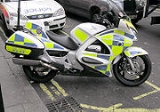
British Transport Police

Encyclopedia
The British Transport Police (BTP) is a special police force that polices those railways and light-rail systems in Great Britain
for which it has entered into an agreement to provide such services. British Transport Police officers do not have any jurisdiction in Northern Ireland
, where policing of the railways is the responsibility of the Police Service of Northern Ireland
.
consequential to being a former part of British Railways, the BTP are also responsible for policing:
This amounts to around 10,000 miles of track and more than 3,000 railway stations and depots. There are more than 1 billion
passenger journeys annually on the mainline alone.
In addition, the British Transport Police in conjunction with the French Police aux Frontières, police the international services operated by Eurostar
.
It is not responsible for policing the rest of the Tyne and Wear Metro
or the Manchester Metrolink
or any other railway with which it does not have a service agreement; it can act as a constabulary for a transport system in Great Britain with which it commences a service agreement. It does not police any heritage railways.
In certain circumstances a BTP constable can act as a police constable outside of their normal railway jurisdiction as described in the "Powers and status of officers" section.
, 327 Police Community Support Officer
s, and 1334 police staff throughout England
, Wales
, and Scotland
. Since June 2009 the Chief Constable has been Andy Trotter OBE, QPM
.
Each division has certain Neighbourhood Policing Teams and the table below outlines the aforementioned teams:
|+ British Transport Police: Neighbourhood Policing Teams>
! style=" border-bottom:1.5px solid black"|Neighbourhood Policing Teams
! style=" border-bottom:1.5px solid black"|Officer in Charge>
| width=50% style="border-bottom:1px solid gray"|Edinburgh Waverley; Glasgow Central; Glasgow Queen Street; Glasgow Subway; Stirling; Haymarket to Falkirk
| width=25% style="border-bottom:1px solid gray"|Chief Inspector Dave Marshall>
| style="border-bottom:1px solid gray"|Southport; Manchester; Wirral
| style="border-bottom:1px solid gray"|Chief Inspector Eddie Wylie>
| style="border-bottom:1px solid gray"|Leeds (covering West Yorkshire); York (East Coast Main Line); Nottingham (Robin Hood Line)
| style="border-bottom:1px solid gray"|Chief Inspector Dave Oram>
| style="border-bottom:1px solid gray"|Birmingham; West Midlands Cross City; Pontypridd; Newport
| style="border-bottom:1px solid gray"|Chief Inspector Sandra England>
| style="border-bottom:1px solid gray"|Euston; Kings Cross; Liverpool Street; Paddington; St Pancras
| style="border-bottom:1px solid gray"|Superintendent Paul Brogden>
| style="border-bottom:1px solid gray"|Clapham; Lewisham; London Bridge; London Bridge First Capital Connect; Victoria Hub; Victoria Loop; Waterloo Hub; Richmond; Bromley
| style="border-bottom:1px solid gray"|Chief Inspector Matt Wratten>
| style="border-bottom:1px solid gray"|Inner London Central Line and Bakerloo; Inner London District and Northern Line; Inner London Victoria and Piccadilly Line; Met, Ham and Circle Line; Central Line East; Central Line West; Central Line North West; District Line East; District Line West; District and Circle Line South; Piccadilly Line West; Piccadilly Line North West; Piccadilly Line North; Northern Line North; Jubilee Line East; Jubilee Line North; DLR; East London Line Extension; Victoria Line North; Victoria and Northern Line South; Hammersmith and City Line; Bakerloo and Jubilee Line South; Bakerloo Line North; Metropolitan Line North West
| style="border-bottom:1px solid gray"|Chief Inspector Paul Wilson>
BTP has appeared on UK television in Railcops.
As of November 2009 BTP had a strength of 2,885 regular police officers. In terms of regular officer numbers this means BTP is 19th largest police force in England & Wales and Scotland
in comparison to the 51 territorial police force
s of Great Britain
.
refers to the police establishment of "One Superintendent, four officers and numerous gate-keepers". This is the first mention of Railway Police anywhere and was three years before the Metropolitan Police Act
was passed. They were not, however, described as "constables" and the description may refer to men controlling the trains not enforcing the law. Specific reference to "constables" rather than mere "policemen" is made by the BTP website article "A History of Policing the Railway" which states "The London, Birmingham and Liverpool Railway Companion of 1838 reports "Each Constable, besides being in the employ of the company, is sworn as a County Constable". Further reference is made by the BTP to "an Act of 1838...which according to J.R. Whitbread in 'The Railway Policeman was the first legislation to provide for any form of policing of the railway whilst under construction, i.e. to protect the public from the navvies more or less."
The modern British Transport Police was formed by the British Transport Commission Act 1949 which combined the already-existing police forces inherited from the pre-nationalisation railways by British Railways, those forces having been previously formed by powers available under common law
to parishes, landowners and other bodies to appoint constable
s to patrol land and/or property under their control. This is distinct from the establishment of a police force by statute, as applicable to the Metropolitan Police
in 1829; BTP did not have jurisdiction on a statutory basis until the enactment of the Transport Police (Jurisdiction) Act 1994, which was subsequently amended by the Railways and Transport Safety Act 2003
.
(now the National Archives) states: "The occasional references to 'Police Department' in the railway staff records relate to signalmen etc. Although some were simultaneousley County Constables"
was passed which required railway and other companies to bear the cost of constables keeping the peace near construction works.
In 1838 the Royal Mail
was conveyed by rail for the first time. The first mail thefts were reported shortly afterwards. In 1848 the Eastern Counties Railway
lost 76 pieces of luggage in just one day, and by the following year thefts from the largest six railways amounted to over £100,000 a year.
The first railway murder was committed by Franz Muller
, who robbed and killed a fellow passenger on a North London Railway
train in 1864.
The first arrest abroad by the British Police was made in 1874 when a Metropolitan Police
Inspector accompanied by a Railway Police Inspector went to the United States to arrest an embezzler.
virtually reformed their police force from scratch in that year, followed by the Great Eastern Railway
, the North Eastern Railway
and Midland Railway
in 1910, the Caledonian Railway
in 1917 and lastly the Great Western Railway
in 1918.
amalgamated over one hundred separate railway systems (of which about 20 had organised police forces) into four groups:-
Each had its own police force controlled by a Chief of Police. These four forces were organised in the same way; each split into a number of Divisions headed by a Superintendent, divided into a number of Divisions Posts led by an Inspector. Detectives worked with their uniformed colleagues at most locations. Many ' non-police' duties were retained however, with officers acting as crossing keepers or locking and sealing wagons.
(BTC) which unified the railway system. On 1 January 1949 the British Transport Commission Police were created, formed from the four old railway police forces, canal police and several minor dock forces.
In 1957 the Maxwell-Johnson enquiry found that policing requirements for the railway could not be met by civil forces and that it was essential that a specialist police force be retained. On 1 January 1962 the British Transport Commission Police ceased to cover British Waterways
property and exactly a year later when the BTC was abolished the name of the force was amended to the British Transport Police. In 1984 London Buses
decided not to use the British Transport Police. The British Transport Docks Board followed in 1985.
The force played a central role in the response to the 7 July 2005 London bombings
. Three of the incidents were at London Underground stations: Edgware Road (Circle Line), Russell Square
and Aldgate
stations.
On 15 July 2006, a Dog Section Training School was opened at the Force Training establishment near Tadworth
, Surrey
.
, and the London Underground
- part of Transport for London
. Around 95% of BTP's funding comes from the train operating companies. Other operators with whom the BTP has a service agreement also contribute appropriately. This funding arrangement does not give the companies power to set objectives for the BTP but there are industry representatives serving as members of the police authority. The police authority does, of course, decide objectives. The industry membership represent 5 out of 13 members.
There is also substantial counter-terrorism funding from the Home Office
The police authority has agreed its budget for 2007/08 at £187.8M – a 9.9% rise.
to make one of the following attestations depending on the jurisdiction in which they have been appointed:
The attestation can be made in Welsh.
" when:
"Railway" means a system of transport employing parallel rails which provide support and guidance for vehicles carried on flanged wheels, and form a track which either is of a gauge of at least 350 millimetres or crosses a carriageway (whether or not on the same level).
A BTP constable may enter
without a warrant, using reasonable force if necessary, and whether or not an offence has been committed. It is an offence to assault or impersonate a BTP constable.
BTP officers can act as police constables outside their normal jurisdiction in the following circumstances:
to assist him/her in the execution of his duties in relation to a particular incident, investigation or operation, a BTP constable also has the powers of the requesting officer for the purposes of that incident, investigation or operation. If a constable from a territorial police force makes the request, then the powers of the BTP constable extend only to the requesting constable's police area. If a constable from the MDP or CNC makes the request, then the powers of the BTP officer are the same as those of the requesting constable.
of one of the forces mentioned above, a BTP constable takes on all the powers and privileges of members of the requesting force. This power is used for planned operations, such as the 2005 G8 summit at Gleneagles
.
A BTP constable may only use such powers if he believes on reasonable grounds that if he cannot do so until he secures the attendance of or a request from a local constable (as above), the purpose for which he believes it ought to be exercised will be frustrated or seriously prejudiced.
The policing protocol between BTP & Home Office forces set outs the practical use of these extended powers.
, BTP constables have the same powers and privileges as members of Kent Police
.
When executing a warrant issued in Scotland, a BTP constable executing it shall have the same powers and duties, and the person arrested the same rights, as they would have had if execution had been in Scotland by a constable of a police force in Scotland. When executing a warrant issued in England, Wales or Northern Ireland, a constable may use reasonable force and has specified search powers provided by section 139 of the Criminal Justice and Public Order Act 1994.
identical to other British police forces. The distinctive black jersey
s with a black and white chequered pattern on the yoke have been replaced with Black Windstopper
fleeces. Officers in Scotland have adopted the same uniform as the Scottish forces.
A BTP constable does not lose the ability to exercise his powers when off duty except for those functions which require the wearing of a uniform.
On 1 July 2004 a Police Authority
for the British Transport Police was created. BTP Officers became employees of the Police Authority, prior to that, they were employees of the Strategic Rail Authority
.
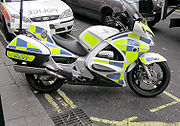 Until the 1990s the principal investigators of railway accidents were the Inspecting Officers of HM Railway Inspectorate
, and BTP involvement was minimal. With major accidents after the 1988 Clapham Junction rail crash
being investigated by more adversarial public inquiries, the BTP took on a more proactive role in crash investigations. Further reforms led to the creation by the Department for Transport
of the Rail Accident Investigation Branch
who take the lead role in investigations of accidents.
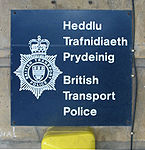 Operation Shield
is an initiative by BTP to reduce the number of knives carried by passengers on the rail network. This initiative came about after knife crime began to rise and also because of the murder of a passenger on a Virgin Trains
service travelling from Glasgow.
collectively describes crimes and offences of trespass and vandalism which occur on railway lines and can affect the running of train services. It is a minor but significant cause of death on British railways. The overwhelming majority - 95% in 2005 - of deaths are suicides with the rest being attributed to trespass.
Graffiti costs rail firms over £5m a year in direct costs alone The BTP maintains a graffiti database which holds over 1900 graffiti tags, each unique to an individual. In 2005 BTP sent 569 suspects to court (an increase of 16% on 2004 figures). Surveys show that fear of crime is exacerbated by graffiti.
The BTP deals with hundreds of instances of theft each day including stolen property and the theft of metals such as copper from railway safety equipment In the North West Area BTP has joined forces with Lancashire Constabulary
and Network Rail to combat thefts of metals from railway lines in an initiative called Operation Tremor
. The BTP established Operation Drum in 2006 as a national response to the increase in metal theft offences and also chairs the relevant Association of Chief Police Officers
working group.
It is estimated that:
Many Specials are recruited from the wider railway community and those working for Train Operating Companies are encouraged by their employers.
Under the terms of the Railways and Transport Safety Act 2003
and the Anti-terrorism, Crime and Security Act 2001
, BTP special constables have identical jurisdiction and powers to BTP regular constables; primary jurisdiction on any railway in Great Britain and a conditional jurisdiction in any other police force area. British Transport Police Special Constables do not wear the 'SC' insignia (a crown with the letters SC underneath) on their epaulettes unlike some of their counterparts in some Home Office police forces.
and then head of the Metropolitan Police Sir Ian Blair stated publicly that they wanted a single police force in Greater London
. As part of this, they wished to have the functions of the BTP within Greater London absorbed by the Metropolitan Police
. However, following a review of the BTP by the Department for Transport
, no changes to the form and function of the force were implemented, and any proposed merger did not happen.
Great Britain
Great Britain or Britain is an island situated to the northwest of Continental Europe. It is the ninth largest island in the world, and the largest European island, as well as the largest of the British Isles...
for which it has entered into an agreement to provide such services. British Transport Police officers do not have any jurisdiction in Northern Ireland
Northern Ireland
Northern Ireland is one of the four countries of the United Kingdom. Situated in the north-east of the island of Ireland, it shares a border with the Republic of Ireland to the south and west...
, where policing of the railways is the responsibility of the Police Service of Northern Ireland
Police Service of Northern Ireland
The Police Service of Northern Ireland is the police force that serves Northern Ireland. It is the successor to the Royal Ulster Constabulary which, in turn, was the successor to the Royal Irish Constabulary in Northern Ireland....
.
Jurisdiction
As well as having jurisdiction of the system operated by Network RailNetwork Rail
Network Rail is the government-created owner and operator of most of the rail infrastructure in Great Britain .; it is not responsible for railway infrastructure in Northern Ireland...
consequential to being a former part of British Railways, the BTP are also responsible for policing:
- The London UndergroundLondon UndergroundThe London Underground is a rapid transit system serving a large part of Greater London and some parts of Buckinghamshire, Hertfordshire and Essex in England...
system - The Docklands Light RailwayDocklands Light RailwayThe Docklands Light Railway is an automated light metro or light rail system opened on 31 August 1987 to serve the redeveloped Docklands area of London...
- High Speed 1
- The Sunderland line of the Tyne and Wear MetroTyne and Wear MetroThe Tyne and Wear Metro, also known as the Metro, is a light rail system in North East England, serving Newcastle upon Tyne, Gateshead, South Tyneside, North Tyneside and Sunderland. It opened in 1980 and in 2007–2008 provided 40 million public journeys on its network of nearly...
(between PelawPelaw Metro stationPelaw Metro station serves the Pelaw area of Gateshead, England. Situated on the Tyne and Wear Metro system, it is at the point where the Yellow and Green lines diverge, with the former continuing to South Shields and the latter over tracks shared with mainline trains to Sunderland and then...
and South HyltonSouth Hylton Metro stationSouth Hylton Metro station serves the suburb of South Hylton on the banks of the River Wear. The station opened as part of the Sunderland extension in 2002...
) - The Midland MetroMidland MetroThe Midland Metro is a light-rail or tram line in the West Midlands of England between the cities of Birmingham and Wolverhampton via West Bromwich and Wednesbury. It is owned and promoted by Centro, and operated by West Midlands Travel Limited, a subsidiary of the National Express Group , under...
- Croydon Tramlink
- The Glasgow SubwayGlasgow SubwayThe Glasgow Subway is an underground metro line in Glasgow, Scotland. Opened on 14 December 1896, it is the third-oldest underground metro system in the world after the London Underground and the Budapest Metro. Formerly a cable railway, the Subway was later electrified, but its twin circular lines...
(since early 2007)
This amounts to around 10,000 miles of track and more than 3,000 railway stations and depots. There are more than 1 billion
1000000000 (number)
1,000,000,000 is the natural number following 999,999,999 and preceding 1,000,000,001.In scientific notation, it is written as 109....
passenger journeys annually on the mainline alone.
In addition, the British Transport Police in conjunction with the French Police aux Frontières, police the international services operated by Eurostar
Eurostar
Eurostar is a high-speed railway service connecting London with Paris and Brussels. All its trains traverse the Channel Tunnel between England and France, owned and operated separately by Eurotunnel....
.
It is not responsible for policing the rest of the Tyne and Wear Metro
Tyne and Wear Metro
The Tyne and Wear Metro, also known as the Metro, is a light rail system in North East England, serving Newcastle upon Tyne, Gateshead, South Tyneside, North Tyneside and Sunderland. It opened in 1980 and in 2007–2008 provided 40 million public journeys on its network of nearly...
or the Manchester Metrolink
Manchester Metrolink
Metrolink is a light rail system in Greater Manchester, England. It consists of four lines which converge in Manchester city centre and terminate in Bury, Altrincham, Eccles and Chorlton-cum-Hardy. The system is owned by Transport for Greater Manchester and operated under contract by RATP Group...
or any other railway with which it does not have a service agreement; it can act as a constabulary for a transport system in Great Britain with which it commences a service agreement. It does not police any heritage railways.
In certain circumstances a BTP constable can act as a police constable outside of their normal railway jurisdiction as described in the "Powers and status of officers" section.
Establishment
As of November 2009 the BTP has 2,885 Police Officers, 218 Special ConstablesSpecial Constabulary
The Special Constabulary is the part-time volunteer section of a statutory police force in the United Kingdom or some Crown dependencies. Its officers are known as Special Constables or informally as Specials.Every United Kingdom territorial police force has a special constabulary except the...
, 327 Police Community Support Officer
Police community support officer
A police community support officer , or community support officer is a uniformed non-warranted officer employed by a territorial police force or the British Transport Police in England and Wales. Police community support officers were introduced in September 2002 by the Police Reform Act 2002...
s, and 1334 police staff throughout England
England
England is a country that is part of the United Kingdom. It shares land borders with Scotland to the north and Wales to the west; the Irish Sea is to the north west, the Celtic Sea to the south west, with the North Sea to the east and the English Channel to the south separating it from continental...
, Wales
Wales
Wales is a country that is part of the United Kingdom and the island of Great Britain, bordered by England to its east and the Atlantic Ocean and Irish Sea to its west. It has a population of three million, and a total area of 20,779 km²...
, and Scotland
Scotland
Scotland is a country that is part of the United Kingdom. Occupying the northern third of the island of Great Britain, it shares a border with England to the south and is bounded by the North Sea to the east, the Atlantic Ocean to the north and west, and the North Channel and Irish Sea to the...
. Since June 2009 the Chief Constable has been Andy Trotter OBE, QPM
Queen's Police Medal
The Queen's Police Medal is awarded to police officers in the United Kingdom and Commonwealth for gallantry or distinguished service. Recipients may use the post-nominal letters "QPM", although the right to use these was only granted officially on 20 July 1969...
.
Divisions
The force is divided into seven areas:| Area | Area Commander | Area HQ Location |
| Scotland | Chief Superintendent Ellie Bird | Glasgow |
| North Eastern | Chief Superintendent Terry Nicholson | Leeds |
| North Western | Chief Superintendent Peter Holden | Manchester |
| London North | Chief Superintendent Mark Smith | London (Caledonian Road) |
| London South | Chief Superintendent Steve Morgan QPM Queen's Police Medal The Queen's Police Medal is awarded to police officers in the United Kingdom and Commonwealth for gallantry or distinguished service. Recipients may use the post-nominal letters "QPM", although the right to use these was only granted officially on 20 July 1969... |
London (London Bridge Street) |
| London Underground London Underground The London Underground is a rapid transit system serving a large part of Greater London and some parts of Buckinghamshire, Hertfordshire and Essex in England... |
Chief Superintendent Mark Newton | London (Broadway) |
| Wales & Western | Chief Superintendent Peter Davies | Birmingham |
Neighbourhood Policing Teams
British Transport Police outlines the aims of Neighbourhood Policing as allowing dedicated teams to focus on certain sections of commuter lines; dealing with the issues therein and providing safer stations and safer journeys.Each division has certain Neighbourhood Policing Teams and the table below outlines the aforementioned teams:
! style=" border-bottom:1.5px solid black"|Neighbourhood Policing Teams
! style=" border-bottom:1.5px solid black"|Officer in Charge>
| width=50% style="border-bottom:1px solid gray"|Edinburgh Waverley; Glasgow Central; Glasgow Queen Street; Glasgow Subway; Stirling; Haymarket to Falkirk
| width=25% style="border-bottom:1px solid gray"|Chief Inspector Dave Marshall>
| style="border-bottom:1px solid gray"|Southport; Manchester; Wirral
| style="border-bottom:1px solid gray"|Chief Inspector Eddie Wylie>
| style="border-bottom:1px solid gray"|Leeds (covering West Yorkshire); York (East Coast Main Line); Nottingham (Robin Hood Line)
| style="border-bottom:1px solid gray"|Chief Inspector Dave Oram>
| style="border-bottom:1px solid gray"|Birmingham; West Midlands Cross City; Pontypridd; Newport
| style="border-bottom:1px solid gray"|Chief Inspector Sandra England>
| style="border-bottom:1px solid gray"|Euston; Kings Cross; Liverpool Street; Paddington; St Pancras
| style="border-bottom:1px solid gray"|Superintendent Paul Brogden>
| style="border-bottom:1px solid gray"|Clapham; Lewisham; London Bridge; London Bridge First Capital Connect; Victoria Hub; Victoria Loop; Waterloo Hub; Richmond; Bromley
| style="border-bottom:1px solid gray"|Chief Inspector Matt Wratten>
| style="border-bottom:1px solid gray"|Inner London Central Line and Bakerloo; Inner London District and Northern Line; Inner London Victoria and Piccadilly Line; Met, Ham and Circle Line; Central Line East; Central Line West; Central Line North West; District Line East; District Line West; District and Circle Line South; Piccadilly Line West; Piccadilly Line North West; Piccadilly Line North; Northern Line North; Jubilee Line East; Jubilee Line North; DLR; East London Line Extension; Victoria Line North; Victoria and Northern Line South; Hammersmith and City Line; Bakerloo and Jubilee Line South; Bakerloo Line North; Metropolitan Line North West
| style="border-bottom:1px solid gray"|Chief Inspector Paul Wilson>
BTP has appeared on UK television in Railcops.
As of November 2009 BTP had a strength of 2,885 regular police officers. In terms of regular officer numbers this means BTP is 19th largest police force in England & Wales and Scotland
Scotland
Scotland is a country that is part of the United Kingdom. Occupying the northern third of the island of Great Britain, it shares a border with England to the south and is bounded by the North Sea to the east, the Atlantic Ocean to the north and west, and the North Channel and Irish Sea to the...
in comparison to the 51 territorial police force
Territorial police force
The phrase Territorial Police Force varies in precise meaning according to the country to which it is related, generally distinguishing a force whose area of responsibility is defined by sub-national boundaries from others which deal with the entire country or a restricted range of...
s of Great Britain
Great Britain
Great Britain or Britain is an island situated to the northwest of Continental Europe. It is the ninth largest island in the world, and the largest European island, as well as the largest of the British Isles...
.
Foundation
The first railway employees described as "police" can be traced back to 30 June 1826. A regulation of the Stockton and Darlington RailwayStockton and Darlington Railway
The Stockton and Darlington Railway , which opened in 1825, was the world's first publicly subscribed passenger railway. It was 26 miles long, and was built in north-eastern England between Witton Park and Stockton-on-Tees via Darlington, and connected to several collieries near Shildon...
refers to the police establishment of "One Superintendent, four officers and numerous gate-keepers". This is the first mention of Railway Police anywhere and was three years before the Metropolitan Police Act
Metropolitan Police Act 1829
The Metropolitan Police Act 1829 was an Act of Parliament introduced by Sir Robert Peel and passed by the Parliament of the United Kingdom. The Act established the Metropolitan Police of London , replacing the previously disorganized system of parish constables and watchmen...
was passed. They were not, however, described as "constables" and the description may refer to men controlling the trains not enforcing the law. Specific reference to "constables" rather than mere "policemen" is made by the BTP website article "A History of Policing the Railway" which states "The London, Birmingham and Liverpool Railway Companion of 1838 reports "Each Constable, besides being in the employ of the company, is sworn as a County Constable". Further reference is made by the BTP to "an Act of 1838...which according to J.R. Whitbread in 'The Railway Policeman was the first legislation to provide for any form of policing of the railway whilst under construction, i.e. to protect the public from the navvies more or less."
The modern British Transport Police was formed by the British Transport Commission Act 1949 which combined the already-existing police forces inherited from the pre-nationalisation railways by British Railways, those forces having been previously formed by powers available under common law
Common law
Common law is law developed by judges through decisions of courts and similar tribunals rather than through legislative statutes or executive branch action...
to parishes, landowners and other bodies to appoint constable
Constable
A constable is a person holding a particular office, most commonly in law enforcement. The office of constable can vary significantly in different jurisdictions.-Etymology:...
s to patrol land and/or property under their control. This is distinct from the establishment of a police force by statute, as applicable to the Metropolitan Police
Metropolitan police
Metropolitan Police is a generic title for the municipal police force for a major metropolitan area, and it may be part of the official title of the force...
in 1829; BTP did not have jurisdiction on a statutory basis until the enactment of the Transport Police (Jurisdiction) Act 1994, which was subsequently amended by the Railways and Transport Safety Act 2003
Railways and Transport Safety Act 2003
The Railways and Transport Safety Act 2003 is an Act of the United Kingdom Parliament-Purposes of the Act:The purposes of the Act include:-*the creation of the Rail Accident Investigation Branch...
.
"Policeman" v. "Constable"
Some early 19th century references to "railway police" or "policemen" do not concern constables but instead describe the men responsible for the signalling and control of the movement of trains (it is still common colloquial practice within railway staff for their modern equivalents in signal boxes and signalling centres to be called "Bobbies"). These personnel carried out their duties mostly in the open beside the track and were often dressed in a similar manner (e.g. a top hat and frock coat) to early police constables but were not directly concerned with law enforcement. Historical references (including those originating from the BTP itself) to when the first group of true "constables" was organised to patrol a railway should be treated with caution. This warning is repeated by the Metropolitan Police (MP) web page dealing with MP records of service which on the matter of records of other forces held by the Public Record OfficePublic Record Office
The Public Record Office of the United Kingdom is one of the three organisations that make up the National Archives...
(now the National Archives) states: "The occasional references to 'Police Department' in the railway staff records relate to signalmen etc. Although some were simultaneousley County Constables"
Navigators
A huge workforce was required to build the ever expanding railway system. These armies of rough workers brought fear into rural Victorian England. The Special Constables Act 1838Special Constables Act 1838
-Summary description:An Act for the Payment of Constables for Keeping the Peace near Public Works.-Preamble:Whereas great mischiefs have arisen by the outrageous and unlawful behaviour of labourers and others employed on railroads [sic], canals, and other public works, by reason whereof the...
was passed which required railway and other companies to bear the cost of constables keeping the peace near construction works.
Historical crime
The continually expanding network of railways gave criminals new opportunities to move around the country and commit crime. The railways were pioneers of the electric telegraph and its use often involved the arrest of criminals arriving or departing by train. On 1 January 1845 a Railway Police Sergeant became the first person to arrest a murderer following the use of an electric telegraph.In 1838 the Royal Mail
Royal Mail
Royal Mail is the government-owned postal service in the United Kingdom. Royal Mail Holdings plc owns Royal Mail Group Limited, which in turn operates the brands Royal Mail and Parcelforce Worldwide...
was conveyed by rail for the first time. The first mail thefts were reported shortly afterwards. In 1848 the Eastern Counties Railway
Eastern Counties Railway
The Eastern Counties Railway was an early English railway company incorporated in 1836. It was intended to link London with Ipswich via Colchester, and then on to Norwich and Yarmouth. Construction began in late March 1837 on the first nine miles, at the London end of the line.Construction was...
lost 76 pieces of luggage in just one day, and by the following year thefts from the largest six railways amounted to over £100,000 a year.
The first railway murder was committed by Franz Muller
Franz Muller
Franz Muller , a German tailor, murdered Thomas Briggs in the first murder committed on a British train. The case caught the imagination of the public due to increasing safety fears about rail travel at the time, and the pursuit of Muller across the Atlantic Ocean by Scotland Yard...
, who robbed and killed a fellow passenger on a North London Railway
North London Railway
The North London Railway was a railway company that opened lines connecting the north of London to the East and West India Docks. The main east to west route is now part the North London Line. Other lines operated by the company fell into disuse, but were later revived as part of the Docklands...
train in 1864.
The first arrest abroad by the British Police was made in 1874 when a Metropolitan Police
Metropolitan police
Metropolitan Police is a generic title for the municipal police force for a major metropolitan area, and it may be part of the official title of the force...
Inspector accompanied by a Railway Police Inspector went to the United States to arrest an embezzler.
Reorganisation
From 1900 several railway companies re-organised their police forces. The London, Brighton and South Coast RailwayLondon, Brighton and South Coast Railway
The London, Brighton and South Coast Railway was a railway company in the United Kingdom from 1846 to 1922. Its territory formed a rough triangle, with London at its apex, practically the whole coastline of Sussex as its base, and a large part of Surrey...
virtually reformed their police force from scratch in that year, followed by the Great Eastern Railway
Great Eastern Railway
The Great Eastern Railway was a pre-grouping British railway company, whose main line linked London Liverpool Street to Norwich and which had other lines through East Anglia...
, the North Eastern Railway
North Eastern Railway (UK)
The North Eastern Railway , was an English railway company. It was incorporated in 1854, when four existing companies were combined, and was absorbed into the London and North Eastern Railway at the Grouping in 1923...
and Midland Railway
Midland Railway
The Midland Railway was a railway company in the United Kingdom from 1844 to 1922, when it became part of the London, Midland and Scottish Railway....
in 1910, the Caledonian Railway
Caledonian Railway
The Caledonian Railway was a major Scottish railway company. It was formed in the early 19th century and it was absorbed almost a century later into the London, Midland and Scottish Railway, in the 1923 railway grouping, by means of the Railways Act 1921...
in 1917 and lastly the Great Western Railway
Great Western Railway
The Great Western Railway was a British railway company that linked London with the south-west and west of England and most of Wales. It was founded in 1833, received its enabling Act of Parliament in 1835 and ran its first trains in 1838...
in 1918.
Inter-war years
The Railways Act 1921Railways Act 1921
The Railways Act 1921, also known as the Grouping Act, was an enactment by the British government of David Lloyd George intended to stem the losses being made by many of the country's 120 railway companies, move the railways away from internal competition, and to retain some of the benefits which...
amalgamated over one hundred separate railway systems (of which about 20 had organised police forces) into four groups:-
- The Great Western Railway
- The London and North Eastern RailwayLondon and North Eastern RailwayThe London and North Eastern Railway was the second-largest of the "Big Four" railway companies created by the Railways Act 1921 in Britain...
- The London, Midland and Scottish RailwayLondon, Midland and Scottish RailwayThe London Midland and Scottish Railway was a British railway company. It was formed on 1 January 1923 under the Railways Act of 1921, which required the grouping of over 120 separate railway companies into just four...
- The Southern RailwaySouthern Railway (Great Britain)The Southern Railway was a British railway company established in the 1923 Grouping. It linked London with the Channel ports, South West England, South coast resorts and Kent...
Each had its own police force controlled by a Chief of Police. These four forces were organised in the same way; each split into a number of Divisions headed by a Superintendent, divided into a number of Divisions Posts led by an Inspector. Detectives worked with their uniformed colleagues at most locations. Many ' non-police' duties were retained however, with officers acting as crossing keepers or locking and sealing wagons.
World War II
During the war the strength of the railway police doubled. With many men conscripted, special constables and women police were again employed.Post war
In 1947 the Transport Act created the British Transport CommissionBritish Transport Commission
The British Transport Commission was created by Clement Attlee's post-war Labour government as a part of its nationalisation programme, to oversee railways, canals and road freight transport in Great Britain...
(BTC) which unified the railway system. On 1 January 1949 the British Transport Commission Police were created, formed from the four old railway police forces, canal police and several minor dock forces.
In 1957 the Maxwell-Johnson enquiry found that policing requirements for the railway could not be met by civil forces and that it was essential that a specialist police force be retained. On 1 January 1962 the British Transport Commission Police ceased to cover British Waterways
British Waterways
British Waterways is a statutory corporation wholly owned by the government of the United Kingdom, serving as the navigation authority in England, Scotland and Wales for the vast majority of the canals as well as a number of rivers and docks...
property and exactly a year later when the BTC was abolished the name of the force was amended to the British Transport Police. In 1984 London Buses
London Buses
London Buses is the subsidiary of Transport for London that manages bus services within Greater London, UK. Buses are required to carry similar red colour schemes and conform to the same fare scheme...
decided not to use the British Transport Police. The British Transport Docks Board followed in 1985.
The force played a central role in the response to the 7 July 2005 London bombings
7 July 2005 London bombings
The 7 July 2005 London bombings were a series of co-ordinated suicide attacks in the United Kingdom, targeting civilians using London's public transport system during the morning rush hour....
. Three of the incidents were at London Underground stations: Edgware Road (Circle Line), Russell Square
Russell Square
Russell Square is a large garden square in Bloomsbury, in the London Borough of Camden. It is near the University of London's main buildings and the British Museum. To the north is Woburn Place and to the south-east is Southampton Row...
and Aldgate
Aldgate
Aldgate was the eastern most gateway through London Wall leading from the City of London to Whitechapel and the east end of London. Aldgate gives its name to a ward of the City...
stations.
On 15 July 2006, a Dog Section Training School was opened at the Force Training establishment near Tadworth
Tadworth
Tadworth is a large suburban village in Surrey, on the south-east slope of Epsom Downs. It forms part of the Borough of Reigate and Banstead. The census area Tadworth and Walton has a population of 7,016. Neighbouring settlements include Walton-on-the-Hill, Kingswood, Epsom, Burgh Heath, Banstead,...
, Surrey
Surrey
Surrey is a county in the South East of England and is one of the Home Counties. The county borders Greater London, Kent, East Sussex, West Sussex, Hampshire and Berkshire. The historic county town is Guildford. Surrey County Council sits at Kingston upon Thames, although this has been part of...
.
How the BTP is funded
The British Transport Police is largely funded by the train operating companies, Network RailNetwork Rail
Network Rail is the government-created owner and operator of most of the rail infrastructure in Great Britain .; it is not responsible for railway infrastructure in Northern Ireland...
, and the London Underground
London Underground
The London Underground is a rapid transit system serving a large part of Greater London and some parts of Buckinghamshire, Hertfordshire and Essex in England...
- part of Transport for London
Transport for London
Transport for London is the local government body responsible for most aspects of the transport system in Greater London in England. Its role is to implement the transport strategy and to manage transport services across London...
. Around 95% of BTP's funding comes from the train operating companies. Other operators with whom the BTP has a service agreement also contribute appropriately. This funding arrangement does not give the companies power to set objectives for the BTP but there are industry representatives serving as members of the police authority. The police authority does, of course, decide objectives. The industry membership represent 5 out of 13 members.
There is also substantial counter-terrorism funding from the Home Office
The police authority has agreed its budget for 2007/08 at £187.8M – a 9.9% rise.
Attestation
Constables of the BTP are required by s.24 of the Railways and Transport Safety Act 2003Railways and Transport Safety Act 2003
The Railways and Transport Safety Act 2003 is an Act of the United Kingdom Parliament-Purposes of the Act:The purposes of the Act include:-*the creation of the Rail Accident Investigation Branch...
to make one of the following attestations depending on the jurisdiction in which they have been appointed:
in England and Wales
[Police Act 1996, Schedule 4 as amended.]The attestation can be made in Welsh.
in Scotland
- Constables are required to take the oath referred to (but not defined) in s.16 Police (Scotland) Act 1967. which is in simpler form merely declaring faithfully to execute the duties of his office.
Communications and Control rooms
As of March 2009, BTP operates two control rooms and one Call Handling Centre:- First Contact Centre: Based in Birmingham and responsible for handling all routine telephone traffic. This facility was created further to criticism by HMIC.
- Force Control Room - Birmingham: Based in Birmingham - alongside the First Contact Centre - and responsible for the East MidlandsEast MidlandsThe East Midlands is one of the regions of England, consisting of most of the eastern half of the traditional region of the Midlands. It encompasses the combined area of Nottinghamshire, Derbyshire, Leicestershire, Rutland, Northamptonshire and most of Lincolnshire...
, West MidlandsWest Midlands (region)The West Midlands is an official region of England, covering the western half of the area traditionally known as the Midlands. It contains the second most populous British city, Birmingham, and the larger West Midlands conurbation, which includes the city of Wolverhampton and large towns of Dudley,...
, WalesWalesWales is a country that is part of the United Kingdom and the island of Great Britain, bordered by England to its east and the Atlantic Ocean and Irish Sea to its west. It has a population of three million, and a total area of 20,779 km²...
, the North West of England, the North East of England, the South West of England and ScotlandScotlandScotland is a country that is part of the United Kingdom. Occupying the northern third of the island of Great Britain, it shares a border with England to the south and is bounded by the North Sea to the east, the Atlantic Ocean to the north and west, and the North Channel and Irish Sea to the...
. - Force Control Room - London: Responsible for the Greater LondonGreater LondonGreater London is the top-level administrative division of England covering London. It was created in 1965 and spans the City of London, including Middle Temple and Inner Temple, and the 32 London boroughs. This territory is coterminate with the London Government Office Region and the London...
area (including the London UndergroundLondon UndergroundThe London Underground is a rapid transit system serving a large part of Greater London and some parts of Buckinghamshire, Hertfordshire and Essex in England...
and Mainline) and the Home CountiesHome CountiesThe home counties is a term which refers to the counties of South East England and the East of England which border London, but do not include the capital city itself...
.
General powers
British Transport Police officers have "all the power and privileges of a constableConstable
A constable is a person holding a particular office, most commonly in law enforcement. The office of constable can vary significantly in different jurisdictions.-Etymology:...
" when:
- on track, (any land or other property comprising the permanent way of any railway, taken together with the ballast, sleepers and metals laid thereon, whether or not the land or other property is also used for other purposes, any level crossings, bridges, viaducts, tunnels, culverts, retaining walls, or other structures used or to be used for the support of, or otherwise in connection with, track; and any walls, fences or other structures bounding the railway or bounding any adjacent or adjoining property)
- on network, (a railway line, or installations associated with a railway line)
- in a station, (any land or other property which consists of premises used as, or for the purposes of, or otherwise in connection with, a railway passenger station or railway passenger terminal (including any approaches, forecourt, cycle store or car park), whether or not the land or other property is, or the premises are, also used for other purposes)
- in a light maintenance depot,
- on other land used for purposes of or in relation to a railway,
- on other land in which a person who provides railway services has a freehold or leasehold interest, and
- throughout Great Britain for a purpose connected to a railway or to anything occurring on or in relation to a railway.
"Railway" means a system of transport employing parallel rails which provide support and guidance for vehicles carried on flanged wheels, and form a track which either is of a gauge of at least 350 millimetres or crosses a carriageway (whether or not on the same level).
A BTP constable may enter
- track,
- a network,
- a station,
- a light maintenance depot, and
- a railway vehicle.
without a warrant, using reasonable force if necessary, and whether or not an offence has been committed. It is an offence to assault or impersonate a BTP constable.
Outside natural jurisdiction
They need however to move between railway sites and often have a presence in city centres. Consequently, BTP officers can be called upon to intervene in incidents outside their natural jurisdiction. ACPO estimate that some such 8,000 incidents occur every year. As a result of the Anti-terrorism, Crime and Security Act 2001Anti-terrorism, Crime and Security Act 2001
The Anti-Terrorism, Crime and Security Act 2001 was formally introduced into the Parliament of the United Kingdom on 19 November 2001, two months after the terrorist attacks on New York on 11 September. It received royal assent and came into force on 14 December 2001...
BTP officers can act as police constables outside their normal jurisdiction in the following circumstances:
On the request of constable
If requested by a constable of:- a territorial police forceTerritorial police forceThe phrase Territorial Police Force varies in precise meaning according to the country to which it is related, generally distinguishing a force whose area of responsibility is defined by sub-national boundaries from others which deal with the entire country or a restricted range of...
, - the Ministry of Defence PoliceMinistry of Defence PoliceThe Ministry of Defence Police is a civilian police force which is part of the United Kingdom's Ministry of Defence. The force is part of the larger government agency, the Ministry of Defence Police and Guarding Agency , together with the Ministry of Defence Guard Service...
(MDP), or - the Civil Nuclear ConstabularyCivil Nuclear ConstabularyThe Civil Nuclear Constabulary is a special police force responsible for providing law enforcement and security at civil nuclear installations, and for nuclear materials in transit, throughout the United Kingdom....
(CNC)
to assist him/her in the execution of his duties in relation to a particular incident, investigation or operation, a BTP constable also has the powers of the requesting officer for the purposes of that incident, investigation or operation. If a constable from a territorial police force makes the request, then the powers of the BTP constable extend only to the requesting constable's police area. If a constable from the MDP or CNC makes the request, then the powers of the BTP officer are the same as those of the requesting constable.
On the request of a Chief Constable (Mutual Aid)
If requested by the Chief ConstableChief Constable
Chief constable is the rank used by the chief police officer of every territorial police force in the United Kingdom except for the City of London Police and the Metropolitan Police, as well as the chief officers of the three 'special' national police forces, the British Transport Police, Ministry...
of one of the forces mentioned above, a BTP constable takes on all the powers and privileges of members of the requesting force. This power is used for planned operations, such as the 2005 G8 summit at Gleneagles
Gleneagles Hotel
The Gleneagles Hotel is a luxury hotel near Auchterarder, Perth and Kinross, Scotland.- History :The hotel was built by the former Caledonian Railway Company and opened in 1924, originally with its own railway station...
.
Spontaneous requirement outside natural jurisdiction
A BTP constable can take on the same powers and privileges of a constable of a territorial police force:- in relation to people whom they suspect on reasonable grounds of having committed, being in the course of committing or being about to commit an offence, or
- if they believe on reasonable grounds that they need those powers and privileges in order to save life or to prevent or minimise personal injury.
A BTP constable may only use such powers if he believes on reasonable grounds that if he cannot do so until he secures the attendance of or a request from a local constable (as above), the purpose for which he believes it ought to be exercised will be frustrated or seriously prejudiced.
The policing protocol between BTP & Home Office forces set outs the practical use of these extended powers.
Channel Tunnel
When policing the Channel TunnelChannel Tunnel
The Channel Tunnel is a undersea rail tunnel linking Folkestone, Kent in the United Kingdom with Coquelles, Pas-de-Calais near Calais in northern France beneath the English Channel at the Strait of Dover. At its lowest point, it is deep...
, BTP constables have the same powers and privileges as members of Kent Police
Kent Police
Kent Police is the territorial police force for Kent in England, including the unitary authority of Medway.-Area and organisation:The force covers an area of with an approximate population of 1,660,588 . The Chief Constable is currently Ian Learmonth, who was appointed in 2010 and is the former...
.
Cross-border powers
A BTP constable can,- when in Scotland, execute an arrest warrantArrest warrantAn arrest warrant is a warrant issued by and on behalf of the state, which authorizes the arrest and detention of an individual.-Canada:Arrest warrants are issued by a judge or justice of the peace under the Criminal Code of Canada....
, warrant of commitment and a warrant to arrest a witness (from England, Wales or Northern Ireland), and - when in England or Wales, execute a warrant for committal, a warrant to imprison (or to apprehend and imprison) and a warrant to arrest a witness (from Scotland).
When executing a warrant issued in Scotland, a BTP constable executing it shall have the same powers and duties, and the person arrested the same rights, as they would have had if execution had been in Scotland by a constable of a police force in Scotland. When executing a warrant issued in England, Wales or Northern Ireland, a constable may use reasonable force and has specified search powers provided by section 139 of the Criminal Justice and Public Order Act 1994.
Status
BTP uniforms are similar and the rank systemUK police ranks
Most of the police forces of the United Kingdom use a standardised set of ranks, with a slight variation in the most senior ranks for Greater London's Metropolitan Police Service and the City of London Police...
identical to other British police forces. The distinctive black jersey
Jersey (clothing)
A jersey is an item of knitted clothing, traditionally in wool or cotton, with sleeves, worn as a pullover, as it does not open at the front, unlike a cardigan. It is usually close-fitting and machine knitted in contrast to a guernsey that is more often hand knit with a thicker yarn...
s with a black and white chequered pattern on the yoke have been replaced with Black Windstopper
Windstopper
Windstopper is a fabric laminate made by W.L. Gore & Associates. It is similar to Gore-Tex, except that it is only windproof and breathable, not waterproof...
fleeces. Officers in Scotland have adopted the same uniform as the Scottish forces.
A BTP constable does not lose the ability to exercise his powers when off duty except for those functions which require the wearing of a uniform.
On 1 July 2004 a Police Authority
Police authority
A police authority in the United Kingdom, is a body charged with securing efficient and effective policing of a police area served by a territorial police force or the area and/or activity policed by a special police force...
for the British Transport Police was created. BTP Officers became employees of the Police Authority, prior to that, they were employees of the Strategic Rail Authority
Strategic Rail Authority
In existence from 2001 to 2006, the Strategic Rail Authority was a non-departmental public body in the United Kingdom set up under the Transport Act 2000 to provide strategic direction for the railway industry....
.
Accident investigation
HM Railway Inspectorate
Established in 1840, HM Railway Inspectorate was the British organisation responsible for overseeing safety on Britain's railways and tramways...
, and BTP involvement was minimal. With major accidents after the 1988 Clapham Junction rail crash
Clapham Junction rail crash
The Clapham Junction rail crash was a serious railway accident involving two collisions between three commuter trains at 08:10 on the morning of Monday, 12 December 1988....
being investigated by more adversarial public inquiries, the BTP took on a more proactive role in crash investigations. Further reforms led to the creation by the Department for Transport
Department for Transport
In the United Kingdom, the Department for Transport is the government department responsible for the English transport network and a limited number of transport matters in Scotland, Wales and Northern Ireland which are not devolved...
of the Rail Accident Investigation Branch
Rail Accident Investigation Branch
The Rail Accident Investigation Branch is a government agency that became operational on 17 October 2005. Its primary role is the investigation of rail accidents in the United Kingdom and the Channel Tunnel in order to find a cause, not to lay blame. The agency has operational centres in The...
who take the lead role in investigations of accidents.
Crime on the railway
Operation Shield
Operation Shield is a nationwide initiative led by British Transport Police, where security scanners are to be deployed at major railway stations with the aim of discouraging crimninal activity on the rail network....
is an initiative by BTP to reduce the number of knives carried by passengers on the rail network. This initiative came about after knife crime began to rise and also because of the murder of a passenger on a Virgin Trains
Virgin Trains
Virgin Trains is a train operating company in the United Kingdom. It operates long-distance passenger services on the West Coast Main Line between London, the West Midlands, North West England, North Wales and Scotland...
service travelling from Glasgow.
Route crime
Route CrimeRoute Crime
Route crime was formerly known as trespass and vandalism. It is believed to be the cause of most deaths to members of the public on the railways in Britain...
collectively describes crimes and offences of trespass and vandalism which occur on railway lines and can affect the running of train services. It is a minor but significant cause of death on British railways. The overwhelming majority - 95% in 2005 - of deaths are suicides with the rest being attributed to trespass.
Graffiti costs rail firms over £5m a year in direct costs alone The BTP maintains a graffiti database which holds over 1900 graffiti tags, each unique to an individual. In 2005 BTP sent 569 suspects to court (an increase of 16% on 2004 figures). Surveys show that fear of crime is exacerbated by graffiti.
The BTP deals with hundreds of instances of theft each day including stolen property and the theft of metals such as copper from railway safety equipment In the North West Area BTP has joined forces with Lancashire Constabulary
Lancashire Constabulary
Lancashire Constabulary is the territorial police force responsible for policing the ceremonial county of Lancashire in the North West England. The force's headquarters are at Hutton, near the city of Preston...
and Network Rail to combat thefts of metals from railway lines in an initiative called Operation Tremor
Operation Tremor
Operation Tremor is a joint operation between British Transport Police, Lancashire Constabulary and Network Rail to combat thieves who have been stealing copper boilers and piping and taking copper cables from train tracks, which can disable signalling equipment and safety devices...
. The BTP established Operation Drum in 2006 as a national response to the increase in metal theft offences and also chairs the relevant Association of Chief Police Officers
Association of Chief Police Officers
The Association of Chief Police Officers , established in 1948, is a private limited company that leads the development of policing practice in England, Wales and Northern Ireland.ACPO provides a forum for chief police officers to share ideas and coordinates the strategic...
working group.
It is estimated that:
- 17 million offences of criminal trespass on the railways are committed annually by adults
- 10 million offences of criminal trespass on the railways committed annually by children
Special Constabulary
British Transport Police first recruited Special Constables in a trial based in the North West Area in 1995, and this was expanded to the whole of Great Britain.Many Specials are recruited from the wider railway community and those working for Train Operating Companies are encouraged by their employers.
Under the terms of the Railways and Transport Safety Act 2003
Railways and Transport Safety Act 2003
The Railways and Transport Safety Act 2003 is an Act of the United Kingdom Parliament-Purposes of the Act:The purposes of the Act include:-*the creation of the Rail Accident Investigation Branch...
and the Anti-terrorism, Crime and Security Act 2001
Anti-terrorism, Crime and Security Act 2001
The Anti-Terrorism, Crime and Security Act 2001 was formally introduced into the Parliament of the United Kingdom on 19 November 2001, two months after the terrorist attacks on New York on 11 September. It received royal assent and came into force on 14 December 2001...
, BTP special constables have identical jurisdiction and powers to BTP regular constables; primary jurisdiction on any railway in Great Britain and a conditional jurisdiction in any other police force area. British Transport Police Special Constables do not wear the 'SC' insignia (a crown with the letters SC underneath) on their epaulettes unlike some of their counterparts in some Home Office police forces.
Proposed merger
Although the British Transport Police is not under the control of the Home Office, and as such was not included as part of the proposed mergers of the Home Office forces of England and Wales in early 2006, both the then London mayor Ken LivingstoneKen Livingstone
Kenneth Robert "Ken" Livingstone is an English politician who is currently a member of the centrist to centre-left Labour Party...
and then head of the Metropolitan Police Sir Ian Blair stated publicly that they wanted a single police force in Greater London
Greater London
Greater London is the top-level administrative division of England covering London. It was created in 1965 and spans the City of London, including Middle Temple and Inner Temple, and the 32 London boroughs. This territory is coterminate with the London Government Office Region and the London...
. As part of this, they wished to have the functions of the BTP within Greater London absorbed by the Metropolitan Police
Metropolitan Police Service
The Metropolitan Police Service is the territorial police force responsible for Greater London, excluding the "square mile" of the City of London which is the responsibility of the City of London Police...
. However, following a review of the BTP by the Department for Transport
Department for Transport
In the United Kingdom, the Department for Transport is the government department responsible for the English transport network and a limited number of transport matters in Scotland, Wales and Northern Ireland which are not devolved...
, no changes to the form and function of the force were implemented, and any proposed merger did not happen.
See also
- List of UK Police forces
- Operation PerseusOperation PerseusOperation Perseus was an initiative launched by the British Transport Police in August 1998. The aim of the operation was to reduce railway crime on the Brighton to Hastings East Coastway line. As part of the launch, Connex South-Central Class 421 3Cop no. 1409 was named "Operation Perseus" at a...
- Policing in the United KingdomPolicing in the United KingdomLaw enforcement in the United Kingdom is organised separately in each of the legal systems of the United Kingdom: England & Wales, Northern Ireland and Scotland ....
- Transit policeTransit policeTransit police are a specialized police agency or unit employed by a common carrier, which could be a transit district, railroad, bus line, other transport carrier, or the state...