

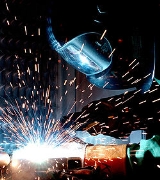
Gas metal arc welding

Encyclopedia
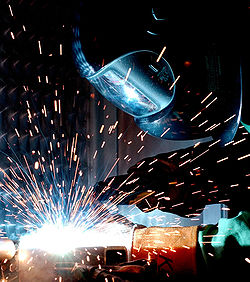
Welding
Welding is a fabrication or sculptural process that joins materials, usually metals or thermoplastics, by causing coalescence. This is often done by melting the workpieces and adding a filler material to form a pool of molten material that cools to become a strong joint, with pressure sometimes...
process in which a continuous and consumable wire
Wire
A wire is a single, usually cylindrical, flexible strand or rod of metal. Wires are used to bear mechanical loads and to carry electricity and telecommunications signals. Wire is commonly formed by drawing the metal through a hole in a die or draw plate. Standard sizes are determined by various...
electrode
Electrode
An electrode is an electrical conductor used to make contact with a nonmetallic part of a circuit...
and a shielding gas
Shielding gas
Shielding gases are inert or semi-inert gases that are commonly used in several welding processes, most notably gas metal arc welding and gas tungsten arc welding . Their purpose is to protect the weld area from atmospheric gases, such as oxygen, nitrogen, carbon dioxide, and water vapour...
are fed through a welding gun. A constant volt
Volt
The volt is the SI derived unit for electric potential, electric potential difference, and electromotive force. The volt is named in honor of the Italian physicist Alessandro Volta , who invented the voltaic pile, possibly the first chemical battery.- Definition :A single volt is defined as the...
age, direct current
Direct current
Direct current is the unidirectional flow of electric charge. Direct current is produced by such sources as batteries, thermocouples, solar cells, and commutator-type electric machines of the dynamo type. Direct current may flow in a conductor such as a wire, but can also flow through...
power source is most commonly used with GMAW, but constant current systems, as well as alternating current
Alternating current
In alternating current the movement of electric charge periodically reverses direction. In direct current , the flow of electric charge is only in one direction....
, can be used. There are four primary methods of metal transfer in GMAW, called globular, short-circuiting, spray, and pulsed-spray, each of which has distinct properties and corresponding advantages and limitations.
Originally developed for welding aluminum
Aluminium
Aluminium or aluminum is a silvery white member of the boron group of chemical elements. It has the symbol Al, and its atomic number is 13. It is not soluble in water under normal circumstances....
and other non-ferrous materials in the 1940s, GMAW was soon applied to steel
Steel
Steel is an alloy that consists mostly of iron and has a carbon content between 0.2% and 2.1% by weight, depending on the grade. Carbon is the most common alloying material for iron, but various other alloying elements are used, such as manganese, chromium, vanadium, and tungsten...
s because it allowed for lower welding time compared to other welding processes. The cost of inert gas limited its use in steels until several years later, when the use of semi-inert gases such as carbon dioxide
Carbon dioxide
Carbon dioxide is a naturally occurring chemical compound composed of two oxygen atoms covalently bonded to a single carbon atom...
became common. Further developments during the 1950s and 1960s gave the process more versatility and as a result, it became a highly used industrial process. Today, GMAW is the most common industrial welding process, preferred for its versatility, speed and the relative ease of adapting the process to robotic automation. Unlike welding processes that do not employ a shielding gas, such as shielded metal arc welding
Shielded metal arc welding
Shielded metal arc welding , also known as manual metal arc welding, flux shielded arc welding or informally as stick welding, is a manual arc welding process that uses a consumable electrode coated in flux to lay the weld...
, it is rarely used outdoors or in other areas of air volatility. A related process, flux cored arc welding
Flux-cored arc welding
Flux-cored arc welding is a semi-automatic or automatic arc welding process. FCAW requires a continuously-fed consumable tubular electrode containing a flux and a constant-voltage or, less commonly, a constant-current welding power supply...
, often does not utilize a shielding gas, instead employing a hollow electrode wire that is filled with flux
Flux (metallurgy)
In metallurgy, a flux , is a chemical cleaning agent, flowing agent, or purifying agent. Fluxes may have more than one function at a time...
on the inside.
Development
The principles of gas metal arc welding began to be understood in the early 19th century, after Humphry DavyHumphry Davy
Sir Humphry Davy, 1st Baronet FRS MRIA was a British chemist and inventor. He is probably best remembered today for his discoveries of several alkali and alkaline earth metals, as well as contributions to the discoveries of the elemental nature of chlorine and iodine...
discovered the short pulsed electric arcs in 1800 and then Vasily Petrov
Vasily Vladimirovich Petrov
Vasily Vladimirovich Petrov was a Russian experimental physicist, self-taught electrical technician, academician of Russian Academy of Sciences ....
independently produced the continuous electric arc
Electric arc
An electric arc is an electrical breakdown of a gas which produces an ongoing plasma discharge, resulting from a current flowing through normally nonconductive media such as air. A synonym is arc discharge. An arc discharge is characterized by a lower voltage than a glow discharge, and relies on...
in 1802 (soon followed by Davy
Humphry Davy
Sir Humphry Davy, 1st Baronet FRS MRIA was a British chemist and inventor. He is probably best remembered today for his discoveries of several alkali and alkaline earth metals, as well as contributions to the discoveries of the elemental nature of chlorine and iodine...
). In his work published in 1803 Petrov proposed the usage of electric arc in welding, having managed to perform a simple experimental welding. But it was not until the 1880s that the technology became developed with the aim of industrial usage. At first, the practical method of carbon arc welding
Carbon arc welding
Carbon arc welding is a process which produces coalescence of metals by heating them with an arc between a nonconsumable carbon electrode and the work-piece. It was the first arc-welding process ever developed but is not used for many applications today, having been replaced by twin-carbon-arc...
invented by Nikolay Benardos
Nikolay Benardos
Nikolay Nikolayevich Benardos was a Ukrainian inventor who in 1881 introduced carbon arc welding, which was the first practical arc welding method.- References :* * at weldworld.ru...
was used, utilising carbon electrodes known from the time of Davy and Petrov. By the late 1880s, metal electrodes had been invented by Nikolay Slavyanov
Nikolay Slavyanov
Nikolay Gavrilovich Slavyanov was a Russian inventor who in 1888 introduced arc welding with consumable metal electrodes, or shielded metal arc welding, the second historical arc welding method after carbon arc welding invented earlier by Nikolay Benardos.- References :* * at weldworld.ru...
(1888) and C. L. Coffin
C. L. Coffin
Charles L. Coffin of Detroit was awarded for an arc welding process using a metal electrode. This was the first time that metal melted from the electrode carried across the arc to deposit filler metal in the joint to make a weld. About the same time, N.G. Slavianoff, a Russian, presented the same...
(1890). In 1920, an early predecessor of GMAW was invented by P. O. Nobel of General Electric
General Electric
General Electric Company , or GE, is an American multinational conglomerate corporation incorporated in Schenectady, New York and headquartered in Fairfield, Connecticut, United States...
. It used a bare electrode wire and direct current, and used arc voltage to regulate the feed rate. It did not use a shielding gas to protect the weld, as developments in welding atmospheres did not take place until later that decade. In 1926 another forerunner of GMAW was released, but it was not suitable for practical use.
It was not until 1948 that GMAW was finally developed by the Battelle Memorial Institute
Battelle Memorial Institute
Battelle Memorial Institute is a private nonprofit applied science and technology development company headquartered in Columbus, Ohio. Battelle is a charitable trust organized as a nonprofit corporation under the laws of the State of Ohio and is exempt from taxation under Section 501 of the...
. It used a smaller diameter electrode and a constant voltage power source, which had been developed by H. E. Kennedy. It offered a high deposition rate, but the high cost of inert gases limited its use to non-ferrous materials and cost savings were not obtained. In 1953, the use of carbon dioxide as a welding atmosphere was developed, and it quickly gained popularity in GMAW, since it made welding steel more economical. In 1958 and 1959, the short-arc variation of GMAW was released, which increased welding versatility and made the welding of thin materials possible while relying on smaller electrode wires and more advanced power supplies. It quickly became the most popular GMAW variation. The spray-arc transfer variation was developed in the early 1960s, when experimenters added small amounts of oxygen to inert gases. More recently, pulsed current has been applied, giving rise to a new method called the pulsed spray-arc variation.
As noted, GMAW is currently one of the most popular welding methods, especially in industrial environments. It is used extensively by the sheet metal industry and, by extension, the automobile industry. There, the method is often used for arc spot welding
Spot welding
Spot welding is a process in which contacting metal surfaces are joined by the heat obtained from resistance to electric current flow. Work-pieces are held together under pressure exerted by electrodes. Typically the sheets are in the thickness range...
, thereby replacing rivet
Rivet
A rivet is a permanent mechanical fastener. Before being installed a rivet consists of a smooth cylindrical shaft with a head on one end. The end opposite the head is called the buck-tail. On installation the rivet is placed in a punched or pre-drilled hole, and the tail is upset, or bucked A rivet...
ing or resistance
Resistance welding
Electric resistance welding refers to a group of welding processes such as spot and seam welding that produce coalescence of faying surfaces where heat to form the weld is generated by the electical reistance of material vs the time and the force used to hold the materials together during welding...
spot welding. It is also popular for automated welding, in which robots handle the workpieces and the welding gun to speed up the manufacturing process. Generally, it is unsuitable for welding outdoors, because the movement of the surrounding air can dissipate the shielding gas and thus make welding more difficult, while also decreasing the quality of the weld. The problem can be alleviated to some extent by increasing the shielding gas output, but this can be expensive and may also affect the quality of the weld. In general, processes such as shielded metal arc welding
Shielded metal arc welding
Shielded metal arc welding , also known as manual metal arc welding, flux shielded arc welding or informally as stick welding, is a manual arc welding process that uses a consumable electrode coated in flux to lay the weld...
and flux cored arc welding
Flux-cored arc welding
Flux-cored arc welding is a semi-automatic or automatic arc welding process. FCAW requires a continuously-fed consumable tubular electrode containing a flux and a constant-voltage or, less commonly, a constant-current welding power supply...
are preferred for welding outdoors, making the use of GMAW in the construction industry rather limited. Furthermore, the use of a shielding gas makes GMAW an unpopular underwater welding process, but can be used in space since there is no oxygen to oxidize the weld.
Equipment
To perform gas metal arc welding, the basic necessary equipment is a welding gun, a wire feed unit, a welding power supplyWelding power supply
A welding power supply is a device that provides an electric current to perform welding. Welding usually requires high current and it can need above 12,000 amperes in spot welding. Low current can also be used; welding two razor blades together at 5 amps with gas tungsten arc welding is a good...
, an electrode wire, and a shielding gas
Shielding gas
Shielding gases are inert or semi-inert gases that are commonly used in several welding processes, most notably gas metal arc welding and gas tungsten arc welding . Their purpose is to protect the weld area from atmospheric gases, such as oxygen, nitrogen, carbon dioxide, and water vapour...
supply.
Welding gun and wire feed unit
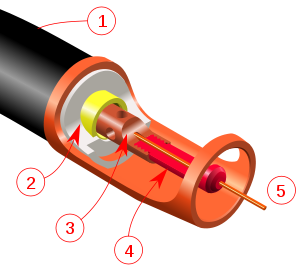
Copper
Copper is a chemical element with the symbol Cu and atomic number 29. It is a ductile metal with very high thermal and electrical conductivity. Pure copper is soft and malleable; an exposed surface has a reddish-orange tarnish...
and sometimes chemically treated to reduce spatter, is connected to the welding power source through the power cable and transmits the electrical energy to the electrode while directing it to the weld area. It must be firmly secured and properly sized, since it must allow the passage of the electrode while maintaining an electrical contact. Before arriving at the contact tip, the wire is protected and guided by the electrode conduit and liner, which help prevent buckling and maintain an uninterrupted wire feed. The gas nozzle is used to evenly direct the shielding gas into the welding zone—if the flow is inconsistent, it may not provide adequate protection of the weld area. Larger nozzles provide greater shielding gas flow, which is useful for high current welding operations, in which the size of the molten weld pool is increased. The gas is supplied to the nozzle through a gas hose, which is connected to the tanks of shielding gas. Sometimes, a water hose is also built into the welding gun, cooling the gun in high heat operations.
The wire feed unit supplies the electrode to the work, driving it through the conduit and on to the contact tip. Most models provide the wire at a constant feed rate, but more advanced machines can vary the feed rate in response to the arc length and voltage. Some wire feeders can reach feed rates as high as 30.5 m/min (1200 in/min), but feed rates for semiautomatic GMAW typically range from 2 to 10 m/min (75–400 in/min).
Welding Gun Types
The most common welding gun is a hand held air-cooled gun, used for general welding. The second most common type of welding torch is water-cooled, and uses higher current levels for heavier sections and larger wire diameters. The third typical holder type is an automatic gun that is water-cooled; this gun is used typically with automated equipment.Power supply
Most applications of gas metal arc welding use a constant voltage power supply. As a result, any change in arc length (which is directly related to voltage) results in a large change in heat input and current. A shorter arc length will cause a much greater heat input, which will make the wire electrode melt more quickly and thereby restore the original arc length. This helps operators keep the arc length consistent even when manually welding with hand-held welding guns. To achieve a similar effect, sometimes a constant current power source is used in combination with an arc voltage-controlled wire feed unit. In this case, a change in arc length makes the wire feed rate adjust in order to maintain a relatively constant arc length. In rare circumstances, a constant current power source and a constant wire feed rate unit might be coupled, especially for the welding of metals with high thermal conductivities, such as aluminum. This grants the operator additional control over the heat input into the weld, but requires significant skill to perform successfully.Alternating current is rarely used with GMAW; instead, direct current is employed and the electrode is generally positively charged. Since the anode
Anode
An anode is an electrode through which electric current flows into a polarized electrical device. Mnemonic: ACID ....
tends to have a greater heat concentration, this results in faster melting of the feed wire, which increases weld penetration and welding speed. The polarity can be reversed only when special emissive-coated electrode wires are used, but since these are not popular, a negatively charged electrode is rarely employed.
Electrode
Electrode selection is based primarily on the composition of the metal being welded, the process variation being used, joint design and the material surface conditions. Electrode selection greatly influences the mechanical properties of the weld and is a key factor of weld quality. In general the finished weld metal should have mechanical properties similar to those of the base material with no defects such as discontinuities, entrained contaminants or porosity within the weld. To achieve these goals a wide variety of electrodes exist. All commercially available electrodes contain deoxidizing metals such as siliconSilicon
Silicon is a chemical element with the symbol Si and atomic number 14. A tetravalent metalloid, it is less reactive than its chemical analog carbon, the nonmetal directly above it in the periodic table, but more reactive than germanium, the metalloid directly below it in the table...
, manganese
Manganese
Manganese is a chemical element, designated by the symbol Mn. It has the atomic number 25. It is found as a free element in nature , and in many minerals...
, titanium
Titanium
Titanium is a chemical element with the symbol Ti and atomic number 22. It has a low density and is a strong, lustrous, corrosion-resistant transition metal with a silver color....
and aluminum
Aluminium
Aluminium or aluminum is a silvery white member of the boron group of chemical elements. It has the symbol Al, and its atomic number is 13. It is not soluble in water under normal circumstances....
in small percentages to help prevent oxygen porosity. Some contain denitriding metals such as titanium and zirconium
Zirconium
Zirconium is a chemical element with the symbol Zr and atomic number 40. The name of zirconium is taken from the mineral zircon. Its atomic mass is 91.224. It is a lustrous, grey-white, strong transition metal that resembles titanium...
to avoid nitrogen porosity. Depending on the process variation and base material being welded the diameters of the electrodes used in GMAW typically range from 0.7 to 2.4 mm (0.028–0.095 in) but can be as large as 4 mm (0.16 in). The smallest electrodes, generally up to 1.14 mm (0.045 in) are associated with the short-circuiting metal transfer process, while the most common spray-transfer process mode electrodes are usually at least 0.9 mm (0.035 in).
Shielding gas
Shielding gases are necessary for gas metal arc welding to protect the welding area from atmospheric gases such as nitrogenNitrogen
Nitrogen is a chemical element that has the symbol N, atomic number of 7 and atomic mass 14.00674 u. Elemental nitrogen is a colorless, odorless, tasteless, and mostly inert diatomic gas at standard conditions, constituting 78.08% by volume of Earth's atmosphere...
and oxygen
Oxygen
Oxygen is the element with atomic number 8 and represented by the symbol O. Its name derives from the Greek roots ὀξύς and -γενής , because at the time of naming, it was mistakenly thought that all acids required oxygen in their composition...
, which can cause fusion defects, porosity, and weld metal embrittlement if they come in contact with the electrode, the arc, or the welding metal. This problem is common to all arc welding processes; for example, in the older Shielded-Metal Arc Welding process (SMAW), the electrode is coated with a solid flux which evolves a protective cloud of carbon dioxide when melted by the arc. In GMAW, however, the electrode wire does not have a flux coating, and a separate shielding gas is employed to protect the weld. This eliminates slag, the hard residue from the flux that builds up after welding and must be chipped off to reveal the completed weld.
The choice of a shielding gas depends on several factors, most importantly the type of material being welded and the process variation being used. Pure inert gases such as argon
Argon
Argon is a chemical element represented by the symbol Ar. Argon has atomic number 18 and is the third element in group 18 of the periodic table . Argon is the third most common gas in the Earth's atmosphere, at 0.93%, making it more common than carbon dioxide...
and helium
Helium
Helium is the chemical element with atomic number 2 and an atomic weight of 4.002602, which is represented by the symbol He. It is a colorless, odorless, tasteless, non-toxic, inert, monatomic gas that heads the noble gas group in the periodic table...
are only used for nonferrous welding; with steel they do not provide adequate weld penetration (argon) or cause an erratic arc and encourage spatter (with helium). Pure carbon dioxide
Carbon dioxide
Carbon dioxide is a naturally occurring chemical compound composed of two oxygen atoms covalently bonded to a single carbon atom...
, on the other hand, allows for deep penetration welds but encourages oxide formation, which adversely affect the mechanical properties of the weld. Its low cost makes it an attractive choice, but because of the reactivity of the arc plasma, spatter is unavoidable and welding thin materials is difficult. As a result, argon and carbon dioxide are frequently mixed in a 75%/25% to 90%/10% mixture. Generally, in short circuit GMAW, higher carbon dioxide content increases the weld heat and energy when all other weld parameters (volts, current, electrode type and diameter) are held the same. As the carbon dioxide content increases over 20%, spray transfer GMAW becomes increasingly problematic, especially with smaller electrode diameters.
Argon is also commonly mixed with other gases, oxygen, helium, hydrogen
Hydrogen
Hydrogen is the chemical element with atomic number 1. It is represented by the symbol H. With an average atomic weight of , hydrogen is the lightest and most abundant chemical element, constituting roughly 75% of the Universe's chemical elemental mass. Stars in the main sequence are mainly...
, and nitrogen. The addition of up to 5% oxygen (like the higher concentrations of carbon dioxide mentioned above) can be helpful in welding stainless steel, however, in most applications carbon dioxide is preferred. Increased oxygen makes the shielding gas oxidize the electrode, which can lead to porosity in the deposit if the electrode does not contain sufficient deoxidizers. Excessive oxygen, especially when used in application for which it is not prescribed, can lead to brittleness in the heat affected zone. Argon-helium mixtures are extremely inert, and can be used on nonferrous materials. A helium concentration of 50%–75% raises the required voltage and increases the heat in the arc, due to helium's higher ionization temperature. Hydrogen is sometimes added to argon in small concentrations (up to about 5%) for welding nickel and thick stainless steel workpieces. In higher concentrations (up to 25% hydrogen), it may be used for welding conductive materials such as copper. However, it should not be used on steel, aluminum or magnesium because it can cause porosity and hydrogen embrittlement
Hydrogen embrittlement
Hydrogen embrittlement is the process by which various metals, most importantly high-strength steel, become brittle and fracture following exposure to hydrogen...
.
Shielding gas mixtures of three or more gases are also available. Mixtures of argon, carbon dioxide and oxygen are marketed for welding steels. Other mixtures add a small amount of helium to argon-oxygen combinations, these mixtures are claimed to allow higher arc voltages and welding speed. Helium is also sometimes used as the base gas, with small amounts of argon and carbon dioxide added. However, because it is less dense than air, helium is less effective in shielding the weld than argon– which is denser than air. It also can lead to arc stability and penetration issues, and increased spatter, due to its much more energetic arc plasma. Helium is also substantially more expensive than other shielding gases. Other specialized and often proprietary gas mixtures claim even greater benefits for specific applications.
The desirable rate of shielding-gas flow depends primarily on weld geometry, speed, current, the type of gas, and the metal transfer mode being utilized. Welding flat surfaces requires higher flow than welding grooved materials, since the gas is dispersed more quickly. Faster welding speeds, in general, mean that more gas needs to be supplied to provide adequate coverage. Additionally, higher current requires greater flow, and generally, more helium is required to provide adequate coverage than if argon is used. Perhaps most importantly, the four primary variations of GMAW have differing shielding gas flow requirements—for the small weld pools of the short circuiting and pulsed spray modes, about 10 L
Litre
pic|200px|right|thumb|One litre is equivalent to this cubeEach side is 10 cm1 litre water = 1 kilogram water The litre is a metric system unit of volume equal to 1 cubic decimetre , to 1,000 cubic centimetres , and to 1/1,000 cubic metre...
/min (20 ft³/h
Hour
The hour is a unit of measurement of time. In modern usage, an hour comprises 60 minutes, or 3,600 seconds...
) is generally suitable, whereas for globular transfer, around 15 L/min (30 ft³/h) is preferred. The spray transfer variation normally requires more shielding-gas flow because of its higher heat input and thus larger weld pool. Typical gas-flow amounts are approximately 20–25 L/min (40–50 ft³/h).
Operation
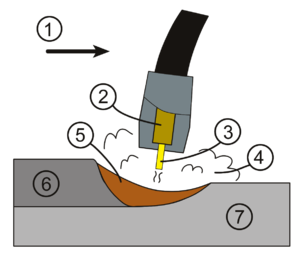
Shielded metal arc welding
Shielded metal arc welding , also known as manual metal arc welding, flux shielded arc welding or informally as stick welding, is a manual arc welding process that uses a consumable electrode coated in flux to lay the weld...
.
Technique
The basic technique for GMAW is quite simple, since the electrode is fed automatically through the torch (head of tip). By contrast, in gas tungsten arc weldingGas tungsten arc welding
Gas tungsten arc welding , also known as tungsten inert gas welding, is an arc welding process that uses a nonconsumable tungsten electrode to produce the weld...
, the welder must handle a welding torch in one hand and a separate filler wire in the other, and in shielded metal arc welding, the operator must frequently chip off slag and change welding electrodes. GMAW requires only that the operator guide the welding gun with proper position and orientation along the area being welded. Keeping a consistent contact tip-to-work distance (the stick out distance) is important, because a long stickout distance can cause the electrode to overheat and will also waste shielding gas. Stickout distance varies for different GMAW weld processes and applications. For short-circuit transfer, the stickout is generally 1/4 inch to 1/2 inch, for spray transfer the stickout is generally 1/2 inch. The position of the end of the contact tip to the gas nozzle are related to the stickout distance and also varies with transfer type and application.
The orientation of the gun is also important—it should be held so as to bisect the angle between the workpieces; that is, at 45 degrees for a fillet weld and 90 degrees for welding a flat surface. The travel angle, or lead angle, is the angle of the torch with respect to the direction of travel, and it should generally remain approximately vertical. However, the desirable angle changes somewhat depending on the type of shielding gas used—with pure inert gases, the bottom of the torch is often slightly in front of the upper section, while the opposite is true when the welding atmosphere is carbon dioxide.
Quality
Two of the most prevalent quality problems in GMAW are drossDross
Dross is a mass of solid impurities floating on a molten metal. It appears usually on the melting of low-melting-point metals or alloys such as tin, lead, zinc or aluminium, or by oxidation of the metal. It can also consist of impurities such as paint leftovers...
and porosity
Porosity
Porosity or void fraction is a measure of the void spaces in a material, and is a fraction of the volume of voids over the total volume, between 0–1, or as a percentage between 0–100%...
. If not controlled, they can lead to weaker, less ductile welds. Dross is an especially common problem in aluminum GMAW welds, normally coming from particles of aluminum oxide or aluminum nitride present in the electrode or base materials. Electrodes and workpieces must be brushed with a wire brush or chemically treated to remove oxides on the surface. Any oxygen in contact with the weld pool, whether from the atmosphere or the shielding gas, causes dross as well. As a result, sufficient flow of inert shielding gases is necessary, and welding in volatile air should be avoided.
In GMAW the primary cause of porosity is gas entrapment in the weld pool, which occurs when the metal solidifies before the gas escapes. The gas can come from impurities in the shielding gas or on the workpiece, as well as from an excessively long or violent arc. Generally, the amount of gas entrapped is directly related to the cooling rate of the weld pool. Because of its higher thermal conductivity
Thermal conductivity
In physics, thermal conductivity, k, is the property of a material's ability to conduct heat. It appears primarily in Fourier's Law for heat conduction....
, aluminum welds are especially susceptible to greater cooling rates and thus additional porosity. To reduce it, the workpiece and electrode should be clean, the welding speed diminished and the current set high enough to provide sufficient heat input and stable metal transfer but low enough that the arc remains steady. Preheating can also help reduce the cooling rate in some cases by reducing the temperature gradient between the weld area and the base material.
Safety
Gas metal arc welding can be dangerous if proper precautions are not taken. Since GMAW employs an electric arc, welders wear protective clothing, including heavy leather gloves and protective long sleeve jackets, to avoid exposure to extreme heat and flames. In addition, the brightness of the electric arc is a source of the condition known as arc eye, an inflammation of the corneaCornea
The cornea is the transparent front part of the eye that covers the iris, pupil, and anterior chamber. Together with the lens, the cornea refracts light, with the cornea accounting for approximately two-thirds of the eye's total optical power. In humans, the refractive power of the cornea is...
caused by ultraviolet light
Ultraviolet
Ultraviolet light is electromagnetic radiation with a wavelength shorter than that of visible light, but longer than X-rays, in the range 10 nm to 400 nm, and energies from 3 eV to 124 eV...
and, in prolonged exposure, possible burning of the retina
Retina
The vertebrate retina is a light-sensitive tissue lining the inner surface of the eye. The optics of the eye create an image of the visual world on the retina, which serves much the same function as the film in a camera. Light striking the retina initiates a cascade of chemical and electrical...
in the eye. Conventional welding helmet
Welding helmet
Welding helmets are headgear used when performing certain types of welding to protect the eyes, face and neck from flash burn, ultraviolet light, sparks, infrared light, and heat. Most commonly used with arc welding processes such as shielded metal arc welding, gas tungsten arc welding, and gas...
s contain dark face plates to prevent this exposure. Newer helmet designs feature a liquid crystal
Liquid crystal
Liquid crystals are a state of matter that have properties between those of a conventional liquid and those of a solid crystal. For instance, an LC may flow like a liquid, but its molecules may be oriented in a crystal-like way. There are many different types of LC phases, which can be...
-type face plate that self-darken upon exposure to high amounts of UV light. Transparent welding curtains, made of a polyvinyl chloride
Polyvinyl chloride
Polyvinyl chloride, commonly abbreviated PVC, is a thermoplastic polymer. It is a vinyl polymer constructed of repeating vinyl groups having one hydrogen replaced by chloride. Polyvinyl chloride is the third most widely produced plastic, after polyethylene and polypropylene. PVC is widely used in...
plastic film, are often used to shield nearby workers and bystanders from exposure to the UV light from the electric arc.
Welders are also often exposed to dangerous gases and particulate matter. GMAW produces smoke containing particles of various types of oxide
Oxide
An oxide is a chemical compound that contains at least one oxygen atom in its chemical formula. Metal oxides typically contain an anion of oxygen in the oxidation state of −2....
s, and the size of the particles in question tends to influence the toxicity of the fumes, with smaller particles presenting a greater danger. Additionally, carbon dioxide
Carbon dioxide
Carbon dioxide is a naturally occurring chemical compound composed of two oxygen atoms covalently bonded to a single carbon atom...
and ozone
Ozone
Ozone , or trioxygen, is a triatomic molecule, consisting of three oxygen atoms. It is an allotrope of oxygen that is much less stable than the diatomic allotrope...
gases can prove dangerous if ventilation is inadequate. Furthermore, because the use of compressed gases in GMAW pose an explosion and fire risk, some common precautions include limiting the amount of oxygen in the air and keeping combustible materials away from the workplace. While porosity usually results from atmospheric contamination, too much shielding gas has a similar effect; if the flow rate is too high it may create a vortex that draws in the surrounding air, thereby contaminating the weld pool as it cools. The gas output should be felt (as a cool breeze) on a dry hand but not enough to create any noticeable pressure, this equates to between 20–25 psi (mild and stainless steel). Above 26 volts the gas debit should be augmented slightly since the weld pool takes longer to cool. As a factor that is often ignored, many flow meters are never adjusted and typically run between 35–45 psi. A healthy reduction of gas will not affect the quality of the weld, will save money on shielding gas and reduce the rate at which the tank must be replaced.
Metal transfer modes
The three transfer modes in GMAW are globular, short-circuiting, and spray. There are a few recognized variations of these three transfer modes including modified short-circuiting and pulsed-spray.Globular
GMAW with globular metal transfer is often considered the most undesirable of the three major GMAW variations, because of its tendency to produce high heat, a poor weld surface, and spatter. The method was originally developed as a cost efficient way to weld steel using GMAW, because this variation uses carbon dioxide, a less expensive shielding gas than argon. Adding to its economic advantage was its high deposition rate, allowing welding speeds of up to 110 mm/s (250 in/min). As the weld is made, a ball of molten metal from the electrode tends to build up on the end of the electrode, often in irregular shapes with a larger diameter than the electrode itself. When the droplet finally detaches either by gravity or short circuiting, it falls to the workpiece, leaving an uneven surface and often causing spatter. As a result of the large molten droplet, the process is generally limited to flat and horizontal welding positions. The high amount of heat generated also is a downside, because it forces the welder to use a larger electrode wire, increases the size of the weld pool, and causes greater residual stresses and distortion in the weld area.Short-circuiting
Further developments in welding steel with GMAW led to a variation known as short-circuit transfer (SCT) or short-arc GMAW, in which the current is lower than for the globular method. As a result of the lower current, the heat input for the short-arc variation is considerably reduced, making it possible to weld thinner materials while decreasing the amount of distortion and residual stress in the weld area. As in globular welding, molten droplets form on the tip of the electrode, but instead of dropping to the weld pool, they bridge the gap between the electrode and the weld pool as a result of the lower wire feed rate. This causes a short circuitShort circuit
A short circuit in an electrical circuit that allows a current to travel along an unintended path, often where essentially no electrical impedance is encountered....
and extinguishes the arc, but it is quickly reignited after the surface tension
Surface tension
Surface tension is a property of the surface of a liquid that allows it to resist an external force. It is revealed, for example, in floating of some objects on the surface of water, even though they are denser than water, and in the ability of some insects to run on the water surface...
of the weld pool pulls the molten metal bead off the electrode tip. This process is repeated about 100 times per second, making the arc appear constant to the human eye. This type of metal transfer provides better weld quality and less spatter than the globular variation, and allows for welding in all positions, albeit with slower deposition of weld material. Setting the weld process parameters (volts, amps and wire feed rate) within a relatively narrow band is critical to maintaining a stable arc: generally between 100 to 200 amps at 17 to 22 volts for most applications. Also, using short-arc transfer can result in lack of fusion and insufficient penetration when welding thicker materials, due to the lower arc energy and rapidly freezing weld pool. Like the globular variation, it can only be used on ferrous metals.
Modified short-circuiting
There are proprietary derivatives of the short-circuiting transfer mode which use a modified waveform to reduce some of the problems found with short-circuiting, mainly spatter and a turbulent weld pool. Typically these systems sense the progression of the short circuit as it happens and modulate the current to limit the amount of force behind spatter and turbulence-producing events. Several manufacturers now sell welding power supplies which employ technology to this end: Miller ElectricMiller Electric
Miller Electric is an arc welding and cutting equipment manufacturing company based in Appleton, WI. Miller Electric has grown from a one-man operation selling products in Northeast Wisconsin, to what is today one of the world's largest manufacturers of arc welding and cutting equipment...
has a process called Regulated Metal Deposition (RMD), while Lincoln Electric
Lincoln Electric
Lincoln Electric is a company in Euclid, Ohio, United States that manufactures arc welding equipment and consumables, plasma and oxy-fuel cutting equipment and robotic welding systems. They are a worldwide leader in production of welding products and have 39 manufacturing locations, including...
sells their process called Surface Tension Transfer (STT). Other companies take a different approach to making short circuit transfer usable: Fronius has a technique called Cold Metal Transfer (CMT) which physically withdraws the electrode from the welding puddle at a certain rate and pattern.
RMD and STT achieve the modified short circuiting via software that controls the current. The RMD process breaks the process into seven steps:
- Wet: Let the ball on the end of the wire wet-out to the puddle.
- Pinch: Increase the current to a level high enough to initiate a pinch effect.
- Clear: Maintain and slightly increase the pinch current to clear the short circuitShort circuitA short circuit in an electrical circuit that allows a current to travel along an unintended path, often where essentially no electrical impedance is encountered....
while simultaneously watching for pinch detection. - Blink: Upon pinch detection, rapidly decrease the current. Pinch detection occurs before the short clears. The inverter “shuts off” and current decays to a low level before the short circuit breaks.
- Ball: Increase current to form a ball for the next short circuit.
- Background: Drop the current to a low enough level to allow a short circuit to occur.
- Pre-short: If the background current exists for a relatively long time, the pre-short period drops current to an even lower level to make sure arc force does not produce excessive puddle agitation.
Spray
Spray transfer GMAW was the first metal transfer method used in GMAW, and well-suited to welding aluminum and stainless steel while employing an inert shielding gas. In this GMAW process, the weld electrode metal is rapidly passed along the stable electric arc from the electrode to the workpiece, essentially eliminating spatter and resulting in a high-quality weld finish. As the current and voltage increases beyond the range of short circuit transfer the weld electrode metal transfer transitions from larger globules through small droplets to a vaporized stream at the highest energies. Since this vaporized spray transfer variation of the GMAW weld process requires higher voltage and current than short circuit transfer, and as a result of the higher heat input and larger weld pool area (for a given weld electrode diameter), it is generally used only on workpieces of thicknesses above about 6.4 mm (0.25 in).Also, because of the large weld pool, it is often limited to flat and horizontal welding positions and sometimes also used for vertical-down welds. It is generally not practical for root pass welds. When a smaller electrode is used in conjunction with lower heat input, its versatility increases. The maximum deposition rate for spray arc GMAW is relatively high; about 60 mm/s (150 in/min).
Pulsed-spray
A variation of the spray transfer mode, pulse-spray is based on the principles of spray transfer but uses a pulsing current to melt the filler wire and allow one small molten droplet to fall with each pulse. The pulses allow the average current to be lower, decreasing the overall heat input and thereby decreasing the size of the weld pool and heat-affected zone while making it possible to weld thin workpieces. The pulse provides a stable arc and no spatter, since no short-circuiting takes place. This also makes the process suitable for nearly all metals, and thicker electrode wire can be used as well. The smaller weld pool gives the variation greater versatility, making it possible to weld in all positions. In comparison with short arc GMAW, this method has a somewhat slower maximum speed (85 mm/s or 200 in/min) and the process also requires that the shielding gas be primarily argon with a low carbon dioxide concentration. Additionally, it requires a special power source capable of providing current pulses with a frequency between 30 and 400 pulses per second. However, the method has gained popularity, since it requires lower heat input and can be used to weld thin workpieces, as well as nonferrous materials.External links
- ESAB Process Handbook
- OSHA Safety and Health Topics- Welding, Cutting, and Brazing
- Fume formation rates in gas metal arc welding – research article from the 1999 Welding Journal