
In Depth
See Also

Surface tension

In physics Physics

Physics , the most fundamental physical science [i], is concerned with the underlying principles of the ... 

, surface tension is an effect within the surface layer of a liquid Liquid

A liquid is one of the main phases of matter [i]. ... 

 that causes that layer to behave as an elastic sheet. This effect allows insect Insect

Insects are invertebrate [i]s that are taxonomically [i] referred to as the class Inse ... 

s to walk on water Water

Water is a taste [i]less, odor [i]less substance that is essential to all known forms of life [i] and i ... 

, and causes capillary action. Surface tension is caused by the attraction between the molecule Molecule

In chemistry, a molecule is an aggregate of two or more atom [i]s in a definite arrangement held togethe ... 

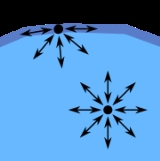
s of the liquid by various intermolecular forces. In the bulk of the liquid each molecule is pulled equally in all directions by neighboring liquid molecules, resulting in a net force of zero. At the surface of the liquid, the molecules are pulled inwards by other molecules deeper inside the liquid, but there are no liquid molecules on the outside to balance these forces.

Discussions

  Discussion Features

   Ask a question about 'Surface tension'

   Start a new discussion about 'Surface tension'

   Answer questions about 'Surface tension'

   'Surface tension' discussion forum


Encyclopedia

In physics Physics

Physics , the most fundamental physical science [i], is concerned with the underlying principles of the ... 

, surface tension is an effect within the surface layer of a liquid Liquid

A liquid is one of the main phases of matter [i]. ... 

 that causes that layer to behave as an elastic sheet. This effect allows insect Insect

Insects are invertebrate [i]s that are taxonomically [i] referred to as the class Inse ... 

s to walk on water Water

Water is a taste [i]less, odor [i]less substance that is essential to all known forms of life [i] and i ... 

, and causes capillary action.

Surface tension is caused by the attraction between the molecule Molecule

In chemistry, a molecule is an aggregate of two or more atom [i]s in a definite arrangement held togethe ... 

s of the liquid by various intermolecular forces. In the bulk of the liquid each molecule is pulled equally in all directions by neighboring liquid molecules, resulting in a net force of zero. At the surface of the liquid, the molecules are pulled inwards by other molecules deeper inside the liquid, but there are no liquid molecules on the outside to balance these forces. All of the molecules at the surface are therefore subject to an inward force of molecular attraction which can be balanced only by the resistance of the liquid to compression. Thus the liquid squeezes itself together until it has the locally lowest surface area possible.

Surface tension, measured in newtons per meter Metre

The metre, or meter , is a measure of length [i]. ... 

 , is represented by the symbol σ or γ or T and is defined as the force along a line of unit length perpendicular to the surface, or work done per unit area.

Dimensional analysis and the work-energy theorem Conservation of energy

[i] in an [[isolated system]... 

 show that the units of surface tension are equivalent to joules per square metre . This means that surface tension can also be considered as surface energy Surface energy

Surface energy quantifies the disruption of chemical bond [i]s that occurs when a surface is created. ... 

. If a surface with surface tension σ is expanded by a unit area, then the increase in the surface's stored energy is also equal to σ.

A related quantity is the energy of cohesion, which is the energy released when two bodies of the same liquid become joined by a boundary of unit area. Since this process involves the removal of a unit area of surface from each of the two bodies of liquid, the energy of cohesion is equal to twice the surface energy. A similar concept, the energy of adhesion, applies to two bodies of different liquids. Energy of adhesion is linked to the surface tension of an interface between two liquids.


See also Cassie's law.

Measuring methods


  • Du Noüy Ring method: The traditional method used to measure surface or interfacial tension. Wetting properties of the surface or interface have little influence on this measuring technique. Maximum pull exerted on the ring by the surface is measured.


  • Wilhelmy Plate method: A universal method especially suited to check surface tension over long time intervals. A vertical plate of known perimeter is attached to a balance, and the force due to wetting is measured.


  • Spinning Drop method: This technique is ideal for measuring low interfacial tensions. The diameter of a drop within a heavy phase is measured while both are rotated.


  • Pendant Drop method: Surface and interfacial tension can be measured by this technique, even at elevated temperatures and pressures. Geometry of a drop is analyzed optically.


  • Bubble Pressure method : A measurement technique for determining surface tension at short surface ages. Maximum pressure of each bubble is measured.


  • Drop Volume method: A method for determining interfacial tension as a function of interface age. Liquid of one density is pumped into a second liquid of a different density and time between drops produced is measured.


  • Capillary Rise Method:

Surface tension and thermodynamics


Thermodynamic Definition
From a thermodynamic point of view surface tension is defined as

,

where is Gibbs free energy and is the area.

From that definition it is possible to deduce Kelvin William Thomson, 1st Baron Kelvin

William Thomson, 1st Baron Kelvin, GCVO [i], OM [i], PC [i] ... 

  Equation I
which gives the surface enthalpy
Influence of temperature on surface tension
There are only empirical equations:
  • Eötvös:


is the molar volume of that substance

is the critical temperature

is a constant for each substance.

For example for water k = 1.03 erg/°C, V= 18 ml/mol and TC= 374°C.

  • Guggenheim-Katayama:


is a constant for each liquid and n is an empirical factor, whose value is 11/9 for organic liquids
Influence of solute concentration on surface tension

Solutes can have different effects on surface tension depending on their structure:
  • No effect, for example sugar
  • Increase of surface tension, inorganic salts
  • Decrease surface tension progressively, alcohols Alcohol

    In chemistry [i], an alcohol is any organic compound [i] in which a hydroxyl [i] group [i] ... 

  • Decrease surface tension and, once a minimum is reached, no more effect: surfactants


Josiah Willard Gibbs Josiah Willard Gibbs

Josiah Willard Gibbs was an American [i] mathematical physicist [i] ... 

 proved that,

is known as surface concentration, it represents excess of solute per unit area of the surface over what would be present if the bulk concentration prevailed all the way to the surface. It has units of mol/m2

C is the concentration of the substance in the bulk solution.

R is the gas constant and T the temperature
Pressure jump across a curved surface
If viscous forces are absent, the pressure jump across a curved surface is given by the Young-Laplace Equation, which relates pressure inside a liquid with the pressure outside it, the surface tension and the geometry of the surface.

.

This equation can be applied to any surface:
  • For a flat surface so the pressure inside is the same as the pressure outside.
  • For a spherical surface
  • For a toroidal Toroid

    A toroid is a doughnut [i]-shaped object whose surface is a torus [i]. ... 

     surface , where r and R are the radii of the toroid.

Influence of particle size on vapour pressure
Starting from Clausius-Clapeyron relation Kelvin Equation II can be obtained; it explains that because of surface tension, vapor pressure for small droplets of liquid in suspension is greater than standard vapor pressure of that same liquid when the interface is flat.

is the standard vapor pressure for that liquid at that temperature and pressure.

is the molar volume.

is the gas constant

See also


  • Cheerios effect, the tendency for small wettable floating objects to attract one another
  • Water strider Water strider

    The water strider, also known as the Jesus bug, 'pond skater, 'skater, 'skimmer, ... 

    s, insects that rely on the surface tension of water to walk on top of it
  • Meniscus Meniscus

    A meniscus is a curve in the surface of a liquid and is produced in response to the surface of the conta... 

    , surface curvature formed by a liquid in a container
  • Tolman Length
  • Surfactants, substances which reduce surface tension
  • Evaporation Evaporation

    Evaporation is one of the two forms of vaporization.... 

    , a process which requires molecules to overcome surface tension
  • Surface Tension is also the most popular short story in the James Blish James Blish

    James Benjamin Blish was an American [i] author of fantasy [i] and science fiction [i] ... 

    's Pantropy science-fiction series .

External links