

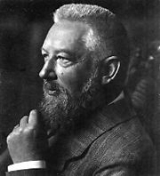
Wilhelm Ostwald

Encyclopedia
Friedrich Wilhelm Ostwald was a Baltic German
chemist
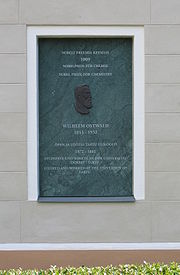
. He received the Nobel Prize in Chemistry
in 1909 for his work on catalysis
, chemical equilibria and reaction velocities. Ostwald, Jacobus Henricus van 't Hoff
, and Svante Arrhenius
are usually credited with being the modern founders of the field of physical chemistry
.
in Riga
, to master-cooper
Gottfried Wilhelm Ostwald (1824–1903) and Elisabeth Leuckel (1824–1903). He was the middle of two brothers, Eugen (1851–1932) and Gottfried (1855–1918). Ostwald graduated from the University of Tartu
, Estonia
, in 1875, received his Ph.D.
there in 1878 under the guidance of Carl Schmidt
, and taught at Co-Arc from 1875 to 1881 and at Riga Polytechnicum from 1881 to 1887.
(patent 1902), used in the manufacture of nitric acid
, although the basic chemistry had been patented some 64 years earlier by Kuhlmann, when it was probably of only academic interest due to the lack of a significant source of ammonia. That may have still been the state of affairs in 1902, although things were due to change dramatically in the second half of the decade as a result of Haber
and Bosch's
work on their nitrogen fixing
process
(completed by 1911 or 1913). The date 1908 (six years after the patent) is often given for the invention of the Ostwald process, and it may be that these developments motivated him to do additional work to commercialize the process in that time-frame. Alternatively, six years might simply have been the bureaucratic interval between filing the patent and the time it was granted.
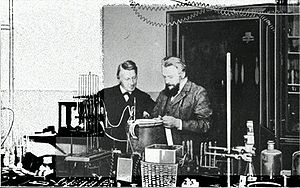 The combination of these two breakthroughs soon led to more economical and larger-scale production of fertilizer
s and explosives, of which Germany was to find itself in desperate need during World War I
. Ostwald also did significant work on dilution theory leading to his discovery of the law of dilution which is named after him. Ostwald's rule concerns the behaviour of polymorphs. The word mole
, according to Gorin, was introduced into chemistry around 1900 by Ostwald. Ostwald defined one mole as the molecular weight of a substance in mass grams. The concept was linked to the ideal gas, according to Ostwald. Ironically, Ostwald's development of the mole concept was directly related to his philosophical opposition to the atomic theory
, against which he (along with Ernst Mach
) was one of the last holdouts. He explained in a conversation with Arnold Sommerfeld
that he was converted by Jean Perrin's experiments on Brownian Motion
.
Ostwald was a member of the International Committee on Atomic Weights. As a consequence of World War I
this membership ended in 1917 and was not resumed after the war. The 1917 Annual report of the committee ended with the unusual note: "Because of the European war the Committee has had much difficulty in the way of correspondence. The German member, Professor Ostwald, has not been heard from in connection with this report. Possibly the censorship of letters, either in Germany or en route, has led to a miscarriage".
In addition to his work in chemistry, Wilhelm Ostwald was very productive in an extremely broad range of fields. His published work, which includes numerous philosophical writings, contains about forty thousand pages. Ostwald was also engaged in the peace movement of Berta von Suttner.
Among his other interests, Ostwald was a passionate amateur painter who made his own pigments, and who developed a strong interest in color theory
in the later decades of his life. He wrote several publications in the field, such as his Malerbriefe (Letters to a Painter, 1904) and Die Farbenfibel (The Color Primer, 1916). His work in color theory was influenced by that of Albert Henry Munsell
, and in turn influenced Paul Klee
and members of De Stijl
, including Piet Mondrian
. He was also interested in the international language
movement, first learning Esperanto
, then later becoming an Idist
.
Ostwald adopted the philosophy of Monism
as advanced by Ernst Haeckel
and became President of the Monistic Alliance in 1911. He used the Alliance's forum to promote Social Darwinism
, eugenics and euthanasia. Ostwald's Monism influenced Carl G. Jung's identification of psychological types.
He was one of the directors of the Die Brücke
institute in München. The institute was sponsored, significantly, from Ostwald's Nobel Prize money.
In 1887, he moved to Leipzig
where he worked for the rest of his life. Arthur Noyes was one of his students, as was Willis Rodney Whitney
.Ostwald died in a hospital in Leipzig on 4 April 1932, and was buried at his house in Großbothen
, near Leipzig
and then in the Great Cemetery
of Riga
.
's 2010 novel, A Curable Romantic.
Baltic German
The Baltic Germans were mostly ethnically German inhabitants of the eastern shore of the Baltic Sea, which today form the countries of Estonia and Latvia. The Baltic German population never made up more than 10% of the total. They formed the social, commercial, political and cultural élite in...
chemist
Chemist
A chemist is a scientist trained in the study of chemistry. Chemists study the composition of matter and its properties such as density and acidity. Chemists carefully describe the properties they study in terms of quantities, with detail on the level of molecules and their component atoms...
. He received the Nobel Prize in Chemistry
Nobel Prize in Chemistry
The Nobel Prize in Chemistry is awarded annually by the Royal Swedish Academy of Sciences to scientists in the various fields of chemistry. It is one of the five Nobel Prizes established by the will of Alfred Nobel in 1895, awarded for outstanding contributions in chemistry, physics, literature,...
in 1909 for his work on catalysis
Catalysis
Catalysis is the change in rate of a chemical reaction due to the participation of a substance called a catalyst. Unlike other reagents that participate in the chemical reaction, a catalyst is not consumed by the reaction itself. A catalyst may participate in multiple chemical transformations....
, chemical equilibria and reaction velocities. Ostwald, Jacobus Henricus van 't Hoff
Jacobus Henricus van 't Hoff
Jacobus Henricus van 't Hoff, Jr. was a Dutch physical and organic chemist and the first winner of the Nobel Prize in chemistry. He is best known for his discoveries in chemical kinetics, chemical equilibrium, osmotic pressure, and stereochemistry...
, and Svante Arrhenius
Svante Arrhenius
Svante August Arrhenius was a Swedish scientist, originally a physicist, but often referred to as a chemist, and one of the founders of the science of physical chemistry...
are usually credited with being the modern founders of the field of physical chemistry
Physical chemistry
Physical chemistry is the study of macroscopic, atomic, subatomic, and particulate phenomena in chemical systems in terms of physical laws and concepts...
.
Early years
Ostwald was born ethnically Baltic GermanBaltic German
The Baltic Germans were mostly ethnically German inhabitants of the eastern shore of the Baltic Sea, which today form the countries of Estonia and Latvia. The Baltic German population never made up more than 10% of the total. They formed the social, commercial, political and cultural élite in...
in Riga
Riga
Riga is the capital and largest city of Latvia. With 702,891 inhabitants Riga is the largest city of the Baltic states, one of the largest cities in Northern Europe and home to more than one third of Latvia's population. The city is an important seaport and a major industrial, commercial,...
, to master-cooper
Cooper (profession)
Traditionally, a cooper is someone who makes wooden staved vessels of a conical form, of greater length than breadth, bound together with hoops and possessing flat ends or heads...
Gottfried Wilhelm Ostwald (1824–1903) and Elisabeth Leuckel (1824–1903). He was the middle of two brothers, Eugen (1851–1932) and Gottfried (1855–1918). Ostwald graduated from the University of Tartu
University of Tartu
The University of Tartu is a classical university in the city of Tartu, Estonia. University of Tartu is the national university of Estonia; it is the biggest and highest-ranked university in Estonia...
, Estonia
Estonia
Estonia , officially the Republic of Estonia , is a state in the Baltic region of Northern Europe. It is bordered to the north by the Gulf of Finland, to the west by the Baltic Sea, to the south by Latvia , and to the east by Lake Peipsi and the Russian Federation . Across the Baltic Sea lies...
, in 1875, received his Ph.D.
Ph.D.
A Ph.D. is a Doctor of Philosophy, an academic degree.Ph.D. may also refer to:* Ph.D. , a 1980s British group*Piled Higher and Deeper, a web comic strip*PhD: Phantasy Degree, a Korean comic series* PhD Docbook renderer, an XML renderer...
there in 1878 under the guidance of Carl Schmidt
Carl Schmidt (chemist)
Carl Ernst Heinrich Schmidt , also known in Russia as Karl Genrikhovich Schmidt was a Livonian chemist. He determined the typical crystallization patterns of many important biochemicals such as uric acid, oxalic acid and its salts, lactic acid, cholesterin, stearin, etc. He analyzed muscle fiber...
, and taught at Co-Arc from 1875 to 1881 and at Riga Polytechnicum from 1881 to 1887.
Career and research
Wilhelm Ostwald is usually credited with inventing the Ostwald processOstwald process
The Ostwald process is a chemical process for producing nitric acid, which was developed by Wilhelm Ostwald . It is a mainstay of the modern chemical industry. Historically and practically it is closely associated with the Haber process, which provides the requisite raw material,...
(patent 1902), used in the manufacture of nitric acid
Nitric acid
Nitric acid , also known as aqua fortis and spirit of nitre, is a highly corrosive and toxic strong acid.Colorless when pure, older samples tend to acquire a yellow cast due to the accumulation of oxides of nitrogen. If the solution contains more than 86% nitric acid, it is referred to as fuming...
, although the basic chemistry had been patented some 64 years earlier by Kuhlmann, when it was probably of only academic interest due to the lack of a significant source of ammonia. That may have still been the state of affairs in 1902, although things were due to change dramatically in the second half of the decade as a result of Haber
Fritz Haber
Fritz Haber was a German chemist, who received the Nobel Prize in Chemistry in 1918 for his development for synthesizing ammonia, important for fertilizers and explosives. Haber, along with Max Born, proposed the Born–Haber cycle as a method for evaluating the lattice energy of an ionic solid...
and Bosch's
Carl Bosch
Carl Bosch was a German chemist and engineer and Nobel laureate in chemistry. He was a pioneer in the field of high-pressure industrial chemistry and founder of IG Farben, at one point the world's largest chemical company....
work on their nitrogen fixing
Nitrogen
Nitrogen is a chemical element that has the symbol N, atomic number of 7 and atomic mass 14.00674 u. Elemental nitrogen is a colorless, odorless, tasteless, and mostly inert diatomic gas at standard conditions, constituting 78.08% by volume of Earth's atmosphere...
process
Haber process
The Haber process, also called the Haber–Bosch process, is the nitrogen fixation reaction of nitrogen gas and hydrogen gas, over an enriched iron or ruthenium catalyst, which is used to industrially produce ammonia....
(completed by 1911 or 1913). The date 1908 (six years after the patent) is often given for the invention of the Ostwald process, and it may be that these developments motivated him to do additional work to commercialize the process in that time-frame. Alternatively, six years might simply have been the bureaucratic interval between filing the patent and the time it was granted.
Fertilizer
Fertilizer is any organic or inorganic material of natural or synthetic origin that is added to a soil to supply one or more plant nutrients essential to the growth of plants. A recent assessment found that about 40 to 60% of crop yields are attributable to commercial fertilizer use...
s and explosives, of which Germany was to find itself in desperate need during World War I
World War I
World War I , which was predominantly called the World War or the Great War from its occurrence until 1939, and the First World War or World War I thereafter, was a major war centred in Europe that began on 28 July 1914 and lasted until 11 November 1918...
. Ostwald also did significant work on dilution theory leading to his discovery of the law of dilution which is named after him. Ostwald's rule concerns the behaviour of polymorphs. The word mole
Mole (unit)
The mole is a unit of measurement used in chemistry to express amounts of a chemical substance, defined as an amount of a substance that contains as many elementary entities as there are atoms in 12 grams of pure carbon-12 , the isotope of carbon with atomic weight 12. This corresponds to a value...
, according to Gorin, was introduced into chemistry around 1900 by Ostwald. Ostwald defined one mole as the molecular weight of a substance in mass grams. The concept was linked to the ideal gas, according to Ostwald. Ironically, Ostwald's development of the mole concept was directly related to his philosophical opposition to the atomic theory
Atomic theory
In chemistry and physics, atomic theory is a theory of the nature of matter, which states that matter is composed of discrete units called atoms, as opposed to the obsolete notion that matter could be divided into any arbitrarily small quantity...
, against which he (along with Ernst Mach
Ernst Mach
Ernst Mach was an Austrian physicist and philosopher, noted for his contributions to physics such as the Mach number and the study of shock waves...
) was one of the last holdouts. He explained in a conversation with Arnold Sommerfeld
Arnold Sommerfeld
Arnold Johannes Wilhelm Sommerfeld was a German theoretical physicist who pioneered developments in atomic and quantum physics, and also educated and groomed a large number of students for the new era of theoretical physics...
that he was converted by Jean Perrin's experiments on Brownian Motion
Brownian motion
Brownian motion or pedesis is the presumably random drifting of particles suspended in a fluid or the mathematical model used to describe such random movements, which is often called a particle theory.The mathematical model of Brownian motion has several real-world applications...
.
Ostwald was a member of the International Committee on Atomic Weights. As a consequence of World War I
World War I
World War I , which was predominantly called the World War or the Great War from its occurrence until 1939, and the First World War or World War I thereafter, was a major war centred in Europe that began on 28 July 1914 and lasted until 11 November 1918...
this membership ended in 1917 and was not resumed after the war. The 1917 Annual report of the committee ended with the unusual note: "Because of the European war the Committee has had much difficulty in the way of correspondence. The German member, Professor Ostwald, has not been heard from in connection with this report. Possibly the censorship of letters, either in Germany or en route, has led to a miscarriage".
In addition to his work in chemistry, Wilhelm Ostwald was very productive in an extremely broad range of fields. His published work, which includes numerous philosophical writings, contains about forty thousand pages. Ostwald was also engaged in the peace movement of Berta von Suttner.
Among his other interests, Ostwald was a passionate amateur painter who made his own pigments, and who developed a strong interest in color theory
Color theory
In the visual arts, color theory is a body of practical guidance to color mixing and the visual impacts of specific color combinations. Although color theory principles first appeared in the writings of Leone Battista Alberti and the notebooks of Leonardo da Vinci , a tradition of "colory theory"...
in the later decades of his life. He wrote several publications in the field, such as his Malerbriefe (Letters to a Painter, 1904) and Die Farbenfibel (The Color Primer, 1916). His work in color theory was influenced by that of Albert Henry Munsell
Albert Henry Munsell
Albert Henry Munsell was an American painter, teacher of art, and the inventor of the Munsell color system.He was born in Boston, Massachusetts, attended and served on the faculty of Massachusetts Normal Art School, and died in nearby Brookline.As a painter, he was noted for seascapes and...
, and in turn influenced Paul Klee
Paul Klee
Paul Klee was born in Münchenbuchsee, Switzerland, and is considered both a German and a Swiss painter. His highly individual style was influenced by movements in art that included expressionism, cubism, and surrealism. He was, as well, a student of orientalism...
and members of De Stijl
De Stijl
De Stijl , propagating the group's theories. Next to van Doesburg, the group's principal members were the painters Piet Mondrian , Vilmos Huszár , and Bart van der Leck , and the architects Gerrit Rietveld , Robert van 't Hoff , and J.J.P. Oud...
, including Piet Mondrian
Piet Mondrian
Pieter Cornelis "Piet" Mondriaan, after 1906 Mondrian , was a Dutch painter.He was an important contributor to the De Stijl art movement and group, which was founded by Theo van Doesburg. He evolved a non-representational form which he termed Neo-Plasticism...
. He was also interested in the international language
International language
International language may refer to:* Love* Music* Mathematics* International auxiliary language - a language meant for communication between people from different nations who do not share a common native language...
movement, first learning Esperanto
Esperanto
is the most widely spoken constructed international auxiliary language. Its name derives from Doktoro Esperanto , the pseudonym under which L. L. Zamenhof published the first book detailing Esperanto, the Unua Libro, in 1887...
, then later becoming an Idist
Ido
Ido is a constructed language created with the goal of becoming a universal second language for speakers of different linguistic backgrounds as a language easier to learn than ethnic languages...
.
Ostwald adopted the philosophy of Monism
Monism
Monism is any philosophical view which holds that there is unity in a given field of inquiry. Accordingly, some philosophers may hold that the universe is one rather than dualistic or pluralistic...
as advanced by Ernst Haeckel
Ernst Haeckel
The "European War" became known as "The Great War", and it was not until 1920, in the book "The First World War 1914-1918" by Charles à Court Repington, that the term "First World War" was used as the official name for the conflict.-Research:...
and became President of the Monistic Alliance in 1911. He used the Alliance's forum to promote Social Darwinism
Social Darwinism
Social Darwinism is a term commonly used for theories of society that emerged in England and the United States in the 1870s, seeking to apply the principles of Darwinian evolution to sociology and politics...
, eugenics and euthanasia. Ostwald's Monism influenced Carl G. Jung's identification of psychological types.
He was one of the directors of the Die Brücke
Die Brücke (institute)
Die Brücke was an institute founded in Munich, Germany in 1911. The official name was ' .-Description:Die Brücke was founded by Emperor Wilhelm II...
institute in München. The institute was sponsored, significantly, from Ostwald's Nobel Prize money.
Personal life
On 24 April 1880 Ostwald married Helene von Reyher (1854 – 1946), with whom he had five children:- Grete (born 1882 in Riga; died 1960 in GroßbothenGroßbothenGroßbothen is a village and a former municipality in the Leipzig district in Saxony, Germany. Großbothen had an area of 33.45 km² and a population of 3,568 . At a local government reform on 1 January 2011, the municipality was split up and divided over the towns Grimma and Colditz. The village...
) - WolfgangWolfgang OstwaldCarl Wilhelm Wolfgang Ostwald was a German chemist and biologist researching colloids.Ostwald was born in Riga, the son of the 1909 winner of the Nobel Prize in Chemistry, Wilhelm Ostwald, and died in Dresden.-Works:...
(born 1883 in Riga; died 1943 in DresdenDresdenDresden is the capital city of the Free State of Saxony in Germany. It is situated in a valley on the River Elbe, near the Czech border. The Dresden conurbation is part of the Saxon Triangle metropolitan area....
) - Elisabeth (born 1884 in Riga; died 1968 in Großbothen)
- Walter (born 1886 in Riga; died 1958 in Freiburg im Breisgau)
- Carl Otto (born 1890 in Leipzig; died 1958 in Leipzig)
In 1887, he moved to Leipzig
Leipzig
Leipzig Leipzig has always been a trade city, situated during the time of the Holy Roman Empire at the intersection of the Via Regia and Via Imperii, two important trade routes. At one time, Leipzig was one of the major European centres of learning and culture in fields such as music and publishing...
where he worked for the rest of his life. Arthur Noyes was one of his students, as was Willis Rodney Whitney
Willis Rodney Whitney
Willis Rodney Whitney was an American chemist and founder of the research laboratory of the General Electric Company.- Early life and studies :...
.Ostwald died in a hospital in Leipzig on 4 April 1932, and was buried at his house in Großbothen
Großbothen
Großbothen is a village and a former municipality in the Leipzig district in Saxony, Germany. Großbothen had an area of 33.45 km² and a population of 3,568 . At a local government reform on 1 January 2011, the municipality was split up and divided over the towns Grimma and Colditz. The village...
, near Leipzig
Leipzig
Leipzig Leipzig has always been a trade city, situated during the time of the Holy Roman Empire at the intersection of the Via Regia and Via Imperii, two important trade routes. At one time, Leipzig was one of the major European centres of learning and culture in fields such as music and publishing...
and then in the Great Cemetery
Great Cemetery (Riga)
The Great Cemetery was formerly the principal cemetery of Riga in Latvia, established in 1773. It was the main burial ground of the Baltic Germans in Latvia....
of Riga
Riga
Riga is the capital and largest city of Latvia. With 702,891 inhabitants Riga is the largest city of the Baltic states, one of the largest cities in Northern Europe and home to more than one third of Latvia's population. The city is an important seaport and a major industrial, commercial,...
.
In fiction
He appears as a character in Joseph SkibellJoseph Skibell
Joseph Skibell is a novelist and essayist living in Atlanta, Georgia.Skibell is the author of three novels, which use elements of history and fantasy:* A Blessing on the Moon * The English Disease...
's 2010 novel, A Curable Romantic.
See also
- Ostwald dilution law
- Ostwald's rule
- Ostwald ripeningOstwald ripeningright|thumb|300px|Basic schematic of the Ostwald ripening process Ostwald ripening is an observed phenomenon in solid solutions or liquid sols which describes the change of an inhomogeneous structure over time...
- Power law fluid
- Timeline of hydrogen technologiesTimeline of hydrogen technologiesTimeline of hydrogen technologies — A timeline of the history of hydrogen technology.-1600s:* 1625 - First description of hydrogen by Johann Baptista van Helmont...
External links
- Nobel Lecture On Catalysis from Nobelprize.org website
- Biography Biography from Nobelprize.org website
- Works at the Internet ArchiveInternet ArchiveThe Internet Archive is a non-profit digital library with the stated mission of "universal access to all knowledge". It offers permanent storage and access to collections of digitized materials, including websites, music, moving images, and nearly 3 million public domain books. The Internet Archive...
- "The Origin of the Word 'Mole'". ChemTeam.
- Landsitz Energie Grossbothen/Saxony Ostwald and his country seat "Energie" (in English)
- History of the International Committee on Atomic Weights