


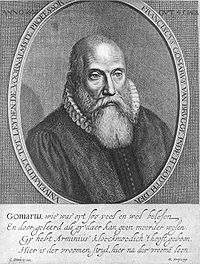
Franciscus Gomarus

Encyclopedia
Bruges
Bruges is the capital and largest city of the province of West Flanders in the Flemish Region of Belgium. It is located in the northwest of the country....
- January 11, 1641, Groningen), was a Dutch
Netherlands
The Netherlands is a constituent country of the Kingdom of the Netherlands, located mainly in North-West Europe and with several islands in the Caribbean. Mainland Netherlands borders the North Sea to the north and west, Belgium to the south, and Germany to the east, and shares maritime borders...
theologian
Theology
Theology is the systematic and rational study of religion and its influences and of the nature of religious truths, or the learned profession acquired by completing specialized training in religious studies, usually at a university or school of divinity or seminary.-Definition:Augustine of Hippo...
, a strict Calvinist
Calvinism
Calvinism is a Protestant theological system and an approach to the Christian life...
and opponent of the teaching of Jacobus Arminius
Jacobus Arminius
Jacobus Arminius , the Latinized name of the Dutch theologian Jakob Hermanszoon from the Protestant Reformation period, served from 1603 as professor in theology at the University of Leiden...
(and his followers), which was formally judged at the Synod of Dort
Synod of Dort
The Synod of Dort was a National Synod held in Dordrecht in 1618-1619, by the Dutch Reformed Church, to settle a divisive controversy initiated by the rise of Arminianism. The first meeting was on November 13, 1618, and the final meeting, the 154th, was on May 9, 1619...
(1618–1619).
Life
His parents, having embraced the principles of the ReformationProtestant Reformation
The Protestant Reformation was a 16th-century split within Western Christianity initiated by Martin Luther, John Calvin and other early Protestants. The efforts of the self-described "reformers", who objected to the doctrines, rituals and ecclesiastical structure of the Roman Catholic Church, led...
, emigrated to the Palatinate in 1578, in order to enjoy freedom to profess their new faith, and they sent their son to be educated at Strasbourg
Strasbourg
Strasbourg is the capital and principal city of the Alsace region in eastern France and is the official seat of the European Parliament. Located close to the border with Germany, it is the capital of the Bas-Rhin département. The city and the region of Alsace are historically German-speaking,...
under Johann Sturm
Johann Sturm
Johann Christoph Sturm was a German philosopher. Sturm is the author of Physica Electiva , a book which criticized Leibniz and prompted him to publish a rebuke.-Works by Sturm:...
. He remained there three years, and then went in 1580 to Neustadt
Neustadt an der Weinstraße
Neustadt an der Weinstraße is a town located in Rhineland-Palatinate, Germany. With 53,892 inhabitants as of 2002, it is the largest town called Neustadt.-Etymology:...
, whither the professors of Heidelberg
Ruprecht Karl University of Heidelberg
The Ruprecht-Karls-Universität Heidelberg is a public research university located in Heidelberg, Baden-Württemberg, Germany. Founded in 1386, it is the oldest university in Germany and was the third university established in the Holy Roman Empire. Heidelberg has been a coeducational institution...
had been driven by the elector-palatine because they were not Lutherans. Here his teachers in theology were Zacharius Ursinus (1534–1583), Hieronymus Zanchius (1560–1590), and Daniel Tossanus
Daniel Tossanus
-Life:He was born at Montbéliard on July 15, 1541, the son of Pierre Toussain. He was educated at Basel and Tübingen. Returning to France he preached for six months in his native town, and went to Orléans, 1560, where, after being a teacher of Hebrew, he was ordained minister of the local Reformed...
(1541–1602). Crossing to England
England
England is a country that is part of the United Kingdom. It shares land borders with Scotland to the north and Wales to the west; the Irish Sea is to the north west, the Celtic Sea to the south west, with the North Sea to the east and the English Channel to the south separating it from continental...
towards the end of 1582, he attended the lectures of John Rainolds
John Rainolds
John Rainolds , English divine, was born about Michaelmas 1549 at Pinhoe, near Exeter.He was educated at Merton and Corpus Christi Colleges, Oxford, becoming a fellow of the latter in 1568. In 1572-73 he was appointed reader in Greek, and his lectures on Aristotle's Rhetoric laid the sure basis of...
(1549–1607) at Oxford
Oxford
The city of Oxford is the county town of Oxfordshire, England. The city, made prominent by its medieval university, has a population of just under 165,000, with 153,900 living within the district boundary. It lies about 50 miles north-west of London. The rivers Cherwell and Thames run through...
, and those of William Whitaker
William Whitaker (theologian)
William Whitaker was a prominent Anglican theologian. He was Master of St. John's College, Cambridge, and a leading divine in the university in the latter half of the sixteenth century.-Early life and education:...
at Cambridge
Cambridge
The city of Cambridge is a university town and the administrative centre of the county of Cambridgeshire, England. It lies in East Anglia about north of London. Cambridge is at the heart of the high-technology centre known as Silicon Fen – a play on Silicon Valley and the fens surrounding the...
. He graduated at Cambridge in 1584, and then went to Heidelberg, where the faculty had been by this time re-established. He was pastor
Pastor
The word pastor usually refers to an ordained leader of a Christian congregation. When used as an ecclesiastical styling or title, this role may be abbreviated to "Pr." or often "Ps"....
of a Dutch Reformed Church
Dutch Reformed Church
The Dutch Reformed Church was a Reformed Christian denomination in the Netherlands. It existed from the 1570s to 2004, the year it merged with the Reformed Churches in the Netherlands and the Evangelical Lutheran Church in the Kingdom of the Netherlands to form the Protestant Church in the...
in Frankfurt
Frankfurt
Frankfurt am Main , commonly known simply as Frankfurt, is the largest city in the German state of Hesse and the fifth-largest city in Germany, with a 2010 population of 688,249. The urban area had an estimated population of 2,300,000 in 2010...
from 1587 till 1593, when the congregation was dispersed by persecution
Persecution
Persecution is the systematic mistreatment of an individual or group by another group. The most common forms are religious persecution, ethnic persecution, and political persecution, though there is naturally some overlap between these terms. The inflicting of suffering, harassment, isolation,...
. In 1594 he was appointed professor
Professor
A professor is a scholarly teacher; the precise meaning of the term varies by country. Literally, professor derives from Latin as a "person who professes" being usually an expert in arts or sciences; a teacher of high rank...
of theology
Theology
Theology is the systematic and rational study of religion and its influences and of the nature of religious truths, or the learned profession acquired by completing specialized training in religious studies, usually at a university or school of divinity or seminary.-Definition:Augustine of Hippo...
at the University of Leiden, and before going there received from the University of Heidelberg the degree of doctor
Doctorate
A doctorate is an academic degree or professional degree that in most countries refers to a class of degrees which qualify the holder to teach in a specific field, A doctorate is an academic degree or professional degree that in most countries refers to a class of degrees which qualify the holder...
.
Theology
He taught quietly at Leiden until 1603, when Jacobus ArminiusJacobus Arminius
Jacobus Arminius , the Latinized name of the Dutch theologian Jakob Hermanszoon from the Protestant Reformation period, served from 1603 as professor in theology at the University of Leiden...
came to be one of his colleagues in the theological faculty, and began to teach what he viewed as essentially Pelagian
Pelagianism
Pelagianism is a theological theory named after Pelagius , although he denied, at least at some point in his life, many of the doctrines associated with his name. It is the belief that original sin did not taint human nature and that mortal will is still capable of choosing good or evil without...
doctrines and to create a new school of theology
Arminianism
Arminianism is a school of soteriological thought within Protestant Christianity based on the theological ideas of the Dutch Reformed theologian Jacobus Arminius and his historic followers, the Remonstrants...
within the university. Gomarus immediately set himself earnestly to oppose these beliefs in his classes at college, and was supported by Johann B. Bogermann (1570–1637), who afterwards became professor of theology at Franeker. Arminius sought to make election dependent upon faith, whilst they sought to enforce absolute predestination
Predestination
Predestination, in theology is the doctrine that all events have been willed by God. John Calvin interpreted biblical predestination to mean that God willed eternal damnation for some people and salvation for others...
as the rule of faith, according to which the whole Scriptures are to be interpreted. Gomarus then became the leader of the opponents of Arminius, who came to be known as Gomarists (Dutch: contra-remonstranten).
He engaged twice in personal disputation with Arminius in the assembly of the States of Holland
States of Holland
The States of Holland and West Frisia were the representation of the two Estates to the court of the Count of Holland...
in 1608, and was one of five Gomarists who met five Arminians or Remonstrants in the same assembly of 1609. On the death of Arminius shortly after this time, Konrad Vorstius, who sympathized with his views, was appointed to succeed him, in spite of the opposition of Gomarus and his friends. Gomarus took his defeat badly, resigned his post, and went to Middleburg
Middleburg
Middleburg may mean the following places in the United States of America:*Middleburg, Florida*Middleburg, Iowa*Middleburg, Kentucky*Middleburg, Maryland*Middleburgh , New York**Middleburgh , New York*Middleburg, Logan County, Ohio...
in 1611, where he became preacher at the Reformed church, and taught theology and Hebrew in the newly founded Illustre Schule.
He was then called in 1614 to a chair of theology at the Academy of Saumur
Academy of Saumur
The Academy of Saumur was a Huguenot university at Saumur in western France. It existed from 1593, when it was founded by Philippe de Mornay, until shortly after 1683, when Louis XIV decided on the revocation of the Edict of Nantes, ending the limited toleration of Protestantism in...
, where he remained four years, and then accepted a call as professor of theology and Hebrew to Groningen, where he stayed until his death on 11 January 1641. Gomarus, despite his position as a professor of Hebrew, urged that restrictions be placed on the Jews.
Synod of Dordrecht
He took a leading part in the Synod of DordrechtSynod of Dort
The Synod of Dort was a National Synod held in Dordrecht in 1618-1619, by the Dutch Reformed Church, to settle a divisive controversy initiated by the rise of Arminianism. The first meeting was on November 13, 1618, and the final meeting, the 154th, was on May 9, 1619...
, assembled in 1618 to judge of the doctrines of Arminius. He was a man of ability, enthusiasm and learning, a considerable Oriental scholar, and also a keen controversialist. He took part in revising the Dutch translation of the Old Testament
Old Testament
The Old Testament, of which Christians hold different views, is a Christian term for the religious writings of ancient Israel held sacred and inspired by Christians which overlaps with the 24-book canon of the Masoretic Text of Judaism...
in 1633, and after his death a book by him, called the Lyra Davidis, was published, which sought to explain the principles of Hebrew metre, and which created some controversy at the time, having been opposed by Louis Cappel
Louis Cappel
Louis Cappel was a French Protestant churchman and scholar.-Life:Cappel, a Huguenot, was born at St Elier, near Sedan. He studied theology at the Academy of Sedan and the Academy of Saumur, and Arabic at the University of Oxford, where he spent two years...
. His works were collected and published in one volume folio, in Amsterdam in 1645. He was succeeded at Groningen in 1643 by his pupil Samuel Maresius
Samuel Maresius
Samuel Maresius was a French-Dutch Reformed theologian ad controversialist.-Life:He was born at Oisement in Picardy, northern France. He studied in Paris, in Saumur Academy under Gomarus, and in Geneva at the time of the Synod of Dort. He was ordained in 1620, and preachedat Laon until a...
(1599–1673).
External links
- Treatise, "Of God's Predestination" in English translation.
- Article on his life, ministry and controversy with Arminius.
- Treatise, "An Examination of the Controversy Regarding Christ's Genealogy in the original Latin.
- "David's Harp," a work on the poetical portions of Old Testament Scripture, in the original Latin. An alternative copy is also available. Accoort Vande Recht-sinnige Leere der Voorsienicheyt Gods