

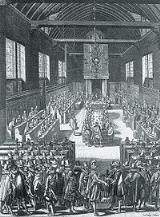
Synod of Dort

Encyclopedia
- Dates in this article are according to the Julian CalendarJulian calendarThe Julian calendar began in 45 BC as a reform of the Roman calendar by Julius Caesar. It was chosen after consultation with the astronomer Sosigenes of Alexandria and was probably designed to approximate the tropical year .The Julian calendar has a regular year of 365 days divided into 12 months...
. Sources using the Old Style calendar will need to be adjusted by adding ten days.
The Synod of Dort (also known as the Synod of Dordt or the Synod of Dordrecht) was a National Synod
Synod
A synod historically is a council of a church, usually convened to decide an issue of doctrine, administration or application. In modern usage, the word often refers to the governing body of a particular church, whether its members are meeting or not...
held in Dordrecht
Dordrecht
Dordrecht , colloquially Dordt, historically in English named Dort, is a city and municipality in the western Netherlands, located in the province of South Holland. It is the fourth largest city of the province, having a population of 118,601 in 2009...
in 1618-1619, by the Dutch Reformed Church
Dutch Reformed Church
The Dutch Reformed Church was a Reformed Christian denomination in the Netherlands. It existed from the 1570s to 2004, the year it merged with the Reformed Churches in the Netherlands and the Evangelical Lutheran Church in the Kingdom of the Netherlands to form the Protestant Church in the...
, to settle a divisive controversy initiated by the rise of Arminianism
Arminianism
Arminianism is a school of soteriological thought within Protestant Christianity based on the theological ideas of the Dutch Reformed theologian Jacobus Arminius and his historic followers, the Remonstrants...
. The first meeting was on November 13, 1618, and the final meeting, the 154th, was on May 9, 1619. Voting representatives from eight foreign Reformed churches
Reformed churches
The Reformed churches are a group of Protestant denominations characterized by Calvinist doctrines. They are descended from the Swiss Reformation inaugurated by Huldrych Zwingli but developed more coherently by Martin Bucer, Heinrich Bullinger and especially John Calvin...
were also invited. Dort was a contemporary English term for the town of Dordrecht (and it remains the local colloquial pronunciation).
Background
There had been previous provincial synods of Dort, and a National Synod in 1576. For that reason the 1618 meeting is sometimes called the Second Synod of Dort.The acts of the Synod were tied to political intrigues that arose during the Twelve Year Truce, a pause in the Dutch war with Spain. After the death of Jacob Arminius his followers presented objections to the Belgic Confession
Belgic Confession
The Confession of Faith, popularly known as the Belgic Confession, is a doctrinal standard document to which many of the Reformed churches subscribe. The Confession forms part of the Reformed Three Forms of Unity...
and the teaching of John Calvin
John Calvin
John Calvin was an influential French theologian and pastor during the Protestant Reformation. He was a principal figure in the development of the system of Christian theology later called Calvinism. Originally trained as a humanist lawyer, he broke from the Roman Catholic Church around 1530...
, Theodore Beza
Theodore Beza
Theodore Beza was a French Protestant Christian theologian and scholar who played an important role in the Reformation...
, and their followers. These objections were published in a document called The Remonstrance of 1610, and the Arminians were therefore also known as Remonstrants. They taught election on the basis of foreseen faith, a universal atonement, resistible grace, and the possibility of lapse from grace. The opposing Calvinists or Gomarists, led by Franciscus Gomarus
Franciscus Gomarus
Franciscus Gomarus , was a Dutch theologian, a strict Calvinist and opponent of the teaching of Jacobus Arminius , which was formally judged at the Synod of Dort .-Life:His parents, having embraced the principles of the Reformation, emigrated to the Palatinate in 1578, in order...
of the University of Leiden, became known as the Contra-Remonstrants.
The Arminians were perceived as ready to compromise with the Spanish, whereas the orthodox Dutch Calvinists were not, so Arminianism was considered by some to be political treason; in 1617–8 there was a pamphlet war and Francis van Aarssens
Francis van Aarssens
Baron Francis van Aarssens or Baron François van Aerssen , from 1611 on lord of Sommelsdijk, was a diplomat and statesman of the United Provinces....
expressed the view that the Arminians were working for Philip IV of Spain
Philip IV of Spain
Philip IV was King of Spain between 1621 and 1665, sovereign of the Spanish Netherlands, and King of Portugal until 1640...
. Planning for a National Synod was begun by Adriaan Pauw
Adriaan Pauw
Adriaan Pauw, knight, heer van Heemstede, Bennebroek, Nieuwerkerk etc. was Grand Pensionary of Holland from 1631 to 1636 and from 1651 to 1653.-Life:...
in March 1618. Before that, there had been a debate as to whether the synod should be national, as the Contra-Remonstrants wished, or provincial for Holland, as the Remonstrants argued. This decision was worked out in 1617, with outside input from the English ambassador Dudley Carleton
Dudley Carleton, 1st Viscount Dorchester
Dudley Carleton, 1st Viscount Dorchester was an English art collector, diplomat and Secretary of State.-Early life:He was the second son of Antony Carleton of Brightwell Baldwin, Oxfordshire, and of Jocosa, daughter of John Goodwin of Winchendon, Buckinghamshire...
.
Purpose
The purpose of the Synod was to settle the controversy over Arminianism. It was subsequently alleged that the outcome had already been decided. According to Frederick Calder, "condemnation [of the Remonstrant doctrines] was determined before the national synod met." On the other hand, beyond the condemnation of the Arminians, the theological formulations of the Canons of the Synod by no means gave support to all the Gomarists wanted. The more extreme views of Dutch Calvinists were moderated in the detailed debates.Proceedings
Simon EpiscopiusSimon Episcopius
Simon Episcopius was a Dutch theologian and Remonstrant who played a significant role at the Synod of Dort in 1618...
(1583–1643) was spokesman of the 14 Remonstrants who were summoned before the Synod in 1618. At the opening of the synod, Episcopius asked to speak.
"Episcopius [...] insisted on being permitted to begin with a refutation of the Calvinistic doctrines, especially that of reprobation, hoping that, by placing his objections to this doctrine in front of all the rest, he might excite such prejudice against the other articles of the system, as to secure the popular voice in his favor. The Synod, however, very properly, reminded him [...] that, as the Remonstrants were accused of departing from the Reformed faith, they were bound first to justify themselves, by giving Scriptural proof in support of their opinions. The Arminians would not submit to this plan of procedure because it destroyed their whole scheme of argument [...] and were thus compelled to withdraw. Upon their departure, the Synod proceeded without them."
He concluded by expressing his dissatisfaction with the organization of the assembly, and alleged that the Contra-Remonstrants had prevented an accurate representation of the Arminian supporters in the Dutch Reformed Church with votes in the synod. A delegation of Episcopius, Bernard Dwinglo and Johannes Arnoldi Corvinus
Johannes Arnoldi Corvinus
Johannes Arnoldi Corvinus was a Dutch Remonstrant minister and jurist.-Life:He was born in Leiden, and in 1606 was a Calvinist preacher there. A pupil of Jacobus Arminius, he took up the Arminian views, he was a public supporter of them by 1609, and in 1610 signed the Five Articles of Remonstrance...
called on the Church of England
Church of England
The Church of England is the officially established Christian church in England and the Mother Church of the worldwide Anglican Communion. The church considers itself within the tradition of Western Christianity and dates its formal establishment principally to the mission to England by St...
representatives, and other coming from outside, asking for support and giving written accounts of the context. After that a month was spent on procedural matters concerning the Remonstrants. They were finally ejected from the Synod at session 57 on 14 January.
The Canons of Dort
The Synod concluded with a rejection of the Arminian views, and set forth the Reformed doctrine on each point, namely: total depravityTotal depravity
Total depravity is a theological doctrine that derives from the Augustinian concept of original sin...
, unconditional election
Unconditional election
Unconditional election is the Calvinist teaching that before God created the world, he chose to save some people according to his own purposes and apart from any conditions related to those persons...
, limited atonement
Limited atonement
Limited atonement is a doctrine in Christian theology which is particularly associated with the Reformed tradition and is one of the five points of Calvinism...
(arguing the efficacy of Christ's atoning work was applicable only to the elect and not the unregenerate world), irresistible (or irrevocable) grace
Irresistible grace
Irresistible Grace is a doctrine in Christian theology particularly associated with Calvinism, which teaches that the saving grace of God is effectually applied to those whom he has determined to save and, in God's timing, overcomes their resistance to obeying the call of the gospel, bringing...
, and the perseverance of the saints
Perseverance of the saints
Perseverance of the saints, as well as the corollary—though distinct—doctrine known as "Once Saved, Always Saved", is a Calvinist teaching that once persons are truly saved they can never lose their salvation....
. These are sometimes referred to as the Five points of Calvinism. The Decision of the Synod of Dort on the Five Main Points of Doctrine in Dispute in the Netherlands, popularly known as the Canons of Dort
Canons of Dort
The Canons of Dort, or Canons of Dordrecht, formally titled The Decision of the Synod of Dort on the Five Main Points of Doctrine in Dispute in the Netherlands, is the judgment of the National Synod held in the Dutch city of Dordrecht in 1618–19...
, is the explanation of the judicial decision of the Synod. In the original preface, the Decision is called a
judgment, in which both, the true view agreeing with God's word concerning the aforesaid five points of doctrine is explained and, the false view disagreeing with God's Word is rejected.
Aftermath
The thirteen Remonstrant ministers, including Episcopius, had been charged to remain in Dort until further instruction. On May 20, 1619, the Remonstrant ministers who had been present were summoned by the lay-commissioners of the synod and directed to abstain from ministerial activities such as preaching, exhorting, administering the sacraments, and visiting the sick. Furthermore, Episcopius was commanded not to write letters or books promoting the doctrines of the Remonstrants. The Remonstrants agreed to refrain from ministering in the government-ordained churches, but confessed their duty to expound their doctrines wherever people would assemble to hear them.On July 5, they were called to the States-General assembly where they were requested to sign The Act of Cessation, the legalization of the order to desist from the ministry. When they refused to sign it, they were sentenced as "disturbers of the public peace" and ordered to leave the United Provinces.
Bible translation
The synod also initiated an official Dutch Bible translation (the StatenvertalingStatenvertaling
The Statenvertaling or Statenbijbel is the first Bible translation from the original Hebrew, Aramaic and Greek languages to the Dutch language, ordered by the government of the Protestant Dutch Republic first published in 1637.The first complete Dutch Bible was printed in Antwerp in 1526 by Jacob...
, i.e. Translation of the States) from the original languages that would be completed in 1637. Translators were appointed, and the States-General were asked to fund the project. It had a lasting impact on the standard Dutch language
Dutch language
Dutch is a West Germanic language and the native language of the majority of the population of the Netherlands, Belgium, and Suriname, the three member states of the Dutch Language Union. Most speakers live in the European Union, where it is a first language for about 23 million and a second...
, which was just then beginning to gain wider acceptance and developing a literary tradition. It would remain the standard translation in Protestant churches for more than three centuries and still is used in some sister churches of the Netherlands Reformed Congregations
Netherlands Reformed Congregations
The Netherlands Reformed Congregations, is a highly conservative denomination with congregations mostly in Canada, the United States, and the Netherlands.-Baptism:...
and similar, smaller denominations.
Political impact
The Synod condemned the religious doctrine of Arminianism as heresy. There followed the political condemnation of the statesman Johan van Oldenbarnevelt who had been the protector of the Remonstrants. For the crime of general perturbation in the state of the nation, both in Church and State (treason), he was beheaded on 13 May 1619, only four days after the final meeting of the Synod. As consequence of the Arminian defeat the jurist Hugo GrotiusHugo Grotius
Hugo Grotius , also known as Huig de Groot, Hugo Grocio or Hugo de Groot, was a jurist in the Dutch Republic. With Francisco de Vitoria and Alberico Gentili he laid the foundations for international law, based on natural law...
was given a life sentence in prison; but he escaped with the help of his wife. Both Van Oldenbarnevelt and Grotius had been in fact been imprisoned since 29 August 1618.
External links
- Canons of Dort at CRC home
- Canons of Dort at Reformed.org
- Works at the Post-Reformation Digital LibraryPost-Reformation Digital LibraryThe Post-Reformation Digital Library represents a database of digitized books from the early modern era. The collected titles are directly linked to full-text versions of the works in question...
- The Ivdgement of the Synode Holden At Dort