


Forty-seven Ronin

Encyclopedia
Samurai
is the term for the military nobility of pre-industrial Japan. According to translator William Scott Wilson: "In Chinese, the character 侍 was originally a verb meaning to wait upon or accompany a person in the upper ranks of society, and this is also true of the original term in Japanese, saburau...
code of honor, bushidō
Bushido
, meaning "Way of the Warrior-Knight", is a Japanese word which is used to describe a uniquely Japanese code of conduct and a way of the samurai life, loosely analogous to the concept of chivalry. It originates from the samurai moral code and stresses frugality, loyalty, martial arts mastery, and...
.
The story tells of a group of samurai who were left leaderless (becoming ronin
Ronin
A or rounin was a Bushi with no lord or master during the feudal period of Japan. A samurai became masterless from the death or fall of his master, or after the loss of his master's favor or privilege....
) after their daimyo
Daimyo
is a generic term referring to the powerful territorial lords in pre-modern Japan who ruled most of the country from their vast, hereditary land holdings...
(feudal lord) Asano Naganori
Asano Naganori
was the daimyo of the Akō Domain in Japan . His title was Takumi no Kami . He is known as the person who triggered a series of incidents retold in a story known as Chushingura, one of the favourite themes of kabuki, joruri and Japanese books and films.He was born in Edo as the eldest son of Asano...
was forced to commit seppuku
Seppuku
is a form of Japanese ritual suicide by disembowelment. Seppuku was originally reserved only for samurai. Part of the samurai bushido honor code, seppuku was either used voluntarily by samurai to die with honor rather than fall into the hands of their enemies , or as a form of capital punishment...
(ritual suicide) for assaulting a court official named Kira Yoshinaka
Kira Yoshinaka
was a kōke . His court title was Kōzuke no suke. He is famous as the adversary of Asano Naganori in the events of the Forty-seven Ronin...
, whose title was Kōzuke
Kozuke Province
was an old province located in the Tōsandō of Japan, which today comprises Gunma Prefecture. It is nicknamed as or .The ancient provincial capital was near modern Maebashi. During the Sengoku period, Kōzuke was controlled variously by Takeda Shingen, Uesugi Kenshin, the late Hōjō clan, and...
no suke. The ronin avenged their master's honor after patiently waiting and planning for two years to kill Kira. In turn, the ronin were themselves forced to commit seppuku for committing the crime of murder
Murder
Murder is the unlawful killing, with malice aforethought, of another human being, and generally this state of mind distinguishes murder from other forms of unlawful homicide...
. With much embellishment, this true story was popularized in Japanese culture as emblematic of the loyalty, sacrifice, persistence, and honor that all good people should preserve in their daily lives. The popularity of the almost mythical tale was only enhanced by rapid modernization during the Meiji
Meiji period
The , also known as the Meiji era, is a Japanese era which extended from September 1868 through July 1912. This period represents the first half of the Empire of Japan.- Meiji Restoration and the emperor :...
era of Japanese history, when it is suggested many people in Japan longed for a return to their cultural roots.
Fictionalized accounts of these events are known as Chūshingura
Chushingura
is the name for fictionalized accounts of the historical revenge by the Forty-seven Ronin of the death of their master, Asano Naganori. Including the early , the story has been told in kabuki, bunraku, stage plays, films, novels, television shows and other media...
. The story was popularized in numerous plays including bunraku
Bunraku
, also known as Ningyō jōruri , is a form of traditional Japanese puppet theater, founded in Osaka in 1684.Three kinds of performers take part in a bunraku performance:* Ningyōtsukai or Ningyōzukai—puppeteers* Tayū—the chanters* Shamisen players...
and kabuki
Kabuki
is classical Japanese dance-drama. Kabuki theatre is known for the stylization of its drama and for the elaborate make-up worn by some of its performers.The individual kanji characters, from left to right, mean sing , dance , and skill...
. Because of the censorship
Censorship
thumb|[[Book burning]] following the [[1973 Chilean coup d'état|1973 coup]] that installed the [[Military government of Chile |Pinochet regime]] in Chile...
laws of the shogunate
Tokugawa shogunate
The Tokugawa shogunate, also known as the and the , was a feudal regime of Japan established by Tokugawa Ieyasu and ruled by the shoguns of the Tokugawa family. This period is known as the Edo period and gets its name from the capital city, Edo, which is now called Tokyo, after the name was...
in the Genroku
Genroku
was a after Jōkyō and before Hōei. This period spanned the years from September 1688 through March 1704. The reigning emperor was .The years of Genroku are generally considered to be the Golden Age of the Edo Period. The previous hundred years of peace and seclusion in Japan had created relative...
era
Japanese era name
The Japanese era calendar scheme is a common calendar scheme used in Japan, which identifies a year by the combination of the and the year number within the era...
, which forbade portrayal of current events, the names were changed. While the version given by the playwrights may have come to be accepted as historical fact by some, the Chūshingura was written some 50 years after the event, and numerous historical records about the actual events that pre-date the Chūshingura survive. The popularity of the story is still high today. With ten different television productions in the years 1997–2007 alone, the Chūshingura ranks among the most familiar of all stories in Japan.
The bakufu
Shogun
A was one of the hereditary military dictators of Japan from 1192 to 1867. In this period, the shoguns, or their shikken regents , were the de facto rulers of Japan though they were nominally appointed by the emperor...
s censorship laws had relaxed somewhat 75 years later, when Japanologist Isaac Titsingh
Isaac Titsingh
Isaac Titsingh FRS was a Dutch surgeon, scholar, merchant-trader and ambassador.During a long career in East Asia, Titsingh was a senior official of the Dutch East India Company . He represented the European trading company in exclusive official contact with Tokugawa Japan...
first recorded the story of the 47 ronin as one of the significant events of the Genroku era.
The story of forty-seven samurai
In 1701 (by the Western calendar), two daimyoDaimyo
is a generic term referring to the powerful territorial lords in pre-modern Japan who ruled most of the country from their vast, hereditary land holdings...
, Asano Takumi-no-Kami Naganori
Asano Naganori
was the daimyo of the Akō Domain in Japan . His title was Takumi no Kami . He is known as the person who triggered a series of incidents retold in a story known as Chushingura, one of the favourite themes of kabuki, joruri and Japanese books and films.He was born in Edo as the eldest son of Asano...
, the young daimyo of the Akō Domain
Ako Domain
The was a domain in feudal Japan. It was located in Harima Province and coincided with the present-day cities of Akō and Aioi and the town of Kamigōri in Hyōgo Prefecture. The domain had its headquarters at Akō Castle....
(a small fiefdom
Fiefdom
A fee was the central element of feudalism and consisted of heritable lands granted under one of several varieties of feudal tenure by an overlord to a vassal who held it in fealty in return for a form of feudal allegiance and service, usually given by the...
in western Honshū
Honshu
is the largest island of Japan. The nation's main island, it is south of Hokkaido across the Tsugaru Strait, north of Shikoku across the Inland Sea, and northeast of Kyushu across the Kanmon Strait...
), and Lord Kamei of the Tsuwano Domain
Tsuwano Domain
The ' was a Japanese domain of the Edo period, located in Iwami Province . The Meiji-era author Mori Ōgai was the son of a Tsuwano retainer.-List of Daimyo:*Sakazaki clan #Sakazaki Naomori...
, were ordered to arrange a fitting reception for the envoys of the Emperor
Emperor Higashiyama
was the 113th emperor of Japan, according to the traditional order of succession.Higashiyama's reign spanned the years from 1687 through 1709.-Genealogy:...
in Edo
Edo
, also romanized as Yedo or Yeddo, is the former name of the Japanese capital Tokyo, and was the seat of power for the Tokugawa shogunate which ruled Japan from 1603 to 1868...
, during their sankin kōtai
Sankin kotai
was a policy of the shogunate during most of the Edo period of Japanese history. The purpose was to control the daimyo. In adopting the policy, the shogunate was continuing and refining similar policies of Toyotomi Hideyoshi. In 1635, a law required sankin kōtai, which was already an established...
service to the Shogun
Shogun
A was one of the hereditary military dictators of Japan from 1192 to 1867. In this period, the shoguns, or their shikken regents , were the de facto rulers of Japan though they were nominally appointed by the emperor...
.
These daimyo names are not fictional, nor is there any question that something actually happened in . What is commonly called the Akō incident was an actual event.
For many years, the version of events retold by A. B. Mitford
Algernon Freeman-Mitford, 1st Baron Redesdale
Algernon Bertram Freeman-Mitford, 1st Baron Redesdale GCVO, KCB , of Batsford Park, Gloucestershire, and Birdhope Craig, Northumberland, was a British diplomat, collector and writer...
in Tales of Old Japan
Tales of Old Japan
Tales of Old Japan is an anthology of short stories, compiled by Algernon Bertram Freeman-Mitford, Lord Redesdale, writing under the better known name of A.B. Mitford. These stories focus on the varying aspects of Japanese life in centuries past...
(1871) was considered authoritative. The sequence of events and the characters in this narrative were presented to a wide popular readership in the West. Mitford invited his readers to construe his story of the Forty-seven Ronin as historically accurate; and while his version of the tale has long been considered a standard work, some of its precise details are now questioned. Nevertheless, even with plausible defects, Mitford's work remains a conventional starting point for further study.
Whether as a mere literary device or as a claim for ethnographic veracity, Mitford explains:
Mitford appended what he explained were translations of Sengakuji documents the author had examined personally. These were proffered as "proofs" authenticating the factual basis of his story. These documents were:
- ...the receipt given by the retainers of Kira Kôtsuké no Suké's son in return for the head of their lord's father, which the priests restored to the family.
- ...a document explanatory of their conduct, a copy of which was found on the person of each of the forty-seven men, dated in the 15th year of Genroku, 12th month.
- ...a paper which the Forty-seven Rǒnin laid upon the tomb of their master, together with the head of Kira Kôtsuké no Suké.
(See Tales of Old Japan
Tales of Old Japan
Tales of Old Japan is an anthology of short stories, compiled by Algernon Bertram Freeman-Mitford, Lord Redesdale, writing under the better known name of A.B. Mitford. These stories focus on the varying aspects of Japanese life in centuries past...
for the widely-known, yet significantly fictional narrative)
Genesis of a tragedy
Tokugawa Tsunayoshi
was the fifth shogun of the Tokugawa dynasty of Japan. He was the younger brother of Tokugawa Ietsuna, thus making him the son of Tokugawa Iemitsu, the grandson of Tokugawa Hidetada, and the great-grandson of Tokugawa Ieyasu....
's shogunate. He became upset at them, allegedly because of either the small presents they offered him (in the time-honored compensation for such an instructor), or because they would not offer bribes as he wanted. Other sources say that he was a naturally rude and arrogant individual, or that he was corrupt, which offended Asano, a devoutly moral
Moral
A moral is a message conveyed or a lesson to be learned from a story or event. The moral may be left to the hearer, reader or viewer to determine for themselves, or may be explicitly encapsulated in a maxim...
Confucian. Regardless, whether Kira treated them poorly, insulted them or failed to prepare them for fulfilling specific bakufu duties, offense was taken.
While Asano bore all this stoically, Kamei became enraged, and prepared to kill Kira to avenge the insults. However, the quick thinking counsellors of Kamei averted disaster for their lord and clan (for all would have been punished if Kamei killed Kira) by quietly giving Kira a large bribe; Kira thereupon began to treat Kamei nicely, which calmed Kamei's anger.
However, Kira allegedly continued to treat Asano harshly, because he was upset that the latter had not emulated his companion. Finally, Kira insulted Asano, calling him a country boor with no manners, and Asano could restrain himself no longer. At the Matsu no Ōrōka
Matsu no Oroka
The was part of Edo Castle. The name derives from the painted shōji that were decorated with motifs of pine trees ....
, the main grand corridor that interconnects different parts of the shogun's residence, he lost his temper and attacked Kira with a dagger, but only wounded him in the face with his first strike; his second missed and hit a pillar. Guards then quickly separated them.
Kira's wound was hardly serious, but the attack on a shogunate official within the boundaries of the shogun's residence was considered a grave offense. Any kind of violence, even drawing a sword
Katana
A Japanese sword, or , is one of the traditional bladed weapons of Japan. There are several types of Japanese swords, according to size, field of application and method of manufacture.-Description:...
, was completely forbidden in Edo Castle
Edo Castle
, also known as , is a flatland castle that was built in 1457 by Ōta Dōkan. It is located in Chiyoda in Tokyo, then known as Edo, Toshima District, Musashi Province. Tokugawa Ieyasu established the Tokugawa shogunate here. It was the residence of the shogun and location of the shogunate, and also...
. The daimyo of Akō had removed his dagger from its scabbard within Edo Castle, and for that offense, he was ordered to kill himself by committing seppuku
Seppuku
is a form of Japanese ritual suicide by disembowelment. Seppuku was originally reserved only for samurai. Part of the samurai bushido honor code, seppuku was either used voluntarily by samurai to die with honor rather than fall into the hands of their enemies , or as a form of capital punishment...
. Asano's goods and lands were to be confiscated after his death, his family was to be ruined, and his retainers were to be made ronin
Ronin
A or rounin was a Bushi with no lord or master during the feudal period of Japan. A samurai became masterless from the death or fall of his master, or after the loss of his master's favor or privilege....
.
This news was carried to Ōishi Kuranosuke Yoshio
Oishi Yoshio
was the chamberlain of the Akō Domain in Harima Province , Japan . He is known as the leader of the Forty-seven Ronin in their 1702 vendetta and thus the hero of the Chūshingura...
, Asano's principal counsellor, who took command and moved the Asano family away, before complying with bakufu orders to surrender the castle to the agents of the government.
The ronin plot revenge

However, Kira was well guarded, and his residence had been fortified, to prevent just such an event. They saw that they would have to put him off his guard before they could succeed. To quell the suspicions of Kira and other shogunate authorities, they dispersed and became tradesmen or monks.
Ōishi himself took up residence in Kyoto
Kyoto
is a city in the central part of the island of Honshū, Japan. It has a population close to 1.5 million. Formerly the imperial capital of Japan, it is now the capital of Kyoto Prefecture, as well as a major part of the Osaka-Kobe-Kyoto metropolitan area.-History:...
, and began to frequent brothels and taverns, as if nothing were further from his mind than revenge. Kira still feared a trap, and sent spies to watch the former retainers of Asano.
One day, as Ōishi returned drunk from some haunt, he fell down in the street and went to sleep, and all the passers-by laughed at him. A Satsuma
Satsuma Province
was an old province of Japan that is now the western half of Kagoshima Prefecture on the island of Kyūshū. Its abbreviation is Sasshū .During the Sengoku Period, Satsuma was a fief of the Shimazu daimyo, who ruled much of southern Kyūshū from their castle at Kagoshima city.In 1871, with the...
man, passing by, was infuriated by this behaviour on the part of a samurai—both by his lack of courage to avenge his master, as well as his current debauched behaviour. The Satsuma man abused and insulted him, and kicked him in the face (to even touch the face of a samurai was a great insult, let alone strike it), and spat on him.
Not too long after, Ōishi went to his loyal wife of twenty years and divorced her so that no harm would come to her when they took revenge, and sent her away with their two younger children to live with her parents; for the eldest boy, Chikara, he gave a choice to stay and fight or to leave. He remained with his father.
Ōishi began to act oddly and very unlike the composed samurai. He frequented geisha houses (particularly the Ichiriki Ochaya
Ichiriki Ochaya
The Ichiriki Ochaya is one of the most famous and historic Ochaya in Kyoto, Japan...
), drank nightly, and acted very obscenely in public. Later Ōishi's men bought a geisha, in hopes he would calm down. This was all a ruse to rid Ōishi of his spies.
Kira's agents reported all this to Kira, who became convinced that he was safe from the retainers of Asano, who must all be bad samurai indeed, without the courage to avenge their master after a year and a half. Thinking them harmless and lacking funds from his "retirement", he then reluctantly let down his guard.
The rest of the faithful ronin now gathered in Edo, and in their roles as workmen and merchants gained access to Kira's house, becoming familiar with the layout of the house and the character of all within. One of the retainers (Kinemon Kanehide Okano) went so far as to marry the daughter of the builder of the house, to obtain plans. All of this was reported to Ōishi. Others gathered arms and secretly transported them to Edo, another offense.
The attack

In , early in the morning in a driving wind during a heavy fall of snow, Ōishi and the ronin attacked Kira Yoshinaka's mansion in Edo. According to a carefully laid-out plan, they split up into two groups and attacked, armed with swords and bows. One group, led by Ōishi, was to attack the front gate; the other, led by his son, Ōishi Chikara, was to attack the house via the back gate. A drum would sound the simultaneous attack, and a whistle would signal that Kira was dead.
Once Kira was dead, they planned to cut off his head, and lay it as an offering on their master's tomb. They would then turn themselves in, and wait for their expected sentence of death. All this had been confirmed at a final dinner, where Ōishi had asked them to be careful, and spare women, children, and other helpless people. The code of bushido
Bushido
, meaning "Way of the Warrior-Knight", is a Japanese word which is used to describe a uniquely Japanese code of conduct and a way of the samurai life, loosely analogous to the concept of chivalry. It originates from the samurai moral code and stresses frugality, loyalty, martial arts mastery, and...
does not require mercy to noncombatants, nor forbid it.
Ōishi had four men scale the fence and enter the porter's lodge, capturing and tying up the guard there. He then sent messengers to all the neighboring houses, to explain that they were not robbers, but retainers out to avenge the death of their master, and that no harm would come to anyone else: they were all perfectly safe. One of the ronin climbed to the roof, and loudly announced to the neighbors that the matter is a revenge act (katakiuchi, 敵討ち). The neighbors, who all hated Kira, were relieved and did nothing to hinder the raiders.
After posting archers (some on the roof), to prevent those in the house (who had not yet awakened) from sending for help, Ōishi sounded the drum to start the attack. Ten of Kira's retainers held off the party attacking the house from the front, but Ōishi Chikara's party broke into the back of the house.
Kira, in terror, took refuge in a closet in the veranda, along with his wife and female servants. The rest of his retainers, who slept in barracks outside, attempted to come into the house to his rescue. After overcoming the defenders at the front of the house, the two parties of father and son joined up, and fought with the retainers who came in. The latter, perceiving that they were losing, tried to send for help, but their messengers were killed by the archers posted to prevent that eventuality.
Eventually, after a fierce struggle, the last of Kira's retainers was subdued; in the process they killed sixteen of Kira's men and wounded twenty-two, including his grandson. Of Kira, however, there was no sign. They searched the house, but all they found were crying women and children. They began to despair, but Ōishi checked Kira's bed, and it was still warm, so he knew he could not be far.
The death of Kira
A renewed search disclosed an entrance to a secret courtyard hidden behind a large scroll; the courtyard held a small building for storing charcoal and firewood, where two more hidden armed retainers were overcome and killed. A search of the building disclosed a man hiding; he attacked the searcher with a dagger, but the man was easily disarmed.He refused to say who he was, but the searchers felt sure it was Kira, and sounded the whistle. The ronin gathered, and Ōishi, with a lantern, saw that it was indeed Kira—as a final proof, his head bore the scar from Asano's attack.
At that, Ōishi went on his knees, and in consideration of Kira's high rank, respectfully addressed him, telling him they were retainers of Asano, come to avenge him as true samurai should, and inviting Kira to die as a true samurai should, by killing himself. Ōishi indicated he personally would act as a second
Kaishakunin
A kaishakunin is an appointed second whose duty is to behead one who has committed seppuku, Japanese ritual suicide, at the moment of agony...
, and offered him the same dagger that Asano had used to kill himself.
However, no matter how much they entreated him, Kira crouched, speechless and trembling. At last, seeing it was useless to ask, Ōishi ordered the ronin to pin him down, and killed him by cutting off his head with the dagger. Kira was killed on the night of the 14th day of the 12th month of the 15th year of Genroku (1703-01-30 Gregorian
Gregorian calendar
The Gregorian calendar, also known as the Western calendar, or Christian calendar, is the internationally accepted civil calendar. It was introduced by Pope Gregory XIII, after whom the calendar was named, by a decree signed on 24 February 1582, a papal bull known by its opening words Inter...
).
They then extinguished all the lamps and fires in the house (lest any cause the house to catch fire, and start a general fire that would harm the neighbors), and left, taking the head.
One of the ronin, the ashigaru
Ashigaru
The Japanese ashigaru were foot-soldiers of medieval Japan. The first known reference to ashigaru was in the 1300s, but it was during the Ashikaga Shogunate-Muromachi period that the use of ashigaru became prevalent by various warring factions.-Origins:Attempts were made in Japan by the Emperor...
Terasaka Kichiemon, was ordered to travel to Akō and inform them that their revenge had been completed. (Though Kichiemon's role as a messenger is the most widely-accepted version of the story, other accounts have him running away before or after the battle, or being ordered to leave before the ronin turned themselves in.)
The aftermath

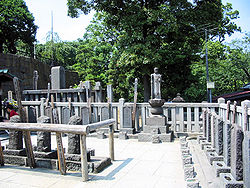
Sengaku-ji
Sengakuji is a Sōtō Zen Buddhist temple located in the Takanawa neighborhood of Minato-ku, near Shinagawa Station, Tokyo, Japan.The graves of Asano Takumi no Kami Naganori and the Forty-seven Ronin are there.-External links:* - in Japanese...
temple, marching about 10 kilometers across the city, causing a great stir on the way. The story quickly went around as to what had happened, and everyone on their path praised them, and offered them refreshment.
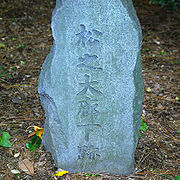
On arriving at the temple, the remaining forty-six ronin washed and cleaned Kira's head in a well, and laid it, and the fateful dagger, before Asano's tomb. They then offered prayers at the temple, and gave the abbot of the temple all the money they had left, asking him to bury them decently, and offer prayers for them. They then turned themselves in; the group was broken into four parts and put under guard of four different daimyo.
During this time, two friends of Kira came to collect his head for burial; the temple still has the original receipt for the head, which the friends and the priests who dealt with them all signed.
The shogunate officials in Edo were in a quandary. The samurai had followed the precepts of bushido
Bushido
, meaning "Way of the Warrior-Knight", is a Japanese word which is used to describe a uniquely Japanese code of conduct and a way of the samurai life, loosely analogous to the concept of chivalry. It originates from the samurai moral code and stresses frugality, loyalty, martial arts mastery, and...
by avenging the death of their lord; but they had also defied the shogunate authority by exacting revenge, which had been prohibited. In addition, the Shogun received a number of petitions from the admiring populace on behalf of the ronin. As expected, the ronin were sentenced to death for the murder of Kira; but the Shogun had finally resolved the quandary by ordering them to honorably commit seppuku, instead of having them executed as criminals. It is known that each of the assailants ended his life in a ritualistic fashion.
Each of the forty-six ronin killed himself in . This has caused a considerable amount of confusion ever since, with some people referring to the "forty-six ronin"; this refers to the group put to death by the Shogun, the actual attack party numbered forty-seven. The forty-seventh ronin, identified as Terasaka Kichiemon, eventually returned from his mission and was pardoned by the Shogun (some say on account of his youth). He lived until the age of 87, dying in around 1747, and was then buried with his comrades. The assailants who died by seppuku were subsequently interred on the grounds of Sengaku-ji, in front of the tomb of their master.
The clothes and arms they wore are still preserved in the temple to this day, along with the drum and whistle; the armor was all home-made, as they had not wanted to possibly arouse suspicion by purchasing any.
The tombs became a place of great veneration, and people flocked there to pray. The graves at this temple have been visited by a great many people throughout the years since the Genroku era. One of those who visited the tombs was the man who had mocked and spat on Ōishi as he lay drunk in the street. Addressing the grave, he begged for forgiveness for his actions, and for thinking that Ōishi was not a true samurai. He then committed suicide, and is buried next to the graves of the ronin.
Re-establishment of the Asano clan's lordship
Though this act is often viewed as an act of loyalty, there had been a second goal, to re-establish the Asanos' lordship and finding a place to serve for fellow samurai. Hundreds of samurai who had served under Asano had been left jobless and many were unable to find employment, as they had served under a disgraced family. Many lived as farmers or did simple handicrafts to make ends meet. The 47 ronin's act cleared their names and many of the unemployed samurai found jobs soon after the ronin had been sentenced to their honorable end.Asano Daigaku Nagahiro, Takuminokami's younger brother and heir, was allowed by the Tokugawa Shogunate to re-establish his name, though his territory was reduced to a tenth of the original.
Criticism
The ronin spent a year waiting for the "right time" for their revenge. It was Yamamoto TsunetomoYamamoto Tsunetomo
, also read Yamamoto Jōchō was a samurai of the Saga Domain in Hizen Province under his lord Nabeshima Mitsushige. For thirty years Yamamoto devoted his life to the service of his lord and clan...
, author of the Hagakure
Hagakure
Hagakure , or is a practical and spiritual guide for a warrior, drawn from a collection of commentaries by the samurai Yamamoto Tsunetomo, former retainer to Nabeshima Mitsushige, the third ruler of what is now the Saga prefecture in Japan...
, who asked this famous question: "What if, nine months after Asano's death, Kira had died of an illness?" The answer obviously is: then the Forty-seven Ronin would have lost their only chance at avenging their master. Even if they had claimed, then, that their dissipated behavior was just an act, that in just a little more time they would have been ready for revenge, who would have believed them? They would have been forever remembered as cowards and drunkards—bringing eternal shame to the name of the Asano clan. The right thing for the ronin to do, wrote Yamamoto, according to proper bushido, was to attack Kira and his men immediately after Asano's death. The ronin would probably have suffered defeat, as Kira was ready for an attack at that time — but this was unimportant. Ōishi, from the perspective of bushido, was too obsessed with success. He conceived his convoluted plan to ensure they would succeed at killing Kira, which is not a proper concern in a samurai: the important thing was not the death of Kira, but for the former samurai of Asano to show outstanding courage and determination in an all-out attack against the Kira house, thus winning everlasting honor for their dead master. Even if they failed to kill Kira, even if they all perished, it wouldn't have mattered, as victory and defeat have no importance in bushido. By waiting a year they improved their chances of success but risked dishonoring the name of their clan, the worst sin a samurai can commit. This is why Yamamoto and others claim that the tale of the Forty-seven Ronin is a good story of revenge — but by no means a story of bushido.
Yamamoto was not the only one to find fault in Ōishi's actions. Below are other authors' criticisms of the events surrounding Asano's attack on Kira and the subsequent attack on Kira's mansion by the forty-seven ronin.
- Asano Naganori showed concern neither for the reputation of his house nor the fate of his family and retainers when he attacked Kira. Asano should have known that attacking a Shogunal official in the Shogun's castle was a grave offence that likely would result in his death and the destruction of his house and confiscation of his domain thereby destroying the livelihood of his loyal retainers.
- Asano was a student of Confucian scholar Yamaga Soko, whose principal teaching was that in peacetime the samurai "should set a high example of devotion to duty". However, although apprenticed to Soko in the military arts, Asano showed a marked lack of samurai spirit as well as a lack of sword skill in his attack on Kira. Asano attacked Kira from behind while Kira was engaged in a discussion and Asano did not succeed in killing Kira. This showed neither courage nor ability.
- There is no evidence in legitimate historical documents that shows that Kira Yoshinaka was the villain so often portrayed that would justify an attack on him in the Shogun's castle. But Kira had to become the villain to make the story of the 47 Loyal Ronin what it was. Little is ever mentioned of Kira's 40 year service in a responsible government position, only that he was a greedy official who gravely insulted Asano. There is no evidence to support either of those assertions.
- It has been argued by some that since the 47 Ronin knowingly violated the law of the Bakufu when they attacked Kira's mansion, it was absurd for the samurai to notify the authorities on completion of their crime with the message that they were now awaiting their orders rather than immediately committing seppuku. This leads some to suspect that the driving force was not the revenge of their dead lord but the hope that praise and admiration for this act of "loyalty" would secure them a pardon and reemployment elsewhere. If they had not expected to live, why did they not disembowel themselves immediately on completion of their revenge?
- With a year and a half between Asano Naganori's death and the slaying of Kira, some had wondered whether the revenge was really a priority of Ōishi Kuranosuke, the chief retainer of Asano Naganori. Of course the story goes that it was all part of Kuranosuke's plan to lull Kira into complacency. Yet the point has been made of the elaborate preparations for the attack in the dead of the night, after Kira's staff was tired out by entertaining guests and when snow muffled the footsteps of the attackers. Some contemporaries such as Sato Naotaka and Dazai Shundai thought such trickery was unworthy of a samurai.
- Kira, according to his income, was a man of lowly hatamoto status. The fact that 16 of his retainers were killed in the attack, while only 4 attackers received relatively light wounds, indicated that this was an unequal battle. The large loss of life among the Kira retainers and servants could have been avoided in a spirited day-time attack on Kira on the open road by just a few men in traditional samurai fashion. In such an assault the attackers would, however, most likely have been cut down immediately afterwards and the chance of a pardon lost. The Bakufu's charge against the 47 Ronin after the incident explicitly mentions the use of projectile weapons, which could mean anything from arrows and catapults to firearms. It may also refer to spears. This clearly gave the attackers an advantage against the Kira retainers who were probably armed only with swords.
- Consideration should be also given to the public emphasis on loyalty and filial piety. The 47 Ronin certainly must have been aware that at times Shogun Tokugawa Tsunayoshi would overturn decisions of his officials to heap praise and rewards on people who in his opinion had lived up to these ideals particularly well. The suggestion that the Ako samurai did not commit suicide but gave themselves up to the authorities in the hope of being singled out for such shogunal praise was not altogether unlikely at the time.
The Forty-Seven Ronin in the arts
The tragedy of the Forty-seven Ronin has been one of the most popular themes in Japanese art, and has lately even begun to make its way into Western art.Immediately following the event, there were mixed feelings among the intelligentsia about whether such vengeance had been appropriate—many agreed that, given their master's last wishes, the forty-seven had done the right thing, but were undecided about whether such a vengeful wish was proper. Over time, however, the story became a symbol, not of bushido, as the forty-seven can be seen as seriously lacking it, but of loyalty to one's master and later, of loyalty to the emperor. Once this happened, it flourished as a subject of drama, storytelling, and visual art.
Plays
The incident immediately inspired a succession of kabukiKabuki
is classical Japanese dance-drama. Kabuki theatre is known for the stylization of its drama and for the elaborate make-up worn by some of its performers.The individual kanji characters, from left to right, mean sing , dance , and skill...
and bunraku
Bunraku
, also known as Ningyō jōruri , is a form of traditional Japanese puppet theater, founded in Osaka in 1684.Three kinds of performers take part in a bunraku performance:* Ningyōtsukai or Ningyōzukai—puppeteers* Tayū—the chanters* Shamisen players...
plays; the first, The Night Attack at Dawn by the Soga appeared only two weeks after they died. It was shut down by the authorities, but many others soon followed, initially especially in Osaka
Osaka
is a city in the Kansai region of Japan's main island of Honshu, a designated city under the Local Autonomy Law, the capital city of Osaka Prefecture and also the biggest part of Keihanshin area, which is represented by three major cities of Japan, Kyoto, Osaka and Kobe...
and Kyoto
Kyoto
is a city in the central part of the island of Honshū, Japan. It has a population close to 1.5 million. Formerly the imperial capital of Japan, it is now the capital of Kyoto Prefecture, as well as a major part of the Osaka-Kobe-Kyoto metropolitan area.-History:...
, further away from the capital. Some even took it as far as Manila
Manila
Manila is the capital of the Philippines. It is one of the sixteen cities forming Metro Manila.Manila is located on the eastern shores of Manila Bay and is bordered by Navotas and Caloocan to the north, Quezon City to the northeast, San Juan and Mandaluyong to the east, Makati on the southeast,...
, to spread the story to the rest of Asia.
The most successful of them was a bunraku
Bunraku
, also known as Ningyō jōruri , is a form of traditional Japanese puppet theater, founded in Osaka in 1684.Three kinds of performers take part in a bunraku performance:* Ningyōtsukai or Ningyōzukai—puppeteers* Tayū—the chanters* Shamisen players...
puppet
Puppet
A puppet is an inanimate object or representational figure animated or manipulated by an entertainer, who is called a puppeteer. It is used in puppetry, a play or a presentation that is a very ancient form of theatre....
play called Kanadehon Chūshingura
Kanadehon Chūshingura
Chūshingura is an 11-act bunraku puppet play composed in 1748. It is one of the most popular Japanese plays, ranked with Zeami's Matsukaze, although the vivid action of Chūshingura differs dramatically from Matsukaze...
(now simply called Chūshingura, or "Treasury of Loyal Retainers"), written in 1748 by Takeda Izumo and two associates; it was later adapted into a kabuki play, which is still one of Japan's most popular.
In the play, to avoid the attention of the censors, the events are transferred into the distant past, to the 14th century reign of shogun
Shogun
A was one of the hereditary military dictators of Japan from 1192 to 1867. In this period, the shoguns, or their shikken regents , were the de facto rulers of Japan though they were nominally appointed by the emperor...
Ashikaga Takauji
Ashikaga Takauji
was the founder and first shogun of the Ashikaga shogunate. His rule began in 1338, beginning the Muromachi period of Japan, and ended with his death in 1358...
. Asano became Enya Hangan Takasada, Kira became Ko no Moronao and Ōishi rather transparently became Ōboshi Yuranosuke Yoshio; the names of the rest of the ronin were disguised to varying degrees. The play contains a number of plot twists that do not reflect the real story: Moronao tries to seduce Enya's wife, and one of the ronin dies before the attack because of a conflict between family and warrior loyalty (another possible cause of the confusion between forty-six and forty-seven).
Cinema and television
The play has been made into a movie at least six times, the earliest starring Onoe Matsunosuke. The film's release date is questioned, but placed between 1910 and 1917. It has been aired on the Jidaigeki Senmon Channel (Japan) with accompanying benshiBenshi
were Japanese performers who provided live narration for silent films . Benshi are sometimes also called or .-Role of the benshi:...
narration. In 1941 the Japanese military commissioned director Kenji Mizoguchi
Kenji Mizoguchi
Kenji Mizoguchi was a Japanese film director and screenwriter. His film Ugetsu won the Silver Lion at the Venice Film Festival, and appeared in the Sight & Sound Critics' Top Ten Poll in 1962 and 1972. Mizoguchi is renowned for his mastery of the long take and mise-en-scène...
(Ugetsu
Ugetsu
Ugetsu is a 1953 Japanese film directed by Kenji Mizoguchi. Set in 16th century Japan, it stars Masayuki Mori and Machiko Kyō, and is inspired by short stories by Ueda Akinari and Guy de Maupassant...
) to make The 47 Ronin
The 47 Ronin
is a 1941/1942 black-and-white two-part jidaigeki Japanese film directed by Kenji Mizoguchi.The first part was originally released in Japan just prior to the attack on Pearl Harbor. The film was directed by Kenji Mizoguchi, and adapted from the play by Seika Mayama...
. They wanted a ferocious morale booster based upon the familiar rekishi geki ("historical drama") of The Loyal 47 Ronin. Instead, Mizoguchi chose for his source Mayama Chūshingura, a cerebral play dealing with the story. The 47 Ronin
The 47 Ronin
is a 1941/1942 black-and-white two-part jidaigeki Japanese film directed by Kenji Mizoguchi.The first part was originally released in Japan just prior to the attack on Pearl Harbor. The film was directed by Kenji Mizoguchi, and adapted from the play by Seika Mayama...
was a commercial failure, having been released in Japan one week before the Attack on Pearl Harbor
Attack on Pearl Harbor
The attack on Pearl Harbor was a surprise military strike conducted by the Imperial Japanese Navy against the United States naval base at Pearl Harbor, Hawaii, on the morning of December 7, 1941...
. The Japanese military and most audiences found the first part to be too serious, but the studio and Mizoguchi both regarded it as so important that Part Two was put into production, despite Part One's lukewarm reception. Renowned by postwar scholars lucky to have seen it in Japan, The 47 Ronin
The 47 Ronin
is a 1941/1942 black-and-white two-part jidaigeki Japanese film directed by Kenji Mizoguchi.The first part was originally released in Japan just prior to the attack on Pearl Harbor. The film was directed by Kenji Mizoguchi, and adapted from the play by Seika Mayama...
wasn't shown in America until the 1970s.
The 1962 version directed by Hiroshi Inagaki, Chūsingura, is most familiar to Western audiences. In this, Toshirō Mifune
Toshiro Mifune
Toshirō Mifune was a Japanese actor who appeared in almost 170 feature films. He is best known for his 16-film collaboration with filmmaker Akira Kurosawa, from 1948 to 1965, in works such as Rashomon, Seven Samurai, Throne of Blood, and Yojimbo...
appears in a supporting role as spearsman Tawaraboshi Genba. Mifune was to revisit the story several times in his career. In 1971 he appeared in the 52-part television series Daichūshingura
Daichushingura
is a television dramatization of the events of the Forty-seven Ronin. The first episode aired on January 5, 1971, and the 52nd and final episode appeared on December 28 of the same year. The NET network broadcast it in the Tuesday evening 9:00–9:56 prime-time slot in Japan.The series featured an...
as Ōishi, while in 1978 he appeared as Lord Tsuchiya in the epic Swords Of Vengeance, aka Ako-Jo danzetsu.
Many Japanese television shows, including single programs, short series, single seasons, and even year-long series such as Daichūshingura and the more recent NHK Taiga drama
Taiga drama
is the name NHK gives to the annual, year-long historical fiction television series it broadcasts in Japan. Beginning in 1963 with the black-and-white Hana no Shōgai, starring kabuki actor Onoe Shōroku and Takarazuka star Awashima Chikage, the network has hired a producer, director, writer, music...
Genroku Ryōran, recount the events of the Forty-seven Ronin. Among both films and television programs, some are quite faithful to the Chūshingura, while others incorporate unrelated material or alter details. In addition, gaiden
Gaiden
is a Japanese-language word meaning "side story" or "tale", used to refer to an anecdote or supplementary biography of a person. This use of gaiden is commonly used in popular Japanese fiction to refer to a spin-off of a previously published work that is neither officially considered a sequel nor...
dramatize events and characters not in the Chūshingura. Kon Ichikawa
Kon Ichikawa
was a Japanese film director.-Early life and career:Ichikawa was born in Ise, Mie Prefecture. In the 1930s Ichikawa attended a technical school in Osaka. Upon graduation, in 1933, he found a job with a local rental film studio, J.O. Studio, in their animation department...
directed another version in 1994. In 2004, Saito Mitsumasa directed a 9-episode mini-series starring Matsudaira Ken, who also starred in a 1999 49-episode TV series of the Chūshingura entitled Genroku Ryoran. In Hirokazu Koreeda
Hirokazu Koreeda
is a Japanese film director, producer, screenwriter and editor. His films explore themes of memory, death, and coming to terms with loss.Koreeda originally planned to be a novelist, but after graduating from Waseda University instead worked as an assistant director on documentaries for TV Man Union...
's 2006 film Hana yori mo naho, the event of the 47 ronin was used as a backdrop in the story, one of the ronin being a neighbour of the protagonists.
The Hollywood film 47 Ronin is currently under production by Universal Pictures
Universal Pictures
-1920:* White Youth* The Flaming Disc* Am I Dreaming?* The Dragon's Net* The Adorable Savage* Putting It Over* The Line Runners-1921:* The Fire Eater* A Battle of Wits* Dream Girl* The Millionaire...
and will star Keanu Reeves
Keanu Reeves
Keanu Charles Reeves is a Canadian actor. Reeves is perhaps best known for his roles in Bill & Ted's Excellent Adventure, Speed, Point Break and the science fiction-action trilogy The Matrix...
as an outcast who joins the samurai in their quest to avenge their slain master along with some of the biggest Japanese actors such as Hiroyuki Sanada
Hiroyuki Sanada
is a Japanese actor.-Life and career:Sanada was born in Tokyo. Originally aiming to be an action star, starting with shorinji kempo, he eventually took up Kyokushin kaikan Sanada began training at age 11 with actor and martial arts star Sonny Chiba's Japan Action Club where he developed good...
, Tadanobu Asano
Tadanobu Asano
, born is a Japanese actor. He is known for his roles as Dragon Eye Morrison in Electric Dragon 80.000 V, Kakihara in Ichi the Killer, Mamoru Arita in Bright Future, Hattori Genosuke in Zatoichi, Kenji in Last Life in the Universe, Aman in Survive Style 5+, Ayano in The Taste of Tea, and Temudjin...
, Kô Shibasaki
Kou Shibasaki
, born Yukie Yamamura, on August 5, 1981 in Toshima, Tokyo, Japan is a Japanese singer and actress.-Music career:Shibasaki made her debut in the music industry in 2002 with her first single Trust My Feelings, but she became recognized for her second single Tsuki no shizuku which was used for the...
, Rinko Kikuchi
Rinko Kikuchi
, born , January 6, 1981, is a Japanese actress. Kikuchi is the first Japanese actress to be nominated for an Academy Award in 50 years. She is currently Japan's only living female Academy Award nominee in acting categories...
, and Akanishi Jin. The film is scheduled to be released on , 2012.
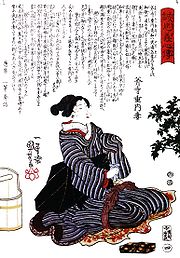
Woodblock prints
The Forty-seven Ronin are one of the most popular themes in woodblock printsWoodblock printing
Woodblock printing is a technique for printing text, images or patterns used widely throughout East Asia and originating in China in antiquity as a method of printing on textiles and later paper....
, or ukiyo-e
Ukiyo-e
' is a genre of Japanese woodblock prints and paintings produced between the 17th and the 20th centuries, featuring motifs of landscapes, tales from history, the theatre, and pleasure quarters...
; the list of artists who have done prints portraying either the original events, or scenes from the play, or the actors, is a Who's Who of woodblock artists. One book on subjects depicted in woodblock prints devotes no less than seven chapters to the history of the appearance of this theme in woodblocks.
Among the artists who produced prints on this subject are Utamaro
Utamaro
was a Japanese printmaker and painter, who is considered one of the greatest artists of woodblock prints . His name was romanized as Outamaro. He is known especially for his masterfully composed studies of women, known as bijinga...
, Toyokuni
Toyokuni
Utagawa Toyokuni , also often referred to as Toyokuni I, to distinguish him from the members of his school who took over his gō after he died, was a great master of ukiyo-e, known in particular for his Kabuki actor prints...
, Hokusai
Hokusai
was a Japanese artist, ukiyo-e painter and printmaker of the Edo period. He was influenced by such painters as Sesshu, and other styles of Chinese painting...
, Kunisada
Kunisada
Utagawa Kunisada was the most popular, prolific and financially successful designer of ukiyo-e woodblock prints in 19th-century Japan...
, Hiroshige
Hiroshige
was a Japanese ukiyo-e artist, and one of the last great artists in that tradition. He was also referred to as Andō Hiroshige and by the art name of Ichiyūsai Hiroshige ....
and Yoshitoshi
Yoshitoshi
Tsukioka Yoshitoshi was a Japanese artist.He is widely recognized as the last great master of Ukiyo-e, a type of Japanese woodblock printing. He is additionally regarded as one of the form's greatest innovators. His career spanned two eras – the last years of feudal Japan, and the first years of...
. However, probably the most famous woodblocks in the genre are those of Kuniyoshi, who produced at least eleven separate complete series on this subject, along with more than twenty triptych
Triptych
A triptych , from tri-= "three" + ptysso= "to fold") is a work of art which is divided into three sections, or three carved panels which are hinged together and can be folded shut or displayed open. It is therefore a type of polyptych, the term for all multi-panel works...
s.
In the West
- The earliest known account of the Akō incident in the West was published in 1822 in Isaac TitsinghIsaac TitsinghIsaac Titsingh FRS was a Dutch surgeon, scholar, merchant-trader and ambassador.During a long career in East Asia, Titsingh was a senior official of the Dutch East India Company . He represented the European trading company in exclusive official contact with Tokugawa Japan...
's posthumous book, Illustrations of Japan. - A widely popularized retelling of the Akō story appeared in 1871 in A.B. Mitford's Tales of Old JapanTales of Old JapanTales of Old Japan is an anthology of short stories, compiled by Algernon Bertram Freeman-Mitford, Lord Redesdale, writing under the better known name of A.B. Mitford. These stories focus on the varying aspects of Japanese life in centuries past...
. - Jorge Luis BorgesJorge Luis BorgesJorge Francisco Isidoro Luis Borges Acevedo , known as Jorge Luis Borges , was an Argentine writer, essayist, poet and translator born in Buenos Aires. In 1914 his family moved to Switzerland where he attended school, receiving his baccalauréat from the Collège de Genève in 1918. The family...
retold the story in his first short story collection, A Universal History of InfamyA Universal History of InfamyA Universal History of Infamy, or A Universal History of Iniquity , is a collection of short stories by Jorge Luis Borges, first published in 1935, and revised by the author in 1954. Most were published individually in the newspaper Critica between 1933 and 1934...
, under the title "The Uncivil Teacher of Etiquette, Kotsuke no Suke." - Lucia St. Clair RobsonLucia St. Clair Robson-Literary biography:Lucia St. Clair Robson was born in Baltimore, Maryland, and grew up in West Palm Beach, Florida. She has been a Peace Corps Volunteer in Venezuela, a teacher in New York City, and a librarian in Annapolis, Maryland. She has also lived in Japan, South Carolina, and Arizona...
's historical fiction novel The Tokaido RoadThe Tokaido Road (novel)The Tokaido Road is a 1991 historical novel by Lucia St. Clair Robson. Set in 1702, it is a fictional account of the famous Japanese revenge story of the Forty-Seven Ronin...
is adapted from the tale of the Forty-seven Ronin. - John FrankenheimerJohn FrankenheimerJohn Michael Frankenheimer was an American film and television director known for social dramas and action/suspense films...
's movie RoninRonin (film)Ronin is a 1998 action-thriller film directed by John Frankenheimer and written by J.D. Zeik and David Mamet. It stars Robert De Niro and Jean Reno as two of several former special forces and intelligence agents who team up to steal a mysterious, heavily guarded suitcase while navigating a maze of...
has a scene in which the story of the 47 ronin is told, thus explaining the origin of the movie title. - The novel The Fifth ProfessionFifth ProfessionThe Fifth Profession is a 1990 novel by David Morrell. It features the characters Savage and Akira, executive protectors - "no mere bodyguard[s] but.....
by David MorrellDavid MorrellDavid Morrell is a Canadian-American novelist, best known for his debut 1972 novel First Blood, which would later become the successful Rambo film franchise starring Sylvester Stallone. He has written 28 novels, and his work has been translated into 26 languages...
mentions the tale of the 47 ronin to show ultimate loyalty even beyond death as this is the overall theme of the book. - The German fantasy thriller Der Sommer des Samurai ("Summer of the Samurai") uses the story of Ōishi YoshioOishi Yoshiowas the chamberlain of the Akō Domain in Harima Province , Japan . He is known as the leader of the Forty-seven Ronin in their 1702 vendetta and thus the hero of the Chūshingura...
and his ronin to add to the plot's mysticism, which revolves around the recovery of Yoshio's katanaKatanaA Japanese sword, or , is one of the traditional bladed weapons of Japan. There are several types of Japanese swords, according to size, field of application and method of manufacture.-Description:...
forged by MuramasaMuramasaMuramasa Sengo was a famous swordsmith who founded the Muramasa school and lived during the Muromachi period in Japan...
, which was stolen by a band of dishonest German industrialists. - In 2007, writer Stephen Hunter told the story in the book, The 47th Samurai, of the Muramasa Blade that became a military sword in WW2 then was the source of a great adventure for character Bob Lee Swagger. Through a twist of fate, Bob Lee becomes the 47th Samurai himself when he joins 45 soldiers (whose leader has been killed, too) and a CIA woman to do battle in a snowy scene resembling the battle that started it all.
External links
- Robson, Lucia St. Clair (1991) The Tokaido Road. Forge Books. New York.
- Chushingura and the Samurai Tradition — Comparisons of the accuracy of accounts by Mitford, Murdoch and others, as well as much other useful material, by a noted scholars of Japan
- Ako's Forty-Seven Samurai — Web site produced by students at Ako High School; contains the story of the 47 Ronin's story, and images of wooden votive tablets of the 47 Ronin in the Oishi Shrine, Ako
- The Trouble with Terasaka: The Forty-Seventh Ronin and the Chushingura Imagination by Henry D. Smith II, Japan Review, 2004, 16:3-65
- Well photos — The well where 47 Ronin washed the head of Kira
- Five different woodblock print versions of the story by Ando Hiroshige
- National Diet Library: photograph of Sengaku-ji (1893); photograph of Sengaku-ji (1911)
- Yoshitoshi, 47 Ronin series (1860)
Further reading
- Turnbull, Stephen. (2011). The Revenge of the 47 Ronin, Edo 1703; Osprey Raid Series #23, Osprey Publishing. ISBN 978-1-84908-427-7