

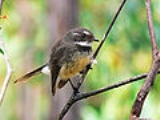
Fantail

Encyclopedia
Fantails are small insectivorous bird
s of southern Asia
and Australasia
belonging to the genus
Rhipidura in the family
Rhipiduridae. Most of the species are about 15 to 18 cm long, specialist aerial feeders, and named as "fantails", but the Australia
n Willie Wagtail
, is a little larger, and though still an expert hunter of insect
s on the wing, concentrates equally on terrestrial prey.
The true wagtail
s are part of the genus Motacilla in the family Motacillidae
and are not close relatives of the fantails.
Fantails adopt a hunched horizontal posture most of the time, with the wings drooped and held away from the body and the tail half cocked. There are some exceptions to this, particularly the Northern Fantail
of New Guinea and the Cockerell's Fantail
of the Solomon Islands
, which have a more upright posture reminiscent of the monarch flycatchers.
The wings of fantails are tapered and have sacrificed speed for agility, making fantails highly efficient at catching insect prey. Overall the fantails are strong fliers
, and some species can undertake long migrations, but the thicket-fantails (Sooty Thicket-fantail
, White-bellied Thicket-fantail
and Black Thicket-fantail
) are very weak fliers, and need to alight regularly.
The bills
of fantails are typical for aerial insect eating birds, being flat and triangular. The gape
is surrounded by two rows of rictal bristles which are long, often as long as the bill.The bills of most species are fairly weak, limiting fantails to softer insects, although the more terrestrial Willie Wagtail has a relatively stronger bill.
The plumage
of most fantails shows some variation, most species are relatively uniform with some markings. A few species, such as the Rennell Fantail
, have uniform plumage, while others have striking if sombre patterns. The colours of most species are greys, blacks, whites and browns, although a few species have yellow or even striking blue feathers. In most species there is no sexual dimorphism
in plumage; the notable exception being the Black Fantail
of New Guinea
where the male has all-over black plumage and the female is almost entirely rufous. In a few species, such as the New Zealand Fantail
, there exist two colour morphs, the common pied morph and the rarer black morph (which is most common on the South Island
).
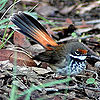 Fantails are an Australasia
n family
that has spread from as far as Samoa
to Pakistan
. In the south the Grey Fantail
ranges as far as the Snares off New Zealand
, in the eastern extend of the family has several endemic forms in western Polynesia
. There are numerous species in Indonesia
, the Philippines
and in South East Asia, and the family ranges into southern China
, India
and the Himalayas
. Some species have a widespread distribution, particularly the Willie Wagtail
, Grey Fantail
, White-throated Fantail
and Northern Fantail
; others have a highly restricted range and in the case of some insular species may be restricted to a single island. The Mussau Fantail
is restricted to a single island in the Bismark Archipelago, and the Kadavu Fantail
has a similarly restricted distribution in the Kadavu Group
of Fiji
.
Most fantails, particularly the tropical or insular forms, are sedentary and undertake no migration
. Some northern and southern species undertake a variety of movements; the Yellow-bellied Fantail
of the Himalayas
is an altitudinal migrant, breeding between 1500-4000m, but moving to lower altitudes (as low as 180m) in the winter. Some Australia
n fantails undertake seasonal migrations, although these show considerable variation even within individual species. Most populations of the Rufous Fantail
exhibit little migratory behaviour, but the south-eastern population moves en masse to northern Queensland
and New Guinea
.
Fantails exhibit wide tastes in habitat; while the majority of species are found in rainforest
s fantails exist in most available habitats from desert
s and mangrove forests to highly modified agricultural and urban
environments. Most species are able to survive in a variety of habitats. Of all the species the Mangrove Fantail has the most restricted habitat requirements, being entirely restricted to mangrove
forests over some of its range, although it can exist 3 km away in the absence of other fantails. Some of the more primitive species are generally more restricted to primary rainforest, but most other species can survive in more disturbed forest. The most adaptable species is the Willie Wagtail, which is abundant in every habitat type in Australia except for dense rainforest.
s and invertebrate
s. The larger Willie Wagtail is capable of tackling small skink
s, but this is exceptional. Insect prey is generally small and easily handled, but larger items sometimes need to be subdued by being banged on branches, an action that also removes the wings of larger prey items like moth
s.
There are two general techniques used by the family in order to obtain prey. The first is known as "static searching", where the fantail will remain at a perch and watch for ariel prey which it will then sally towards and snatch from the air before returning to the perch in order to consume and resume searching. The second method used is known as "progressive searching", where the fantail moves through vegetation searching for insect prey which it gleans; the movement of the searching fantail also flushes out hidden prey which is also pursued and consumed. The Willie Wagtail performs a terrestrial version of this technique, pumping its tail from side to side and undertaking quick darting movements across open ground in order to flush out prey.
Fantails frequently form associations with other species in order obtain prey. Some species perch on the backs of cattle, which they use both as a vantage point and because the cattle flush up insects. This behaviour has given the Willie wagtail the nickname "Shepherd's Companion". Fantails are often very bold around people and will approach them closely in order capture insects flushed by them. Different species are also frequently found in Mixed-species feeding flock
s, travelling with other small insectivorous birds on the periphery of the flocks taking advantage of flushed prey.
and aggressively defend their territories from conspecifics (other members of the same species) as well as other fantail species and other flycatchers. Within the territory the female selects the nesting
site, these sites are often close to the previous year's nest. Breeding responsibilities, nest building,incubation and chick feeding, are shared between both sexes.
The nest, a small cup of grass stems neatly bound together in spider silk
, takes around 10 days to construct. Many species incorporate a trailing tail into the base of the nest; this possibly breaks up the shape of the nest, although little other effort is made to conceal the nest. To compensate for the high visibility of the nest fantails will aggressively defend their chicks from potential predators.
Female fantails will also distract a potential predator by appearing to be injured and luring the predator away from the nest. While the female is pretending to be injured the male may continue to attack the predator. In spite of this fantails have a generally low nesting success.
Bird
Birds are feathered, winged, bipedal, endothermic , egg-laying, vertebrate animals. Around 10,000 living species and 188 families makes them the most speciose class of tetrapod vertebrates. They inhabit ecosystems across the globe, from the Arctic to the Antarctic. Extant birds range in size from...
s of southern Asia
Asia
Asia is the world's largest and most populous continent, located primarily in the eastern and northern hemispheres. It covers 8.7% of the Earth's total surface area and with approximately 3.879 billion people, it hosts 60% of the world's current human population...
and Australasia
Australasia
Australasia is a region of Oceania comprising Australia, New Zealand, the island of New Guinea, and neighbouring islands in the Pacific Ocean. The term was coined by Charles de Brosses in Histoire des navigations aux terres australes...
belonging to the genus
Genus
In biology, a genus is a low-level taxonomic rank used in the biological classification of living and fossil organisms, which is an example of definition by genus and differentia...
Rhipidura in the family
Family (biology)
In biological classification, family is* a taxonomic rank. Other well-known ranks are life, domain, kingdom, phylum, class, order, genus, and species, with family fitting between order and genus. As for the other well-known ranks, there is the option of an immediately lower rank, indicated by the...
Rhipiduridae. Most of the species are about 15 to 18 cm long, specialist aerial feeders, and named as "fantails", but the Australia
Australia
Australia , officially the Commonwealth of Australia, is a country in the Southern Hemisphere comprising the mainland of the Australian continent, the island of Tasmania, and numerous smaller islands in the Indian and Pacific Oceans. It is the world's sixth-largest country by total area...
n Willie Wagtail
Willie Wagtail
The Willie Wagtail is a passerine bird native to Australia, New Guinea, the Solomon Islands, the Bismarck Archipelago, and eastern Indonesia. It is a common and familiar bird throughout much of its range, living in most habitats apart from thick forest...
, is a little larger, and though still an expert hunter of insect
Insect
Insects are a class of living creatures within the arthropods that have a chitinous exoskeleton, a three-part body , three pairs of jointed legs, compound eyes, and two antennae...
s on the wing, concentrates equally on terrestrial prey.
The true wagtail
Wagtail
The wagtails form the passerine bird genus Motacilla. They are small birds with long tails which they wag frequently. Motacilla, the root of the family and genus name, means moving tail...
s are part of the genus Motacilla in the family Motacillidae
Motacillidae
The Motacillidae are a family of small passerine birds with medium to long tails. There are around 65 species in 6 genera and they include the wagtails, longclaws and pipits. The longclaws are entirely restricted to the Afrotropics, and the wagtails are predominately found in Europe, Africa and...
and are not close relatives of the fantails.
Description
The fantails are small bodied (11.5–21 cm long) birds with long tails; in some species the tail is longer than the body and in most the tail is longer than the wing. When the tail is folded it is rounded at the end, but when spread in display or aerial foraging it has a characteristic fan shape that gives the family its name.Fantails adopt a hunched horizontal posture most of the time, with the wings drooped and held away from the body and the tail half cocked. There are some exceptions to this, particularly the Northern Fantail
Northern Fantail
The Northern Fantail is a species of bird in the Rhipiduridae family.It is found in Australia, Indonesia, and Papua New Guinea....
of New Guinea and the Cockerell's Fantail
Cockerell's Fantail
The Cockerell's Fantail is a species of bird in the Rhipiduridae family. It is found in Papua New Guinea and the Solomon Islands....
of the Solomon Islands
Solomon Islands
Solomon Islands is a sovereign state in Oceania, east of Papua New Guinea, consisting of nearly one thousand islands. It covers a land mass of . The capital, Honiara, is located on the island of Guadalcanal...
, which have a more upright posture reminiscent of the monarch flycatchers.
The wings of fantails are tapered and have sacrificed speed for agility, making fantails highly efficient at catching insect prey. Overall the fantails are strong fliers
Bird flight
Flight is the main mode of locomotion used by most of the world's bird species. Flight assists birds while feeding, breeding and avoiding predators....
, and some species can undertake long migrations, but the thicket-fantails (Sooty Thicket-fantail
Sooty Thicket-fantail
The Sooty Thicket-fantail is a species of bird in the Rhipiduridae family. It is found in Indonesia and Papua New Guinea.Its natural habitat is subtropical or tropical moist lowland forests.-References:...
, White-bellied Thicket-fantail
White-bellied Thicket-fantail
The White-bellied Thicket-fantail is a species of bird in the Rhipiduridae family.It is found in Indonesia and Papua New Guinea....
and Black Thicket-fantail
Black Thicket-fantail
The Black Thicket-fantail is a species of bird in the Rhipiduridae family. It is found in Indonesia and Papua New Guinea....
) are very weak fliers, and need to alight regularly.
The bills
Beak
The beak, bill or rostrum is an external anatomical structure of birds which is used for eating and for grooming, manipulating objects, killing prey, fighting, probing for food, courtship and feeding young...
of fantails are typical for aerial insect eating birds, being flat and triangular. The gape
Gape
In bird anatomy, the gape is the interior of the open mouth of a bird and the gape flange is the region where the two mandibles join together, at the base of the beak...
is surrounded by two rows of rictal bristles which are long, often as long as the bill.The bills of most species are fairly weak, limiting fantails to softer insects, although the more terrestrial Willie Wagtail has a relatively stronger bill.
The plumage
Plumage
Plumage refers both to the layer of feathers that cover a bird and the pattern, colour, and arrangement of those feathers. The pattern and colours of plumage vary between species and subspecies and can also vary between different age classes, sexes, and season. Within species there can also be a...
of most fantails shows some variation, most species are relatively uniform with some markings. A few species, such as the Rennell Fantail
Rennell Fantail
The Rennell Fantail is a species of bird in the Rhipiduridae family.It is endemic to the Solomon Islands.Its natural habitat is subtropical or tropical moist lowland forests.-References:...
, have uniform plumage, while others have striking if sombre patterns. The colours of most species are greys, blacks, whites and browns, although a few species have yellow or even striking blue feathers. In most species there is no sexual dimorphism
Sexual dimorphism
Sexual dimorphism is a phenotypic difference between males and females of the same species. Examples of such differences include differences in morphology, ornamentation, and behavior.-Examples:-Ornamentation / coloration:...
in plumage; the notable exception being the Black Fantail
Black Fantail
The Black Fantail is a species of bird in the Rhipiduridae family.It is found in Indonesia and Papua New Guinea.Its natural habitat is subtropical or tropical moist montanes.-References:...
of New Guinea
New Guinea
New Guinea is the world's second largest island, after Greenland, covering a land area of 786,000 km2. Located in the southwest Pacific Ocean, it lies geographically to the east of the Malay Archipelago, with which it is sometimes included as part of a greater Indo-Australian Archipelago...
where the male has all-over black plumage and the female is almost entirely rufous. In a few species, such as the New Zealand Fantail
New Zealand Fantail
The New Zealand Fantail is a small insectivorous bird. A common fantail found in the South Island of New Zealand, also in the North Island as subspecies Rhipidura fuliginosa placabilis, the Chatham Islands as Rhipidura fuliginosa penita and formerly the Lord Howe Island as Rhipidura fuliginosa...
, there exist two colour morphs, the common pied morph and the rarer black morph (which is most common on the South Island
South Island
The South Island is the larger of the two major islands of New Zealand, the other being the more populous North Island. It is bordered to the north by Cook Strait, to the west by the Tasman Sea, to the south and east by the Pacific Ocean...
).
Range, migration and habitat
Australasia
Australasia is a region of Oceania comprising Australia, New Zealand, the island of New Guinea, and neighbouring islands in the Pacific Ocean. The term was coined by Charles de Brosses in Histoire des navigations aux terres australes...
n family
Family (biology)
In biological classification, family is* a taxonomic rank. Other well-known ranks are life, domain, kingdom, phylum, class, order, genus, and species, with family fitting between order and genus. As for the other well-known ranks, there is the option of an immediately lower rank, indicated by the...
that has spread from as far as Samoa
Samoa
Samoa , officially the Independent State of Samoa, formerly known as Western Samoa is a country encompassing the western part of the Samoan Islands in the South Pacific Ocean. It became independent from New Zealand in 1962. The two main islands of Samoa are Upolu and one of the biggest islands in...
to Pakistan
Pakistan
Pakistan , officially the Islamic Republic of Pakistan is a sovereign state in South Asia. It has a coastline along the Arabian Sea and the Gulf of Oman in the south and is bordered by Afghanistan and Iran in the west, India in the east and China in the far northeast. In the north, Tajikistan...
. In the south the Grey Fantail
Grey Fantail
The Grey Fantail is a small insectivorous bird. A common fantail found in Australia , New Guinea, the Solomon Islands, Vanuatu and New Caledonia...
ranges as far as the Snares off New Zealand
New Zealand
New Zealand is an island country in the south-western Pacific Ocean comprising two main landmasses and numerous smaller islands. The country is situated some east of Australia across the Tasman Sea, and roughly south of the Pacific island nations of New Caledonia, Fiji, and Tonga...
, in the eastern extend of the family has several endemic forms in western Polynesia
Polynesia
Polynesia is a subregion of Oceania, made up of over 1,000 islands scattered over the central and southern Pacific Ocean. The indigenous people who inhabit the islands of Polynesia are termed Polynesians and they share many similar traits including language, culture and beliefs...
. There are numerous species in Indonesia
Indonesia
Indonesia , officially the Republic of Indonesia , is a country in Southeast Asia and Oceania. Indonesia is an archipelago comprising approximately 13,000 islands. It has 33 provinces with over 238 million people, and is the world's fourth most populous country. Indonesia is a republic, with an...
, the Philippines
Philippines
The Philippines , officially known as the Republic of the Philippines , is a country in Southeast Asia in the western Pacific Ocean. To its north across the Luzon Strait lies Taiwan. West across the South China Sea sits Vietnam...
and in South East Asia, and the family ranges into southern China
China
Chinese civilization may refer to:* China for more general discussion of the country.* Chinese culture* Greater China, the transnational community of ethnic Chinese.* History of China* Sinosphere, the area historically affected by Chinese culture...
, India
India
India , officially the Republic of India , is a country in South Asia. It is the seventh-largest country by geographical area, the second-most populous country with over 1.2 billion people, and the most populous democracy in the world...
and the Himalayas
Himalayas
The Himalaya Range or Himalaya Mountains Sanskrit: Devanagari: हिमालय, literally "abode of snow"), usually called the Himalayas or Himalaya for short, is a mountain range in Asia, separating the Indian subcontinent from the Tibetan Plateau...
. Some species have a widespread distribution, particularly the Willie Wagtail
Willie Wagtail
The Willie Wagtail is a passerine bird native to Australia, New Guinea, the Solomon Islands, the Bismarck Archipelago, and eastern Indonesia. It is a common and familiar bird throughout much of its range, living in most habitats apart from thick forest...
, Grey Fantail
Grey Fantail
The Grey Fantail is a small insectivorous bird. A common fantail found in Australia , New Guinea, the Solomon Islands, Vanuatu and New Caledonia...
, White-throated Fantail
White-throated Fantail
The White-throated Fantail is a small passerine bird. It is found in forest, scrub and cultivation across tropical southern Asia from the Himalayas, India and Bangladesh east to Indonesia. It has numerous subspecies, including R. a...
and Northern Fantail
Northern Fantail
The Northern Fantail is a species of bird in the Rhipiduridae family.It is found in Australia, Indonesia, and Papua New Guinea....
; others have a highly restricted range and in the case of some insular species may be restricted to a single island. The Mussau Fantail
Matthias Fantail
The Mussau Fantail or Matthias Fantail, Rhipidura matthiae is a fantail which is endemic to Mussau Island in the St. Matthias Islands of Papua New Guinea.- External links :*...
is restricted to a single island in the Bismark Archipelago, and the Kadavu Fantail
Kadavu Fantail
The Kadavu Fantail is a species of bird in the fantail family Rhipiduridae.It is endemic to Kadavu and Ono in the Kadavu Islands, Fiji...
has a similarly restricted distribution in the Kadavu Group
Kadavu Group
The Kadavu Group is an archipelago south of Viti Levu, one of Fiji's two main islands. Dominated by Kadavu Island, the fourth largest island in Fiji, the group also includes Galoa, Ono, and a number of islets in the Great Astrolabe Reef....
of Fiji
Fiji
Fiji , officially the Republic of Fiji , is an island nation in Melanesia in the South Pacific Ocean about northeast of New Zealand's North Island...
.
Most fantails, particularly the tropical or insular forms, are sedentary and undertake no migration
Bird migration
Bird migration is the regular seasonal journey undertaken by many species of birds. Bird movements include those made in response to changes in food availability, habitat or weather. Sometimes, journeys are not termed "true migration" because they are irregular or in only one direction...
. Some northern and southern species undertake a variety of movements; the Yellow-bellied Fantail
Yellow-bellied Fantail
The Yellow-bellied Fantail Rhipidura hypoxantha is a fantail found in the Indian Subcontinent.-External links:*...
of the Himalayas
Himalayas
The Himalaya Range or Himalaya Mountains Sanskrit: Devanagari: हिमालय, literally "abode of snow"), usually called the Himalayas or Himalaya for short, is a mountain range in Asia, separating the Indian subcontinent from the Tibetan Plateau...
is an altitudinal migrant, breeding between 1500-4000m, but moving to lower altitudes (as low as 180m) in the winter. Some Australia
Australia
Australia , officially the Commonwealth of Australia, is a country in the Southern Hemisphere comprising the mainland of the Australian continent, the island of Tasmania, and numerous smaller islands in the Indian and Pacific Oceans. It is the world's sixth-largest country by total area...
n fantails undertake seasonal migrations, although these show considerable variation even within individual species. Most populations of the Rufous Fantail
Rufous Fantail
The Rufous Fantail Rhipidura rufifrons inhabits the east coast of Australia. The base of its tail is bright orange-red in colour and their wings are greyish brown. They have a black and white breast that grades into a white colour on the chin and throat....
exhibit little migratory behaviour, but the south-eastern population moves en masse to northern Queensland
Queensland
Queensland is a state of Australia, occupying the north-eastern section of the mainland continent. It is bordered by the Northern Territory, South Australia and New South Wales to the west, south-west and south respectively. To the east, Queensland is bordered by the Coral Sea and Pacific Ocean...
and New Guinea
New Guinea
New Guinea is the world's second largest island, after Greenland, covering a land area of 786,000 km2. Located in the southwest Pacific Ocean, it lies geographically to the east of the Malay Archipelago, with which it is sometimes included as part of a greater Indo-Australian Archipelago...
.
Fantails exhibit wide tastes in habitat; while the majority of species are found in rainforest
Rainforest
Rainforests are forests characterized by high rainfall, with definitions based on a minimum normal annual rainfall of 1750-2000 mm...
s fantails exist in most available habitats from desert
Desert
A desert is a landscape or region that receives an extremely low amount of precipitation, less than enough to support growth of most plants. Most deserts have an average annual precipitation of less than...
s and mangrove forests to highly modified agricultural and urban
Urban area
An urban area is characterized by higher population density and vast human features in comparison to areas surrounding it. Urban areas may be cities, towns or conurbations, but the term is not commonly extended to rural settlements such as villages and hamlets.Urban areas are created and further...
environments. Most species are able to survive in a variety of habitats. Of all the species the Mangrove Fantail has the most restricted habitat requirements, being entirely restricted to mangrove
Mangrove
Mangroves are various kinds of trees up to medium height and shrubs that grow in saline coastal sediment habitats in the tropics and subtropics – mainly between latitudes N and S...
forests over some of its range, although it can exist 3 km away in the absence of other fantails. Some of the more primitive species are generally more restricted to primary rainforest, but most other species can survive in more disturbed forest. The most adaptable species is the Willie Wagtail, which is abundant in every habitat type in Australia except for dense rainforest.
Behaviour
The behaviour of many species of fantail has not been studied, but overall the family is highly uniform in its habits. Anecdotal observations of less studied species suggest a high degree of similarity with the better studied species. Fantails are highly active birds, with several of the smaller species continuously on the move; even when perched they continue to rock back and forth, spin 180° on the spot, wag their tail from side to side or fan and unfan it. In flight they are highly agile and undertake highly aerobatic and intricate looping flights while using their fanned tail to catch insects in flight.Diet and foraging
The majority of the diet of fantails composes of small insectInsect
Insects are a class of living creatures within the arthropods that have a chitinous exoskeleton, a three-part body , three pairs of jointed legs, compound eyes, and two antennae...
s and invertebrate
Invertebrate
An invertebrate is an animal without a backbone. The group includes 97% of all animal species – all animals except those in the chordate subphylum Vertebrata .Invertebrates form a paraphyletic group...
s. The larger Willie Wagtail is capable of tackling small skink
Skink
Skinks are lizards belonging to the family Scincidae. Together with several other lizard families, including Lacertidae , they comprise the superfamily or infraorder Scincomorpha...
s, but this is exceptional. Insect prey is generally small and easily handled, but larger items sometimes need to be subdued by being banged on branches, an action that also removes the wings of larger prey items like moth
Moth
A moth is an insect closely related to the butterfly, both being of the order Lepidoptera. Moths form the majority of this order; there are thought to be 150,000 to 250,000 different species of moth , with thousands of species yet to be described...
s.
There are two general techniques used by the family in order to obtain prey. The first is known as "static searching", where the fantail will remain at a perch and watch for ariel prey which it will then sally towards and snatch from the air before returning to the perch in order to consume and resume searching. The second method used is known as "progressive searching", where the fantail moves through vegetation searching for insect prey which it gleans; the movement of the searching fantail also flushes out hidden prey which is also pursued and consumed. The Willie Wagtail performs a terrestrial version of this technique, pumping its tail from side to side and undertaking quick darting movements across open ground in order to flush out prey.
Fantails frequently form associations with other species in order obtain prey. Some species perch on the backs of cattle, which they use both as a vantage point and because the cattle flush up insects. This behaviour has given the Willie wagtail the nickname "Shepherd's Companion". Fantails are often very bold around people and will approach them closely in order capture insects flushed by them. Different species are also frequently found in Mixed-species feeding flock
Mixed-species feeding flock
A mixed-species feeding flock, also termed a mixed-species foraging flock, mixed hunting party or informally bird wave, is a flock of usually insectivorous birds of different species, that join each other and move together while foraging...
s, travelling with other small insectivorous birds on the periphery of the flocks taking advantage of flushed prey.
Breeding
Fantails are territorialTerritory (animal)
In ethology the term territory refers to any sociographical area that an animal of a particular species consistently defends against conspecifics...
and aggressively defend their territories from conspecifics (other members of the same species) as well as other fantail species and other flycatchers. Within the territory the female selects the nesting
Bird nest
A bird nest is the spot in which a bird lays and incubates its eggs and raises its young. Although the term popularly refers to a specific structure made by the bird itself—such as the grassy cup nest of the American Robin or Eurasian Blackbird, or the elaborately woven hanging nest of the...
site, these sites are often close to the previous year's nest. Breeding responsibilities, nest building,incubation and chick feeding, are shared between both sexes.
The nest, a small cup of grass stems neatly bound together in spider silk
Spider silk
Spider silk is a protein fiber spun by spiders. Spiders use their silk to make webs or other structures, which function as nets to catch other animals, or as nests or cocoons for protection for their offspring...
, takes around 10 days to construct. Many species incorporate a trailing tail into the base of the nest; this possibly breaks up the shape of the nest, although little other effort is made to conceal the nest. To compensate for the high visibility of the nest fantails will aggressively defend their chicks from potential predators.
Female fantails will also distract a potential predator by appearing to be injured and luring the predator away from the nest. While the female is pretending to be injured the male may continue to attack the predator. In spite of this fantails have a generally low nesting success.
Species
Based on del Hoyo et al. (2006)- Yellow-bellied FantailYellow-bellied FantailThe Yellow-bellied Fantail Rhipidura hypoxantha is a fantail found in the Indian Subcontinent.-External links:*...
, Rhipidura(Chelidorhynx) hypoxantha - Blue FantailBlue FantailThe Blue Fantail is a species of bird in the Rhipiduridae family.It is endemic to the Philippines. Its natural habitat is subtropical or tropical moist lowland forests.-References:...
, Rhipidura superciliaris - Blue-headed FantailBlue-headed FantailThe Blue-headed Fantail Rhipidura cyaniceps is a fantail endemic to the Philippines.-External links:*...
, Rhipidura cyaniceps - Chestnut-bellied FantailChestnut-bellied FantailThe Chestnut-bellied Fantail is a species of bird in the Rhipiduridae family.It is found in Indonesia and Papua New Guinea....
, Rhipidura hyperythra - Friendly FantailFriendly FantailThe Friendly Fantail is a species of bird in the Rhipiduridae family.It is found in Indonesia and Papua New Guinea.Its natural habitat is subtropical or tropical moist montanes.-References:...
, Rhipidura albolimbata - Grey FantailGrey FantailThe Grey Fantail is a small insectivorous bird. A common fantail found in Australia , New Guinea, the Solomon Islands, Vanuatu and New Caledonia...
, Rhipidura albiscapa - New Zealand FantailNew Zealand FantailThe New Zealand Fantail is a small insectivorous bird. A common fantail found in the South Island of New Zealand, also in the North Island as subspecies Rhipidura fuliginosa placabilis, the Chatham Islands as Rhipidura fuliginosa penita and formerly the Lord Howe Island as Rhipidura fuliginosa...
, Rhipidura fuliginosa- Lord Howe FantailLord Howe FantailThe Lord Howe Fantail , also known as the Lord Howe Island Fantail or Fawn-breasted Fantail, was a small bird in the fantail family, Rhipiduridae. It is an extinct subspecies of the New Zealand Fantail...
, Rhipidura fuliginosa cervina - extinct (c.1925)
- Lord Howe Fantail
- Mangrove Fantail, Rhipidura phasiana
- Brown FantailBrown FantailThe Brown Fantail is a species of bird in the Rhipiduridae family.It is found in Papua New Guinea and the Solomon Islands.-References:* BirdLife International 2004. . Downloaded on 27 July 2007....
, Rhipidura drownei - Dusky FantailDusky FantailThe Makira Fantail or Dusky Fantail is a species of bird in the Rhipiduridae family.It is endemic to the Solomon Islands.Its natural habitat is subtropical or tropical moist lowland forests....
, Rhipidura tenebrosa - Rennell FantailRennell FantailThe Rennell Fantail is a species of bird in the Rhipiduridae family.It is endemic to the Solomon Islands.Its natural habitat is subtropical or tropical moist lowland forests.-References:...
, Rhipidura rennelliana - Streaked FantailStreaked FantailThe Streaked Fantail is a species of bird in the Rhipiduridae family. Rhipidura verreauxi has precedence over Rhipidura spilodera . It is found in Fiji, New Caledonia, and Vanuatu...
, Rhipidura spilodera or Rhipidura verreauxi - Kadavu FantailKadavu FantailThe Kadavu Fantail is a species of bird in the fantail family Rhipiduridae.It is endemic to Kadavu and Ono in the Kadavu Islands, Fiji...
, Rhipidura personata - Samoan FantailSamoan FantailThe Samoan Fantail is a species of bird in the Rhipiduridae family.It is endemic to Samoa.Its natural habitats are subtropical or tropical moist lowland forests and subtropical or tropical moist montanes.-References:...
, Rhipidura nebulosa - Rusty-bellied FantailRusty-bellied FantailThe Rusty-bellied Fantail is a species of bird in the Rhipiduridae family.It is endemic to Indonesia.Its natural habitats are subtropical or tropical moist lowland forests and subtropical or tropical moist montanes....
or Rusty-flanked Fantail, Rhipidura teysmanni - Tawny-backed FantailTawny-backed FantailThe Tawny-backed Fantail is a species of bird in the Rhipiduridae family. It is endemic to Indonesia. Its natural habitats are subtropical or tropical moist lowland forests and subtropical or tropical moist montanes...
or Cinnamon-backed Fantail, Rhipidura superflua - Streaky-breasted FantailStreaky-breasted FantailThe Streak-breasted Fantail is a species of bird in the Rhipiduridae family.It is endemic to Indonesia.Its natural habitats are subtropical or tropical moist lowland forests and subtropical or tropical moist montanes....
, Rhipidura dedemi - Long-tailed FantailLong-tailed FantailThe Long-tailed Fantail is a species of bird in the Rhipiduridae family.It is endemic to Indonesia.Its natural habitat is subtropical or tropical moist lowland forests.It is threatened by habitat loss.-References:...
, Rhipidura opistherythra - Palau FantailPalau FantailThe Palau Fantail is a species of bird in the Rhipiduridae family.It is endemic to Palau.Its natural habitat is subtropical or tropical moist lowland forests.-References:...
, Rhipidura lepida - Rufous-backed FantailRufous-backed FantailThe Rufous-backed Fantail is a species of bird in the Rhipiduridae family.It is found in Indonesia and Papua New Guinea.Its natural habitat is subtropical or tropical moist lowland forests.-References:...
, Rhipidura rufidorsa - Bismarck FantailBismarck FantailThe Bismarck Fantail Rhipidura dahli is a fantail. The binomial commemorates the German naturalist Friedrich Dahl....
, Rhipidura dahli - Matthias FantailMatthias FantailThe Mussau Fantail or Matthias Fantail, Rhipidura matthiae is a fantail which is endemic to Mussau Island in the St. Matthias Islands of Papua New Guinea.- External links :*...
, Rhipidura matthiae - Malaita FantailMalaita FantailThe Malaita Fantail is a fantail endemic to Malaita in the Solomon Islands.-External links:*...
, Rhipidura malaitae - Arafura FantailArafura FantailThe Arafura Fantail , sometimes known as the Wood Fantail, inhabits the Lesser Sunda Islands, the northern coast of Australia from the Kimberley to the western side of the Cape York Peninsula, including subcoastally in the Top End of the Northern Territory, and southern New Guinea...
, Rhipidura dryas - Pohnpei FantailPohnpei FantailThe Pohnpei Fantail is a fantail which is endemic to the Pacific island of Pohnpei in the Federated States of Micronesia. It is a common bird in forest and at the forest edge...
, Rhipidura kubaryi - Rufous FantailRufous FantailThe Rufous Fantail Rhipidura rufifrons inhabits the east coast of Australia. The base of its tail is bright orange-red in colour and their wings are greyish brown. They have a black and white breast that grades into a white colour on the chin and throat....
, Rhipidura rufifrons- Guam Rufous Fantail, Rhipidura rufifrons uraniae - extinct (1984)
- Manus FantailManus FantailThe Manus Fantail Rhipidura semirubra is a fantail endemic to the Admiralty Islands of Papua New Guinea.-External links:*...
, Rhipidura semirubra - Dimorphic FantailDimorphic FantailThe Dimorphic Fantail is a species of bird in the Rhipiduridae family.It is found in West Papua, Indonesia and Papua New Guinea.Its natural habitat is subtropical or tropical moist montanes.-References:...
, Rhipidura brachyrhyncha - Black FantailBlack FantailThe Black Fantail is a species of bird in the Rhipiduridae family.It is found in Indonesia and Papua New Guinea.Its natural habitat is subtropical or tropical moist montanes.-References:...
, Rhipidura atra - Black-and-cinnamon FantailBlack-and-cinnamon FantailThe Black-and-cinnamon Fantail is a species of bird in the Rhipiduridae family.It is endemic to the Philippines.-References:* BirdLife International 2004. . Downloaded on 27 July 2007....
, Rhipidura nigrocinnamomea - Rufous-tailed FantailRufous-tailed FantailThe Rufous-tailed Fantail is a species of bird in the Rhipiduridae family.It is endemic to Indonesia.Its natural habitat is subtropical or tropical moist montanes.-References:...
, Rhipidura phoenicura - White-bellied FantailWhite-bellied FantailThe White-bellied Fantail is a species of bird in the Rhipiduridae family.It is endemic to Indonesia. Its natural habitat is subtropical or tropical moist montanes.-References:...
, Rhipidura euryura
- Spotted FantailSpotted FantailThe Spotted Fantail is a species of bird in the Rhipiduridae family.It is found in Brunei, Indonesia, Malaysia, and Thailand. Its natural habitat is subtropical or tropical moist lowland forests.-References:...
, Rhipidura perlata - White-browed FantailWhite-browed FantailThe White-browed Fantail, Rhipidura aureola, is a small passerine bird.The White-browed Fantail breeds across tropical southern Asia from India and Sri Lanka east to Vietnam. This species is found in forest and other woodland. Three eggs are laid in a small cup nest in a tree.- Description :The...
, Rhipidura aureola - Pied FantailPied FantailThe Pied Fantail is a species of bird in the Rhipiduridae family.It is found in Brunei, Cambodia, Indonesia, Laos, Malaysia, Myanmar, the Philippines, Singapore, Thailand, and Vietnam....
, Rhipidura javanica - Spot-breasted Fantail, Rhipidura albogularis
- White-throated FantailWhite-throated FantailThe White-throated Fantail is a small passerine bird. It is found in forest, scrub and cultivation across tropical southern Asia from the Himalayas, India and Bangladesh east to Indonesia. It has numerous subspecies, including R. a...
, Rhipidura albicollis - Brown-capped FantailBrown-capped FantailThe Brown-capped Fantail is a species of bird in the Rhipiduridae family.It is endemic to Indonesia.Its natural habitats are subtropical or tropical moist lowland forests and subtropical or tropical moist montanes.-References:...
, Rhipidura diluta - Cinnamon-tailed FantailCinnamon-tailed FantailThe Cinnamon-tailed Fantail, Rhipidura fuscorufa is a fantail restricted to the Banda Sea Islands of Indonesia.- References : Database entry includes a brief justification of why this species is near threatened- External links :*...
, Rhipidura fuscorufa - Northern FantailNorthern FantailThe Northern Fantail is a species of bird in the Rhipiduridae family.It is found in Australia, Indonesia, and Papua New Guinea....
, Rhipidura rufiventris - Cockerell's FantailCockerell's FantailThe Cockerell's Fantail is a species of bird in the Rhipiduridae family. It is found in Papua New Guinea and the Solomon Islands....
or White-winged Fantail, Rhipidura cockerelli - Sooty Thicket-fantailSooty Thicket-fantailThe Sooty Thicket-fantail is a species of bird in the Rhipiduridae family. It is found in Indonesia and Papua New Guinea.Its natural habitat is subtropical or tropical moist lowland forests.-References:...
, Rhipidura threnothorax - White-bellied Thicket-fantailWhite-bellied Thicket-fantailThe White-bellied Thicket-fantail is a species of bird in the Rhipiduridae family.It is found in Indonesia and Papua New Guinea....
, Rhipidura leucothorax - Black Thicket-fantailBlack Thicket-fantailThe Black Thicket-fantail is a species of bird in the Rhipiduridae family. It is found in Indonesia and Papua New Guinea....
, Rhipidura maculipectus - Willie WagtailWillie WagtailThe Willie Wagtail is a passerine bird native to Australia, New Guinea, the Solomon Islands, the Bismarck Archipelago, and eastern Indonesia. It is a common and familiar bird throughout much of its range, living in most habitats apart from thick forest...
, Rhipidura leucophrys
External links
- Fantail videos on the Internet Bird Collection