


Estophilia

Encyclopedia
Estonian language
Estonian is the official language of Estonia, spoken by about 1.1 million people in Estonia and tens of thousands in various émigré communities...
, Estonian literature
Estonian literature
Estonian literature refers to literature written in the Estonian language The domination of Estonia after the Northern Crusades, from the 13th century to 1918 by Germany, Sweden, and Russia resulted few early written literary works in Estonian language. The oldest records of written Estonian...
or Estonian culture, History of Estonia
History of Estonia
Estonia was settled near the end of the last glacial era, beginning from around 8500 BC. Before the German invasions in the 13th century proto-Estonians of the Ancient Estonia worshipped the spirits of nature...
and Estonia
Estonia
Estonia , officially the Republic of Estonia , is a state in the Baltic region of Northern Europe. It is bordered to the north by the Gulf of Finland, to the west by the Baltic Sea, to the south by Latvia , and to the east by Lake Peipsi and the Russian Federation . Across the Baltic Sea lies...
in general. Such people are known as Estophiles. Its opposite is Estophobia
Anti-Estonian sentiment
Anti-Estonian sentiment generally describes dislike or hate of the Estonian people or the Republic of Estonia. Its opposite is Estophilia.-Bronze Soldier controversy:...
.
The term particularly refers to the activities of the Estophile Movement of the late 18th to early 19th century, when Baltic German scholars began documenting and promoting Estonian culture and language
Estonian language
Estonian is the official language of Estonia, spoken by about 1.1 million people in Estonia and tens of thousands in various émigré communities...
. This movement played a crucial role triggering the Estonian Age of Awakening almost 100 years later that eventually led to the Estonian Declaration of Independence
Estonian Declaration of Independence
The Estonian Declaration of Independence, also known as the Manifesto to the Peoples of Estonia , is the founding act of the Republic of Estonia from 1918. It is celebrated on 24 February, the National Day or Estonian Independence Day....
in 1918, the Estonian War of Independence and the foundation of the Republic of Estonia.
Background
Since the Northern CrusadesNorthern Crusades
The Northern Crusades or Baltic Crusades were crusades undertaken by the Christian kings of Denmark and Sweden, the German Livonian and Teutonic military orders, and their allies against the pagan peoples of Northern Europe around the southern and eastern shores of the Baltic Sea...
, Estonian culture had been rather suppressed in society, and the ruling culture
Culture
Culture is a term that has many different inter-related meanings. For example, in 1952, Alfred Kroeber and Clyde Kluckhohn compiled a list of 164 definitions of "culture" in Culture: A Critical Review of Concepts and Definitions...
– the one that governed cities, partook in the Hanseatic league
Hanseatic League
The Hanseatic League was an economic alliance of trading cities and their merchant guilds that dominated trade along the coast of Northern Europe...
, and organised trade
Trade
Trade is the transfer of ownership of goods and services from one person or entity to another. Trade is sometimes loosely called commerce or financial transaction or barter. A network that allows trade is called a market. The original form of trade was barter, the direct exchange of goods and...
– was Germanic
Germanic peoples
The Germanic peoples are an Indo-European ethno-linguistic group of Northern European origin, identified by their use of the Indo-European Germanic languages which diversified out of Proto-Germanic during the Pre-Roman Iron Age.Originating about 1800 BCE from the Corded Ware Culture on the North...
, with the occasional influx of new meme
Meme
A meme is "an idea, behaviour or style that spreads from person to person within a culture."A meme acts as a unit for carrying cultural ideas, symbols or practices, which can be transmitted from one mind to another through writing, speech, gestures, rituals or other imitable phenomena...
s when the rulers changed. Indigenous Estonian culture was largely restricted to the peasant
Peasant
A peasant is an agricultural worker who generally tend to be poor and homeless-Etymology:The word is derived from 15th century French païsant meaning one from the pays, or countryside, ultimately from the Latin pagus, or outlying administrative district.- Position in society :Peasants typically...
s. While vertical mobility
Vertical mobility
Vertical mobility refers to a person or group's movement up or down a status hierarchy. This is commonly referred to as social mobility, yet vertical mobility can also refer to any movement up or down a hierarchy of any kind, not necessarily related to social status in the same way that social...
was not impossible, the ethnic Estonians that became citizens or landlords tended to Germanise voluntarily.
However, while this suppression largely isolated the Germanic administrators from Estonian lower classes, it did not destroy the native culture. The relatively long time of peace from Swedish rule onwards gave the upper classes an opportunity to take up hobbies
Hobby
A hobby is a regular activity or interest that is undertaken for pleasure, typically done during one's leisure time.- Etymology :A hobby horse is a wooden or wickerwork toy made to be ridden just like a real horse...
, and some of them ended up learning about the native Estonian culture, in the process, contributing to systematic understanding of it.
The Enlightenment
Age of Enlightenment
The Age of Enlightenment was an elite cultural movement of intellectuals in 18th century Europe that sought to mobilize the power of reason in order to reform society and advance knowledge. It promoted intellectual interchange and opposed intolerance and abuses in church and state...
era brought with it greater tolerance and spread the desire to educate the uneducated. For example, the very first Estonian language
Estonian language
Estonian is the official language of Estonia, spoken by about 1.1 million people in Estonia and tens of thousands in various émigré communities...
periodical publication, the Lühhike öppetus
Lühhike öppetus
Lühhike öppetus , by modern orthography 'Lühike õpetus', was the first periodical publication in the Estonian language. Edited by Dr...
(Estonian
Estonian language
Estonian is the official language of Estonia, spoken by about 1.1 million people in Estonia and tens of thousands in various émigré communities...
for Brief Instruction), concerned medical techniques.
Estophile Enlightenment Period (1750–1840)
Educated German immigrants and local Baltic Germans in Estonia, educated at German universities introduced Enlightenment ideasAge of Enlightenment
The Age of Enlightenment was an elite cultural movement of intellectuals in 18th century Europe that sought to mobilize the power of reason in order to reform society and advance knowledge. It promoted intellectual interchange and opposed intolerance and abuses in church and state...
that propagated freedom of thinking and brotherhood and equality. The French Revolution
French Revolution
The French Revolution , sometimes distinguished as the 'Great French Revolution' , was a period of radical social and political upheaval in France and Europe. The absolute monarchy that had ruled France for centuries collapsed in three years...
provided a powerful motive for the enlightened local upper class to create literature for the peasantry. The freeing of the peasantry from serfdom on the nobles estates in 1816 in Southern Estonia:Governorate of Livonia (Russian: Лифляндская губерния) and 1819 in Northern Estonia: Governorate of Estonia
Governorate of Estonia
The Governorate of Estonia or Estland, also known as the Government of Estonia or Province of Estonia, was a governorate of the Russian Empire in what is now northern Estonia.-Historical overview:...
(Russian: Эстляндская губерния) by Alexander I of Russia
Alexander I of Russia
Alexander I of Russia , served as Emperor of Russia from 23 March 1801 to 1 December 1825 and the first Russian King of Poland from 1815 to 1825. He was also the first Russian Grand Duke of Finland and Lithuania....
gave rise to a debate as to the future fate of the former enslaved peoples. Although Baltic Germans at large regarded the future of Estonians as being a fusion with the Baltic Germans, the Estophile educated class admired the ancient culture of the Estonians and their era of freedom before the conquests by Danes and Germans in the 13th century. The Estophile Enlightenment Period formed the transition from religious Estonian literature to newspapers written in Estonian for the mass public.
The ideas of Johann Gottfried Herder
Johann Gottfried Herder
Johann Gottfried von Herder was a German philosopher, theologian, poet, and literary critic. He is associated with the periods of Enlightenment, Sturm und Drang, and Weimar Classicism.-Biography:...
greatly influenced the Baltic German intelligentsia
Intelligentsia
The intelligentsia is a social class of people engaged in complex, mental and creative labor directed to the development and dissemination of culture, encompassing intellectuals and social groups close to them...
to see the value in the indigenous
Indigenous peoples
Indigenous peoples are ethnic groups that are defined as indigenous according to one of the various definitions of the term, there is no universally accepted definition but most of which carry connotations of being the "original inhabitants" of a territory....
culture. Inspired by Herder's collection of European and Estonian folk songs, they came to view native folklore
Folklore
Folklore consists of legends, music, oral history, proverbs, jokes, popular beliefs, fairy tales and customs that are the traditions of a culture, subculture, or group. It is also the set of practices through which those expressive genres are shared. The study of folklore is sometimes called...
as natural expressions of truth and spontaneity. As a result they founded several scientific societies, published textbooks for school
School
A school is an institution designed for the teaching of students under the direction of teachers. Most countries have systems of formal education, which is commonly compulsory. In these systems, students progress through a series of schools...
s, newspaper
Newspaper
A newspaper is a scheduled publication containing news of current events, informative articles, diverse features and advertising. It usually is printed on relatively inexpensive, low-grade paper such as newsprint. By 2007, there were 6580 daily newspapers in the world selling 395 million copies a...
s and literary works of considerable merit, such as the construction of the epic
Epic poetry
An epic is a lengthy narrative poem, ordinarily concerning a serious subject containing details of heroic deeds and events significant to a culture or nation. Oral poetry may qualify as an epic, and Albert Lord and Milman Parry have argued that classical epics were fundamentally an oral poetic form...
Kalevipoeg
Kalevipoeg
Kalevipoeg is an epic poem by Friedrich Reinhold Kreutzwald held to be the Estonian national epic.- Origins : There existed an oral tradition within Ancient Estonia of legends explaining the origin of the world...
from folk sources.
Otto Wilhelm Masing
Otto Wilhelm Masing
Otto Wilhelm Masing was an early Livonian Estophile and a major advocate of peasant rights, especially regarding education....
and Garlieb Merkel
Garlieb Merkel
Garlieb Helwig Merkel was a Baltic German writer and activist and an early Estophile and Lettophile....
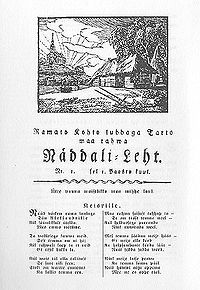
were prominent Estophiles. Masing was one of the main advocates of peasant education and published a weekly newspaper in the Estonian language called "Maa rahva Näddali Leht" (Peasants’ Weekly) from 1821.
The Litterarum Societatis Esthonicae
Learned Estonian Society
The Learned Estonian Society is Estonia's oldest scholarly organisation, and was formed at the University of Tartu in 1838. Its charter was to study Estonia's history and pre-history, its language, literature and folklore....
(Estonian: Õpetatud Eesti Selts) (English: Learned Estonian Society) was established in Tartu
Tartu
Tartu is the second largest city of Estonia. In contrast to Estonia's political and financial capital Tallinn, Tartu is often considered the intellectual and cultural hub, especially since it is home to Estonia's oldest and most renowned university. Situated 186 km southeast of Tallinn, the...
in 1838, which counted as its members Friedrich Robert Faehlmann
Friedrich Robert Faehlmann
Friedrich Robert Faehlmann was an Estonian philologist and an Estophile active in Livonia, Russian Empire...
and Friedrich Reinhold Kreutzwald
Friedrich Reinhold Kreutzwald
Friedrich Reinhold Kreutzwald was an Estonian writer, who is considered to be the father of the national literature for the country.-Life:Friedrich's parents were serfs at the Jõepere estate, Virumaa. His father worked as a granary keeper and his mother was a chambermaid...
, author of the Estonian national epic Kalevipoeg
Kalevipoeg
Kalevipoeg is an epic poem by Friedrich Reinhold Kreutzwald held to be the Estonian national epic.- Origins : There existed an oral tradition within Ancient Estonia of legends explaining the origin of the world...
which was inspired by the Finnish epic Kalevala
Kalevala
The Kalevala is a 19th century work of epic poetry compiled by Elias Lönnrot from Finnish and Karelian oral folklore and mythology.It is regarded as the national epic of Finland and is one of the most significant works of Finnish literature...
.
Folklore recording
FolkloreFolklore
Folklore consists of legends, music, oral history, proverbs, jokes, popular beliefs, fairy tales and customs that are the traditions of a culture, subculture, or group. It is also the set of practices through which those expressive genres are shared. The study of folklore is sometimes called...
being a relatively easily identifiable collectible
Collectible
A collectable or collectible is any object regarded as being of value or interest to a collector . There are numerous types of collectables and terms to denote those types. An antique is a collectable that is old...
, a number of Estophiles have undertaken recording various folktales and folk songs. On one hand, this led to development of Estonian literary tradition; on another, growing amounts of written Estonian language
Estonian language
Estonian is the official language of Estonia, spoken by about 1.1 million people in Estonia and tens of thousands in various émigré communities...
texts necessitated development of (relatively) unified rules of orthography
Orthography
The orthography of a language specifies a standardized way of using a specific writing system to write the language. Where more than one writing system is used for a language, for example Kurdish, Uyghur, Serbian or Inuktitut, there can be more than one orthography...
, and thus, led to analysis of Estonian grammar
Grammar
In linguistics, grammar is the set of structural rules that govern the composition of clauses, phrases, and words in any given natural language. The term refers also to the study of such rules, and this field includes morphology, syntax, and phonology, often complemented by phonetics, semantics,...
and phonetics
Phonetics
Phonetics is a branch of linguistics that comprises the study of the sounds of human speech, or—in the case of sign languages—the equivalent aspects of sign. It is concerned with the physical properties of speech sounds or signs : their physiological production, acoustic properties, auditory...
.
Linguistic analyses
An Estonian grammar was printed in German in 1637. Johann Heinrich RosenplänterJohann Heinrich Rosenplänter
Johann Heinrich Rosenplänter was a Baltic German linguist and Estophile. He edited one of the first scientific journals on Estonian language, Beiträge zur genauern Kenntniß der ehstnischen Sprache ....
published the first academic journal
Academic journal
An academic journal is a peer-reviewed periodical in which scholarship relating to a particular academic discipline is published. Academic journals serve as forums for the introduction and presentation for scrutiny of new research, and the critique of existing research...
in 1813 on an Estonian topic called Beiträge zur genauern Kenntniß der ehstnischen Sprache
Beiträge zur genauern Kenntniß der ehstnischen Sprache
Beiträge zur genauern Kenntniß der ehstnischen Sprache, commonly referred to as Beiträge, was the first scientific journal on Estonian language, edited by Johann Heinrich Rosenplänter and published in 1813–1832....
(Towards a more precise Knowledge of the Estonian Language), aimed at developing written Estonian. In 1843, a grammar
Grammar
In linguistics, grammar is the set of structural rules that govern the composition of clauses, phrases, and words in any given natural language. The term refers also to the study of such rules, and this field includes morphology, syntax, and phonology, often complemented by phonetics, semantics,...
of the Estonian language
Estonian language
Estonian is the official language of Estonia, spoken by about 1.1 million people in Estonia and tens of thousands in various émigré communities...
was compiled by pastor Eduard Ahrens using the Finnish
Finnish language
Finnish is the language spoken by the majority of the population in Finland Primarily for use by restaurant menus and by ethnic Finns outside Finland. It is one of the two official languages of Finland and an official minority language in Sweden. In Sweden, both standard Finnish and Meänkieli, a...
and popular orthography rather than the German-Latin models used previously.
Modern Estophiles
While the significance of Estophiles has waned over the centuries, a number of people (Astrīde Ivask, Seppo Kuusisto, Kazuto Matsumura and others) are still widely regarded as such. Since World War IIWorld War II
World War II, or the Second World War , was a global conflict lasting from 1939 to 1945, involving most of the world's nations—including all of the great powers—eventually forming two opposing military alliances: the Allies and the Axis...
, many of the Estophiles around the world have been in close connection with various Estonian exile communities. One of the most active Estophile organizations is the Tuglas Society http://www.tuglas.fi in Finland, named after the Estonian writer Friedebert Tuglas
Friedebert Tuglas
Friedebert Tuglas was an Estonian writer and critic who introduced Impressionism and Symbolism to Estonian literature. Persecuted under the czar, he became an acknowledged representative of Estonian literature in the Soviet era.-Biography:The son of a carpenter, Tuglas studied at the Hugo Treffner...
.
Scholarship Estophilus
In order to promote the study of Estonian language and culture, the Estonian InstituteEstonian Institute
The Estonian Institute is a non-governmental and non-profit organisation aiming to promote Estonian culture abroad. The institute was founded in 1989 as a shadow foreign office for the Estonian independence movement by Lennart Meri, later the first foreign minister and first president of Estonia...
offers an annual scholarship. The objective of the scholarship is to fund research and studies conducted in Estonia by academically advanced students interested in Estonian language and culture. The scholarship is financed by the Estonian Ministry of Education and Research.
See also
- Anglophile
- Fennophile
- FrancophileFrancophileIs a person with a positive predisposition or interest toward the government, culture, history, or people of France. This could include France itself and its history, the French language, French cuisine, literature, etc...
- RussophileRussophiliaRussophilia is the love of Russia and/or Russians. The term is used in two basic contexts: in international politics and in cultural context. "Russophilia" and "Russophilic" are the terms used to denote pro-Russian sentiments, usually in politics and literature...
- HispanophileHispanophileHispanophile is a word with two meanings. The first meaning refers to a person who is fond of Spain, its people, or its cultures, and it can also be the corresponding adjective. The second meaning generalizes the first one to all Spanish-speaking countries...
Further reading
- Johann Gottfried (University of CaliforniaUniversity of CaliforniaThe University of California is a public university system in the U.S. state of California. Under the California Master Plan for Higher Education, the University of California is a part of the state's three-tier public higher education system, which also includes the California State University...
): 'Georg Julius von Schultz (Dr. Bertram), 1808–1875. Possibilities and Limitations of Estophilia among the Baltic Germans in the 19th Century'. Printed in Zeitschrift für Ostforschung. (Google Books preview) - Ea JansenEa JansenEa Jansen was a historian of Finno-Ugric history originally from Estonia. Until her death, she worked for the .[From an Ethnic Community to National Statehood: The Case of Estonians] - An article written by Jansen in 1998....
(Estonian InstituteEstonian InstituteThe Estonian Institute is a non-governmental and non-profit organisation aiming to promote Estonian culture abroad. The institute was founded in 1989 as a shadow foreign office for the Estonian independence movement by Lennart Meri, later the first foreign minister and first president of Estonia...
): How Estonian literary culture was born