

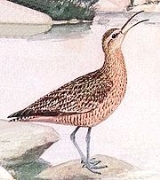
Eskimo Curlew

Encyclopedia
The Eskimo or the "Northern Curlew" is a critically endangered shorebird, now considered by many to be extinct.
, and is classed with them in the genus Numenius. It was formerly placed in the separate genus Mesoscolopax. Numenius is classed in the family Scolopacidae
. Other species in that family include woodcock
s, phalarope
s, snipe
s, and sandpipers. Scolopacidae is a Charadriiform
lineage.
The species was described by Johann Reinhold Forster
in 1772. The generic name has three possible etymologies
. One is that it comes from the Greek
"noumenios". "Noumenios" means "of the new moon", the curlews' thin beak
being compared to a thin crescent moon. A second possibility is that the genus name comes from the word numen, meaning "nod", and referring to this species head being bent forwards and down. The final possibility is that Numenius is a Latinized form of the Greek noumenios, which was the word Diogenes Laertius
used to refer to a species of curlew. The specific name "borealis" is Latin for "northern".
This species has many common names. It has been named the Prairie Pigeon, Fute, Little Curlew, Doe-bird, and Doughbird. These last two names come from its fatness during early migration
south.
, but smaller in size. In the field, the only certain way to distinguish the Eskimo Curlew are its unbarred undersides of the primaries (Townsend, 1933). The call is poorly understood, but includes clear whistling sounds.
Eskimo Curlew formed a species pair with the Asia
n Little Curlew
, Numenius minutus, but is slightly larger, longer-winged, shorter legged and warmer in plumage tone than its Asian relative.
bird. Members of this species bred on the tundra of western arctic Canada
and Alaska
.
Eskimo Curlews migrated
to the pampas of Argentina
in the late summer and returned in February. They were formerly very rare vagrants to western Europe
, but there have been no recent records. In Britain, there are four records, all from the 19th Century.
A comparison of dates and migratory patterns has led some to conjecture that Eskimo Curlews and American Golden-Plover
are the shorebirds that attracted the attention of Christopher Columbus
to nearby land after 65 days at sea and out of sight of land on his first voyage. In the 1800s millions of Eskimo Curlews followed migration routes from the present Yukon and Northwest Territories
, flying east along the northern shore of Canada, then south over the Atlantic Ocean to South America
in the winter. When returning to North America, they would fly north through the Great Plains
.
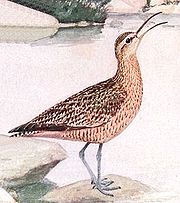 Eskimo Curlews picked up food by sight, as well as feeding by probing. They ate mostly berries while on the fall migration in Canada. During the rest of their migration and on the breeding grounds they ate insects. Snails and other invertebrate were also part of their diet during migration.
were located in open areas on the ground and are difficult to locate. They were made of wisps of dried grass or leaves. The eggs are green with brown splotches.
This species' specific incubation
behavior is unknown. It is not certain which sex if not both incubated, and what the specific timeline was. These birds evidently did not attack intruders approaching their nests, which provides reason to believe that their nests were far apart from each other.
 At one time, the Eskimo Curlew may have been one of the most numerous shorebirds in North America
with a population in the millions. As many as 2 million birds per year were killed near the end of the 19th century. The last confirmed sightings were in 1962 on Galveston Island, Texas
(photographed) and on Barbados in 1963 (specimen). There was a reliable report of 23 birds in Texas in 1981, and more recent additional unconfirmed reports from Texas, Canada (1987), Argentina (1990), and Nova Scotia (2006). No confirmed record of this species has been reported in South America since 1939. Full details on all sightings up to 1986 are included in the on line edition of Eskimo Curlew: A Vanishing Species?
This species is fully protected in Argentina
, the Brazil
, Canada
, the United States
, and Mexico
. Hunting has been outlawed since around 1916.
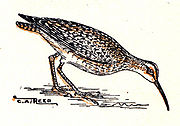
.jpg) The plight of this bird inspired the novel (and subsequent Emmy Award winning 1972 ABC Afterschool Special
The plight of this bird inspired the novel (and subsequent Emmy Award winning 1972 ABC Afterschool Special
) Last of the Curlews
.
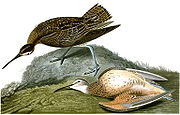
The Esquimaux Curlew (sic) appears as plate
CCCLVII of Audubon's
Birds of America
.
In the 1950s the Eskimo Curlew was a subject of the Mark Trail
comic strip by Ed Dodd
and Tom Hill.
Taxonomy
The Eskimo Curlew is one of eight species of curlewCurlew
The curlews , genus Numenius, are a group of eight species of birds, characterised by long, slender, downcurved bills and mottled brown plumage. They are one of the most ancient lineages of scolopacid waders, together with the godwits which look similar but have straight bills...
, and is classed with them in the genus Numenius. It was formerly placed in the separate genus Mesoscolopax. Numenius is classed in the family Scolopacidae
Scolopacidae
The sandpipers are a large family, Scolopacidae, of waders or shorebirds. They include many species called sandpipers, as well as those called by names such as curlew and snipe. The majority of these species eat small invertebrates picked out of the mud or soil...
. Other species in that family include woodcock
Woodcock
The woodcocks are a group of seven or eight very similar living species of wading birds in the genus Scolopax. Only two woodcocks are widespread, the others being localized island endemics. Most are found in the Northern Hemisphere but a few range into Wallacea...
s, phalarope
Phalarope
A phalarope or wadepiper is any of three living species of slender-necked shorebirds in the genus Phalaropus of the bird family Scolopacidae. They are close relatives of the shanks and tattlers, the Actitis and Terek Sandpipers, and also of the turnstones and calidrids...
s, snipe
Snipe
A snipe is any of about 25 wading bird species in three genera in the family Scolopacidae. They are characterized by a very long, slender bill and crypsis plumage. The Gallinago snipes have a nearly worldwide distribution, the Lymnocryptes Jack Snipe is restricted to Asia and Europe and the...
s, and sandpipers. Scolopacidae is a Charadriiform
Charadriiformes
Charadriiformes is a diverse order of small to medium-large birds. It includes about 350 species and has members in all parts of the world. Most Charadriiformes live near water and eat invertebrates or other small animals; however, some are pelagic , some occupy deserts and a few are found in thick...
lineage.
The species was described by Johann Reinhold Forster
Johann Reinhold Forster
Johann Reinhold Forster was a German Lutheran pastor and naturalist of partial Scottish descent who made contributions to the early ornithology of Europe and North America...
in 1772. The generic name has three possible etymologies
Etymology
Etymology is the study of the history of words, their origins, and how their form and meaning have changed over time.For languages with a long written history, etymologists make use of texts in these languages and texts about the languages to gather knowledge about how words were used during...
. One is that it comes from the Greek
Greek language
Greek is an independent branch of the Indo-European family of languages. Native to the southern Balkans, it has the longest documented history of any Indo-European language, spanning 34 centuries of written records. Its writing system has been the Greek alphabet for the majority of its history;...
"noumenios". "Noumenios" means "of the new moon", the curlews' thin beak
Beak
The beak, bill or rostrum is an external anatomical structure of birds which is used for eating and for grooming, manipulating objects, killing prey, fighting, probing for food, courtship and feeding young...
being compared to a thin crescent moon. A second possibility is that the genus name comes from the word numen, meaning "nod", and referring to this species head being bent forwards and down. The final possibility is that Numenius is a Latinized form of the Greek noumenios, which was the word Diogenes Laertius
Diogenes Laertius
Diogenes Laertius was a biographer of the Greek philosophers. Nothing is known about his life, but his surviving Lives and Opinions of Eminent Philosophers is one of the principal surviving sources for the history of Greek philosophy.-Life:Nothing is definitively known about his life...
used to refer to a species of curlew. The specific name "borealis" is Latin for "northern".
This species has many common names. It has been named the Prairie Pigeon, Fute, Little Curlew, Doe-bird, and Doughbird. These last two names come from its fatness during early migration
Bird migration
Bird migration is the regular seasonal journey undertaken by many species of birds. Bird movements include those made in response to changes in food availability, habitat or weather. Sometimes, journeys are not termed "true migration" because they are irregular or in only one direction...
south.
Description
Eskimo Curlews are about 12 or 13 inches in length. Adults have long dark greyish legs and a long bill curved slightly downwards. The upperparts are mottled brown and the underparts are light brown. They show cinnamon wing linings in flight. They are similar in appearance to the Hudsonian Curlew, the American subspecies of the WhimbrelWhimbrel
The Whimbrel Numenius phaeopus, is a wader in the large family Scolopacidae. It is one of the mostwidespread of the curlews, breeding across much of subarctic North America, Europe and Asia as far south as Scotland....
, but smaller in size. In the field, the only certain way to distinguish the Eskimo Curlew are its unbarred undersides of the primaries (Townsend, 1933). The call is poorly understood, but includes clear whistling sounds.
Eskimo Curlew formed a species pair with the Asia
Asia
Asia is the world's largest and most populous continent, located primarily in the eastern and northern hemispheres. It covers 8.7% of the Earth's total surface area and with approximately 3.879 billion people, it hosts 60% of the world's current human population...
n Little Curlew
Little Curlew
The Little Curlew, Numenius minutus, is a wader in the large bird family Scolopacidae. It is a very small curlew, which breeds in the far north of Siberia. It is closely related to the North American Eskimo Curlew....
, Numenius minutus, but is slightly larger, longer-winged, shorter legged and warmer in plumage tone than its Asian relative.
Distribution and habitat
The Eskimo Curlew is a New WorldNew World
The New World is one of the names used for the Western Hemisphere, specifically America and sometimes Oceania . The term originated in the late 15th century, when America had been recently discovered by European explorers, expanding the geographical horizon of the people of the European middle...
bird. Members of this species bred on the tundra of western arctic Canada
Canada
Canada is a North American country consisting of ten provinces and three territories. Located in the northern part of the continent, it extends from the Atlantic Ocean in the east to the Pacific Ocean in the west, and northward into the Arctic Ocean...
and Alaska
Alaska
Alaska is the largest state in the United States by area. It is situated in the northwest extremity of the North American continent, with Canada to the east, the Arctic Ocean to the north, and the Pacific Ocean to the west and south, with Russia further west across the Bering Strait...
.
Eskimo Curlews migrated
Bird migration
Bird migration is the regular seasonal journey undertaken by many species of birds. Bird movements include those made in response to changes in food availability, habitat or weather. Sometimes, journeys are not termed "true migration" because they are irregular or in only one direction...
to the pampas of Argentina
Argentina
Argentina , officially the Argentine Republic , is the second largest country in South America by land area, after Brazil. It is constituted as a federation of 23 provinces and an autonomous city, Buenos Aires...
in the late summer and returned in February. They were formerly very rare vagrants to western Europe
Europe
Europe is, by convention, one of the world's seven continents. Comprising the westernmost peninsula of Eurasia, Europe is generally 'divided' from Asia to its east by the watershed divides of the Ural and Caucasus Mountains, the Ural River, the Caspian and Black Seas, and the waterways connecting...
, but there have been no recent records. In Britain, there are four records, all from the 19th Century.
A comparison of dates and migratory patterns has led some to conjecture that Eskimo Curlews and American Golden-Plover
American Golden Plover
The American Golden Plover is a medium-sized plover.Adults are spotted gold and black on the crown, back and wings. Their face and neck are black with a white border; they have a black breast and a dark rump. The legs are black....
are the shorebirds that attracted the attention of Christopher Columbus
Christopher Columbus
Christopher Columbus was an explorer, colonizer, and navigator, born in the Republic of Genoa, in northwestern Italy. Under the auspices of the Catholic Monarchs of Spain, he completed four voyages across the Atlantic Ocean that led to general European awareness of the American continents in the...
to nearby land after 65 days at sea and out of sight of land on his first voyage. In the 1800s millions of Eskimo Curlews followed migration routes from the present Yukon and Northwest Territories
Northwest Territories
The Northwest Territories is a federal territory of Canada.Located in northern Canada, the territory borders Canada's two other territories, Yukon to the west and Nunavut to the east, and three provinces: British Columbia to the southwest, and Alberta and Saskatchewan to the south...
, flying east along the northern shore of Canada, then south over the Atlantic Ocean to South America
South America
South America is a continent situated in the Western Hemisphere, mostly in the Southern Hemisphere, with a relatively small portion in the Northern Hemisphere. The continent is also considered a subcontinent of the Americas. It is bordered on the west by the Pacific Ocean and on the north and east...
in the winter. When returning to North America, they would fly north through the Great Plains
Great Plains
The Great Plains are a broad expanse of flat land, much of it covered in prairie, steppe and grassland, which lies west of the Mississippi River and east of the Rocky Mountains in the United States and Canada. This area covers parts of the U.S...
.
Diet
Reproduction
Nesting probably occurred in June. NestsBird nest
A bird nest is the spot in which a bird lays and incubates its eggs and raises its young. Although the term popularly refers to a specific structure made by the bird itself—such as the grassy cup nest of the American Robin or Eurasian Blackbird, or the elaborately woven hanging nest of the...
were located in open areas on the ground and are difficult to locate. They were made of wisps of dried grass or leaves. The eggs are green with brown splotches.
This species' specific incubation
Avian incubation
Incubation refers to the process by which certain oviparous animals hatch their eggs, and to the development of the embryo within the egg. The most vital factor of incubation is the constant temperature required for its development over a specific period. Especially in domestic fowl, the act of...
behavior is unknown. It is not certain which sex if not both incubated, and what the specific timeline was. These birds evidently did not attack intruders approaching their nests, which provides reason to believe that their nests were far apart from each other.
Near extinction
North America
North America is a continent wholly within the Northern Hemisphere and almost wholly within the Western Hemisphere. It is also considered a northern subcontinent of the Americas...
with a population in the millions. As many as 2 million birds per year were killed near the end of the 19th century. The last confirmed sightings were in 1962 on Galveston Island, Texas
Texas
Texas is the second largest U.S. state by both area and population, and the largest state by area in the contiguous United States.The name, based on the Caddo word "Tejas" meaning "friends" or "allies", was applied by the Spanish to the Caddo themselves and to the region of their settlement in...
(photographed) and on Barbados in 1963 (specimen). There was a reliable report of 23 birds in Texas in 1981, and more recent additional unconfirmed reports from Texas, Canada (1987), Argentina (1990), and Nova Scotia (2006). No confirmed record of this species has been reported in South America since 1939. Full details on all sightings up to 1986 are included in the on line edition of Eskimo Curlew: A Vanishing Species?
This species is fully protected in Argentina
Argentina
Argentina , officially the Argentine Republic , is the second largest country in South America by land area, after Brazil. It is constituted as a federation of 23 provinces and an autonomous city, Buenos Aires...
, the Brazil
Brazil
Brazil , officially the Federative Republic of Brazil , is the largest country in South America. It is the world's fifth largest country, both by geographical area and by population with over 192 million people...
, Canada
Canada
Canada is a North American country consisting of ten provinces and three territories. Located in the northern part of the continent, it extends from the Atlantic Ocean in the east to the Pacific Ocean in the west, and northward into the Arctic Ocean...
, the United States
United States
The United States of America is a federal constitutional republic comprising fifty states and a federal district...
, and Mexico
Mexico
The United Mexican States , commonly known as Mexico , is a federal constitutional republic in North America. It is bordered on the north by the United States; on the south and west by the Pacific Ocean; on the southeast by Guatemala, Belize, and the Caribbean Sea; and on the east by the Gulf of...
. Hunting has been outlawed since around 1916.
In popular culture
ABC Afterschool Special
The ABC Afterschool Special is an American television anthology series that aired on ABC from 1972 to 1996, usually in the late afternoon on week days. Most of the episodes were dramatic presentations of situations, often controversial, of interest to children and teenagers. Several episodes were...
) Last of the Curlews
Last of the Curlews
Last of the Curlews is a novel, a fictionalized account of the life of the last Eskimo Curlew. It was written by Fred Bodsworth, a Canadian newspaper reporter and naturalist, and published in 1954.-Plot introduction:...
.
The Esquimaux Curlew (sic) appears as plate
Photographic plate
Photographic plates preceded photographic film as a means of photography. A light-sensitive emulsion of silver salts was applied to a glass plate. This form of photographic material largely faded from the consumer market in the early years of the 20th century, as more convenient and less fragile...
CCCLVII of Audubon's
John James Audubon
John James Audubon was a French-American ornithologist, naturalist, and painter. He was notable for his expansive studies to document all types of American birds and for his detailed illustrations that depicted the birds in their natural habitats...
Birds of America
Birds of America (book)
The Birds of America is a book by naturalist and painter John James Audubon, containing illustrations of a wide variety of birds of the United States. It was first published as a series of sections between 1827 and 1838, in Edinburgh and London....
.
In the 1950s the Eskimo Curlew was a subject of the Mark Trail
Mark Trail
Mark Trail is a newspaper comic strip created by the American cartoonist Ed Dodd. Introduced April 15, 1946, the strip centers on environmental and ecological themes. In 2006, King Features syndicated the strip to nearly 175 newspapers....
comic strip by Ed Dodd
Ed Dodd
Edward Benton Dodd was a 20th century American cartoonist known for his Mark Trail comic strip.-Early years:...
and Tom Hill.