

Scolopacidae

Encyclopedia
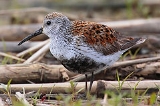
The sandpipers are a large family, Scolopacidae, of wader
s or shorebirds. They include many species called sandpipers, as well as those called by names such as curlew
and snipe
. The majority of these species eat small invertebrate
s picked out of the mud or soil. Different lengths of bills
enable different species to feed in the same habitat
, particularly on the coast
, without direct competition for food.
Sandpipers have long bodies and legs, and narrow wings. Most species have a narrow bill, but otherwise the form and length are quite variable. They are small to medium sized birds, measuring 12 to 66 cm (4.7 to 26 in) cm in length. The bills are sensitive, allowing the birds to feel the mud and sand
as they probe for food. They generally have dull plumage
, with cryptic brown, grey, or streaked patterns, although some display brighter colours during the breeding season.
Most species nest in open areas, and defend their territories with aerial displays. The nest
itself is a simple scrape in the ground, in which the bird typically lays three or four eggs
. The young of most species are precocial
.
ary lineages. The groups, with species numbers in parentheses, are:
record is very bad for a group that was probably present at the non-avian dinosaur
's extinction. "Totanus" teruelensis (Late Miocene
of Los Mansuetos (Spain
) is sometimes considered a scolopacid – maybe a shank – but may well be a larid; little is known of it.
Paractitis has been named from the Early Oligocene of Sasketchewan (Canada
), while Mirolia is known from the Middle Miocene
at Deiningen
in the Nördlinger Ries
(Germany
). Most living genera would seem to have evolve
d throughout the Oligocene
to Miocene
with the wader
s perhaps a bit later; see the genus accounts for the fossil record.
In addition there are some indeterminable remains that might belong to extant genera or their extinct relatives:
, at as little 11 centimetres (4.3 in) and 18 grams (0.6 oz) in length, to the Eastern Curlew, at up to 66 centimetres (26 in) in length and 1 kg (2.2 lbs). Within species there is considerable variation in patterns of sexual dimorphism
. Males are larger than females in Ruff
s and several sandpipers, but are smaller than females in the knot
s, curlew
s, phalarope
s and godwit
s. The sexes are similarly sized in the snipe
s, woodcock
and tringine sandpipers. Compared to the other large family of wading birds, the plover
s (Charadriidae
) they tend to have smaller eye, more slender heads, and longer thinner bills. Some are quite long-legged, and most species have three forward pointing toes with a smaller hind toe (the exception is the Sanderling
, which lacks a hind toe).
Sandpipers are more geared towards tactile foraging methods than the plovers, which favour more visual foraging methods, and this is reflected in the high density of tactile receptors in the tips of their bills
. These receptors are housed in a slight horny swelling at the tip of the bill (except for the Surfbird
and the two turnstone
s). Bill shape is highly variable within the family, reflecting differences in feeding ecology. Bill length relative to head length varies from three times the length of the head in the Long-billed Curlew
to just under half the head length in the Tuamotu Sandpiper
. Bills may be straight, slightly upcurled or strongly downcurved. Like all birds, the bills of sandpipers are capable of cranial kinesis
, literally being able to move the bones of the skull (other than the obvious movement of the lower jaw) and specifically bending the upper jaw without opening the entire jaw, an act known as rhynchokinesis. It has been hypothesized this helps when probing by allowing the bill to be partly opened with less force and improving manipulation of prey items in the substrate. Rhynchokinesis is also used by sandpipers feeding on prey in water to catch and manipulate prey.
, occurring across most of the world's land surfaces except for Antarctica and the driest deserts. A majority of the family breed at moderate to high latitudes in the Northern Hemisphere, in fact accounting for the most northerly breeding birds in the world. Only a few species breed in tropical regions, ten of which are snipes and woodcocks and the remaining species being the unusual Tuamotu Sandpiper, which breeds in French Polynesia
(although prior the arrival of humans in the Pacific there were several other closely related species of Polynesian sandpiper
).
Wader
Waders, called shorebirds in North America , are members of the order Charadriiformes, excluding the more marine web-footed seabird groups. The latter are the skuas , gulls , terns , skimmers , and auks...
s or shorebirds. They include many species called sandpipers, as well as those called by names such as curlew
Curlew
The curlews , genus Numenius, are a group of eight species of birds, characterised by long, slender, downcurved bills and mottled brown plumage. They are one of the most ancient lineages of scolopacid waders, together with the godwits which look similar but have straight bills...
and snipe
Snipe
A snipe is any of about 25 wading bird species in three genera in the family Scolopacidae. They are characterized by a very long, slender bill and crypsis plumage. The Gallinago snipes have a nearly worldwide distribution, the Lymnocryptes Jack Snipe is restricted to Asia and Europe and the...
. The majority of these species eat small invertebrate
Invertebrate
An invertebrate is an animal without a backbone. The group includes 97% of all animal species – all animals except those in the chordate subphylum Vertebrata .Invertebrates form a paraphyletic group...
s picked out of the mud or soil. Different lengths of bills
Beak
The beak, bill or rostrum is an external anatomical structure of birds which is used for eating and for grooming, manipulating objects, killing prey, fighting, probing for food, courtship and feeding young...
enable different species to feed in the same habitat
Habitat
* Habitat , a place where a species lives and grows*Human habitat, a place where humans live, work or play** Space habitat, a space station intended as a permanent settlement...
, particularly on the coast
Coast
A coastline or seashore is the area where land meets the sea or ocean. A precise line that can be called a coastline cannot be determined due to the dynamic nature of tides. The term "coastal zone" can be used instead, which is a spatial zone where interaction of the sea and land processes occurs...
, without direct competition for food.
Sandpipers have long bodies and legs, and narrow wings. Most species have a narrow bill, but otherwise the form and length are quite variable. They are small to medium sized birds, measuring 12 to 66 cm (4.7 to 26 in) cm in length. The bills are sensitive, allowing the birds to feel the mud and sand
Sand
Sand is a naturally occurring granular material composed of finely divided rock and mineral particles.The composition of sand is highly variable, depending on the local rock sources and conditions, but the most common constituent of sand in inland continental settings and non-tropical coastal...
as they probe for food. They generally have dull plumage
Plumage
Plumage refers both to the layer of feathers that cover a bird and the pattern, colour, and arrangement of those feathers. The pattern and colours of plumage vary between species and subspecies and can also vary between different age classes, sexes, and season. Within species there can also be a...
, with cryptic brown, grey, or streaked patterns, although some display brighter colours during the breeding season.
Most species nest in open areas, and defend their territories with aerial displays. The nest
Bird nest
A bird nest is the spot in which a bird lays and incubates its eggs and raises its young. Although the term popularly refers to a specific structure made by the bird itself—such as the grassy cup nest of the American Robin or Eurasian Blackbird, or the elaborately woven hanging nest of the...
itself is a simple scrape in the ground, in which the bird typically lays three or four eggs
Bird egg
Bird eggs are laid by females and incubated for a time that varies according to the species; a single young hatches from each egg. Average clutch sizes range from one to about 17...
. The young of most species are precocial
Precocial
In biology, the term precocial refers to species in which the young are relatively mature and mobile from the moment of birth or hatching. The opposite developmental strategy is called "altricial," where the young are born or hatched helpless. Extremely precocial species may be called...
.
Taxonomy
This large family is often further subdivided into groups of similar birds. These groups do not necessarily consist of a single genus, but as presented here they do form distinct monophyletic evolutionEvolution
Evolution is any change across successive generations in the heritable characteristics of biological populations. Evolutionary processes give rise to diversity at every level of biological organisation, including species, individual organisms and molecules such as DNA and proteins.Life on Earth...
ary lineages. The groups, with species numbers in parentheses, are:
- CurlewCurlewThe curlews , genus Numenius, are a group of eight species of birds, characterised by long, slender, downcurved bills and mottled brown plumage. They are one of the most ancient lineages of scolopacid waders, together with the godwits which look similar but have straight bills...
s
- Genus Numenius (8 species, of which 1–2 recently extinct)
- Upland SandpiperUpland SandpiperThe Upland Sandpiper is a large shorebird, closely related to the curlews . Older names are the Upland Plover and Bartram's Sandpiper. It is the only member of the genus Bartramia. The genus name and the old common name Bartram's Sandpiper commemorate the American naturalist William Bartram...
- Upland Sandpiper
- Genus Bartramia (monotypicMonotypicIn biology, a monotypic taxon is a taxonomic group with only one biological type. The term's usage differs slightly between botany and zoology. The term monotypic has a separate use in conservation biology, monotypic habitat, regarding species habitat conversion eliminating biodiversity and...
)- GodwitGodwitThe godwits are a group of large, long-billed, long-legged and strongly migratory wading birds of the genus Limosa. They form large flocks on coasts and estuaries in winter....
s
- Godwit
- Genus Limosa (4 species)
- DowitcherDowitcherThe three dowitchers are medium-sized long-billed wading birds. They resemble godwits in body and bill shape, and the reddish underparts in summer, but are much shorter legged, more like snipe to which they are also somewhat closer related...
s
- Dowitcher
- Genus Limnodromus (3 species)
- SnipeSnipeA snipe is any of about 25 wading bird species in three genera in the family Scolopacidae. They are characterized by a very long, slender bill and crypsis plumage. The Gallinago snipes have a nearly worldwide distribution, the Lymnocryptes Jack Snipe is restricted to Asia and Europe and the...
and woodcockWoodcockThe woodcocks are a group of seven or eight very similar living species of wading birds in the genus Scolopax. Only two woodcocks are widespread, the others being localized island endemics. Most are found in the Northern Hemisphere but a few range into Wallacea...
s
- Snipe
- Genera Coenocorypha, Lymnocryptes, Gallinago and Scolopax (nearly 30 species, plus some 6 extinct)
- PhalaropePhalaropeA phalarope or wadepiper is any of three living species of slender-necked shorebirds in the genus Phalaropus of the bird family Scolopacidae. They are close relatives of the shanks and tattlers, the Actitis and Terek Sandpipers, and also of the turnstones and calidrids...
s
- Phalarope
- Genus Phalaropus (3 species)
- ShanksTringaTringa is a genus of waders, containing the shanks and tattlers. They are mainly freshwater birds, often with brightly coloured legs as reflected in the English names of six species, as well as the specific names of two of these and the Green Sandpiper. They are typically associated with northern...
and tattlerTattler (bird)The tattlers are the two very similar bird species in the shorebird genus Tringa. They formerly had their own genus, Heteroscelus. The old genus name means "different leg" in Greek, referring to the leg scales that differentiate the tattlers from their close relatives, the shanks.The species are:*...
s
- Shanks
- Genera Xenus, Actitis, and Tringa which now includes Catoptrophorus and Heteroscelus (16 species)
- Polynesian sandpiperPolynesian sandpiperThe two to four species of Polynesian sandpipers, the only members of the genus Prosobonia, are small wading birds confined to remote Pacific islands of French Polynesia. Only one species now exists, and it is rare and little known. This bird is sometimes separated in the genus Aechmorhynchus,...
s
- Polynesian sandpiper
- Genus Prosobonia (1 extant species, 3–5 extinct)
- CalidridCalidridThe calidrids or typical waders are a group of Arctic-breeding, strongly migratory wading birds. These birds form huge mixed flocks on coasts and estuaries in winter. They are the typical "sandpipers", small to medium-sized, long-winged and relatively short-billed.Their bills have sensitive tips...
s and turnstoneTurnstoneTurnstones are the bird species in the genus Arenaria in the family Scolopacidae. They are closely related to calidrid sandpipers and might be considered members of the tribe Calidriini....
s
- Calidrid
- Roughly 25 species, mostly in Calidris which might be split up into several genera. Other genera currently accepted are Aphriza, Eurynorhynchus, Limicola, Tryngites, and Philomachus, in addition to the 2 Arenaria turnstones.
Evolution
The early fossilFossil
Fossils are the preserved remains or traces of animals , plants, and other organisms from the remote past...
record is very bad for a group that was probably present at the non-avian dinosaur
Dinosaur
Dinosaurs are a diverse group of animals of the clade and superorder Dinosauria. They were the dominant terrestrial vertebrates for over 160 million years, from the late Triassic period until the end of the Cretaceous , when the Cretaceous–Paleogene extinction event led to the extinction of...
's extinction. "Totanus" teruelensis (Late Miocene
Late Miocene
The Late Miocene is a sub-epoch of the Miocene Epoch made up of two stages. The Tortonian and Messinian stages comprise the Late Miocene sub-epoch....
of Los Mansuetos (Spain
Spain
Spain , officially the Kingdom of Spain languages]] under the European Charter for Regional or Minority Languages. In each of these, Spain's official name is as follows:;;;;;;), is a country and member state of the European Union located in southwestern Europe on the Iberian Peninsula...
) is sometimes considered a scolopacid – maybe a shank – but may well be a larid; little is known of it.
Paractitis has been named from the Early Oligocene of Sasketchewan (Canada
Canada
Canada is a North American country consisting of ten provinces and three territories. Located in the northern part of the continent, it extends from the Atlantic Ocean in the east to the Pacific Ocean in the west, and northward into the Arctic Ocean...
), while Mirolia is known from the Middle Miocene
Middle Miocene
The Middle Miocene is a sub-epoch of the Miocene Epoch made up of two stages: the Langhian and Serravallian stages. The Middle Miocene is preceded by the Early Miocene....
at Deiningen
Deiningen
Deiningen is a municipality in the district of Donau-Ries in Bavaria in Germany....
in the Nördlinger Ries
Nördlinger Ries
The Nördlinger Ries is a large circular depression in western Bavaria, Germany, located north of the Danube in the district of Donau-Ries. The city of Nördlingen is located about southwest of the centre of the depression....
(Germany
Germany
Germany , officially the Federal Republic of Germany , is a federal parliamentary republic in Europe. The country consists of 16 states while the capital and largest city is Berlin. Germany covers an area of 357,021 km2 and has a largely temperate seasonal climate...
). Most living genera would seem to have evolve
Evolution
Evolution is any change across successive generations in the heritable characteristics of biological populations. Evolutionary processes give rise to diversity at every level of biological organisation, including species, individual organisms and molecules such as DNA and proteins.Life on Earth...
d throughout the Oligocene
Oligocene
The Oligocene is a geologic epoch of the Paleogene Period and extends from about 34 million to 23 million years before the present . As with other older geologic periods, the rock beds that define the period are well identified but the exact dates of the start and end of the period are slightly...
to Miocene
Miocene
The Miocene is a geological epoch of the Neogene Period and extends from about . The Miocene was named by Sir Charles Lyell. Its name comes from the Greek words and and means "less recent" because it has 18% fewer modern sea invertebrates than the Pliocene. The Miocene follows the Oligocene...
with the wader
Wader
Waders, called shorebirds in North America , are members of the order Charadriiformes, excluding the more marine web-footed seabird groups. The latter are the skuas , gulls , terns , skimmers , and auks...
s perhaps a bit later; see the genus accounts for the fossil record.
In addition there are some indeterminable remains that might belong to extant genera or their extinct relatives:
- Scolopacidae gen. et sp. indet. (Middle Miocene of Františkovy Lázně, Czech Republic – Late Miocene of Kohfidisch, Austria)
- Scolopacidae gen. et sp. indet. (Edson Early Pliocene of Sherman County, USA)
Description
The sandpipers exhibit considerable range in size and appearance, the wide range of body forms reflecting a wide range of ecological niches. Sandpipers range in size from the Least SandpiperLeast Sandpiper
The Least Sandpiper is the smallest shorebird.This species has greenish legs and a short thin dark bill. Breeding adults are brown with dark brown streaks on top and white underneath. They have a light line above the eye and a dark crown. In winter, Least Sandpipers are grey above...
, at as little 11 centimetres (4.3 in) and 18 grams (0.6 oz) in length, to the Eastern Curlew, at up to 66 centimetres (26 in) in length and 1 kg (2.2 lbs). Within species there is considerable variation in patterns of sexual dimorphism
Sexual dimorphism
Sexual dimorphism is a phenotypic difference between males and females of the same species. Examples of such differences include differences in morphology, ornamentation, and behavior.-Examples:-Ornamentation / coloration:...
. Males are larger than females in Ruff
Ruff
The Ruff is a medium-sized wading bird that breeds in marshes and wet meadows across northern Eurasia. This highly gregarious sandpiper is migratory and sometimes forms huge flocks in its winter grounds, which include southern and western Europe, Africa, southern Asia and Australia...
s and several sandpipers, but are smaller than females in the knot
Knot
A knot is a method of fastening or securing linear material such as rope by tying or interweaving. It may consist of a length of one or several segments of rope, string, webbing, twine, strap, or even chain interwoven such that the line can bind to itself or to some other object—the "load"...
s, curlew
Curlew
The curlews , genus Numenius, are a group of eight species of birds, characterised by long, slender, downcurved bills and mottled brown plumage. They are one of the most ancient lineages of scolopacid waders, together with the godwits which look similar but have straight bills...
s, phalarope
Phalarope
A phalarope or wadepiper is any of three living species of slender-necked shorebirds in the genus Phalaropus of the bird family Scolopacidae. They are close relatives of the shanks and tattlers, the Actitis and Terek Sandpipers, and also of the turnstones and calidrids...
s and godwit
Godwit
The godwits are a group of large, long-billed, long-legged and strongly migratory wading birds of the genus Limosa. They form large flocks on coasts and estuaries in winter....
s. The sexes are similarly sized in the snipe
Snipe
A snipe is any of about 25 wading bird species in three genera in the family Scolopacidae. They are characterized by a very long, slender bill and crypsis plumage. The Gallinago snipes have a nearly worldwide distribution, the Lymnocryptes Jack Snipe is restricted to Asia and Europe and the...
s, woodcock
Woodcock
The woodcocks are a group of seven or eight very similar living species of wading birds in the genus Scolopax. Only two woodcocks are widespread, the others being localized island endemics. Most are found in the Northern Hemisphere but a few range into Wallacea...
and tringine sandpipers. Compared to the other large family of wading birds, the plover
Plover
Plovers are a widely distributed group of wading birds belonging to the subfamily Charadriinae. There are about 40 species in the subfamily, most of them called "plover" or "dotterel". The closely related lapwing subfamily, Vanellinae, comprises another 20-odd species.Plovers are found throughout...
s (Charadriidae
Charadriidae
The bird family Charadriidae includes the plovers, dotterels, and lapwings, about 64 to 66 species in all.- Morphology :They are small to medium-sized birds with compact bodies, short, thick necks and long, usually pointed, wings, but most species of lapwing may have more rounded wings...
) they tend to have smaller eye, more slender heads, and longer thinner bills. Some are quite long-legged, and most species have three forward pointing toes with a smaller hind toe (the exception is the Sanderling
Sanderling
The Sanderling is a small wader. It is a circumpolar Arctic breeder, and is a long-distance migrant, wintering south to South America, South Europe, Africa, and Australia...
, which lacks a hind toe).
Sandpipers are more geared towards tactile foraging methods than the plovers, which favour more visual foraging methods, and this is reflected in the high density of tactile receptors in the tips of their bills
Beak
The beak, bill or rostrum is an external anatomical structure of birds which is used for eating and for grooming, manipulating objects, killing prey, fighting, probing for food, courtship and feeding young...
. These receptors are housed in a slight horny swelling at the tip of the bill (except for the Surfbird
Surfbird
The Surfbird is a small stocky wader in the family Scolopacidae. It is usually classified in a genus of its own, as Aphriza virgata, and was once considered to be allied to the turnstones, but more recent data suggests it is very close genetically to the Red and Great Knots and should be included...
and the two turnstone
Turnstone
Turnstones are the bird species in the genus Arenaria in the family Scolopacidae. They are closely related to calidrid sandpipers and might be considered members of the tribe Calidriini....
s). Bill shape is highly variable within the family, reflecting differences in feeding ecology. Bill length relative to head length varies from three times the length of the head in the Long-billed Curlew
Long-billed Curlew
The Long-billed Curlew, Numenius americanus, is a large North American shorebird of the family Scolopacidae. This species was also called "sicklebird" and the "candlestick bird". The species is native to central and western North America...
to just under half the head length in the Tuamotu Sandpiper
Tuamotu Sandpiper
The Tuamotu Sandpiper, Prosobonia cancellata, is an endangered member of the large wader family Scolopacidae, that is endemic to the Tuamotu Islands in French Polynesia. It is sometimes placed in the monotypic genus Aechmorhynchus...
. Bills may be straight, slightly upcurled or strongly downcurved. Like all birds, the bills of sandpipers are capable of cranial kinesis
Cranial kinesis
Cranial kinesis is the term for significant movement of skull bones relative to each other in addition to movement at the joint between the upper and lower jaw. It is usually taken to mean relative movement between the upper jaw and the braincase....
, literally being able to move the bones of the skull (other than the obvious movement of the lower jaw) and specifically bending the upper jaw without opening the entire jaw, an act known as rhynchokinesis. It has been hypothesized this helps when probing by allowing the bill to be partly opened with less force and improving manipulation of prey items in the substrate. Rhynchokinesis is also used by sandpipers feeding on prey in water to catch and manipulate prey.
Distribution, habitat, and movements
The sandpipers have a cosmopolitan distributionCosmopolitan distribution
In biogeography, a taxon is said to have a cosmopolitan distribution if its range extends across all or most of the world in appropriate habitats. For instance, the killer whale has a cosmopolitan distribution, extending over most of the world's oceans. Other examples include humans, the lichen...
, occurring across most of the world's land surfaces except for Antarctica and the driest deserts. A majority of the family breed at moderate to high latitudes in the Northern Hemisphere, in fact accounting for the most northerly breeding birds in the world. Only a few species breed in tropical regions, ten of which are snipes and woodcocks and the remaining species being the unusual Tuamotu Sandpiper, which breeds in French Polynesia
French Polynesia
French Polynesia is an overseas country of the French Republic . It is made up of several groups of Polynesian islands, the most famous island being Tahiti in the Society Islands group, which is also the most populous island and the seat of the capital of the territory...
(although prior the arrival of humans in the Pacific there were several other closely related species of Polynesian sandpiper
Polynesian sandpiper
The two to four species of Polynesian sandpipers, the only members of the genus Prosobonia, are small wading birds confined to remote Pacific islands of French Polynesia. Only one species now exists, and it is rare and little known. This bird is sometimes separated in the genus Aechmorhynchus,...
).
Diet and feeding
There are broadly four feeding styles employed by the sandpipers, although many species are flexible and may use more than one style. The first is pecking with occasional probing, usually done by species in drier habitats that do not have soft soils or mud. The second, and most common, method employed is probing soft soils, muds and sands for prey. The third, used by Tringa shanks, involves running in shallow water with the bill under the water chasing fish, a method that uses sight as well as tactile senses. The final method, employed by the phalaropes and some Calidris sanpipers, involves pecking at the water for small prey.External links
- Sandpiper media on the Internet Bird Collection