
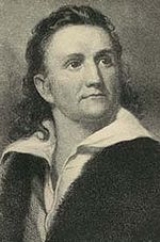
John James Audubon (April 26, 1785 – January 27, 1851) was a
FrenchThe French are a nation that share a common French culture and speak the French language as a mother tongue. Historically, the French population are descended from peoples of Celtic, Latin and Germanic origin, and are today a mixture of several ethnic groups...
-
AmericanThe United States of America is a federal constitutional republic comprising fifty states and a federal district...
ornithologistOrnithology is a branch of zoology that concerns the study of birds. Several aspects of ornithology differ from related disciplines, due partly to the high visibility and the aesthetic appeal of birds...
,
naturalistNatural history is the scientific research of plants or animals, leaning more towards observational rather than experimental methods of study, and encompasses more research published in magazines than in academic journals. Grouped among the natural sciences, natural history is the systematic study...
, and
painterPainting is the practice of applying paint, pigment, color or other medium to a surface . The application of the medium is commonly applied to the base with a brush but other objects can be used. In art, the term painting describes both the act and the result of the action. However, painting is...
. He was notable for his expansive studies to document all types of American birds and for his detailed illustrations that depicted the birds in their natural habitats. His major work, a color-plate book entitled The Birds of North America (1827–1839), is considered one of the finest ornithological works ever completed. Audubon identified 25 new species and a number of new sub-species.
Early life
Jean-Jacques Audubon was born in
Les CayesLes Cayes , is a town and seaport in southwestern Haiti, with a population of approximately 45,904 people . Estimates from 2008 place the population at close to 70,000 people...
in the French colony of
Saint-DomingueThe labour for these plantations was provided by an estimated 790,000 African slaves . Between 1764 and 1771, the average annual importation of slaves varied between 10,000-15,000; by 1786 it was about 28,000, and from 1787 onward, the colony received more than 40,000 slaves a year...
(now
HaitiHaiti , officially the Republic of Haiti , is a Caribbean country. It occupies the western, smaller portion of the island of Hispaniola, in the Greater Antillean archipelago, which it shares with the Dominican Republic. Ayiti was the indigenous Taíno or Amerindian name for the island...
) on his father's sugar
plantationA plantation is a long artificially established forest, farm or estate, where crops are grown for sale, often in distant markets rather than for local on-site consumption...
. He was the illegitimate (or natural) son of Lieutenant Jean Audubon, a French naval officer (and
privateerA privateer is a private person or ship authorized by a government by letters of marque to attack foreign shipping during wartime. Privateering was a way of mobilizing armed ships and sailors without having to spend public money or commit naval officers...
), and his mistress Jeanne Rabine, a 27-year-old chambermaid from
Les TouchesLes Touches is a commune in the Loire-Atlantique department in western France....
, France. They named the boy Jean Rabin. His mother died when the boy was a few months old, as she had suffered from tropical disease since arriving on the island. His father already had two mixed-race children by his
mulattoMulatto denotes a person with one white parent and one black parent, or more broadly, a person of mixed black and white ancestry. Contemporary usage of the term varies greatly, and the broader sense of the term makes its application rather subjective, as not all people of mixed white and black...
housekeeper, Sanitte (described as a
quadroonQuadroon, and the associated words octoroon and quintroon are terms that, historically, were applied to define the ancestry of people of mixed-race, generally of African and Caucasian ancestry, but also, within Australia, to those of Aboriginal and Caucasian ancestry...
, meaning she was three-quarters European in ancestry). Following Jeanne Rabin's death, Jean Audubon renewed his relationship with Sanitte and had another daughter by her, named Rose. Sanitte also took care of the infant boy Jean.
The senior Audubon had risen from his early days as a cabin boy, and commanded ships. During the
American RevolutionThe American Revolution was the political upheaval during the last half of the 18th century in which thirteen colonies in North America joined together to break free from the British Empire, combining to become the United States of America...
, the father Jean Audubon had been imprisoned by the British Empire. After his release, he helped the American cause. He had long worked to save money and secure his family's future with real estate. Due to slave unrest in the Caribbean, in 1789 he sold part of his plantation in Saint-Domingue and purchased a 284-acre farm called
Mill GroveMill Grove is a historic stone house in Audubon, Pennsylvania on the National Register of Historic Places. It is the first home in America of painter John James Audubon for which the community is named. It is maintained as a museum and wildlife sanctuary by Montgomery County.Mill Grove was owned...
, 20 miles from
Philadelphia, PennsylvaniaPhiladelphia is the largest city in the Commonwealth of Pennsylvania and the county seat of Philadelphia County, with which it is coterminous. The city is located in the Northeastern United States along the Delaware and Schuylkill rivers. It is the fifth-most-populous city in the United States,...
, to diversify his investments. Rising unrest in Saint-Domingue from African slaves, who vastly outnumbered French colonists, convinced Jean Audubon to return to France, where he became a member of the
Republican GuardRepublican Guard is the organization of a republic which serves to protect the President and the government. Usually synonymous with Presidential Guard.* Albanian Republican Guard* Algerian Republican Guard...
. In 1791 he arranged for his natural children Jean and Rose, who was very fair, to be delivered to him in France.
The children were raised in
CouëronCouëron is a commune in the Loire-Atlantique department in western France.Couëron is one of the 24 communes of the Urban Community of Nantes.-Geography:...
, near
NantesNantes is a city in western France, located on the Loire River, from the Atlantic coast. The city is the 6th largest in France, while its metropolitan area ranks 8th with over 800,000 inhabitants....
,
FranceThe French Republic , The French Republic , The French Republic , (commonly known as France , is a unitary semi-presidential republic in Western Europe with several overseas territories and islands located on other continents and in the Indian, Pacific, and Atlantic oceans. Metropolitan France...
, by Audubon and his wife Anne Moynet Audubon, whom he had married years before. In 1794 they formally adopted both the natural children to regularize their legal status. They renamed the boy Jean-Jacques Fougère Audubon. When Audubon, at age 18, boarded ship for emigration to the United States in 1803, he changed his name to an anglicized form: John James Audubon.
From his earliest days, Audubon had an affinity for birds. "I felt an intimacy with them...bordering on frenzy [that] must accompany my steps through life." His father encouraged his interest in nature:
"he would point out the elegant movement of the birds, and the beauty and softness of their plumage. He called my attention to their show of pleasure or sense of danger, their perfect forms and splendid attire. He would speak of their departure and return with the seasons."
In France during the chaotic years of the
French RevolutionThe French Revolution , sometimes distinguished as the 'Great French Revolution' , was a period of radical social and political upheaval in France and Europe. The absolute monarchy that had ruled France for centuries collapsed in three years...
and its aftermath, the younger Audubon grew up to be a handsome and gregarious man. He played flute and violin, and learned to ride,
fenceFencing, which is also known as modern fencing to distinguish it from historical fencing, is a family of combat sports using bladed weapons.Fencing is one of four sports which have been featured at every one of the modern Olympic Games...
, and dance. A great walker, he loved roaming in the woods, often returning with natural curiosities, including birds' eggs and nests, of which he made crude drawings. His father planned to make a seaman of his son. At twelve, Audubon went to military school and became a cabin boy. He quickly found out that he was susceptible to seasickness and not fond of mathematics or navigation. After failing the officer's qualification test, Audubon ended his incipient naval career. He was cheerfully back on solid ground and exploring the fields again, focusing on birds.
Immigration to the United States
In 1803, his father obtained a false passport so that Audubon could go to the United States to avoid conscription in the
Napoleonic WarsThe Napoleonic Wars were a series of wars declared against Napoleon's French Empire by opposing coalitions that ran from 1803 to 1815. As a continuation of the wars sparked by the French Revolution of 1789, they revolutionised European armies and played out on an unprecedented scale, mainly due to...
. Jean Audubon and Claude Rozier arranged a business partnership between their sons to pursue in Pennsylvania (to see the terms of the Partnership Agreement, see
Jean Ferdinand RozierJean Ferdinand Rozier was born in Nantes, France to Francois Claude Rozier and Renee Angelique Colas . In 1802 he served in the French Navy. Jean Ferdinand immigrated from France to New York in 1806, eventually settling in the village of Ste...
). It was based on Claude Rozier's buying half of Jean Audubon’s share of a plantation in Haiti, and lending money to the partnership as secured by half interest in lead mining at Audubon's property of Mill Grove.
Audubon caught
yellow feverYellow fever is an acute viral hemorrhagic disease. The virus is a 40 to 50 nm enveloped RNA virus with positive sense of the Flaviviridae family....
upon arrival in New York City. The ship's captain placed him in a boarding house run by Quaker women. They nursed Audubon to recovery and taught him English, including the Quaker form of using "thee" and "thou", otherwise then anachronistic. He traveled with the family's Quaker lawyer to the Audubon family farm
Mill GroveMill Grove is a historic stone house in Audubon, Pennsylvania on the National Register of Historic Places. It is the first home in America of painter John James Audubon for which the community is named. It is maintained as a museum and wildlife sanctuary by Montgomery County.Mill Grove was owned...
. The 284 acres (114.9 ha) homestead is located on the
Perkiomen CreekPerkiomen Creek is a tributary of the Schuylkill River in Berks, Lehigh and Montgomery counties in Pennsylvania in the United States.Perkiomen Creek begins in Hereford Township, Berks County, initially flows eastward into Upper Milford Township, Lehigh County, and turns southward to reenter...
a few miles from
Valley ForgeValley Forge in Pennsylvania was the site of the military camp of the American Continental Army over the winter of 1777–1778 in the American Revolutionary War.-History:...
.
Audubon lived with the tenants in the two-story stone house, in an area that he considered a paradise. "Hunting, fishing, drawing, and music occupied my every moment; cares I knew not, and cared naught about them." Studying his surroundings, Audubon quickly learned the ornithologist's rule, which he wrote, "The nature of the place—whether high or low, moist or dry, whether sloping north or south, or bearing tall trees or low shrubs—generally gives hint as to its inhabitants." His father hoped that the lead mines on the property could be commercially developed, as lead was an essential component of bullets. This could provide his son with a profitable occupation. Audubon met his neighbor William Bakewell, the owner of the nearby estate "Fatland Ford", whose daughter Lucy he married five years later. The two young people shared many common interests, and early on began to spend time together, exploring the natural world around them.
Audubon set about to study American birds, determined to illustrate his findings in a more realistic manner than most artists did then. He began conducting the first known
bird-bandingBird ringing or bird banding is a technique used in the study of wild birds, by attaching a small, individually numbered, metal or plastic tag to their legs or wings, so that various aspects of the bird's life can be studied by the ability to re-find the same individual later...
on the continent: he tied yarn to the legs of
Eastern PhoebeThe Eastern Phoebe is a small passerine bird. This tyrant flycatcher breeds in eastern North America, although its normal range does not include the southeastern coastal USA....
s and determined that they returned to the same nesting spots year after year. He also began drawing and painting birds, and recording their behavior. After an accidental fall into a creek, Audubon contracted a severe fever. He was nursed and recovered at Fatland Ford, with Lucy at his side. Risking conscription in France, Audubon returned in 1805 to see his father and ask permission to marry. He also needed to discuss family business plans. While there, he met the naturalist and physician Charles-Marie D'Orbigny, who improved Audubon's
taxidermyTaxidermy is the act of mounting or reproducing dead animals for display or for other sources of study. Taxidermy can be done on all vertebrate species of animals, including mammals, birds, fish, reptiles, and amphibians...
skills and taught him scientific methods of research. Although his return ship was overtaken by an English
privateerA privateer is a private person or ship authorized by a government by letters of marque to attack foreign shipping during wartime. Privateering was a way of mobilizing armed ships and sailors without having to spend public money or commit naval officers...
, Audubon and his hidden gold coins survived the encounter.
Audubon resumed his bird studies and created his own nature museum, perhaps inspired by the great museum of natural history created by
Charles Willson PealeCharles Willson Peale was an American painter, soldier and naturalist. He is best remembered for his portrait paintings of leading figures of the American Revolution, as well as establishing one of the first museums....
in Philadelphia. Peale's bird exhibits were considered scientifically advanced. Audubon's room was brimming with birds' eggs, stuffed raccoons and opossums, fish, snakes, and other creatures. He had become proficient at specimen preparation and
taxidermyTaxidermy is the act of mounting or reproducing dead animals for display or for other sources of study. Taxidermy can be done on all vertebrate species of animals, including mammals, birds, fish, reptiles, and amphibians...
.
Deeming the mining venture too risky, with his father's approval Audubon sold part of the Mill Grove farm, including the house and mine. He retained some land for investment. He went to New York to learn the import-export trade, hoping to find a business to support his marriage to Lucy. The protective Mr. Bakewell wanted to see the young Frenchman established in a solid career before releasing his daughter to him.
Marriage and family
In 1808, six months after arriving in Kentucky, Audubon married Lucy Bakewell. Though their finances were tenuous, the Audubons started a family. They had two sons: Victor Gifford (1809–1860) and John Woodhouse Audubon (1812–1862); and two daughters who died while young: Lucy at two years (1815–1817) and Rose at nine months (1819–1820). Both sons would help publish their father's works. John W. became a naturalist, writer and painter in his own right.
Starting out in business
The business partnership between Audubon and Ferdinand Rozier was moved west at various stages, ending ultimately in
Ste. Genevieve, MissouriSte. Genevieve is a city in and the county seat of Ste. Genevieve County, Missouri, United States. The population was 11,654 at the 2000 census...
, the first European settlement west of the
Mississippi RiverThe Mississippi River is the largest river system in North America. Flowing entirely in the United States, this river rises in western Minnesota and meanders slowly southwards for to the Mississippi River Delta at the Gulf of Mexico. With its many tributaries, the Mississippi's watershed drains...
. Shipping goods ahead, Audubon and Rozier started a
general storeA general store, general merchandise store, or village shop is a rural or small town store that carries a general line of merchandise. It carries a broad selection of merchandise, sometimes in a small space, where people from the town and surrounding rural areas come to purchase all their general...
in
Louisville, KentuckyLouisville is the largest city in the U.S. state of Kentucky, and the county seat of Jefferson County. Since 2003, the city's borders have been coterminous with those of the county because of a city-county merger. The city's population at the 2010 census was 741,096...
; on the
Ohio RiverThe Ohio River is the largest tributary, by volume, of the Mississippi River. At the confluence, the Ohio is even bigger than the Mississippi and, thus, is hydrologically the main stream of the whole river system, including the Allegheny River further upstream...
, it was the most important port between Pittsburgh and New Orleans. Soon he was drawing bird specimens again. He regularly burned earlier efforts to force continuous improvement. He also took detailed field notes to document his drawings. Because rising tensions with the British resulted in President
JeffersonThomas Jefferson was the principal author of the United States Declaration of Independence and the Statute of Virginia for Religious Freedom , the third President of the United States and founder of the University of Virginia...
's embargo of British trade, Audubon's business was not thriving.
In 1810, Audubon moved the business to the less competitive
Henderson, KentuckyHenderson is a city in Henderson County, Kentucky, United States, along the Ohio River in the western part of the state. The population was 27,952 at the 2010 census. It is part of the Evansville Metropolitan Area often referred to as "Kentuckiana", although "Tri-State Area" or "Tri-State" are more...
area. He and his small family took over an abandoned log cabin. In the fields and forests, Audubon wore typical frontier clothes and moccasins "and a ball pouch, a buffalo horn filled with gunpowder, a butcher knife, and a tomahawk on his belt."
He frequently turned to hunting and fishing to feed his family, as business was slow. On a prospecting trip downriver with a load of goods, Audubon joined up with
ShawneeThe Shawnee, Shaawanwaki, Shaawanooki and Shaawanowi lenaweeki, are an Algonquian-speaking people native to North America. Historically they inhabited the areas of Ohio, Virginia, West Virginia, Western Maryland, Kentucky, Indiana, and Pennsylvania...
and
OsageThe Osage Nation is a Native American Siouan-language tribe in the United States that originated in the Ohio River valley in present-day Kentucky. After years of war with invading Iroquois, the Osage migrated west of the Mississippi River to their historic lands in present-day Arkansas, Missouri,...
hunting parties, learning their methods, drawing specimens by the bonfire, and finally parting "like brethren." Audubon had great respect for
Native AmericansThe indigenous peoples of the Americas are the pre-Columbian inhabitants of North and South America, their descendants and other ethnic groups who are identified with those peoples. Indigenous peoples are known in Canada as Aboriginal peoples, and in the United States as Native Americans...
: "Whenever I meet Indians, I feel the greatness of our Creator in all its splendor, for there I see the man naked from His hand and yet free from acquired sorrow." Audubon also admired the skill of Kentucky riflemen and the "regulators", citizen lawmen who created a kind of justice on the Kentucky frontier. In his travel notes, he claims to have encountered
Daniel BooneDaniel Boone was an American pioneer, explorer, and frontiersman whose frontier exploits mad']'e him one of the first folk heroes of the United States. Boone is most famous for his exploration and settlement of what is now the Commonwealth of Kentucky, which was then beyond the western borders of...
.
Audubon and Ferdinand Rozier mutually agreed to end their partnership at Ste. Genevieve on April 6, 1811, as Audubon decided to work at ornithology and art, as well as to return to Lucy and their son. Rozier agreed to pay Audubon $3,000 (equivalent to ~$120,000 in 2010 dollars), with $1,000 in cash and the balance to be paid over time.
The terms of the dissolution of the partnership include those by Audubon:
I John Audubon, having this day mutual consent with Ferdinand Rozier, dissolved and forever closed the partnership and firm of Audubon and Rozier, and having Received from said Ferdinand Rozier payment and notes to the full amount of my part of the goods and debts of the late firm of Audubon and Rozier, I the said John Audubon one of the firm aforesaid do hereby release and forever quit claim to all and any interest which I have or may have in the stock on hand and debts due to the late firm of Audubon and Rozier assign, transfer and set over to said Ferdinand Rozier, all my rights, titles, claims and interest in the goods, merchandise and debts due to the late firm of Audubon and Rozier, and do hereby authorize and empower him for my part, to collect the same in any manner what ever either privately or by suit or suits in law or equity hereby declaring him sole and absolute proprietor and rightful owner of all goods, merchandise and debts of this firm aforesaid, as completely as they were the goods and property of the late firm Audubon and Rozier.
In witness thereof I have set my hand and seal this Sixth day of April 1811
[seal]
John Audubon
Ed D. DeVillamonte
Audubon witnessed the 1812 New Madrid earthquake while out riding, which was among the most severe to strike the mid-continent. When Audubon arrived home, he was relieved to find no major damage, but the area was shaken by aftershocks for months. Again while on horseback, he encountered his first
tornadoA tornado is a violent, dangerous, rotating column of air that is in contact with both the surface of the earth and a cumulonimbus cloud or, in rare cases, the base of a cumulus cloud. They are often referred to as a twister or a cyclone, although the word cyclone is used in meteorology in a wider...
, thinking it was another earthquake. Ever the naturalist, he described how its "horrible noise resembled the roar of
NiagaraThe Niagara Falls, located on the Niagara River draining Lake Erie into Lake Ontario, is the collective name for the Horseshoe Falls and the adjacent American Falls along with the comparatively small Bridal Veil Falls, which combined form the highest flow rate of any waterfalls in the world and has...
." He noted that as the tornado retreated, "the air was filled with an extremely disagreeable sulphurous odor."
Citizenship and debt
During a visit to Philadelphia in 1812 following Congress' declaration of war with Great Britain, Audubon became an American citizen and gave up his French citizenship. After his return to Kentucky, he found that rats had eaten his entire collection of more than 200 drawings. After weeks of
depressionDepression is a state of low mood and aversion to activity that can affect a person's thoughts, behaviour, feelings and physical well-being. Depressed people may feel sad, anxious, empty, hopeless, helpless, worthless, guilty, irritable, or restless...
, he took to the field again, determined to re-do his drawings to an even higher standard.
The
War of 1812The War of 1812 was a military conflict fought between the forces of the United States of America and those of the British Empire. The Americans declared war in 1812 for several reasons, including trade restrictions because of Britain's ongoing war with France, impressment of American merchant...
upset Audubon's plans to move his business to New Orleans. He formed a partnership with Lucy's brother and built up their trade in Henderson. Between 1812 and the
Panic of 1819The Panic of 1819 was the first major financial crisis in the United States, and had occurred during the political calm of the Era of Good Feelings. The new nation previously had faced a depression following the war of independence in the late 1780s and led directly to the establishment of the...
, times were good. Audubon bought land and slaves, founded a flour mill, and enjoyed his growing family. After 1819, Audubon went bankrupt and was thrown into jail for debt. The little money he earned was from drawing portraits, particularly death-bed sketches, greatly esteemed by country folk before photography. He wrote, "[M]y heart was sorely heavy, for scarcely had I enough to keep my dear ones alive; and yet through these dark days I was being led to the development of the talents I loved."
Early ornithological career
After a short stay in Cincinnati to work as a naturalist and taxidermist at a museum, Audubon with his gun, paintbox, and assistant Joseph Mason, traveled south on the Mississippi. He was committed to find and paint all the birds of North America for eventual publication. His goal was to surpass the earlier ornithological work of poet-naturalist
Alexander WilsonAlexander Wilson was a Scottish-American poet, ornithologist, naturalist, and illustrator.Wilson was born in Paisley, Scotland, the son of an illiterate distiller. In 1779 he was apprenticed as a weaver. His main interest at this time was in writing poetry...
. Though he could not afford to buy Wilson's work, Audubon used it to guide him when he had access to a copy.
On October 12, 1820, Audubon started into
MississippiMississippi is a U.S. state located in the Southern United States. Jackson is the state capital and largest city. The name of the state derives from the Mississippi River, which flows along its western boundary, whose name comes from the Ojibwe word misi-ziibi...
,
AlabamaAlabama is a state located in the southeastern region of the United States. It is bordered by Tennessee to the north, Georgia to the east, Florida and the Gulf of Mexico to the south, and Mississippi to the west. Alabama ranks 30th in total land area and ranks second in the size of its inland...
, and
FloridaFlorida is a state in the southeastern United States, located on the nation's Atlantic and Gulf coasts. It is bordered to the west by the Gulf of Mexico, to the north by Alabama and Georgia and to the east by the Atlantic Ocean. With a population of 18,801,310 as measured by the 2010 census, it...
in search of ornithological specimens. He traveled with George Lehman, a professional Swiss landscape artist. The following summer, he moved upriver to the Oakley Plantation in the
Felicianas-Demographics:As of the census of 2000, there were 15,111 people, 3,645 households, and 2,704 families residing in the parish. The population density was 37 people per square mile . There were 4,485 housing units at an average density of 11 per square mile...
, where he taught drawing to Eliza Pirrie, the young daughter of the owners. Though low paying, the job was ideal, as it afforded him much time to roam and paint in the woods. (Located at 11788 Highway 965, between
JacksonJackson is a town in East Feliciana Parish, Louisiana, United States. The population was 4,130 at the 2000 census. It is part of the Baton Rouge Metropolitan Statistical Area.-History:...
and
St. FrancisvilleSt. Francisville is a town in and the parish seat of West Feliciana Parish, Louisiana, United States. The population was 1,712 at the 2000 census. It is part of the Baton Rouge Metropolitan Statistical Area.-Geography:St...
, the plantation is now the Audubon State Historic Site.) Audubon called his future work
Birds of AmericaThe Birds of America is a book by naturalist and painter John James Audubon, containing illustrations of a wide variety of birds of the United States. It was first published as a series of sections between 1827 and 1838, in Edinburgh and London....
. He attempted to paint one page each day. Painting with newly discovered technique, he decided his earlier works were inferior and re-did them. He hired hunters to gather specimens for him. Audubon realized the ambitious project would take him away from his family for months at a time.
Audubon sometimes used his drawing talent to trade for goods or sell small works to raise cash. He made charcoal portraits on demand at $5 each and gave drawing lessons. In 1823 Audubon took lessons in oil painting technique from John Steen, a teacher of American landscape, and history painter
Thomas ColeThomas Cole was an English-born American artist. He is regarded as the founder of the Hudson River School, an American art movement that flourished in the mid-19th century...
. Though he did not use oils much for his bird work, Audubon earned good money painting oil portraits for patrons along the Mississippi. (Audubon's account reveals that he learned oil painting in December 1822 from Jacob Stein, an itinerant portrait artist, and after they had enjoyed all the portrait patronage to be expected in
Natchez, MississippiNatchez is the county seat of Adams County, Mississippi, United States. With a total population of 18,464 , it is the largest community and the only incorporated municipality within Adams County...
during January–March 1823, they resolved to travel together as perambulating portrait-artists.)
Lucy became the steady breadwinner for the couple and their two young sons. Trained as a teacher, she conducted classes for children out of their home. Later she became a local teacher in Louisiana and took up residence, with her children, at the home of a wealthy plantation owner.
Audubon returned to Philadelphia in 1824 to seek a publisher for his bird drawings. Though he met
Thomas SullyThomas Sully was an American painter, mostly of portraits.-Early life:Sully was born in Horncastle, Lincolnshire, England, to the actors Matthew and Sarah Sully. In March 1792 the Sullys and their nine children immigrated to Richmond, Virginia, where Thomas’s uncle managed a theater...
, one of the most famous portrait painters of the time and a valuable ally, Audubon was rebuffed for publication. He had earned the enmity of some of the city's leading scientists at the
Academy of Natural SciencesThe Academy of Natural Sciences of Drexel University, formerly Academy of Natural Sciences of Philadelphia, is the oldest natural science research institution and museum in the New World...
. He took oil painting lessons from Sully and met
Charles BonaparteCharles Lucien Jules Laurent Bonaparte, 2nd Prince of Canino and Musignano was a French naturalist and ornithologist.-Biography:...
, who admired his work and recommended he go to Europe to have his bird drawings engraved.
Birds of America
With his wife's support, in 1826 at age 41, Audubon took his growing collection of work to England. He sailed from New Orleans to
LiverpoolLiverpool is a city and metropolitan borough of Merseyside, England, along the eastern side of the Mersey Estuary. It was founded as a borough in 1207 and was granted city status in 1880...
on the cotton hauling ship "Delos", reaching England in the autumn of 1826, taking a portfolio of over 300 drawings. With letters of introduction to prominent Englishmen, Audubon gained their quick attention. "I have been received here in a manner not to be expected during my highest enthusiastic hopes."
The British could not get enough of his images of backwoods America and its natural attractions. He met with great acceptance as he toured around England and Scotland, and was lionized as "the American woodsman." He raised enough money to begin publishing his
Birds of AmericaThe Birds of America is a book by naturalist and painter John James Audubon, containing illustrations of a wide variety of birds of the United States. It was first published as a series of sections between 1827 and 1838, in Edinburgh and London....
. This monumental work consists of 435 hand-colored, life-size prints of 497 bird species, made from engraved copper plates of various sizes depending on the size of the image. They were printed on sheets measuring about 39 by 26 inches (660.4 mm). The work contains just over 700 North American bird species.
The pages were organized for artistic effect and contrasting interest, as if the reader were taking a visual tour. (Some critics thought he should have organized the plates in Linnaean order as befitting a "serious" ornithological treatise.) The first and perhaps most famous plate was the Wild Turkey, which had been
Benjamin FranklinDr. Benjamin Franklin was one of the Founding Fathers of the United States. A noted polymath, Franklin was a leading author, printer, political theorist, politician, postmaster, scientist, musician, inventor, satirist, civic activist, statesman, and diplomat...
's candidate for the national bird. It lost to the Bald Eagle.
The cost of printing the entire work was $115,640 (over $2,000,000 today), paid for from advance subscriptions, exhibitions, oil painting commissions, and animal skins, which Audubon hunted and sold. Audubon's great work was a remarkable accomplishment. It took more than 14 years of field observations and drawings, plus his single-handed management and promotion of the project to make it a success. A reviewer wrote, "All anxieties and fears which overshadowed his work in its beginning had passed away. The prophecies of kind but overprudent friends, who did not understand his self-sustaining energy, had proved untrue; the malicious hope of his enemies, for even the gentle lover of nature has enemies, had been disappointed; he had secured a commanding place in the respect and gratitude of men."
Colorists applied each color in assembly-line fashion (over fifty were hired for the work). The original edition was engraved in
aquatintAquatint is an intaglio printmaking technique, a variant of etching.Intaglio printmaking makes marks on the matrix that are capable of holding ink. The inked plate is passed through a printing press together with a sheet of paper, resulting in a transfer of the ink to the paper...
by Robert
HavellThe Havell family of Reading, Berkshire, England included a number of notable engravers, etchers and painters, as well as writers, publishers, educators, and musicians. In particular, members of this family were foremost practitioners of aquatint; and had a long association with Indian art and...
, Jr., who took over the task after the first ten plates engraved by W. H. Lizars were deemed inadequate. Known as the Double Elephant folio after its double elephant paper size, it is often regarded as the greatest picture book ever produced and the finest aquatint work. By the 1830s, the aquatint process was largely superseded by
lithographyLithography is a method for printing using a stone or a metal plate with a completely smooth surface...
. A contemporary French critic wrote, "A magic power transported us into the forests which for so many years this man of genius has trod. Learned and ignorant alike were astonished at the spectacle...It is a real and palpable vision of the New World."
Audubon sold oil-painted copies of the drawings to make extra money and publicize the book. He had his portrait painted by John Syme, who clothed the naturalist in frontier clothes. The portrait was hung at the entrance of his exhibitions, promoting his rustic image. (The painting now hangs in the
White HouseThe White House is the official residence and principal workplace of the president of the United States. Located at 1600 Pennsylvania Avenue NW in Washington, D.C., the house was designed by Irish-born James Hoban, and built between 1792 and 1800 of white-painted Aquia sandstone in the Neoclassical...
.) The
New-York Historical SocietyThe New-York Historical Society is an American history museum and library located in New York City at the corner of 77th Street and Central Park West in Manhattan. Founded in 1804 as New York's first museum, the New-York Historical Society presents exhibitions, public programs and research that...
has all 435 of the preparatory watercolors for Birds of America. Lucy Audubon sold them to the society after her husband's death. All but 80 of the original copper plates were melted down when Lucy Audubon, desperate for money, sold them for scrap to the
Phelps Dodge CorporationPhelps Dodge Corporation was an American mining company founded in 1834 by Anson Greene Phelps and William Earle Dodge, Sr.. On March 19, 2007, it was acquired by Freeport-McMoRan and now operates under the name Freeport-McMoRan Copper & Gold Inc.-History:...
.
King
George IVGeorge IV was the King of the United Kingdom of Great Britain and Ireland and also of Hanover from the death of his father, George III, on 29 January 1820 until his own death ten years later...
was also an avid fan of Audubon and a subscriber to the book.
LondonLondon is the capital city of :England and the :United Kingdom, the largest metropolitan area in the United Kingdom, and the largest urban zone in the European Union by most measures. Located on the River Thames, London has been a major settlement for two millennia, its history going back to its...
's
Royal SocietyThe Royal Society of London for Improving Natural Knowledge, known simply as the Royal Society, is a learned society for science, and is possibly the oldest such society in existence. Founded in November 1660, it was granted a Royal Charter by King Charles II as the "Royal Society of London"...
recognized his achievement by electing Audubon a fellow. He followed
Benjamin FranklinDr. Benjamin Franklin was one of the Founding Fathers of the United States. A noted polymath, Franklin was a leading author, printer, political theorist, politician, postmaster, scientist, musician, inventor, satirist, civic activist, statesman, and diplomat...
, who was the first American fellow. While in
EdinburghEdinburgh is the capital city of Scotland, the second largest city in Scotland, and the eighth most populous in the United Kingdom. The City of Edinburgh Council governs one of Scotland's 32 local government council areas. The council area includes urban Edinburgh and a rural area...
to seek subscriptions for the book, Audubon gave a demonstration of his method of propping up birds with wire at professor
Robert Jamesonthumb|Robert JamesonProfessor Robert Jameson, FRS FRSE was a Scottish naturalist and mineralogist.As Regius Professor at the University of Edinburgh for fifty years, Jameson is notable for his advanced scholarship in natural history, his superb museum collection, and for his tuition of Charles...
's
Wernerian Natural History AssociationThe Wernerian Natural History Society , commonly abbreviated as the Wernerian Society, was a learned society interested in the broad field of natural history, and saw papers presented on various topics such as mineralogy, plants, insects, and scholarly expeditions...
. Student
Charles DarwinCharles Robert Darwin FRS was an English naturalist. He established that all species of life have descended over time from common ancestry, and proposed the scientific theory that this branching pattern of evolution resulted from a process that he called natural selection.He published his theory...
was in the audience. Audubon also visited the dissecting theatre of the anatomist
Robert KnoxRobert Knox was a Scottish surgeon, anatomist and zoologist. He was the most popular lecturer in anatomy in Edinburgh before his involvement in the Burke and Hare body-snatching case. This ruined his career, and a later move to London did not improve matters...
. Audubon was a hit in France as well, gaining the King and several of the nobility as subscribers.
Later career
Audubon returned to America in 1829 to complete more drawings for his magnum opus. He also hunted animals and shipped the valued skins to British friends. He was reunited with his family. After settling business affairs, Lucy accompanied him back to England. Audubon found that during his absence, he had lost some subscribers due to the uneven quality of coloring of the plates. Others were in arrears in their payments. His engraver fixed the plates and Audubon reassured subscribers, but a few begged off. He responded, " 'The Birds of America' will then raise in value as much as they are now depreciated by certain fools and envious persons." He was elected a Fellow of the
American Academy of Arts and SciencesThe American Academy of Arts and Sciences is an independent policy research center that conducts multidisciplinary studies of complex and emerging problems. The Academy’s elected members are leaders in the academic disciplines, the arts, business, and public affairs.James Bowdoin, John Adams, and...
in 1830.
He followed Birds of America with a sequel Ornithological Biographies. This was a collection of life histories of each species written with
ScottishScotland is a country that is part of the United Kingdom. Occupying the northern third of the island of Great Britain, it shares a border with England to the south and is bounded by the North Sea to the east, the Atlantic Ocean to the north and west, and the North Channel and Irish Sea to the...
ornithologist
William MacGillivrayWilliam MacGillivray FRSE MWS was a Scottish naturalist and ornithologist.MacGillivray was born in Old Aberdeen and brought up on the island of Harris. He returned to Aberdeen where he attended King's College, graduating MA in 1815. He studied medicine, but did not complete the course...
. The two books were printed separately to avoid a British law requiring copies of all publications with text to be deposited in Crown libraries, a huge financial burden for the self-published Audubon. Both books were published between 1827 and 1839.
During the 1830s, Audubon continued making expeditions in North America. During a trip to
Key WestKey West is an island in the Straits of Florida on the North American continent at the southernmost tip of the Florida Keys. Key West is home to the southernmost point in the Continental United States; the island is about from Cuba....
, a companion wrote in a newspaper article, "Mr. Audubon is the most enthusiastic and indefatigable man I ever knew...Mr. Audubon was neither dispirited by heat, fatigue, or bad luck...he rose every morning at 3 o'clock and went out...until 1 o'clock." Then he would draw the rest of the day before returning to the field in the evening, a routine he kept up for weeks and months. In the posthumously published book,
The life of John James Audubon, derived primarily from his notes, Audubon relates that he visited the northeastern Florida coastal sugar plantation of John Bulow in early January, 1832. The sugar mill was built under the direction of a Scotch engineer who accompanied Audubon on an excursion in the region. The mill was destroyed in the
Seminole WarsThe Seminole Wars, also known as the Florida Wars, were three conflicts in Florida between the Seminole — the collective name given to the amalgamation of various groups of native Americans and Black people who settled in Florida in the early 18th century — and the United States Army...
, and is preserved today as the
Bulow Plantation Ruins Historic State ParkBulow Plantation Ruins State Historic Park is a Florida State Park in Flagler Beach, Florida. It is three miles west of Flagler Beach on CR 2001, south of SR 100, and contains the ruins of an ante-bellum plantation. The original plantation was begun in 1821, growing indigo, cotton, rice, and sugar...
. In 1833, Audubon set forth from Maine accompanied by his son John, and five other young colleagues to explore the
ornithologyOrnithology is a branch of zoology that concerns the study of birds. Several aspects of ornithology differ from related disciplines, due partly to the high visibility and the aesthetic appeal of birds...
of
LabradorLabrador is the distinct, northerly region of the Canadian province of Newfoundland and Labrador. It comprises the mainland portion of the province, separated from the island of Newfoundland by the Strait of Belle Isle...
. On the return voyage, the Ripley made a stop at St.George's,
Newfoundland, and Audubon and his assistants documented 36 species of birds.
Some of his most famous works are believed to be painted at the house and gardens of Capt. John H. Geiger, who was Key West's first harbor pilot, which later became
Audubon House and Tropical GardensThe Audubon House & Tropical Gardens is located at 205 Whitehead Street, Key West, Florida.Brick-pathed gardens offer a lush view of orchids, bromeliads and other tropical foliage, an herb garden and 1840-style nursery....
.
In 1839, having finished the Ornithological Biography, Audubon returned to the United States with his family. He bought an estate on the
Hudson RiverThe Hudson is a river that flows from north to south through eastern New York. The highest official source is at Lake Tear of the Clouds, on the slopes of Mount Marcy in the Adirondack Mountains. The river itself officially begins in Henderson Lake in Newcomb, New York...
(now Audubon Park). In 1842, he published an octavo edition of Birds of America, with 65 additional plates. It earned $36,000 and was purchased by 1100 subscribers. Audubon spent much time on "subscription gathering trips", drumming up sales of the octavo edition, as he hoped to leave his family a sizable income.
Death
Audubon made some excursions out West where he hoped to record Western species he had missed, but his health began to fail. In 1848, he manifested signs of senility, his "noble mind in ruins." He died at his family home on January 27, 1851. Audubon is buried, close to the location of his home, in the graveyard at the Church of the Intercession in the
Trinity Church CemeteryTrinity Church Cemetery consists of three separate burial grounds associated with Trinity Church in Manhattan, New York, USA. The first was established in the Churchyard located at 74 Trinity Place at Wall Street and Broadway...
and Mausoleum at 155th Street and Broadway in
ManhattanManhattan is the oldest and the most densely populated of the five boroughs of New York City. Located primarily on the island of Manhattan at the mouth of the Hudson River, the boundaries of the borough are identical to those of New York County, an original county of the state of New York...
. There is an imposing monument in his honor at the cemetery, which is the center of the
Heritage Rose District of NYCThe Heritage Rose District of New York City is the first and only rose district in the country. It is the result of the efforts of the Office of the Manhattan Borough President and the Heritage Rose Foundation, a non-profit organization dedicated to the preservation of old roses.The Heritage Rose...
.
Audubon's final work, on
mammalMammals are members of a class of air-breathing vertebrate animals characterised by the possession of endothermy, hair, three middle ear bones, and mammary glands functional in mothers with young...
s, was the Viviparous Quadrupeds of North America, prepared in collaboration with his good friend
Rev John BachmanThe Rev. John Bachman was an American Lutheran minister, social activist and naturalist who collaborated with J.J. Audubon to produce Viviparous Quadrapeds of North America and whose writings, particularly Unity of the Human Race, were influential in the development of the theory of evolution. He...
of
Charleston, South CarolinaCharleston is the second largest city in the U.S. state of South Carolina. It was made the county seat of Charleston County in 1901 when Charleston County was founded. The city's original name was Charles Towne in 1670, and it moved to its present location from a location on the west bank of the...
, who supplied much of the scientific text. His son John Woodhouse Audubon drew most of the plates. The work was completed by Audubon's sons and son-in-law and was published posthumously.
Art and methods
Audubon developed his own methods for drawing birds. First, he killed them using fine shot. He then used wires to prop them into a natural position, unlike the common method of many ornithologists, who prepared and stuffed the specimens into a rigid pose. When working on a major specimen like an eagle, he would spend up to four 15-hour days, preparing, studying, and drawing it. His paintings of birds are set true-to-life in their natural habitat. He often portrayed them as if caught in motion, especially feeding or hunting. This was in stark contrast to the stiff representations of birds by his contemporaries, such as
Alexander WilsonAlexander Wilson was a Scottish-American poet, ornithologist, naturalist, and illustrator.Wilson was born in Paisley, Scotland, the son of an illiterate distiller. In 1779 he was apprenticed as a weaver. His main interest at this time was in writing poetry...
. Audubon based his paintings on his extensive field observations.
He worked primarily with watercolor early on. He added colored chalk or pastel to add softness to feathers, especially those of owls and herons. He employed multiple layers of watercoloring, and sometimes used
gouacheGouache[p], also spelled guache, the name of which derives from the Italian guazzo, water paint, splash or bodycolor is a type of paint consisting of pigment suspended in water. A binding agent, usually gum arabic, is also present, just as in watercolor...
. All species were drawn life size which accounts for the contorted poses of the larger birds as Audubon strove to fit them within the page size. Smaller species were usually placed on branches with berries, fruit, and flowers. He used several birds in a drawing to present all views of anatomy and wings. Larger birds were often placed in their ground habitat or perching on stumps. At times, as with woodpeckers, he combined several species on one page to offer contrasting features. He frequently depicted the birds' nests and eggs, and occasionally natural predators, such as snakes. He usually illustrated male and female variations, and sometimes juveniles. In later drawings, Audubon used assistants to render the habitat for him. Going beyond faithful renderings of anatomy, Audubon employed carefully constructed composition, drama, and slightly exaggerated poses to achieve artistic as well as scientific effects.
Legacy
Audubon's influence on ornithology and natural history was far reaching. Nearly all later ornithological works were inspired by his artistry and high standards.
Charles DarwinCharles Robert Darwin FRS was an English naturalist. He established that all species of life have descended over time from common ancestry, and proposed the scientific theory that this branching pattern of evolution resulted from a process that he called natural selection.He published his theory...
quoted Audubon three times in On the Origin of Species and also in later works. Despite some errors in field observations, he made a significant contribution to the understanding of bird anatomy and behavior through his field notes. Birds of America is still considered one of the greatest examples of book art. Audubon discovered 25 new species and 12 new subspecies.
- He was elected to the Royal Society of Edinburgh
The Royal Society of Edinburgh is Scotland's national academy of science and letters. It is a registered charity, operating on a wholly independent and non-party-political basis and providing public benefit throughout Scotland...
, the Linnaean Society, and the Royal SocietyThe Royal Society of London for Improving Natural Knowledge, known simply as the Royal Society, is a learned society for science, and is possibly the oldest such society in existence. Founded in November 1660, it was granted a Royal Charter by King Charles II as the "Royal Society of London"...
in recognition of his contributions.
- The homestead Mill Grove in Audubon, PA is open to the public and contains a museum presenting all his major works, including Birds of America.
- The Audubon Museum at John James Audubon State Park
John James Audubon State Park is located on U. S. Highway 41 in Henderson, Kentucky, just south of the Ohio River. Its inspiration is John James Audubon, the ornithologist, naturalist and painter who resided in Henderson from 1810 to 1819 when Henderson was a frontier village.-History:John James...
in Henderson, KentuckyHenderson is a city in Henderson County, Kentucky, United States, along the Ohio River in the western part of the state. The population was 27,952 at the 2010 census. It is part of the Evansville Metropolitan Area often referred to as "Kentuckiana", although "Tri-State Area" or "Tri-State" are more...
houses many of Audubon's original watercolors, oilAn oil is any substance that is liquid at ambient temperatures and does not mix with water but may mix with other oils and organic solvents. This general definition includes vegetable oils, volatile essential oils, petrochemical oils, and synthetic oils....
s, engravingEngraving is the practice of incising a design on to a hard, usually flat surface, by cutting grooves into it. The result may be a decorated object in itself, as when silver, gold, steel, or glass are engraved, or may provide an intaglio printing plate, of copper or another metal, for printing...
s and personal memorabilia.
- In 1905, the National Audubon Society
The National Audubon Society is an American non-profit environmental organization dedicated to conservation. Incorporated in 1905, Audubon is one of the oldest of such organizations in the world and uses science, education and grassroots advocacy to advance its conservation mission...
was incorporated and named in his honor. Its mission "is to conserve and restore natural ecosystems, focusing on birds..."
- He was honored by the United States Postal Service
The United States Postal Service is an independent agency of the United States government responsible for providing postal service in the United States...
with a 22¢ Great Americans seriesThe Great Americans series is a set of definitive stamps issued by the United States Postal Service, starting on December 27, 1980 with the 19¢ stamp depicting Sequoyah, and continuing through 2002, the final stamp being the 78¢ Alice Paul self-adhesive stamp. The series, noted for its simplicity...
postage stampA postage stamp is a small piece of paper that is purchased and displayed on an item of mail as evidence of payment of postage. Typically, stamps are made from special paper, with a national designation and denomination on the face, and a gum adhesive on the reverse side...
.
- On December 6 2010, a copy of Birds of America was sold at a Sotheby's
Sotheby's is the world's fourth oldest auction house in continuous operation.-History:The oldest auction house in operation is the Stockholms Auktionsverk founded in 1674, the second oldest is Göteborgs Auktionsverk founded in 1681 and third oldest being founded in 1731, all Swedish...
auction for $11.5 million, a record price for a single printed book.
- On 26 April 2011, Google
Google Inc. is an American multinational public corporation invested in Internet search, cloud computing, and advertising technologies. Google hosts and develops a number of Internet-based services and products, and generates profit primarily from advertising through its AdWords program...
celebrated his 226th birthday by displaying a special Google Doodle on its global homepage.
Places named in his honor
- Audubon
Audubon is a Borough in Camden County, New Jersey, United States. As of the 2010 United States Census, the borough population was 8,819.On March 13, 1905, through an act of the New Jersey Legislature, Audubon was created a borough from portions of Haddon Township. It was named after John James...
and Audubon ParkAudubon Park is a Borough in Camden County, New Jersey, United States. As of the 2010 United States Census, the borough population was 1,023.Audubon Park was incorporated as a borough on July 3, 1947, from portions of Audubon Borough, based on the results of a referendum held on October 28, 1947,...
, both in New Jersey. Many street signs in Audubon Park are named after birds drawn by him. .
- Audubon, Pennsylvania
Audubon is a census-designated place in Montgomery County, Pennsylvania, United States. The population was 8,433 at the 2010 census.-Geography:Audubon is located at in the township of Lower Providence....
, also has the Audubon Bird Sanctuary.
- The Audubon Nature Institute
The Audubon Nature Institute is family of museums and parks dedicated to nature based in New Orleans, Louisiana. It consists of the Audubon Zoo, Aquarium of the Americas, Audubon Louisiana Nature Center, Audubon Park, Woldenberg Riverfront Park, Freeport-McMoRan Audubon Species Survival Center,...
, a family of museums, parks and other organizations in New Orleans, eight of which bear the Audubon name.
- The Audubon Park and country club in Louisville, Kentucky
Louisville is the largest city in the U.S. state of Kentucky, and the county seat of Jefferson County. Since 2003, the city's borders have been coterminous with those of the county because of a city-county merger. The city's population at the 2010 census was 741,096...
is in the area of his former general store.
- Several towns and Audubon County, Iowa
-2010 census:The 2010 census recorded a population of 6,119 in the county, with a population density of . There were 2,972 housing units, of which 2,617 were occupied.-2000 census:...
.
- In Louisiana, John James Audubon Bridge (Mississippi River)
The John James Audubon Bridge is a new Mississippi River crossing between Pointe Coupee and West Feliciana parishes in south central Louisiana. The bridge is the longest cable-stayed span in the Western Hemisphere and replaces the ferry between the communities of New Roads and St. Francisville...
.
- The northbound span of the Bi-State Vietnam Gold Star Bridges was originally named the Audubon Memorial Bridge.
- John James Audubon State Park
John James Audubon State Park is located on U. S. Highway 41 in Henderson, Kentucky, just south of the Ohio River. Its inspiration is John James Audubon, the ornithologist, naturalist and painter who resided in Henderson from 1810 to 1819 when Henderson was a frontier village.-History:John James...
and the Audubon Museum (located within the park) in Henderson, KentuckyHenderson is a city in Henderson County, Kentucky, United States, along the Ohio River in the western part of the state. The population was 27,952 at the 2010 census. It is part of the Evansville Metropolitan Area often referred to as "Kentuckiana", although "Tri-State Area" or "Tri-State" are more...
.
- Rue Jean-Jacques Audubon in Nantes
Nantes is a city in western France, located on the Loire River, from the Atlantic coast. The city is the 6th largest in France, while its metropolitan area ranks 8th with over 800,000 inhabitants....
and Rue Audubon in ParisParis is the capital and largest city in France, situated on the river Seine, in northern France, at the heart of the Île-de-France region...
.
Posthumous collections
- John James Audubon, Writings & Drawings (Christoph Irmscher, ed.) (The Library of America, 1999) ISBN 978-1-88301168-0
- John James Audubon, The Audubon Reader (Richard Rhodes, ed.) (Everyman Library, 2006) ISBN 1-4000-4369-7
- Audubon: Early Drawings (Richard Rhodes, Scott V. Edwards, Leslie A. Morris) (Harvard University Press and Houghton Library 2008) ISBN
978-0-674-03102-9
Further reading
- Chalmers, John Audubon in Edinburgh and his Scottish Associates, 2003. NMS Publishing, Edinburgh, 978 1 901663 79 2
- Small, E., Catling, Paul M., Cayouette, J., and Brookes, B. Audubon: Beyond Birds: Plant Portraits and Conservation Heritage of John James Audubon, 2009. NRC Research Press, Ottawa, ISBN 978-0-660-198-94-1
External links
- Audubon's Birds of America at the University of Pittsburgh, a complete high resolution digitization of all 435 double elephant folios as well as his Ornithological Biography
- The John James Audubon Collection, Houghton Library
Houghton Library is the primary repository for rare books and manuscripts at Harvard University. It is part of the Harvard College Library within the Harvard Faculty of Arts and Sciences. Houghton is located on the south side of Harvard Yard, next to Widener Library.- History :Harvard's first...
, Harvard University
- "Audubon biography", National Audubon Society
- The Audubon Journey His editions discussed in sequence
- "Louise Hauss and David Brent Miller Audubon Collection", Jule Collins Smith Museum of Art, Auburn University
- Audubon Art, The Audubon House Gallery
- Guide to identifying Audubon prints
- John James Audubon — 'The Birds of America, Catalog of the 435 plates
- Life of John James Audubon (1869) (full book)
- James Audubon State Park site
- Large Collection of Paintings by Audubon
- National Gallery of Art: Selections from John James Audubon's The Birds of America (1826–1838)
- International celebration of Audubon through stamps
- Audubon's Birds of America, podcast from the Beinecke Library, Yale University
- John James Audubon and Audubon family letters, (ca. 1783–1845) from the Smithsonian Archives of American Art
The Archives of American Art is the largest collection of primary resources documenting the history of the visual arts in the United States. More than 16 million items of original material are housed in the Archives' research centers in Washington, D.C...