


Diphtheria toxin

Encyclopedia
Diphtheria toxin is an exotoxin
secreted by Corynebacterium diphtheriae
, the pathogen
bacterium
that causes diphtheria
. Unusually, the toxin gene
is encoded by a bacteriophage
(a virus
that infects bacteria). The toxin causes the disease diphtheria in humans by gaining entry into the cell cytoplasm and inhibiting protein synthesis.
linked by disulfide bridges. Binding to the cell surface of the less stable of these two subunits allows the more stable part of the protein to penetrate the host cell
.
The crystal structure
of the diphtheria toxin homodimer has been determined to 2.5A
resolution. The structure
reveals a Y-shaped molecule
consisting of 3 domains. Fragment A contains the catalytic C domain, and fragment B consists of the T and R domains
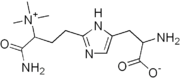 This is NAD+-diphthamide ADP-ribosyltransferase
. It catalyzes the ADP-ribosylation of eukaryotic elongation factor
-2 (eEF2), inactivating this protein. It does so by ADP-ribosylating the unusual amino acid
diphthamide
. In this way, it acts as a RNA translational
inhibitor. The catalysed reaction is as follows:
The exotoxin A
of Pseudomonas aeruginosa
uses a similar mechanism of action.
for humans is about 0.1 μg of toxin per kg of bodyweight. A massive release of toxin into the body will likely cause lethal necrosis
of the heart
and liver
.
uses diphtheria toxin as an antineoplastic agent.
Exotoxin
An exotoxin is a toxin excreted by a microorganism, like bacteria, fungi, algae, and protozoa. An exotoxin can cause damage to the host by destroying cells or disrupting normal cellular metabolism. They are highly potent and can cause major damage to the host...
secreted by Corynebacterium diphtheriae
Corynebacterium diphtheriae
Corynebacterium diphtheriae is a pathogenic bacterium that causes diphtheria. It is also known as the Klebs-Löffler bacillus, because it was discovered in 1884 by German bacteriologists Edwin Klebs and Friedrich Löffler .-Classification:Four subspecies are recognized: C. diphtheriae mitis, C....
, the pathogen
Pathogen
A pathogen gignomai "I give birth to") or infectious agent — colloquially, a germ — is a microbe or microorganism such as a virus, bacterium, prion, or fungus that causes disease in its animal or plant host...
bacterium
Bacteria
Bacteria are a large domain of prokaryotic microorganisms. Typically a few micrometres in length, bacteria have a wide range of shapes, ranging from spheres to rods and spirals...
that causes diphtheria
Diphtheria
Diphtheria is an upper respiratory tract illness caused by Corynebacterium diphtheriae, a facultative anaerobic, Gram-positive bacterium. It is characterized by sore throat, low fever, and an adherent membrane on the tonsils, pharynx, and/or nasal cavity...
. Unusually, the toxin gene
Gene
A gene is a molecular unit of heredity of a living organism. It is a name given to some stretches of DNA and RNA that code for a type of protein or for an RNA chain that has a function in the organism. Living beings depend on genes, as they specify all proteins and functional RNA chains...
is encoded by a bacteriophage
Bacteriophage
A bacteriophage is any one of a number of viruses that infect bacteria. They do this by injecting genetic material, which they carry enclosed in an outer protein capsid...
(a virus
Virus
A virus is a small infectious agent that can replicate only inside the living cells of organisms. Viruses infect all types of organisms, from animals and plants to bacteria and archaea...
that infects bacteria). The toxin causes the disease diphtheria in humans by gaining entry into the cell cytoplasm and inhibiting protein synthesis.
Structure
Diphtheria toxin is a single polypeptide chain of 535 amino acids consisting of two subunitsProtein subunit
In structural biology, a protein subunit or subunit protein is a single protein molecule that assembles with other protein molecules to form a protein complex: a multimeric or oligomeric protein. Many naturally occurring proteins and enzymes are multimeric...
linked by disulfide bridges. Binding to the cell surface of the less stable of these two subunits allows the more stable part of the protein to penetrate the host cell
Host (biology)
In biology, a host is an organism that harbors a parasite, or a mutual or commensal symbiont, typically providing nourishment and shelter. In botany, a host plant is one that supplies food resources and substrate for certain insects or other fauna...
.
The crystal structure
Crystal structure
In mineralogy and crystallography, crystal structure is a unique arrangement of atoms or molecules in a crystalline liquid or solid. A crystal structure is composed of a pattern, a set of atoms arranged in a particular way, and a lattice exhibiting long-range order and symmetry...
of the diphtheria toxin homodimer has been determined to 2.5A
Ångström
The angstrom or ångström, is a unit of length equal to 1/10,000,000,000 of a meter . Its symbol is the Swedish letter Å....
resolution. The structure
Secondary structure
In biochemistry and structural biology, secondary structure is the general three-dimensional form of local segments of biopolymers such as proteins and nucleic acids...
reveals a Y-shaped molecule
Molecule
A molecule is an electrically neutral group of at least two atoms held together by covalent chemical bonds. Molecules are distinguished from ions by their electrical charge...
consisting of 3 domains. Fragment A contains the catalytic C domain, and fragment B consists of the T and R domains
- The N-terminal catalytic domain, known as the C domain, has an unusual beta+alpha foldProtein foldingProtein folding is the process by which a protein structure assumes its functional shape or conformation. It is the physical process by which a polypeptide folds into its characteristic and functional three-dimensional structure from random coil....
. The C domain blocks protein synthesisProtein biosynthesisProtein biosynthesis is the process in which cells build or manufacture proteins. The term is sometimes used to refer only to protein translation but more often it refers to a multi-step process, beginning with amino acid synthesis and transcription of nuclear DNA into messenger RNA, which is then...
by transfer of ADP-ribose from NADNADNAD may refer to:* No abnormality detected, a medical status description* No apparent distress, a status description in childbirth* NAD Electronics, a Canadian audio equipment manufacturer...
to a diphthamideDiphthamideDiphthamide is a modified histidine amino acid found in eukaryotic elongation factor 2 .It is usually found at position H715 in mammalian eEF2 . This residue is modified by the protein encoded by the OVCA1 gene . DPH1 knockout mice are inviable while heterozygotes develop diverse types of...
residue of EF-2.
- A central translocation domain, known as the T domain or TM domain. The T domain has a multi-helical globinGlobinGlobins are a related family of proteins, which are thought to share a common ancestor. These proteins all incorporate the globin fold, a series of eight alpha helical segments. Two prominent members of this family include myoglobin and hemoglobin, which both bind the heme prosthetic group...
-like foldProtein foldingProtein folding is the process by which a protein structure assumes its functional shape or conformation. It is the physical process by which a polypeptide folds into its characteristic and functional three-dimensional structure from random coil....
with two additional helicesAlpha helixA common motif in the secondary structure of proteins, the alpha helix is a right-handed coiled or spiral conformation, in which every backbone N-H group donates a hydrogen bond to the backbone C=O group of the amino acid four residues earlier...
at N-termini, but which has no counterpart to the first globinGlobinGlobins are a related family of proteins, which are thought to share a common ancestor. These proteins all incorporate the globin fold, a series of eight alpha helical segments. Two prominent members of this family include myoglobin and hemoglobin, which both bind the heme prosthetic group...
helixHelixA helix is a type of smooth space curve, i.e. a curve in three-dimensional space. It has the property that the tangent line at any point makes a constant angle with a fixed line called the axis. Examples of helixes are coil springs and the handrails of spiral staircases. A "filled-in" helix – for...
. This domain is thought to unfold in the membraneCell membraneThe cell membrane or plasma membrane is a biological membrane that separates the interior of all cells from the outside environment. The cell membrane is selectively permeable to ions and organic molecules and controls the movement of substances in and out of cells. It basically protects the cell...
. pHPHIn chemistry, pH is a measure of the acidity or basicity of an aqueous solution. Pure water is said to be neutral, with a pH close to 7.0 at . Solutions with a pH less than 7 are said to be acidic and solutions with a pH greater than 7 are basic or alkaline...
-induced conformational changeConformational changeA macromolecule is usually flexible and dynamic. It can change its shape in response to changes in its environment or other factors; each possible shape is called a conformation, and a transition between them is called a conformational change...
in the T domain triggers insertion into the endosomal membrane and facilitates the transfer of the C domain into the cytoplasmCytoplasmThe cytoplasm is a small gel-like substance residing between the cell membrane holding all the cell's internal sub-structures , except for the nucleus. All the contents of the cells of prokaryote organisms are contained within the cytoplasm...
.
- A C-terminal receptor-binding domain, known as the R domain. This domain has a beta-sandwich foldProtein foldingProtein folding is the process by which a protein structure assumes its functional shape or conformation. It is the physical process by which a polypeptide folds into its characteristic and functional three-dimensional structure from random coil....
consisting of nine strands in two sheets with greek-key topology; it is a subclass of immunoglobin-like fold. The R domain binds to cell surface receptor, permitting the toxinToxinA toxin is a poisonous substance produced within living cells or organisms; man-made substances created by artificial processes are thus excluded...
to enter the cellCell (biology)The cell is the basic structural and functional unit of all known living organisms. It is the smallest unit of life that is classified as a living thing, and is often called the building block of life. The Alberts text discusses how the "cellular building blocks" move to shape developing embryos....
by receptorReceptor (biochemistry)In biochemistry, a receptor is a molecule found on the surface of a cell, which receives specific chemical signals from neighbouring cells or the wider environment within an organism...
mediated endocytosisEndocytosisEndocytosis is a process by which cells absorb molecules by engulfing them. It is used by all cells of the body because most substances important to them are large polar molecules that cannot pass through the hydrophobic plasma or cell membrane...
.
Mechanism
NAD+-diphthamide ADP-ribosyltransferase
In enzymology, a NAD+-diphthamide ADP-ribosyltransferase is an enzyme that catalyzes the chemical reactionThus, the two substrates of this enzyme are NAD+ and peptide diphthamide, whereas its two products are nicotinamide and peptide N-diphthamide.This enzyme belongs to the family of...
. It catalyzes the ADP-ribosylation of eukaryotic elongation factor
Elongation factor
Elongation factors are a set of proteins that facilitate the events of translational elongation, the steps in protein synthesis from the formation of the first peptide bond to the formation of the last one.Elongation is the most rapid step in translation:...
-2 (eEF2), inactivating this protein. It does so by ADP-ribosylating the unusual amino acid
Amino acid
Amino acids are molecules containing an amine group, a carboxylic acid group and a side-chain that varies between different amino acids. The key elements of an amino acid are carbon, hydrogen, oxygen, and nitrogen...
diphthamide
Diphthamide
Diphthamide is a modified histidine amino acid found in eukaryotic elongation factor 2 .It is usually found at position H715 in mammalian eEF2 . This residue is modified by the protein encoded by the OVCA1 gene . DPH1 knockout mice are inviable while heterozygotes develop diverse types of...
. In this way, it acts as a RNA translational
Translation (genetics)
In molecular biology and genetics, translation is the third stage of protein biosynthesis . In translation, messenger RNA produced by transcription is decoded by the ribosome to produce a specific amino acid chain, or polypeptide, that will later fold into an active protein...
inhibitor. The catalysed reaction is as follows:
- NAD+ + peptide diphthamide
 nicotinamide + peptide N-(ADP-D-ribosyl)diphthamide
The exotoxin A
Pseudomonas exotoxin
The Pseudomonas exotoxin is an exotoxin produced by Pseudomonas aeruginosa.It inhibits elongation factor-2. It does so by ADP-ribosylation of EF2. This then causes the elongation of polypeptides to cease.It has been investigated as a treatment for hepatitis B....
of Pseudomonas aeruginosa
Pseudomonas aeruginosa
Pseudomonas aeruginosa is a common bacterium that can cause disease in animals, including humans. It is found in soil, water, skin flora, and most man-made environments throughout the world. It thrives not only in normal atmospheres, but also in hypoxic atmospheres, and has, thus, colonized many...
uses a similar mechanism of action.
Lethal dose
Diphtheria toxin is extraordinarily potent. The lethal doseLethal dose
A lethal dose is an indication of the lethality of a given substance or type of radiation. Because resistance varies from one individual to another, the 'lethal dose' represents a dose at which a given percentage of subjects will die...
for humans is about 0.1 μg of toxin per kg of bodyweight. A massive release of toxin into the body will likely cause lethal necrosis
Necrosis
Necrosis is the premature death of cells in living tissue. Necrosis is caused by factors external to the cell or tissue, such as infection, toxins, or trauma. This is in contrast to apoptosis, which is a naturally occurring cause of cellular death...
of the heart
Heart
The heart is a myogenic muscular organ found in all animals with a circulatory system , that is responsible for pumping blood throughout the blood vessels by repeated, rhythmic contractions...
and liver
Liver
The liver is a vital organ present in vertebrates and some other animals. It has a wide range of functions, including detoxification, protein synthesis, and production of biochemicals necessary for digestion...
.
History
Diphtheria toxin was discovered in 1890 by Emil Adolf von Behring. In 1951, Freeman found that the toxin gene was not encoded on the bacterial chromosome, but by a lysogenic phage infecting all toxigenic strains.Clinical use
The drug denileukin diftitoxDenileukin diftitox
Denileukin diftitox is an antineoplastic agent, an engineered protein combining Interleukin-2 and Diphtheria toxin. This can bind to Interleukin-2 receptors and introduce the diphtheria toxin into cells that express those receptors, killing the cells...
uses diphtheria toxin as an antineoplastic agent.