
All Topics  
Corynebacterium diphtheriae

 
Corynebacterium Diphtheriae

   Email Print
   Bookmark   Link


Corynebacterium diphtheriae


Corynebacterium diphtheriae is a pathogenic bacterium that causes diphtheria
Diphtheria

Diphtheria is an upper Respiration tract illness characterized by sore throat, low fever, and an adherent membrane on the tonsils, pharynx, and/or nasal cavity....
. It is also known as the Klebs-Löffler bacillus, because it was discovered in 1884 by German
Germany

Germany , officially the Federal Republic of Germany , is a country in Central Europe. It is bordered to the north by the North Sea, Denmark, and the Baltic Sea; to the east by Poland and the Czech Republic; to the south by Austria and Switzerland; and to the west by France, Luxembourg, Belgium, and the Netherlands....
 bacteriologists Edwin Klebs
Edwin Klebs

Edwin Klebs was a Germany-Switzerland pathologist. He is mainly known for his work on infectious diseases. He was the father of Arnold Klebs....
 (1834 – 1912) and Friedrich Löffler
Friedrich Löffler

Friedrich August Johannes Loeffler was a Germany bacteriologist at the University of Greifswald. Among his discoveries was the organism causing diphtheria and the cause of foot and mouth disease ....
 (1852 – 1915).

. diphtheriae is an aerobic
Aerobic organism

An aerobic organism or aerobe is an organism that can survive and grow in an oxygenated environment....
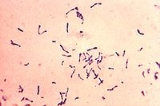
  Gram positive organism, characterized by non-encapsulated, non-sporulated, immobile, straight or curved rods with a length of 1 to 8 µm and width of 0.3 to 0.8 µm, which form ramified aggregations in culture (looking like "Chinese characters") and sometimes which have clubbed ends[Gr.Coryne,a club] .


Discussion
Ask a question about 'Corynebacterium diphtheriae'
Start a new discussion about 'Corynebacterium diphtheriae'
Answer questions from other users
Full Discussion Forum


Encyclopedia


Corynebacterium diphtheriae is a pathogenic bacterium that causes diphtheria
Diphtheria

Diphtheria is an upper Respiration tract illness characterized by sore throat, low fever, and an adherent membrane on the tonsils, pharynx, and/or nasal cavity....
. It is also known as the Klebs-Löffler bacillus, because it was discovered in 1884 by German
Germany

Germany , officially the Federal Republic of Germany , is a country in Central Europe. It is bordered to the north by the North Sea, Denmark, and the Baltic Sea; to the east by Poland and the Czech Republic; to the south by Austria and Switzerland; and to the west by France, Luxembourg, Belgium, and the Netherlands....
 bacteriologists Edwin Klebs
Edwin Klebs

Edwin Klebs was a Germany-Switzerland pathologist. He is mainly known for his work on infectious diseases. He was the father of Arnold Klebs....
 (1834 – 1912) and Friedrich Löffler
Friedrich Löffler

Friedrich August Johannes Loeffler was a Germany bacteriologist at the University of Greifswald. Among his discoveries was the organism causing diphtheria and the cause of foot and mouth disease ....
 (1852 – 1915).

Morphology and toxin production

C. diphtheriae is an aerobic
Aerobic organism

An aerobic organism or aerobe is an organism that can survive and grow in an oxygenated environment....
  Gram positive organism, characterized by non-encapsulated, non-sporulated, immobile, straight or curved rods with a length of 1 to 8 µm and width of 0.3 to 0.8 µm, which form ramified aggregations in culture (looking like "Chinese characters") and sometimes which have clubbed ends[Gr.Coryne,a club] . The bacterium may contain polymetaphosphate aggregates called Volutin granules. It is pathogenic only in humans. C. diphtheriae produce diphtheria toxin
Diphtheria toxin

Diphtheria toxin is an exotoxin secreted by Corynebacterium diphtheriae, the pathogen bacteria that causes diphtheria....
, a proteic
Protein

Proteins are organic compounds made of amino acids arranged in a linear chain and joined together by peptide bonds between the carboxyl and amino groups of adjacent amino acid Residue ....
 exotoxin
Exotoxin

An exotoxin is a toxin excreted by a microrganism, including bacterium, fungi, algae, and protozoa. An exotoxin can cause damage to the host by destroying cells or disrupting normal cellular metabolism....
, with a molecular weight of 62 kilodaltons which ADP-ribosylates host EF-2
Elongation factor

Elongation factors are a set of proteins that facilitate the events of translation elongation, the steps in protein synthesis from the formation of the first peptide bond to the formation of the last one....
, resulting in the inhibition of protein synthesis and thus is responsible for the signs of diphtheria. The inactivation of this toxin with an antitoxic serum (antitoxin
Antitoxin

An antitoxin is an antibody with the ability to neutralize a specific toxin. Antitoxins are produced by certain animals, plants, and bacterium. Although they are most effective in neutralizing toxins, they can kill bacteria and other microorganisms....
) is the basis of the antidiphtheric therapeutic vaccination
Vaccination

Vaccination is the administration of antigenic material to produce immunity to a disease. Vaccines can prevent or ameliorate the effects of infection by a pathogen....
. However, not all strains are toxigenic; the ability to produce the exotoxin is conferred on the bacterium when it is infected by a bacteriophage
Bacteriophage

A bacteriophage is any one of a number of viruses that infection bacteria. The term is commonly used in its shortened form, phage.Typically, bacteriophages consist of an outer protein hull enclosing genetic material....
 (a mechanism termed "lysogenic activation"). A non-toxigenic strain can thus become toxigenic by the infection of such a bacteriophage.

Classification

Four subspecies are recognized: C. diphtheriae mitischodis, C. diphtheriae intermedius, C. diphtheriae gravis, and C. diphtheriae belfanti. The four subspecies differ slightly in their colonial morphology and biochemical properties such as the ability to metabolize certain nutrients, but all may be toxigenic (and therefore cause diphtheria) or non-toxigenic.

Diagnosis


In order to accurately identify C. diphtheriae, a Gram stain is performed to show gram-positive, highly pleomorphic organisms with no particular arrangement (classically resembling Chinese character
Chinese character

A Chinese character, also known as a Han character , is a logogram used in writing Chinese language ,'' Japanese language ,'' less frequently Korean language ,'' and formerly Vietnamese language .''...
s). Then, culture the organism on an enrichment medium, namely Löffler's serum, to allow it to overgrow any other organisms present in the specimen. After that, use a selective plate known as tellurite agar which allows all Corynebacteria (including C. diphtheriae) to reduce tellurite to metallic tellurium producing brown colonies and, only in the case of C. diphtheriae, a black halo around the colonies allowing for easy differentation of the organism.

A low concentration of iron is required in the medium for toxin production. At high iron concentrations, iron molecules bind to an aporepressor on the beta bacteriophage
Bacteriophage

A bacteriophage is any one of a number of viruses that infection bacteria. The term is commonly used in its shortened form, phage.Typically, bacteriophages consist of an outer protein hull enclosing genetic material....
 which carries the genes for the Tox gene, converting it to a repressor
Repressor

A repressor is a DNA-binding protein that regulates the Gene_expression of one or more genes by decreasing the rate of transcription . This blocking of expression is called repression....
 which shuts down toxin production. This is most appreciated when performing Elek's test
Elek's test

Elek's test is a virulence test performed upon Corynebacterium diphtheriae.It was characterized in 1949.References...
 for toxogenecity, in order to know if the organism is able to produce the diphtheria toxin or not.

Sensitivity

The bacterium is sensitive to the majority of antibiotics, such as the penicillin
Penicillin

Penicillin is a group of antibiotics derived from Penicillium fungi. They are Beta-lactam antibiotics used in the treatment of bacterial infections caused by susceptible, usually Gram-positive, organisms....
s, ampicillin
Ampicillin

Ampicillin is a beta-lactam antibiotic antibiotic that has been used extensively to treat bacterium infections since 1961. It is considered part of the aminopenicillin family and is roughly equivalent to amoxicillin in terms of spectrum and level of activity....
, cephalosporin
Cephalosporin

The cephalosporins are a class of beta-lactam antibiotic originally derived from Acremonium, which was previously known as "Cephalosporium"....
s, quinolone
Quinolone

The quinolones are a family of chemical synthesis broad-spectrum antibiotics. The wikt:parent compound of the group is nalidixic acid. The majority of quinolones in clinical use belong to the subset of fluoroquinolones, which have a fluorine atom attached the central ring system, typically at the 6-position....
s, chloramphenicol
Chloramphenicol

Chloramphenicol is a bacteriostatic antimicrobial originally derived from the bacterium Streptomyces venezuelae, isolated by David Gottlieb, and introduced into clinical practice in 1949....
, tetracycline
Tetracycline

Tetracycline is a broad-spectrum polyketide antibiotic produced by the Streptomyces genus of Actinobacteria, indicated for use against many bacterial infections....
s, cefuroxime
Cefuroxime

Cefuroxime is a second-generation cephalosporin antibiotic that has been widely available in the USA as Ceftin since 1977. Glaxo Smith Kline sells the antibiotic in Australia under the name Zinnat....
 and trimethoprim
Trimethoprim

Trimethoprim is a bacteriostatic antibiotic mainly used in the prophylaxis and treatment of urinary tract infections. It belongs to the class of chemotherapy agents known as dihydrofolate reductase inhibitors....
. Diphtheria was isolated in 5% off 133 patients

External links

  • [https://www.cebitec.uni-bielefeld.de/groups/gi/software/coryneregnet/ CoryneRegNet] - Database of Corynebacterial Transcription Factors and Regulatory Networks